Stanza · Audio guide
Saqqara Audio Guide
A place to remember. A story to take with you.
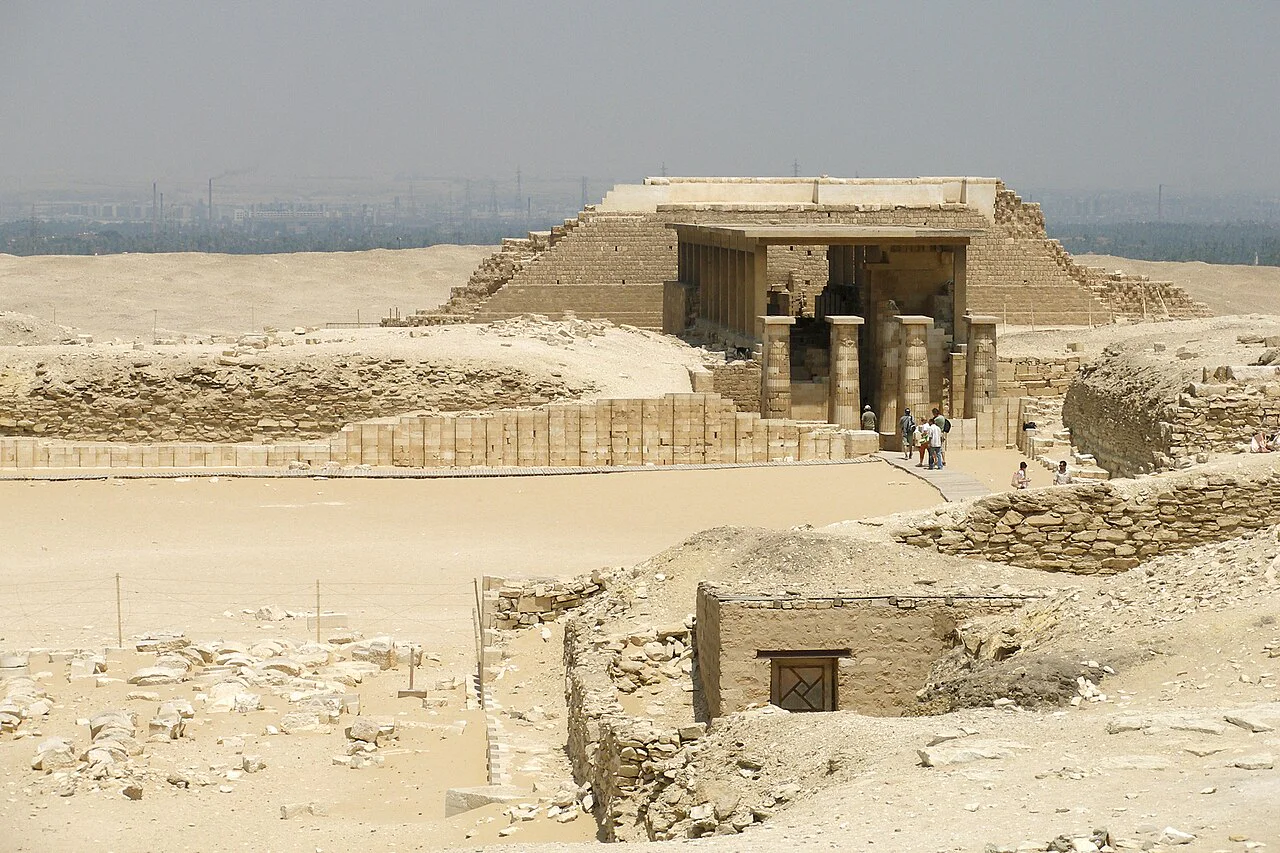
Saqqara is an Egyptian village located in the Giza Governorate that served as the necropolis for the ancient capital of Memphis. It contains numerous ancient structures including the Pyramid of Djoser and…
Download Stanza, then search for “Saqqara”.
About the tour
One guide. Your kind of visit.
Saqqara is an Egyptian village located in the Giza Governorate that served as the necropolis for the ancient capital of Memphis. It contains numerous ancient structures including the Pyramid of Djoser and various mastaba tombs.
Ready when you are.
- 01Get the free Stanza app.
iOS & Android
- 02Find your guide.
“Saqqara”
- 03Download before you go.
Works offline
Audio guide / 42 narrated stops
Inside the guide
Get to know a few of the stories before you go. Open a stop to read more.
01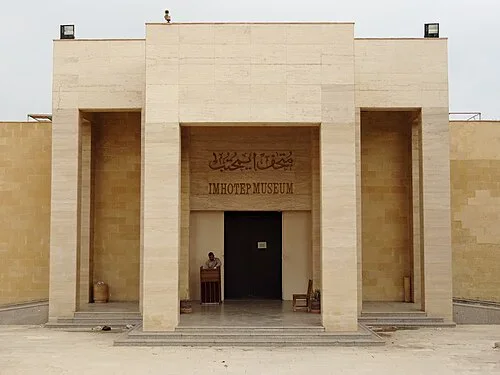 Imhotep Museum
Saqqara was the burial ground of ancient Memphis, and it stayed in use for more than three thousand years. Kings and officials chose its desert plateau for their tombs. Its best-known early monument is the Step Pyramid, built in the Third Dynasty. The royal architect Imhotep designed it. It is the oldest complete stone building complex known to history. Other kings built pyramids here too. In time, animal cults and Coptic monasteries came to the site. This museum takes its name from Imhotep, and it opened in 2006. The French Egyptologist Jean-Philippe Lauer had wanted a museum here. He spent most of his life at the Step Pyramid complex, starting in the 1920s. James Quibell had excavated on the plateau before him. Inside, the finds sit in climate-controlled rooms, safer from theft than the storehouses out on the sites.
Olaf Tausch · CC BY 3.0
02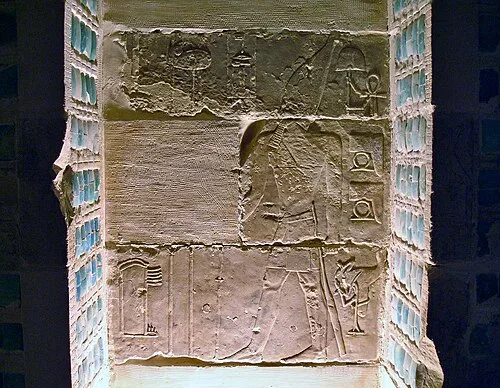 Imhotep Museum
Carved Relief Panel with Tile Borders
Three bands of carving fill the centre of this panel. Figures in profile stand and walk between hieroglyph signs. Near the top, one sign looks like an ankh, the Egyptian symbol of life. Rows of blue-green blocks frame the carved stone on either side. We cannot be sure which monument this panel first belonged to.
Juan R. Lazaro · CC BY 2.0
03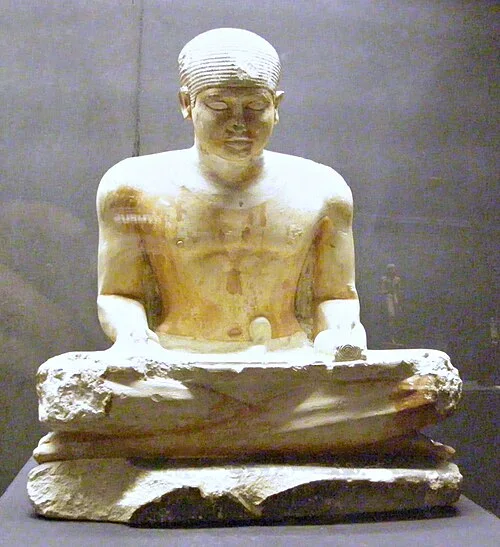 Imhotep Museum
Seated Scribe Statue
The seated figure rests both hands on his lap, and his face is calm and smooth. A close-cropped wig or cap, cut in neat ridges, covers his head. He sits on a plain, rough-cut base. This seated pose, with the hands resting in the lap, was a common way to show an official. Its date is given as the Fifth Dynasty. Nothing in the figure itself tells us his name.
Listen in the appHarald Gaertner · CC BY-SA 3.0
04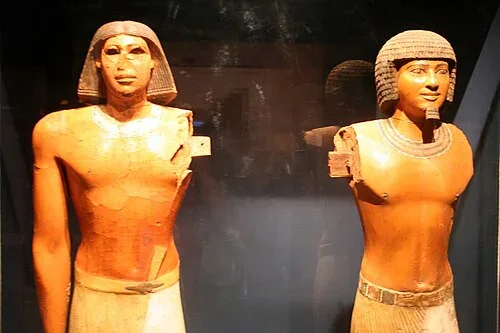 Imhotep Museum
Pair of Standing Statues
The two figures stand side by side in a glass case, a man and a woman. Their surfaces are a warm reddish brown, with pale patches where the paint has worn away. The woman wears a heavy wig, cut in fine rows that fall to her shoulders, and a broad collar. The man wears a shorter wig. Both wear a belt above a white skirt or kilt. Pairs like these show a husband and wife together, a common way to present a couple in stone. Who this couple was, and where the figures first stood, is not known from the statues alone.
Listen in the appPhoto: Kurohito · CC BY-SA 3.0
05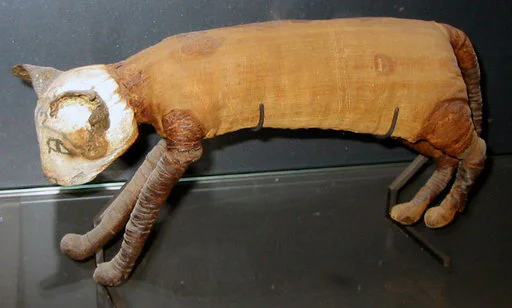 Bubasteion of Saqqara
Cat Mummy in a Museum Case
This cat mummy is kept in the Louvre in Paris, and its legs are wrapped separately from its body. Cats at Saqqara were prepared in one of two ways. In the first, the legs and tail were bound close to the body. In the second, the head, body, legs and tail were each wrapped separately, sometimes with eyes and ears added. The preparation was basic: the body was dried out, and the innards were left inside. Priests perhaps sold pilgrims mummies of different qualities. Underground galleries at Saqqara were also cut as burial sites for mummified ibises, baboons, dogs and falcons. In 2011, excavators worked in a dog catacomb at Saqqara. They uncovered almost eight million animal mummies, most of them dogs. It is thought the animals were meant to carry their owners' prayers to the gods.
Listen in the appGreudin · Public domain
06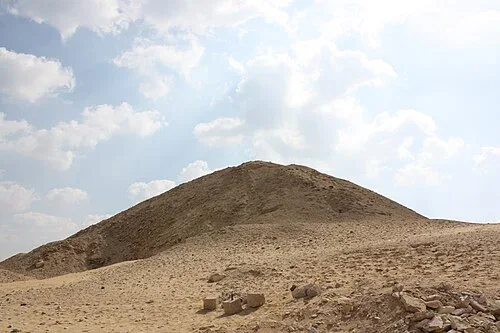 Pyramid of Teti
King Teti, who founded the Sixth Dynasty, was buried beneath this pyramid. Its name meant, roughly, that the places of Teti endure. Today it looks more like a sand-covered hill, and the reason lies in how it was built. Royal pyramids of the Fifth and Sixth Dynasties were not built wholly of massive stone, but had a rubble core. The core was made of small local stone and debris. A layer of cut limestone once covered it, but that layer has since been removed. Without it, the core slumped and crumbled. The pyramids of the Fourth Dynasty at Giza have survived in much better condition.
Listen in the appWknight94 talk · CC BY-SA 3.0
07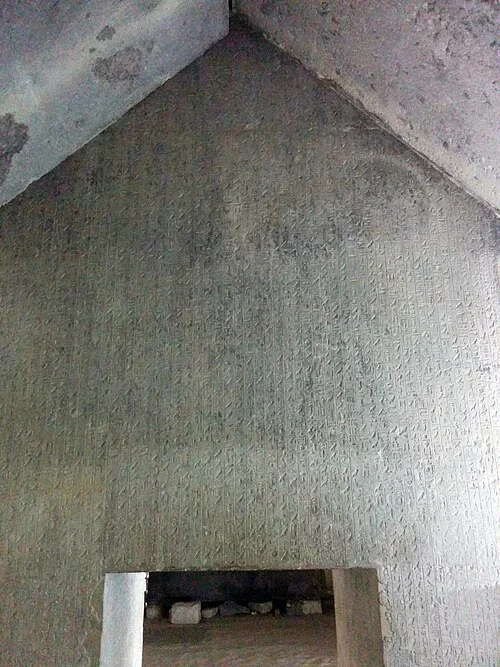 Pyramid of Teti
Inscribed Wall in the Pyramid of Teti
Fine signs cover this whole wall, from the bottom edge up to the sloping top. They are packed so tightly that they blur into one texture across the stone. The ceiling above slants up to a sharp point, built from huge stone beams. At the foot of the wall, a low opening leads onward.
Listen in the appPhoto: Sailko · CC BY 3.0
08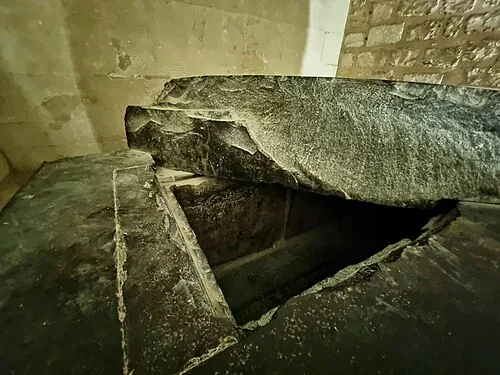 Pyramid of Teti
Sarcophagus in the Pyramid of Teti Burial Chamber
In the burial chamber, a dark stone sarcophagus lies where the king was buried. It is made of greywacke, a hard, dark stone, and it was never finished. The lid lies partly slid aside and is broken. How and when that happened is not settled. Inside the hollow box, faint inscriptions are etched into the walls. It was the first royal sarcophagus known to carry inscriptions.
Listen in the appProf. Mortel · CC BY 2.0
09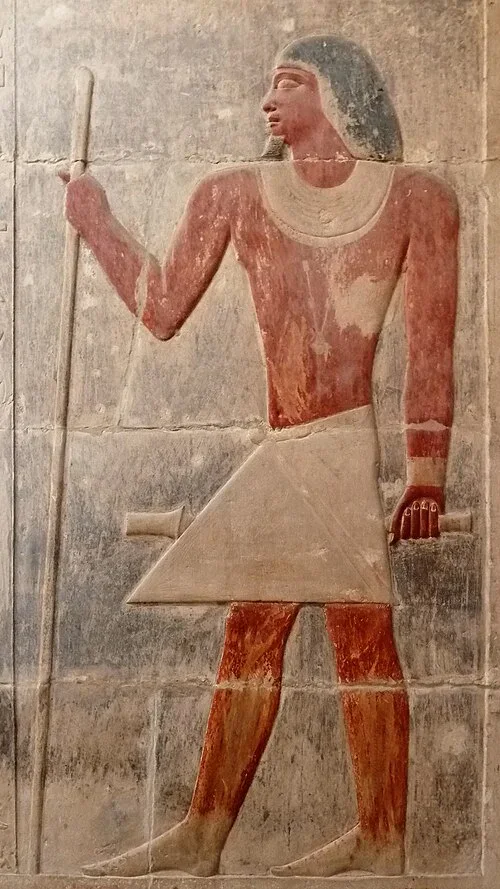 Mastaba of Kagemni
Standing Figure with Staff, Mastaba of Kagemni
Old Kingdom courtiers often chose to be buried close to their king's pyramid. Their low rectangular tombs, called mastabas, grew up in clusters around the royal monuments. At Saqqara, such clusters formed around the pyramids of Unas and Teti. Kagemni served as chief justice and vizier, and he supervised Teti's pyramid complex. His tomb dates to the Sixth Dynasty, in Teti's time. The painted relief here is associated with that tomb, but the carving alone does not name the man. He stands in profile, holding a tall staff and wearing a white kilt.
Listen in the appSémhur (talk) · CC BY-SA 4.0
10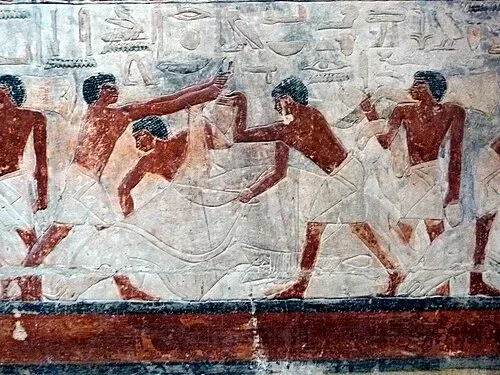 Mastaba of Kagemni
Cattle-Processing Scene, Mastaba of Kagemni
A row of men moves across this painted band, most of them bent forward with an arm raised. They wear short white kilts, and hieroglyph signs fill the space above them. The scene is described as the processing of cattle. The animal being worked on is not clear. Scenes like this one show labour painted on tomb walls.
Listen in the appSémhur (talk) · CC BY-SA 4.0
- 11
Mastaba of Mereruka: Statue Niche and False Door
A statue in a false door niche, and a popular story of a curse on the tomb's owner.
- 12
Plan of the Pyramid of Iput I
A plan of a queen's pyramid complex, with its enclosure wall, rooms and small red blocks.
- 13
Mastaba of Ti in an Early Photograph
An early view of Ti's tomb at Saqqara, with pillars and blocks against a desert horizon.
- 14
Columned Court and Floor Shaft, Mastaba of Ti
An open shaft in the floor of a pillared court, whose purpose is not known.
- 15
Fishing Skiff and Fish Band (Mastaba of Ti Relief)
A tall man holds a long pole in a skiff, above a painted band of fish in Ti's tomb.
- 16
Statue Head in a Serdab Opening
A carved head looks out from a narrow opening in the closed statue room of a tomb.
- 17
Hemicycle at the Serapeum Approach
At least five weathered figures line a curved wall beside the processional way to the Serapeum.
- 18
Serapeum Gallery with Walkway
A rock-cut gallery in the Serapeum, and how the site grew before its rediscovery by Auguste Mariette.
- 19
Inscribed Sarcophagus in the Serapeum Gallery
A dark carved sarcophagus in the Serapeum, and the prince who enlarged the sacred bulls' burial ground.
- 20
Large Stone Block in a Serapeum Passage
A large dark block fills a narrow passage, and whether it was left unfinished is still an open question.
- 21
Pyramid of Userkaf
The small, steep pyramid Userkaf built at Saqqara, and how the site became royal again.
- 22
Pyramid of Userkaf, Close View
Where Userkaf's pyramid sits among Saqqara's other pyramids, with loose stones scattered at its foot.
- 23
Pyramid of Neferhetepes
A small pyramid built for Queen Neferhetepes, set a short distance from King Userkaf's enclosure.
- 24
Step Pyramid of Djoser
Djoser's six-tiered step pyramid, the oldest complete stone building complex known in history.
- 25
Cobra Frieze at the Djoser Complex
A row of carved cobra heads runs along a wall in Djoser's complex, an emblem of royal protection.
- 26
'T' Temple, Djoser Complex
Tall stone pillars, a trench that may mirror the king's road to the netherworld, and the dummy buildings.
- 27
Tomb of Akhethetep
A courtier's tomb near Djoser's pyramid, whose decorated chapel now stands in Paris.
- 28
Pyramid of Unas
The smallest pyramid of the Old Kingdom, and a New Kingdom prince's inscription recording its repair.
- 29
Burial Chamber Wall, Pyramid of Unas
The king who first filled his pyramid's chambers with spells meant to carry him up to the gods.
- 30
Star-Patterned Ceiling of the Unas Chamber
A burial chamber ceiling painted to look like the night sky, with its stars pointing north.
- 31
Sarcophagus Chamber of the Pyramid of Unas
A burial room with a gabled roof, reached past three granite slabs, built to hold the king's sarcophagus.
- 32
Mastaba of Mehou: False Door
A painted false door, a threshold that never opened, in a tomb said to belong to a vizier of King Teti.
- 33
Painted Registers, Mastaba of Mehou
Stacked painted bands that show how many scenes an Old Kingdom tomb wall could hold on one surface.
- 34
Spotted Cow Scene, Mastaba of Mehou
A spotted animal and two men at work on it, from a tomb at Saqqara.
- 35
Boat Scene, Mastaba of Mehou
A long painted boat with a raised deck, shown in a tomb at Saqqara.
- 36
Buried Pyramid of Sekhemkhet
An unfinished pyramid hidden under sand until 1951, whose sealed sarcophagus turned out to be empty.
- 37
Tomb of Horemheb: Pillared Court
The general who built a large tomb at Saqqara before taking the throne, and was later buried at Thebes.
- 38
Columns in the Tomb of Horemheb
Rows of columns with carved tops, creating a temple-like court in a private tomb at Saqqara.
- 39
Asiatic Captive Relief, Tomb of Horemheb
A bearded man in a headband, said to be an Asiatic captive from the tomb of Horemheb at Saqqara.
- 40
Tomb of Maya and Merit
The rock-cut tomb front of Maya and Merit, whose reliefs and statues now sit in Leiden and London.
- 41
Carved Relief with Cobra and Hieroglyphic Columns
A carved relief with a cobra and hieroglyph columns, typical of the official tombs built at Saqqara from the Eighteenth Dynasty onward.
- 42
Monastery of Saint Jeremiah in Saqqara
An early excavation scene of a stone stair and carved columns, from the Christian monastery of Saint Jeremiah at Saqqara.
Saqqara
Frequently asked questions
How much does the guide cost?
Free app download. Listed guide price: $4.99. Guide price shown in the app. Audio guide only. Venue admission is separate.
Can I listen without internet?
Yes. Download the guide’s audio, images, and maps in the app before your visit. Your downloaded content is then available offline.
Can I listen in my language?
This audio guide is available in 15 languages, including English.
Do I need to follow a schedule?
No. This is a self-guided experience. Choose your stops, pause whenever you like, and return to a story at your own pace.
Saqqara
The Stanza Journal
At your own pace
Explore Saqqara.
Download Stanza, then search for “Saqqara”.
Free app download · Guide price shown in the app
Keep exploring
Nearby audio guides
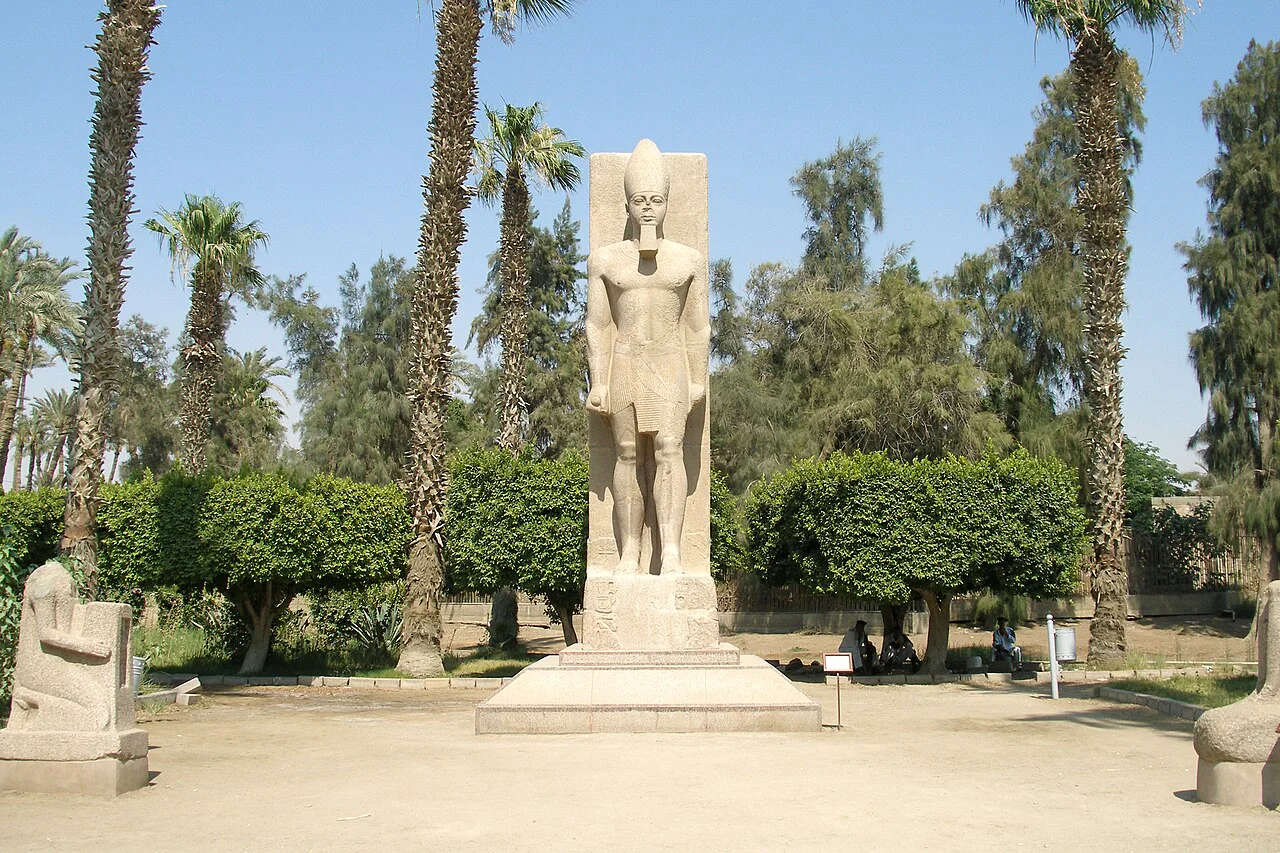
Mit Rahinah · 2 km
Memphis, Egypt
Content & sources
Vyacheslav Argenberg · CC BY 4.0
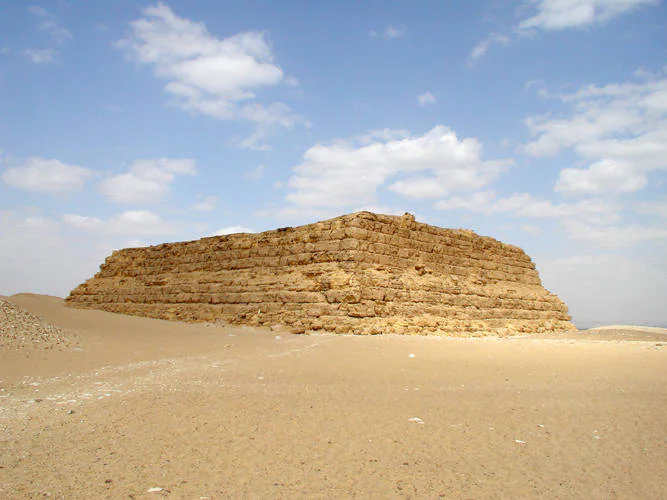
Saqqara · 2 km
Mastabat al-Fir'aun
Content & sources
Jon Bodsworth · Copyrighted free use
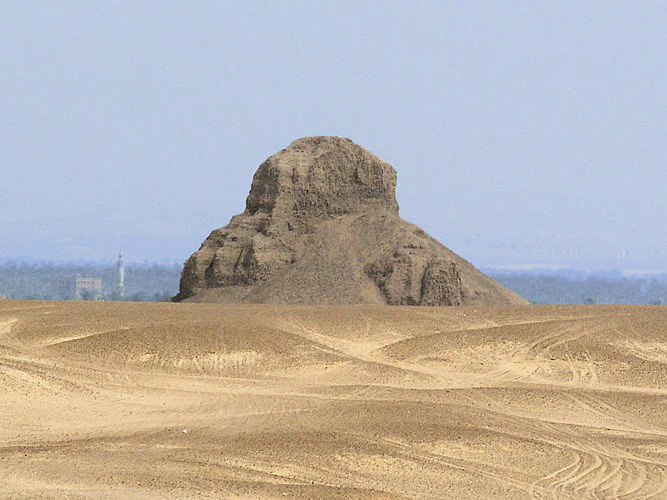
Minshat Dahshur · 7 km
Black Pyramid
Content & sources
Jon Bodsworth · Copyrighted free use
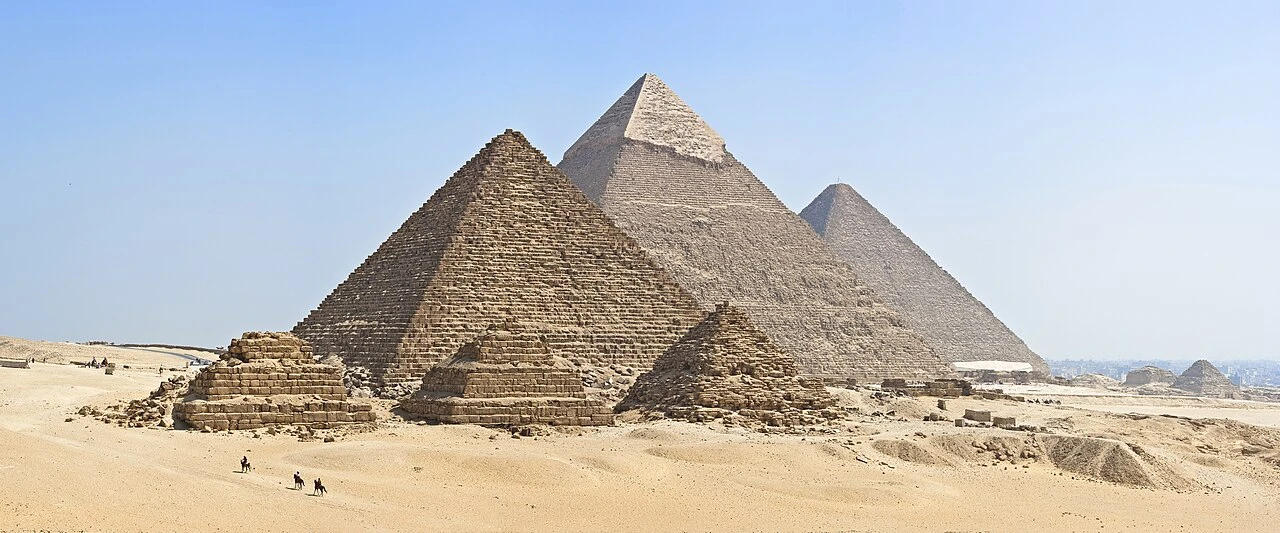
Giza · 17 km
Giza pyramid complex
Content & sources
KennyOMG · CC BY-SA 4.0