Languages
15Giza pyramid complex Audio Guide
Giza pyramid complex is an archaeological site in Giza, Egypt. Explore it with Stanza's guided offline audio tour — narrated in 15 languages.
Quick Facts
38
Stops
15
Languages
100%
Offline
📍 Giza, Egypt · 29.9761°N, 31.1328°E
About Giza pyramid complex
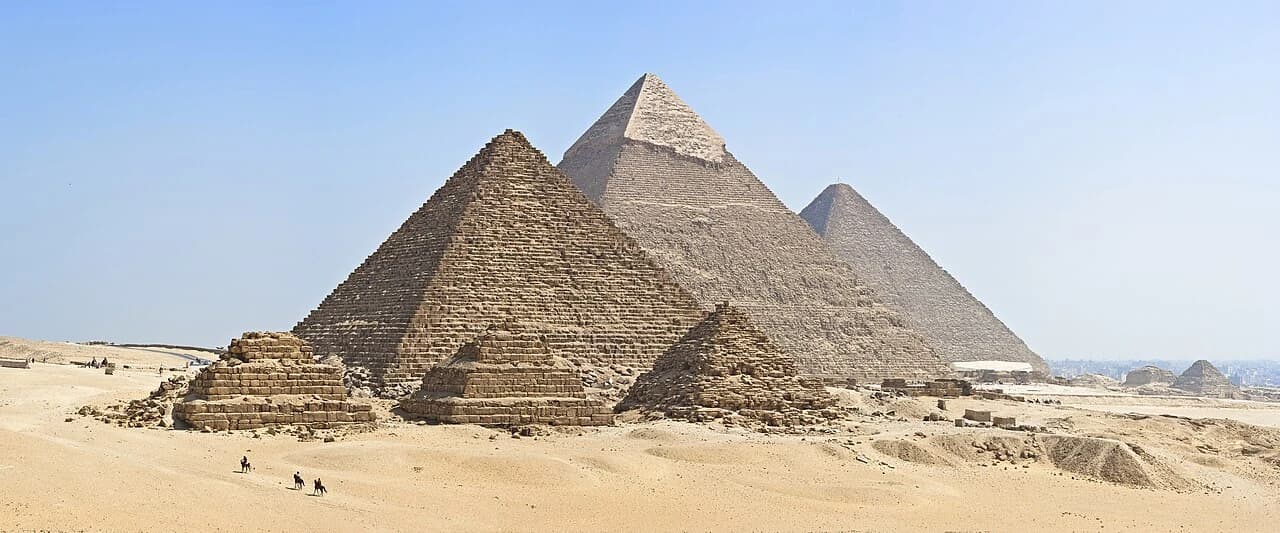
The Giza pyramid complex is an archaeological site located on the Giza Plateau in Egypt. It is an ancient Egyptian necropolis known for its three great pyramids and the Great Sphinx.
This self-guided audio tour features 38 narrated stops organized across 7 sections. As a archaeological site, Giza pyramid complex offers a unique cultural experience in the heart of Giza, Egypt.
The Stanza audio guide is available in 15 languages and works entirely offline — download the complete tour including audio narration, maps, and images before your visit. As you walk through Giza pyramid complex, GPS-triggered narration plays automatically at each point of interest.
Last updated:
What you will hear
Great Pyramid of Giza (Khufu)
The last surviving Wonder of the Ancient World, built for Pharaoh Khufu using approximately 2.3 million stone blocks.
The Queen's Chamber and Air Shafts
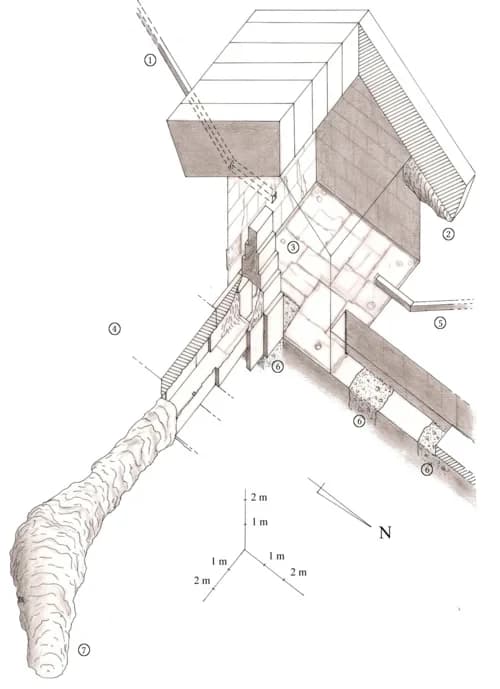
Located lower in the pyramid's structure than the King's Chamber is the so-called Queen’s Chamber. Despite the name given to it by early explorers, there is no evidence a queen was ever buried here; it likely served a ritual purpose for the Pharaoh's spirit. The most intriguing features are the two air shafts shown in the diagram. These narrow tunnels are only 20 centimeters wide and lead from the walls toward the exterior of the pyramid. Because they are too small for humans, they remained a mystery for centuries. In 1993 and again in 2002, researchers used small, high-tech robots equipped with cameras to crawl up these shafts. To the world's surprise, the robots discovered that the shafts were blocked by small limestone doors fitted with two copper handles. One robot even drilled through a door, only to find another door behind it. These shafts do not seem designed for ventilation, as they don't reach the outside. Their true purpose—whether to point toward specific stars or to provide a path for the soul—remains one of the most enduring mysteries of the Giza plateau.
The Granite Sarcophagus
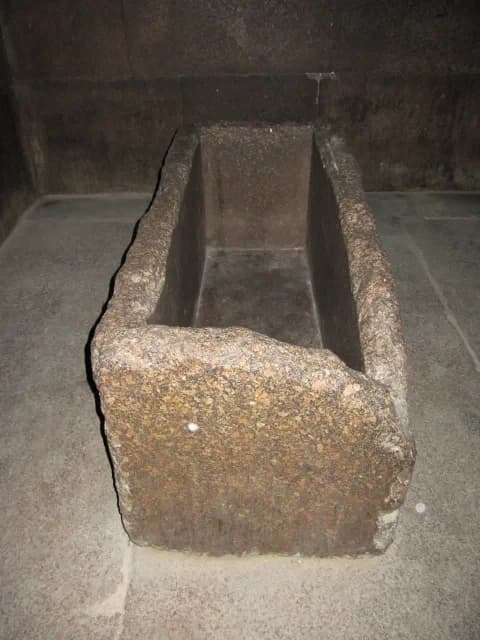
Resting at the far end of the King's Chamber is the only original object remaining: the sarcophagus of Pharaoh Khufu. It was carved from a single, massive block of red granite. You might notice the chipped corner and the rough edges, which are likely the result of ancient and modern souvenir hunters. A fascinating detail is the measurement of this stone box. It is actually about one inch wider than the entrance to the room. This means the sarcophagus could not have been brought in through the passages; it had to be placed in the chamber while the pyramid was still being built around it. When Caliph Al-Ma'mun’s men finally reached this room in the 9th century, they expected to find a king draped in gold. Instead, they found the sarcophagus empty, without a lid. Whether the body of Khufu and his funerary treasures were stolen in antiquity or were never placed here at all remains a subject of intense debate among historians. The empty vessel remains a silent witness to the vanished presence of the monarch for whom this entire mountain of stone was raised.
The King's Chamber
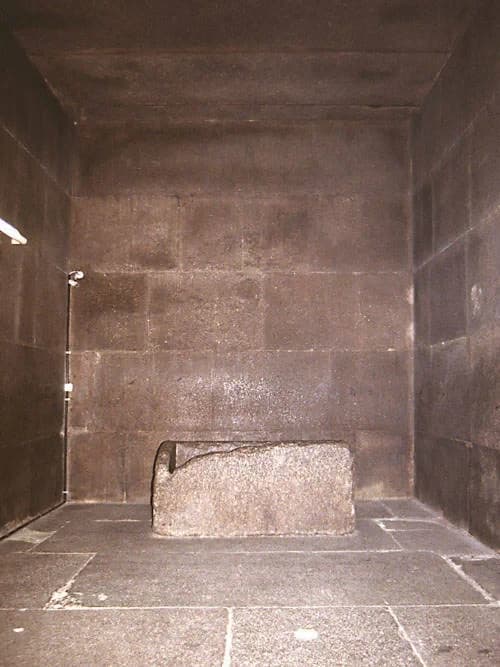
The King's Chamber represents a dramatic shift in construction materials. While the bulk of the pyramid is local limestone, this room is built entirely from massive blocks of red granite. These stones were quarried in Aswan, nearly 900 kilometers to the south, and transported up the Nile. Notice the ceiling, which is perfectly flat, unlike the corbelled ceiling of the Grand Gallery. To protect this room from the millions of tons of stone pressing down from above, the architects built five relieving chambers directly over it. These are hidden spaces separated by heavy granite slabs, designed to redirect the weight outward into the pyramid's core. Unlike the richly decorated tombs found in the Valley of the Kings from later eras, these walls are stark and entirely plain. There are no hieroglyphs, paintings, or carvings here. This austerity reflects the religious beliefs of the 4th Dynasty, where the focus was on the geometric perfection of the structure and the symbolic journey of the King's spirit. The room is perfectly rectangular, echoing the silence and permanence intended for the Pharaoh’s eternal rest.
Mortuary Temple of Khufu
The remains of the temple where the Pharaoh's cult was maintained, featuring a unique black basalt pavement.
The Basalt Pavement
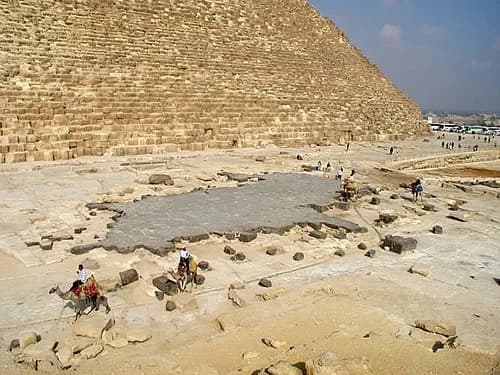
Notice the striking dark floor stones that stand out against the light desert sand. This is natural basalt, a volcanic rock that was hauled to this site to pave the courtyard of the Mortuary Temple. Originally, this black pavement was part of a grand architectural vision. Imagine it as it once was: surrounded by white limestone walls and punctuated by columns of red granite. This deliberate use of color was highly symbolic for the ancient Egyptians. The black of the basalt represented the fertile earth of the Nile Valley, the red granite symbolized the sun and life, and the white limestone stood for the purity of the heavens. This courtyard was likely open to the sky, allowing the sun to illuminate the sharp contrasts between the materials. Today, only the floor remains of this once-magnificent space, but the durability of the basalt has allowed it to survive the elements much better than the limestone walls. These stones have been walked upon for over four millennia, from the priests of the Old Kingdom to the visitors of the modern age.
Tomb of Queen Hetepheres I
The secret burial shaft of Khufu's mother, which contained the most spectacular Old Kingdom funerary furniture ever discovered.
Tomb of Hetepheres
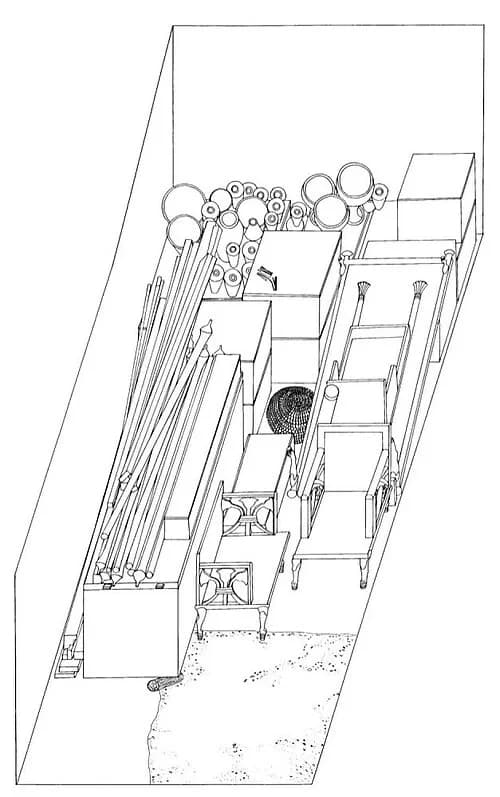
This diagram illustrates one of the most remarkable archaeological finds at Giza. In 1925, a photographer for the Harvard-Boston Expedition, led by George Reisner, was setting up his tripod near the Great Pyramid. One of the tripod legs suddenly sank into the ground, revealing a hidden shaft that had been missed by grave robbers for thousands of years. This vertical shaft plunged 27 meters deep into the bedrock. At the bottom, archaeologists found the secret burial chamber of Queen Hetepheres, the mother of Khufu. Because the space was barely larger than a walk-in closet, her extensive funeral equipment was packed together with incredible density. Chairs, a bed, and carrying litters were piled high, their wood having decayed but their gold casings remaining in place. The tomb was a re-burial, likely moved here in secret after her original tomb was robbed. This discovery provided scholars with an unprecedented look at the domestic luxury of the royal family during the 4th Dynasty, as almost everything found inside was reconstructed to show the peak of Old Kingdom craftsmanship.
Pyramid G1-b (Queen Meritites I)
The central queen's pyramid, believed to belong to Queen Meritites I, a wife of Khufu.
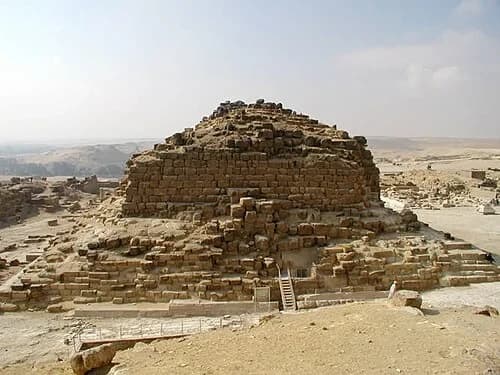
Pyramid G1-b
Continuing south along the eastern face of the Great Pyramid, we find the central satellite pyramid, G1-b. Historical evidence suggests this was the tomb of Queen Meritites I, one of the primary wives of Pharaoh Khufu. Like its neighbors, it follows a standard design for royal women of the 4th Dynasty. If you look at the north side, you can see the entrance to a passage that leads down into a relatively simple burial chamber carved into the bedrock. These smaller pyramids were an essential part of the royal funerary complex. The ancient Egyptians believed that the afterlife was a continuation of the social order on Earth. By building these structures for his wives and family members, the King ensured that those closest to him could accompany him into eternity and share in the divine status he achieved after death. Though much of the exterior stone is gone, the scale of these small pyramids still reflects the immense power and resources available to the royal house during this period.
Giza Solar Boat Museum Site
The discovery site of Khufu's Solar Boat, a full-sized vessel intended to carry the Pharaoh through the afterlife.
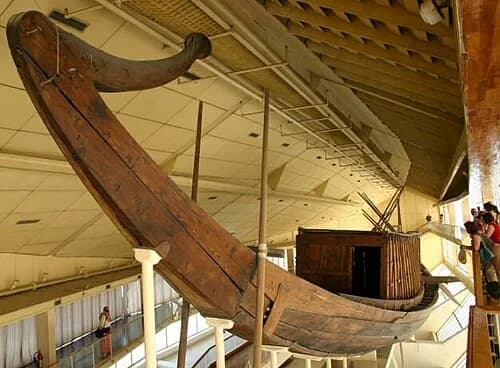
The Prow of the Solar Boat
Observe the graceful, towering curve of the ship's prow, reaching high toward the ceiling. This 43-meter-long vessel is a masterclass in ancient maritime engineering, constructed primarily from Lebanese cedar. In the Old Kingdom, such wood was a precious luxury, imported over hundreds of miles by sea. Perhaps the most remarkable feature of the construction is the complete absence of metal nails or pegs. Instead, the entire hull was held together by an intricate stitching system. Thousands of meters of linen ropes were threaded through meticulously carved holes in the planks. This design was highly practical for a wooden ship. When launched, the dry wood would swell in the water, pressing the planks together. This pressure would cause the linen ropes to tighten, pulling the seams shut and making the entire hull naturally watertight without the need for additional caulk. It is a striking example of the deep understanding of materials and physics possessed by builders 4,500 years ago, where every curve and joint served both a functional and a ritual purpose.
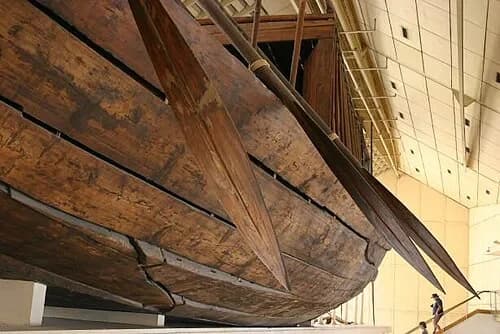
Cedar Planking and Rope Holes
Getting close to the hull allows for a better look at the intricate stitching method used by the ancient builders. You can see the small, precisely carved holes along the edges of the cedar planks. It took modern experts 14 years to solve the monumental puzzle of reassembling this vessel. Because the original linen ropes had long since rotted away into dust, the restorers had to rely almost entirely on the physical marks, carvings, and notations left on the wood by the original craftsmen. The discovery itself was a scene frozen in time; the boat had been placed in its limestone pit with the oars and ropes laid neatly on top, as if the crew had simply stepped away for a short break 4,500 years ago. This careful arrangement suggests that the process of disassembling and burying the boat was a ritual act in itself. Reassembling the 1,224 pieces required a deep dive into ancient shipbuilding techniques, essentially learning a lost language of joinery. The resulting structure reveals a ship that is both robust and flexible, designed to endure for eternity in the sands beside the pyramid.
Pyramid G IIIb
The central satellite pyramid of Menkaure, which retains some of its granite casing.
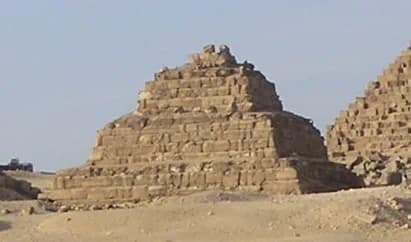
Pyramid G IIIb
This central structure in the row of satellite pyramids is notable for its anonymity. Unlike many other monuments on the plateau, no inscriptions or identifying marks were ever found within its burial chamber to name the royal woman for whom it was built. Its rough state today reveals the inner blocks of the core, as the original smooth casing was removed long ago for other building projects. The placement of this pyramid highlights the organized, family-centric nature of the cemetery during the 4th Dynasty. The royal family members were laid to rest in a deliberate alignment, ensuring they could accompany the Pharaoh into the afterlife. Even without a name, the scale and position of the structure confirm the importance of the woman buried here. It stands as a silent part of a larger plan that integrated the King's family into his eternal journey. The weathered edges of the blocks show the toll that four and a half millennia of desert winds have taken.
Dream Stele of Thutmose IV
A large granite slab positioned between the paws of the Sphinx, commemorating a dream that promised the crown to a young prince.
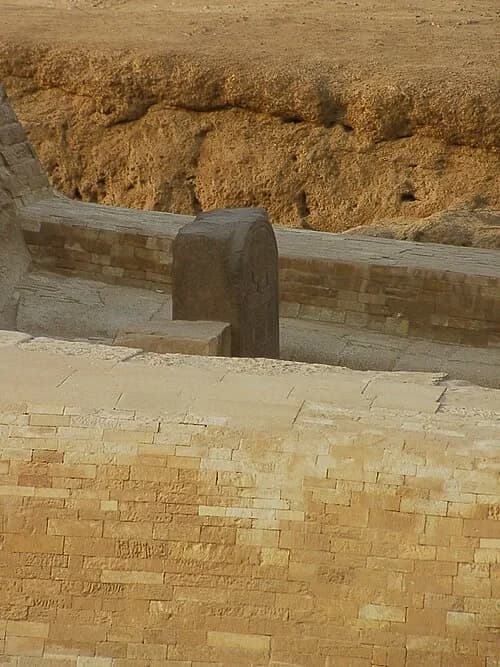
The Dream Stele
Placed between the massive paws of the Sphinx, this large granite slab known as the Dream Stele records a famous royal legend. In the 14th century BC, over a thousand years after the Sphinx was created, Prince Thutmose IV stopped here to rest while hunting. He fell asleep in the shadow of the statue, which at the time was almost entirely buried in the shifting desert sands. In his dream, the Sphinx spoke to him, identifying itself as a god and complaining about the suffocating weight of the sand. It promised the prince that if he cleared the enclosure and freed the statue, he would eventually be crowned Pharaoh. Thutmose fulfilled the request, clearing the site and restoring the monument. Not long after, he did indeed ascend to the throne. He erected this granite stele to commemorate the divine pact and legitimize his rule. The carvings on the stone show the king making offerings to the Sphinx, serving as a permanent record of his miraculous rise to power. It stands as a bridge between the Old Kingdom builders and the New Kingdom rulers.
Want to hear the rest?
Download the Stanza app to unlock all 38 stops and the complete guided audio tour.
Frequently Asked Questions
How long does the Giza pyramid complex audio tour take?
The Giza pyramid complex audio guide includes 38 narrated stops. Most visitors spend 45 minutes to 1.5 hours exploring the complete tour, though you can listen at your own pace and skip or revisit any stop.
Is the Giza pyramid complex audio guide available in my language?
Stanza supports 15 languages: English, Spanish, French, German, Italian, Portuguese, Russian, Japanese, Chinese, Korean, Arabic, Hindi, Polish, Dutch, Hebrew. Check the guide in the app to confirm the languages currently available for this tour.
Can I use the audio guide offline at Giza pyramid complex?
Yes! Download the complete Giza pyramid complex tour — including all audio, maps, and images — before your visit. The Stanza app works completely offline, so you don't need WiFi or mobile data at the venue.
How much does the Giza pyramid complex audio guide cost?
The Stanza app is free to download. The current listed price for the Giza pyramid complex audio guide is $5.99; app-store region and currency may affect the final price.
How do I use the Stanza audio guide at Giza pyramid complex?
Download the free Stanza app, search for "Giza pyramid complex", and download the tour. When you arrive at the venue, the app uses GPS to detect your location and automatically plays the relevant narration as you move between points of interest — completely hands-free.
What makes the Stanza audio guide different from other Giza pyramid complex tours?
Stanza offers GPS-triggered narration that plays automatically as you walk through Giza pyramid complex — no need to manually select stops. The tour is available in 15 languages, works fully offline, and includes 38 expertly narrated stops with images and historical context.
What other audio guides are available near Giza pyramid complex?
Stanza offers multiple audio guides in Giza, Egypt and nearby areas. After downloading the app, browse the map to discover all available tours near Giza pyramid complex. Each guide can be downloaded for offline use.