Languages
15Luxor Temple Audio Guide
Luxor Temple is a landmark in Luxor, Egypt. Explore it with Stanza's GPS-triggered offline audio guide — available in 15 languages.
Quick Facts
15
Stops
15
Languages
100%
Offline
📍 Luxor, Egypt · 25.7000°N, 32.6392°E
About Luxor Temple
Luxor Temple is a large ancient Egyptian temple complex located on the east bank of the Nile River in the city today known as Luxor (ancient Thebes). It was dedicated to the Theban Triad of Amun, Mut, and Khonsu.
Luxor Temple is also known as معبدالأقصر, معبد الأقصر.
This self-guided audio tour features 15 narrated stops organized across 8 sections. As a temple, Luxor Temple offers a unique cultural experience in the heart of Luxor, Egypt.
The Stanza audio guide is available in 15 languages and works entirely offline — download the complete tour including audio narration, maps, and images before your visit. As you walk through Luxor Temple, GPS-triggered narration plays automatically at each point of interest.
Last updated:
What you will hear
The First Pylon and the Royal Entrance
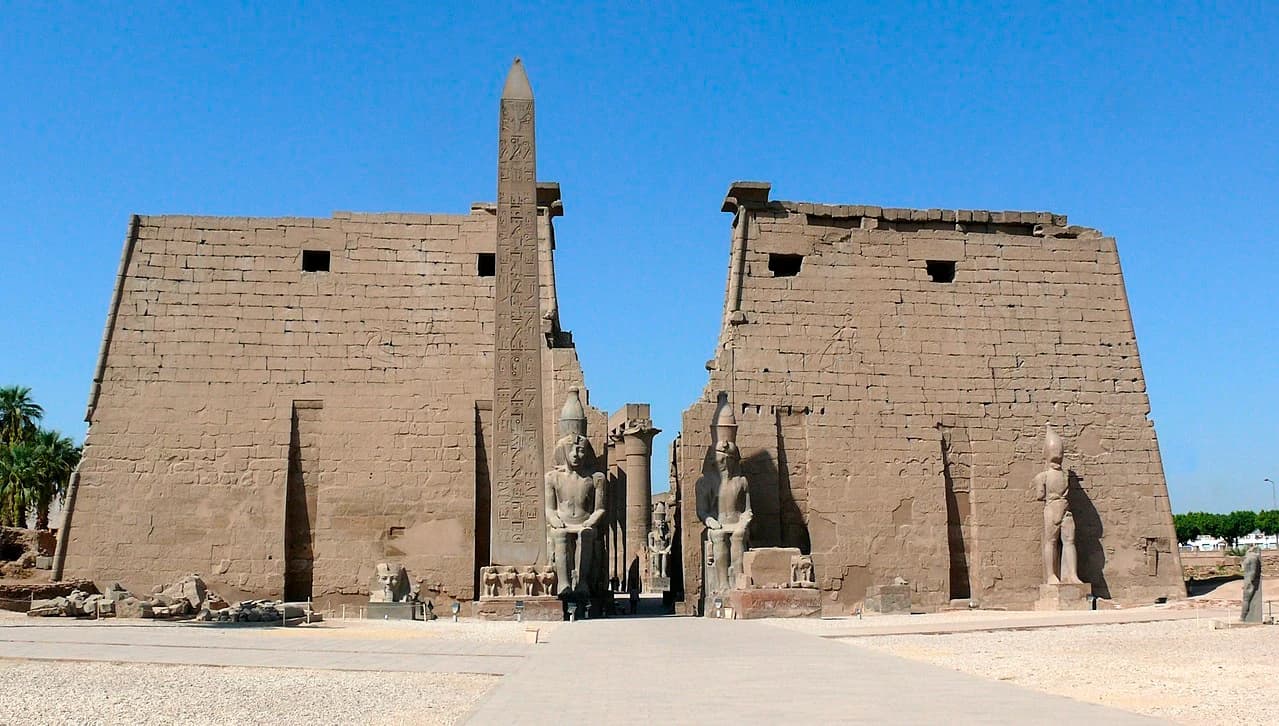
The grand entrance built by Ramesses II, featuring colossal statues and the remaining pink granite obelisk.
The Luxor Obelisk
1300 BCE
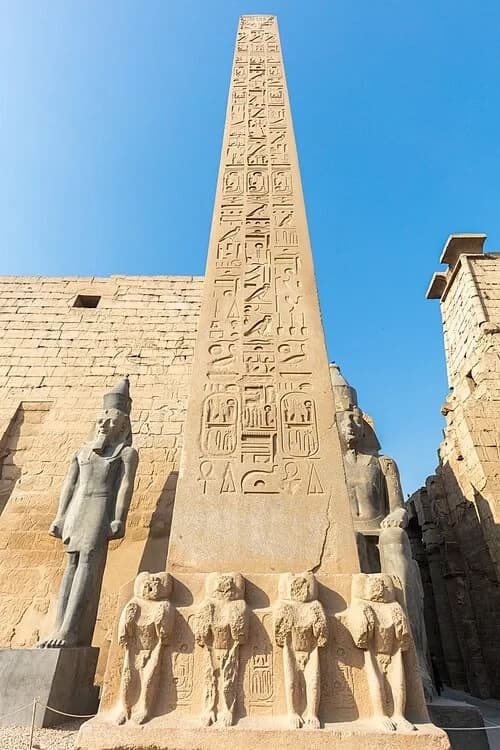
The grand entrance before you was commissioned by Ramesses II to emphasize his absolute royal authority. The massive gateway, known as a pylon, stands approximately 24 meters high and spans 65 meters in width. Flanking the entrance are two colossal seated statues of the pharaoh himself, carved with the heavy, powerful features typical of the 19th Dynasty. Rising high above them is the eastern pink granite obelisk, a single monolith reaching 22.52 meters into the sky. Its surface is covered in deep hieroglyphs praising the achievements of the king and his relationship with the gods. For the ancient visitor, this facade was designed to be overwhelming, signaling that they were entering a space of immense power and divinity. The scale of the statues and the height of the obelisk were intended to project the pharaoh's presence far beyond the temple walls. While the years have weathered the stone and removed some of the original surrounding features, the entrance still retains the imposing character Ramesses II envisioned for his addition to the temple.
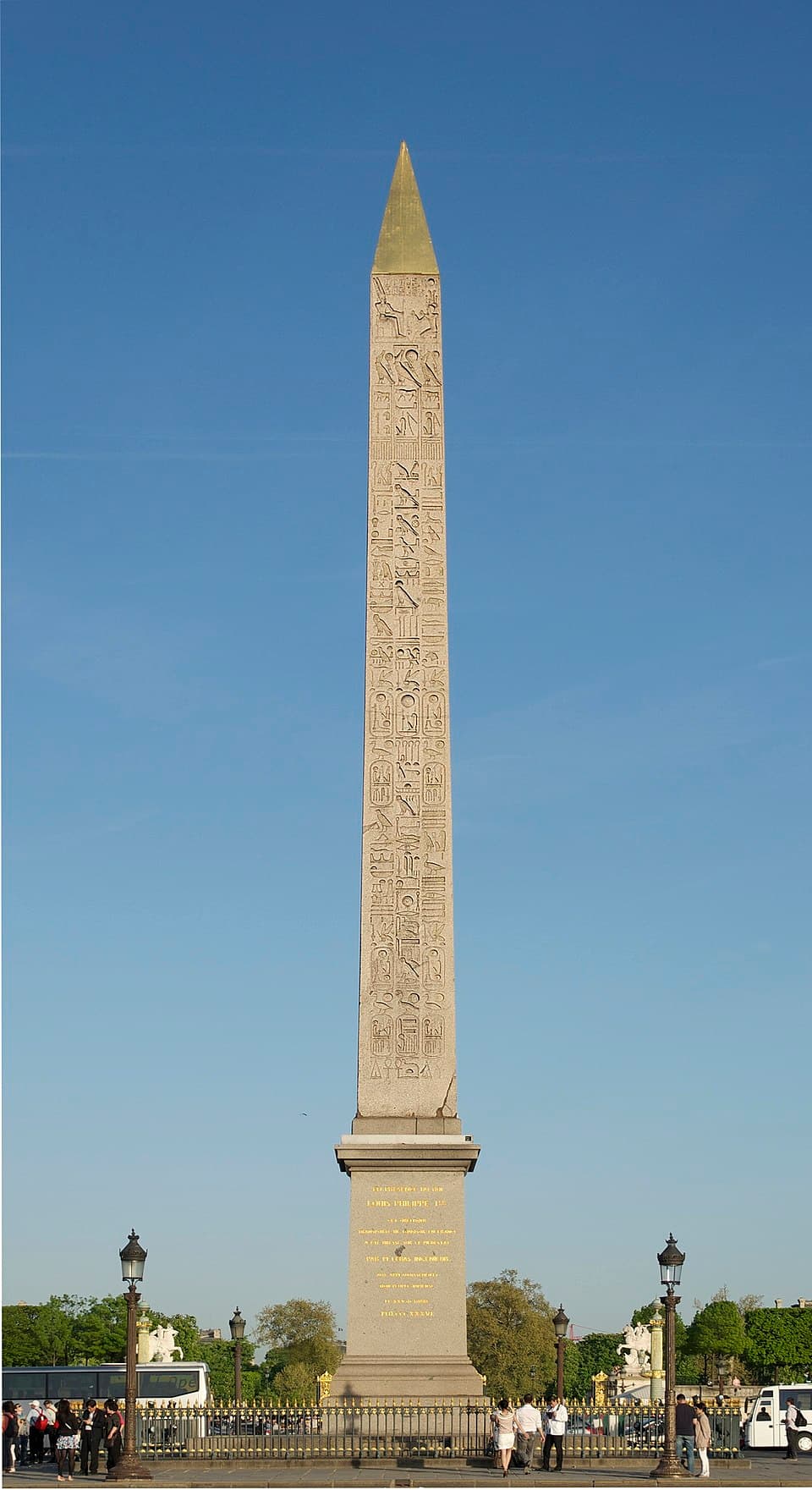
The Paris Obelisk
Beside the standing monolith at the entrance, you will notice an empty pedestal where a twin obelisk once stood. This missing companion was given to France in the 1830s as a diplomatic gift and was transported to Paris, where it was re-erected in the Place de la Concorde in 1836. Its absence breaks the original visual symmetry of the temple gateway, leaving a visible gap in the grand design established by Ramesses II. Transporting a monolith weighing approximately 250 tons across the sea in the 19th century was an incredible engineering feat, requiring custom-built ships and years of planning. The decision to move the obelisk reflected the intense European fascination with ancient Egypt at the time. While its twin now stands thousands of miles away, the remaining obelisk here at Luxor continues to mark the threshold of the sanctuary. The empty space serves as a reminder of how the temple's artifacts have been dispersed globally over the last two centuries, becoming symbols of Egypt's ancient glory in distant cities.
The Great Court of Ramesses II
A massive open courtyard containing 74 papyrus-bud columns and reliefs depicting the symbolic union of Egypt.
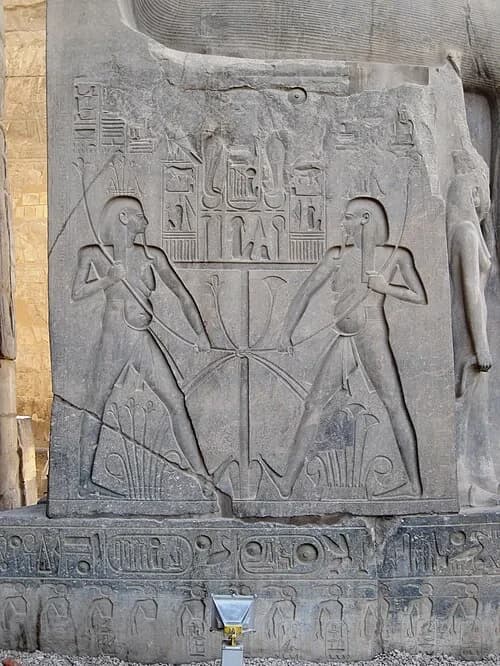
Symbol of Unified Egypt
Observe the intricate relief carved into the base of the royal statues, a scene known as the Sema-Tawy. This visual metaphor was a crucial piece of royal propaganda. It depicts two Nile gods—recognizable by their heavy bodies representing the river's abundance—pulling tightly on ropes. One god represents Upper Egypt, symbolized by the lotus plant, while the other represents Lower Egypt, symbolized by the papyrus. They are shown binding these two plants together around a central symbol that represents a windpipe or the lungs, which in ancient Egyptian iconography stood for the concept of union. By placing this image at the base of his throne or feet, the pharaoh was visually claiming his primary responsibility: holding the two halves of the country together. It served as a constant reminder to all who saw it that the stability of the entire nation rested upon the shoulders of the king. The repetition of this image throughout the temple reinforced the idea that Egypt was not two separate regions, but a single, unified entity maintained by divine right.
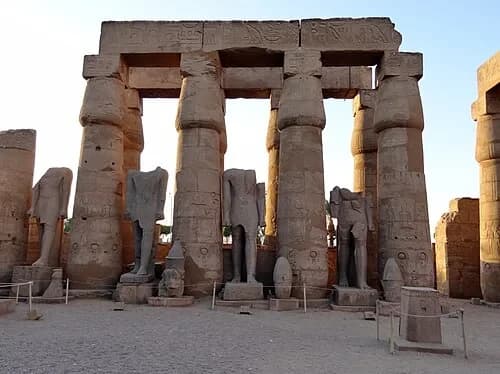
The Court of Ramesses II
Step into this large open courtyard, which represents a major expansion of the temple complex. It is surrounded by 74 papyrus-bud columns, many of which are separated by standing statues of the pharaoh. If you look closely at the layout, you may notice that the courtyard is slightly angled. This wasn't a mistake by the ancient architects; instead, Ramesses II intentionally skewed the axis of this space to align it more perfectly with the processional path leading toward Karnak. By doing so, he effectively hijacked the older 18th Dynasty temple design, ensuring that his own monumental additions were the first thing encountered by anyone arriving during the Opet Festival. The standing statues between the columns further reinforced this royal presence, showing the king in a traditional pose that signaled his role as the eternal protector of the shrine. This courtyard transformed the approach to the inner sanctuary, creating a grand, rhythmic space that prepared visitors for the more intimate and sacred chambers that lay further ahead within the temple's older core.
The Mosque of Abu Haggag
A living testament to the site's continuous religious activity, this mosque was built directly atop the ancient Egyptian columns.
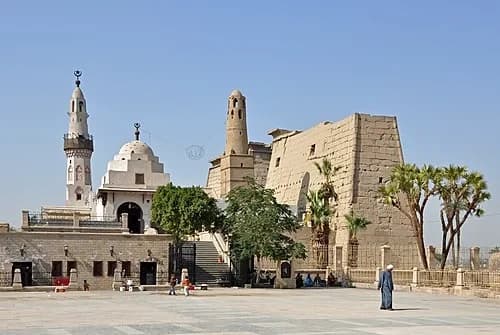
The Mosque of Abu Haggag
Rising high above the temple's courtyard is the Mosque of Abu Haggag, an active place of worship that dates back to the 13th century. It is dedicated to a Sufi saint who is said to have lived and died here. One of the most striking features of this building is the height of its entrance, which sits approximately 12 meters above the current temple floor. When the mosque was originally constructed, the ancient Egyptian temple was almost completely buried under centuries of accumulated sand and debris. Builders used the tops of the buried columns as foundations, unaware of the vast complex hidden beneath their feet. Even after the temple was excavated in the 19th century, the mosque was preserved as a vital part of the local community's heritage. Today, it remains an active religious site, and every year, a local festival is held that echoes the ancient Opet processions. The mosque serves as a visible bridge between different eras of faith, demonstrating how this site has remained a center of spiritual significance for thousands of years.
The Grand Colonnade of Amenhotep III
A majestic processional way defined by towering papyrus columns, finished under the reign of Tutankhamun.
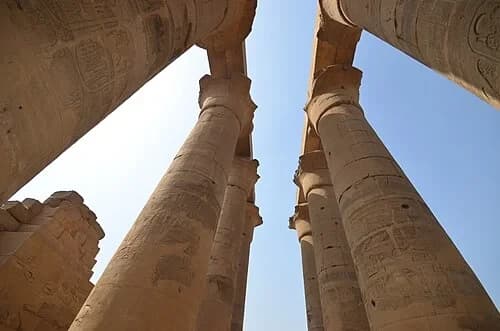
The Grand Colonnade
Enter the Grand Colonnade, a majestic processional way defined by 14 massive papyrus-bud columns that rise high above the ground. This space was originally conceived by Amenhotep III, but construction was interrupted, and much of the final decoration was carried out during the brief reign of Tutankhamun. The scale of these columns was intended to create a sense of awe as priests and royals moved toward the inner sanctuary. If you examine the walls flanking the walkway, you can see detailed reliefs depicting the Opet Festival parade in remarkable detail. These carvings show the sacred barges of the gods being towed along the Nile, accompanied by musicians, dancers, and cheering crowds. It is one of the most complete visual records of an ancient Egyptian festival ever discovered. Because Tutankhamun finished the work, these walls provide a rare look into his efforts to restore the traditional religion following a period of religious upheaval. The sheer height of the columns overhead makes this one of the most atmospheric and iconic spaces in the entire temple complex.
The Sun Court of Amenhotep III
The core of the initial 18th Dynasty design by architect Amenhotep son of Hapu, used for the rejuvenation of kingship.
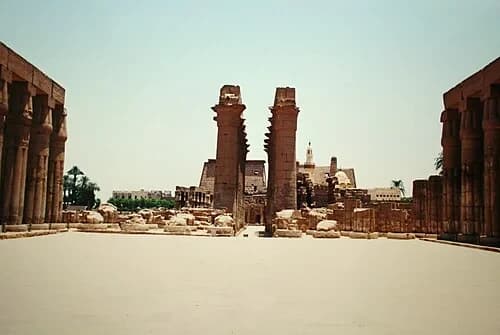
The Sun Court of Amenhotep III
The Sun Court forms the heart of the original 18th Dynasty construction, built during the peak of Egypt’s imperial power. This part of the temple is often referred to by its ancient name, 'ipet resyt,' or the 'Southern Sanctuary.' It was designed by the pharaoh's most trusted advisor and architect, Amenhotep son of Hapu. Unlike the darker, more enclosed inner chambers, this space was intended to be filled with light, reflecting the king’s deep connection to the sun god, Amun-Ra. The arrangement of the columns creates a wide, open area that once hosted the most sacred parts of the Opet Festival. Here, the pharaoh would undergo a ritual rejuvenation of his 'ka,' or divine spirit, merging his human self with the eternal office of the kingship. The architectural harmony of the court, with its repetitive, elegant columns, was meant to embody the cosmic order, or 'Ma'at,' which the king was responsible for maintaining. This space remains one of the most well-preserved examples of New Kingdom temple architecture, showcasing the sophisticated design principles used during one of Egypt's most prosperous eras.
The Roman Sanctuary
A pagan shrine converted into a Roman cult center and later a Christian church, featuring rare surviving frescoes.
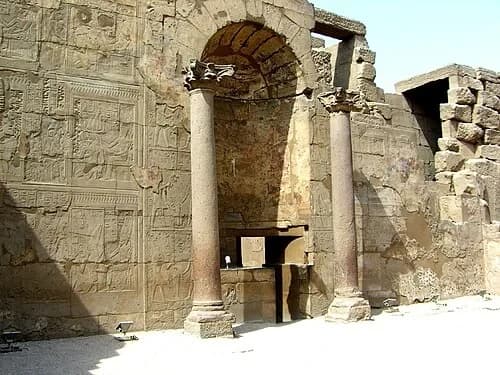
The Roman Imperial Chapel
As you move deeper into the temple, you will encounter a stark change in architectural style. This area was converted into a Roman Imperial Chapel during the late 3rd or early 4th century CE. Notice the distinct Corinthian columns and the curved architectural niche, or apse, which are characteristic of Roman design rather than traditional Egyptian forms. When the Roman Empire occupied Egypt, they didn't just abandon these ancient sites; they often repurposed them to suit their own political and religious needs. In this case, the Romans transformed the very heart of the Egyptian sanctuary into a cult center for the worship of the Emperor. They literally carved their own architecture into the existing stone walls, blending two vastly different cultures. This chapel served as a visible sign of Roman authority, showing that the Emperor had now taken the place of the pharaoh as the divine ruler of the land. The modification of this space is a clear example of how the temple was adapted to fit the changing political landscapes of the ancient Mediterranean world.
The Birth Room and Inner Sanctuaries
The most sacred part of the 'Southern Sanctuary', containing reliefs that legitimize the pharaoh's divine right to rule.
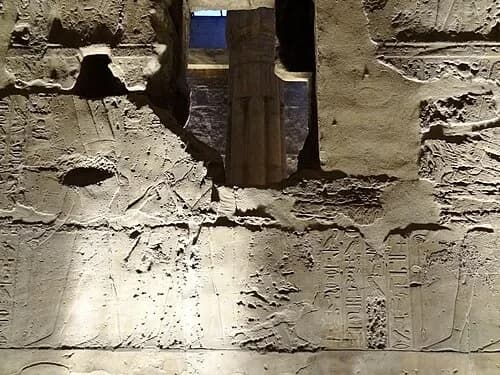
The Divine Birth Room
Reliefs in this small chamber tell a very specific and important story: the divine birth of Pharaoh Amenhotep III. The carvings depict a complex narrative where the king of the gods, Amun-Ra, visits the pharaoh's mother. According to the reliefs, the god took on the appearance of the human king to father the future pharaoh. This entire room functioned as a sophisticated piece of royal propaganda. In ancient Egypt, the king's right to rule was not just inherited; it was divine. By showing that he was literally the son of a god, Amenhotep III was providing proof that he was more than just a man and that his authority was absolute and unquestionable. You can follow the story through the various scenes on the walls, from the divine conception to the presentation of the infant prince to the other gods of the Egyptian pantheon. It is a fascinating example of how art was used to bolster the legitimacy of the throne, ensuring that the pharaoh’s power was seen as a part of the natural and divine order of the world.
Preservation and Modern Legacy
Reflecting on the temple's survival through millennia and the modern challenges of protecting this UNESCO World Heritage site.
The Ding Jinhao Engraving Incident
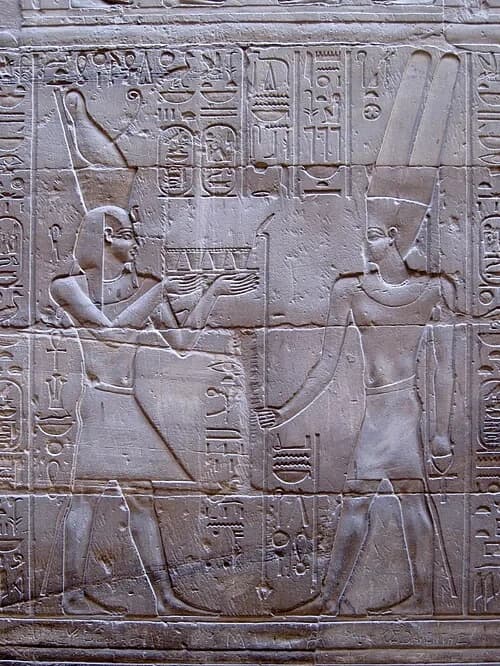
In the granite sanctuary at the very back of the temple, you will find reliefs that at first glance appear traditionally Egyptian. However, the hieroglyphs within the cartouches actually spell out the name of the Greek conqueror, Alexander the Great. Alexander claimed to have rebuilt this area, and he used these carvings to portray himself in the role of a traditional pharaoh, offering sacrifices to the god Amun. It was a strategic move designed to win the support of the Egyptian people and religious elite by honoring their traditions. This chamber serves as the final stop in a journey through three millennia of history, showing how every major ruler of Egypt sought to leave their mark on this sacred ground. This long history of continuous religious and political activity is a key reason why the temple complex was designated a UNESCO World Heritage site in 1979. Alexander’s name is spelled phonetically in the cartouches, a permanent mark of the Macedonian king’s brief but impactful stay in the Nile Valley.
Want to hear the rest?
Download the Stanza app to unlock all 15 stops and full GPS-guided navigation.
Frequently Asked Questions
How long does the Luxor Temple audio tour take?
The Luxor Temple audio guide includes 15 narrated stops. Most visitors spend 45 minutes to 1.5 hours exploring the complete tour, though you can listen at your own pace and skip or revisit any stop.
Is the Luxor Temple audio guide available in my language?
Stanza supports 15 languages: English, Spanish, French, German, Italian, Portuguese, Russian, Japanese, Chinese, Korean, Arabic, Hindi, Polish, Dutch, Hebrew. Check the guide in the app to confirm the languages currently available for this tour.
Can I use the audio guide offline at Luxor Temple?
Yes! Download the complete Luxor Temple tour — including all audio, maps, and images — before your visit. The Stanza app works completely offline, so you don't need WiFi or mobile data at the venue.
How much does the Luxor Temple audio guide cost?
The Stanza app is free to download. The current listed price for the Luxor Temple audio guide is $2.99; app-store region and currency may affect the final price.
How do I use the Stanza audio guide at Luxor Temple?
Download the free Stanza app, search for "Luxor Temple", and download the tour. When you arrive at the venue, the app uses GPS to detect your location and automatically plays the relevant narration as you move between points of interest — completely hands-free.
What makes the Stanza audio guide different from other Luxor Temple tours?
Stanza offers GPS-triggered narration that plays automatically as you walk through Luxor Temple — no need to manually select stops. The tour is available in 15 languages, works fully offline, and includes 15 expertly narrated stops with images and historical context.
What other audio guides are available near Luxor Temple?
Stanza offers multiple audio guides in Luxor, Egypt and nearby areas. After downloading the app, browse the map to discover all available tours near Luxor Temple. Each guide can be downloaded for offline use.