Languages
15Abu Simbel Audio Guide
Abu Simbel is an archaeological site in Abu Simbel City, Egypt. Explore it with Stanza's guided offline audio tour — narrated in 15 languages.
Quick Facts
22
Stops
15
Languages
100%
Offline
📍 Abu Simbel City, Egypt · 22.3369°N, 31.6256°E
About Abu Simbel
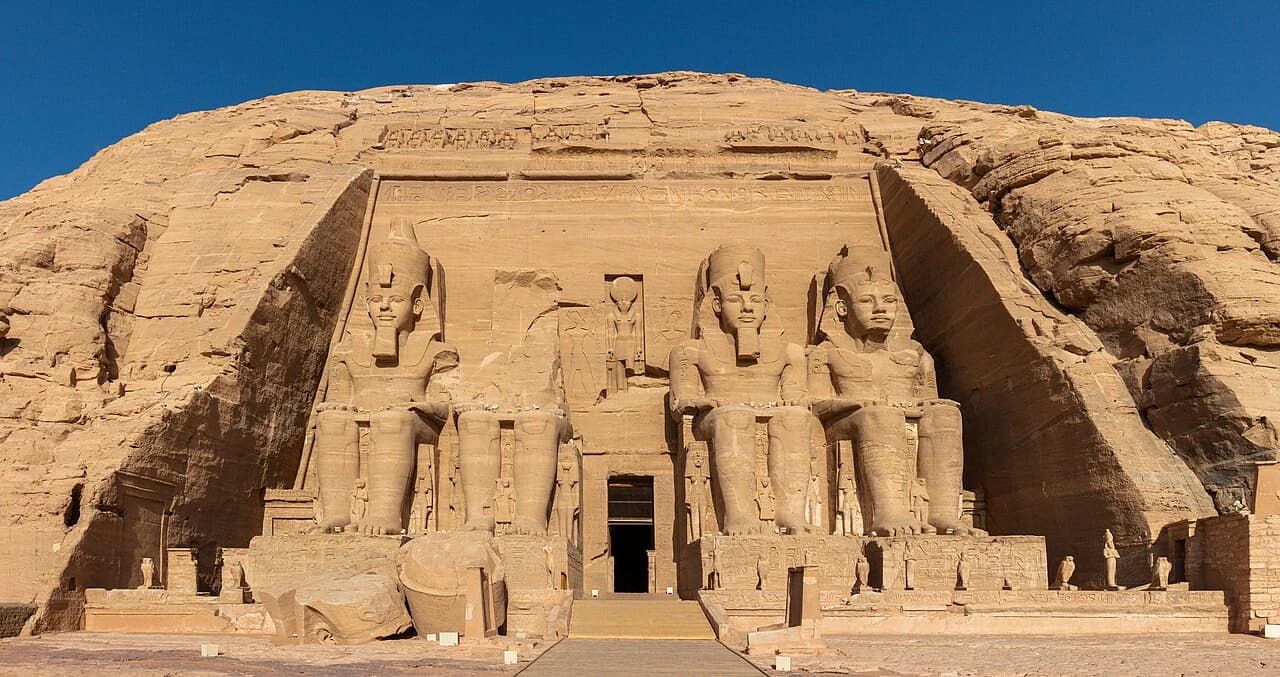
Abu Simbel is an archaeological site and temple complex located in southern Egypt. It is a UNESCO World Heritage Site renowned for its two massive rock-cut temples, built by Pharaoh Ramesses II.
Abu Simbel is also known as Great and Small Temples of Abu Simbel, Temples at Abu Simbel, Abu Simbel temples, ابو سمبل, and 4 other names in various languages.
This self-guided audio tour features 22 narrated stops organized across 4 sections, including The Facade of the Great Temple, The Great Hypostyle Hall, Reliefs of the Battle of Kadesh, The Second Pillared Hall. As a archaeological site, Abu Simbel offers a unique cultural experience in the heart of Abu Simbel City, Egypt.
The Stanza audio guide is available in 15 languages and works entirely offline — download the complete tour including audio narration, maps, and images before your visit. As you walk through Abu Simbel, GPS-triggered narration plays automatically at each point of interest.
Last updated:
What you will hear
The Facade of the Great Temple
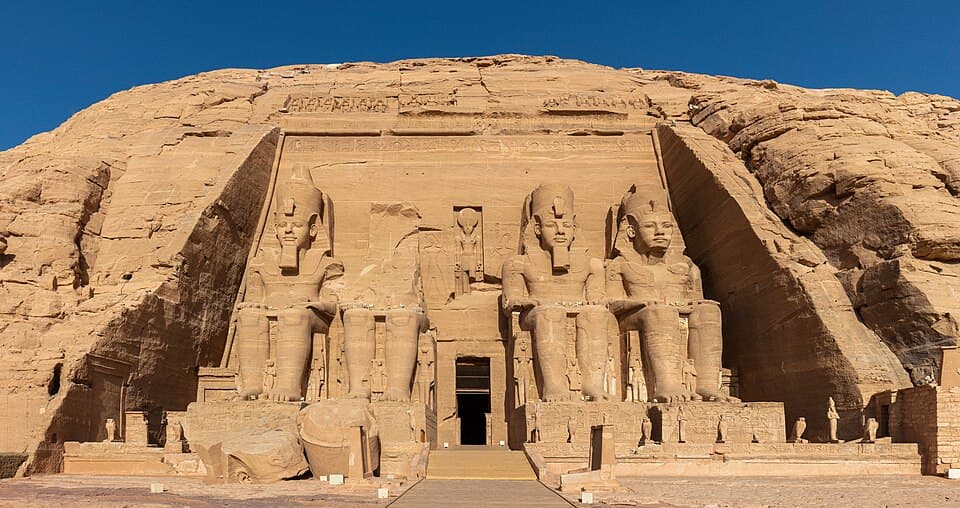
Explores the monumental entrance featuring the four 20-meter colossi of Ramesses II, the fallen statue, and the ancient inscriptions left by early travelers.
The Temple of Ramses II
Getting closer to the Great Temple, the dramatic history of the site becomes visible on its very surface. The second colossus from the left is notably damaged; its upper body and head lie in fragments on the ground at its feet. This was not caused by human hands or modern neglect, but by a massive earthquake that struck the region in approximately 1213 BCE, just a few decades after the temple was finished. When the temple was moved in the 1960s, engineers chose to leave these fragments exactly as they were found, preserving the site's historical narrative. The ground here is scattered with large sections of the statue’s crown and shoulders, allowing you to see the incredible detail of the carving up close. You can observe the fine lines of the royal beard and the intricate hieroglyphs carved into the Pharaoh's shoulders and chest. These inscriptions provide the king's formal titles, reinforcing his identity as the 'Strong Bull' and 'Beloved of Amun.' This blend of monumental perfection and natural ruin serves as a poignant reminder of the tension between eternal ambition and the inevitable passage of time.
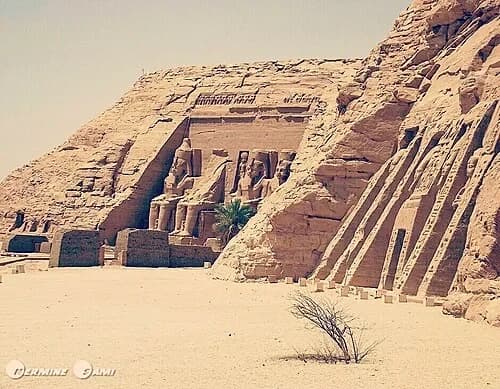
The Temples of Abu Simbel
Standing back to take in both temples, you can appreciate the unique architectural relationship between them. While the Great Temple on the left is dedicated to the gods Amun-Ra, Ra-Horakhty, and Ptah, as well as the deified Ramses II himself, the Small Temple on the right is dedicated to the goddess Hathor and Queen Nefertari. This was a rare honor; it is one of the few instances in Egyptian history where a queen was granted a temple of this scale. Notice that on the facade of the Small Temple, the statues of the queen are the same height as those of the king. This equality in size was a significant departure from traditional Egyptian art, where queens were typically shown as tiny figures reaching only to the king's knees. The entire complex was designed to be a visual manifestation of royal and divine partnership. The space between the temples serves as a grand approach, once overlooking the banks of the Nile and now facing the vast expanse of Lake Nasser. The golden hue of the stone changes throughout the day, shifting from pale yellow in the morning to a deep, warm orange as the sun sets, highlighting the deep-cut reliefs and monumental forms.
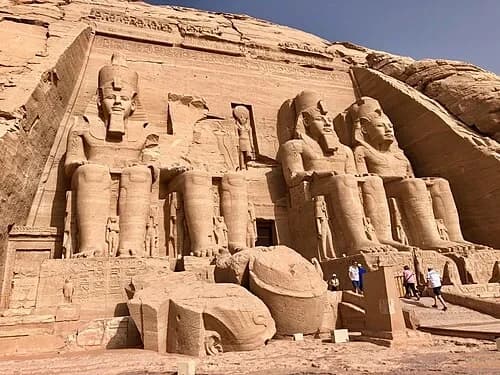
The Great Temple of Ramses II
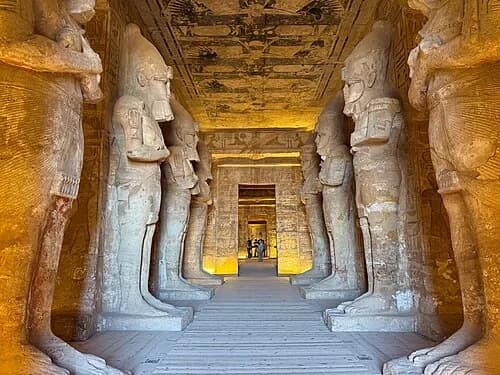
Transitioning from the bright desert sun into the interior of the Great Temple reveals a cool, dim world of monumental proportions. The first chamber you enter is the great hypostyle hall. Eight massive pillars support the ceiling, arranged in two rows of four. Each pillar features a colossal figure of Ramses II standing against it, depicted in the 'Osiride' pose—arms crossed over the chest, holding the crook and flail, symbols of Pharaonic power and the god of the afterlife, Osiris. These figures represent the Pharaoh’s eternal nature, merging his identity with the god of resurrection. On the left side, the figures wear the white crown of Upper Egypt, while on the right, they wear the double crown of the unified land. Look up at the ceiling to see the remains of colorful paintings, including vultures with outstretched wings, representing the protective goddess Nekhbet. The walls around these pillars are covered in vibrant reliefs depicting the Pharaoh’s military victories. The scale of the interior echoes the exterior, ensuring that the transition into the mountain feels like entering a divine realm where the king and the gods are one.
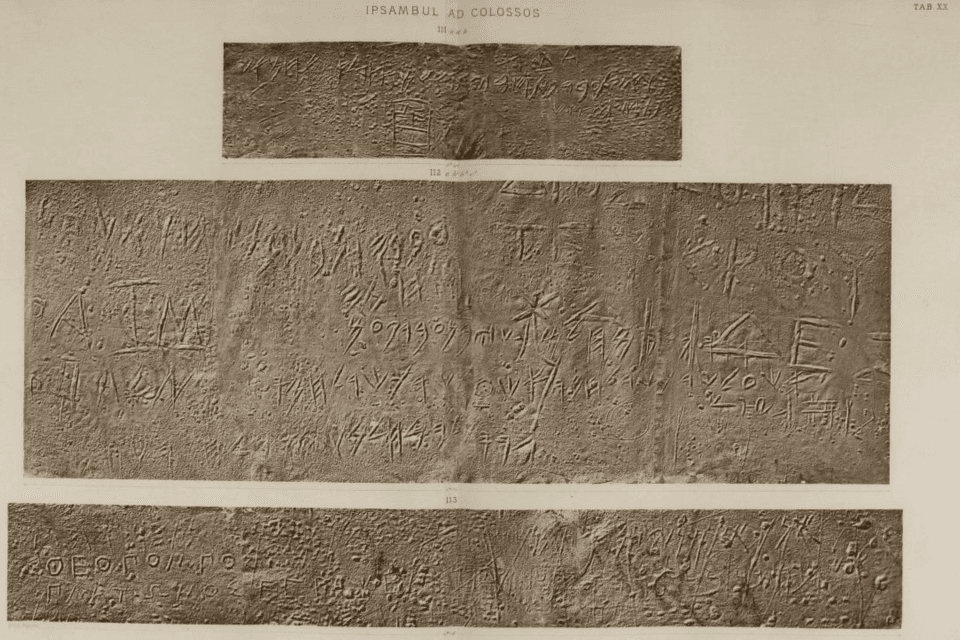
Abu Simbel Phoenician Graffiti
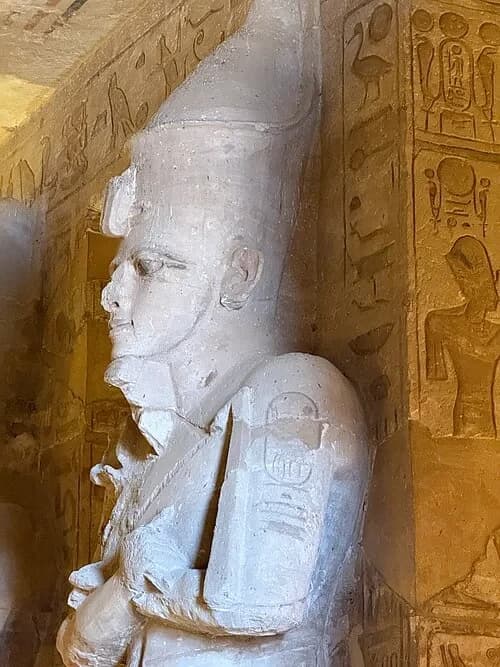
The intricate stone carvings of Abu Simbel carry layers of history that extend far beyond the reign of Ramses II. While the primary reliefs, like the profile of the Pharaoh shown here, were created to honor the gods, the temple’s exterior became a canvas for later visitors. Among the most historically significant additions are inscriptions left by Phoenician and Greek mercenaries who passed through this region in the 6th century BCE, during the reign of Psamtik II. These ancient 'graffiti' are often found on the legs of the colossal statues at the entrance. They were not seen as acts of vandalism in the modern sense but as a way for travelers to leave a permanent mark of their presence at a site that was already ancient to them. The technique used for these later inscriptions is much shallower than the deep, masterful Pharaonic reliefs you see in the royal profiles. By looking closely at the weathered surfaces, you can see how the stone preserves these different eras—the refined, idealized art of the New Kingdom and the spontaneous, functional writing of ancient soldiers and explorers. This dialogue between the monument and its visitors has continued for over two millennia, making the temple a living record of human travel and fascination.
The Great Hypostyle Hall
The first interior hall, dominated by eight massive Osirid pillars depicting the Pharaoh as the god of the afterlife, framing the path to the sanctuary.
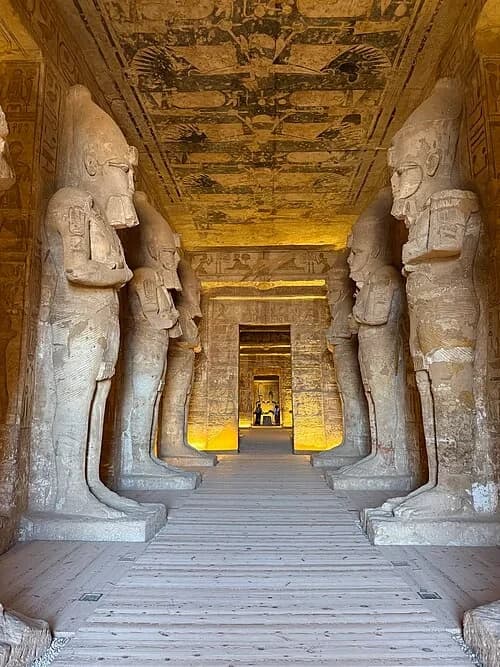
Interior of the Great Temple of Abu Simbel
As you move deeper into the hypostyle hall, the atmosphere shifts, becoming more intimate and sacred. The rows of Osiride pillars create a rhythmic progression toward the sanctuary. The figures of the Pharaoh, standing with calm, stoic expressions, seem to guard the path to the inner rooms. Their features are finely carved, with the soft contours of the face contrasting against the rigid, block-like structure of the pillars they are attached to. The walls behind these pillars are densely packed with narrative reliefs. In the flickering light, you can make out scenes of the Pharaoh presenting captives to the gods or receiving divine blessings. These carvings served a dual purpose: they were religious offerings to ensure the king's favor with the gods and political statements to remind anyone who entered of his absolute power. The preservation of the interior is remarkable; because these rooms were carved into the mountain and later buried by sand for centuries, the crispness of the carvings and even some of the original mineral pigments have survived, offering a rare glimpse into the intended splendor of the New Kingdom.
Interior of the Great Temple of Abu Simbel
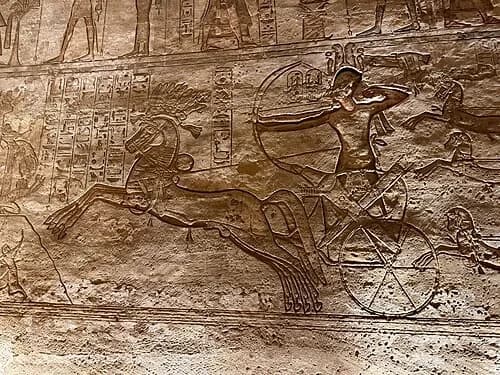
Among the most impressive interior features is the massive relief depicting Ramses II in the heat of battle. This scene captures the Pharaoh in his war chariot, horses galloping forward with incredible energy. The king is shown at a larger scale than his soldiers and enemies, emphasizing his heroic role in the conflict. He is seen drawing his bow, with the reins of the horses tied around his waist so his hands remain free for combat. This specific carving is believed to represent the Battle of Kadesh, fought against the Hittites. It is a masterpiece of ancient narrative art, showing a chaotic swirl of chariots, fallen enemies, and charging troops. The detail is so fine that you can see the individual feathers in the horses' plumes and the tension in the Pharaoh's arms. Such scenes were designed to project an image of invincibility, turning a military stalemate into a legendary victory for the ages. The use of sunken relief—where the outlines are carved deep into the surface—creates strong shadows that make the scene appear to leap off the wall when illuminated by torchlight or, today, by modern spotlights.
Interior of the Great Temple of Abu Simbel
Looking down the long, central aisle of the temple, you can see the deliberate architectural progression that leads to the most sacred space: the sanctuary. The temple was engineered so that its axis aligns with the sun. Twice a year, on approximately February 22nd and October 22nd, the first rays of the rising sun travel through the entire length of the temple, passing through the entrance and the two halls to illuminate the statues in the sanctuary at the very back. This solar phenomenon was not an accident but a sophisticated feat of ancient Egyptian astronomy and engineering. It is believed these dates may correspond to the Pharaoh's birthday and his coronation, though this is a subject of ongoing discussion among historians. As you walk this path, the rooms become smaller and the floor rises slightly, creating a sense of increasing holiness as you approach the gods. The walls along this axis are decorated with the most important religious rituals, showing the king interacting directly with the highest deities of the Egyptian pantheon. This alignment connects the earthly architecture of the temple with the celestial movements of the sun god, Ra.
Reliefs of the Battle of Kadesh
The walls of the first hall are covered in detailed reliefs celebrating Ramesses II's military prowess, specifically his victory over the Hittites.
Interior of the Great Temple of Abu Simbel
On the sides of the pillars in the inner halls, you will find beautiful, smaller-scale reliefs that offer a more personal look at Pharaonic ritual. One common scene shows the Pharaoh standing before a god, often Horus or Amun-Ra. The god is frequently shown holding the 'Ankh'—the symbol of life—to the Pharaoh's nose, a gesture representing the breath of life and divine energy being granted to the king. These carvings are executed with great delicacy. Notice the detailed costumes, including the pleated kilts, elaborate broad collars, and the specific crowns worn by both the king and the deity. The hieroglyphs surrounding the figures are not just decorative; they record the specific prayers and the titles of the gods. In many places, you can still see traces of the original yellow, red, and blue paint that once covered these walls. These inner chambers were intended to be experienced in near-darkness, with only the light of small oil lamps to reveal the figures. This created a flickering, lifelike quality to the reliefs, as if the gods were truly present and interacting with the Pharaoh in the heart of the mountain.

The Relocation of the Great Temple of Abu Simbel
At the very end of the long axis lies the sanctuary, the most sacred room in the entire complex. Here, four seated statues are carved directly into the back wall. They represent Ptah, the god of the underworld; Amun-Ra, the king of the gods; the deified Ramses II himself; and Ra-Horakhty, the sun god. During the solar alignment events, the sun shines on the figures of Amun-Ra, Ramses, and Ra-Horakhty, while Ptah—the god associated with the darkness of the earth—remains appropriately in the shadows. When the temple was relocated between 1964 and 1968, preserving this exact astronomical alignment was one of the greatest challenges for modern engineers. They had to recalculate the position with extreme precision to ensure the sun would still reach the sanctuary on the correct days. Today, you are standing inside an entirely reconstructed mountain. The original sandstone was cut into blocks, numbered, and then carefully fitted back together over a massive concrete dome that supports the artificial hill. Looking at these figures, it is impossible to see the seams where the blocks were cut, a tribute to the skill of both the ancient artisans who first carved them and the modern workers who saved them from the rising Nile.
The Second Pillared Hall
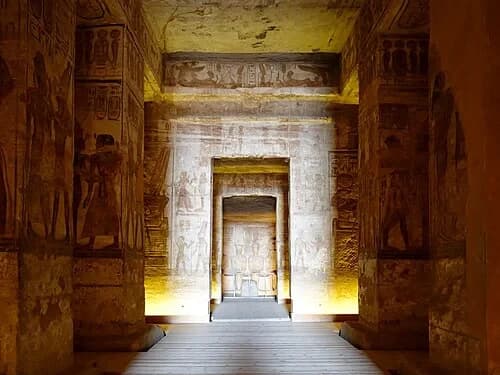
A smaller, more intimate hall with four decorated pillars showing the King being welcomed by various deities, leading toward the spiritual heart of the temple.
The Small Hypostyle Hall of the Great Temple
Beyond the grand public spaces of the temple lie several smaller side chambers and the second, or small, hypostyle hall. These rooms were used for more private rituals and for storing the sacred objects and offerings used in the temple’s daily services. Unlike the large, booming main hall, these spaces feel intimate and quiet. The walls are no less decorated, featuring scenes that focus on the Pharaoh’s personal devotion. In these side rooms, the reliefs often show the king presenting food, incense, and floral offerings to various deities. The carvings are incredibly dense, with every square inch of the stone utilized to record the king's piety. Notice how the floor is made of smooth, flat stones, and the walls show the natural texture of the surrounding rock. These rooms provide a sense of the day-to-day operation of an ancient Egyptian temple, which was not just a place of worship but a busy center of administration and resource management. The survival of these delicate interior spaces is particularly impressive, as they were the most vulnerable to damage during the relocation process, yet they remain almost perfectly intact for us to explore today.
Want to hear the rest?
Download the Stanza app to unlock all 22 stops and the complete guided audio tour.
Frequently Asked Questions
How long does the Abu Simbel audio tour take?
The Abu Simbel audio guide includes 22 narrated stops. Most visitors spend 45 minutes to 1.5 hours exploring the complete tour, though you can listen at your own pace and skip or revisit any stop.
Is the Abu Simbel audio guide available in my language?
Stanza supports 15 languages: English, Spanish, French, German, Italian, Portuguese, Russian, Japanese, Chinese, Korean, Arabic, Hindi, Polish, Dutch, Hebrew. Check the guide in the app to confirm the languages currently available for this tour.
Can I use the audio guide offline at Abu Simbel?
Yes! Download the complete Abu Simbel tour — including all audio, maps, and images — before your visit. The Stanza app works completely offline, so you don't need WiFi or mobile data at the venue.
How much does the Abu Simbel audio guide cost?
The Stanza app is free to download. The current listed price for the Abu Simbel audio guide is $3.99; app-store region and currency may affect the final price.
How do I use the Stanza audio guide at Abu Simbel?
Download the free Stanza app, search for "Abu Simbel", and download the tour. When you arrive at the venue, the app uses GPS to detect your location and automatically plays the relevant narration as you move between points of interest — completely hands-free.
What makes the Stanza audio guide different from other Abu Simbel tours?
Stanza offers GPS-triggered narration that plays automatically as you walk through Abu Simbel — no need to manually select stops. The tour is available in 15 languages, works fully offline, and includes 22 expertly narrated stops with images and historical context.
What other audio guides are available near Abu Simbel?
Stanza offers multiple audio guides in Abu Simbel City, Egypt and nearby areas. After downloading the app, browse the map to discover all available tours near Abu Simbel. Each guide can be downloaded for offline use.