Stanza · Audio guide
Al-Azhar Mosque Audio Guide
A place to remember. A story to take with you.
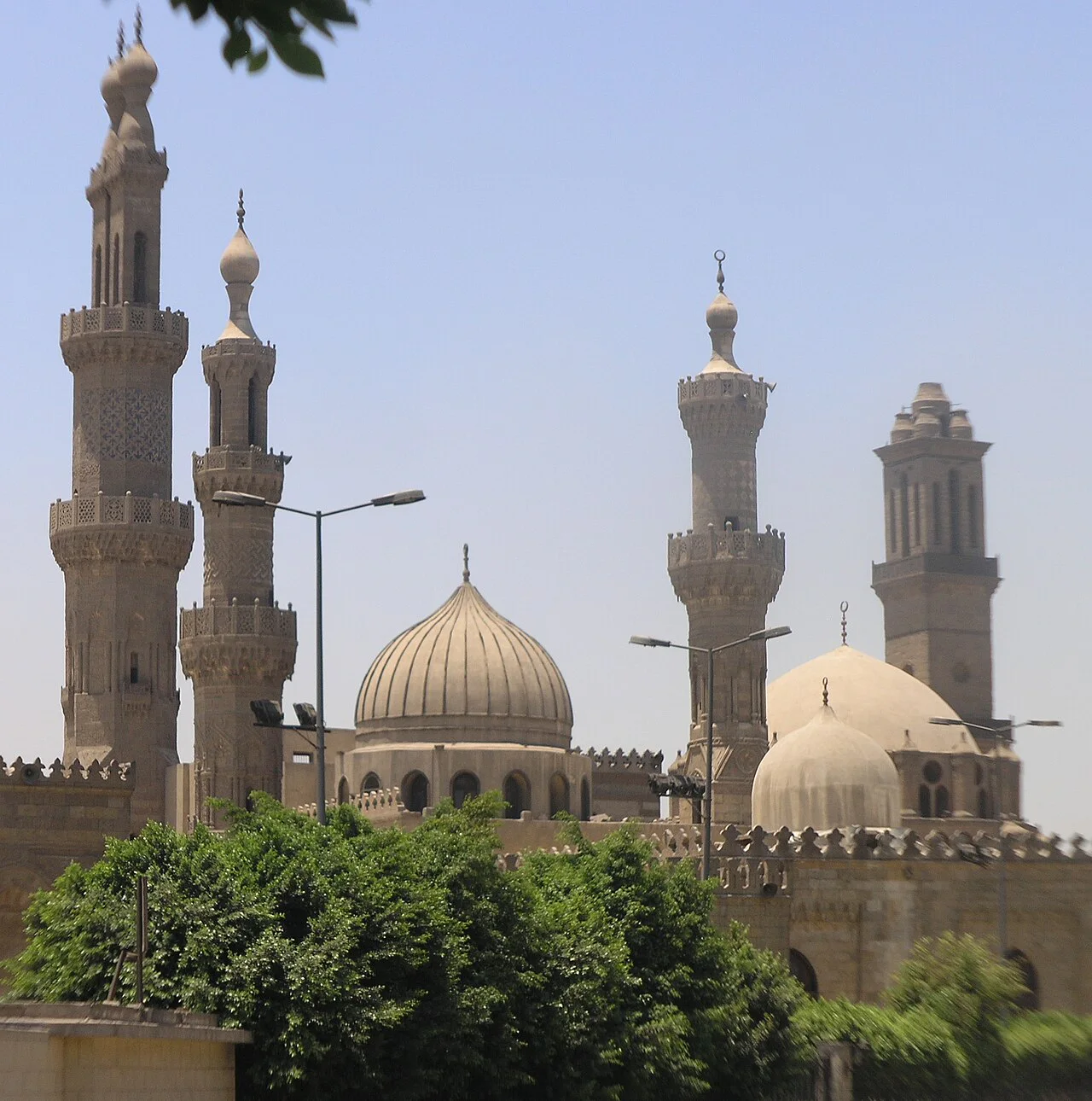
Al-Azhar Mosque is a mosque located in the historic Islamic core of Cairo, Egypt. It was the first mosque established in the city after it was commissioned as the capital of the Fatimid Caliphate in 970 CE.
Download Stanza, then search for “Al-Azhar Mosque”.
About the tour
One guide. Your kind of visit.
Al-Azhar Mosque is a mosque located in the historic Islamic core of Cairo, Egypt. It was the first mosque established in the city after it was commissioned as the capital of the Fatimid Caliphate in 970 CE.
Ready when you are.
- 01Get the free Stanza app.
iOS & Android
- 02Find your guide.
“Al-Azhar Mosque”
- 03Download before you go.
Works offline
Audio guide / 12 narrated stops
Inside the guide
Get to know a few of the stories before you go. Open a stop to read more.
01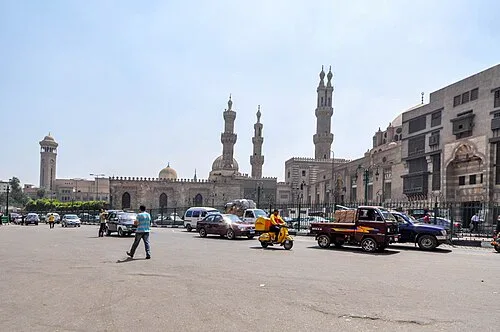 The Grand Entrance and the Gate of the Barbers
Al-Azhar from the Plaza: A Thousand-Year Foundation
A thousand years ago, this plaza was the edge of a brand-new city. Al-Azhar was begun in 970 by the Fatimid commander Jawhar al-Siqilli, and finished two years later. Jawhar had just conquered Egypt for the Fatimid caliphs, and Cairo became their new capital. The mosque was built as the city's congregational mosque, and as a base for spreading Isma'ili Shi'a Islam. That mattered, because the older city of Fustat, close by, was largely Sunni. The Fatimids wanted their own doctrine preached from their own stage. Over the following centuries the mosque grew into one of the paramount centers of Islamic learning, and this tour follows those layers, from Fatimid arches to Ottoman gates. Cairo's nickname, the City of a Thousand Minarets, begins here with this first mosque.
Photo: Baldiri · CC BY-SA 3.0
02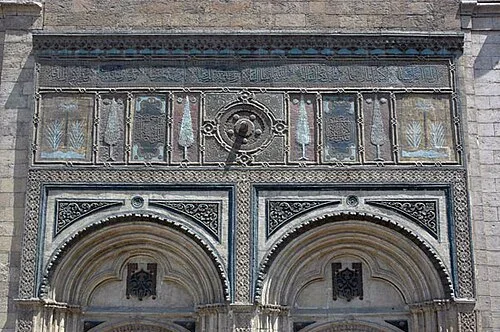 The Grand Entrance and the Gate of the Barbers
Bab al-Muzayinin, the Gate of the Barbers
Students once queued outside this gate to have their heads shaved before entering the halls of study. That is why it is called the Gate of the Barbers, Bab al-Muzayinin. The Ottoman official Abd al-Rahman Katkhuda built it in 1753, and it soon became the main entrance to the mosque. Each of its two doors sits within a recessed arch, and semi-circular arches with trefoil-decorated tympanums stand above them. Above the arches runs a frieze of cypress trees, a hallmark of Ottoman work. Katkhuda's gate opened the largest campaign of renovations the mosque had seen since the days of the Mamluks.
Photo: Baldiri · CC BY-SA 3.0
03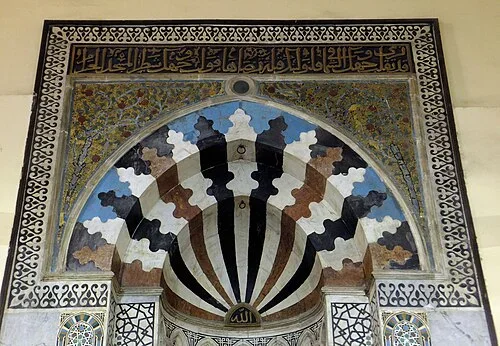 The Vestibule Madrasas
Madrasa al-Taybarsiyya and Its Polychrome Mihrab
Amir Taybars built his madrasa in 1309, meaning it as a complementary mosque beside Al-Azhar. In time the two merged, and his college was absorbed into the mosque. Here the Shafi'i and Maliki schools of law were taught, though the chroniclers disagree on the arrangement. Al-Maqrizi said only the Shafi'i studied in this madrasa, while Ibn Duqmaq said one hall was reserved for the Shafi'i and the other for the Maliki. Taybars was buried here too, in a tomb within his own foundation. Today the rooms hold manuscripts from the library. Of the original building only the qibla wall survives, the wall facing Mecca, along with its mihrab, the niche that marks that direction. The historian Creswell called this polychrome mihrab one of the finest in Cairo.
Listen in the appRobert Prazeres · CC BY-SA 4.0
04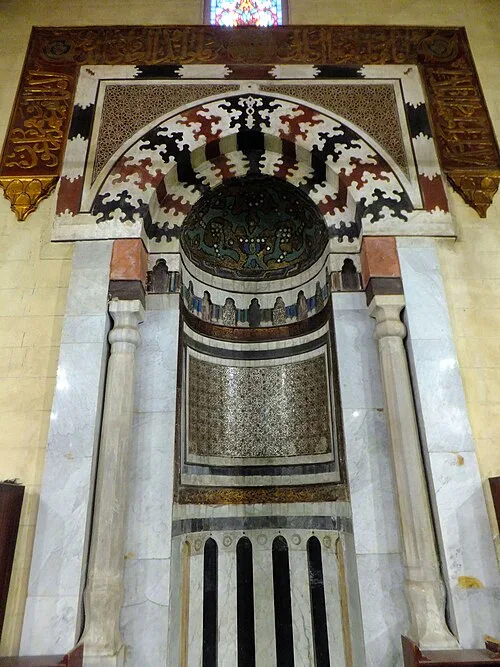 The Vestibule Madrasas
Madrasa al-Aqbughawiyya
In 1302 an earthquake shook Al-Azhar and many other mosques across Mamluk lands. The repairs were shared out among the amirs, the princes of the Sultanate, under the head of the army, Sayf al-Din Salar. They were the first repairs since the reign of Baibars. In 1339 Amir Sayf al-Din Aqbugha Abd al-Wahid founded this school along the mosque's northwest wall. Part of the mosque wall was cut away to fit the new building. He meant it as a stand-alone mosque and school, with his own tomb chamber inside. Much of what stands is original: the entrance, the qibla wall, and the mihrabs with their glass mosaics. The dome was rebuilt in Ottoman times, and the facade was remodeled in 1888 for Khedive Tewfik. Even the minaret's top has been refashioned more than once, ending today in the Mamluk-style finial.
Listen in the appRobert Prazeres · CC BY-SA 4.0
05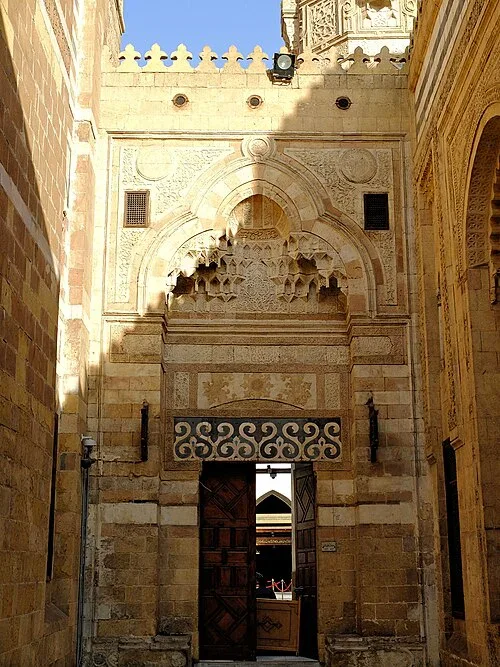 The Gate and Minaret of Sultan Qaytbay
The Gate of Sultan Qaytbay (Bab al-Gindi)
After Saladin and then Baibars, sultans competed to attach their names to this prestigious mosque, and building here became a mark of power. Sultan Qaytbay's gate of 1495, a refined piece of late Mamluk work, stands across the courtyard from the Gate of the Barbers.
Listen in the appPhoto: R Prazeres · CC BY-SA 4.0
06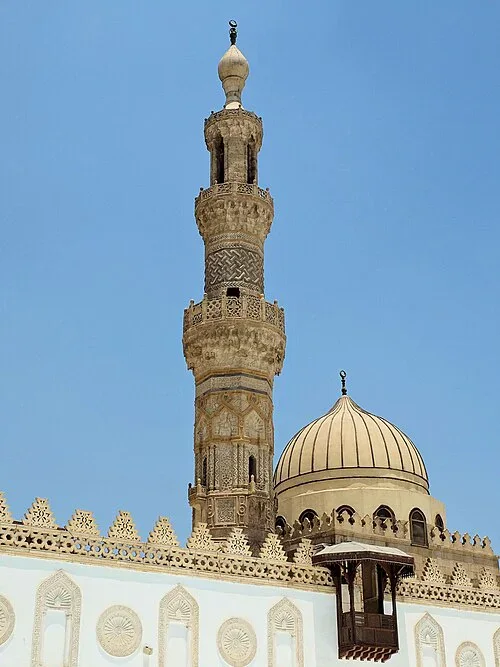 The Gate and Minaret of Sultan Qaytbay
The Three-Tiered Minaret of Qaytbay
Two sultans tried and failed to raise a stone minaret at this mosque before this one. Barquq tried in 1397, and al-Mu'ayyad tried in 1424. Both times the construction was found defective and pulled down. The minaret that finally stands was built in 1483, or in 1495; the accounts disagree. It reads from the bottom up. A square base rises into a transitional segment, then an octagonal shaft with keel-arched panels on each face. A balcony leads to a second octagonal shaft, decorated with plaiting. Above that, the shaft turns cylindrical, built of eight brick pillars, and carries four arches. Three balconies ring the whole, each supported by muqarnas, the stalactite vaulting that eases the transition from a flat surface to a curved one. Muqarnas was first recorded in Egypt in 1085, so the craft was already old when this tower rose.
Listen in the appPhoto: R Prazeres · CC BY-SA 4.0
07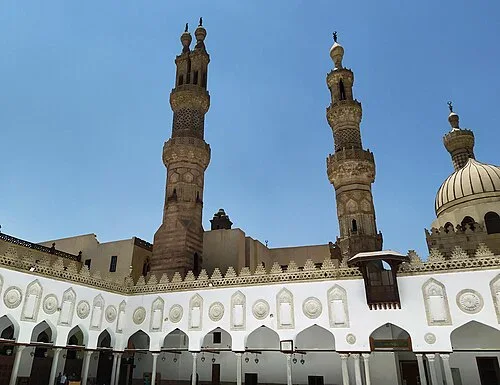 The Central Sahn and Fatimid Arcades
The Central Sahn: Marble Court and the Name 'The Resplendent'
The white marble paving of this courtyard was added in about 1010, some forty years after the mosque's founding. Arcades ring it on every side, and the minarets of later sultans rise above the walls. The mosque began under another name: Jami al-Qahira, the Mosque of Cairo. It became al-Azhar, the resplendent, by the end of the caliph al-Aziz Billah's reign. The reason for the change is disputed. One tradition links the name to Fatima, daughter of the Prophet, who bore the epithet az-Zahra, the shining one. The Fatimid caliphs claimed her as their ancestress, so the tribute would fit. But that story is confirmed in no Arabic source, and later scholars have both defended and doubted it. The other theory points to the caliph's palaces near the mosque, which al-Aziz Billah had named the Brilliant Palaces. Those palaces were completed and named before the mosque took its new name.
Listen in the appRadosław Botev · CC BY 3.0 pl
08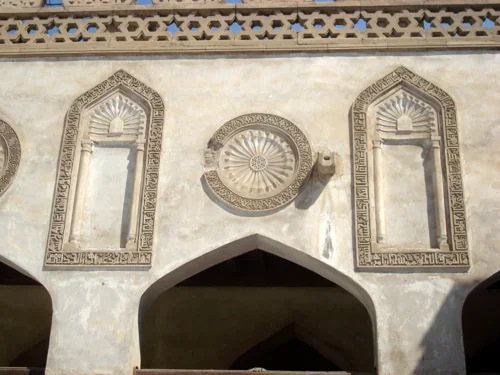 The Central Sahn and Fatimid Arcades
Fatimid Stucco: Keel Arches and Kufic Inscription
Caliph al-Hafiz gave the courtyard its decoration in a major refurbishment of 1138. His work established the keel-shaped arches and carved stucco that run along these walls. Two kinds of ornament alternate. Above the center of each arch sits a sunken roundel ringed with twenty-four lobes. Between the arches, shallow niches sit under fluted hoods, resting on little engaged columns. A band of Quranic writing in Kufic script winds around those columns, added after al-Hafiz but still within the Fatimid period. Those inscriptions are the only decoration here traced with certainty to the Fatimids themselves. The stucco was redone in 1891, and the vegetal band around the roundel followed in 1893. The Fatimid design reaches us, then, through a careful later restoration.
Listen in the appŁukasz Piątak · CC BY-SA 4.0
09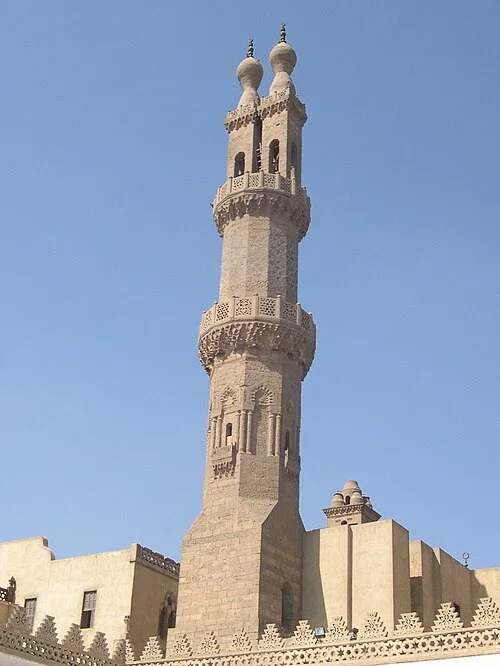 The Double-Finial Minaret of Sultan al-Ghuri
One minaret on this mosque carries two spires instead of one. Sultan Qansuh al-Ghuri, among the last of the Mamluk sultans, raised it, and its double finial, two bulbous tops in place of a single one, makes it unique on Cairo's skyline. Like Qaytbay's gate and minaret, it was a sultan's mark on Al-Azhar. He may also have rebuilt the dome in front of the mosque's original mihrab.
Listen in the appupyernoz · CC BY 2.0
10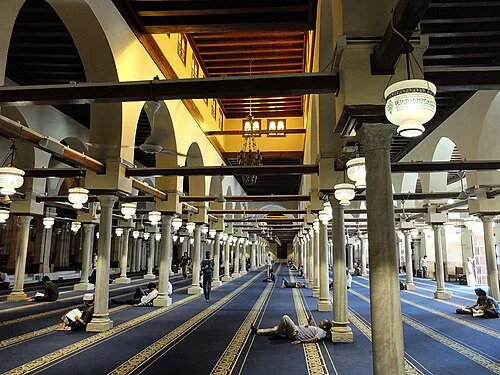 The Original Fatimid Hypostyle Sanctuary
Inside the Original Fatimid Sanctuary: Columns of the Ages
These columns were standing in Egypt long before the mosque was founded. The original structure measured about eighty-five meters in length. It held three arcades around a courtyard, and the prayer hall ran five aisles deep. The marble columns were reused from sites across Egyptian history, from Pharaonic times through Roman rule to Coptic dominance. They came in different heights, so the builders leveled the roofline with bases of varying thickness. The taller the column, the thinner its base. That detail shows in the long rows of columns supporting this hall. Even the qibla wall sits slightly off the correct angle to Mecca. Outside, the stucco shows influences from Abbasid, Coptic, and Byzantine architecture.
Listen in the appPhoto: R Prazeres · CC BY-SA 4.0
- 11
The Mihrab and the Revolt of 1798
The revolt of 1798: Napoleon's guns aimed at the mosque, its desecration, and the student who killed a French general.
- 12
Katkhuda's Ottoman Hall: A Living Institution
Katkhuda's great prayer hall, the students' quarters around the mosque, and his own grave within its walls.
Al-Azhar Mosque
Frequently asked questions
How much does the guide cost?
Free app download. Listed guide price: $0.99. Guide price shown in the app. Audio guide only. Venue admission is separate.
Can I listen without internet?
Yes. Download the guide’s audio, images, and maps in the app before your visit. Your downloaded content is then available offline.
Can I listen in my language?
This audio guide is available in 15 languages, including English.
Do I need to follow a schedule?
No. This is a self-guided experience. Choose your stops, pause whenever you like, and return to a story at your own pace.
Al-Azhar Mosque
The Stanza Journal
At your own pace
Explore Al-Azhar Mosque.
Download Stanza, then search for “Al-Azhar Mosque”.
Free app download · Guide price shown in the app
Keep exploring
Nearby audio guides
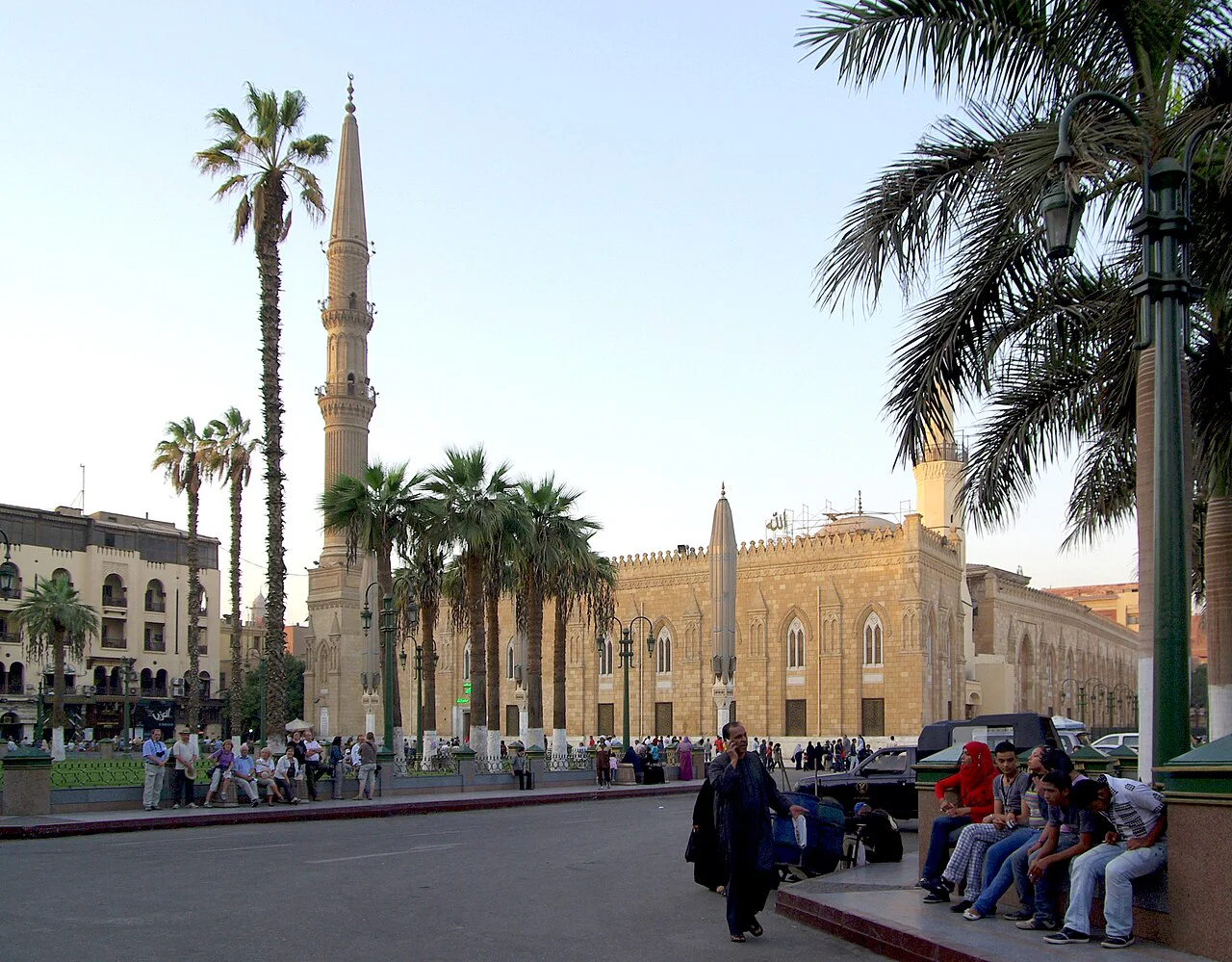
Cairo · 1 km
Al-Hussein Mosque
Content & sources
Photo: Berthold Werner · CC BY 3.0
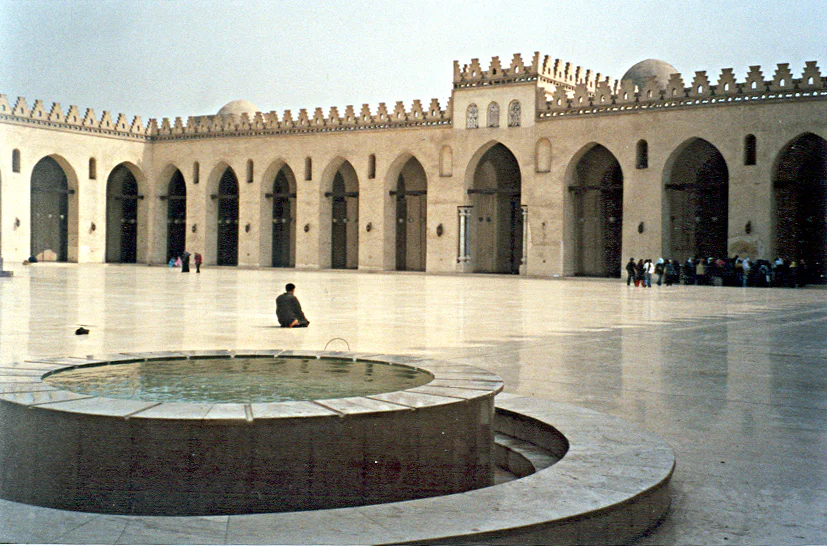
Cairo · 1 km
Al-Hakim Mosque
Content & sources
Michel Benoist Mbenoist at fr.wikipedia · CC BY 2.5
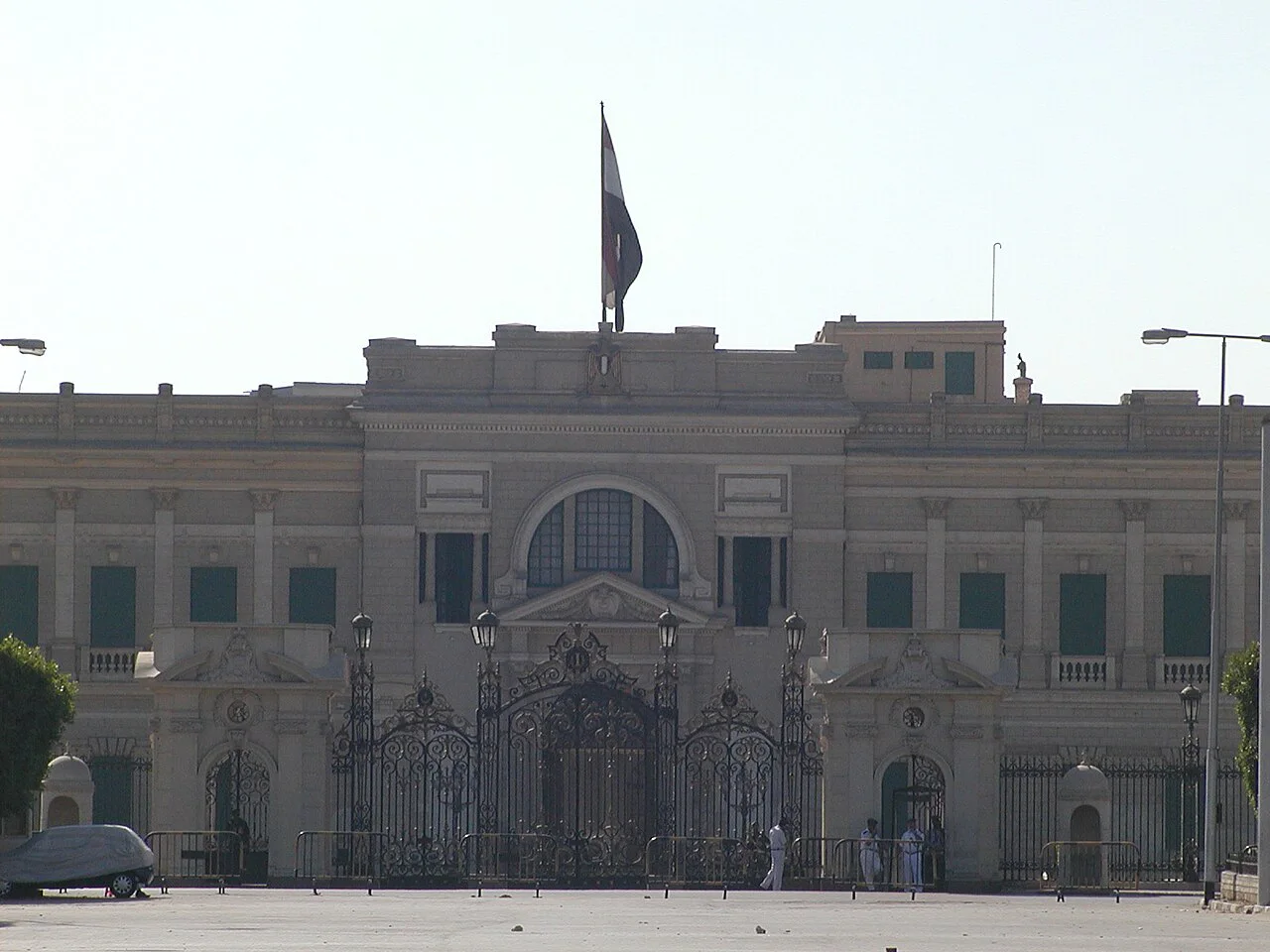
Cairo · 1 km
Abdeen Palace
Content & sources
Gérard Ducher (user:Néfermaât) · CC BY-SA 2.5
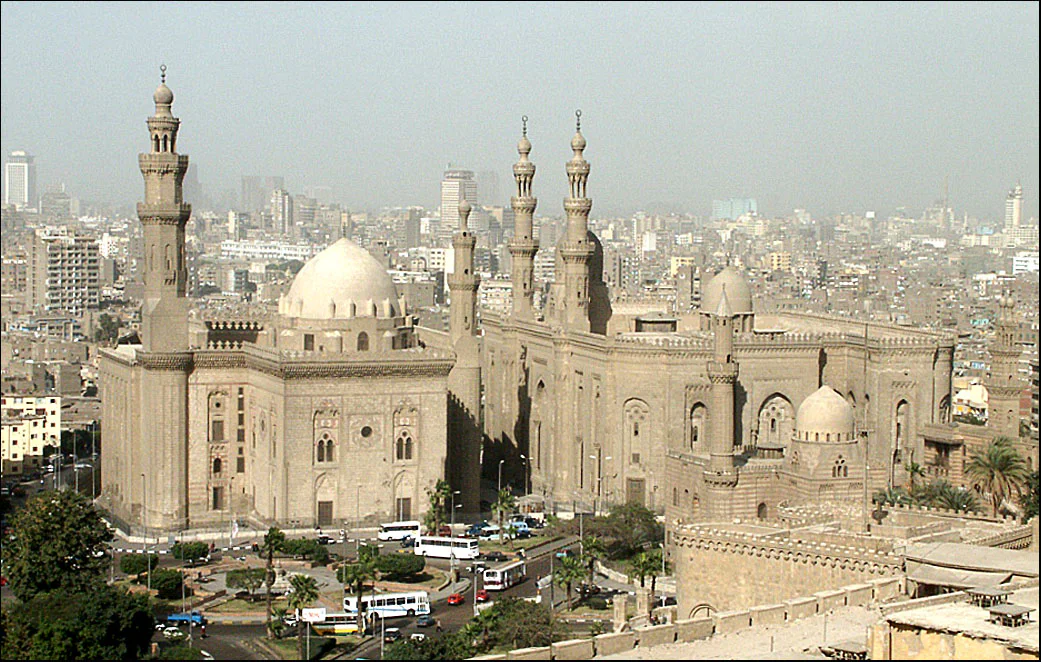
Cairo · 2 km
Al-Rifa'i Mosque
Content & sources
Original uploader was Chris Karman at nl.wikipedia · CC BY-SA 3.0