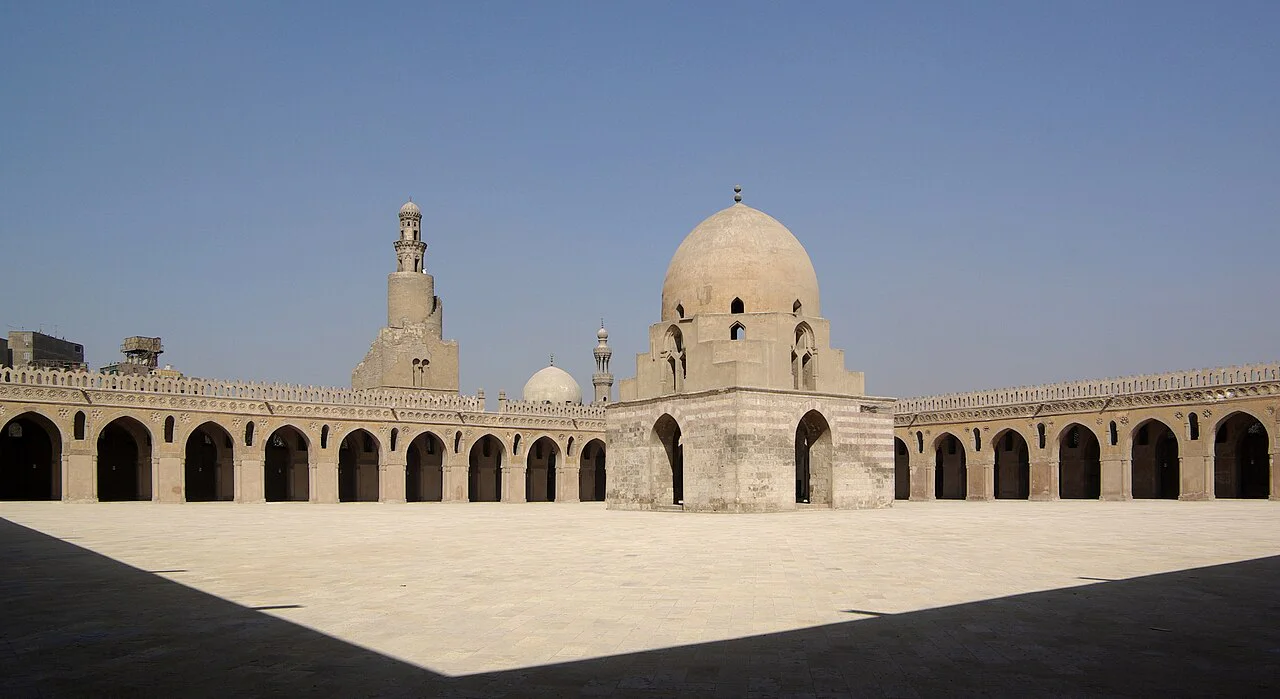
Stanza · Audio guide
Mosque of Ibn Tulun Audio Guide
A place to remember. A story to take with you.
The Mosque of Ibn Tulun is a mosque located in Islamic Cairo, Egypt. Built between 876 and 879 CE, it is the oldest well-preserved mosque in Egypt and an important representative of classical Abbasid…
Download Stanza, then search for “Mosque of Ibn Tulun”.
About the tour
One guide. Your kind of visit.
The Mosque of Ibn Tulun is a mosque located in Islamic Cairo, Egypt. Built between 876 and 879 CE, it is the oldest well-preserved mosque in Egypt and an important representative of classical Abbasid architecture.
Ready when you are.
- 01Get the free Stanza app.
iOS & Android
- 02Find your guide.
“Mosque of Ibn Tulun”
- 03Download before you go.
Works offline
Audio guide / 12 narrated stops
Inside the guide
Get to know a few of the stories before you go. Open a stop to read more.
01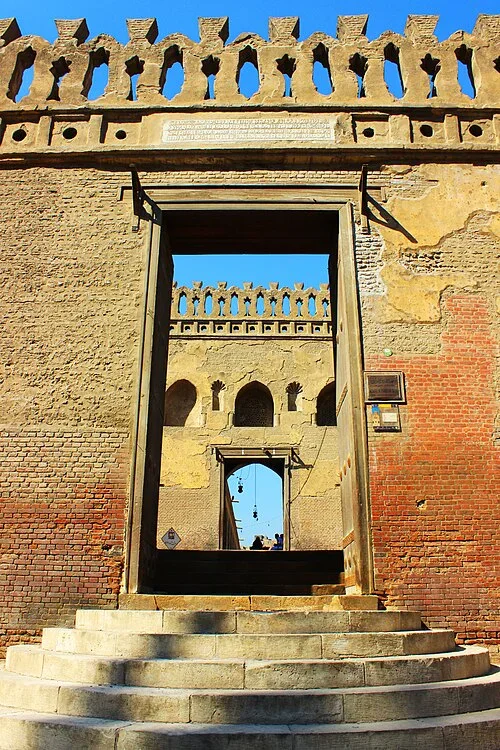 Outer Enclosure and Entrance Portal
Entrance Portal of the Mosque of Ibn Tulun
Welcome to the Mosque of Ibn Tulun, the oldest well-preserved mosque in Egypt. The story begins with Ahmad ibn Tulun, sent from Baghdad as the Abbasid governor of Egypt in 868. He turned his post into real power, ruling Egypt and parts of the Levant as his own. In 870 he started a brand-new capital, al-Qata'i, on open ground northwest of the old city of Fustat. This mosque was to be its great congregational mosque. Work began in 876 and an original inscription slab records its completion in the spring of 879. A tenth-century writer, Balawi, even preserves the architect's name: al-Nasrani, a man whose name suggests he was a Christian, and who had earlier built an aqueduct for Ibn Tulun nearby. The staircase climbs through a wall of brick crowned with openwork crenellations, their shapes vaguely like linked human figures. Crossing it means stepping into the ninth century.
Photo: Hossam abo almakarem · CC BY-SA 4.0
02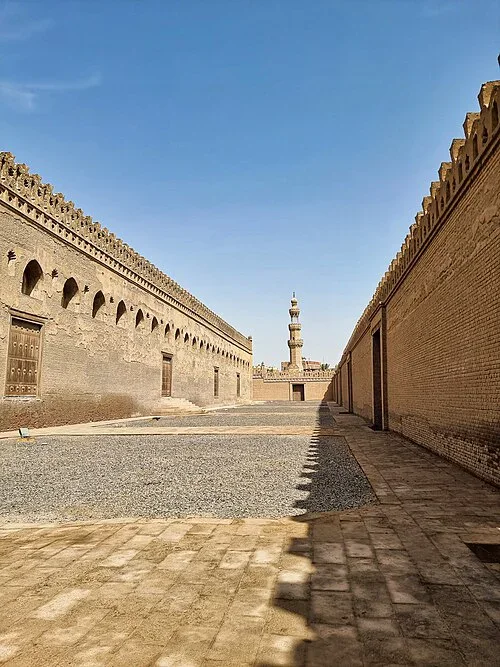 Outer Enclosure and Entrance Portal
The Outer Enclosure (Ziyada)
This broad, empty corridor between two walls is the ziyada, the outer enclosure. It wraps around the mosque on three sides as a buffer between the prayer space and the city. It was never bare ground. The ziyada once held ablution facilities, latrines, and a medical clinic, and shops and neighbourhood markets pressed against its outer walls. Those market structures were only cleared away in the early twentieth century. The emptiness you see now is also evidence of a survival. In 905, Baghdad sent an army under the general Muhammad ibn Sulayman al-Katib to retake Egypt, and he razed Ibn Tulun's capital of al-Qata'i to the ground. Only the mosque and the adjoining palace, the Dar al-Imara, were left standing. The mosque was spared for its religious function, while the palace was put back to work by the new governors. That makes this building the only surviving monument of a whole vanished city.
Prof. Mortel · CC BY 2.0
03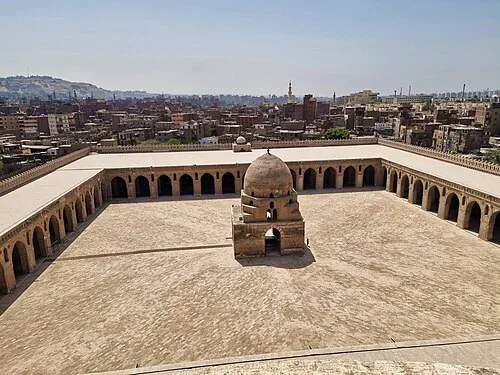 The Great Courtyard and Arcades
The Great Courtyard (Sahn)
From above, the mosque's plan reads at a glance: a huge open courtyard ringed by roofed arcades, with a domed fountain at its heart. The whole complex, enclosure included, covers about twenty-six thousand square metres, which puts it among the largest mosques in Egypt. It was also the third congregational mosque built in what is now Cairo, after the Mosque of Amr and the main mosque of al-Askar. And it is the oldest mosque in the country to largely keep its original form. The ground itself carries a story. The mosque was built on a small rise called Gebel Yashkur, the Hill of Thanksgiving. A local legend holds that Noah's Ark came to rest here after the Deluge, rather than on Mount Ararat. It is legend, not history, but people have told it on this spot for centuries.
Listen in the appProf. Mortel · CC BY 2.0
04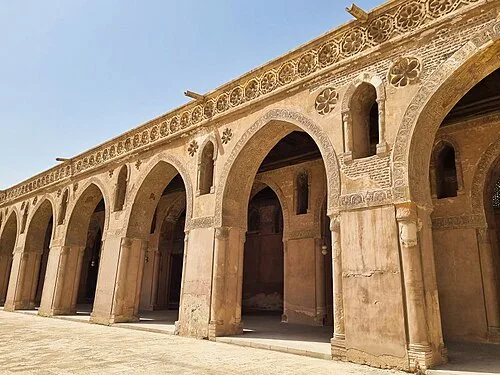 The Great Courtyard and Arcades
Arcades of Brick and Stucco
The arcades around the courtyard rest on thick brick piers, and that was a deliberate choice. The account goes that a mosque of this size would have demanded some three hundred marble columns, and the usual source for those was older churches. Ibn Tulun refused to strip other people's places of worship for his own. So the builders raised piers of brick instead and faced them with carved stucco, the craft Ibn Tulun knew from Samarra in Iraq, the Abbasid capital where he had spent his early career. Scholars sort the patterns into what they call Samarra B and Samarra C styles: geometry and vines, rosettes flanking the windows. The carving was originally painted in vivid colours, though the paint has since faded away. Look along the arches and you can see the survival is uneven. The southwestern side still keeps most of the carved decoration on the undersides of its arches; elsewhere it has largely worn away.
Listen in the appProf. Mortel · CC BY 2.0
05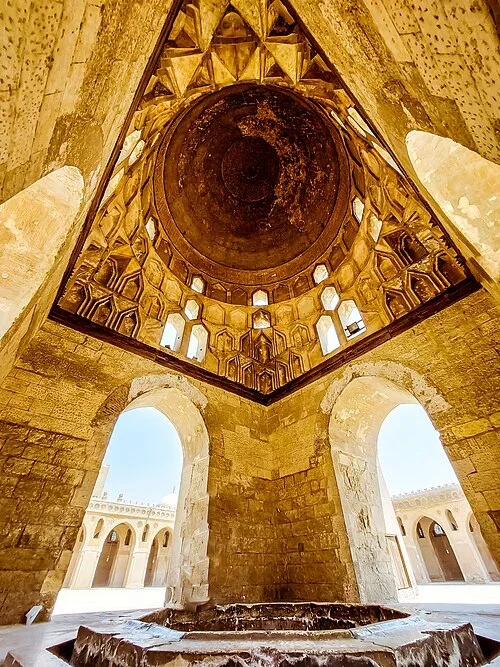 Sultan Lajin's Ablution Fountain Kiosk
The domed kiosk at the centre of the courtyard is the work of a man who once hid here as a fugitive. By the twelfth century the mosque had fallen into ruin and was serving as a caravanserai for North African pilgrims heading to the Hijaz. After the assassination of the Mamluk sultan al-Ashraf Khalil, one of the accomplices, a prince named Lajin, hid inside the mosque. Mamluk-era writers say he sheltered in the ruins of the minaret and spent a miserable year there. He vowed that if God saved him and made him sultan, he would restore the mosque. In 1296 he did become sultan, and he kept the vow. His restoration gave the mosque the fountain and this domed kiosk, a new pulpit, and renewed work on the main prayer niche and the minaret. A wooden inscription on the kiosk's outer wall records the campaign, though it has partly faded. Inside, the dome rises over an octagonal stone basin, its corners sculpted in stalactite-like muqarnas, with verses from the Quran carved in stucco above.
Listen in the appHEBA55 (HEBA MOHAMED ) · CC BY-SA 4.0
06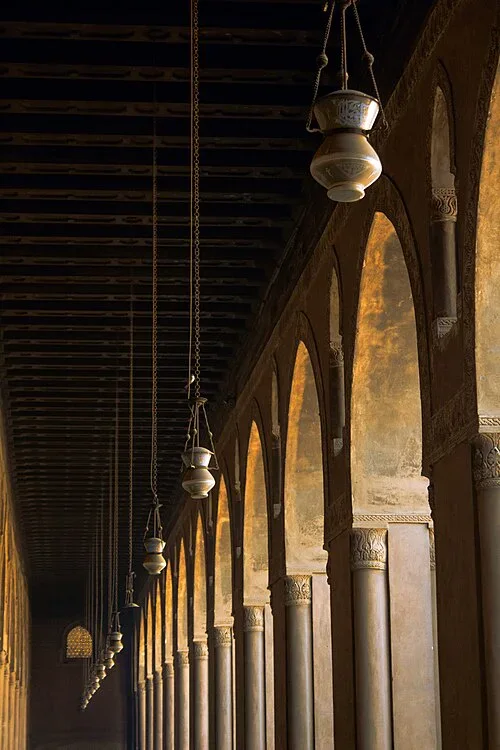 The Sanctuary Prayer Hall
 (Riwaq al-Qibla)
The prayer hall on the qibla side is the deepest of the four wings, five aisles wide under a wooden roof built with palm; the other three wings are only two aisles deep. Rows of pointed brick arches carry the roof, and lamps hang from it in long ranks, the way they have hung in mosques for centuries. After long periods of neglect and other uses, it is once again a working mosque. The most extraordinary thing here runs along the walls. Just below the ceiling, a wooden frieze carries a carved inscription in Kufic letters, and it runs around the entire mosque. Nearly two kilometres of it, quoting roughly one fifteenth of the whole Quran. Much has disappeared over time, so the frieze survives only in fragments. Even so, it makes this the oldest surviving Islamic monument to carry religious inscriptions of such length.
Listen in the appPhoto: Sphotography13 · CC BY-SA 4.0
07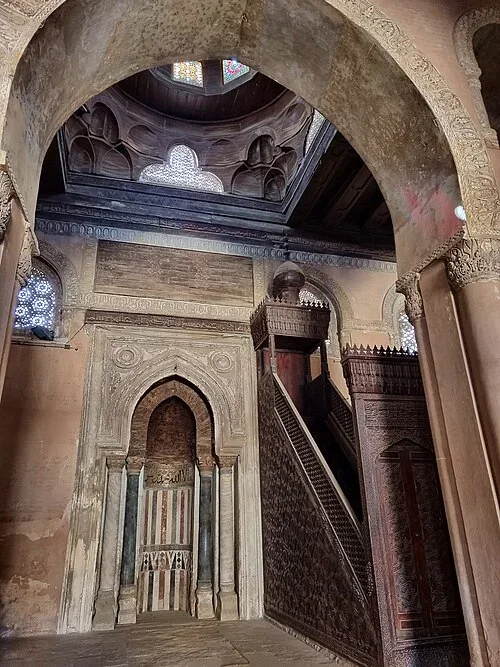 The Main Mihrab and Mamluk Minbar
The Main Mihrab
The main mihrab is the tallest of the mosque's six prayer niches, set at the centre of the qibla wall, and its decoration comes from two different ages. The carved stucco around the niche is original Tulunid work, as are the pairs of marble columns beside it with their Coptic-style capitals. Step closer to the niche itself and the story changes. The marble panelling at the bottom, the painted wood above, and between them a wide band of glass mosaic all belong to Sultan Lajin's restoration of 1296. The mosaic spells out the Shahada, the Muslim declaration of faith, in Naskhi script. Above the niche, a wooden frieze repeats the same declaration in Kufic letters, followed by a blessing. And one detail belongs to the founder alone: the doorway to the right of the niche. Through it, Ibn Tulun could walk straight from his palace, the Dar al-Imara, which stood directly behind this wall, into his own mosque.
Listen in the appProf. Mortel · CC BY 2.0
08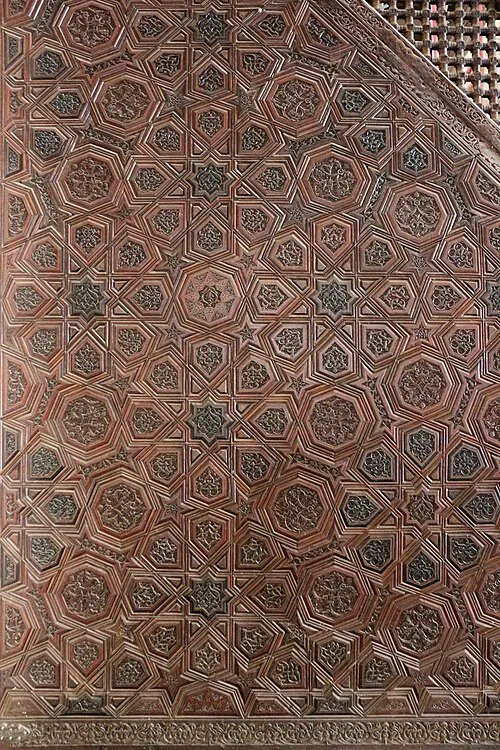 The Main Mihrab and Mamluk Minbar
The Mamluk Minbar
Beside the mihrab stands the minbar, the pulpit the imam climbs to deliver the sermon: a wooden staircase leading up to a small kiosk-like structure, crowned by a curving finial. It is part of Lajin's restoration. Its inscription names him and dates it to 1296. The carving is the reason to linger. Every surface is worked into stars and polygons, interlaced so densely that the eye keeps finding new patterns in the same panel. It is an excellent example of early Mamluk woodwork.
Listen in the appPhoto: Sailko · CC BY 3.0
09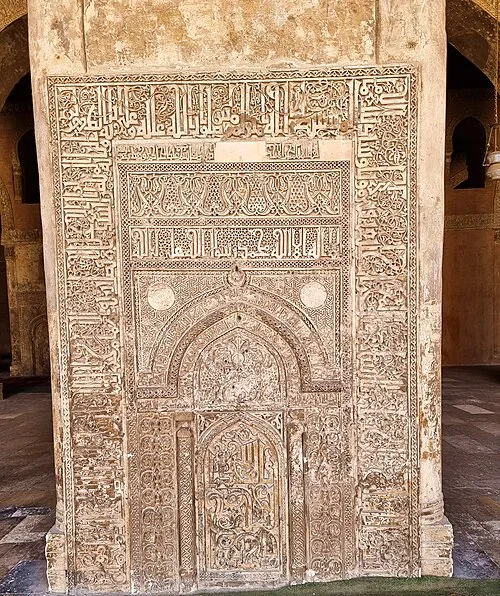 Stucco Masterpieces and Historical Mihrabs
The Flat Mihrab of al-Afdal
The main mihrab is not alone. The prayer hall holds six niches in all, and five of them are flat panels rather than concave rooms, each added by a later generation. This one is ornately decorated. It was installed by al-Afdal Shahinshah, son of the powerful Fatimid vizier Badr al-Jamali, and it is dated to 1094. The Kufic inscription on it names the Fatimid caliph al-Mustansir, on whose orders the niche was made. It also carries the Shi'a form of the Shahada, adding Ali as God's wali after the declaration of faith, a mark of the Fatimids' own loyalties. On the pier to the left stands a partial copy of this very mihrab, and the differences are telling. The copy names Sultan Lajin instead of al-Mustansir, and it leaves Ali's name out entirely. Two niches, side by side, recording two different dynasties in the same hall.
Listen in the appProf. Mortel · CC BY 2.0
10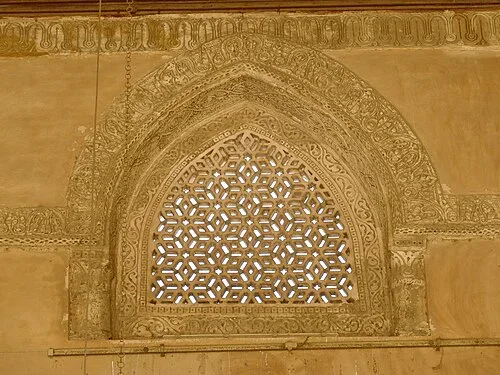 Stucco Masterpieces and Historical Mihrabs
Stucco Window Grilles
High in the walls, light enters through one hundred twenty-eight windows, each outlined with carved stucco and closed with a pierced grille. The grilles are all geometric, but they are not all the same age, and the dating runs backwards from what you might expect. Only three or four of them are original, from Ibn Tulun's own time, and they are the ones with the simplest patterns. The more elaborate the design, the later the grille. Most belong to later restorations, and at least six come from Sultan Lajin's campaign of 1296. So the upper walls work like a catalogue of the mosque's repairs. More than eleven centuries of craftsmen left their work side by side in stucco, and the simplest pattern is the rarest thing here.
Listen in the appPhoto: R Prazeres · CC BY-SA 4.0
- 11
The Spiral Minaret
The spiral minaret: Samarra's imprint on Cairo, a legend of a parchment wound around a finger, and a tower scholars still argue over.
- 12
View from the Minaret: The Mosque and the City
The whole mosque and the city beyond it, seen from the top of the spiral.
Mosque of Ibn Tulun
Frequently asked questions
How much does the guide cost?
Free app download. Listed guide price: $0.99. Guide price shown in the app. Audio guide only. Venue admission is separate.
Can I listen without internet?
Yes. Download the guide’s audio, images, and maps in the app before your visit. Your downloaded content is then available offline.
Can I listen in my language?
This audio guide is available in 15 languages, including English.
Do I need to follow a schedule?
No. This is a self-guided experience. Choose your stops, pause whenever you like, and return to a story at your own pace.
Mosque of Ibn Tulun
The Stanza Journal
At your own pace
Explore Mosque of Ibn Tulun.
Download Stanza, then search for “Mosque of Ibn Tulun”.
Free app download · Guide price shown in the app
Keep exploring
Nearby audio guides
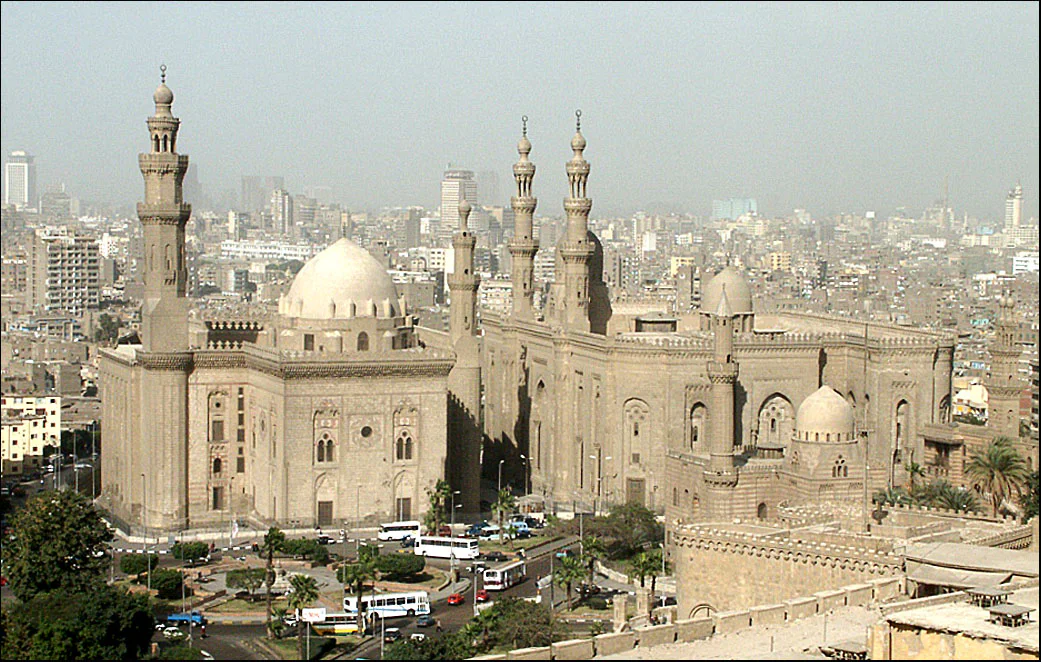
Cairo · 1 km
Al-Rifa'i Mosque
Content & sources
Original uploader was Chris Karman at nl.wikipedia · CC BY-SA 3.0
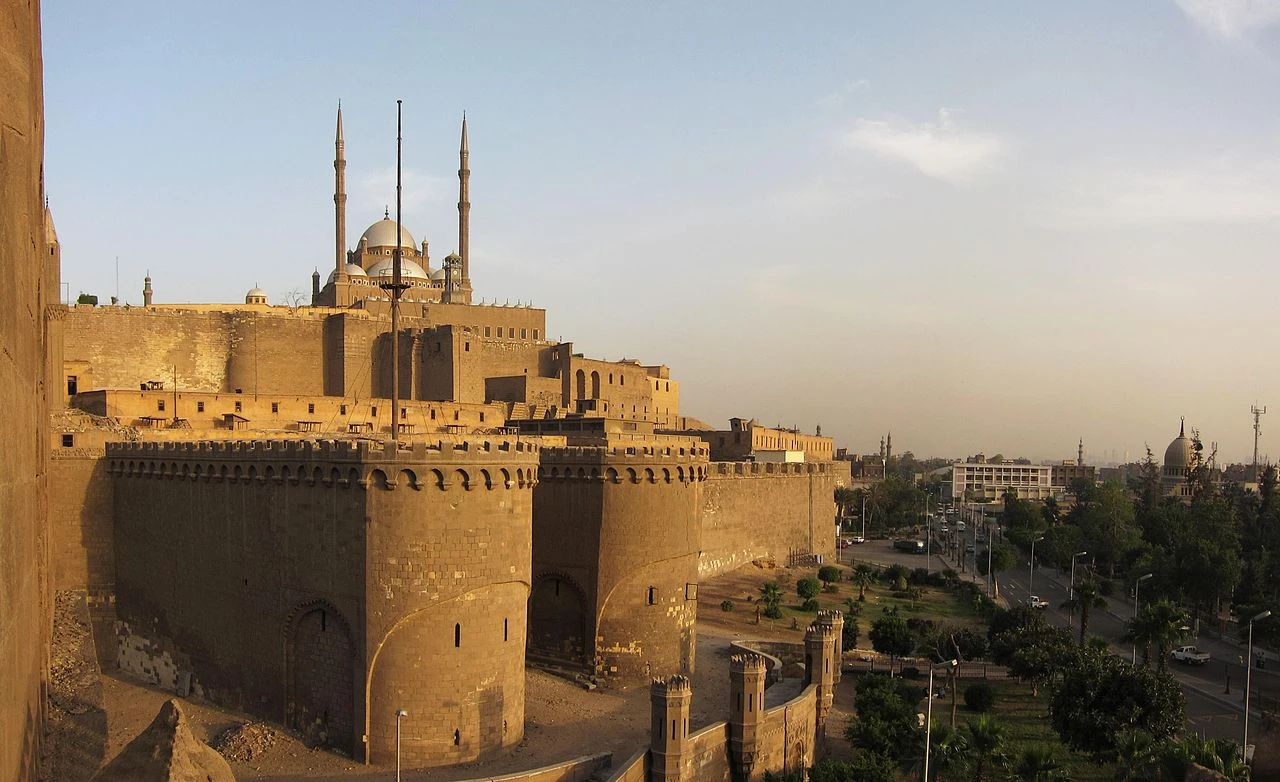
Cairo · 1 km
Cairo Citadel
Content & sources
Ahmed Al.Badawy from Cairo, Egypt · CC BY-SA 2.0
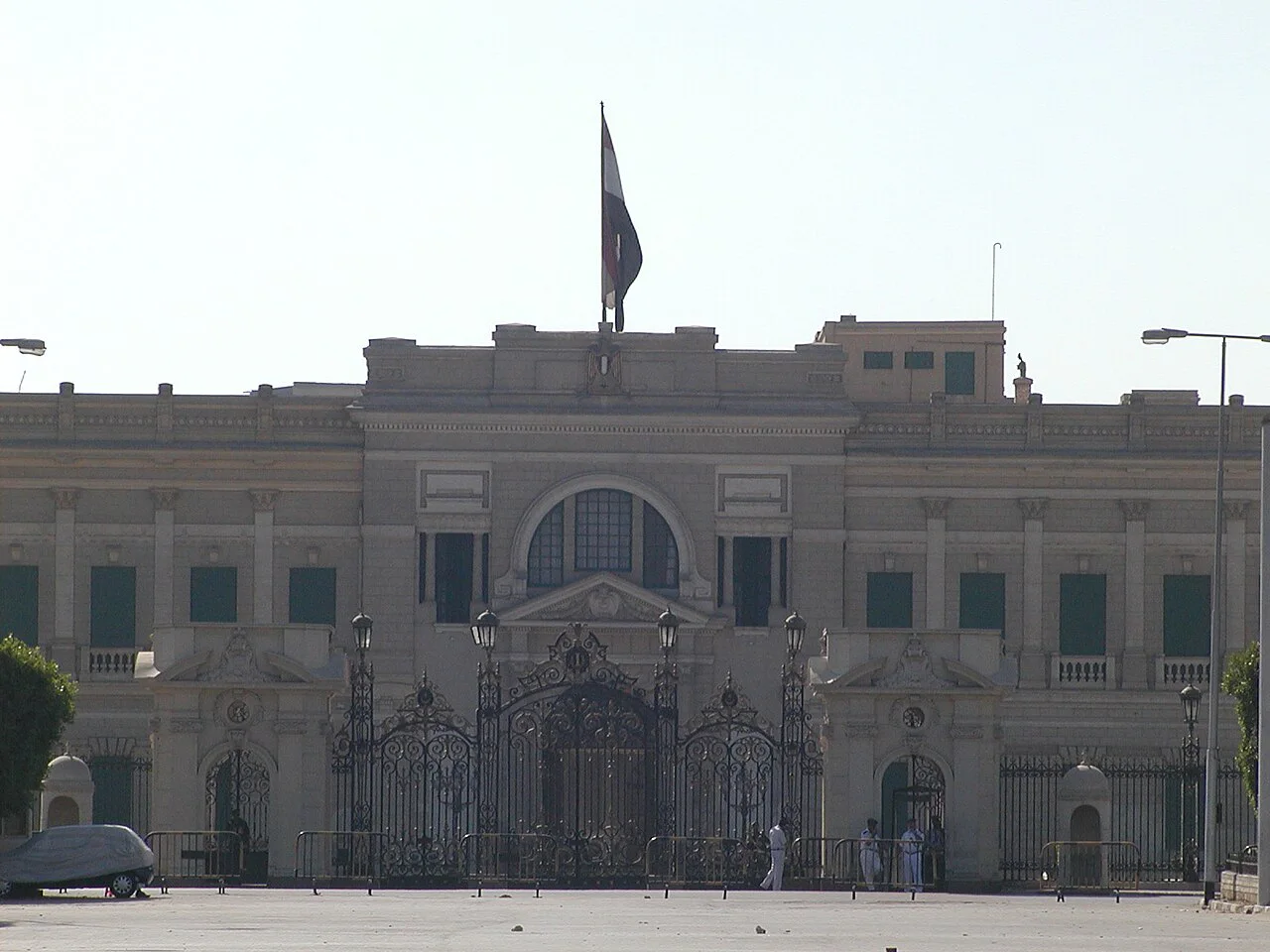
Cairo · 1 km
Abdeen Palace
Content & sources
Gérard Ducher (user:Néfermaât) · CC BY-SA 2.5
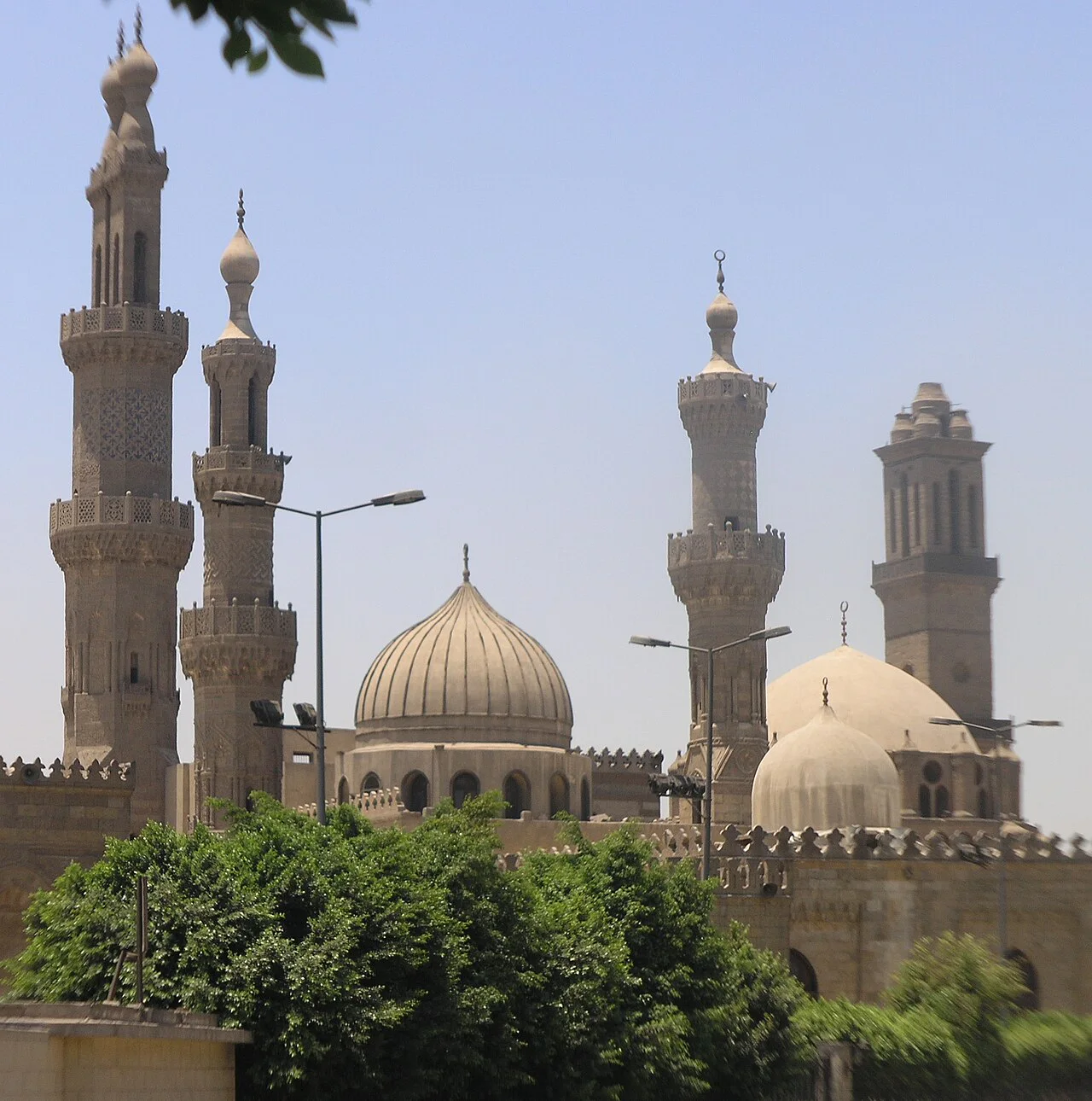
Cairo · 2 km
Al-Azhar Mosque
Content & sources
Daniel Mayer · CC BY-SA 4.0