Stories & history/Uxmal, Yucatán, Mexico
Uxmal’s Puuc architecture: five details you can actually recognise
Five ways to turn a decorated wall into something you can read, with careful distinctions between visible forms and their interpretation.
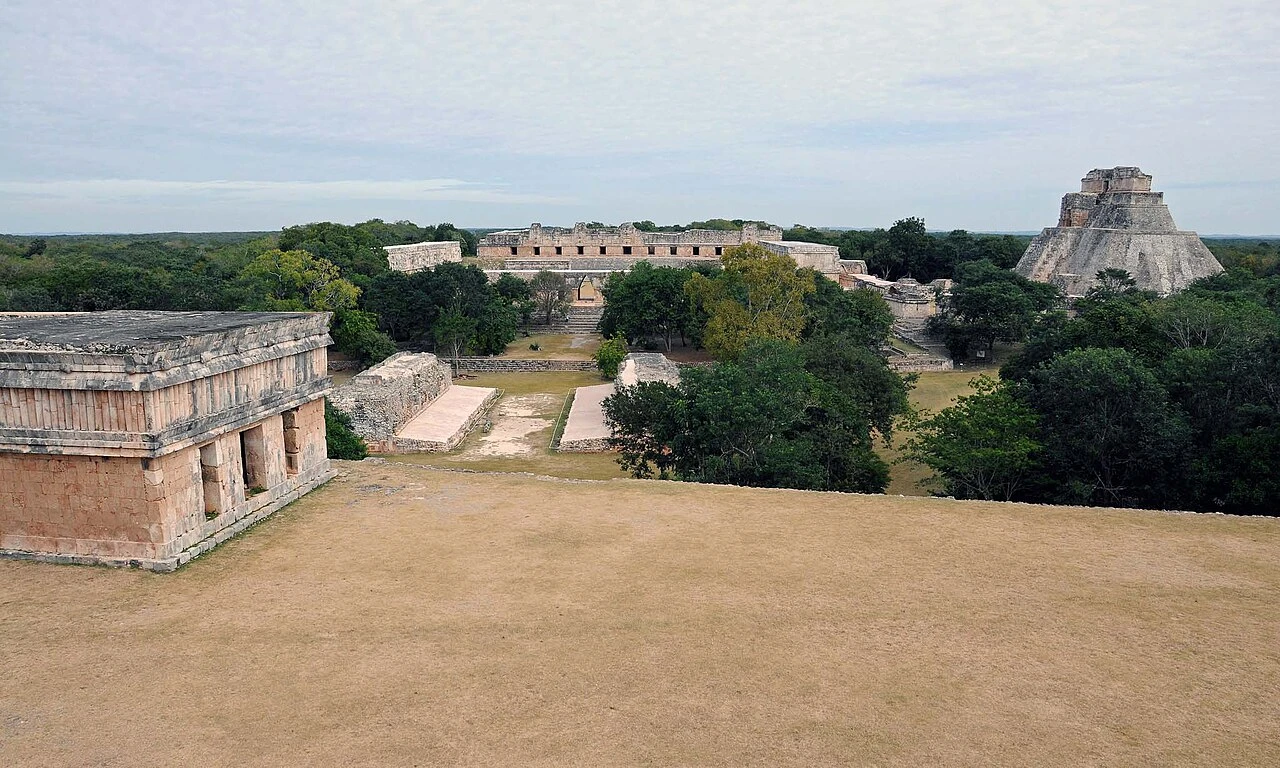
The Pyramid of the Magician supplies Uxmal’s memorable silhouette. The smaller pieces of its façades reward another kind of looking: follow one line, find a repeated unit, then notice where a figure interrupts the pattern. Puuc names both a region of low hills and an architectural tradition. These five clues help you see that tradition without needing to decode every symbol.
1. A quiet lower wall and a busy upper band
Take a few steps back within the permitted area. On a typical Puuc façade, doors interrupt a relatively plain lower wall, while a projecting horizontal band marks the transition to a richly decorated upper zone. UNESCO identifies this division as a defining characteristic. The contrast is the detail: the undecorated stone gives the patterned area visual force. Do not expect every building or every phase to repeat exactly the same arrangement.
2. A lattice built from separate stones
Choose a patch of diagonal lattice or a stepped geometric pattern. Trace one unit and then its neighbour: this is assembled stone mosaic, not a single enormous slab carved in place. Carefully shaped pieces build a repeating design. At the Governor’s Palace, INAH describes lattice beside masks and ruler imagery; compare a geometric field with a figure rather than treating the whole frieze as one undifferentiated ornament.
3. Faces repeated vertically and across a façade
Look for projecting facial elements and masks stacked at a corner or repeated above doorways. INAH identifies Chaac, associated with rain, among the Governor’s Palace motifs, including arrangements that run in zigzags as well as stacks. This gives you a pattern to recognise, not a rule that every face is Chaac. INAH’s Nunnery account also identifies Tláloc imagery. Name an individual figure only with supporting interpretation, not simply because it has a conspicuous nose.
4. A serpent line that frames a ruler
When a pattern stops looking purely geometric, follow its outline before naming it. INAH’s specialist account describes a seated ruler above the Governor’s Palace central entrance, framed by two-headed serpents. The identification with the ruler Chan Chak K’ak’nal Ajaw is presented as probable. If visible from the open route, compare the framing creatures with the human figure: the composition makes authority conspicuous. You do not need to read a glyph to recognise that relationship.
5. A courtyard whose four sides are not copies
In the Nunnery Quadrangle, compare the buildings across the courtyard from a permitted viewpoint. INAH describes four ranges at different levels, with variations in form and design. Notice how height, door rhythm and decorated fronts work together; it is an arranged encounter between buildings, not four identical walls. “Nunnery” is a later colonial label, not proof that Maya nuns lived here. The visible layout is firmer evidence than the inherited name.
Give the details time, and recognise restoration
Use about 30–45 minutes as an optional detail-looking allowance within your wider visit, not a measured walking circuit. Choose two or three clues if heat or attention intervenes. The Peabody Museum’s published fieldwork account documents substantial clearing, consolidation and reassembly at Uxmal. Present façades combine ancient material with conservation history; a complete-looking pattern should not be mistaken for an untouched survival.
For the practical Mérida outing, use our separate visit article and recheck INAH’s current entry and access information. Stanza’s independent Uxmal guide page offers public previews and lists 34 narrated stops. Check the style, language and app price before choosing; download ahead and select stories matching the open route. Audio supplies interpretation, not admission or permission to climb.
A few more questions before you go
Can I recognise Puuc architecture without entering the buildings?
Yes. Façade divisions, mosaic patterns and the relationship between buildings can be studied from permitted exterior viewpoints. Fine details may remain distant, and a blocked view is a reason to choose another example rather than cross a barrier.
Sources & further reading
Visitor information checked .
INAH, UNESCO and the Peabody Museum’s original fieldwork record checked on 19 October 2026. Historic research and brochures explain architecture, not current access. Follow barriers and staff instructions; no climb, room entry or close view is guaranteed. Interpretations of imagery are identified as such.
- UNESCO: Uxmal and the two-part Puuc façade
- INAH: site record, quadrangle and visitor information
- INAH, José Huchim Herrera: Governor’s Palace imagery
- Peabody Museum: Uxmal fieldwork and restoration record
Questions or a correction? Let us know. Our content standards (English).