Stanza · Audio guide
Tatev Monastery Audio Guide
A place to remember. A story to take with you.
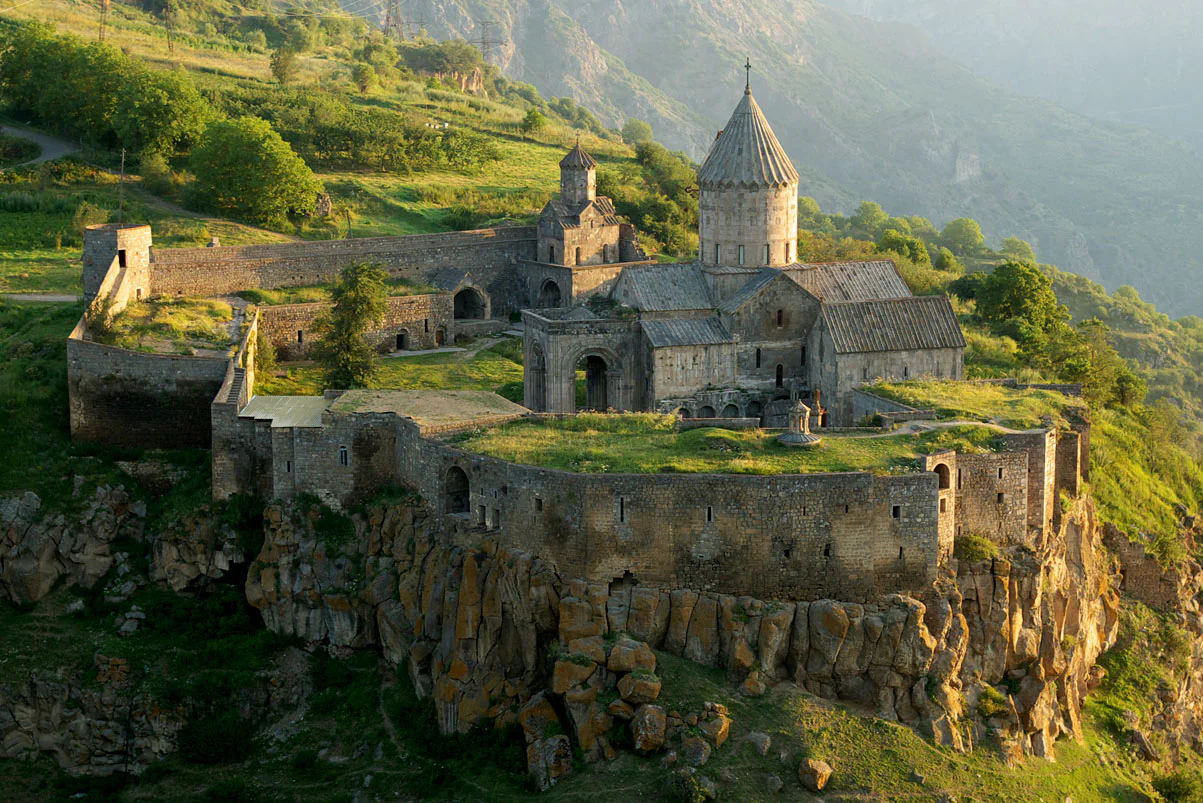
The Tatev Monastery is a 9th-century Armenian Apostolic Christian monastery located on a basalt plateau in southeastern Armenia. It served as the bishopric seat of Syunik and was a significant center of…
Download Stanza, then search for “Tatev Monastery”.
About the tour
One guide. Your kind of visit.
The Tatev Monastery is a 9th-century Armenian Apostolic Christian monastery located on a basalt plateau in southeastern Armenia. It served as the bishopric seat of Syunik and was a significant center of economic, political, spiritual, and cultural activity.
Ready when you are.
- 01Get the free Stanza app.
iOS & Android
- 02Find your guide.
“Tatev Monastery”
- 03Download before you go.
Works offline
Audio guide / 16 narrated stops
Inside the guide
Get to know a few of the stories before you go. Open a stop to read more.
01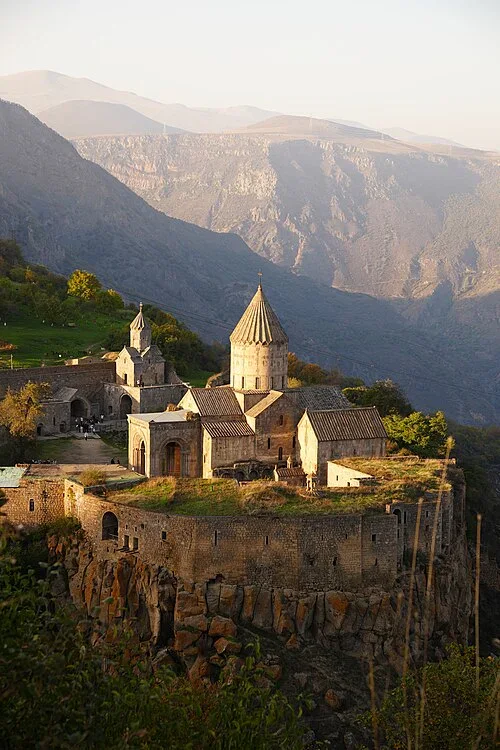 Monastery Lookout and Vorotan Canyon Viewpoint
Tatev Monastery above the Vorotan Gorge
Welcome to Tatev, a ninth-century Armenian Apostolic monastery perched on the edge of a deep gorge of the Vorotan River. The plateau beneath it served people long before the monastery came. In pre-Christian times a pagan temple stood here, and after Armenia adopted Christianity in the fourth century, a modest church replaced it. Tradition gives the place its name through Eustateus, a disciple of the Apostle Thaddeus, who preached and was martyred in this region. His name is said to have slowly evolved into Tatev. From these beginnings the monastery grew into the bishopric seat of Syunik, a center of spiritual, economic and political life for the whole region. The setting did much of the defending. The monastery occupies a large basalt plateau that ends abruptly at the gorge, so nature built the fortress before any mason arrived. Walls and churches completed what the cliff began, turning this cliff top into a walled monastic town.
Photo: Ash Khachaturyan · CC BY-SA 4.0
02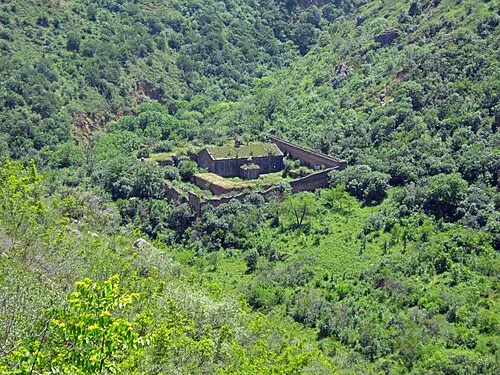 Monastery Lookout and Vorotan Canyon Viewpoint
Tatevi Anapat Hermitage in the Gorge
Far below the monastery, hidden among the trees on the gorge floor, lie the low stone walls of Tatevi Anapat, the Great Hermitage. Where the monastery above was fortified and public, the hermitage was its contemplative counterpart, a place for the ascetic life that depended on Tatev. The canyon that defended the monastery also sheltered this quieter calling. Its isolated buildings, wrapped in green forest, are easy to miss even from high above. In 1995 the two monasteries together with their surrounding areas of the Vorotan Valley were placed on the tentative list of UNESCO World Heritage Sites, a first step toward formal recognition. The ruin seen from afar is a modest one, but it belongs to the same story as the walled complex on the plateau.
Photo: Emma YSU · CC BY-SA 4.0
03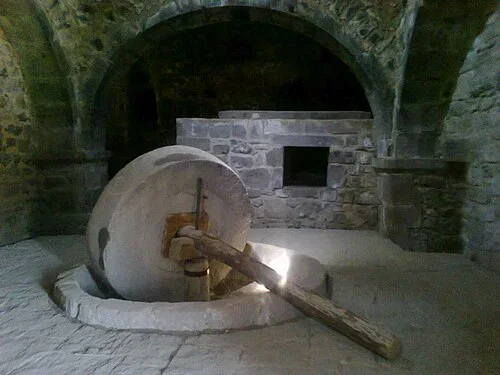 The Historic Oil Mill (Dzithan)
The Oil Mill (Dzithan) Millstone
Just outside the monastery's fortifications, to the northeast, sits its oil mill, known in Armenian as the dzithan. A great feudal monastery needed working infrastructure, and this building shows the economic power behind the prayer. The mill has four production rooms, including two domed storage rooms and pressing chambers with arched ceilings. It is one of the best preserved medieval olive presses in Armenia, an excellent illustration of how such mills were built across the region in the Middle Ages. The round millstone at its heart did the first work, crushing the harvest before pressing. The mill was among the very first structures restored under the Tatev Revival program, launched in 2008 to bring the monastery back to life. After that restoration it became fully operational again, so the machinery you see here is not just a relic. It can still work, much as it did for the brotherhood centuries ago.
Listen in the appPhoto: Albero · CC BY-SA 3.0
04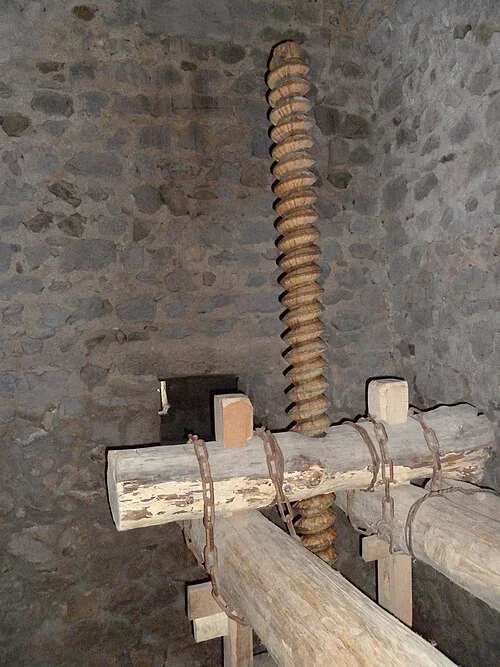 The Historic Oil Mill (Dzithan)
The Wooden Screw Press
The heart of the press is this great wooden screw, carved as one thick threaded column, standing upright through heavy horizontal beams. Chains and wooden wedges hold the beams in place around it. The principle is simple and ingenious. Turning the screw drew the beams down with enormous force, and that force pressed the crushed harvest until the oil ran free. Every thread of the screw had to be cut by hand, from a single piece of wood, by a craftsman who understood exactly how much load it would carry. Nothing here is metal gearing or imported machinery, only timber, stone and leverage. It is a quiet reminder that a medieval monastery was not only a place of manuscripts and liturgy. It was also a workplace, full of practical engineering like this.
Listen in the appPhoto: Nare Atoyan · CC BY-SA 3.0
05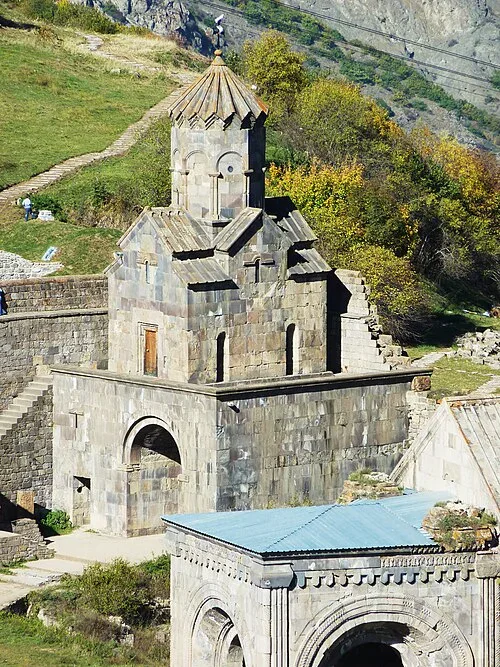 Fortified Northern Gate and Church of the Holy Mother of God
Northern Gate and the Church of the Holy Mother of God
Every visitor to Tatev passes through the same threshold, the northern gate, and for over nine centuries a church has watched over it. The Holy Mother of God Church was built in 1087 as a second storey above a covered mausoleum near the entrance. That makes it a rare gate church, a sanctuary and a defensive structure in a single building. The arrangement is easy to read in the stonework: a vaulted entry passage below, and the domed church set directly on top of it. Anyone approaching the monastery walked beneath a place of worship, through the strongest point of the northern wall. The church was severely damaged in the earthquake of 1931. Its reconstruction to its original appearance formed the first stage of the complex's recent restoration, begun in August 2016 and finished in October 2018. Since that restoration, visitors have entered through this North Entrance, where the old water spring was also returned to its historic spot.
Listen in the appPhoto: Moreau.henri · CC BY-SA 3.0
06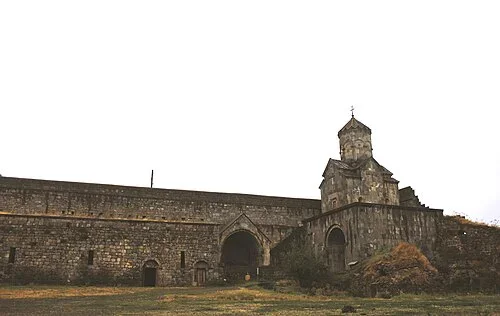 Fortified Northern Gate and Church of the Holy Mother of God
The Fortress Walls
From the gate, the fortifications run away in a long, unbroken line of dark stone. In the fourteenth century, walls rose along the south, west and north sides of the monastery, with buildings for habitation, administration and other needs built against them. In the eighteenth century a second campaign added the practical rooms of a working community: the bishop's residence, cells for the monks, storage, a dining hall, a kitchen, a bakery and a winery. Everything a monastery needed to survive a siege was brought inside the wall. The churches stand at the center of it all, ringed by living space and stone. That layered plan is what makes Tatev read as a fortress first, a monastery second, and both at once.
Listen in the appPhoto: Lubekar · CC BY-SA 4.0
07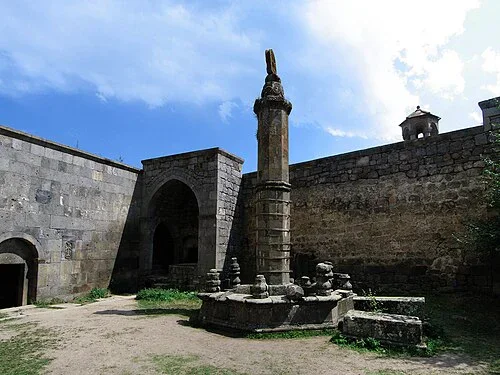 Main Courtyard and the Gavazan Swinging Column
The Gavazan Swinging Column
South of the cathedral stands the strangest structure in the monastery, the Gavazan, a word that means staff. Built in the year 906 and dedicated to the Holy Trinity, it is an octagonal column of stone about eight meters tall, crowned with a cross. Its secret is at the base. The column is built with an articulated construction there, which lets it sway and tilt without collapsing, then return upright and hold itself at a constant right angle to the earth. It has come through centuries of invasions and earthquakes relatively unscathed, the only structure of the complex to remain intact through them all. People have long said that the column trembled at small earth tremors, giving warning of larger quakes to come, and some stories even claim it stirred at approaching cavalry. Those explanations are doubted, and the true purpose of the motion remains a matter of debate. The engineering, at least, is not in doubt.
Listen in the appOleg Kurtsev · CC BY-SA 3.0
08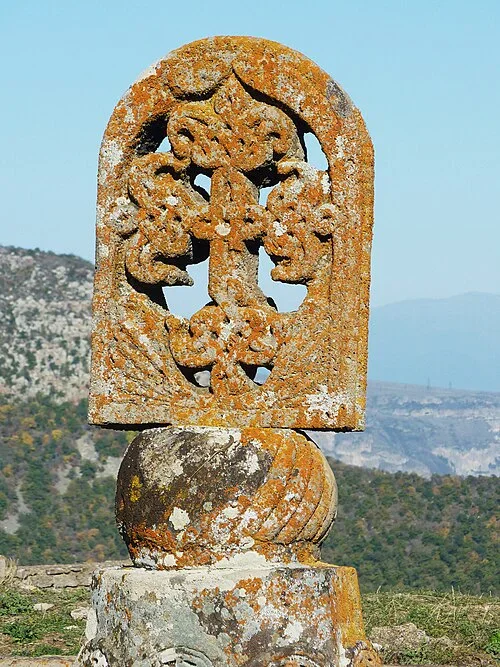 Main Courtyard and the Gavazan Swinging Column
The Khachkar Crown of the Column
The carved cross-stone at the top of the Gavazan was installed in the sixteenth century by Arakel, an archbishop from Syunik, and it still stands there today. Look closely at the join between the two, and something seems off. The pillar is made of porous bluish basalt, while the cross-stone, called a khachkar, is tuff, a different stone altogether. Its shape and dimensions sit awkwardly on the massive column, and observers have compared it to a toy placed on a giant. Some scholars argue the original top was something else entirely, an emblem matched to the pillar's size, and that Arakel replaced it. One hypothesis goes further: that the pillar was first raised in pre-Christian times as a monument of worship, and that its top broke in the devastating Moz earthquake of the eighth century. A cross-stone was then set on the surviving shaft, and the monument was turned Christian, its older meaning obscured and forgotten. It remains an open question, argued rather than answered.
Listen in the appPhoto: Moreau.henri · CC BY-SA 3.0
09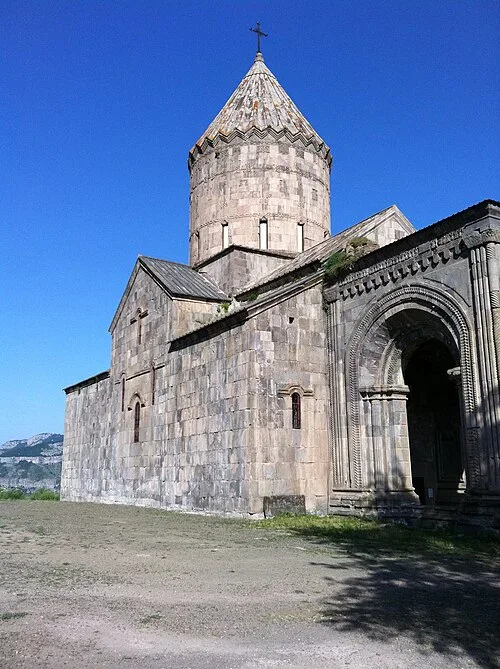 Cathedral of Saints Paul and Peter
 - Exterior
The oldest building still standing in the monastery is the one with the tall conical dome: the cathedral of Saints Paul and Peter. Work began in 895, and the church was complete by 906. Bishop Hovhannes led the project, and the money came from the ruling house of Syunik. Prince Ashot gave, his wife Princess Shushan gave, and so did Princes Grigor Supan and Dzagik. The donors are carved into the building itself. Niches on the eastern facade hold bas-relief portraits of Prince Ashot and Princess Shushan, each framed by snakes meant as protectors. On the western wall, a cross-stone installed by Bishop Hovhannes records the church's construction. The name Tatev carries a second legend, tied to this church. The story goes that a builder fell from the dome as it neared completion, crying out in Armenian, "Ta tev" — give me wings. In one telling it was the master builder; in another, an apprentice caught trying to place a cross of his own design. In every telling, his cry became the name of the place.
Listen in the appPhoto: Armenocide · CC BY-SA 3.0
10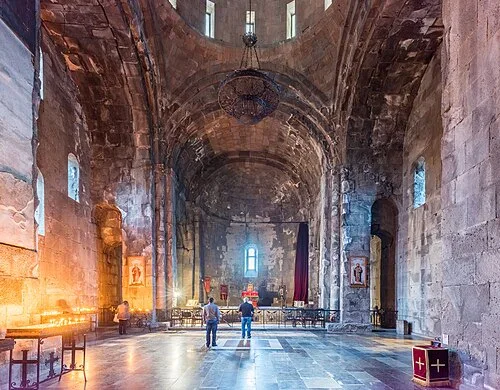 Cathedral of Saints Paul and Peter
Cathedral Interior - Worship and Earthquake
Inside, the cathedral is a rectangular basilica running from west to east, its walls of hewn stone lit by narrow windows. The altar sits in an apse at the eastern end, flanked by two depositories, small chambers on either side. Two pillars at the eastern side carry the central dome, while annexes on the west brace it. This remains a house of worship of the Armenian Apostolic Church, and the liturgy is celebrated here still. The building carries a wound as well. In 1931 an earthquake destroyed the cathedral's dome and its bell tower. The dome was reconstructed in the years that followed, and it rises over the nave again. The bell tower was never rebuilt, and it remains destroyed to this day.
Listen in the appDiego Delso · CC BY-SA 4.0
- 11
The 930 Frescoes
A rare surviving fragment of the 930 wall paintings, made by painters from Constantinople working beside Armenian artists.
- 12
Church of Saint Gregory the Illuminator
The monastery's earliest documented church, destroyed by an earthquake and raised again by the Orbelian family.
- 13
Mausoleum of Gregory of Tatev
The 1787 tomb chapel of Gregory of Tatev, the philosopher whose memory Armenians honored centuries after his death.
- 14
Cross-Stones of the Mausoleum Facade
Crosses, interlace and inscriptions on the mausoleum facade, the visible face of the monastery's 17th and 18th century rebirth.
- 15
The University of Tatev - A Fortress of Learning
The University of Tatev, the monastery's feudal power, and the scholars who moved the Armenian Church's seat back to Etchmiadzin.
- 16
Vaulted Classrooms and Closing Reflection
The vaulted classrooms along the fortress walls, the 1921 proclamation of Mountainous Armenia, and a closing thought on Tatev itself.
Tatev Monastery
Frequently asked questions
How much does the guide cost?
Free app download. Listed guide price: $1.99. Guide price shown in the app. Audio guide only. Venue admission is separate.
Can I listen without internet?
Yes. Download the guide’s audio, images, and maps in the app before your visit. Your downloaded content is then available offline.
Can I listen in my language?
This audio guide is available in 15 languages, including English.
Do I need to follow a schedule?
No. This is a self-guided experience. Choose your stops, pause whenever you like, and return to a story at your own pace.
At your own pace
Explore Tatev Monastery.
Download Stanza, then search for “Tatev Monastery”.
Free app download · Guide price shown in the app
Keep exploring
Nearby audio guides
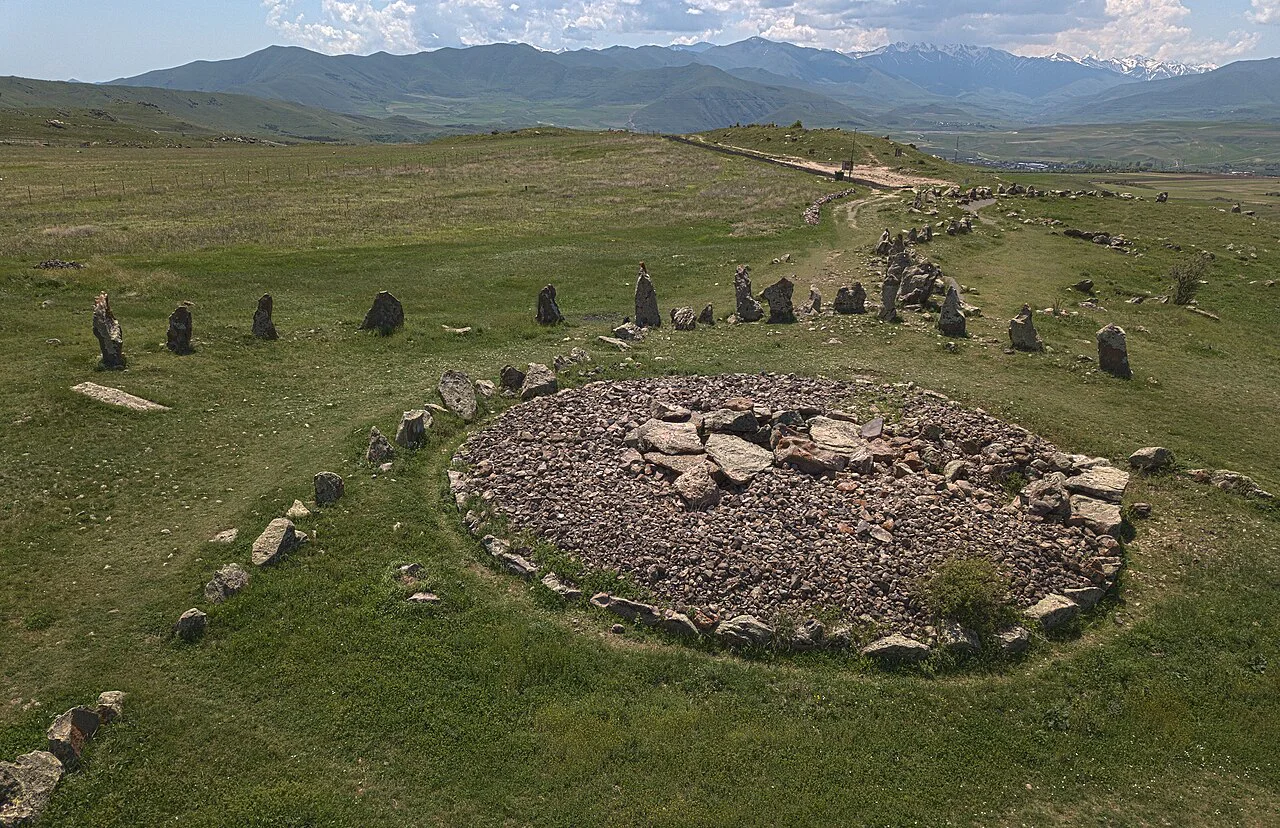
Sisian · 27 km
Carahunge
Content & sources
Aleksey Chalabyan a.k.a Xelgen · CC BY-SA 4.0
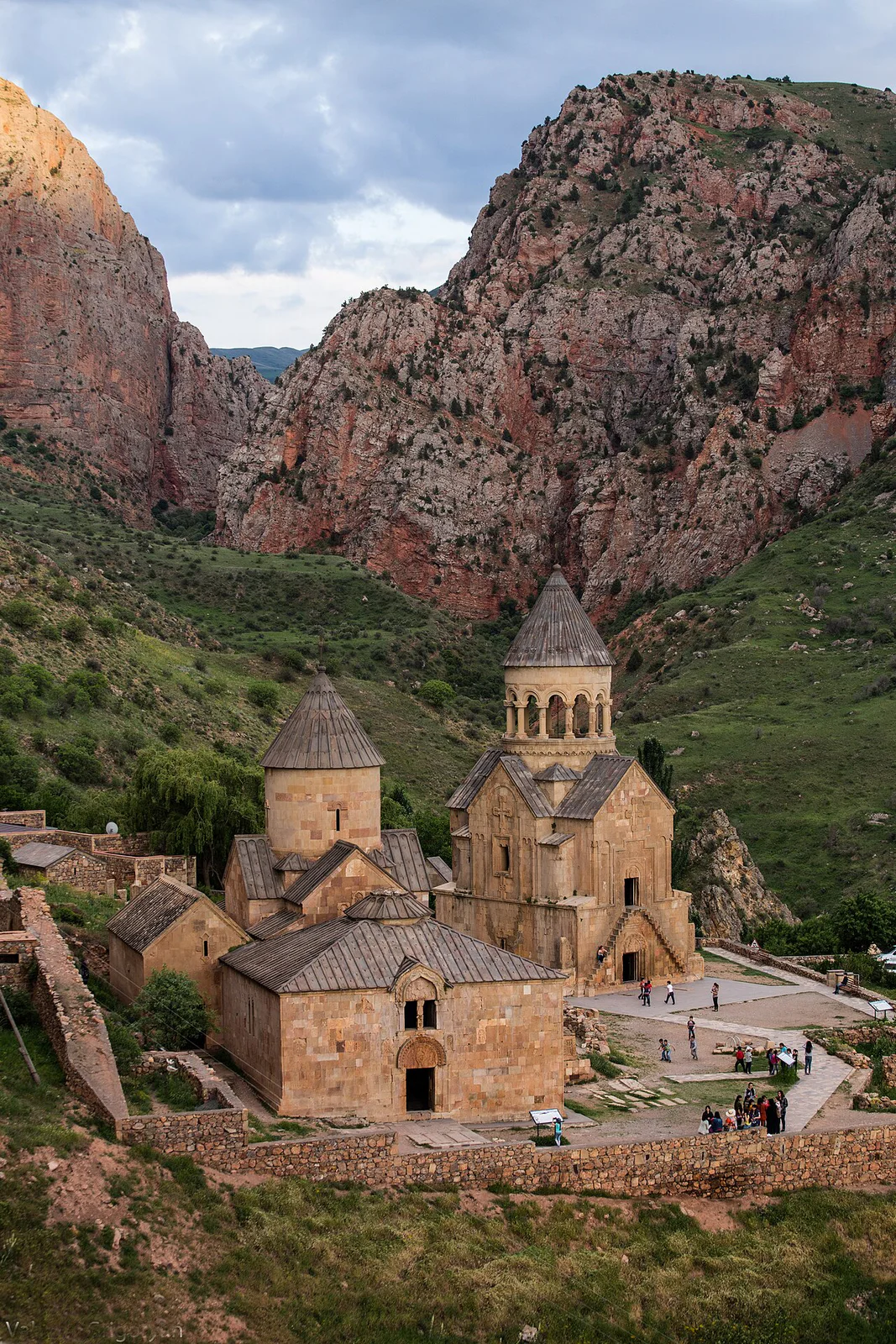
Areni · 94 km
Noravank
Content & sources
Vahagn Grigoryan · CC BY-SA 4.0
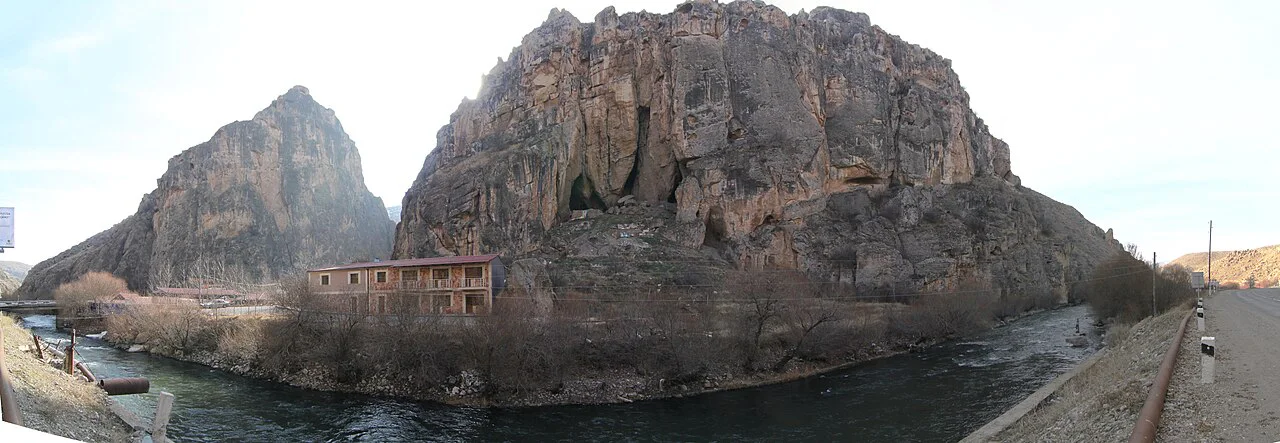
Amaghu · 98 km
Areni-1 cave
Content & sources
Photo: Serouj · CC BY 3.0
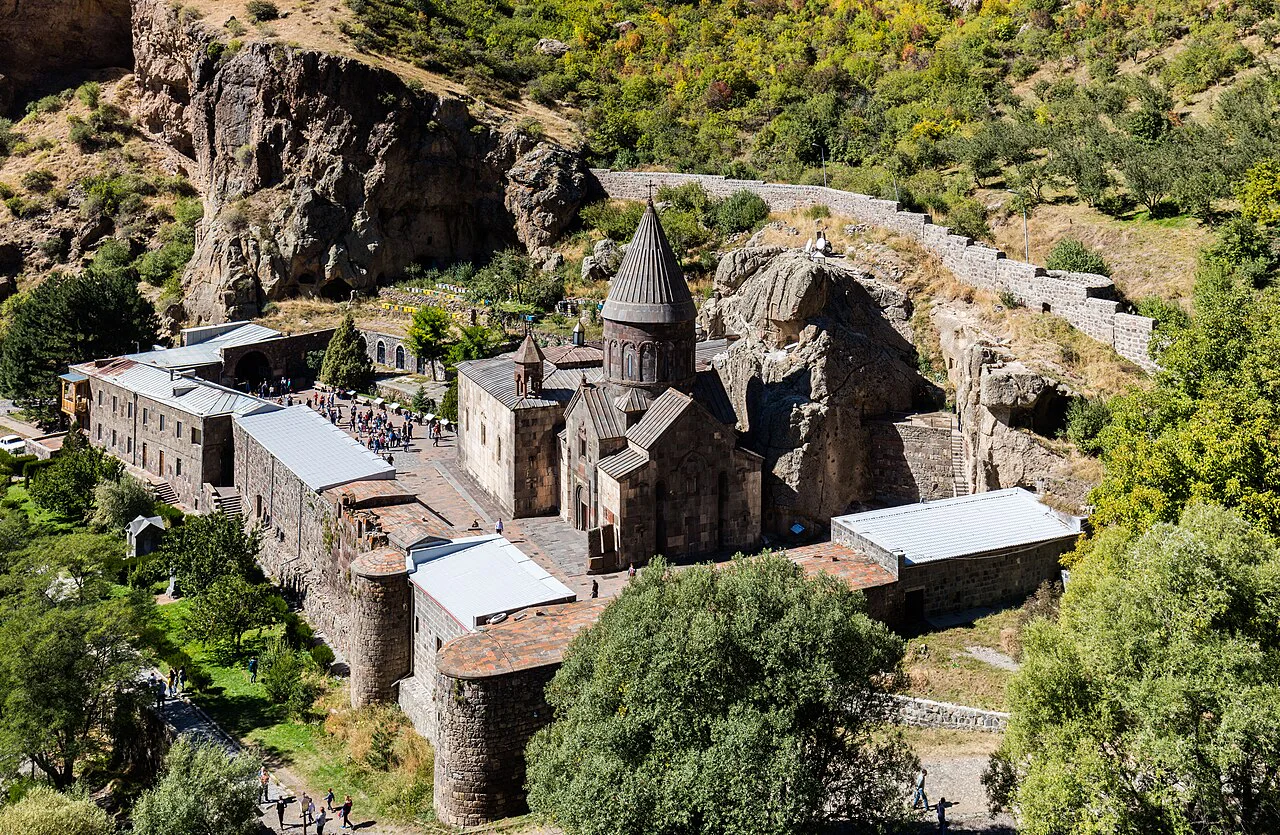
Goght · 149 km
Geghard
Content & sources
Diego Delso · CC BY-SA 4.0