Stanza · Audio guide
Geghard Audio Guide
A place to remember. A story to take with you.
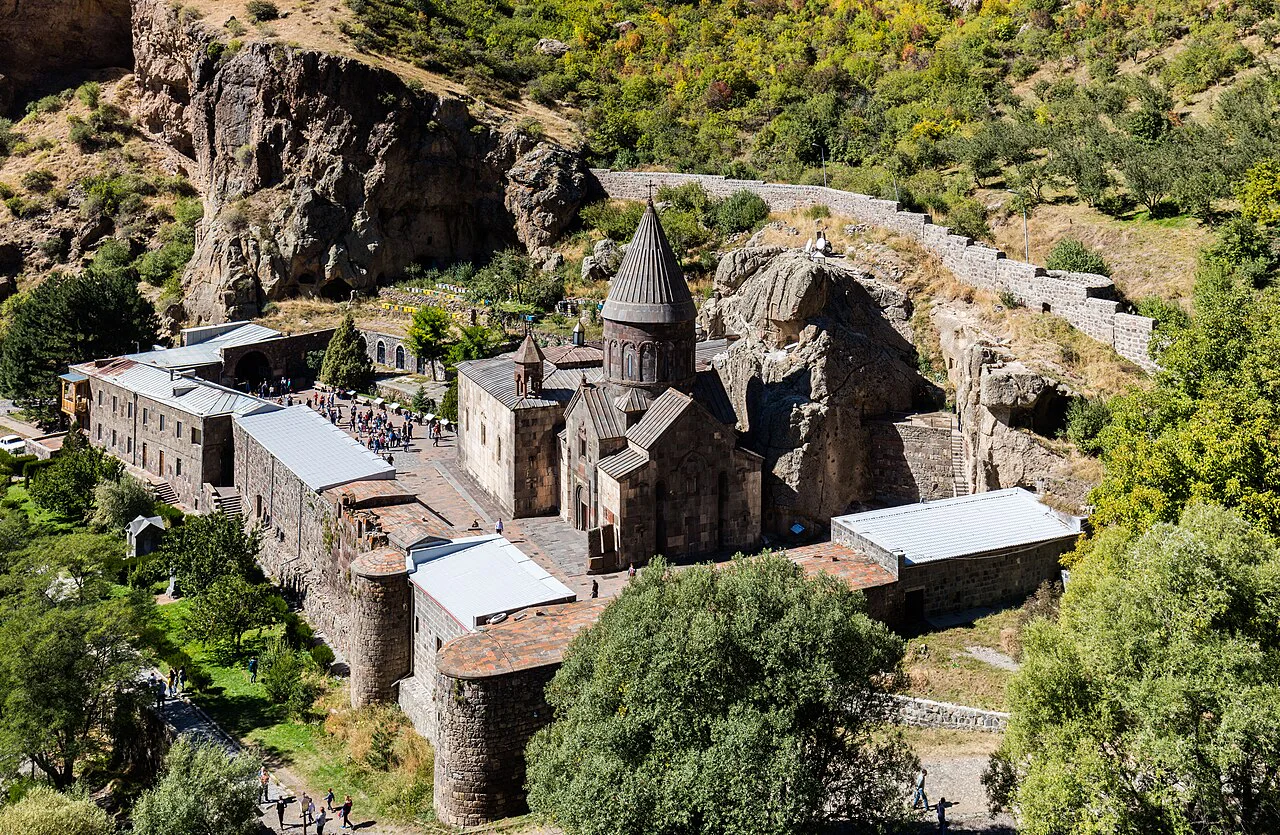
Geghard is a medieval monastery in the Kotayk province of Armenia that is partially carved out of the adjacent mountain. It is listed as a UNESCO World Heritage Site with enhanced protection status.
Download Stanza, then search for “Geghard”.
About the tour
One guide. Your kind of visit.
Geghard is a medieval monastery in the Kotayk province of Armenia that is partially carved out of the adjacent mountain. It is listed as a UNESCO World Heritage Site with enhanced protection status.
Ready when you are.
- 01Get the free Stanza app.
iOS & Android
- 02Find your guide.
“Geghard”
- 03Download before you go.
Works offline
Audio guide / 13 narrated stops
Inside the guide
Get to know a few of the stories before you go. Open a stop to read more.
01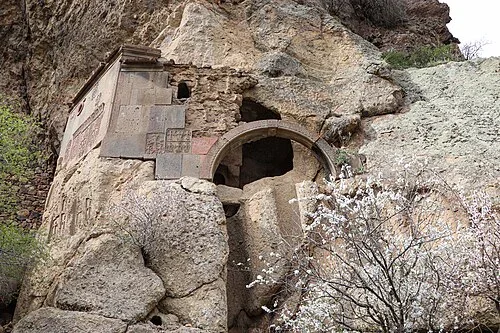 Outer Approach and Saint Gregory Cliff Chapel View
Saint Gregory the Illuminator Chapel
Welcome to Geghard. Look up at that chapel clinging to the cliff face, high above the road. It was built before 1177, and part of it isn't built at all - it's carved straight out of the solid rock. Its shape probably follows the cave that was already there. Everything you'll see today does this: the monastery and the mountain merge into one. Tradition says the monastery itself was founded in the fourth century by Gregory the Illuminator, the man who brought Christianity to Armenia, at a sacred spring inside a cave. The monastery's first name was Ayrivank - the Monastery of the Cave - which tells you exactly what kind of place this was. One old story about this site involves noble siblings and a miraculous pickaxe said to have carved the rock with divine help. It's legend, passed down rather than written down, but it captures how impossible the carving here once seemed. Keep this chapel in mind as we go - it's the oldest thing visible on the site, standing guard over the gorge.
Photo: Beko · CC BY-SA 4.0
02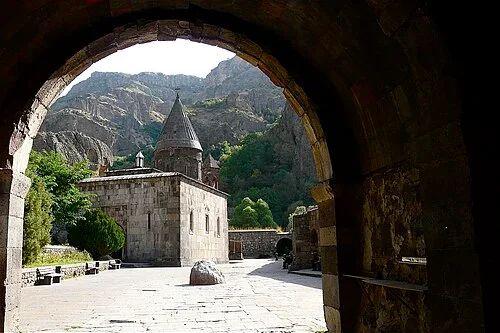 Fortified Gateway and Main Monastic Courtyard
Fortified Gateway and Monastic Courtyard
Now step through this stone arch into the courtyard. Notice the walls on three sides of the complex - those are the twelfth and thirteenth century ramparts. The cliffs behind form the fourth wall, nature's own fortification. Geghard wasn't just a place of prayer; it was built like a fortress, because it had treasures worth defending. The most precious one you'll hear about at the end of our visit. That wealth gave rise to a famous legend. The story goes that the conqueror Timur came to storm the monastery, and the monks were saved by a celestial army that appeared to drive him off. It's a tale monks told, not a documented battle, but it belongs to this gate - to a place that needed walls at all. Across the courtyard you can see the main church, the Katoghike, with its cone roof. That's where we're headed next.
Rita Willaert from 9890 Gavere, Belgium · CC BY 2.0
03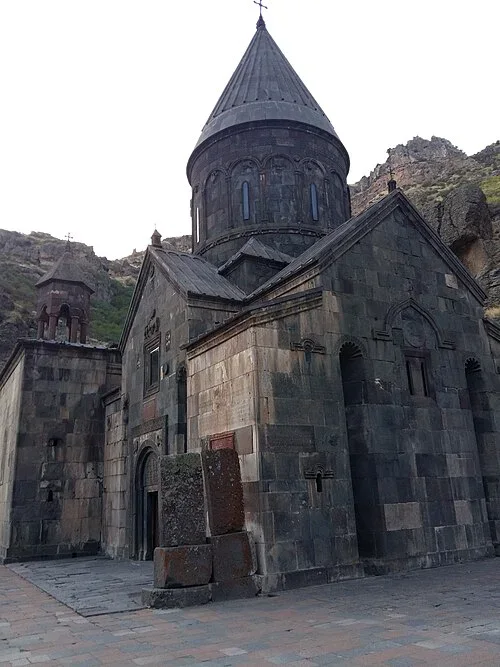 Katoghike Cathedral Facade and Sculpted Reliefs
Katoghike Main Church Exterior
Here it is, the heart of the monastery: the Katoghike, the main church, built in 1215. There are older inscriptions on this site going back to the 1160s, but this church marks the real beginning of Geghard's golden age. Its patrons were two brothers, Zakare and Ivane Zakarian. They were generals serving Queen Tamar of Georgia, and they had led the reconquest of most of Armenia from the Turks. Winning the land back, they poured resources into rebuilding its holy places - and this church was theirs. Look at how it sits: built directly against the mountain, its conical dome rising above the gorge. The mountain isn't just scenery here; the church leans into it. Everything else we'll see today - the halls, the tombs, the cave churches - grew outward and inward from this building.
Listen in the appPhoto: Ագնետա · CC BY-SA 4.0
04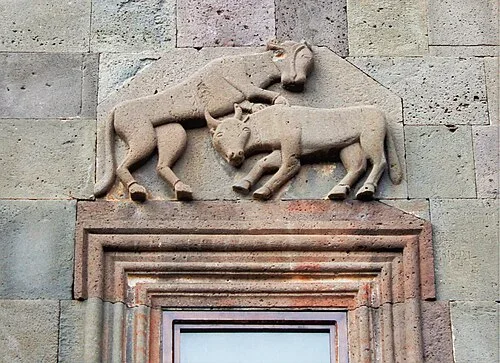 Katoghike Cathedral Facade and Sculpted Reliefs
Bull and Lion Relief of the Katoghike
Look just above the window here at this carving: a lion attacking a bull, both worked in deep relief into the stone of the main church. This is part of the rich exterior carving. Animal figures like these run all through Armenian church sculpture and reach back to much older traditions - animals as symbols of power, protection, the wild and the tamed. What did this particular lion and bull mean to the people who carved it? That, honestly, no one recorded. We can read the craftsmanship plainly - the muscles, the tension in the bodies - but the intended message is lost. It's a good reminder as you walk through Geghard: much of what you see speaks clearly, and some things keep their silence.
Listen in the appPhoto: Beko · CC BY-SA 4.0
05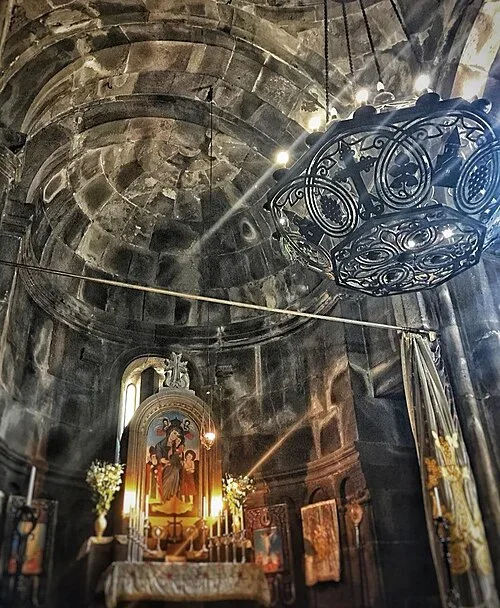 Katoghike Cathedral Interior
Let's go inside. Notice first that the mountain doesn't show itself in here at all - the church completely encloses its wall of rock. The plan is classic Armenian: an equal-armed cross set inside a square, all covered by the dome above you. In the four corners there are small two-storey chapels with barrel vaults, tucked into the angles of the cross. Now look closely at the walls. They carry many inscriptions, and nearly all of them record donations - gifts of money, land, and goods from pilgrims and patrons across the centuries. This church was funded line by line, name by name. And it's worth remembering as you stand here: this is still a consecrated place of worship, not a museum. What you're seeing is a living sanctuary that has held services for eight hundred years.
Listen in the appPhoto: AndyHM · CC BY-SA 4.0
06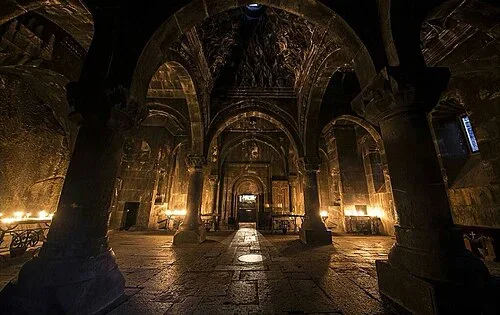 The Central Gavit and Stalactite Vault
The Central Gavit
This hall, west of the church, is the gavit - a kind of vestibule and assembly room that Armenian monasteries added to their main churches. This one was built between 1215 and 1225, partly free-standing and partly carved into the cliff. Look at the four massive columns standing free in the center, carrying the stone roof, with different kinds of vaulting in the spaces around them. This was the busiest room in the monastery. Monks taught here. Meetings were held here. Pilgrims and visitors arriving at Geghard were received here first, before they ever reached the church. It was also the threshold to what lay beyond - the rock-cut chambers deeper in the mountain are reached through this hall. So in a way, this room was the front door of the whole second monastery, the one carved underground.
Listen in the appFurkan Akkurt · CC BY-SA 4.0
07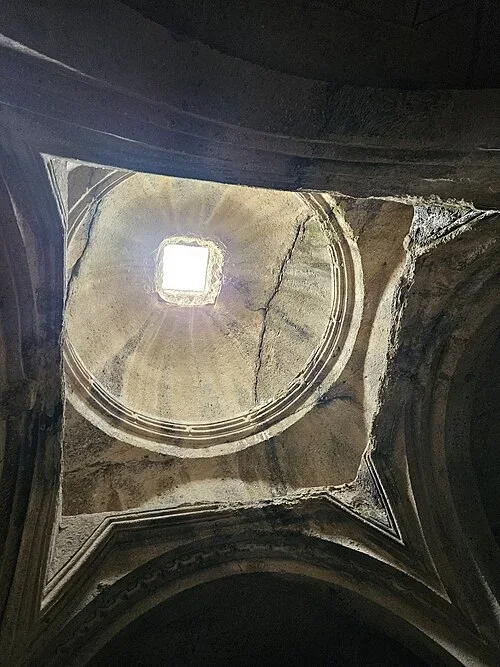 The Central Gavit and Stalactite Vault
Stalactite Dome of the Gavit
Now look up. Above the center of the hall, the dome is covered in stalactites - stone carved to hang from the ceiling in cascading, honeycomb-like tiers. Specialists consider this the best example of the technique anywhere in Armenia. The style has a story behind it. These 'stalactite vaults' are thought to derive from the muqarnas of Islamic architecture, and they began appearing in Armenia from the eleventh century. Vaults very much like this one decorate a Seljuk caravanserai in Aksaray, in Anatolia, dated 1229 - almost the same years as this hall. That's architecture traveling with trade and contact between cultures. And notice the center of the dome: a hole, open to the sky, letting a column of daylight fall into the hall. In a room lit by lamps, that shaft of light was the clock and the crown of the space.
Listen in the appFurkan Akkurt · CC BY-SA 4.0
08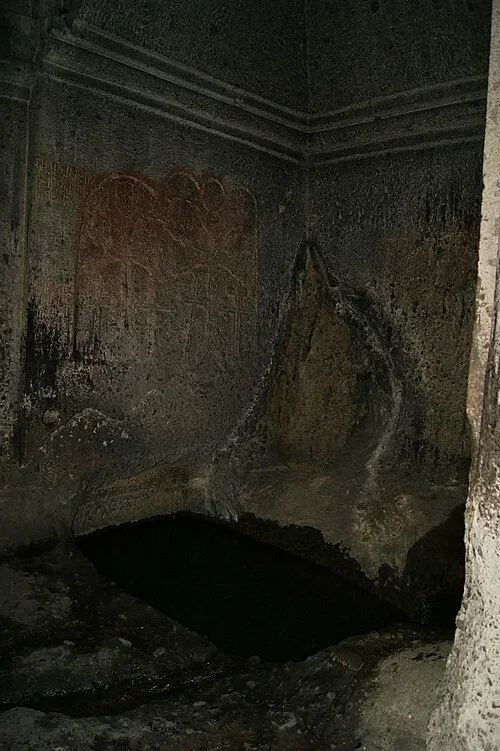 Avazan Cave Church and Sacred Spring
Avazan Rock-Cut Church and Sacred Spring
This dark chamber is where the rock-cutting began. It's called Avazan - the basin - hewn in the 1240s out of an ancient cave, northwest of the gavit. Look at the water basin here in the floor. The spring that feeds it was sacred in pre-Christian times; people came to this water long before any church stood here. The Christian builders didn't erase that older sanctity - they built their chapel around it. This work happened during the reign of Prince Avag, who died in 1250. And we know one name from the stone itself. An inscription here reads: 'Remember Archimandrite Galdzag' - the master who directed the excavation. Think about what that means: carving a church downward and outward from living rock, with hammers and chisels, by hand. Galdzag's work started something. Over the following decades, entire chambers, tombs, and a second church followed, all cut the same way.
Listen in the appPhoto: Vahag851 · CC BY-SA 3.0
09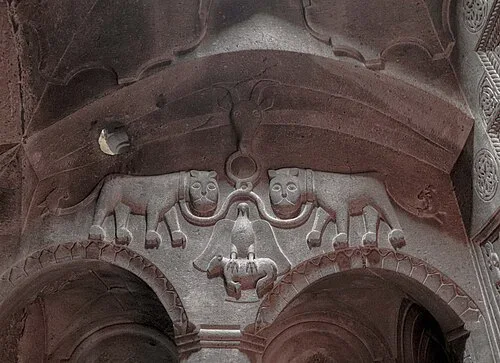 Proshyan Family Mausoleum and Coat of Arms
Coat of Arms of the Proshyan Princes
This chamber is the dynastic heart of Geghard. In the mid-thirteenth century, Prince Prosh Khaghbakian bought the monastery from the Zakarids and made it the family monastery and mausoleum of the Proshyans. The chamber reached from the northeast of the gavit became his own tomb in 1283. Now look at the high relief on the northern wall, above the archways. In the center, a ram's head holds a chain in its jaws; the chain winds around the necks of two lions facing you. And look at the tails - instead of tufts, they end in dragons' heads looking upward, images that reach all the way back to heathen times. Between the lions, an eagle with half-spread wings grips a lamb in its claws. This is probably the coat of arms of the Proshyan princes. A family that bought a monastery and turned it into their burial vault, then signed it with lions and eagles cut into the mountain itself.
Listen in the appPhoto: Beko · CC BY-SA 4.0
10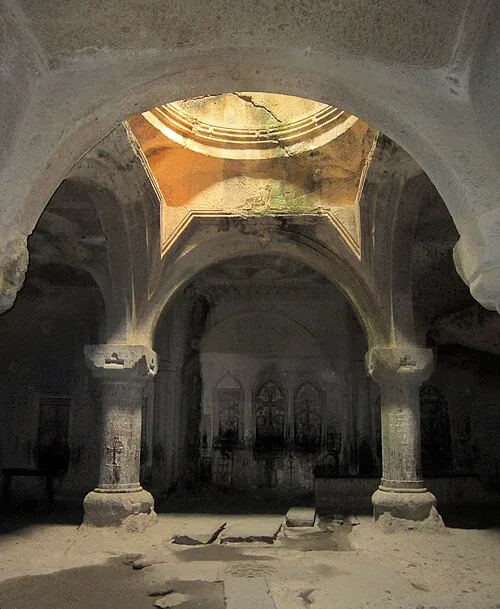 Rock Staircase and Upper Zhamatun Acoustic Chamber
Upper Zhamatun
Climb the external staircase beside the gavit door and step into the Upper Zhamatun, hewn in 1288 one level above the mausoleum you just saw. An inscription tells us it was the tomb of Papak Proshyan and his wife Ruzukan, though their tombstones have since disappeared. The princes Merik and Grigor are buried here too, and others whose graves are now lost. The chamber copies the form of a gavit: columns cut from the living rock carry low semicircular arches, and above them rises a cupola. Now for the reason musicians and visitors prize this room. The acoustics here are extraordinary - the hard stone walls and curved vault carry every sound, holding it in the chamber. Stand quietly for a moment and you'll understand why singers have sought this room out. It was built as a tomb, and it became one of the great resonant spaces of Armenia.
Listen in the appSoghomon Matevosyan · CC BY 4.0
- 11
Upper Zhamatun Dome and Skylight
The cupola's skylight, the hidden view down into the tomb, and the legend of the diamond light.
- 12
Cliffside Khachkars
Cross-stones carved into the cliffs, and the hermit monks who lived in the canyon walls.
- 13
The Holy Lance
The spear that gave Geghard its name, the monastery's decline and revival, and what it all means.
Geghard
Frequently asked questions
How much does the guide cost?
Free app download. Listed guide price: $0.99. Guide price shown in the app. Audio guide only. Venue admission is separate.
Can I listen without internet?
Yes. Download the guide’s audio, images, and maps in the app before your visit. Your downloaded content is then available offline.
Can I listen in my language?
This audio guide is available in 15 languages, including English.
Do I need to follow a schedule?
No. This is a self-guided experience. Choose your stops, pause whenever you like, and return to a story at your own pace.
At your own pace
Explore Geghard.
Download Stanza, then search for “Geghard”.
Free app download · Guide price shown in the app
Keep exploring
Nearby audio guides
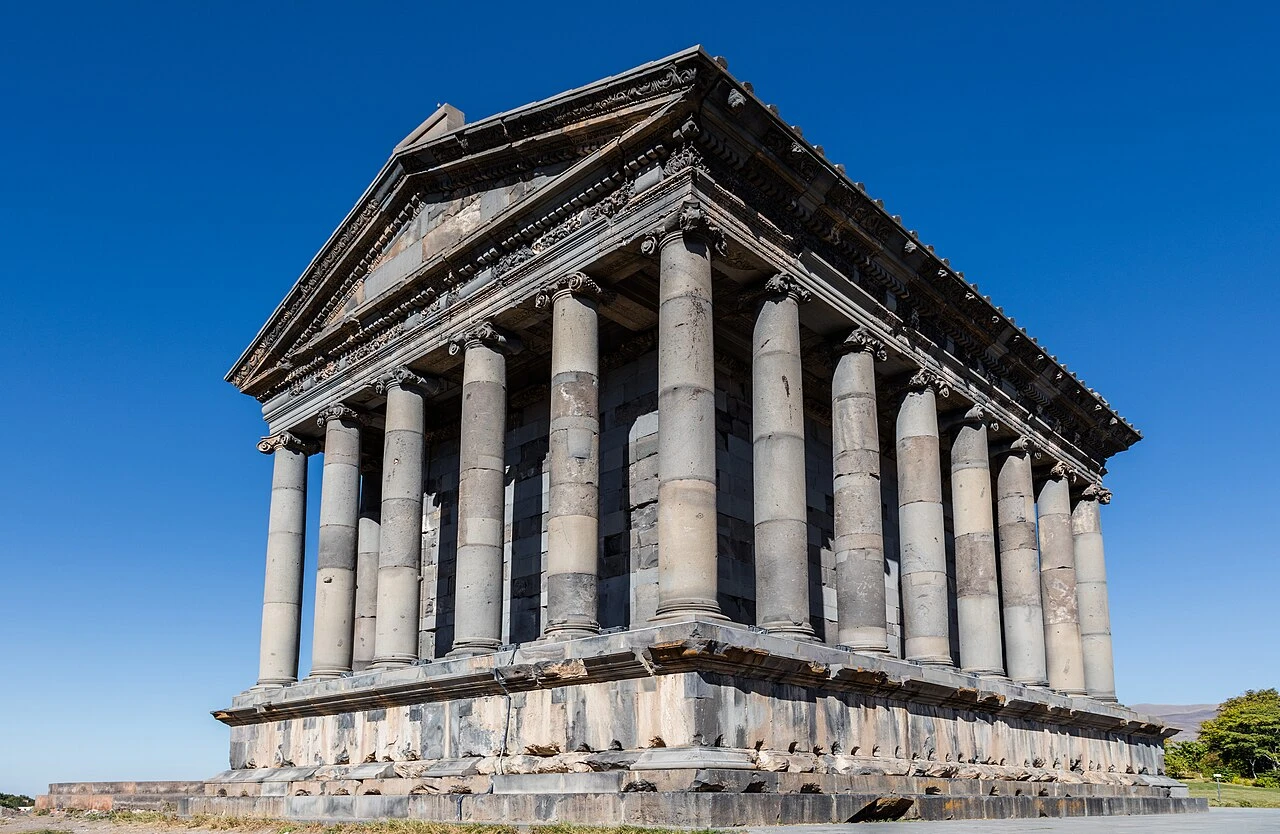
Garni · 8 km
Garni Temple
Content & sources
Diego Delso · CC BY-SA 4.0
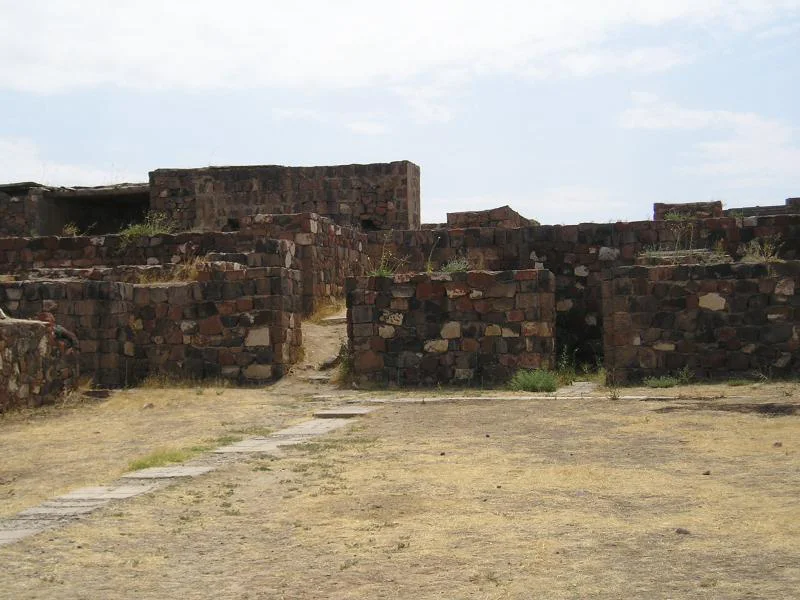
Yerevan · 24 km
Erebuni Fortress
Content & sources
Photo: Numerius Negidius · Public domain
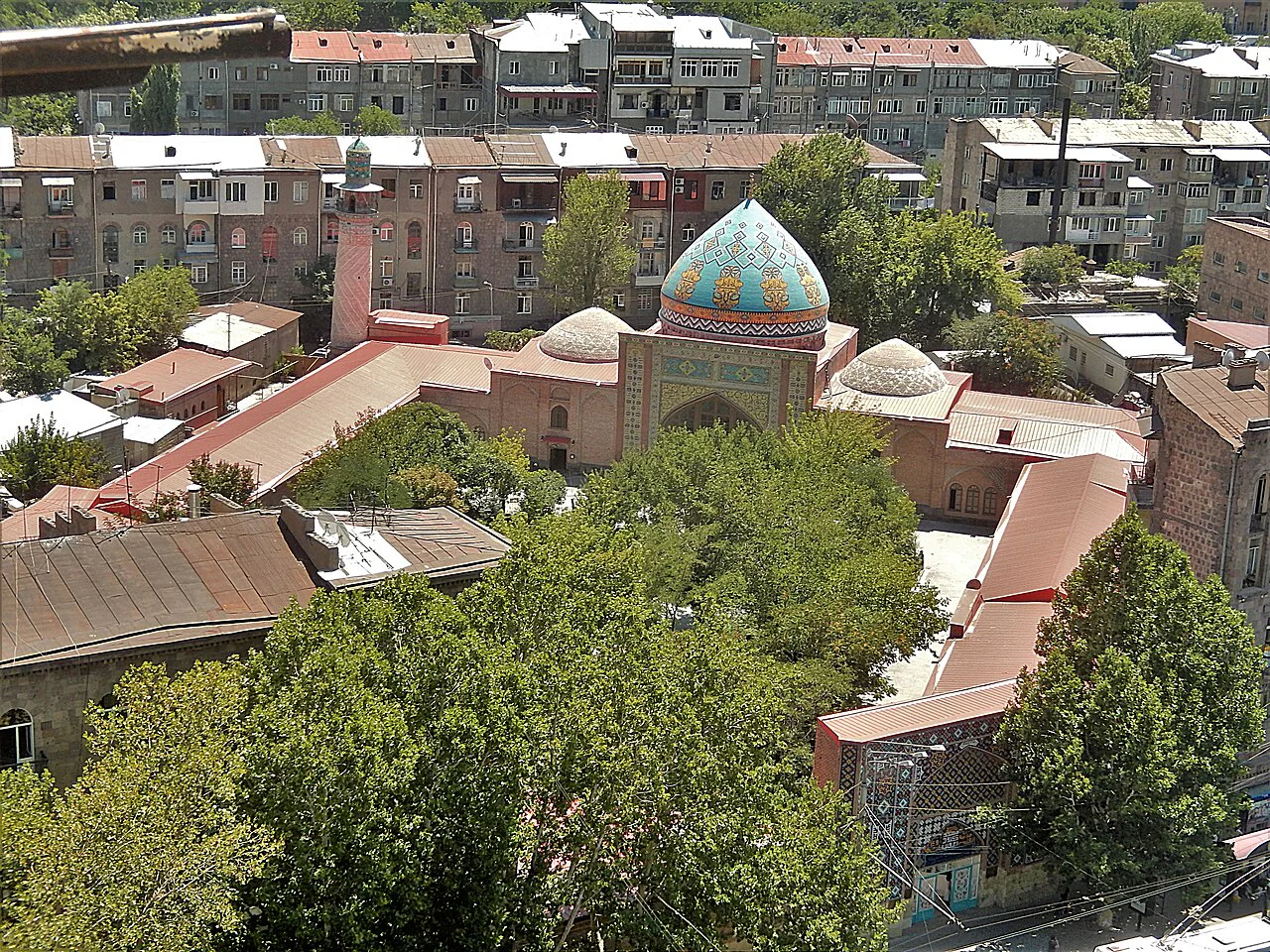
Yerevan · 27 km
Blue Mosque, Yerevan
Content & sources
Armineaghayan · CC BY-SA 4.0
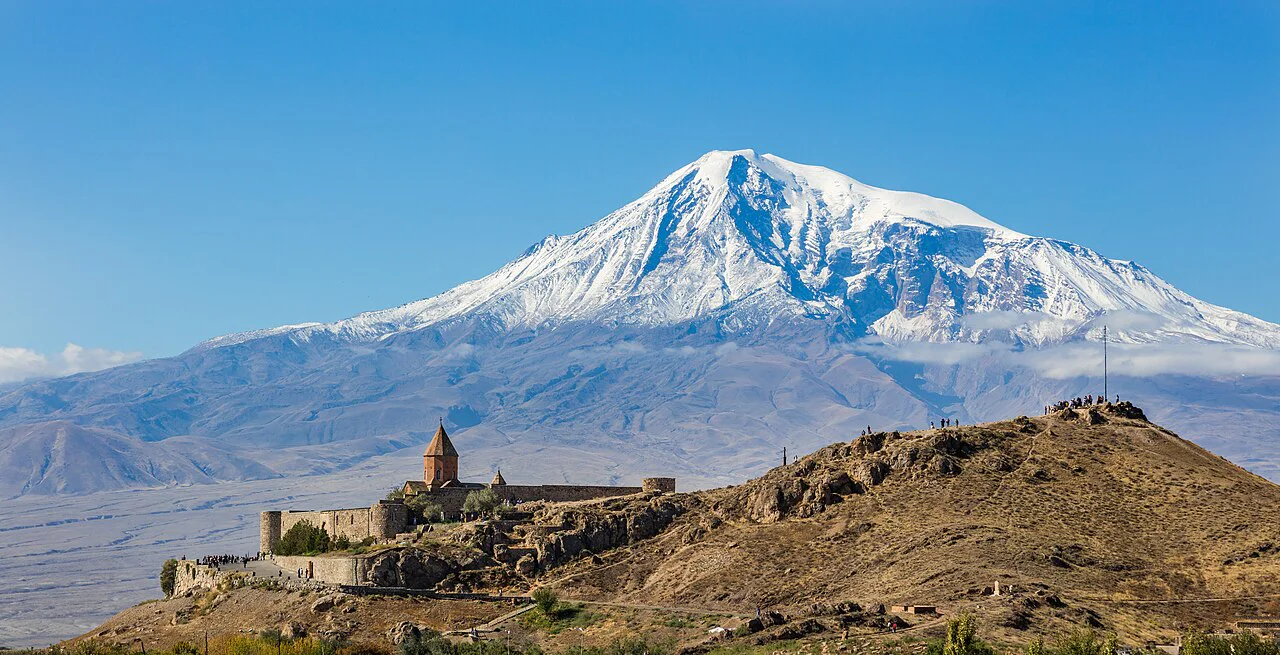
Lusarat · 36 km
Khor Virap
Content & sources
Diego Delso · CC BY-SA 4.0