Stanza · Audio guide
Qal'at al-Bahrain Audio Guide
A place to remember. A story to take with you.
Qal'at al-Bahrain is an archaeological site in Bahrain that features an artificial mound containing seven stratified layers of history. It served as the capital of the Dilmun civilization and is recognized as…
Download Stanza, then search for “Qal'at al-Bahrain”.
About the tour
One guide. Your kind of visit.
Qal'at al-Bahrain is an archaeological site in Bahrain that features an artificial mound containing seven stratified layers of history. It served as the capital of the Dilmun civilization and is recognized as the oldest fortification in the Persian Gulf region.
Ready when you are.
- 01Get the free Stanza app.
iOS & Android
- 02Find your guide.
“Qal'at al-Bahrain”
- 03Download before you go.
Works offline
Audio guide / 11 narrated stops
Inside the guide
Get to know a few of the stories before you go. Open a stop to read more.
01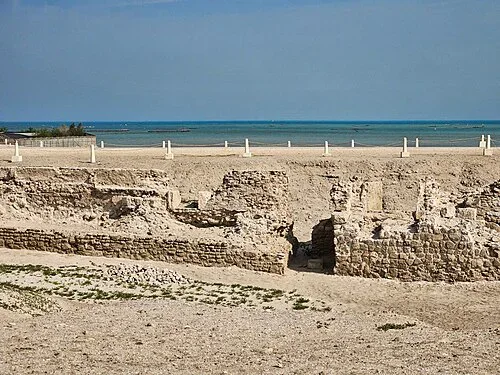 The Northern Shoreline and Ancient Dilmun Port
The Northern Shore and Harbour of the Dilmun Capital
Welcome to Qal'at al-Bahrain, the Bahrain Fort, on the northern shore of Bahrain Island. Low stone walls run down toward the water's edge here, and beyond them the Gulf opens out. This shore is where the story begins. The site was the capital of the Dilmun civilisation, and its principal trading port. Merchant ships from Mesopotamia and the Indus Valley put in at the harbour that lay along this northern edge of the city wall. People have lived on this spot for more than four thousand years, reaching back into the Bronze Age. The name comes from the fort that now crowns the mound, since qal'a is simply the Arabic word for fort. In 2005, UNESCO inscribed the whole site, ancient harbour included, as a World Heritage Site. The goods those ships carried are the subject of the next track.
Photo: O.Mustafin · CC0
02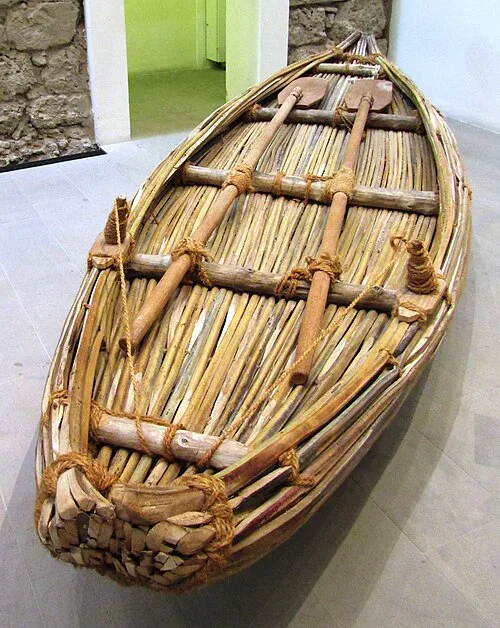 The Northern Shoreline and Ancient Dilmun Port
The Vessel and the Cargo of Dilmun
A boat of reeds and bundled timber, lashed with rope, with two wooden paddles resting across its benches. It appears to be a reconstruction of a traditional Gulf craft, the kind of vessel that moved Dilmun's trade. The excavated finds tie the city to three worlds at once. A cuneiform inscription and a piece of hematite point to Mesopotamia. Steatite bowls came from Oman. Carnelian beads, a stone weight and a few potsherds connect the port to the Indus Civilisation. The large vessels found here were used to import food from Oman and Mesopotamia. The city also produced goods of its own. Excavators uncovered a large copper-casting workshop, stocked with crucibles for melting metal and with moulds, both two-piece and wax. The quantities point to professional artisans working on a real scale. Their copper wares were traded on to Oman and Mesopotamia, and Dilmun stamp seals turned up among the finds.
Photo: O.Mustafin · CC0
03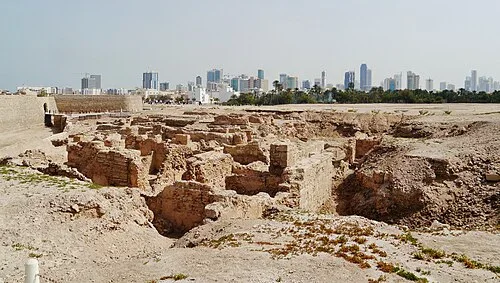 The Stratified Tell and Ancient Residential Quarters
The Twelve-Metre Tell: A Mound Made of Cities
Cities here were built on top of one another. The mound at Qal'at al-Bahrain is a tell, an artificial hill made entirely of human occupation. Layer after layer of settlement, each raised on the flattened ruins of the last. The mound rises about twelve metres. Within it, excavations have counted seven separate layers of building. The oldest goes back to about 2300 BC, and people were still adding to the mound into the eighteenth century. Only about a quarter of the site has been dug, and that fraction has already revealed houses, public buildings, commercial quarters, religious structures and military works. The mound matters because of what it preserved. This was the capital of Dilmun, and it holds the richest remains of that civilisation, which was otherwise known mainly from Sumerian written references. Dilmun carries a legend too. In the Epic of Gilgamesh it appears as the land of immortality, the ancestral place of the Sumerians and a meeting point of the gods. Gilgamesh came looking for eternal life. The mound kept something else instead, four thousand years of ordinary living, stacked in layers.
Listen in the appPhoto: Zairon · CC BY-SA 4.0
04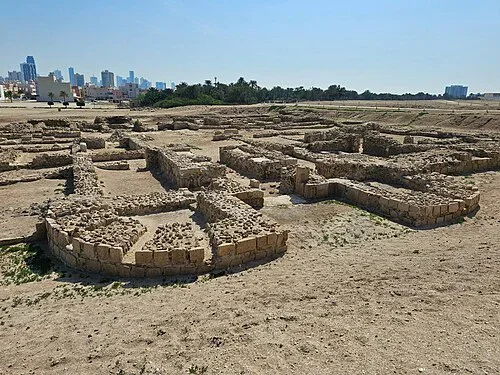 The Stratified Tell and Ancient Residential Quarters
Streets and Houses of the Ancient City
The streets of the ancient town were laid out running north to south, about twelve metres wide. Around the whole settlement stood fortifications, raised along the cardinal directions. Their walls were built of stone masonry in varying thicknesses, with gates wide enough for donkey caravans to pass through carrying goods. Those gates were rebuilt again and again. Excavators found them at four successive levels, and the latest gate still held two polished stone pivots for a double-leafed door. Inside the walls, modest houses of much the same size and construction lined a network of roads. At the centre, on high ground, stood a large complex with warehouses. The excavators read it as a palace, the administrative heart of a trading economy. From it, a street ran north to a grand gate that probably opened onto the palace grounds. The town prospered on that trade until around 1800 BC. Then it was deserted. In time, drift sand blown in from the sea buried what remained.
Listen in the appProf. Mortel · CC BY 2.0
05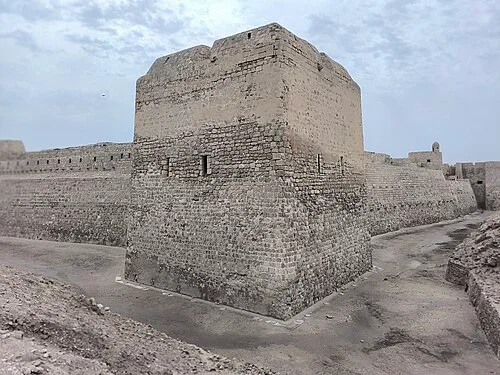 The Dry Moat and Portuguese Outer Defenses
The Portuguese Bastion
This massive square bastion, rising sheer above the dry moat, is the fort that gave the whole site its name. How old the fortress really is, the accounts disagree. One tradition places an earlier fort here as far back as the sixth century AD. Other accounts describe a fort raised by local Arab rulers, which the Portuguese later enlarged. The Portuguese chapter itself is clear. After rounding the Cape of Good Hope, Portugal set out to control the sea routes from the Cape all the way to India, the strategy of Admiral Afonso de Albuquerque. Bahrain was seized in 1521, a few years after his death. Portuguese control lasted until 1602. The fortress was reinforced to secure the trade routes of the Gulf, and its thick bastions were built for the age of gunpowder, when artillery decided sieges. The Portuguese called it Forte de Barém, the fort of Bahrain, and the Arabic name Qal'at al-Bahrain says the same thing.
Listen in the appPhoto: Dobroš · CC BY-SA 4.0
06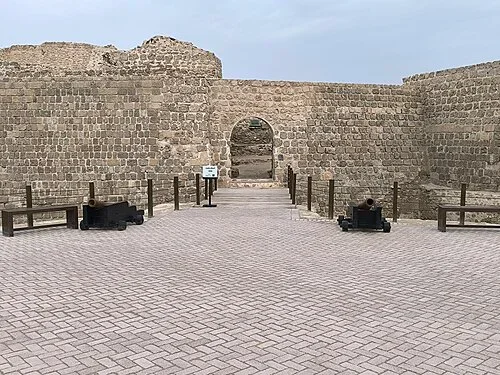 The Dry Moat and Portuguese Outer Defenses
Gateway of the Fortress
Two old cannons stand before the arched gateway, dark against the pale stone. They suit the last age of this fortress, when gunpowder defended it, though where and when they were made is not known. Their placement makes the point better than any label. This stronghold was planted on top of the ancient capital for one reason, command of the harbour below and of the Gulf trade route it served. Whoever held the gateway held the port, and whoever held the port held the trade of the region. Beyond the arch, the paved way runs into the fortress itself.
Listen in the appPhoto: Dobroš · CC BY-SA 4.0
07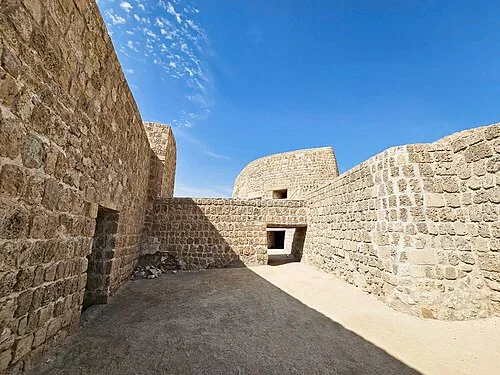 The Fort Courtyard and Arched Galleries
Inside the Walls: Courtyard and Round Tower
Inside the walls, the courtyard sits between heavy carved stone blocks, and a round tower rises at the corner. This fortress is the last of many. The same strategic spot was fortified over and over across the site's long life, by the Kassites, in Hellenistic times, in the Islamic centuries and by Portuguese military engineers, with Persian occupation coming later still. The site was also a notable Hellenistic settlement, the era when the island was known as Tylos. Which visible stretch of wall belongs to which building phase is hard to say. The masonry in the courtyard mixes phases of rebuilding, each answering the last. What the round tower and the thick curtain walls show is the instinct of every garrison that held this mound, to build high, build thick, and watch the coast.
Listen in the appProf. Mortel · CC BY 2.0
08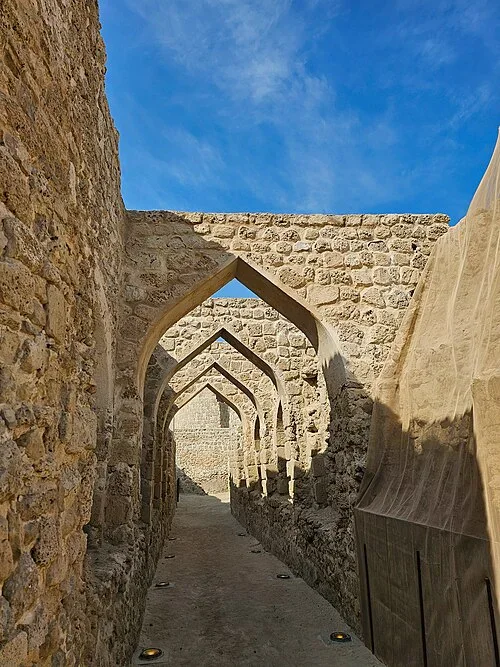 The Fort Courtyard and Arched Galleries
The Islamic City and Its Arches
These pointed arches carry the corridor forward, one opening behind the next, under a vault of rough stone. They belong to the long Islamic chapter of the site, a period reckoned here from the year 622 to about 1400. Excavations beneath the later fortifications brought that town's houses to light. Each small house was built of little stones swept with plaster, and held two rooms, a bath, a date-press room and a courtyard. At the centre of the town lay a souk, a market of facing shops stretching from east to west. The Islamic town was not built on empty ground. Its walls rose over structures of the Tylos period, the Hellenistic era heard of earlier, so these arches stand on yet another buried layer.
Listen in the appProf. Mortel · CC BY 2.0
09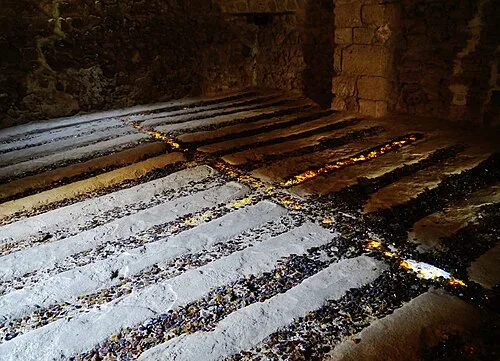 The Traditional Date Presses
The Madbasa: Pressing the Date Harvest
Grooves cut into this stone floor once ran with date syrup. This room is a madbasa, a traditional press house for turning the date harvest into dibs, the thick dark syrup that sweetened the Gulf long before sugar was common. The parallel channels were part of the work. In press houses across the region, dates were pressed and their juice gathered and channelled along grooves like these. At Qal'at al-Bahrain, madbasas are recorded inside the houses of the Islamic-period town, one to a house. The trade in dates runs to the very roots of the settlement. The first small village here planted palm trees by the oasis, tended cattle, sheep and goats, and fished the sea. The palms gave the island its oldest harvest, and the harvest gave rooms like this one their work.
Listen in the appPhoto: Zairon · CC BY-SA 4.0
10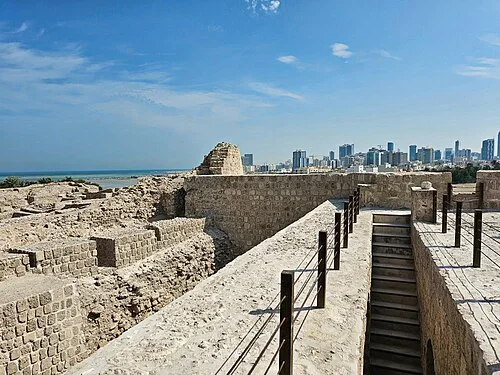 The Upper Ramparts and Sentry Watchtowers
The Excavators' Story
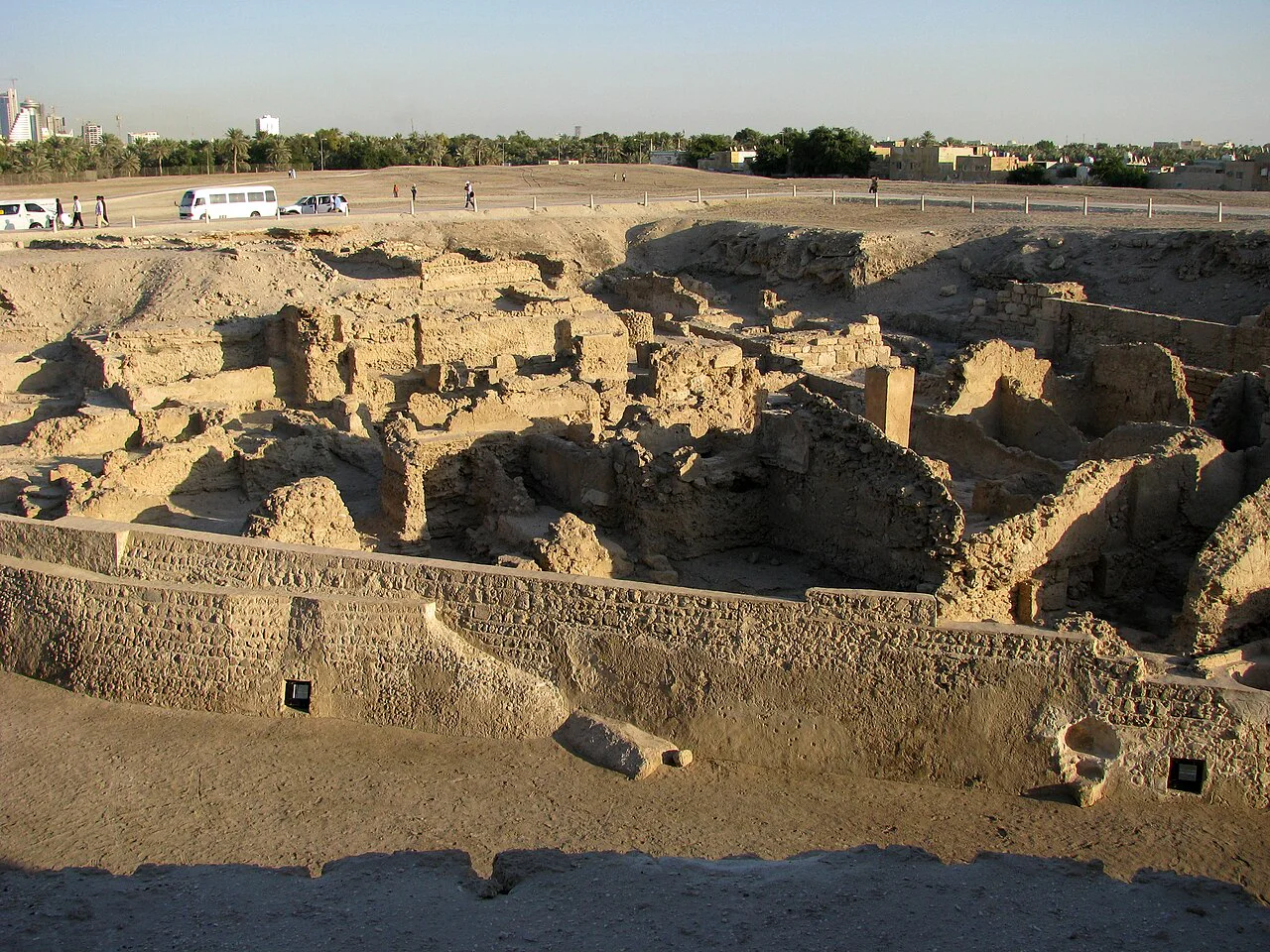
From the upper ramparts, the excavation spreads out below, the trenches where the mound gave up its secrets. The digging began with a Danish expedition led by Geoffrey Bibby, working for the Prehistoric Museum of Moesgaard. It started in 1954 and continued into the early 1970s. From the 1970s onward, a French team from the National Centre for Scientific Research took over the work. The French uncovered about fifty cuneiform tablets. Three of them carry the name of a Kassite king called Agum, believed to be Agum the Third. Tablets like these are administrative in nature, and they show that Kassite authority governed the city in the Middle Dilmun period. Since 1987, Danish and Bahraini archaeologists have worked the site together. Beyond the old walls, the towers of Manama line the horizon, the present city looking over the ancient one.
Listen in the appProf. Mortel · CC BY 2.0
- 11
Sentinel of the Gulf
The domed watchtower, the site as sentinel of the Gulf, and what the layered mound preserves.
Qal'at al-Bahrain
Frequently asked questions
How much does the guide cost?
Free app download. Listed guide price: $1.99. Guide price shown in the app. Audio guide only. Venue admission is separate.
Can I listen without internet?
Yes. Download the guide’s audio, images, and maps in the app before your visit. Your downloaded content is then available offline.
Can I listen in my language?
This audio guide is available in 15 languages, including English.
Do I need to follow a schedule?
No. This is a self-guided experience. Choose your stops, pause whenever you like, and return to a story at your own pace.
At your own pace
Explore Qal'at al-Bahrain.
Download Stanza, then search for “Qal'at al-Bahrain”.
Free app download · Guide price shown in the app
Keep exploring
Audio guides — Bahrain
Al Shamal · 58 km
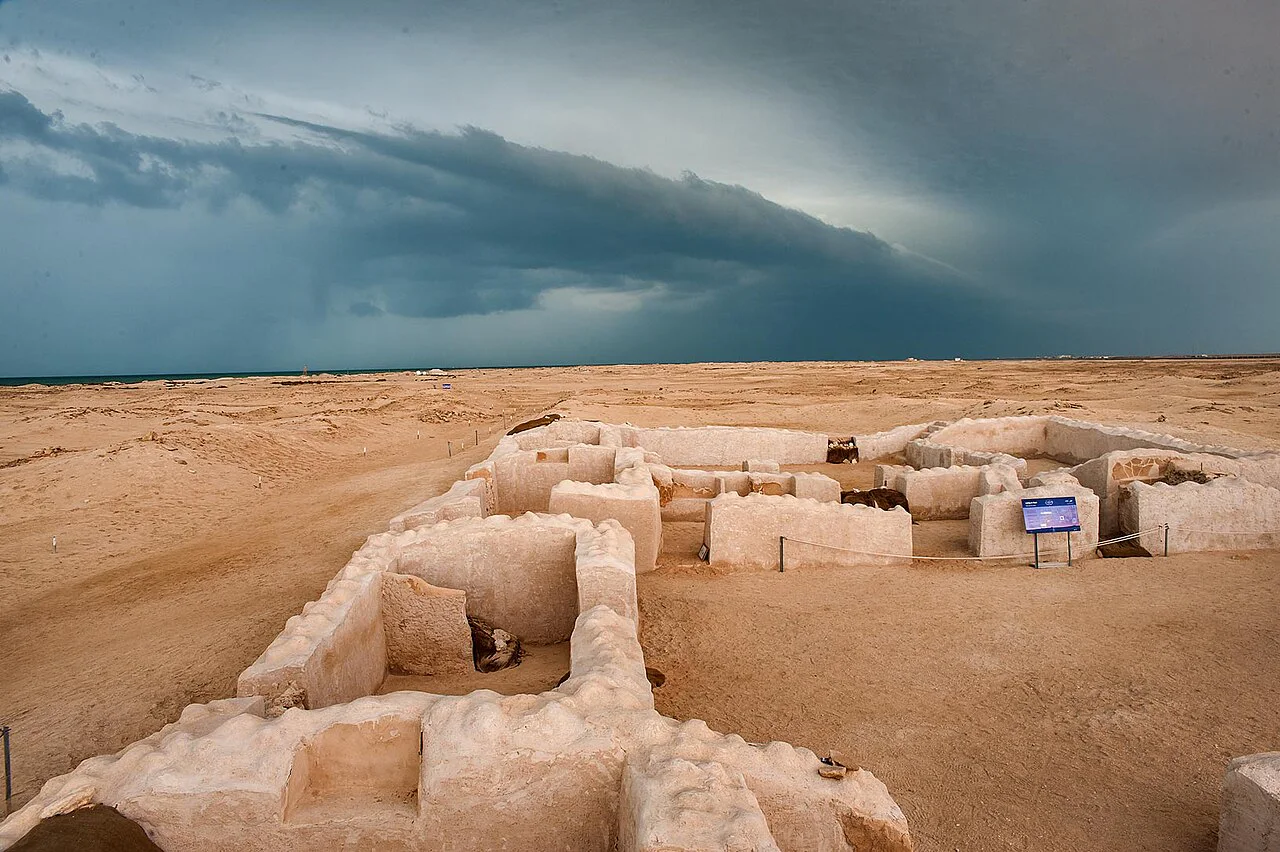
Zubarah
Content & sources
Alex Sergeev (www.asergeev.com) · CC BY-SA 3.0
Kuwait City
Grand Mosque of Kuwait
Content & sources
Photo: Zairon · CC BY 4.0