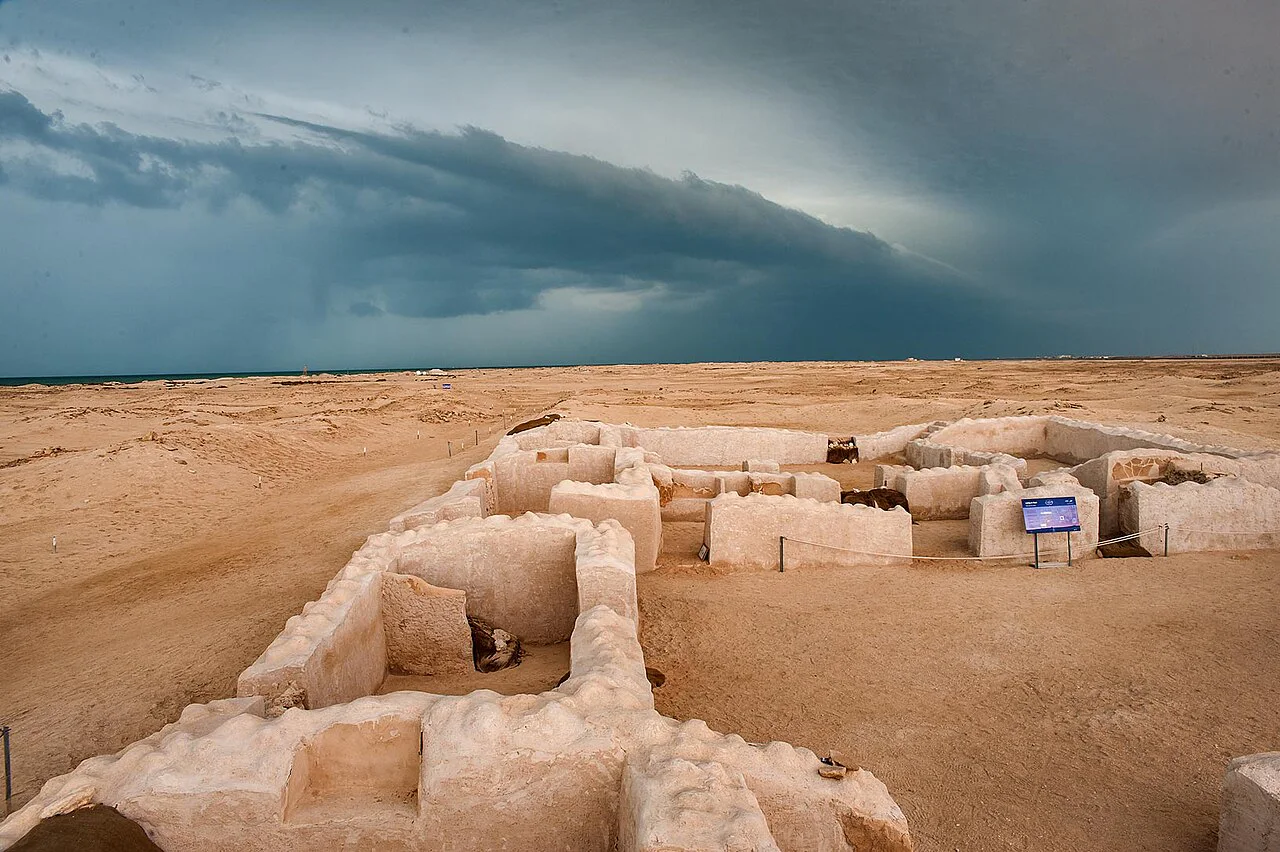
Stanza · Audio guide
Zubarah Audio Guide
A place to remember. A story to take with you.
Zubarah is a ruined, ancient town located on the northwestern coast of the Qatar peninsula. It was founded by the Bani Utbah tribal confederation in the mid-eighteenth century and was designated a UNESCO…
Download Stanza, then search for “Zubarah”.
About the tour
One guide. Your kind of visit.
Zubarah is a ruined, ancient town located on the northwestern coast of the Qatar peninsula. It was founded by the Bani Utbah tribal confederation in the mid-eighteenth century and was designated a UNESCO World Heritage Site in 2013.
Ready when you are.
- 01Get the free Stanza app.
iOS & Android
- 02Find your guide.
“Zubarah”
- 03Download before you go.
Works offline
Audio guide / 13 narrated stops
Inside the guide
Get to know a few of the stories before you go. Open a stop to read more.
01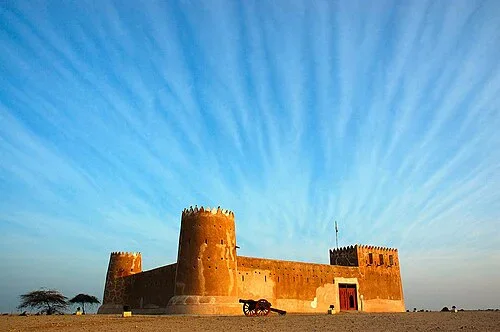 Al Zubara Fort Exterior and Main Entrance
Al Zubara Fort: Corner Towers and Sloping Walls
Welcome to Zubarah, a town now in ruins on Qatar's northwest coast. It is best known for its fort, finished in 1938, which is officially named after the town. Its walls slope, and a tower stands at each corner. Three of the corner towers are round. The fourth, at the southeast corner, is rectangular. Curved, pointed battlements crown the top of every tower. The southeast tower has the most machicolations. These are openings beneath its top, through which defenders could drop things on attackers below. A cannon sits near the foot of the large round tower. The design recalls older features common in Arab and Gulf forts. Its foundations are concrete, not stone. That puts the fort at a turning point, when building in stone gave way to cement.
Listen in the appRafeek Qatar · CC BY-SA 2.0
02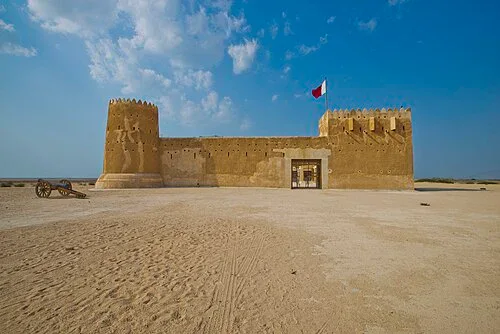 Al Zubara Fort Exterior and Main Entrance
Al Zubara Fort Entrance Gate
Zubarah was once a walled port, built around pearling and trade. Several Bani Utbah tribes likely moved in during the 1760s, when the place was already a small, active coastal village. It was added to the UNESCO World Heritage List in 2013. It is one of the most extensive and best-preserved settlements of its period in the region. Its layout has survived in a way unlike any other settlement in the Gulf. It shows town life, trade, and the economy before oil and gas were found in the twentieth century. The site includes a fortified town, a harbour, a sea canal, two screening walls, Qal'at Murair, and Al Zubara Fort. The fort is the more recent of these parts, and a flag flies from a pole above the wall.
Photo: Raytohgraphy · CC BY-SA 4.0
03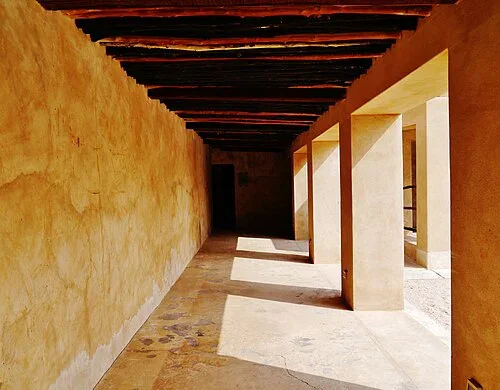 Fort Courtyard and Museum Exhibition Rooms
Fort Courtyard Arcade
Inside Al Zubara Fort, a covered walkway runs beside an open courtyard. Pale square piers line one side, beneath a ceiling of dark beams. The other side is a thick wall, finished in warm yellow plaster. Courtyard buildings like this are an old form, and the open court gave air and shade. It also gave a sheltered way past the rooms. Light falls across the floor in bright bands, and the far end stays in shadow.
Listen in the appPhoto: Zairon · CC BY 4.0
04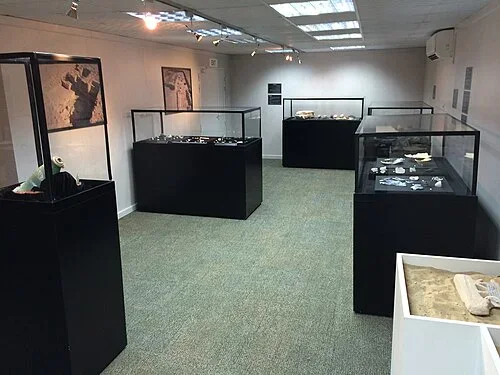 Fort Courtyard and Museum Exhibition Rooms
Fort Museum Galleries
Zubarah's economy depended on the pearl season, which ran through the long summer months. Pearling drew Bedouin from Qatar's interior, along with people from all over the Gulf. They came to dive, to trade, and to guard the town from attack while its men were at sea. Divers worked in pairs. One dived for about a minute. His partner stayed in the boat and pulled him back to safety, along with the mollusks he had gathered. Those mollusks might hide a pearl inside. Excavations have turned up the trade's tools, including pearl boxes, diving weights, and small weights for measuring. Until cultured pearls arrived in the early 1900s, pearling was the most important industry in the Persian Gulf. It employed up to a third of the region's male population. Traces of tents and palm-leaf huts near the beach may be the homes of temporary workers.
Listen in the appVincent van Zeijst · CC BY-SA 3.0
05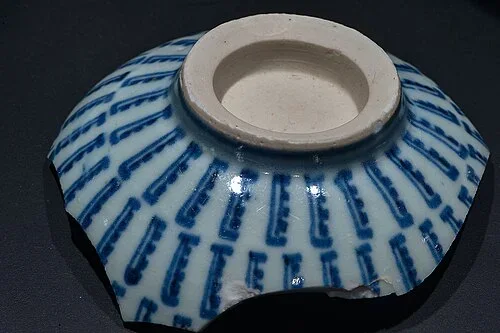 Fort Courtyard and Museum Exhibition Rooms
Blue-and-White Ceramic Sherd on Display
In the late eighteenth century, Zubarah's trade reached far beyond the Gulf. Excavations have turned up ceramics, coins and food remains from eastern Asia, Persia, the Ottoman Empire, Africa, Europe, and the Gulf itself. Coffee pots, mostly of Chinese origin, were used to drink Arabic coffee. A broken bowl here has rows of blue marks across a pale glaze, and one side has broken away. By 1790, the town's port had grown larger than Qatif's. A dhow is a traditional wooden boat of Arabia. In one room of a courtyard building, someone cut a merchant's dhow into the plaster.
Listen in the appAlex Sergeev (www.asergeev.com) · CC BY-SA 3.0
06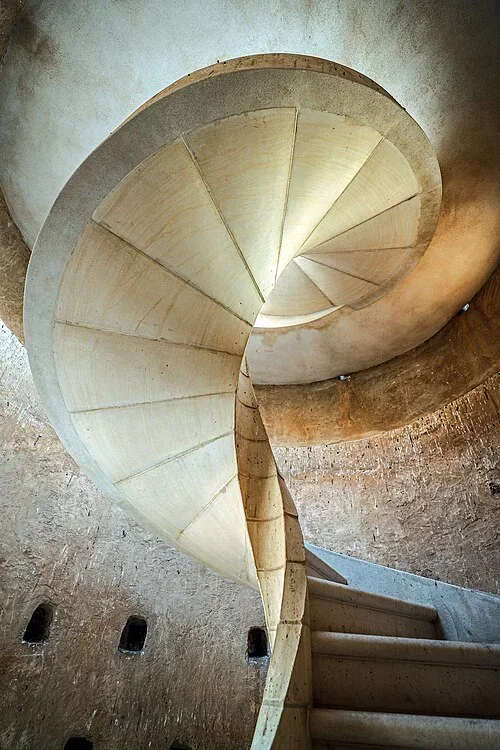 Fort Battlements and Defensive Watchtower
Spiral Stair Inside a Tower
A spiral staircase climbs through the tower in tight curves, its wedge-shaped steps narrowing toward a central core. Small openings pierce the wall lower down. This tower and its stair are part of a site that has been studied and restored for decades. Research here goes back to March 1956, when the first Danish expeditions to Qatar included Zubarah. Archaeologists from Aarhus University and Moesgård Museum made a first survey of the area. Another team, from the University of Hamburg, recorded the architectural remains in great detail with a 3D scanner. The restoration programme uses a special mortar and plaster that resist salt. The work follows UNESCO heritage guidelines and aims to keep the site authentic while opening parts of it to visitors.
Listen in the appPhoto: Firossyed · CC BY-SA 4.0
07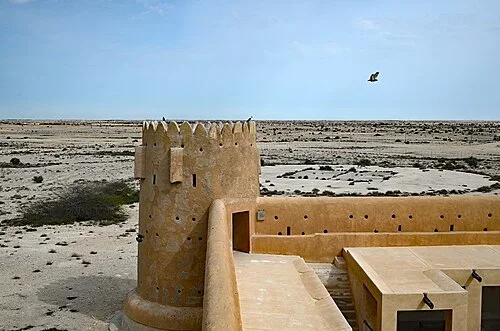 Fort Battlements and Defensive Watchtower
Fort Rooftop with Round Corner Tower
Zubarah covers around four hundred hectares, making it Qatar's most substantial archaeological site. Sixty hectares of that lie inside the outer town wall. The two main habitats here are sabkha, a flat salt pan, and stony desert. The fort stands on a low coastal hillock. Beyond it the land runs flat to the horizon, broken only by low scrub and scattered stones. A bird glides high above the ground.
Listen in the appP. Hughes · CC BY 4.0
08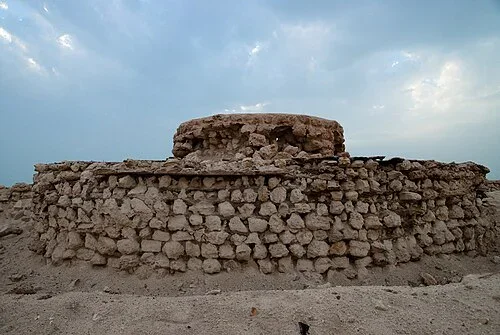 Outer Defensive Town Wall and Watchtowers
Rubble-Stone Tower Remains
These rubble-stone tower remains belong to the town's defences, yet the town was attacked several times in the late eighteenth century. The first major attack came in 1778. A second followed in 1782. Nasr Al-Madhkur ordered both. About two thousand Persian troops were sent out. By December 1782, preparations for a landing on the Qatari coast had begun. In 1783, Persian forces landed between Zubarah and Freiha. A coalition of local Qatari tribes, among them the Al Maadeed of Freiha, repelled them in a decisive battle. Sheikh Muhammad bin Khalifa was killed in the fighting, along with many of his soldiers. Afterwards, Sheikh Ahmed bin Muhammad bin Khalifa assumed control of the island of Bahrain. He expelled the Persians and installed a governor on his behalf. His main home, however, stayed in Zubarah.
Listen in the appColleen Morgan · CC BY 2.0
09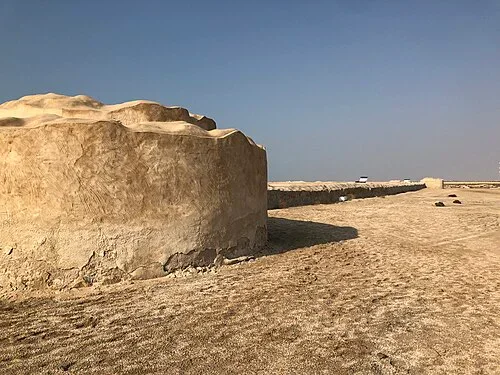 Outer Defensive Town Wall and Watchtowers
Plastered Round Tower and Wall Line
An outer wall once curved around Zubarah in an arc about two and a half kilometres long, from shore to shore. Some twenty semi-circular towers stood along it. A parapet and walkway ran along its top, most likely giving gunners a better position. Only a few defended gateways let people in from the land, or through the harbour. There was no sea wall, but a strong fort guarded the main landing place on the beach. Fresh water was scarce here. The town's main supply came from shallow wells at Qal'at Murair, to the east. The Al Musallam clan demanded tribute from the Bani Utbah newcomers of the 1760s, and Sheikh Muhammad bin Khalifa refused. Skirmishes followed. By 1768, the Al Khalifa had completed a fortified settlement, Qal'at Murair. Two screening walls ran in an east-west line from the outer wall toward Qal'at Murair. Round towers at regular intervals strengthened them. They likely helped secure the water carried from Murair's wells to the town. The walls also channelled traffic to and from the town across the open flats.
Listen in the appDavide Mauro · CC BY-SA 4.0
10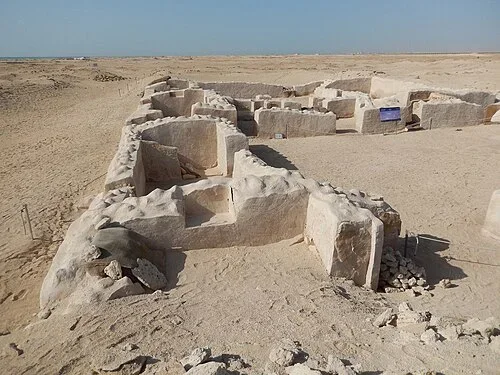 Residential Quarters and Urban Street Grid
Excavated Walls with Blue Information Panel
Many of the streets ran at right angles to one another. Some neighbourhoods followed a strict grid. That suggests the town was planned as one major undertaking. Still, it seems to have been built in stages. At its height, the town's population is estimated at no more than nine thousand. Most homes were courtyard houses. A ring of small rooms surrounded a large central courtyard, where most daily life took place. A portico usually opened onto the courtyard's south side, giving shade from the sun. The entrance led through a bent corridor. It kept passers-by from looking inside, and it stopped sand blowing into the house. The walls were built of soft local stone, or of limestone quarried at Freiha, then covered in thick gypsum plaster. Doorways and niches were decorated with geometric stucco.
Listen in the appVincent van Zeijst · CC BY-SA 3.0
- 11
Excavated Rooms and Walls
The date presses where households turned dates into syrup, and the 2014 dig that found the largest date-pressing site in the country and region.
- 12
Ruined Rooms with Recessed Niches
The town's biggest building complex, with nine linked courtyards and a tower at each corner.
- 13
Open Desert Ground with Low Remains
A 1790 almanac written in Zubarah, with prayer times, months and farming notes.
Zubarah
Frequently asked questions
How much does the guide cost?
Free app download. Listed guide price: $1.99. Guide price shown in the app. Audio guide only. Venue admission is separate.
Can I listen without internet?
Yes. Download the guide’s audio, images, and maps in the app before your visit. Your downloaded content is then available offline.
Can I listen in my language?
This audio guide is available in 15 languages, including English.
Do I need to follow a schedule?
No. This is a self-guided experience. Choose your stops, pause whenever you like, and return to a story at your own pace.
At your own pace
Explore Zubarah.
Download Stanza, then search for “Zubarah”.
Free app download · Guide price shown in the app
Keep exploring
Audio guides — Qatar
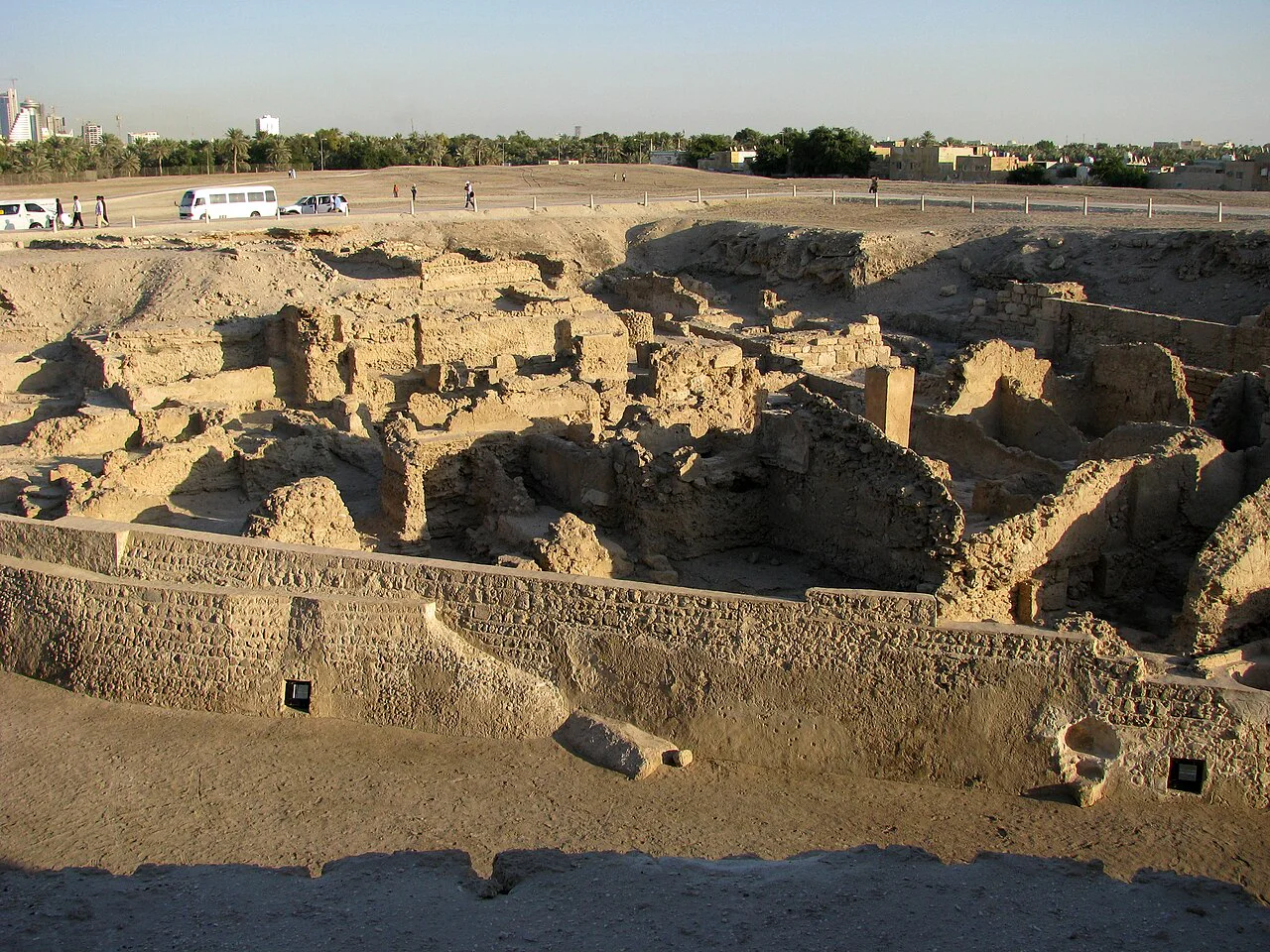
Manama · 58 km
Qal'at al-Bahrain
Content & sources
Peter from Riyadh, Saudi Arabia · CC BY 2.0
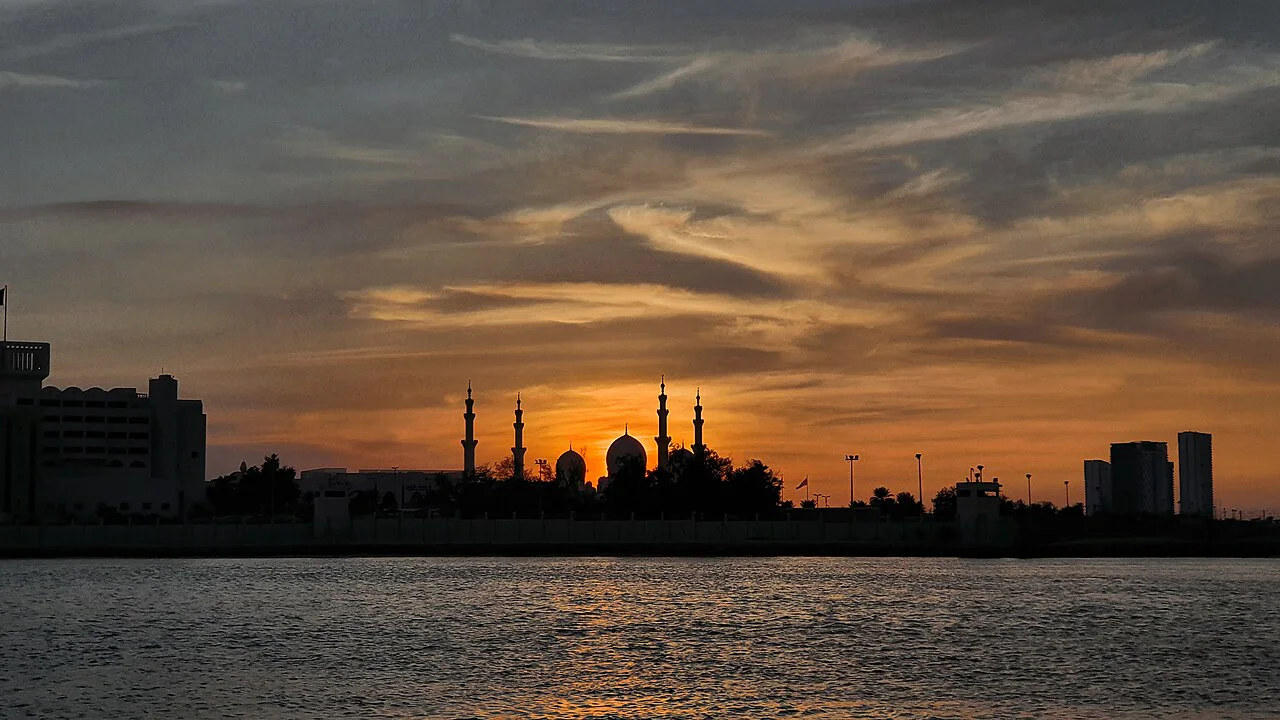
Abu Dhabi
Sheikh Zayed Grand Mosque
Content & sources
Photo: PotatoWitch · CC BY-SA 4.0