Stanza · Audio guide
Catedral de São Sebastião do Rio de Janeiro Audio Guide
A place to remember. A story to take with you.
The Metropolitan Cathedral of Saint Sebastian is a cathedral of the Catholic Church and the seat of the Archdiocese of Rio de Janeiro. It is dedicated to Saint Sebastian, the patron saint of Rio de Janeiro.
Download Stanza, then search for “Catedral de São Sebastião do Rio de Janeiro”.
About the tour
One guide. Your kind of visit.
The Metropolitan Cathedral of Saint Sebastian is a cathedral of the Catholic Church and the seat of the Archdiocese of Rio de Janeiro. It is dedicated to Saint Sebastian, the patron saint of Rio de Janeiro.
Ready when you are.
- 01Get the free Stanza app.
iOS & Android
- 02Find your guide.
“Catedral de São Sebastião do Rio de Janeiro”
- 03Download before you go.
Works offline
Audio guide / 7 narrated stops
Inside the guide
Get to know a few of the stories before you go. Open a stop to read more.
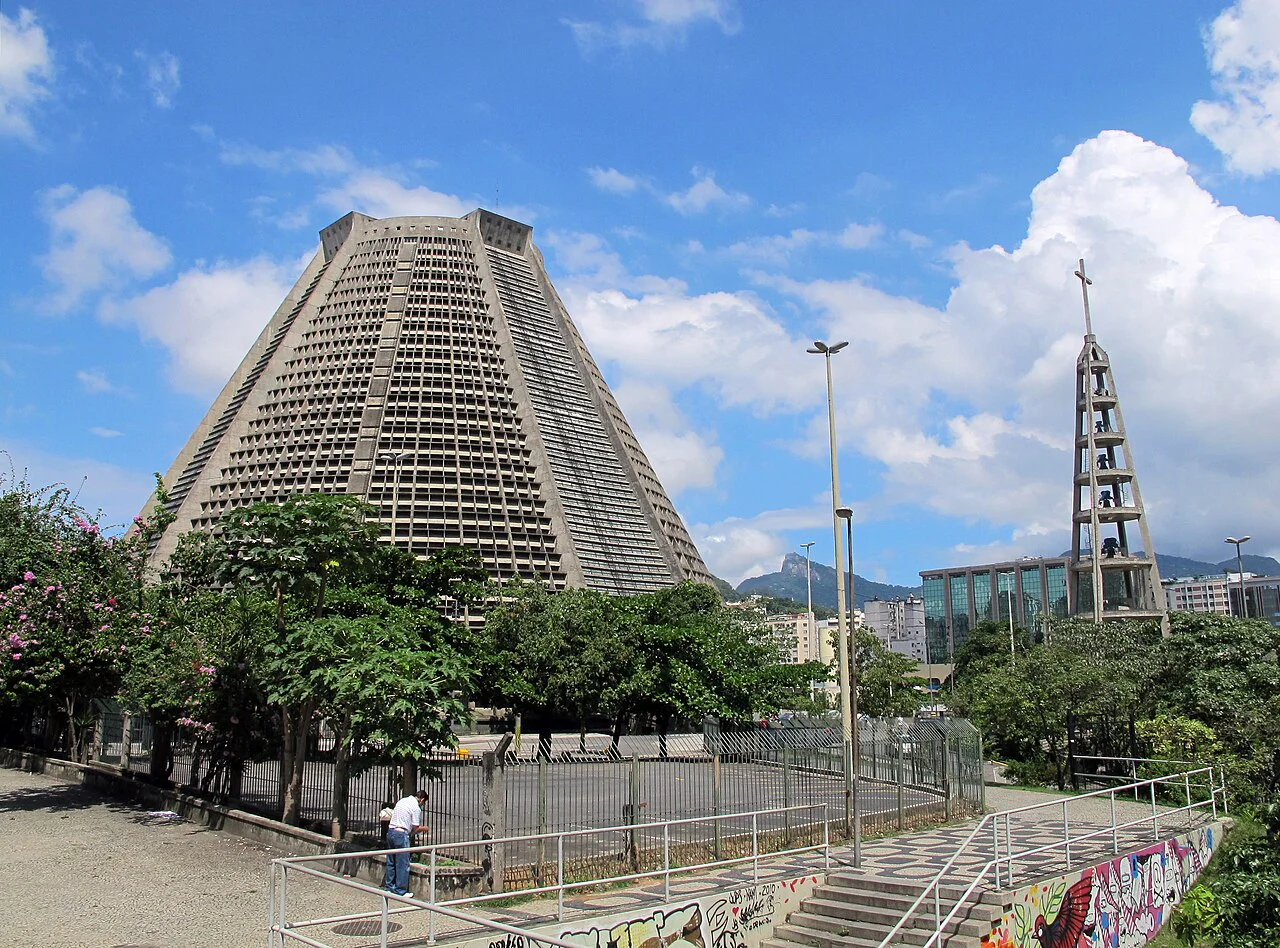
01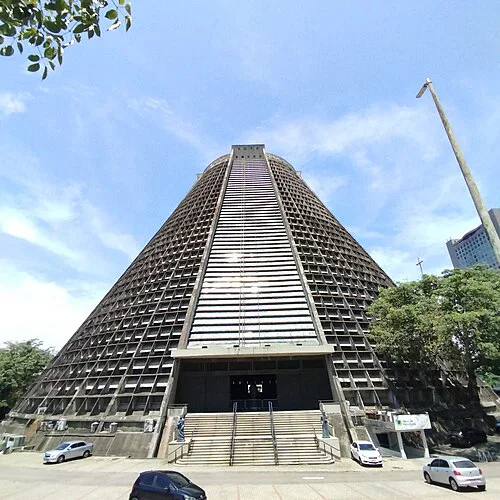 Cathedral Plaza and Mayan-Pyramid Exterior
The Conical Cathedral: Exterior View
Welcome to Rio de Janeiro's Metropolitan Cathedral, dedicated to Saint Sebastian, the city's patron saint. Before you rises one of the strangest and boldest cathedrals in the world: not a tower, not a basilica with a long nave, but a single vast cone of concrete, seventy-five metres tall, its surface ribbed with straight lines that taper as they climb. It was designed by the architect Edgar de Oliveira da Fonseca and built between 1964 and 1979. People still argue about where the idea came from. Some say Fonseca was thinking of the stepped pyramids the Maya built in Central America, turned smooth and vertical. Others insist he had the Apollo space capsules in mind, a shape pointing to the future rather than the past. The architect himself gave a reason that settles nothing and explains everything: a circle, he said, puts every person at the same distance from God, and near to God. No front row, no back pews. Everyone stands inside the same ring. That idea will make sense the moment you go in. For now, walk toward the great doors at the base of the cone, and notice the bronze panels set into them.
Photo: Elián Zozias · CC BY-SA 4.0
02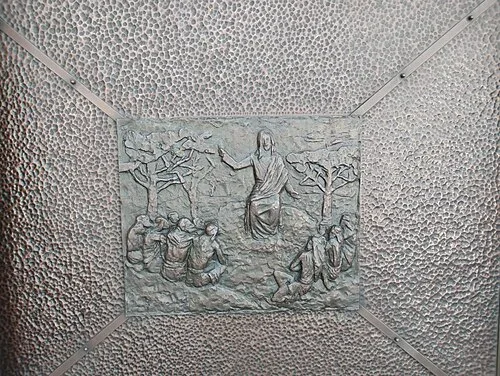 Bronze Main Entrance Doors
The Bronze Doors of Faith
Here at the threshold, look closely at the door itself. The main entrance is made of bronze reliefs, each one hammered and textured so the metal catches the light like rough stone. Their theme, from one panel to the next, is faith. The panel in front of you shows a standing figure with an arm raised, speaking to a group of people gathered at his feet, trees rising behind them. The scene reads as a moment of teaching, words passing from one figure to many. What matters is that you are being prepared before you enter. The entire artistic programme inside the cathedral was conceived by a priest, Father Paulo Lachen Maier, and these doors are its opening statement: sacred art worked into the very surface you push to come in. Go ahead and step through. What waits on the other side is unlike any church interior you have seen.
Photo: Clara Albuquerque de Jesus Toledo · CC BY-SA 4.0
03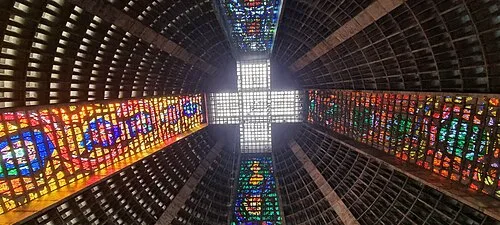 Central Nave and Stained Glass Windows
The Four Stained Glass Windows and the Ceiling Cross
Stop here and tip your head back. Four immense stained glass windows climb the walls of the cone, straight and sober bands of colour, rising sixty-four metres from the floor all the way to the ceiling, where they meet in a luminous cross of white light. In daylight the colours pour down the concrete; at night, lit from within, they burn outward over the whole square. Now notice what you don't see: columns. None. The outer shell carries all the weight, so the floor opens into one uninterrupted circle about ninety-six metres across, room enough for twenty thousand people standing. That is the architect's circle made real. Wherever you move in this hall, you are the same distance from the walls around you, and the light falls on everyone alike. Take a moment with it. Then walk toward the sanctuary at the centre, where the cathedral's true purpose is waiting.
Listen in the apptongeron91 · CC BY-SA 2.0
04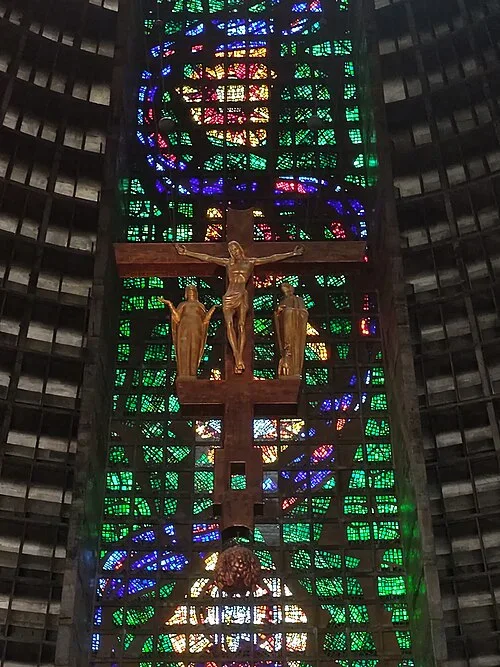 High Altar and Sanctuary Area
The High Altar and the Cathedra
Before you hangs a large crucifix, suspended so the figure of Christ appears against the green of the stained glass behind it, flanked by standing figures. It is a striking piece, but the story of this spot is older than the building around it. A cathedral is named for the cathedra, the bishop's chair, the seat of the archbishop. And Rio de Janeiro, whose diocese was created in 1676, went nearly three hundred years without one of its own. The church here was always borrowed. Bishops moved from parish church to parish church, and for the longest stretch they sat in the Church of Our Lady of Mount Carmel. That eighteenth-century building was declared the city's cathedral in the early nineteenth century, and it is still remembered as the Old Cathedral. Only in 1972 was the first mass celebrated here, in a permanent seat built for the purpose. Nearly three centuries of borrowed temples, ended by this cone of concrete. That is why this building exists at all: so that the archbishop's chair, and the archdiocese itself, finally had a home.
Listen in the appPhoto: Aline L. Rosa · CC0
05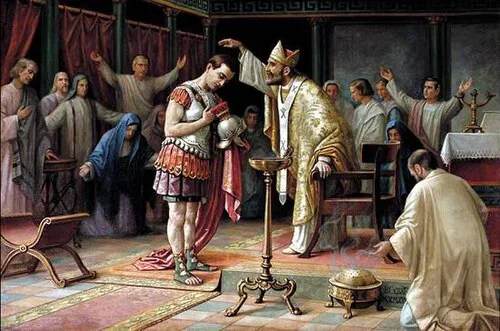 High Altar and Sanctuary Area
Benedito Calixto: Thou Shalt Be the Protector of the Church of Christ
Here is something you might not expect inside a building from the 1970s: a traditional oil painting, made in 1917 by Benedito Calixto, one of Brazil's great academic painters. It is called Thou Shalt Be the Protector of the Church of Christ. Look at the scene: a bishop in vestments, hand raised in blessing over a young Roman soldier, who stands with armour at his feet while onlookers watch from the shadows of a classical hall. Calixto painted in the old academic manner, all warm colour and careful modelling, and it sits in deliberate contrast to the raw concrete around it. That contrast is the point. This cathedral, for all its modernism, did not turn its back on the older Brazilian tradition of religious painting. It gathered that tradition inside and let it speak alongside the new. Sacred art here is not one style or one century; it is a continuity, from Calixto's canvas to the glass walls above your head.
Listen in the appBenedito Calixto · Public domain
06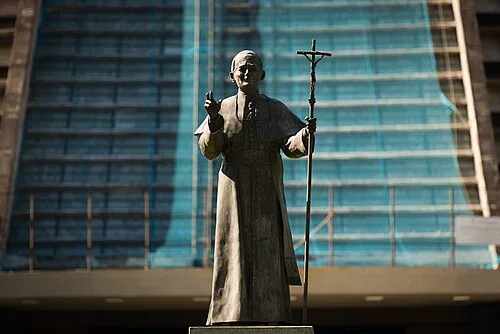 Statue of Pope John Paul II
Come back out into the daylight and the gardens around the cathedral. Here stands a bronze figure of Pope John Paul II, shown in his vestments, staff in one hand, the other raised in blessing. Set him against the backdrop and you get the full effect: the ribbed concrete wall of the cone rising behind him, so the pope and the building frame each other. The grounds of this cathedral work as a stage for modern Catholic devotion, a place where the church's recent history is given faces and figures in bronze. This monument is one of them: a pope who led the church into the era this cathedral was built for. Take the path a little further along, because there is one more figure waiting here, and it is the quietest and most surprising of all.
Listen in the appPhoto: Donatas Dabravolskas · CC BY-SA 4.0
07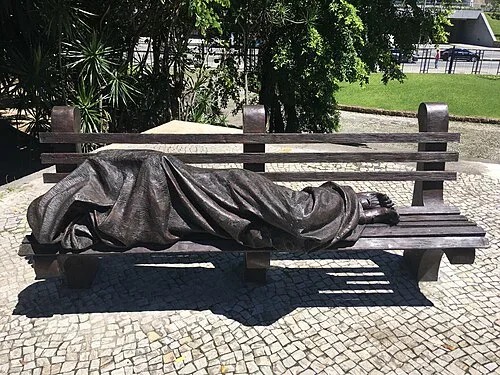 Homeless Jesus Sculpture
Jesus the Homeless
And here is the last stop: a bronze figure lying on a park bench, wrapped in a blanket from head to shoulders. At first glance you might take it for a person sleeping rough, which is exactly the idea. Look at the feet poking out from the blanket, with the wounds visible in them, and you recognise who this is. It is Jesus the Homeless, made by the Canadian sculptor Timothy P. Schmalz; this casting was placed near the cathedral grounds in 2018. Think about where your visit began and where it ends. A building built on that same circle of equals now keeps at its edge a sculpture of its most overlooked neighbour, asking to be seen. From the cone to the bench, this is one continuous statement: a modern church, speaking to the modern city, about who counts. Thank you for walking through it with me.
Listen in the appPhoto: ArlindoPereira · CC BY-SA 4.0
Catedral de São Sebastião do Rio de Janeiro
Frequently asked questions
How much does the guide cost?
Free app download. Listed guide price: $0.99. Guide price shown in the app. Audio guide only. Venue admission is separate.
Can I listen without internet?
Yes. Download the guide’s audio, images, and maps in the app before your visit. Your downloaded content is then available offline.
Can I listen in my language?
This audio guide is available in 15 languages, including English.
Do I need to follow a schedule?
No. This is a self-guided experience. Choose your stops, pause whenever you like, and return to a story at your own pace.
At your own pace
Explore Catedral de São Sebastião do Rio de Janeiro.
Download Stanza, then search for “Catedral de São Sebastião do Rio de Janeiro”.
Free app download · Guide price shown in the app
Keep exploring
Audio guides — Brazil
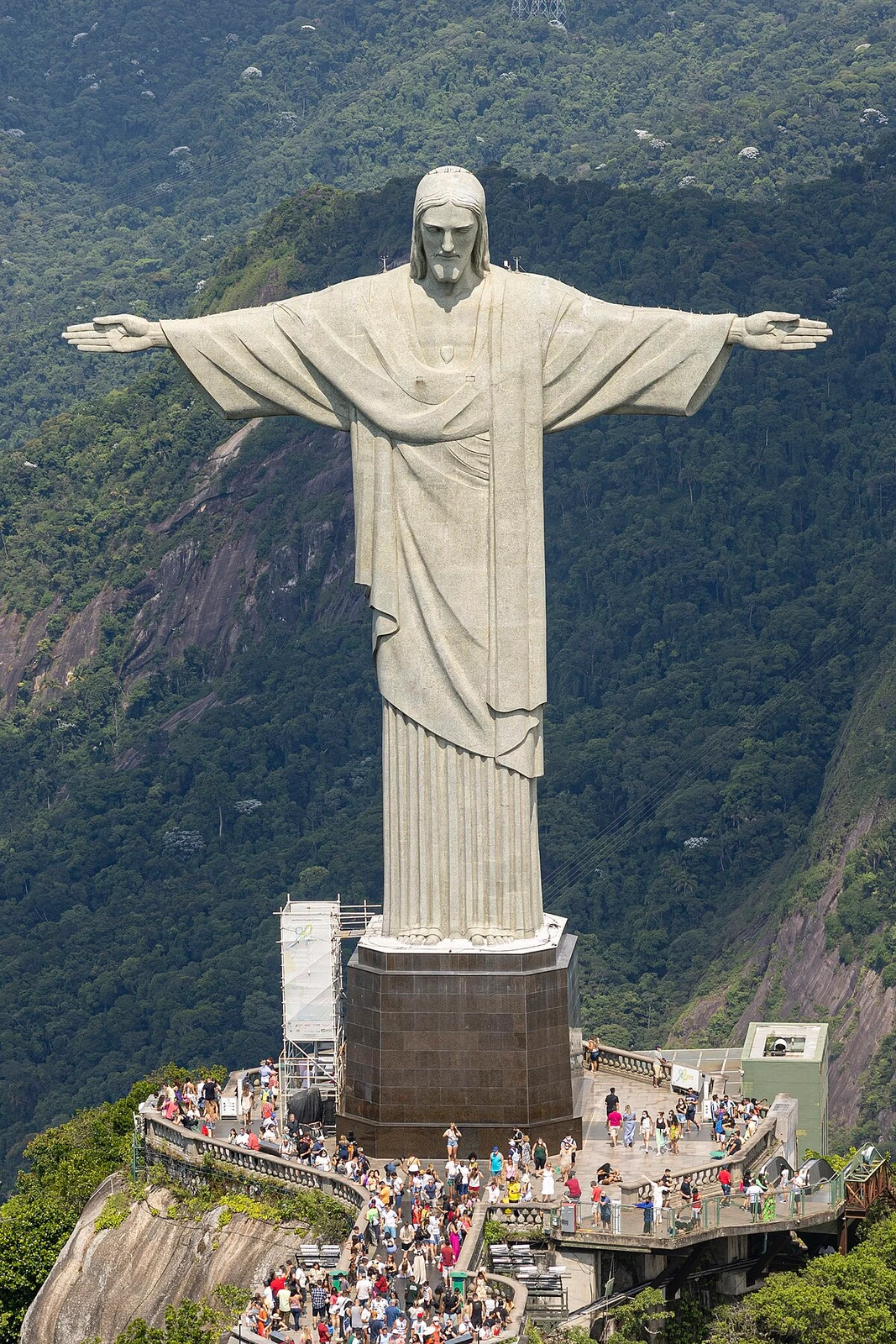
Rio de Janeiro · 5 km
Christ the Redeemer
Content & sources
Photo: Arne Müseler · CC BY-SA 3.0 de
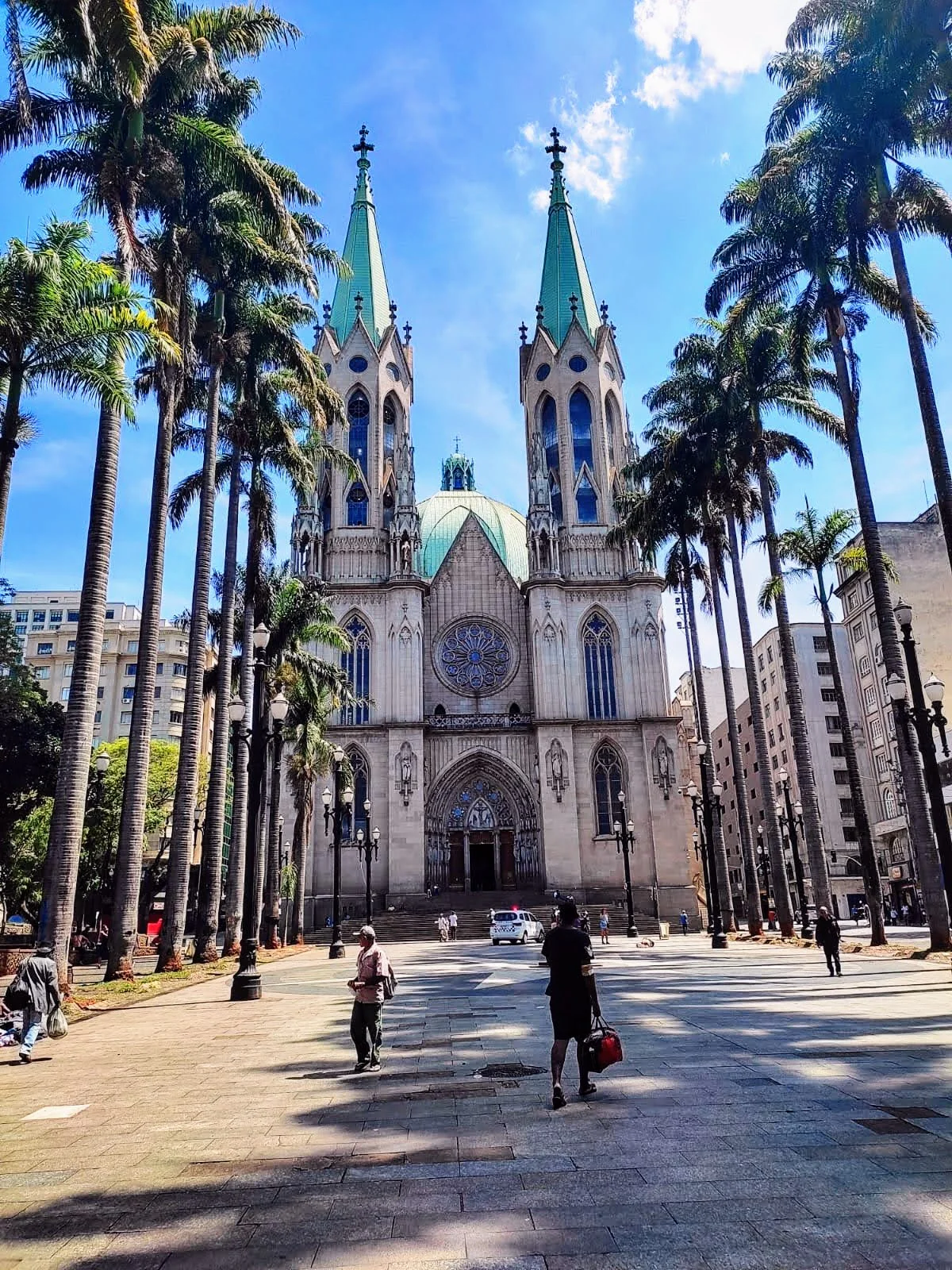
São Paulo
Catedral Metropolitana de São Paulo
Content & sources
Photo: Geovana li malike · CC BY-SA 4.0
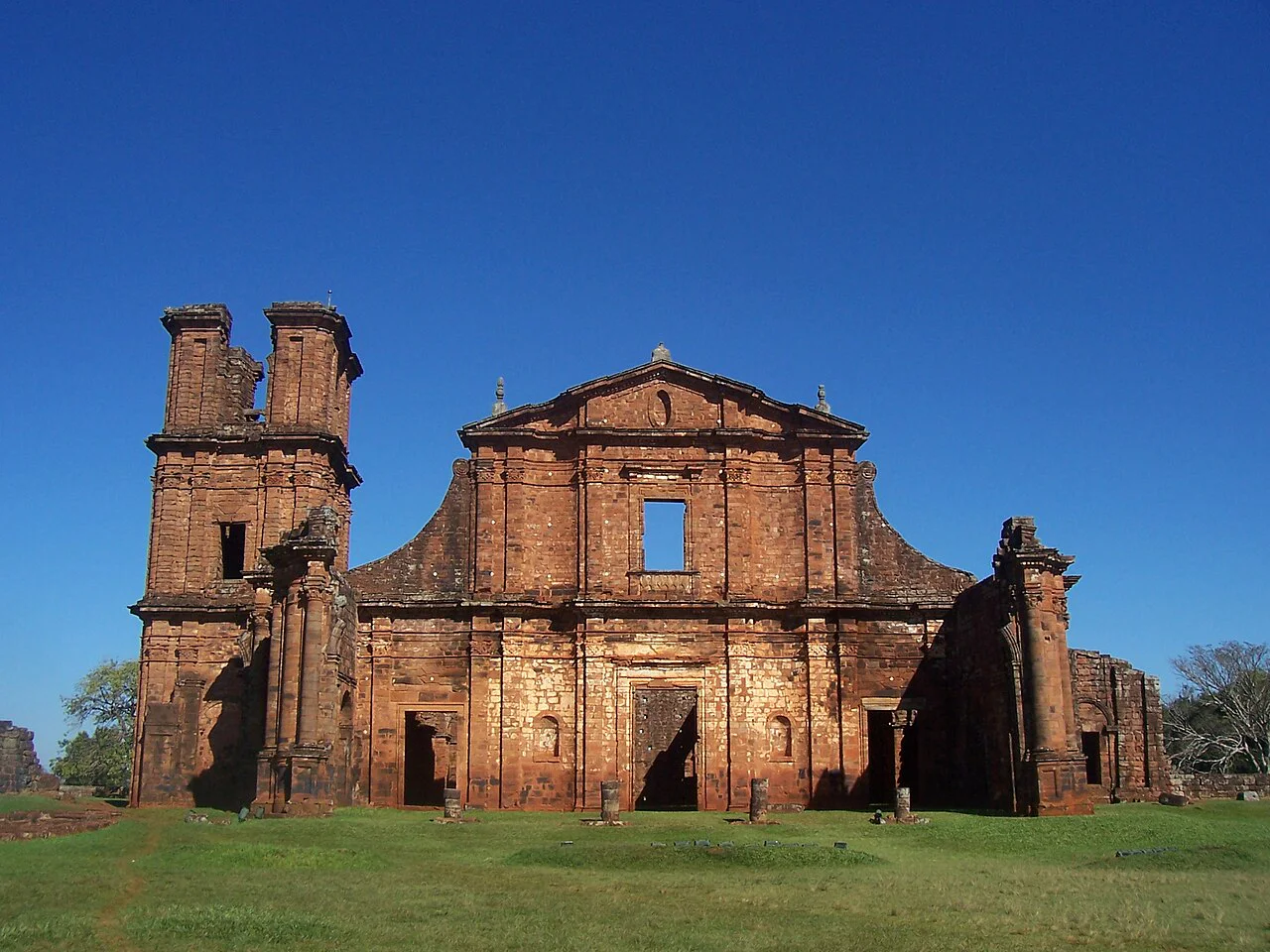
São Miguel das Missões
Sítio Arqueológico de São Miguel Arcanjo
Content & sources
Leandro Kibisz (Loco085) · CC BY-SA 3.0