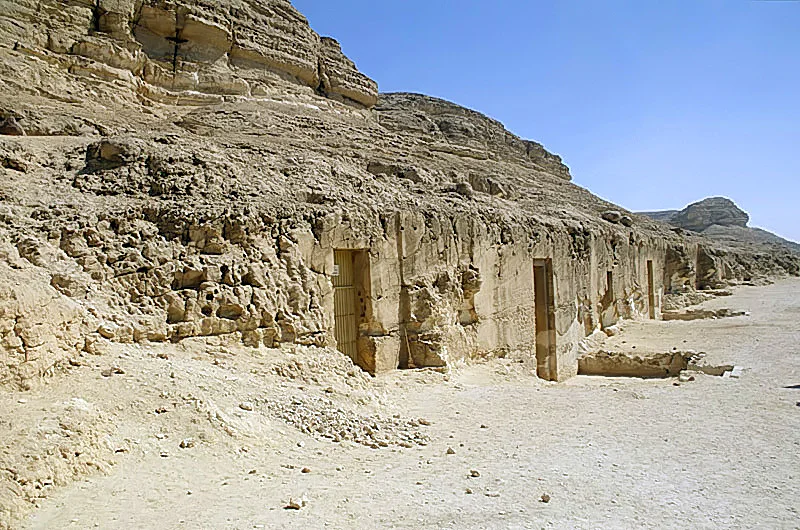
Stanza · Audio guide
Beni Hasan Audio Guide
A place to remember. A story to take with you.
Beni Hasan is an ancient Egyptian funerary site cut into the limestone cliffs on the east bank of the Nile. It contains monumental tombs that were excavated into the cliffs overlooking the valley.
Download Stanza, then search for “Beni Hasan”.
About the tour
One guide. Your kind of visit.
Beni Hasan is an ancient Egyptian funerary site cut into the limestone cliffs on the east bank of the Nile. It contains monumental tombs that were excavated into the cliffs overlooking the valley.
Ready when you are.
- 01Get the free Stanza app.
iOS & Android
- 02Find your guide.
“Beni Hasan”
- 03Download before you go.
Works offline
Audio guide / 18 narrated stops
Inside the guide
Get to know a few of the stories before you go. Open a stop to read more.
01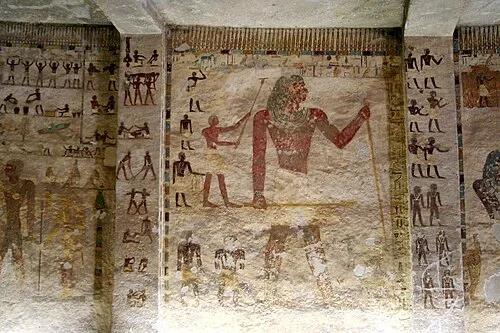 Tomb of Khety
Khety's Chapel: The Governor Among His Scenes
Khety governed the sixteenth province of Upper Egypt, and his rock-cut tomb at Beni Hasan is dated roughly between 2055 and 1956 BC. The chapel was originally supported by two rows of columns topped with lotus-flower capitals. Only one column from each row survives intact. The tall painted figure holding a long staff is read as Khety himself, following the usual convention of Egyptian tomb decoration. Around him the walls carry the panorama he chose for his province. The east wall shows military training, an assault on fortified structures, and a hundred and twenty-two pairs of wrestlers. Other walls depict desert hunting, woodworking, spinning and weaving, board games, acrobatics, winemaking, music and sport.
Photo: Kurohito · CC BY-SA 3.0
02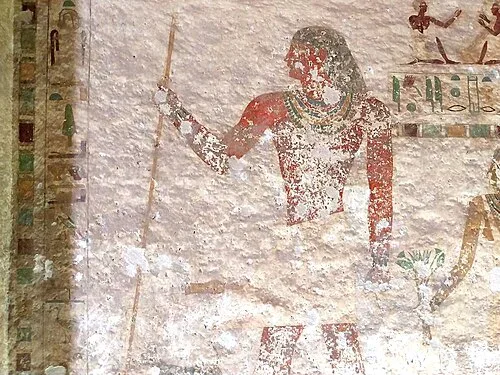 Tomb of Khety
The Tomb Owner with His Staff
The largest figure on these chapel walls is always the tomb's owner. He stands head and shoulders above the people around him, leaning on a long staff. Egyptian painters used size for rank, not for distance, so the great man dwarfs his own estate workers. Around him run registers of servants, herds and produce, each row busy with small figures. A governor had himself shown this way so that everything which sustained him in life would keep serving him after death. The staff in his hand marks the authority behind it all.
Photo: Udimu · CC BY-SA 4.0
03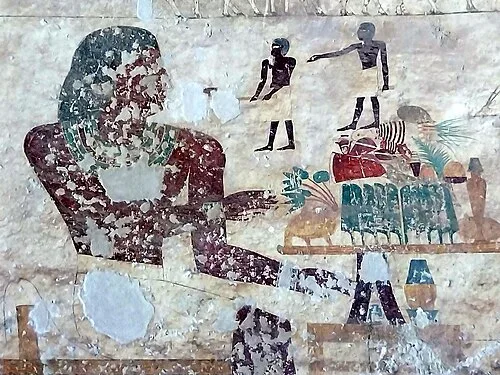 Tomb of Khety
Offerings for the Afterlife
A great seated figure faces a table piled with bread, fowl, jars and produce, carried in by his attendants. A chapel like this was more than a decorated room. It was a place where offerings could be made to sustain the dead owner. Mourners and priests would bring real food and drink to the tomb. Painted provisions served the same purpose if those offerings ever stopped. Bread and geese depicted on the wall could feed the deceased just as well. That is why so much of the wall here is given over to food and drink.
Listen in the appPhoto: Udimu · CC BY-SA 4.0
04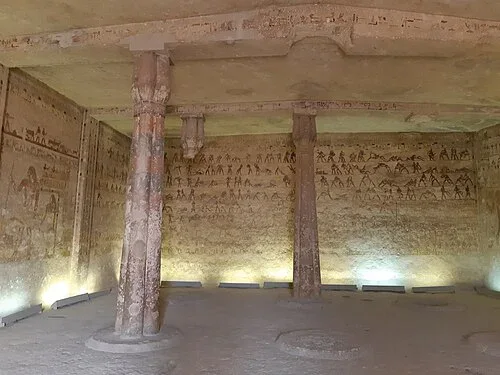 Tomb of Baqet III
Inside the Chapel of Baqet III
Baqet III was governor of the Oryx nome and the son of a provincial official named Ramushenti. His tomb belongs to the southern group of the cemetery, generally taken as the earlier part, from the first phase of the Middle Kingdom. Inside the chapel, rock-cut columns carry the roof, and the walls are crowded with tiny painted figures. His chapel was preceded by a court, and a small shrine in its south-eastern corner held a false door and an offering table. Two great themes fill these walls, a long wrestling cycle and a panorama of the province at work.
Listen in the appPhoto: Leon petrosyan · CC BY-SA 4.0
05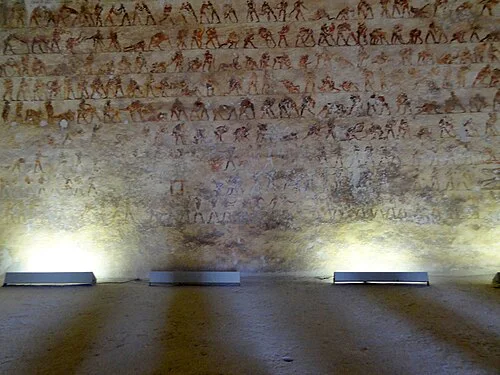 Tomb of Baqet III
The Great Wrestling Wall
On the east wall of Baqet III's chapel, wrestlers grapple in row after row. The cycle holds two hundred and twenty pairs, each bout frozen mid-move, a grip here, a throw there. Scholars have read the sequence almost like a graphic training manual for combat, one move answering another down the wall. That is the interpretation offered today, not a purpose the ancient painters recorded themselves. Whatever the intention, the wall lays out the sport hold by hold, at a scale matched by little else in Egyptian art.
Listen in the appOlaf Tausch · CC BY 3.0
06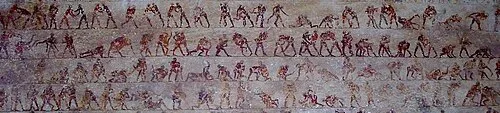 Tomb of Baqet III
Red and Brown: Reading the Wrestlers
Two bodies locked in a grapple are hard to tell apart, and the painters here solved that with colour. In every pair, one wrestler is painted red and the other dark brown. The red man's limbs and the brown man's stay distinct even at the height of a throw. That simple code keeps every hold and counter-hold legible down the whole frieze. The bouts belong to the great wrestling cycle that fills the east wall of this same chapel.
Listen in the appUnknown author · Public domain
07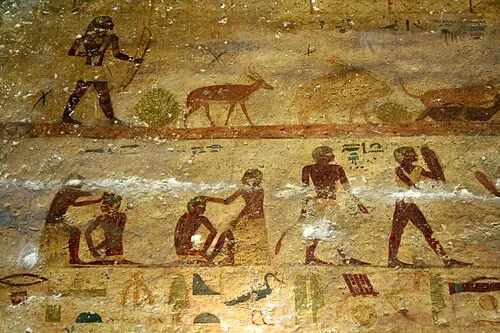 Tomb of Baqet III
Work, Tax and the Desert Hunt
Hunters chase desert game in the upper register of this wall. Below them, figures work at their trades. Baqet III's walls combine hunting and fishing, craftsmen at work, tax collection, animals, and even a battle and the siege of a fortress. Together they form a panorama of a province at work, chosen by the man who governed it. Funerary art of this period was generally opening up from rigid religious formulas toward scenes of real activity. These walls show that shift plainly, less ritual and more daily life. Tax collection appears here too, the governor's own administrative duty recorded in paint.
Listen in the appPhoto: Kurohito · CC BY-SA 3.0
08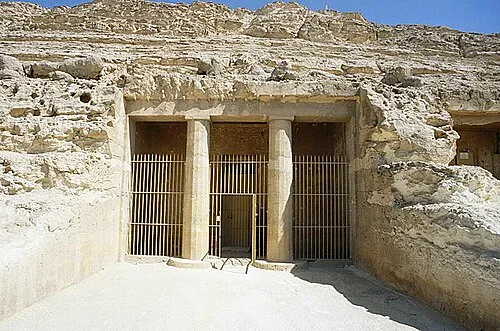 Tomb of Khnumhotep II
Beni Hasan: The Cliff Cemetery of the Oryx Nome
Beni Hasan served as the principal cemetery of the Oryx nome, the sixteenth province of Upper Egypt, during the Middle Kingdom. Burials here range from the late Old Kingdom onward, and the grandest tombs belonged to the province's governors. The accepted account holds that the cliff was chosen for its solid rock and its closeness to the provincial capital. Thirty-nine monumental tombs sit in a single stratum halfway up the cliff, their entrances strung along a natural terrace about a quarter of a mile long. Farther down the slope, the lower cemetery holds roughly nine hundred simpler graves. Four of the great tombs are open to visitors, those of Amenemhat, Khnumhotep II, Baqet III and Khety. South of the cemetery, in a wadi, Hatshepsut later built a rock-cut temple for the goddess Pakhet, the sanctuary the Greeks knew as Speos Artemidos.
Listen in the appRoland Unger · CC BY-SA 3.0
09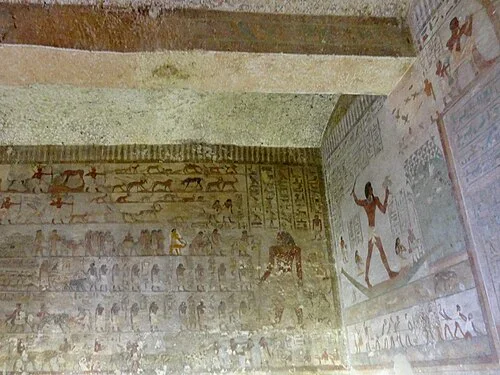 Tomb of Khnumhotep II
Khnumhotep II and His Life in Writing
Khnumhotep II served as Overseer of the Eastern Desert under King Senusret II. A court and a portico with two fluted columns stand before his chapel. Inside, two burial shafts drop to the burial chambers, and a hall once supported by four columns leads to a shrine made for the owner's statue. The pride of the tomb is its writing. An inscription running across two hundred and twenty-two columns of text recounts Khnumhotep's life. It is a rare case of a provincial grandee narrating his own career on his own walls.
Listen in the appOlaf Tausch · CC BY 3.0
10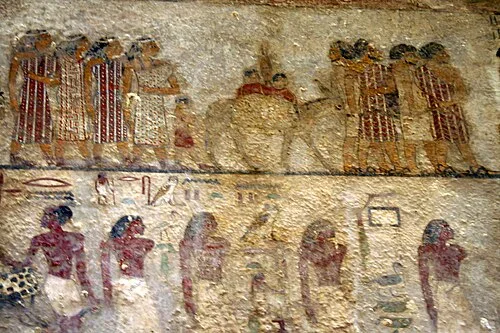 Tomb of Khnumhotep II
The Caravan of the Aamu
On the north wall of Khnumhotep II's chapel, a procession moves from right to left. Fifteen men, women and children are painted in brightly patterned garments, striped and coloured in a way quite unlike Egyptian dress. They are the Aamu, people from the lands to the east of Egypt. The writing beside them records a larger group still, thirty-seven in all. The inscription ties their arrival to mesdemet, the black eye-paint Egyptians prized. So the scene reads as trade, a delegation coming in with goods, and perhaps seeking them. It counts among the earliest and most detailed pictures of Levantine peoples anywhere in Egyptian art, a record of migration and exchange from the early second millennium BC.
Listen in the appPhoto: Kurohito · CC BY-SA 3.0
- 11
Abisharie, Ruler of the Hill-Lands
The named leader of the Aamu caravan, and the foreign title that would later give history the word Hyksos.
- 12
The Asiatic Lyre Player
A musician in patterned dress carrying an Asiatic lyre, a reminder that delegations brought skills as well as goods.
- 13
Hunting in the Marshes
A tomb owner striking down waterfowl in the papyrus thicket, a hunt that was also meant to feed the dead.
- 14
Amenemhat (Ameny): The Last Great Governor
The last known governor of the Oryx nome, his tomb's grand approach, and the era of vast tombs that ended after him.
- 15
The Family Shrine of Ameny
A shrine cut into the tomb's eastern wall, holding Ameny with his wife Hetepet and his mother Henu.
- 16
Columns Carved from the Living Rock
The multi-sided, fluted columns of Beni Hasan, carved straight out of the cliff rather than built and dressed.
- 17
A Ceiling of Beams and Matting
A painted ceiling of geometric patterns that imitates wooden beams and woven matting in solid rock.
- 18
Ameny's Estate: Fields, Craft and River
The estate scenes on Ameny's walls, boats and fields and craft, and a quiet look at how the paint has faded.
Beni Hasan
Frequently asked questions
How much does the guide cost?
Free app download. Listed guide price: $2.99. Guide price shown in the app. Audio guide only. Venue admission is separate.
Can I listen without internet?
Yes. Download the guide’s audio, images, and maps in the app before your visit. Your downloaded content is then available offline.
Can I listen in my language?
This audio guide is available in 15 languages, including English.
Do I need to follow a schedule?
No. This is a self-guided experience. Choose your stops, pause whenever you like, and return to a story at your own pace.
At your own pace
Explore Beni Hasan.
Download Stanza, then search for “Beni Hasan”.
Free app download · Guide price shown in the app
Keep exploring
Audio guides — Egypt
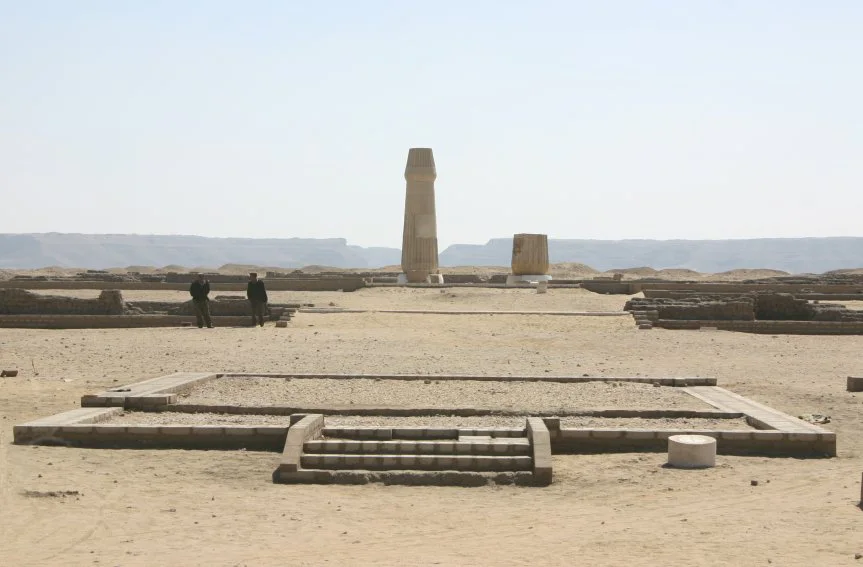
Minya Governorate · 30 km
Amarna
Content & sources
en:User:Markh · CC BY-SA 3.0
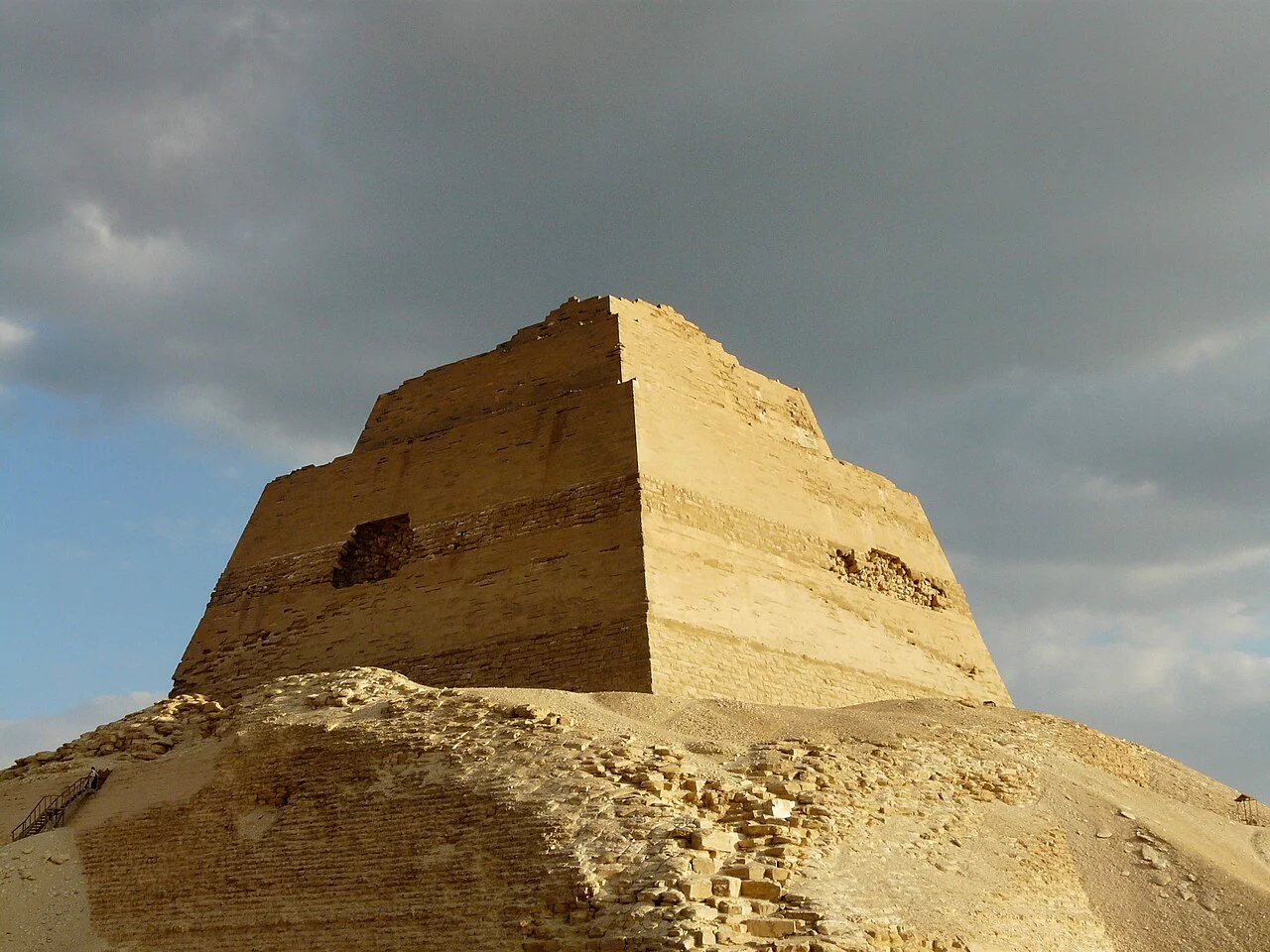
Meidoum
Meidum
Content & sources
Photo: Kurohito · CC BY-SA 3.0
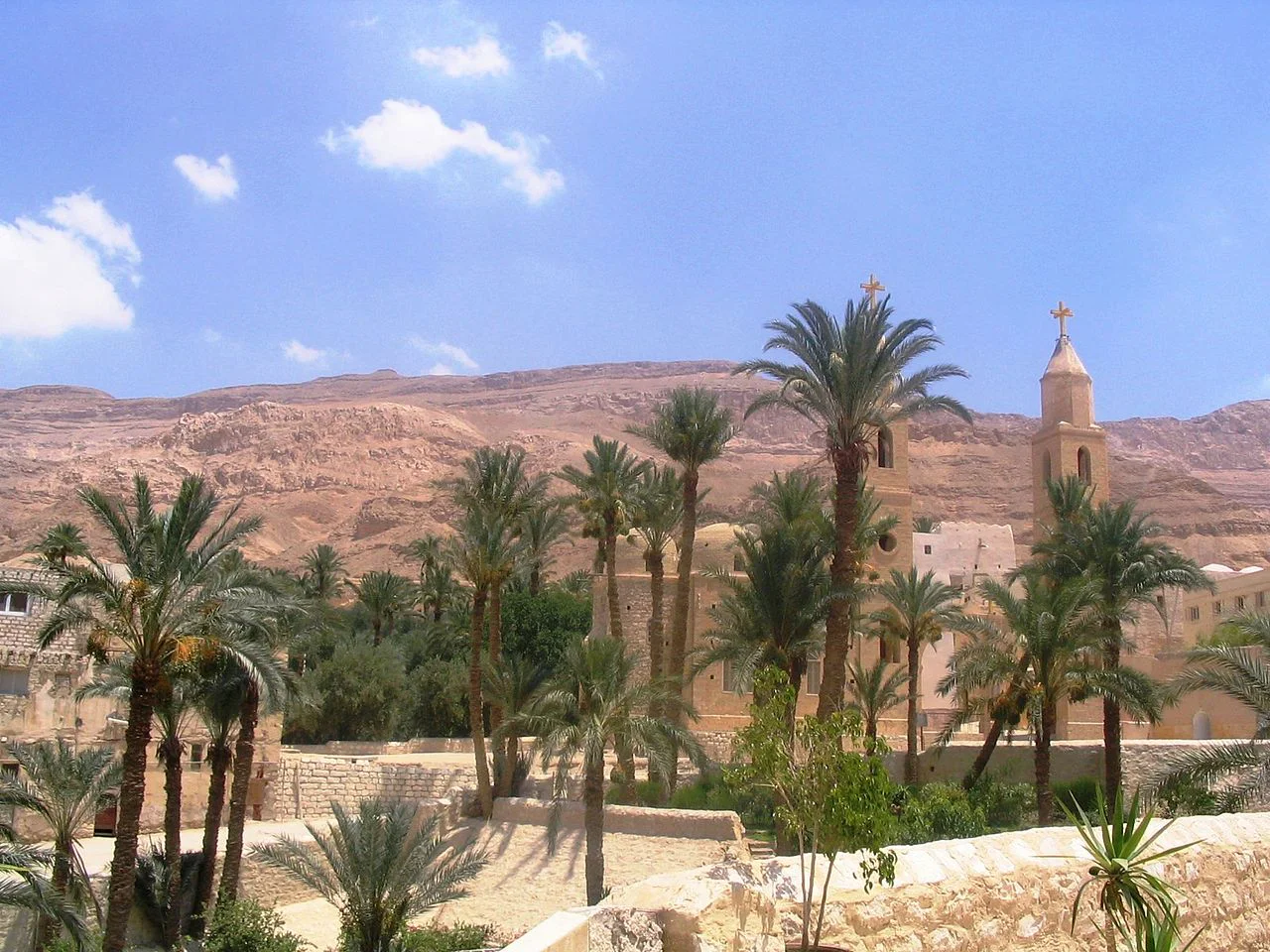
Monastery of Saint Anthony
Monastery of Saint Anthony
Content & sources
Tentoila (talk) · Public domain
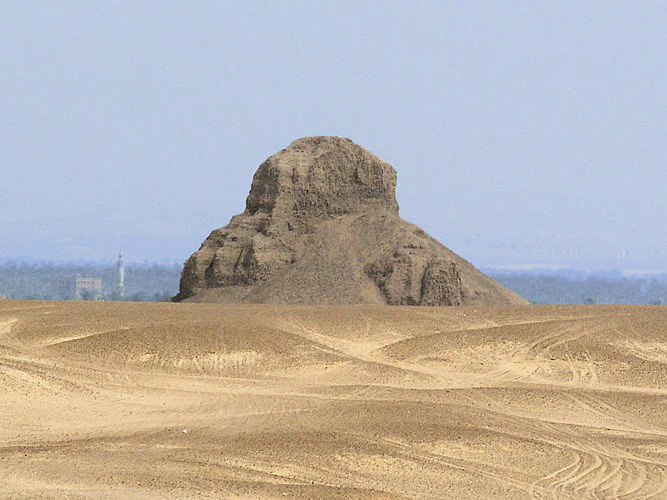
Minshat Dahshur
Black Pyramid
Content & sources
Jon Bodsworth · Copyrighted free use