Stanza · Audio guide
Meidum Audio Guide
A place to remember. A story to take with you.
Meidum is an archaeological site in Lower Egypt that contains a large pyramid and several mudbrick mastabas. It is significant as the location of Egypt's first straight-sided pyramid.
Download Stanza, then search for “Meidum”.
About the tour
One guide. Your kind of visit.
Meidum is an archaeological site in Lower Egypt that contains a large pyramid and several mudbrick mastabas. It is significant as the location of Egypt's first straight-sided pyramid.
Ready when you are.
- 01Get the free Stanza app.
iOS & Android
- 02Find your guide.
“Meidum”
- 03Download before you go.
Works offline
Audio guide / 9 narrated stops
Inside the guide
Get to know a few of the stories before you go. Open a stop to read more.
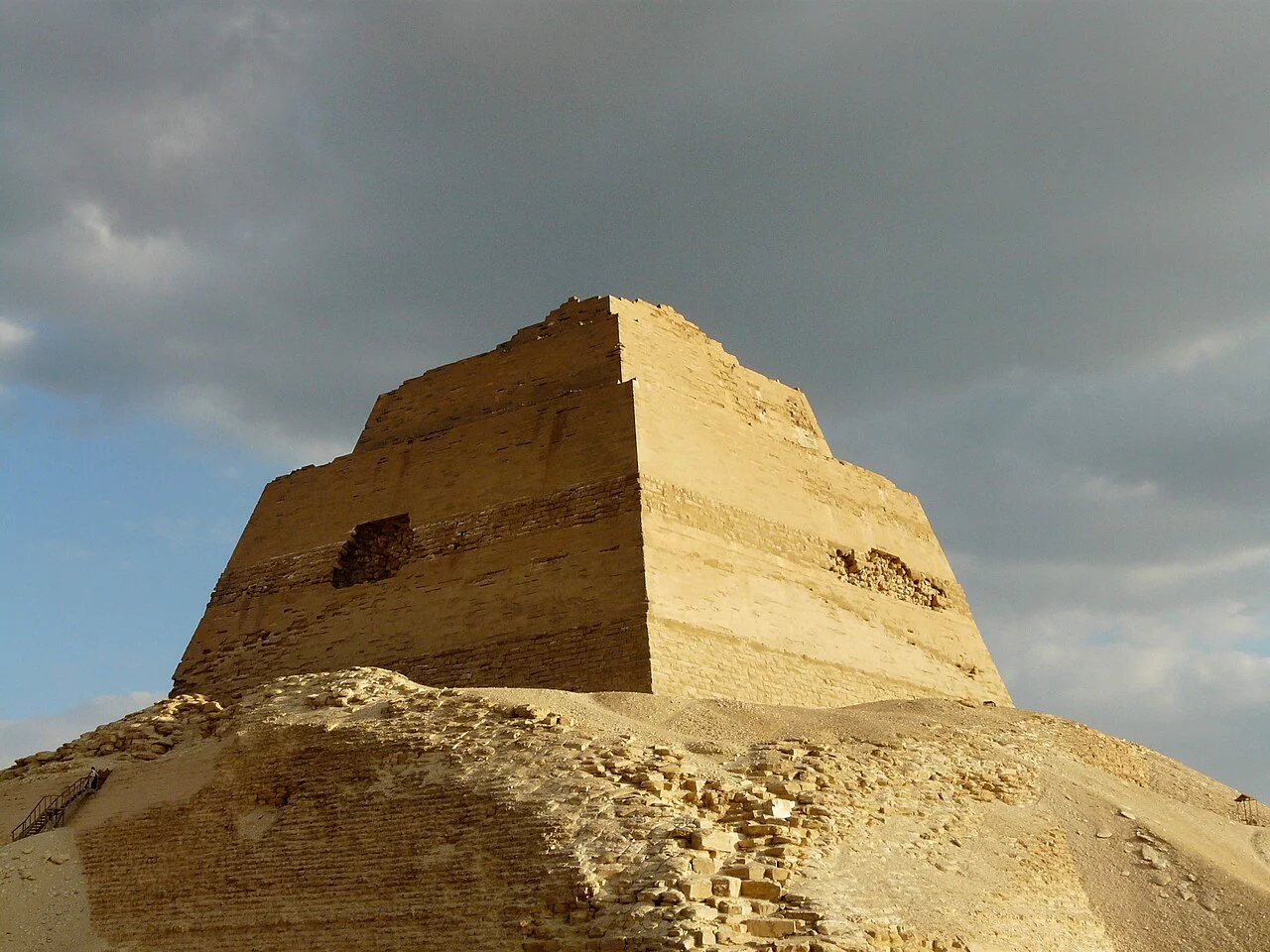
01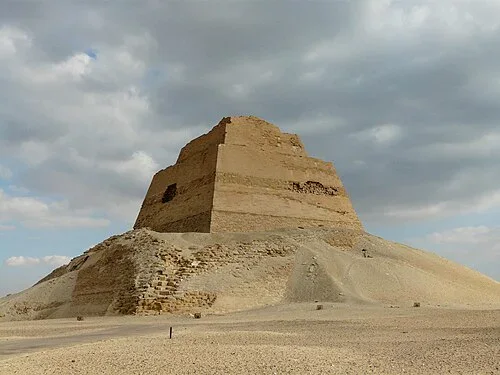 Pyramid Exterior and the Evolution of Design
The Meidum Pyramid
Welcome to Meidum, an archaeological site about seventy kilometres south of Cairo. Egyptians knew this lonely tower as el-heram el-kaddaab, the false pyramid, for its strange silhouette rising out of the open desert. It began as a royal tomb around twenty-six hundred BC. It is argued to have been started under Huni, the last pharaoh of the Third Dynasty, and continued by his successor Sneferu. A tomb like this was meant to carry a king into the afterlife and to project his divine power. In ruin the pyramid stands about sixty-five metres high. Finished, it would have climbed past ninety. The question this visit keeps asking is why Egypt's first straight-sided pyramid stands broken.
Photo: Kurohito · CC BY-SA 3.0
02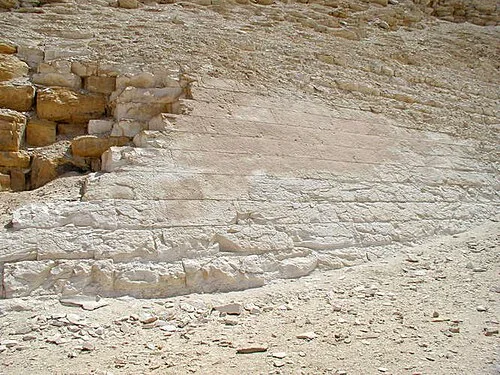 Pyramid Exterior and the Evolution of Design
The Surviving Casing
Up close, the masonry tells the pyramid's life in three stages. The archaeologist Borchardt numbered them E1, E2 and E3. E1 was a step pyramid much like the one built for Djoser. E2 wrapped a band of new stone around the old building, a ring only about five metres wide. It raised the number of steps from five to seven. E3 filled the steps in with limestone casing, turning the stack of steps into smooth, straight slopes. That smooth facing still clings to the stepped core at the base, and it is what made this Egypt's first straight-sided pyramid. The finished faces were set to slope at fifty-one degrees, fifty minutes, thirty-five seconds. The surveyor Flinders Petrie measured the design and found the same proportions as the Great Pyramid at Giza, a ratio of seven to forty-four. How the builders hauled all that stone is still argued over. One early guess, a single long straight ramp, is now widely doubted, and ramps running along the sides of the steps remain a hypothesis.
Jon Bodsworth · Copyrighted free use
03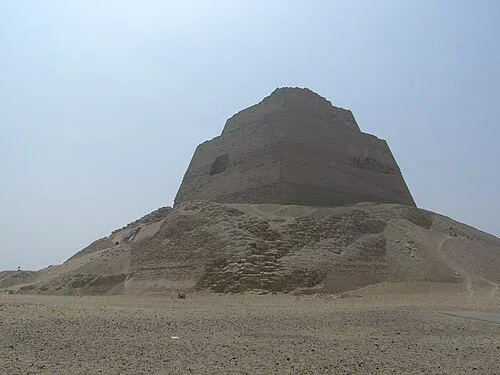 The Debris Mound and the Collapse Theory
The Rubble Mound and the Collapse
The whole pyramid sits in a vast mound of its own debris. That mound is the clue to what went wrong. The outer casing was founded on sand, not on rock like the inner layers. The inner steps had also been finished as if they were the final stage. Their surfaces were polished, and their platforms tipped outward instead of lying level. The story goes that a downpour struck while the building was still under way, and the outer layers slid off in one motion. Excavation supports a sudden fall. Everything beneath the rubble was found fully intact. The casing stones were only carried off after digging exposed them. One scholar, Franck Monnier, argues the collapse came much later, in the New Kingdom. The evidence of the untouched interior weighs the other way, toward a disaster in Sneferu's own reign.
Listen in the appNo machine-readable author provided. Neithsabes assumed (based on copyright claims). · Public domain
04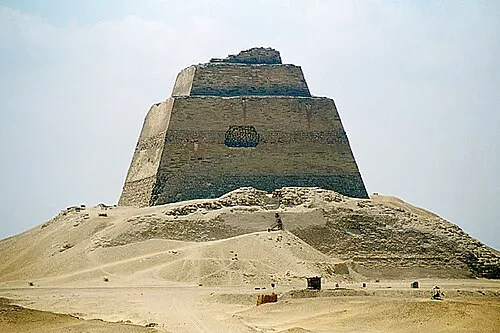 The Northern Face and Entrance Chapel
The North Face and the Medieval View
The north face shows its history in bands of masonry stacked one above the other. This face also carries the ruin's later life. In the fifteenth century the historian al-Maqrizi described the pyramid as a five-stepped mountain. If he counted right, the monument has lost ground since his day. The writer Mendelssohn suspected a loose translation instead. Al-Maqrizi's words could read 'five-storied mountain', which would match the pyramid much as it stands now, with its bands of masonry and a step on top. By the time Napoleon's expedition surveyed the site in 1799, only today's three steps were left.
Listen in the appRoland Unger · CC BY-SA 3.0
05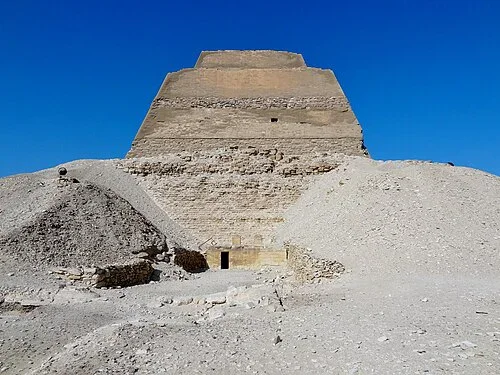 The Northern Face and Entrance Chapel
The Entrance and the Way In
A doorway opens low on the north face, and the pyramid's inside lies beyond it. The ancient entrance sits much higher, about twenty metres above the present ground. From there a steep passage drops some seventeen metres to a horizontal corridor below the original ground level. A short vertical shaft then climbs to the burial chamber, its walls closing inward course by course. Inside, nothing was finished. The walls are raw and unpolished. The wooden support beams still stand in place, and builders normally removed those once the work was done. This chamber was probably never used for a burial.
Listen in the appOlaf Tausch · CC BY 3.0
06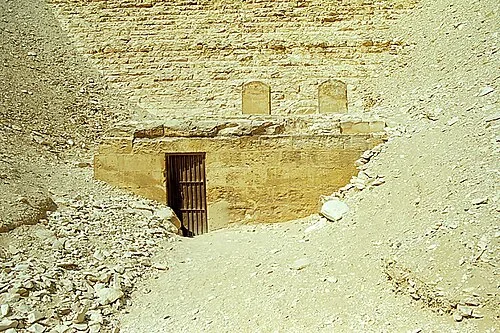 Eastern Mortuary Temple and Causeway
The Mortuary Temple
On the east side of the pyramid a small mortuary temple hides in the debris. Excavators found it beneath the rubble, apparently never finished. Its limestone walls were only partly polished. Two stelas stand inside it, the tall slabs that would normally carry the pharaoh's name. Both are blank, waiting for a name that never came. The temple is quiet proof that death outpaced the building work.
Listen in the appRoland Unger · CC BY-SA 3.0
07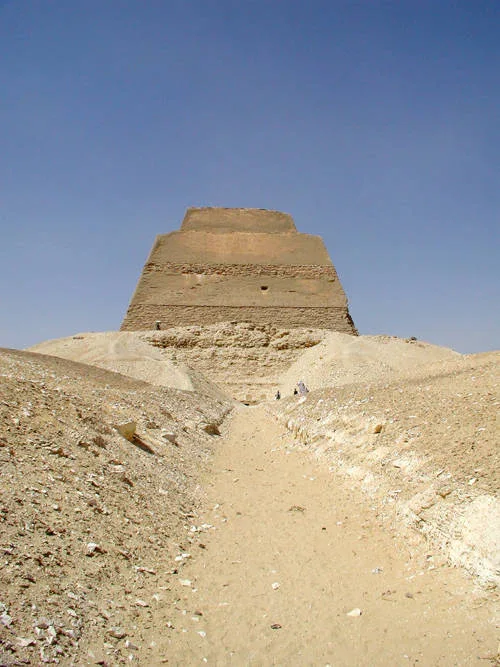 Eastern Mortuary Temple and Causeway
The Causeway
A sunken causeway runs east from the pyramid, a walled corridor through the sand. From Sneferu's reign onward, Egyptian pyramid complexes included a valley temple at the lower end of the causeway. Meidum has none. Whether one was never started or has simply vanished, no trace of it has been found. It is one more sign that this complex was abandoned before its plans were complete.
Listen in the appJon Bodsworth · Copyrighted free use
08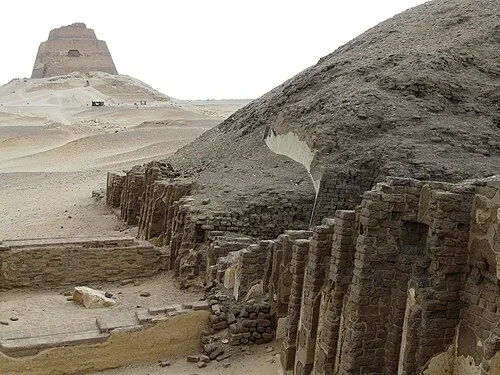 The Mudbrick Mastabas and Ancient Art
The Mudbrick Mastabas
Around the king's monument, the desert holds a cemetery of its own. Mudbrick mastabas, the flat rectangular tombs of the early Fourth Dynasty, belong to high officials and members of the royal court. The grandest is the mastaba of Nefermaat, from which the pyramid itself can be seen in the distance. Several of these tombs were never completed or used, and in them excavators found none of the usual burials. A whole court built its tombs around a king, and parts of the cemetery were left unfinished.
Listen in the appPhoto: Kurohito · CC BY-SA 3.0
09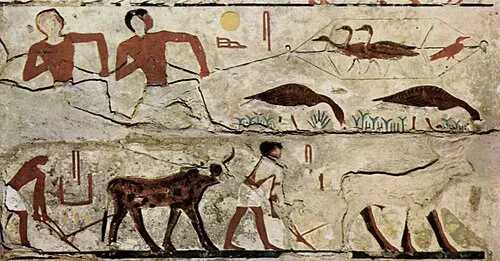 The Mudbrick Mastabas and Ancient Art
Painted Relief from the Tomb of Itet
The walls of these tombs were painted for the afterlife, and the work survives in strong colour. One painted relief, attributed to the burial chamber of Itet in the Nefermaat mastaba, shows birds being caught and fields being ploughed with cattle. The workers lean into their tasks, and every figure moves. The painting is kept today in the Egyptian Museum in Cairo. Images like these were meant to be useful. Painted food and the rhythms of estate life were to supply the dead for eternity. The hands that made them belonged to the generation of craftsmen who tried to raise Egypt's first straight-sided pyramid. Meidum's story holds both at once: a royal tomb that was probably never used for a burial, and a court's art that still carries its colours.
Listen in the appMaler der Grabkammer der Itet · Public domain
Meidum
Frequently asked questions
How much does the guide cost?
Free app download. Listed guide price: $0.99. Guide price shown in the app. Audio guide only. Venue admission is separate.
Can I listen without internet?
Yes. Download the guide’s audio, images, and maps in the app before your visit. Your downloaded content is then available offline.
Can I listen in my language?
This audio guide is available in 15 languages, including English.
Do I need to follow a schedule?
No. This is a self-guided experience. Choose your stops, pause whenever you like, and return to a story at your own pace.
At your own pace
Explore Meidum.
Download Stanza, then search for “Meidum”.
Free app download · Guide price shown in the app
Keep exploring
Nearby audio guides
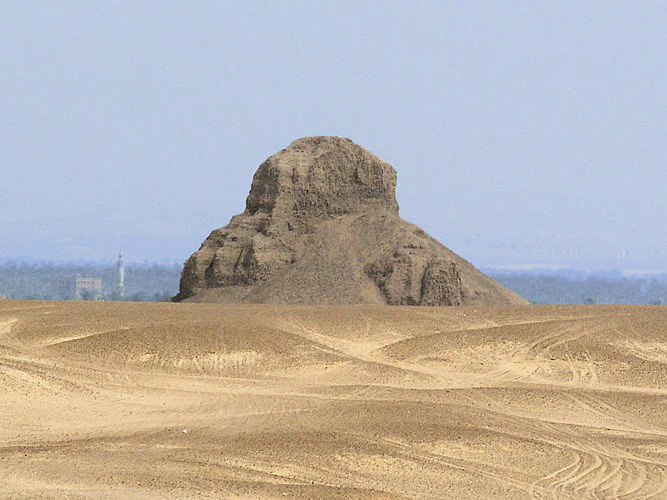
Minshat Dahshur · 47 km
Black Pyramid
Content & sources
Jon Bodsworth · Copyrighted free use
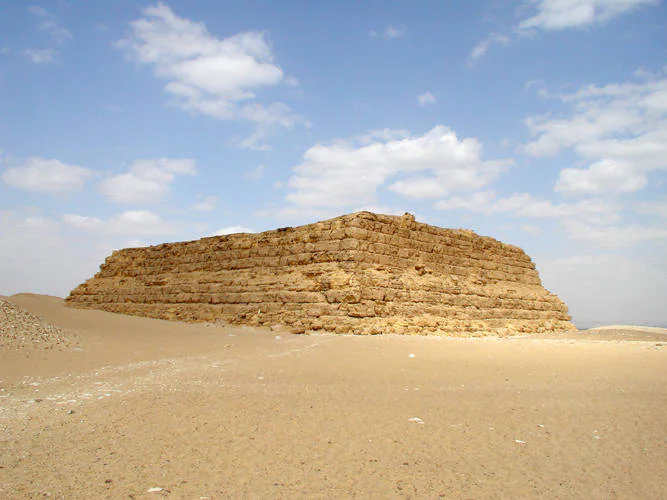
Saqqara · 52 km
Mastabat al-Fir'aun
Content & sources
Jon Bodsworth · Copyrighted free use
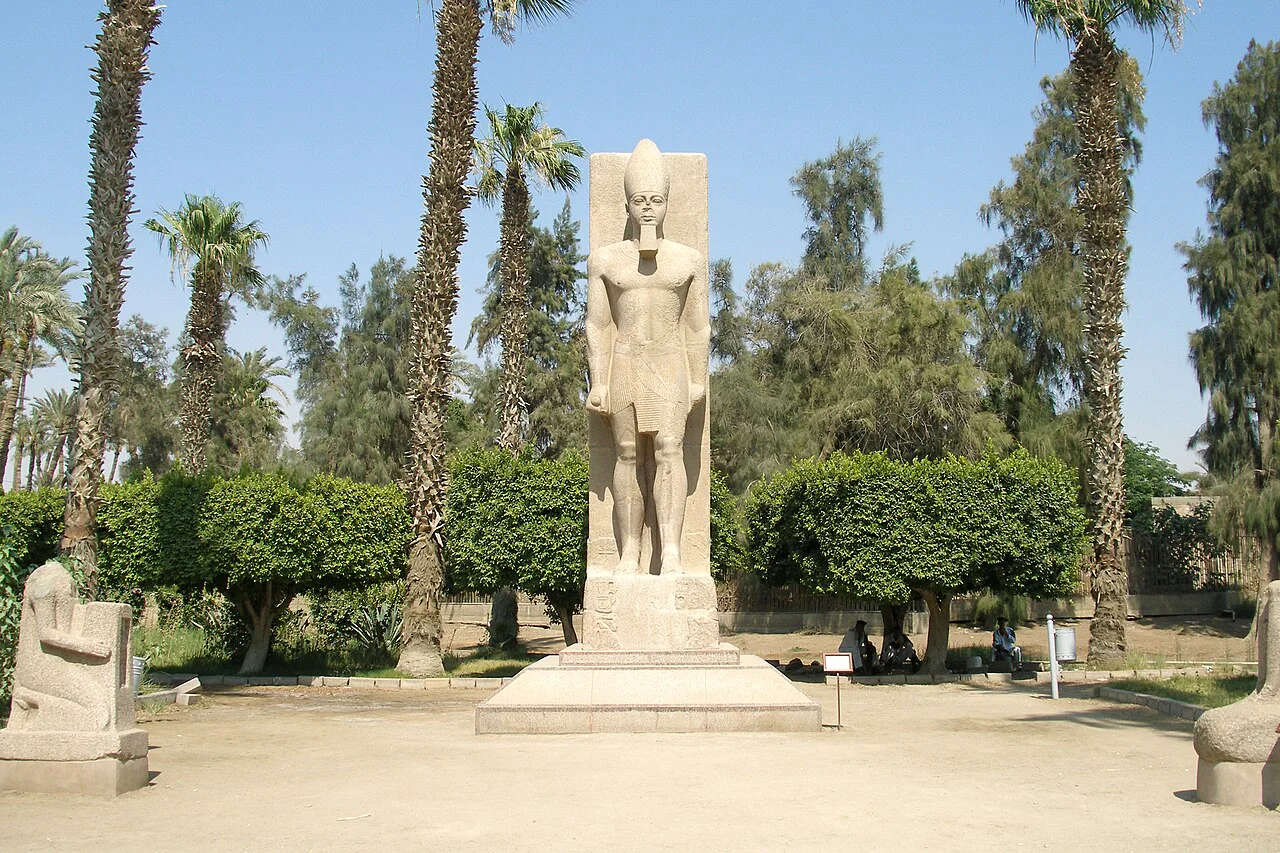
Mit Rahinah · 53 km
Memphis, Egypt
Content & sources
Vyacheslav Argenberg · CC BY 4.0
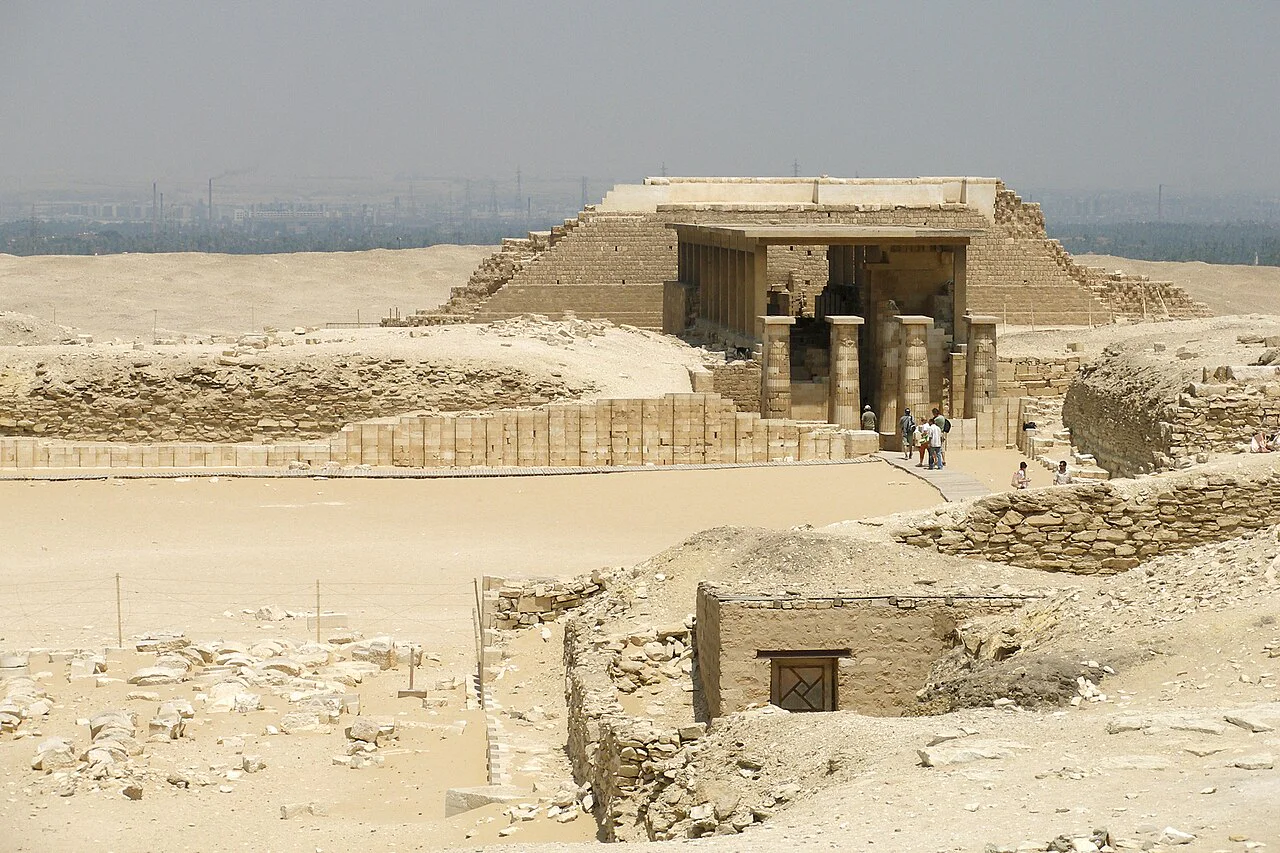
Saqqara · 53 km
Saqqara
Content & sources
Vyacheslav Argenberg · CC BY 4.0