Stanza · Audio guide
Tazumal Audio Guide
A place to remember. A story to take with you.
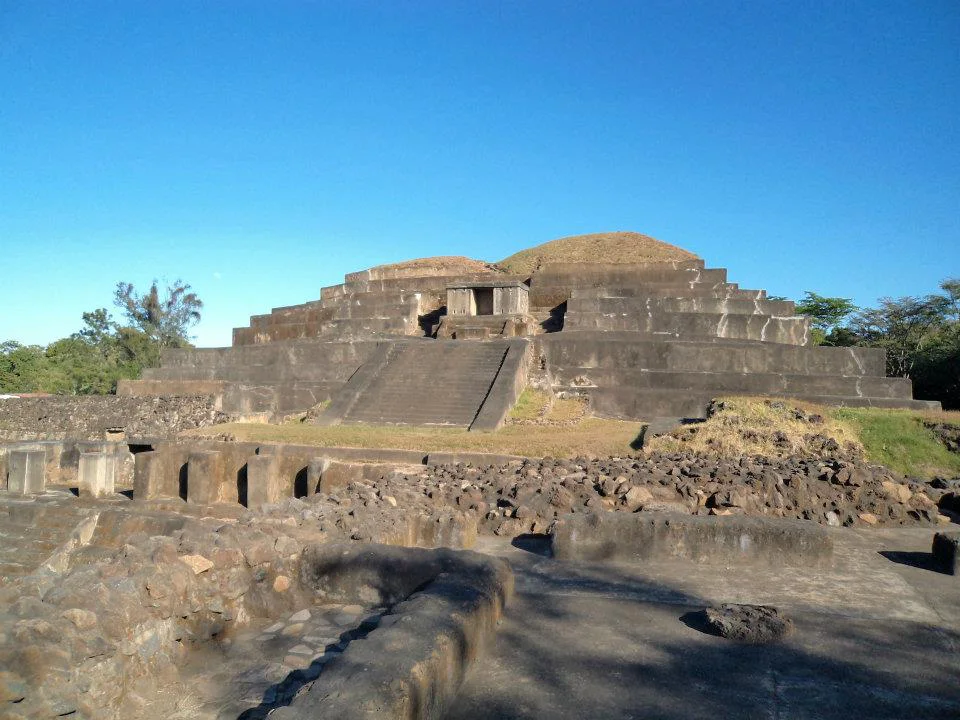
Tazumal is a pre-Columbian archaeological site and architectural complex located in Chalchuapa, El Salvador. It forms part of the remains of the ancient Mesoamerican city of Chalchuapa.
Download Stanza, then search for “Tazumal”.
About the tour
One guide. Your kind of visit.
Tazumal is a pre-Columbian archaeological site and architectural complex located in Chalchuapa, El Salvador. It forms part of the remains of the ancient Mesoamerican city of Chalchuapa.
Ready when you are.
- 01Get the free Stanza app.
iOS & Android
- 02Find your guide.
“Tazumal”
- 03Download before you go.
Works offline
Audio guide / 11 narrated stops
Inside the guide
Get to know a few of the stories before you go. Open a stop to read more.
01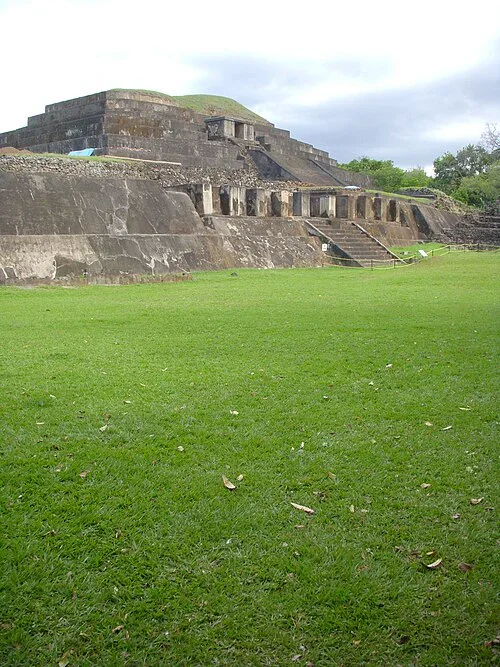 Park Plaza and Grand Approach
Tazumal: Gateway to the Ceremonial City
Welcome to Tazumal, in western El Salvador. Tazumal forms the southern portion of the archaeological zone of Chalchuapa, an ancient Mesoamerican city. This was one of its ceremonial hearts, a centre of politics and religion built and rebuilt over roughly a thousand years, beginning around AD 200. One oddity stands out straight away: every building in the complex faces west. Earlier sites in the region were laid out on a north–south line instead. Here the buildings turn their fronts toward the open lawn. Across the grass the pyramids rise in stepped tiers. Away in the northwestern corner, two unexcavated mounds sit partly inside a cemetery from the last century. Their shape suggests a Mesoamerican ballcourt, though little more than their outlines is known. Test pits dug there did find the mortar floor of an I-shaped court, the classic layout for the Mesoamerican ballgame.
otrarove · CC BY-SA 3.0
02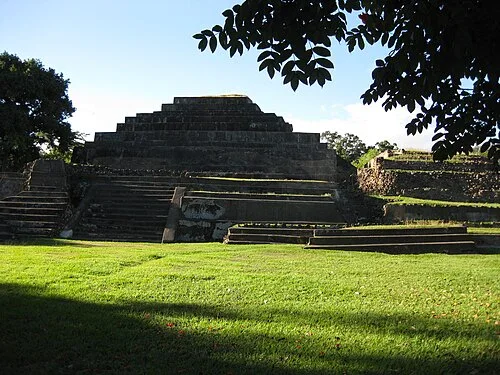 Park Plaza and Grand Approach
Ash from the Mountain: Ilopango and the Restart
Deep in this site's timeline sits a catastrophe. Around the boundary between the Late Preclassic and the Early Classic, the Ilopango volcano erupted some seventy-five kilometres east of Chalchuapa. The disaster interrupted construction at Tazumal. The pause may have lasted several generations. Work resumed during the Early to Middle Classic, between about AD 250 and 650. Even then, the city never fully recovered the enormous scale of its Preclassic building boom. The pyramids here carry that recovery in their stacked layers, each one a fresh start after the ash.
Jose Quintanilla · CC BY-SA 3.0
03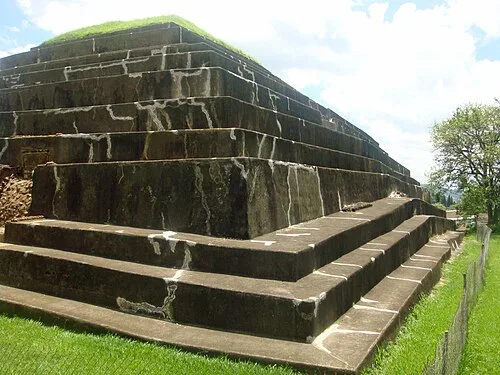 Structure B1-2 (The Toltec Pyramid)
The Toltec Pyramid (Structure B1-2)
Among the pyramids here, one wears a foreign style. Structure B1-2, southwest of the main pyramid, faces west and rises in three stepped levels from a low basal platform. It covers about twenty-five metres square and stands just under seven metres tall. Its profile uses talud-tablero architecture, the sloping-then-vertical pattern of central Mexico, here in the manner of Tula, the Toltec capital. That style, appearing in a Maya ceremonial centre, marks a cultural shift. By the Early Postclassic, Tazumal had absorbed the influence of the Nahua-speaking Pipil. The evidence suggests trade with neighbouring Pipil populations rather than a full Pipil settlement, but the change ran deep. Worship here turned to Nahua deities: Quetzalcoatl the feathered serpent, Tlaloc the rain god, and Xipe Totec. A Maya city had taken on the religion of central Mexico.
Listen in the appMariordo (Mario Roberto Durán Ortiz) · CC BY-SA 3.0
04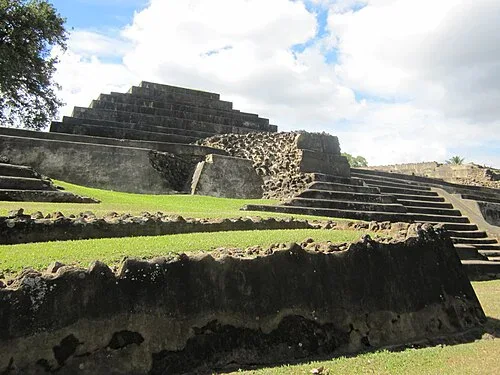 Structure B1-2 (The Toltec Pyramid)
The Collapse That Revealed the Original Masonry
In October 2004, the south side of this pyramid gave way. The failure had been building for decades. In the 1950s, restorers had coated the structure with modern cement, judging it close enough to the original finish. The cement sealed the building and turned it into a water trap. Roots from nearby cedar trees had also worked six metres into the masonry, cracking the structure badly. After the collapse, El Salvador's National Council for Culture and Art, CONCULTURA, began excavating and stabilising the ruins. Soon two projects ran side by side: CONCULTURA's investigation of the pyramid, and PAES, a project of Japan's Nagoya University. Their teams stripped away the modern cement. The collapse that damaged the building also brought its authentic pre-Columbian masonry back into the light.
Listen in the appJose Quintanilla · CC BY-SA 3.0
05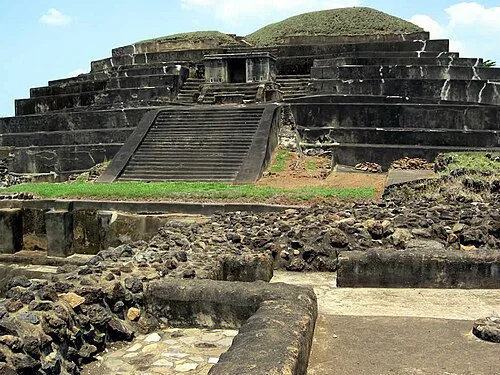 Structure B1-1 (The Great Pyramid)
The Great Pyramid (Structure B1-1)
The great pyramid dominates everything here. Structure B1-1 is the principal building of the Tazumal group, rising about twenty-four metres. It grew in phases through the Classic period and into the Early Postclassic, each generation adding its own layer. Boggs named its base the Great Platform, a slab of ground some eighty-seven metres across at its widest. It stands as much as seven and a half metres high. Its origin is telling. The platform began as a central temple with separate platforms on each side, aligned to the cardinal directions. The west platforms formed the main approach. As the complex grew, the gaps between them were filled in, creating one enormous base. It was remodelled at least three times before reaching its final dimensions. The broad staircase on the western face was the ceremonial way up.
Listen in the appDavid Stanley from Nanaimo, Canada · CC BY 2.0
06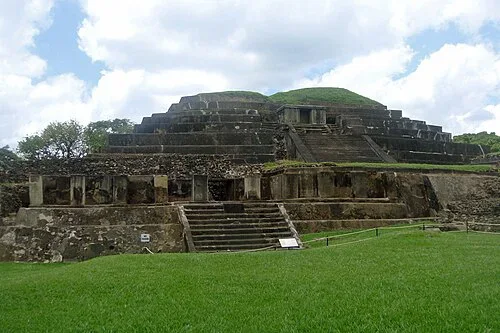 Structure B1-1 (The Great Pyramid)
The Temple of the Columns
At the western base of the great pyramid sits a building with an unusual job. The western platform carries a superstructure known as the Temple of the Columns. Because the whole complex faces west, this building may have served as the main pyramid's facade, a grand ante-chamber before the temple proper. Its layout was formal. Square columns held up the roof. Two chambers of identical size faced each other across a central space with two more columns. The northern chamber opened on its east side, with a possible second entrance to the south. Anyone approaching the great temple from the west would have passed through this columned hall first.
Listen in the appMariordo (Mario Roberto Durán Ortiz) · CC BY-SA 3.0
07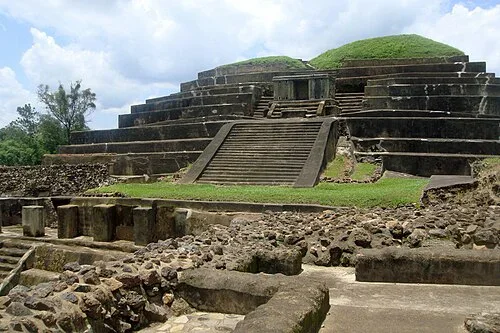 Structure B1-1 (The Great Pyramid)
Tombs Beneath the Pyramid and the Copan Flask
The ground around the pyramid holds its dead. Excavations here uncovered twenty-two tombs, many holding multiple burials, all dating to the Classic period. Their offerings included nearly four hundred clay vessels. There were jadeite earrings, pendants, collars, rings and axes, along with worked pyrite mirrors and pearls. A test pit sunk into the presumed southern platform area found a capped offering: a cylindrical ceramic vessel with a polychrome bowl resting on it like a lid. Inside lay fifty fragments of jade. With them were two larger jade pieces, seashell, snail shell, animal bone, mica and traces of red pigment. The standout find came in 1952. Boggs discovered Tomb 20 beneath a small building called the Oratorio, and inside it a small red ceramic flask covered in hieroglyphic text. The text names K'ahk' Uti' Witz' K'awiil, the twelfth ruler of Copan. A piece naming Copan's king had travelled to Chalchuapa, physical evidence of Late Classic ties with the great Honduran city.
Listen in the appMariordo (Mario Roberto Durán Ortiz) · CC BY-SA 3.0
08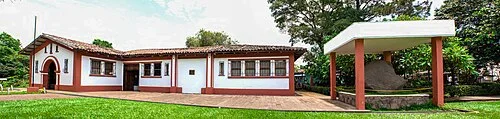 The Tazumal Stele Enclosure
The Tazumal Stele
The Tazumal Stele carries a case of mistaken identity. For years it was popularly called the Virgen del Tazumal, the Virgin of Tazumal, but the nickname is wrong. It is a stele, a carved stone slab, found in front of the main pyramid. In 1892 the historian Santiago I. Barberena brought it, with two other sculptures, to the National Museum in San Salvador. It is on display today in the country's National Museum of Anthropology, the Museo Nacional de Antropología Dr. David J. Guzmán. The stele stands two point six five metres tall and just over a metre wide. It portrays a richly dressed ruler of Late Classic Chalchuapa. One arm stretches out; the other bends, holding a staff or sceptre, probably an atlatl, a spear-thrower. On his head sits a headdress bearing the face of Tlaloc, the rain god of central Mexico. That image had spread across the whole Maya area from the fourth century onward, carried by the reach of Teotihuacan.
Listen in the appOrlando Salvador Flores Castaneda · CC BY-SA 3.0
09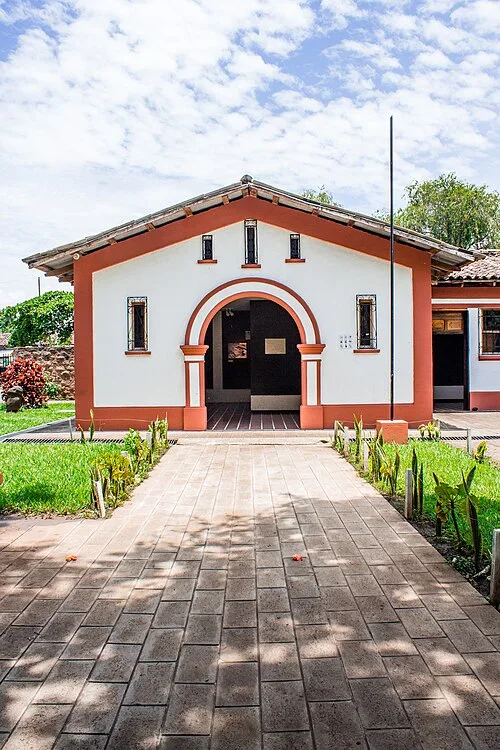 Stanley H. Boggs Site Museum
The Stanley H. Boggs Site Museum
This museum takes its name from the man who gave Tazumal its modern life. Stanley H. Boggs excavated and restored the site across the mid-twentieth century, working on the two main pyramids between 1942 and 1944. Even the name Tazumal comes from the farm where the main structures stood when he began digging. In 1947 the site was declared a National Historic Monument. The ruins became a national symbol: until 2001, the Salvadoran hundred-colón note carried their image. Boggs also did some detective work. Three sculptures, two chacmools and a crouching jaguar, had been sent to the National Museum in San Salvador in 1910. Chacmools are reclining stone figures common at Toltec sites such as Tula. Boggs established that the pair had apparently stood on the summit of a circular structure, B1-6, about fifteen metres across, which once stood outside the park but no longer survives. They were Toltec-style monuments of the Early Postclassic, more traces of the central Mexican current running through Chalchuapa.
Listen in the appOrlando Salvador Flores Castaneda · CC BY-SA 3.0
10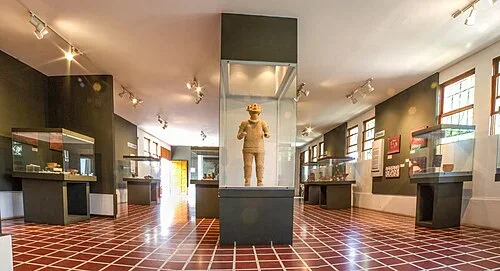 Stanley H. Boggs Site Museum
Gold Before Gold: The First Mesoamerican Metalwork
Three small gold ornaments changed what anyone assumed about Mesoamerican metal. They were excavated at Tazumal and made by the lost-wax method, in which a model is melted away and molten metal takes its place. They are tentatively dated to the eighth century AD and came from a Late Classic tomb. Together with roughly contemporary metal pieces from Copan, they count among the earliest documented evidence of metalworking in Mesoamerica. At least one ornament was a traded piece from the Isthmus of Tehuantepec, far to the northwest. They fit a wider pattern. Tazumal took part in long-distance exchange reaching central Mexico, the northern Yucatán and lower Central America. Green obsidian found at the site points the same way, toward central Mexico.
Listen in the appOrlando Salvador Flores Castaneda · CC BY-SA 3.0
- 11
Xipe Totec: Closing the Thousand-Year Story
A ceramic god from central Mexico, and the thirteenth-century end of Tazumal's thousand-year story.
Tazumal
Frequently asked questions
How much does the guide cost?
Free app download. Listed guide price: $0.99. Guide price shown in the app. Audio guide only. Venue admission is separate.
Can I listen without internet?
Yes. Download the guide’s audio, images, and maps in the app before your visit. Your downloaded content is then available offline.
Can I listen in my language?
This audio guide is available in 15 languages, including English.
Do I need to follow a schedule?
No. This is a self-guided experience. Choose your stops, pause whenever you like, and return to a story at your own pace.
At your own pace
Explore Tazumal.
Download Stanza, then search for “Tazumal”.
Free app download · Guide price shown in the app
Keep exploring
Nearby audio guides
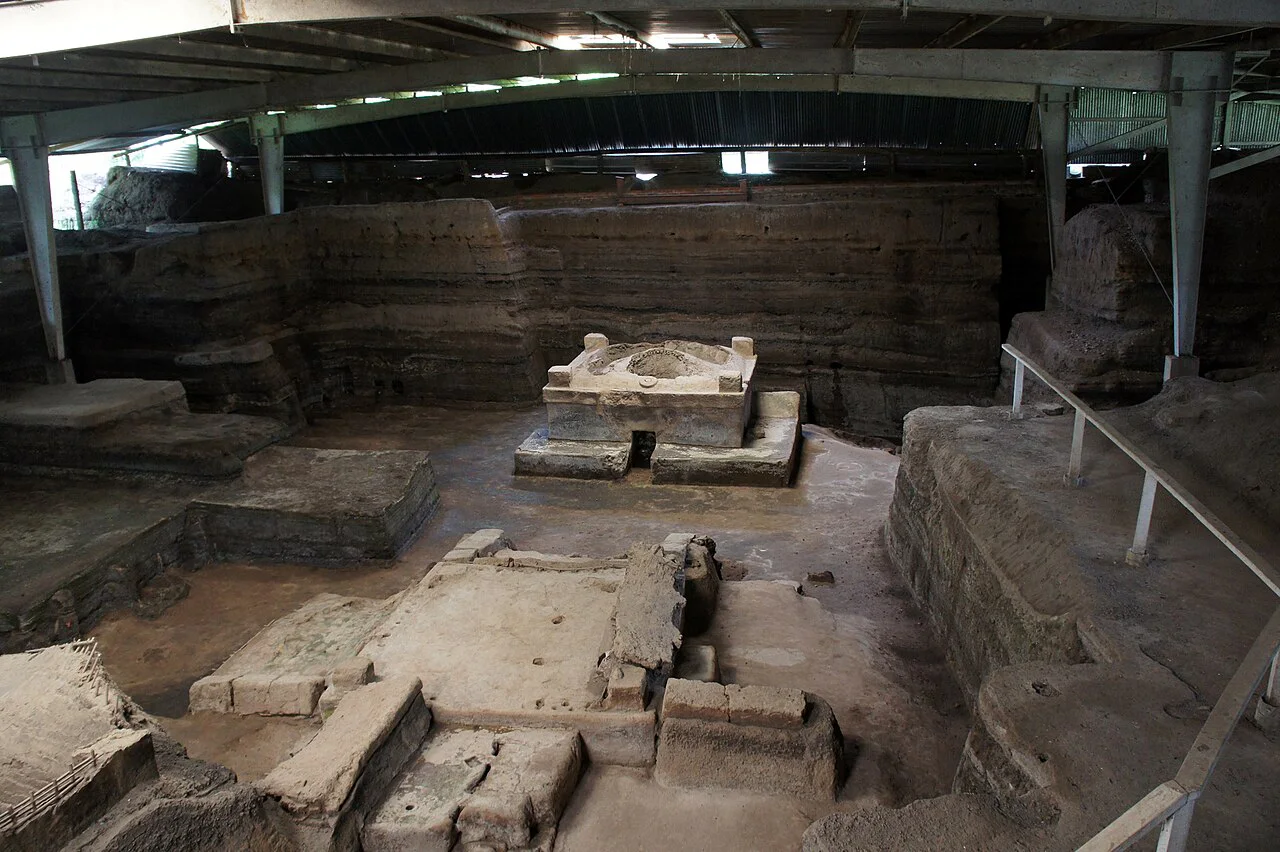
San Juan Opico · 38 km
Joya de Cerén
Content & sources
Mariordo (Mario Roberto Duran Ortiz) · CC BY-SA 3.0
Copán Ruinas · 111 km
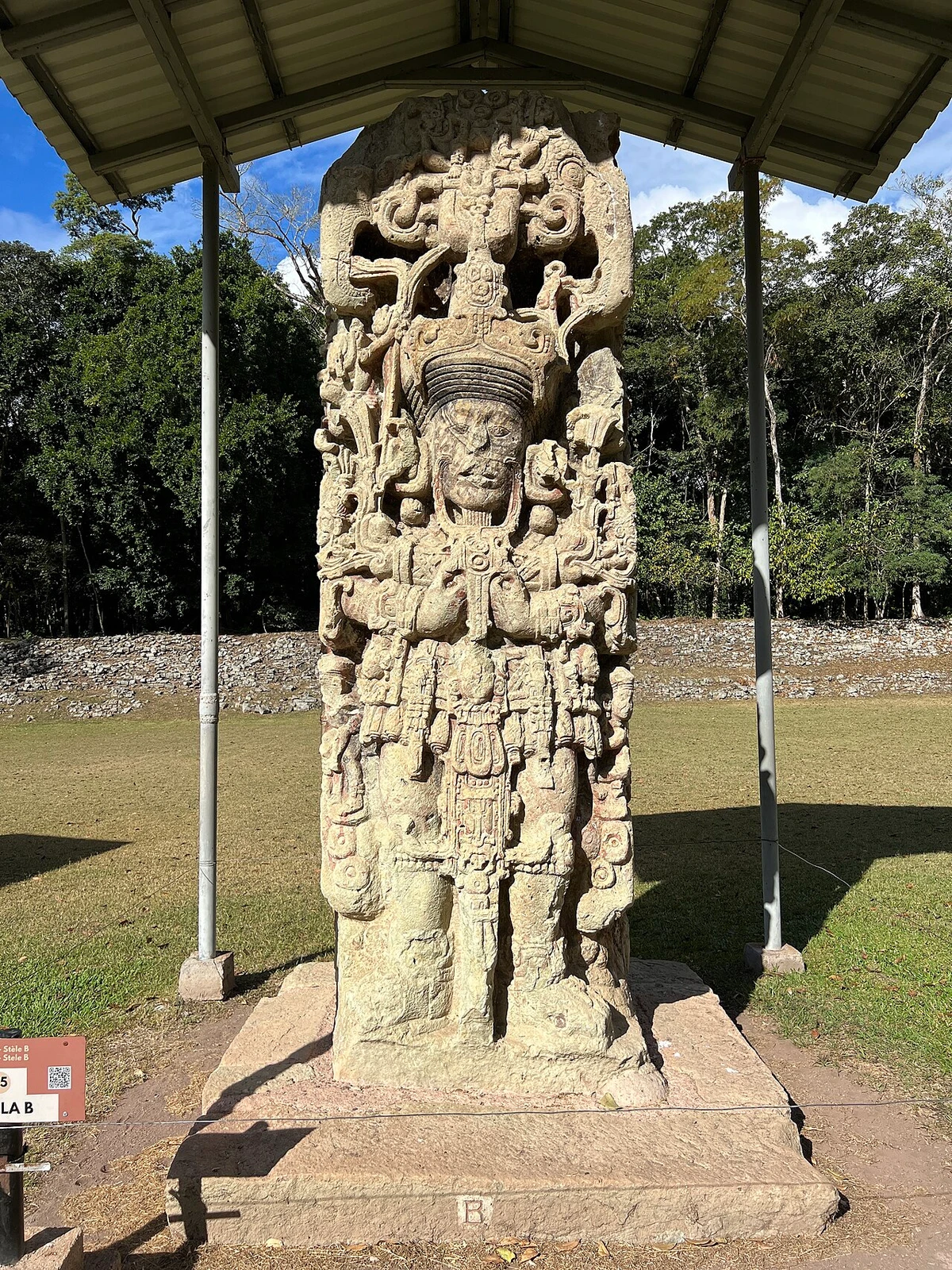
Copán Archaeological Site
Content & sources
Photo: Nosferattus · CC0