Stanza · Audio guide
Gelati Monastery Audio Guide
A place to remember. A story to take with you.
Gelati is a medieval monastic complex near Kutaisi in the Imereti region of western Georgia. It was founded in 1106 by King David IV of Georgia as a monastic and educational center.
Download Stanza, then search for “Gelati Monastery”.
About the tour
One guide. Your kind of visit.
Gelati is a medieval monastic complex near Kutaisi in the Imereti region of western Georgia. It was founded in 1106 by King David IV of Georgia as a monastic and educational center.
Ready when you are.
- 01Get the free Stanza app.
iOS & Android
- 02Find your guide.
“Gelati Monastery”
- 03Download before you go.
Works offline
Audio guide / 13 narrated stops
Inside the guide
Get to know a few of the stories before you go. Open a stop to read more.
01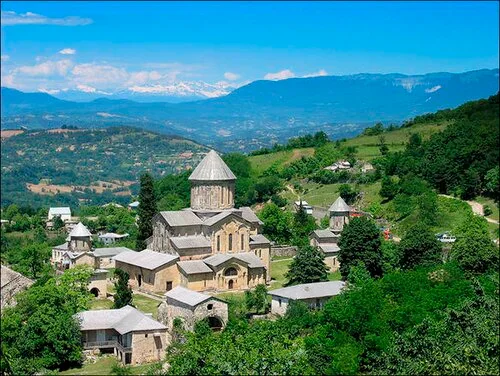 Western Enclosure and Courtyard Panorama
Gelati Monastery from the Western Entrance
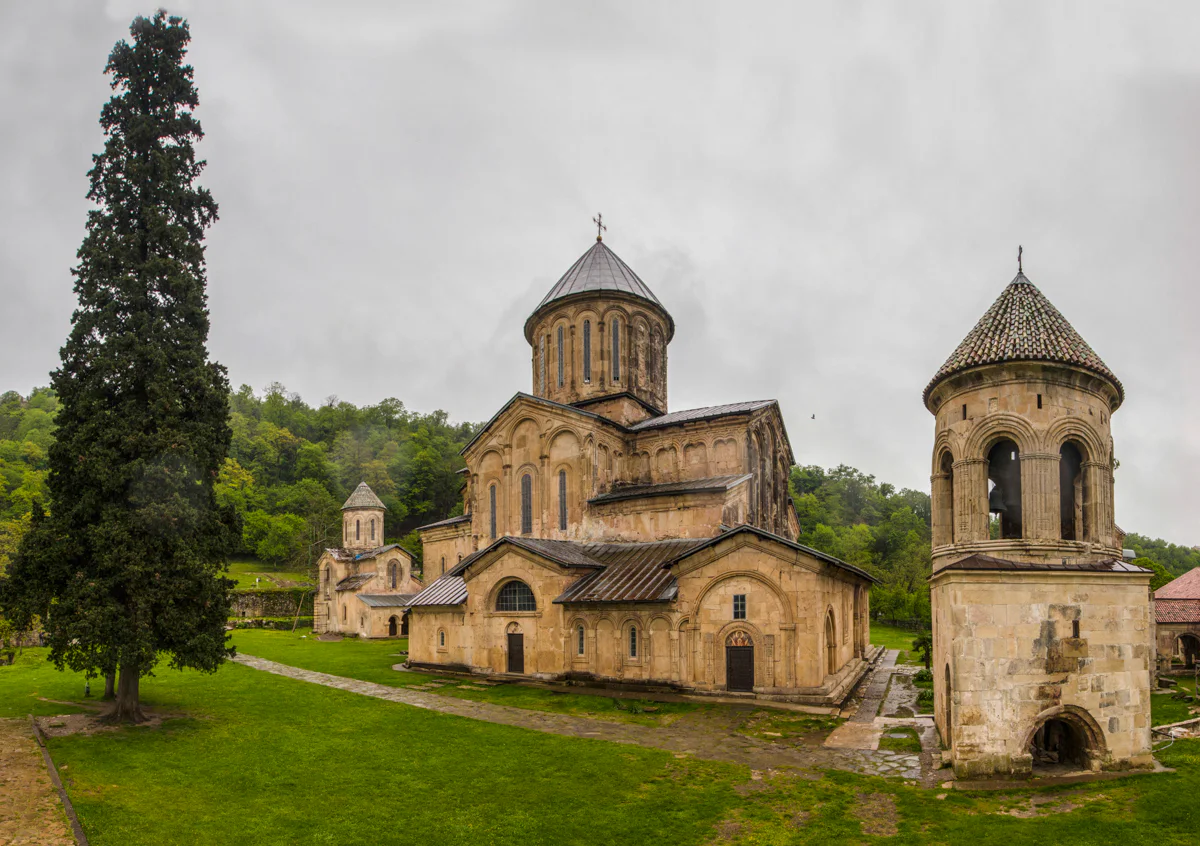
Welcome to Gelati, one of the great medieval monasteries of Georgia. It was founded in 1106 by King David the Fourth. The hill stands a few kilometers from Kutaisi, which was then the capital of his kingdom, and the wooded plateau keeps the buildings set apart from the city. The complex holds a main cathedral, two smaller churches, a belfry and an academy building, and this guide moves through them in turn. The stone is pale and dressed to catch the light, so the monastery can be seen from far across the country. David meant Gelati for two things at once: prayer and learning. It became a spiritual sanctuary and a royal center of science and education, at the height of what Georgians call their Golden Age. The question worth carrying through the visit is why the king who unified Georgia poured so much of himself into this one hillside.
Ievani Pkhakadze · CC BY-SA 1.0
02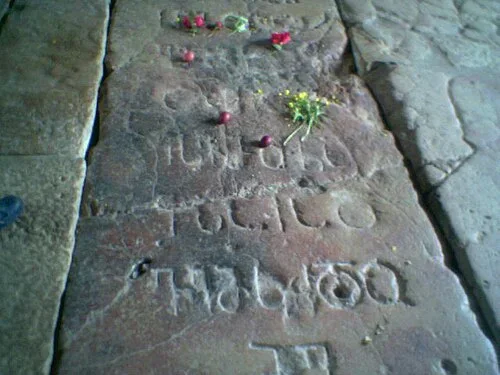 The South Gate, Royal Tomb, and Ganja Gates
Tomb of David the Builder at the South Gate
At the main southern entrance lies a flat stone slab, carved with Georgian letters and worn smooth by centuries of footsteps. Fresh flowers are scattered across it. The stone covers the grave of David the Builder himself, the king who unified Georgia and founded this monastery. The story goes that David asked to be buried in the threshold, so that everyone entering the monastery would step upon his grave. It would have been the last gesture of a monumental ruler: the humblest possible resting place, under the feet of every pilgrim. However exactly his wish was worded, the grave has stayed in the doorway, and visitors still leave flowers on the letters of his name. Beside the gate hangs something his son brought home as a trophy.
Photo: Kober · Public domain
03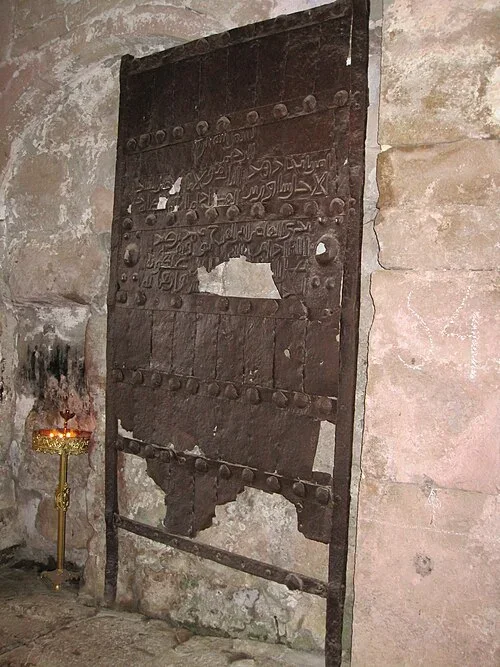 The South Gate, Royal Tomb, and Ganja Gates
The Ganja Gates
The wrought-iron gate beside David's tomb carries an inscription in Arabic, and it is older than the monastery around it: the date on it reads 1063. These are the gates of Ganja, a city in the Seljuk lands. In 1138 an earthquake struck the city, and David's son, King Demetrius the First, took it. He brought the gates back to Georgia as a victory trophy and dedicated a wing of them to Gelati, beside his father's grave. It was a son's homage, told in captured iron: the trophy of his campaign laid at the threshold his father had chosen for himself. The metal is pitted and patched now, but the inscription still runs across its face.
Listen in the appPhoto: Kober · Public domain
04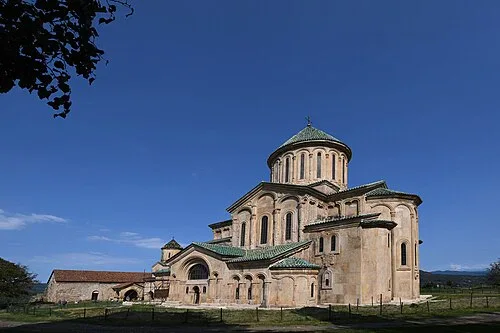 Cathedral of the Nativity of the Virgin: Exterior and Nave
Cathedral of the Nativity of the Virgin - Exterior
The main church was begun in 1106, the same year David founded the monastery, and it took roughly twenty-four years to build. His son Demetrius the First completed it in 1130 and dedicated it to the Virgin Mary. The plan is a cross drawn in stone: four arms meeting under a central dome, the shape of the crucifixion at the heart of the building. The walls are solid stone, with full archways carrying the vaults. A royal foundation, announcing itself across the valley long before anyone reached its gates.
Listen in the appHerbert Frank from Wien (Vienna), AT · CC BY 2.0
05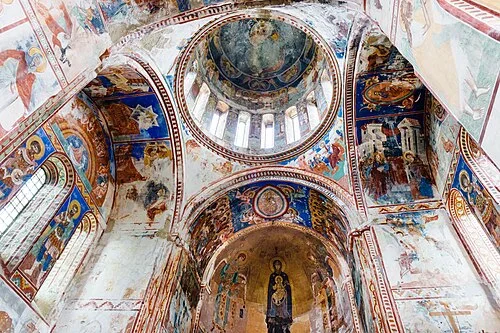 Cathedral of the Nativity of the Virgin: Exterior and Nave
Inside the Cathedral - Dome and Nave
Inside, the walls and vaults carry a continuous program of medieval painting, layer upon layer of it. Some of the murals go back to the twelfth century, among them Christ Pantokrator on the ceiling of the central dome, gazing down the whole height of the church. This is not a ruin. Gelati is still an active monastery, its churches regularly used for worship, and all of the original structures remain intact and in use. The cathedral also kept the monastery's treasures for centuries. The most valuable was the Khakhuli triptych, an icon enshrined here from the twelfth century. In 1859 it was stolen. It was returned in 1923, but in a reduced condition, missing much of what had made it famous.
Listen in the appMarmontel · CC BY 2.0
06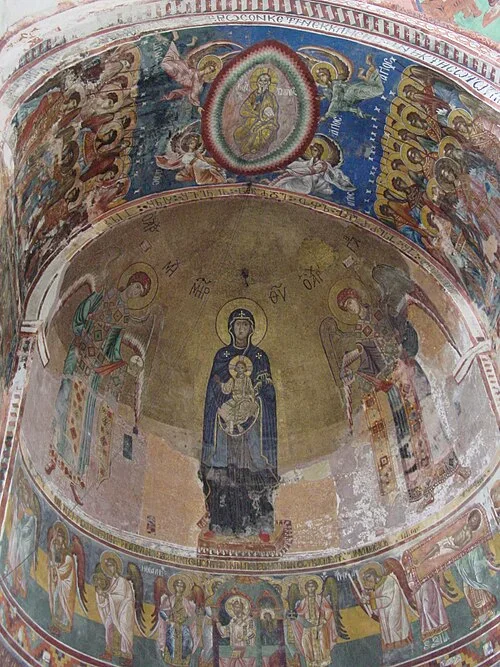 The Golden Apse Mosaic and Royal Murals
The Golden Apse Mosaic of the Theotokos
The apse, the half-dome behind the altar, holds the monastery's greatest artwork. The Virgin Mary stands full-length, holding the Christ child, against a field of gold that fills the curve of the apse. The archangels Michael and Gabriel flank her in ceremonial dress. The figures are set out in classic Byzantine style, and the mosaic was made in the twelfth century, during the reign of Demetrius the First. It is an artwork of cultural importance in Georgia. Gold grounds like this were the language of the great churches of the Byzantine world, and Gelati's builders clearly wanted their church to speak it. Its gold still dominates the sanctuary.
Listen in the appVladimer Shioshvili · CC BY-SA 2.0
07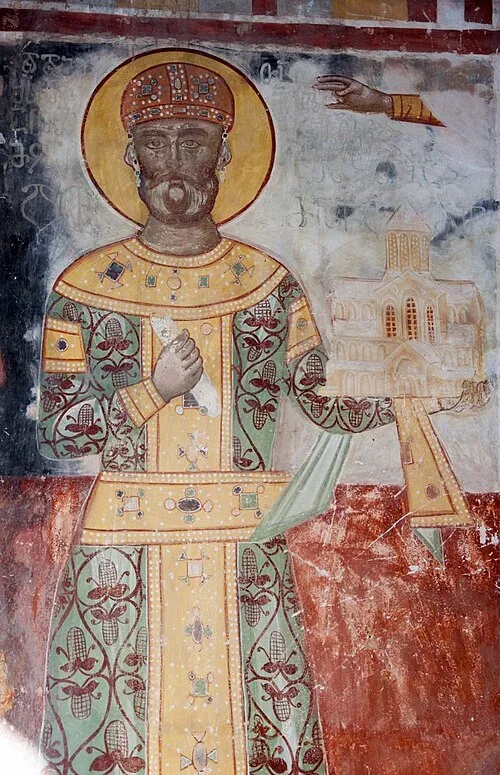 The Golden Apse Mosaic and Royal Murals
Royal Portrait Fresco of David the Builder
On the north wall of the cathedral, David the Builder appears in paint, crowned and ringed with a halo. He holds a scroll in one hand; in the other, a small model of this church, which he lifts toward heaven. Above him a hand reaches down from a cloud, the blessing hand of God accepting the gift. This is a donor portrait: the founder shown not as a distant ruler but as the church's perpetual patron, presenting his foundation to God for all time. He does not stand alone. The north wall carries a whole cycle of Georgian monarchs and churchmen, reaching down the generations to Bagrat the Third of Imereti, each of them taking a place beside the man who built the church.
Listen in the appUnknown; photographed by the National Archives of Georgia expedition team in 2015. · Public domain
08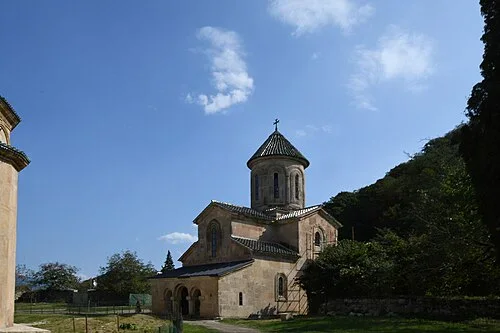 Church of Saint George
 - Exterior
David died long before this church was built. Saint George's is a thirteenth-century addition, one of the smaller churches that rose while the monastery kept expanding for more than two centuries after its founder. Royal foundations rarely stand still. Successive rulers and patrons added their own buildings to the ensemble, until Gelati became a complex of churches rather than a single construction. The domed church under its pitched roof belongs to that later story, a living ensemble that kept changing shape long after the founding years. One more church from these later centuries is still to come: Saint Nicholas.
Listen in the appHerbert Frank from Wien (Vienna), AT · CC BY 2.0
09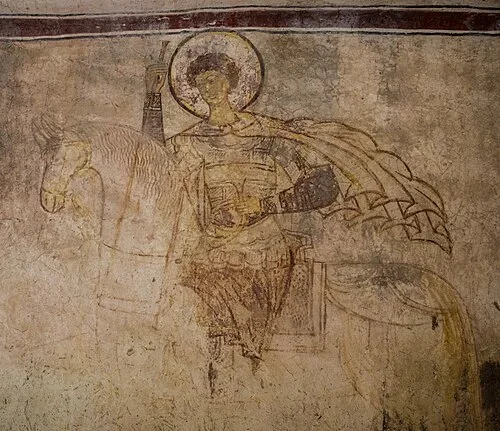 Church of Saint George
Mural of Saint George in the Church of Saint George
Inside Saint George's, a warrior saint rides across the wall. This is Saint George himself, the military martyr, lance raised, his cloak streaming behind him on a faded horse. Warrior saints like George carried special weight in medieval Georgia, a kingdom that had fought hard for its survival and its unity. Paintings of this kind filled the monastery's smaller churches, and George in particular was a figure the Georgian church held dear. The paint has faded to earth tones, but the raised lance is still easy to follow.
Listen in the appJon Gudorf Photography · CC BY-SA 2.0
10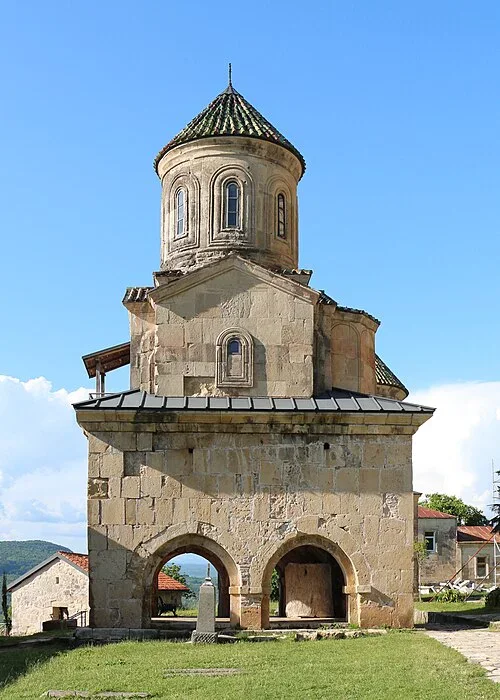 Church of Saint Nicholas and the Medieval Belfry
Two-Storey Church of Saint Nicholas
Saint Nicholas is the third standing church of the complex, and the strangest in shape. It was built in the thirteenth century. Its ground floor is open, a vaulted undercroft of tall arched passages, and the church itself sits on top of it, a complete upper storey beneath a conical dome. The design sets it apart from the cathedral and from Saint George's, both of which stand on the ground. It shows Gelati's builders experimenting within the Georgian tradition, generation after generation, well past the founding years.
Listen in the appBernard Gagnon · CC BY 4.0
- 11
The Medieval Belfry
The belfry of a monastery that answered to the king alone, and the wealth that paid for it.
- 12
The Gelati Academy
The academy where philosophers from Constantinople taught, scribes copied manuscripts, and Gelati earned its grand nicknames.
- 13
The Valley Overlook - Closing View
The closing view over the valley: Gelati as royal pantheon and the measure of a Golden Age court.
Gelati Monastery
Frequently asked questions
How much does the guide cost?
Free app download. Listed guide price: $0.99. Guide price shown in the app. Audio guide only. Venue admission is separate.
Can I listen without internet?
Yes. Download the guide’s audio, images, and maps in the app before your visit. Your downloaded content is then available offline.
Can I listen in my language?
This audio guide is available in 15 languages, including English.
Do I need to follow a schedule?
No. This is a self-guided experience. Choose your stops, pause whenever you like, and return to a story at your own pace.
At your own pace
Explore Gelati Monastery.
Download Stanza, then search for “Gelati Monastery”.
Free app download · Guide price shown in the app
Keep exploring
Audio guides — Georgia
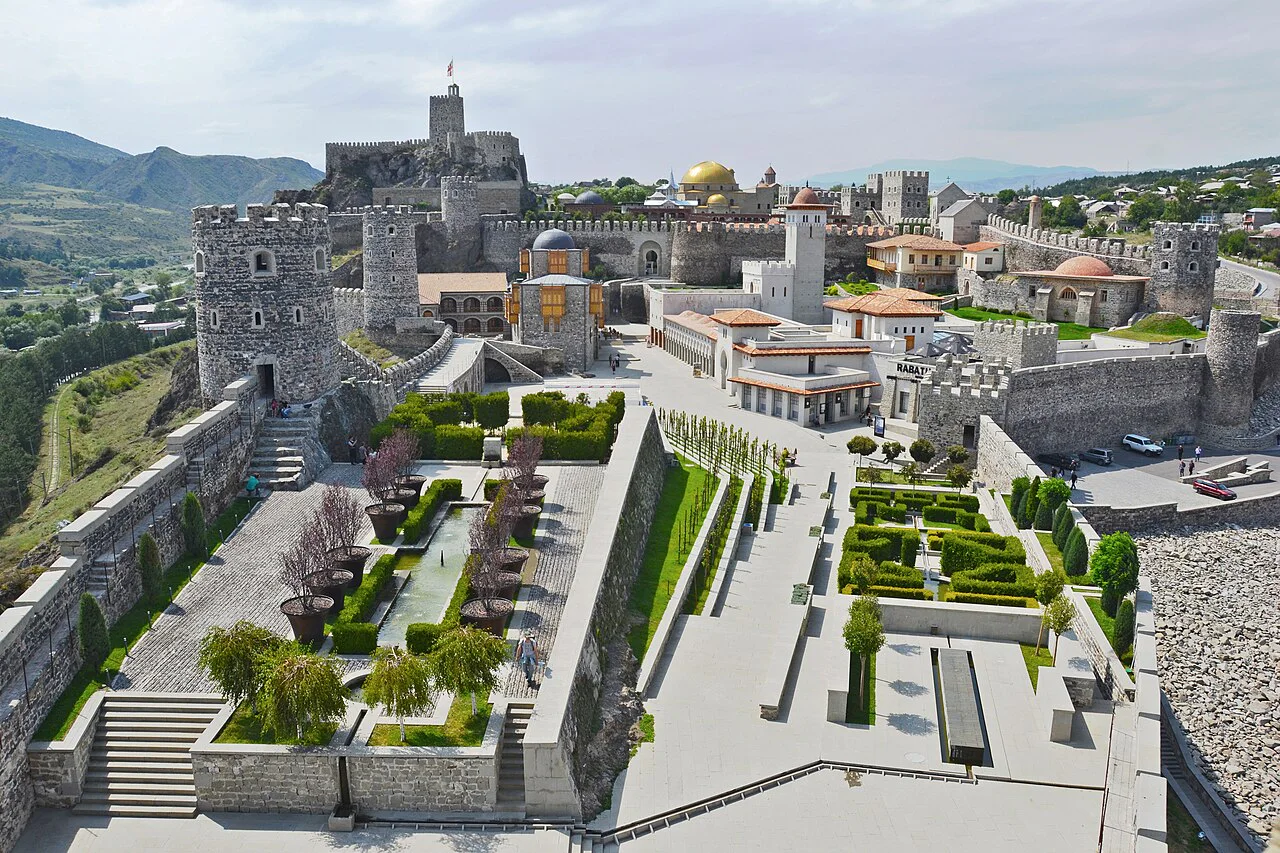
Akhaltsikhe · 75 km
Akhaltsikhe Castle
Content & sources
Photo: I kynitsky · CC BY-SA 4.0
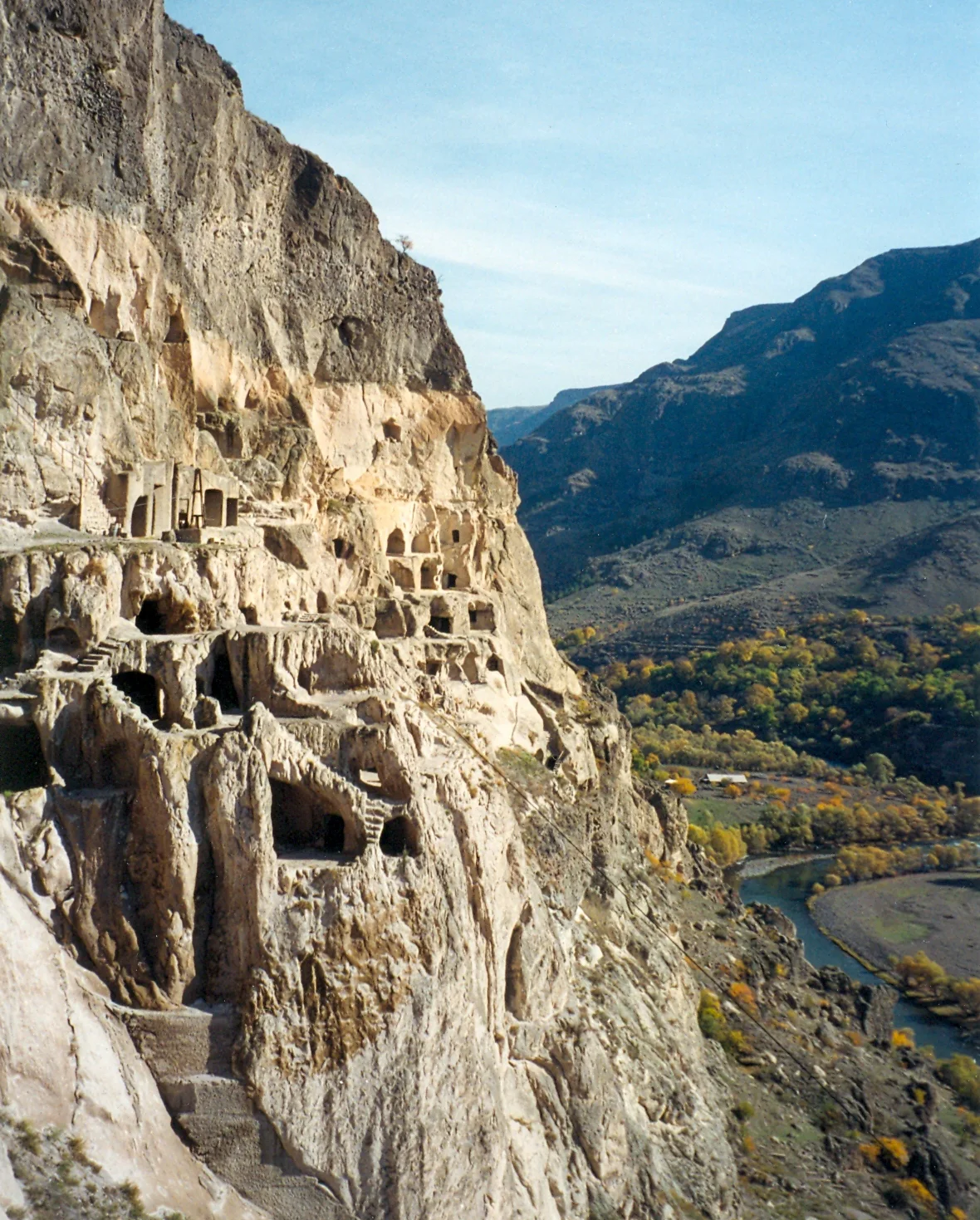
Vardzia · 110 km
Vardzia
Content & sources
Photo: Doron · CC BY-SA 3.0
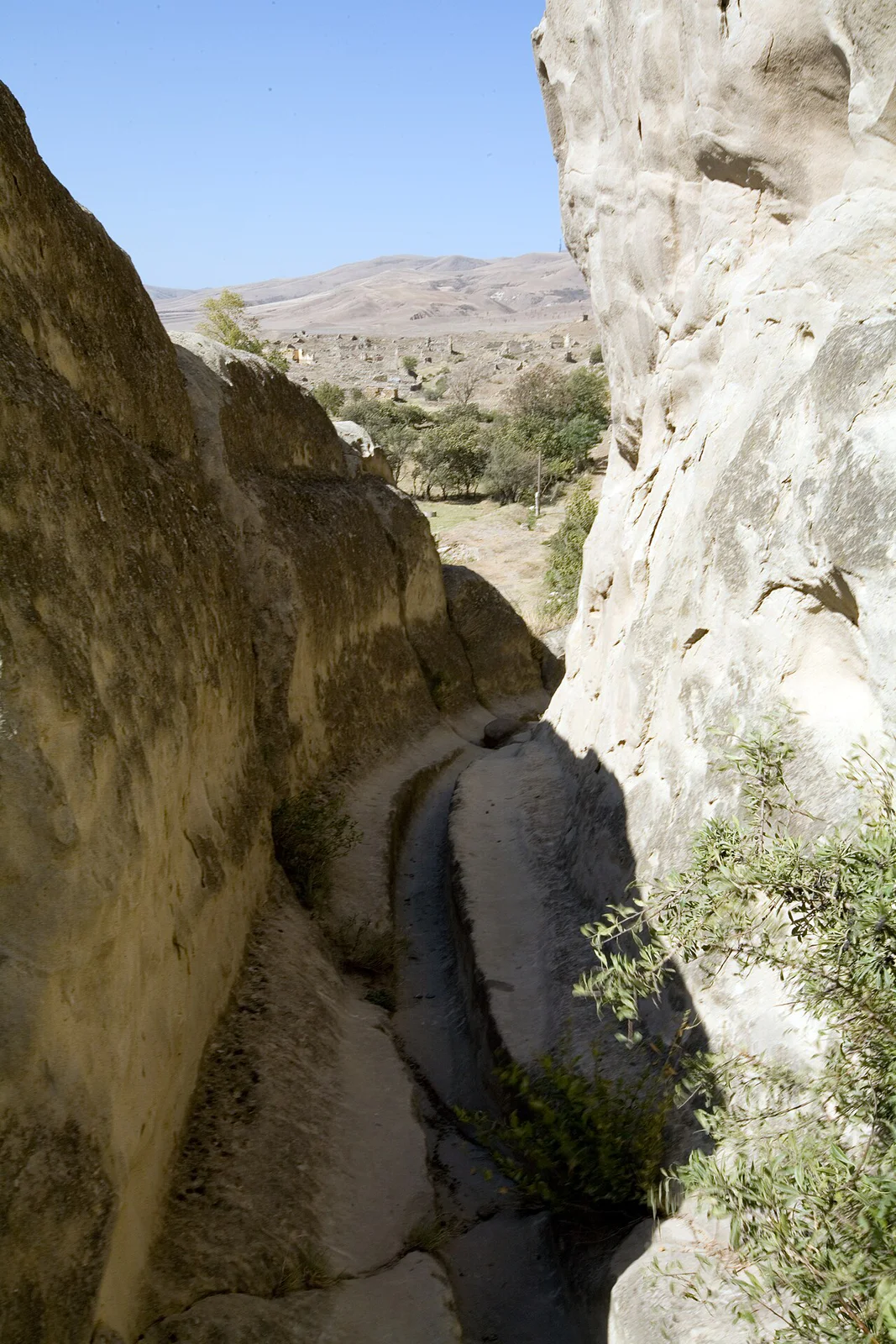
Uplistsikhe · 124 km
Uplistsikhe
Content & sources
Photo: EvgenyGenkin · CC BY-SA 3.0
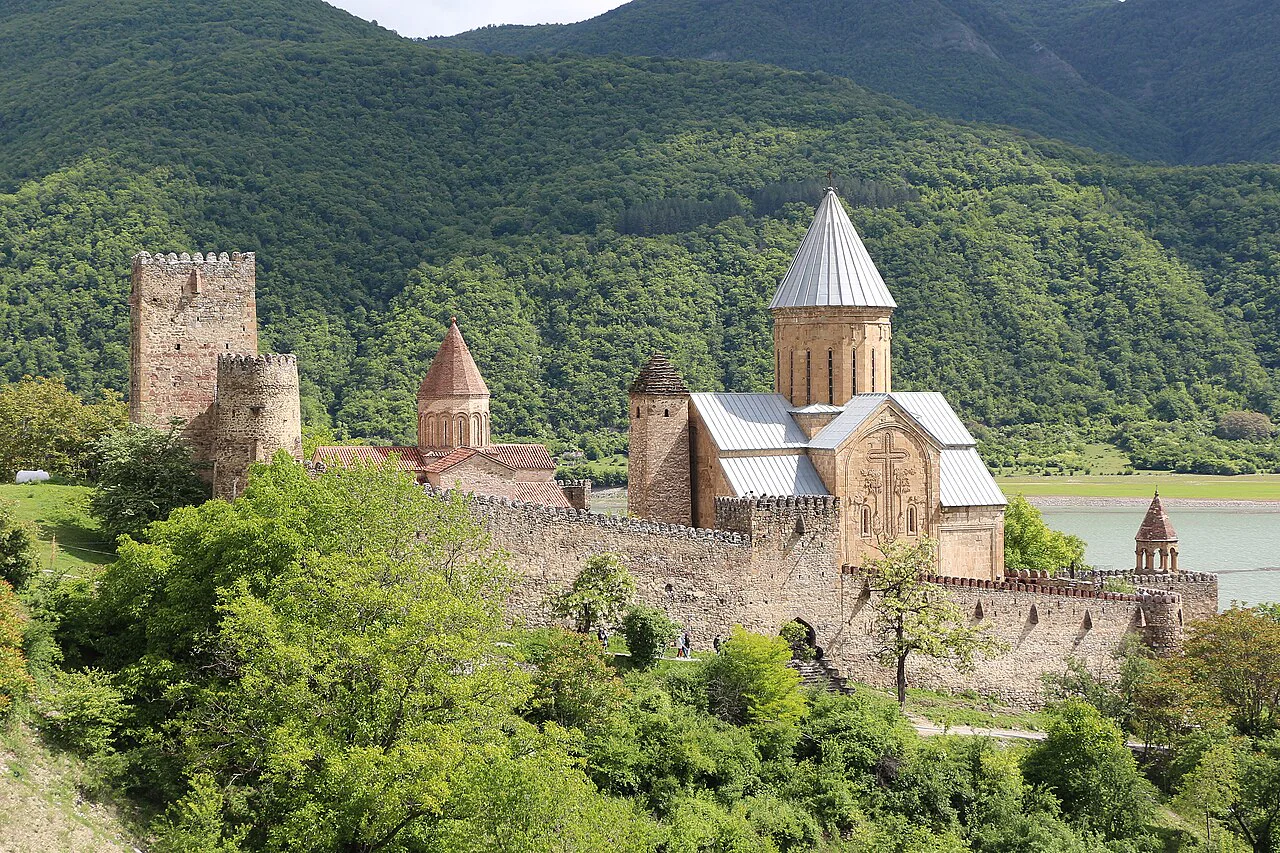
Shalikiantkari
Ananuri
Content & sources
Bernard Gagnon · CC BY 4.0