Stanza · Audio guide
Ananuri Audio Guide
A place to remember. A story to take with you.
Ananuri is a castle complex located on the Aragvi River in Georgia. It is situated in the Dusheti Municipality about 72 kilometers from Tbilisi.
Download Stanza, then search for “Ananuri”.
About the tour
One guide. Your kind of visit.
Ananuri is a castle complex located on the Aragvi River in Georgia. It is situated in the Dusheti Municipality about 72 kilometers from Tbilisi.
Ready when you are.
- 01Get the free Stanza app.
iOS & Android
- 02Find your guide.
“Ananuri”
- 03Download before you go.
Works offline
Audio guide / 11 narrated stops
Inside the guide
Get to know a few of the stories before you go. Open a stop to read more.
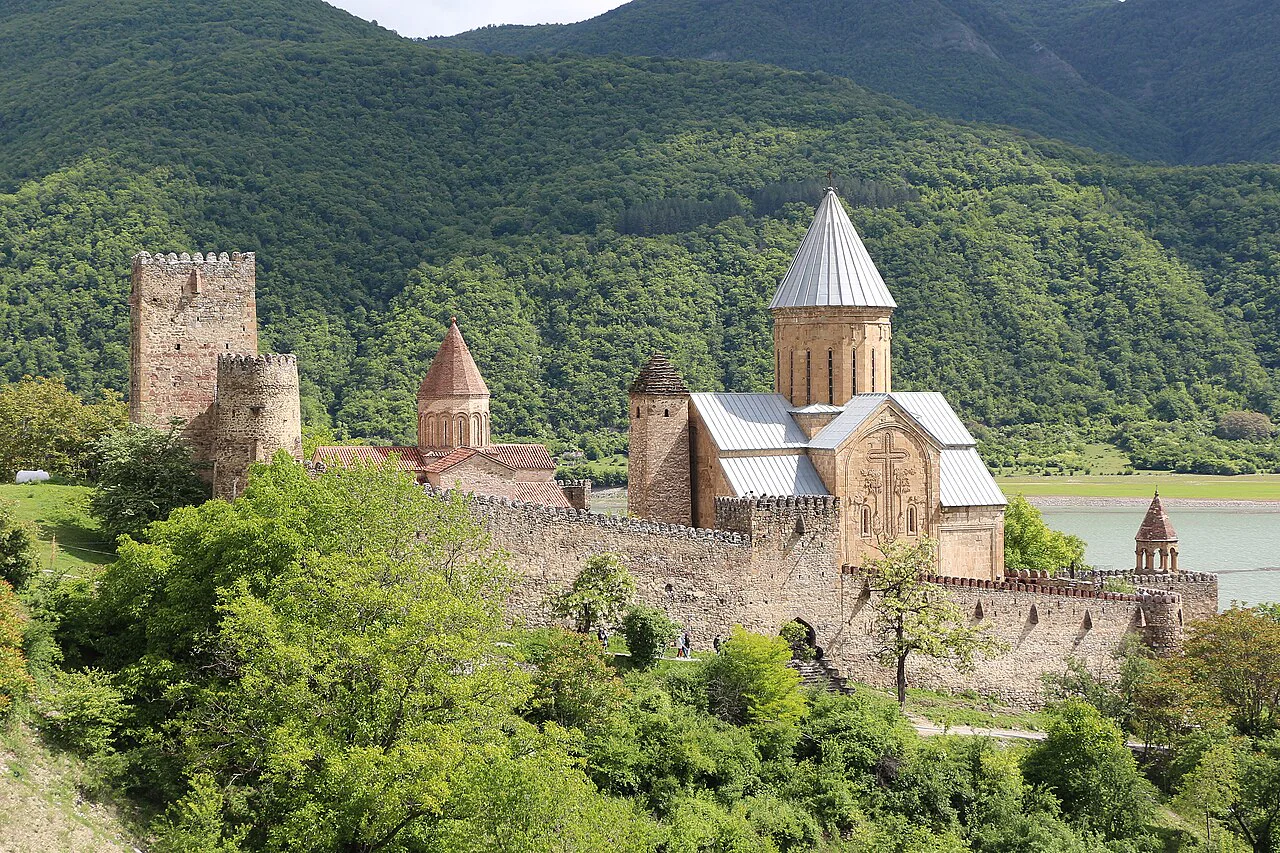
01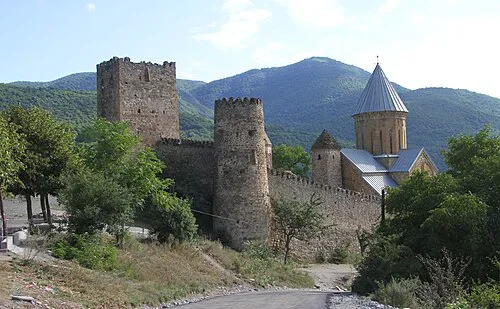 Southern Gatehouse & Fortress Approach
Approach to Ananuri Fortress: Curtain Walls and Gatehouse
Welcome to Ananuri. You're standing on the old road north from Tbilisi, about seventy kilometers away, and the fortress in front of you was built exactly here for a reason: it guards the gorge of the Aragvi River. From the thirteenth century onward, this was the seat of the eristavis, the Dukes of Aragvi, a feudal dynasty that ruled this whole valley. Look at the stone curtain wall running along the towers. It originally stood five to six meters high on average, and on the east side it reached ten meters. Later generations raised it by another two or three meters, and you can still trace those layers of building and repair in the masonry. Inside, this is really two castles joined by one crenellated wall, with churches and towers packed together. But every fortress has a weakness, and Ananuri's was water. The story the locals tell is that the castle could never be taken in a siege, because a secret tunnel carried water up from the river. When enemies finally captured a woman called Ana, from the village of Nuri, they tortured her to make her reveal that tunnel. She died without saying a word. That, the legend goes, is how the place got its name: Ana from Nuri, Ananuri. It's folklore, not history, but it tells you what mattered most in this valley: water, loyalty, and silence. Keep that water in mind. It will matter again later in our walk.
Photo: Gerd Eichmann · CC BY-SA 4.0
02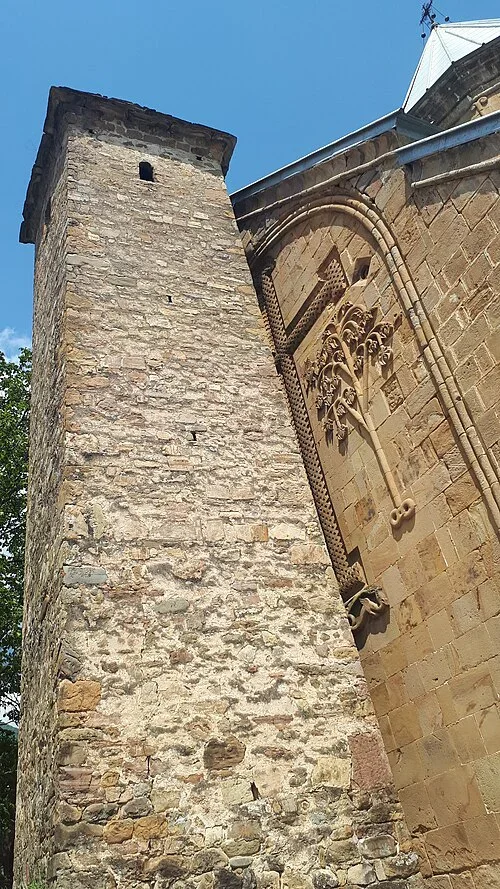 Citadel Courtyard & Khevsurian Watchtower
The Khevsurian Stepped-Roof Watchtower
Here in the courtyard stands something that looks very different from everything around it. This narrow, rough stone tower is the oldest building in the whole complex, probably from the fourteenth or fifteenth century. It's called the Khevsurian tower, because its style comes from the high mountain regions of Georgia, where people built towers like this one for centuries. Notice the stepped, pyramid-shaped stone roof. Roof styles like this are rarely seen down here in the lowlands. The tower is about eighteen meters tall and very slender, and its entrance is high up on the east side, through an arched doorway that was once barred. The bottom levels are a solid, windowless mass, deliberately, so there was nothing for attackers to break into. Now look at the contrast around you. Beside this raw, practical tower stand elegantly carved church walls, and all of it wrapped in dressed stone fortifications. That contrast is the history of Ananuri in one view. This began as a simple watch post, watching the road through the gorge. Over roughly four hundred years it accumulated churches, curtain walls, and towers, until it had outgrown its origins entirely. Very few places let you see the whole growth of a stronghold in a single glance.
Photo: Kober · CC BY-SA 4.0
03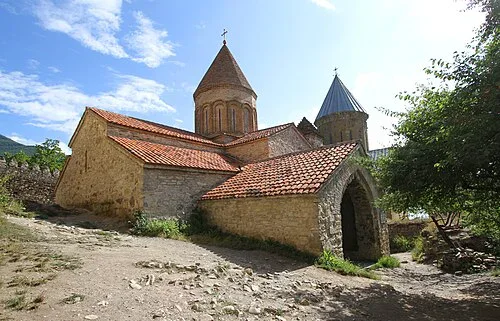 Church of the Deity (Ghvtaeba)
: Exterior and Ducal Burial Church
This smaller church is the older of the two within the walls. It's called the Church of the Deity, Ghvtaeba in Georgian, and it stands in the western part of the upper citadel. It was built of rubble stone and brick, most likely at the end of the sixteenth century or in the first half of the seventeenth. Look at the proportions: it's a cross-dome church, about sixteen meters long by thirteen wide, with the dome resting on the corners of the altar and a pair of columns on the west side. Notice, too, how it leans against a tall square tower. In a fortress, even the churches shared their walls with the defenses. But this building was never only about defense. It was the burial church of the Dukes of Aragvi, and some of the dukes themselves lie here within it. That tells you what Ananuri really was: not a barracks, but the home of a ruling house, its place of worship and its family tomb in one.
Listen in the appPhoto: Gerd Eichmann · CC BY-SA 4.0
04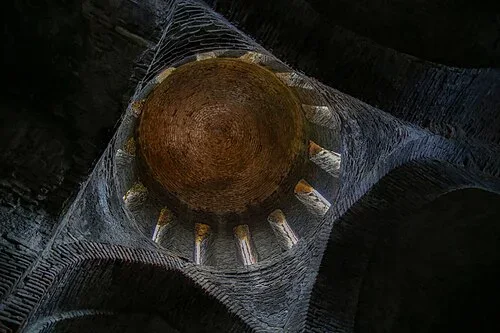 Church of the Deity (Ghvtaeba)
Inside the Church of the Deity: Dome and the Edisher Baldachin
Step inside, and look up. The dome opens above you on brickwork, with light falling down into the church. The interior here is bare now, its old decoration gone, so one object carries this church's human story. Near the south door stands a rectangular canopy of finely cut stone, a baldachin, raised on arches at the corners. It is a funerary monument, and a long inscription in Georgian script runs across three of its walls. It tells us that this canopy was built in the year 1674 by Ana-Khanum, a daughter of the Abashidze family, for her husband Edisher Eristavi, who died before his time. Edisher was not just any nobleman. The inscription calls him the chief justice, the mdivanbeg, of all Georgia, one of the highest offices in the kingdom. So this is a memorial from a grieving wife to a man of real power. The vault of the canopy was once painted, with the Virgin enthroned, the Annunciation, the Crucifixion, and archangels and apostles on its arches. When the dukes of Aragvi were buried here, they lay beneath a monument raised by love and by rank together. It's the most personal thing you'll see inside these walls.
Listen in the appStefano Bolognini · CC BY-SA 2.0
05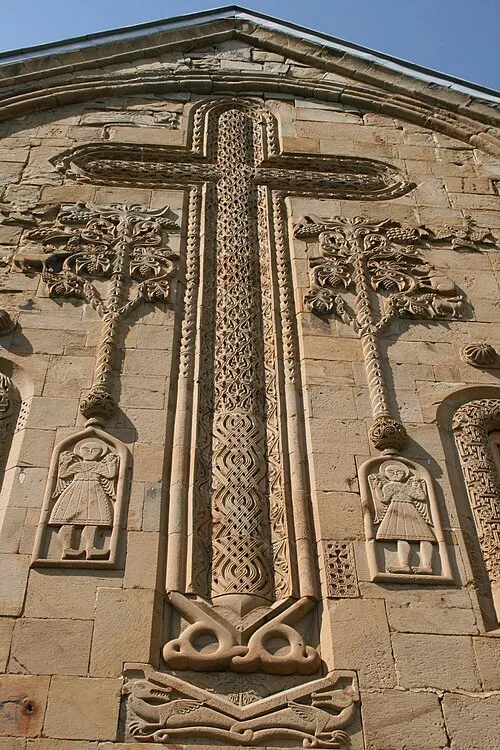 Church of the Mother of God: Facade Reliefs
The Grapevine Cross: South Facade of the Church of the Mother of God
Now turn to the great church beside it, and to the carving on its south facade. This is the Church of the Mother of God, and its facade is covered in some of the finest stone relief work from late-medieval Georgia. The centerpiece is right in front of you: a monumental cross, but look closely. The cross is not plain stone. Its whole shaft is woven from vine stems and leaves, a grapevine cross, a distinctly Georgian image of the cross, flanked by carved figures and ornament on both sides. A nineteen-line building inscription on this same facade tells us who made all of this. It records that the church was completed in 1689, commissioned by Bardzim, the mdivanbeg, and built by a master named Kaikhosro Baghsarashvili. That's worth pausing on. A feudal dynasty at its height, a royal official as patron, and a named master builder taking credit in stone, in nineteen lines of text. In this period, a church facade was a statement. The vine cross, the figures, the flowing ornament, all of it was carved directly into the architecture, proclaiming the faith and the standing of the family that paid for it. This is what Ananuri looked like when the Dukes of Aragvi were at the height of their power. What happened to that power, you'll hear shortly.
Listen in the appPhoto: Kober · Public domain
06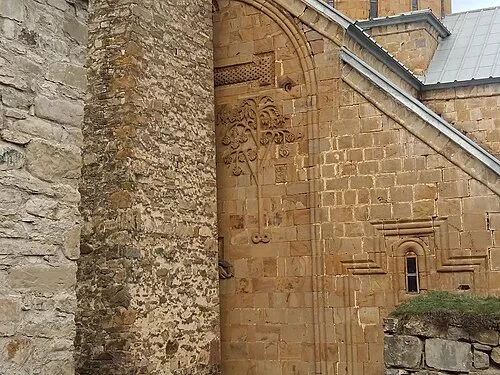 Church of the Mother of God: Facade Reliefs
The Carved Entrance: Tree of Life and North Facade
Now come around to the north side, to the church's carved entrance, and look at this relief. Here the masons chose a different image. In place of the great cross you saw on the south facade, a stylized tree rises inside a frame of richly worked arches. A trunk, branches, spreading foliage, all cut into the stone in shallow, confident relief. It reads like a tree of life, a symbol of growth and renewal set exactly where worshippers pass into the church. Notice how the carving works with the building rather than on it. The tree fills the spandrel above the doorway, shaped to the angle of the wall, and the arch mouldings around it carry their own bands of ornament, layer after layer. Then compare it with the cross facade around the corner. Same church, same workshop, same year of completion, and yet a completely different visual language: there, a dense woven vine; here, a calm, ordered tree in an architectural frame. That range is what marks out a master workshop. The carvers could do ornament, symbolism, and structure all at once, and they varied the message facade by facade. Take a moment with the surface itself. Every leaf and stem was cut by hand into these blocks over three centuries ago, and the sharpness you can still see tells you how good they were.
Listen in the appPhoto: Mutialulu · CC0
07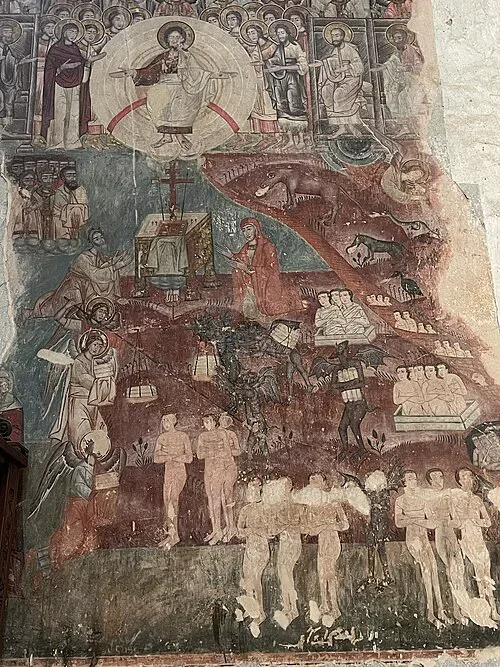 Church of the Mother of God: Nave & Frescoes
The Last Judgment: Fresco Fragments in the Church of the Mother of God
Let's step inside the Church of the Mother of God. When it was new, this whole interior was painted. Every wall, every pillar, every surface carried images, as Orthodox churches of this period did. Look at the south wall, below the windows, and you can see the largest surviving piece: a Last Judgment. Christ and the heavenly court above, and below them the souls of the dead, the blessed and the condemned, arranged in rows. It's a fragment now, faded and flaking, but you can still follow the composition. Elsewhere in the church, look for figures of saints on the pillars, and on the stone pylons, depictions of the monk fathers, some identified by inscriptions written in Georgian letters. So the painters didn't just decorate; they named their subjects, connecting this mountain fortress church to the wider sacred history of Georgia. Now consider what you're not seeing. Most of the original painting was destroyed by fire in the eighteenth century, and the eighteenth century was violent here. Smoke and flame took what centuries of weather might have spared. What remains on these walls is a remnant, but a precious one: enough to show that this church was once a fully painted sacred space, glowing with color, inside a fortress that was built for war.
Listen in the appCarole Raddato · CC BY-SA 2.0
08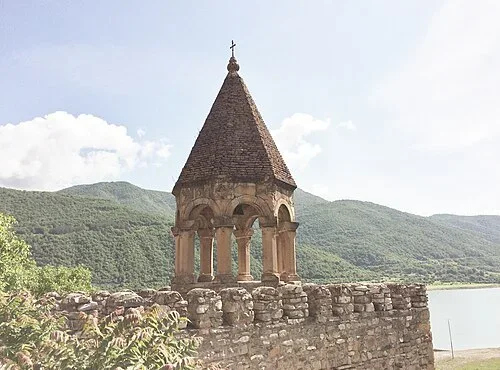 The Octagonal Belfry & Mkurnali Chapel
The Octagonal Belfry above the Walls
Now look up, at the stone bell tower rising above the fortifications. It's an open structure, octagonal, with arched openings on its sides, so the bell inside could ring out freely in every direction. Think about what that meant here. This is a fortified ensemble, but it is also a house of prayer, and the two shared one skyline. When the bell rang, its sound carried over the curtain walls and the towers, out across the gorge. It called the community to worship, and in a place like this, a bell had other work too. Sound traveled further and faster than any messenger; a bell could gather people inside the walls quickly when something was wrong. So the same tower served both purposes, and nobody here needed to explain the difference. It's a quiet corner of the complex compared with what you've seen, the carved facades and the painted walls. But it completes the picture. Defense, worship, and warning, all built into a single cluster of stone above the Aragvi. Take a breath here, and listen to how still it is now, where a bell once carried across the valley.
Listen in the appPhoto: Lika Kharazishvili · CC BY-SA 4.0
09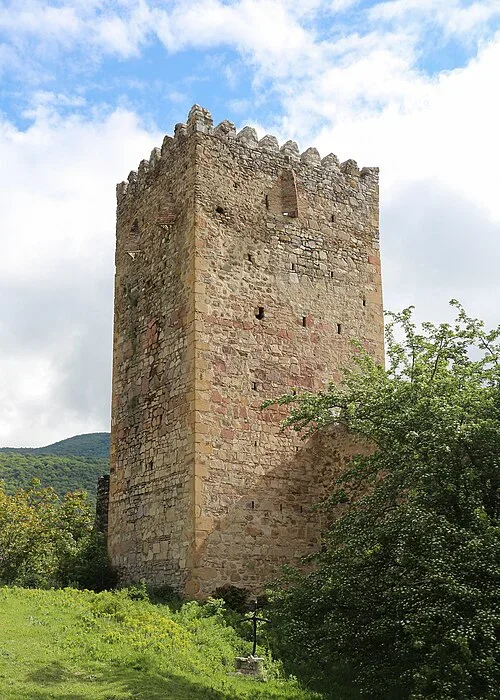 Sheupovari Tower & The 1739 Last Stand
The Sheupovari Tower and the 1739 Last Stand
This tower has a name, and the name is a story in itself. It's called Sheupovari, which means the stubborn one. It's the great square tower of the upper castle, the strongest point of the whole fortress, and it's the best preserved part of Ananuri today. Its moment came in 1739, and chroniclers of the time tell it in detail. The Duke of the rival duchy of Ksani, Shanshe, had been grievously insulted: while he was away in Russia, the Aragvi dukes had dishonored his family. He returned, punished the offenders, and then came against Ananuri with his own army and hired Lezgin fighters. Inside the fortress was Duke Bardzim of Aragvi with his brother. The fighting was bitter, and the attackers could achieve nothing, until they found the fortress's weak point. They cut the water supply. It was summer, and those inside, with no water, were forced to negotiate. Bardzim surrendered on a sacred oath of safe passage. The Ksani men broke the oath and killed him, and killed other members of his family as well. But Bardzim's son refused to yield. He shut himself in this tower, the stubborn one, and held out. So the besiegers set it on fire, and those inside burned alive. The Aragvi people responded in grief. They walled up the enormous seven-storey tower entirely, and left it sealed as a tomb for the burned. It stayed sealed for two hundred years. Only in 1939 did archaeologists open it, and found inside the burnt bones of adults and children, together with weapons and household belongings. The Aragvi dynasty's hold on this fortress ended here.
Listen in the appBernard Gagnon · CC BY 4.0
10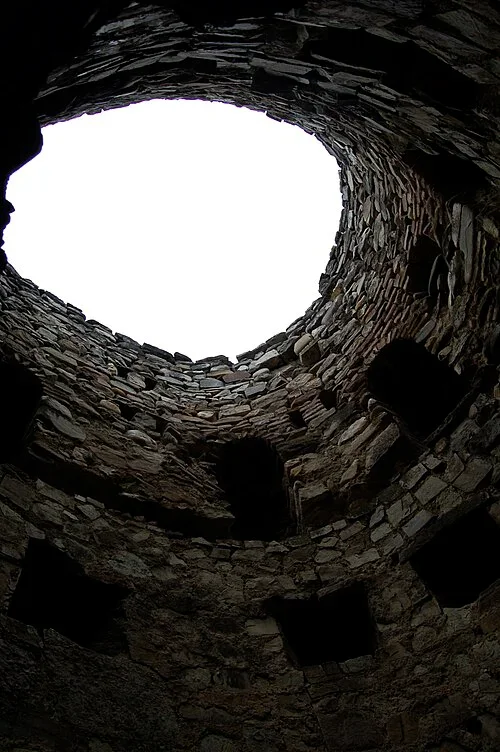 Sheupovari Tower & The 1739 Last Stand
Inside a Tower: After the Massacre
Step inside a tower here, into the dark, and look up. The stone walls climb around you, and at the top, a circle of open sky. This is the view the defenders lived with: light from above, the world beyond reachable only through narrow openings. Hold that image while I tell you what came after the disaster of 1739. The Aragvi dynasty was destroyed, but the valley was not finished with its new masters. Four years later, the local peasants rose up against the rule of Shanshe of Ksani. They killed the usurpers, and then did something remarkable: they invited King Teimuraz the Second to come and rule over them directly, taking the dukes out of the picture entirely. Power in this valley passed from a dynasty to the crown. But rule here was never calm. In 1746, King Teimuraz himself had to put down another peasant uprising, and he could only do it with the help of King Erekle the Second of Kakheti, one of the most powerful rulers in eastern Georgia. So the fortress changed hands through blood and oath-breaking, then through revolt, then through royal intervention. And through all of it, Ananuri stayed in use. Soldiers still garrisoned these walls into the beginning of the nineteenth century. Standing in this cold stone chamber, you can feel why: whatever happened outside, these walls endured.
Listen in the appMorten Oddvik from Trondheim, Norway · CC BY 2.0
- 11
The Aragvi Valley and Zhinvali Reservoir: Closing Vista
The closing panorama: Ananuri above the turquoise water of the Zhinvali Reservoir, a rare surviving whole, and recognition on the UNESCO tentative list since 2007.
Ananuri
Frequently asked questions
How much does the guide cost?
Free app download. Listed guide price: $0.99. Guide price shown in the app. Audio guide only. Venue admission is separate.
Can I listen without internet?
Yes. Download the guide’s audio, images, and maps in the app before your visit. Your downloaded content is then available offline.
Can I listen in my language?
This audio guide is available in 15 languages, including English.
Do I need to follow a schedule?
No. This is a self-guided experience. Choose your stops, pause whenever you like, and return to a story at your own pace.
At your own pace
Explore Ananuri.
Download Stanza, then search for “Ananuri”.
Free app download · Guide price shown in the app
Keep exploring
Nearby audio guides
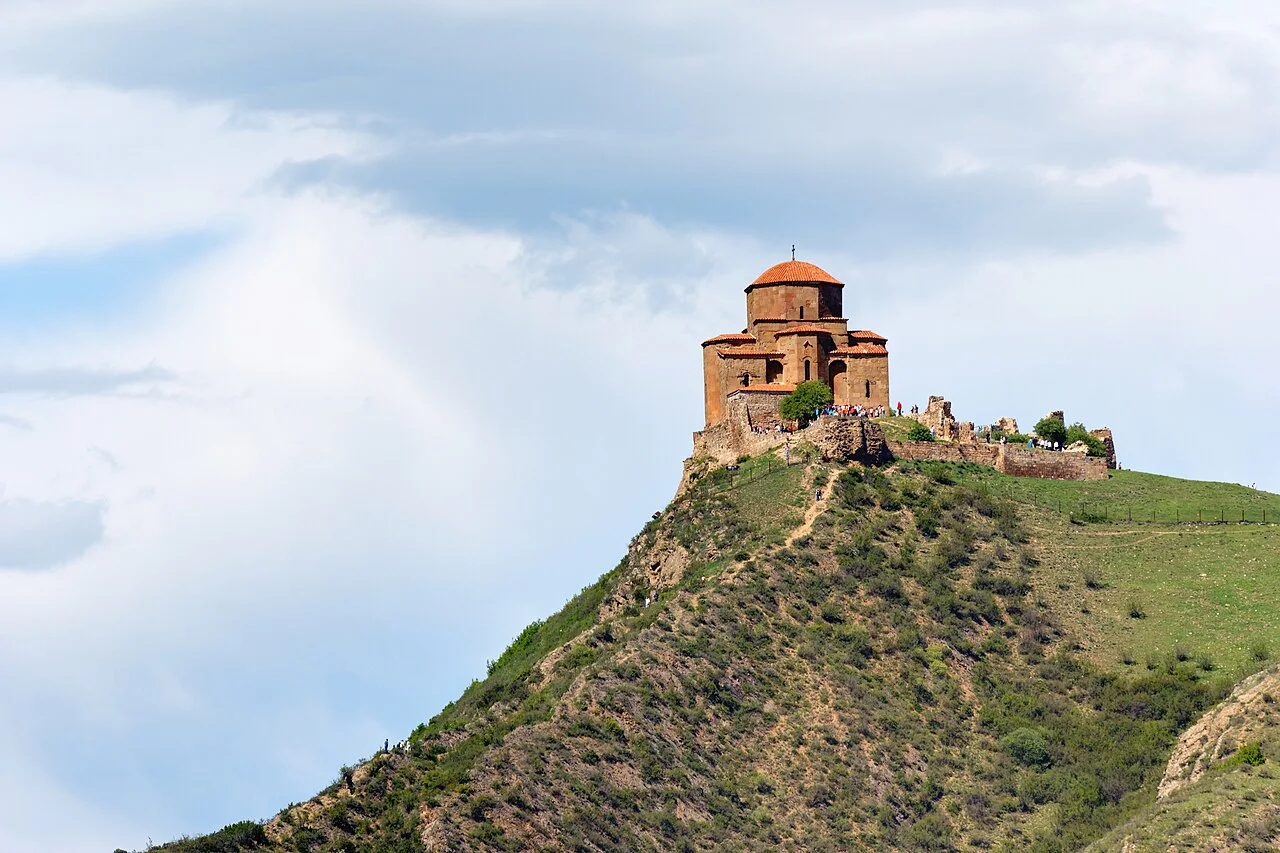
Mtskheta Municipality · 36 km
Jvari Monastery
Content & sources
Photo: Alexxx1979 · CC BY-SA 4.0
Uplistsikhe · 46 km
Uplistsikhe
Content & sources
Photo: EvgenyGenkin · CC BY-SA 3.0
Gremi · 81 km
Gremi
Content & sources
Zangala at Georgian Wikipedia · Public domain
Haghpat · 119 km
Haghpat Monastery
Content & sources
Diego Delso · CC BY-SA 4.0