Stanza · Audio guide
Aachener Dom Audio Guide
A place to remember. A story to take with you.
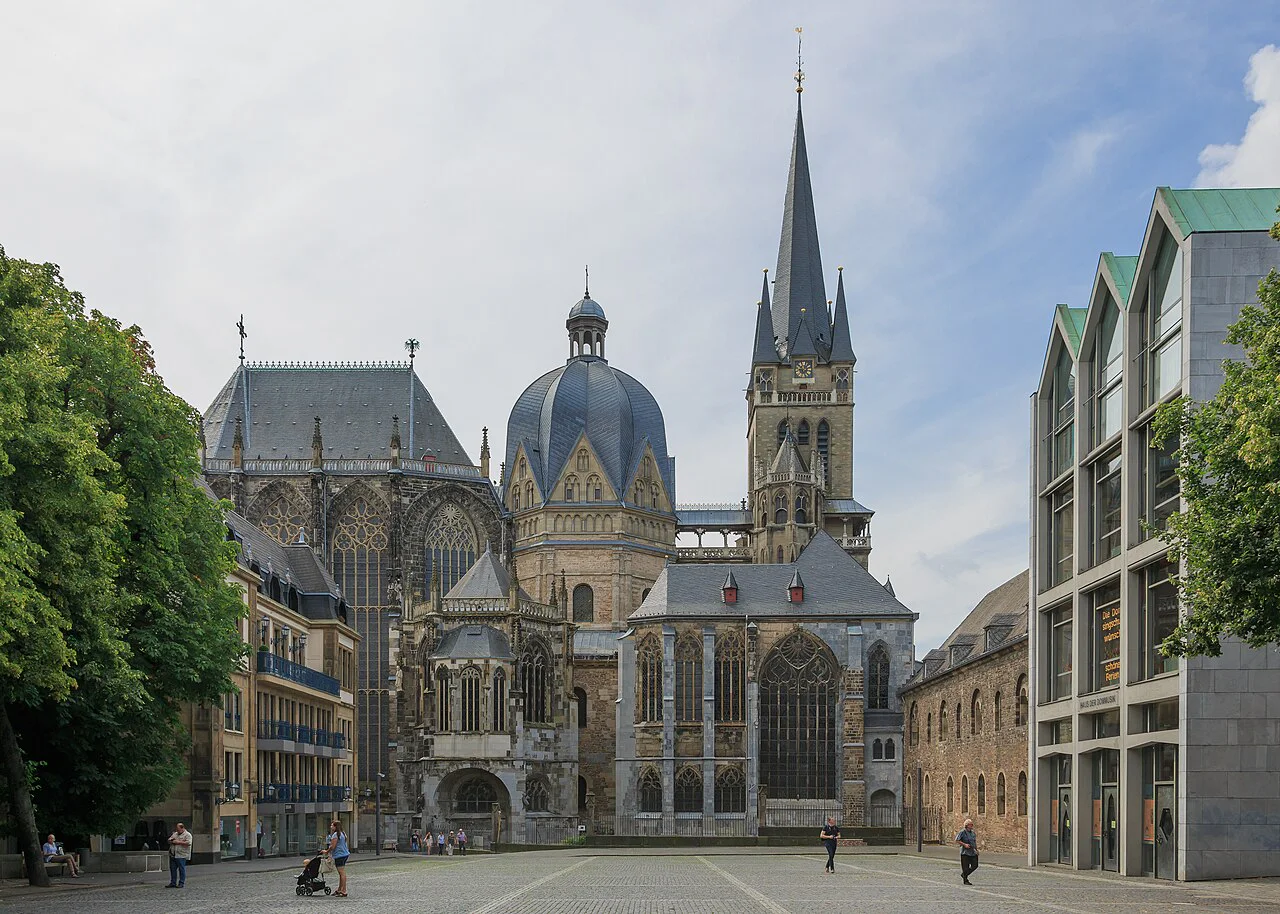
Aachen Cathedral is a Catholic church located in Aachen, Germany. It serves as the cathedral of the Diocese of Aachen.
Download Stanza, then search for “Aachener Dom”.
About the tour
One guide. Your kind of visit.
Aachen Cathedral is a Catholic church located in Aachen, Germany. It serves as the cathedral of the Diocese of Aachen.
Ready when you are.
- 01Get the free Stanza app.
iOS & Android
- 02Find your guide.
“Aachener Dom”
- 03Download before you go.
Works offline
Audio guide / 16 narrated stops
Inside the guide
Get to know a few of the stories before you go. Open a stop to read more.
01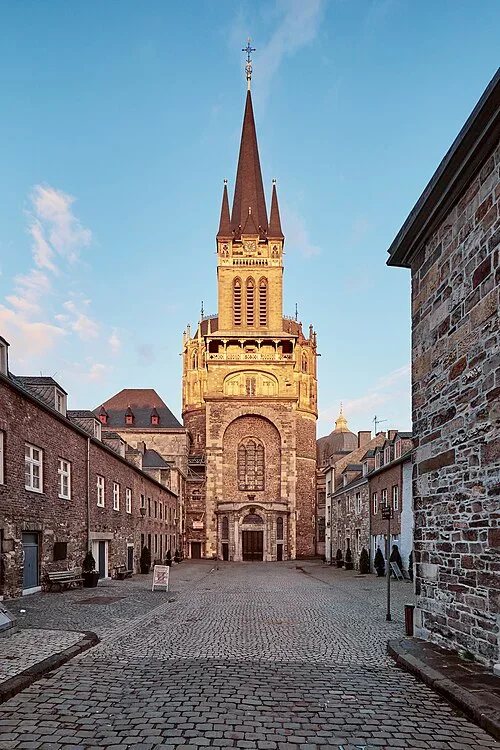 Westwork and Entrance Porch
Aachen Cathedral from the Domhof
Welcome to Aachen Cathedral, the church of one emperor and of the kings who came after him. What you see from the courtyard began as the palace chapel of Charlemagne, ruler of the Franks. Timber found in the structure dates the building work to between about 793 and 813, and he raised it on the site of a Roman bath. From 936 to 1531, German kings were crowned inside his chapel. In 1978 the cathedral was among the first twelve places ever inscribed on the UNESCO World Heritage list, honoured for its artistry and its central place in the history of the Holy Roman Empire. The west facade tells that whole story in stone. Its core is Carolingian, part of Charlemagne's own westwork, with the two flanking stair towers from his day. The bell tower crowning it is a Gothic revival addition of the nineteenth century, and the porch closing off the entrance is from the eighteenth. Each age added its own layer around the emperor's church.
Photo: Geolina163 · CC BY-SA 3.0
02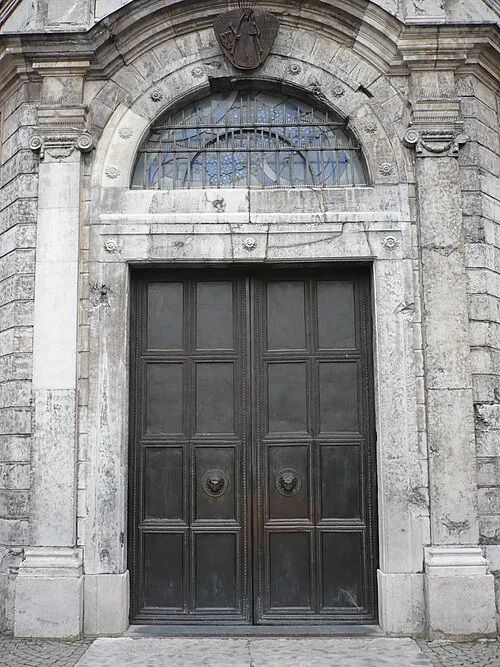 Westwork and Entrance Porch
The Wolf's Door (Wolfstür)
The great bronze doors of the entrance were cast here in Aachen around the year 800, and they still swing on their hinges twelve hundred years later. Their form copies the temple doors of ancient Rome, and that was the point: Charlemagne was claiming to have founded a New Rome in Aachen. Each leaf is divided into eight rectangles, a number early Christians read as the sign of Sunday, the day of Resurrection, and of perfection. The framing strips carry egg-shaped ornaments, an ancient symbol of life that Christians took further, to mean eternal life. The door rings are lions' heads, wreathed in twenty-four acanthus scrolls, numerology again. The whole door weighs forty-three hundredweight. Until 1788 it stood between the westwork and the octagon, and then the new porch swallowed it, drawing the entrance inside. This is also the door of a legend. The story goes that the builders ran out of money and made a pact with the Devil: funds to finish the church, in exchange for the soul of the first to enter. The citizens sent a wolf through the door first. The Devil took the animal's soul, saw he had been tricked, and stormed out, severing his thumb in a lion-head handle as he went. That thumb, people say, can still be felt inside the lion's mouth.
Carolus Ludovicus · CC BY-SA 2.0 de
03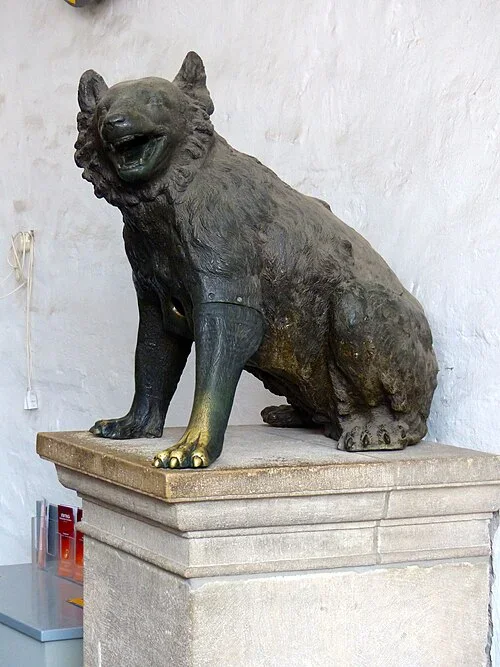 Westwork and Entrance Porch
The Bronze Bear of the Forehall
In the forehall a bronze bear sits on a stone pedestal, mouth open, its front paws catching the light with a golden sheen. It was probably made in the tenth century, in Ottonian times, and what it was for, or where it stood before it came here, nobody knows. Opposite it stands a bronze pine cone studded with perforated scales, its date a matter of argument, its Ottonian base carrying a verse inscription that names the rivers Tigris and Euphrates. The entrance of this church has been collecting curious bronzes for a thousand years.
Listen in the appPhoto: Geolina163 · CC BY-SA 3.0
04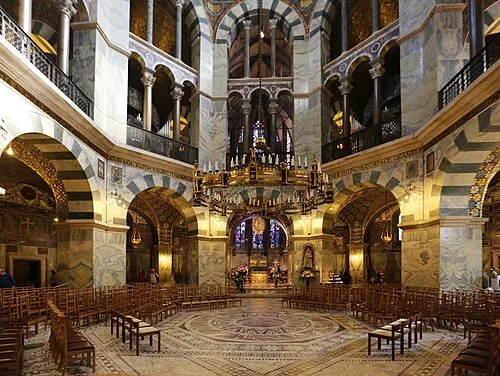 The Carolingian Octagon
The heart of the cathedral is Charlemagne's octagon, built as the chapel of his palace between 796 and 805. The architect was Odo of Metz, and his models were Byzantine: above all the Basilica of San Vitale in Ravenna, and the central-plan churches of Constantinople. What he produced was the first domed building north of the Alps since antiquity. For more than two hundred years, no vault north of the mountains matched its height or its span. The inner octagon measures about fourteen and a half metres across, ringed by a sixteen-sided outer wall with two storeys of vaulted passages, the upper one known as the Hochmünster, the high church. Charlemagne had the walls plastered red, with crushed brick mixed into the plaster to make it last. The colour was probably a deliberate echo of imperial Rome. This was no monument kept for show; it was the working chapel of his court, where the emperor and his household heard mass beneath the dome.
Listen in the appHOWI - Horsch, Willy · CC BY-SA 3.0
05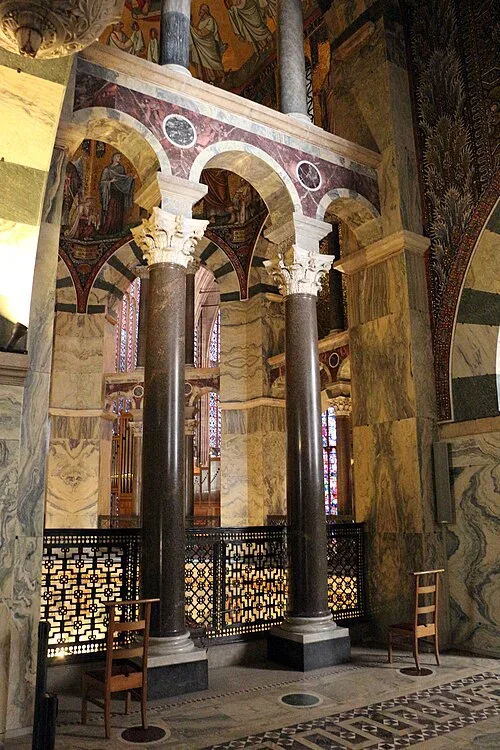 The Carolingian Octagon
The Antique Columns of the Gallery
The openings of the upper gallery are divided by columns that are older than the church itself. Charlemagne had them brought from Rome and Ravenna at the end of the eighth century, and others came from St. Gereon in Cologne. Filling his new imperial church with the stones of the ancient world was part of the same claim as the bronze door: this was to be a new Rome. In 1794 French revolutionary troops occupied Aachen and carted the columns off to Paris, and some of them are still in the Louvre. After the wars, in 1815, up to half the pieces remaining there were brought back. In the 1840s they were restored to their original places, twenty-eight of them returned from France. New columns of Odenberg granite stand in for the ones that never came home, and the old bronze bases were exchanged for marble. The gallery today is part ancient stone, part nineteenth-century repair.
Listen in the appPhoto: Sailko · CC BY 3.0
06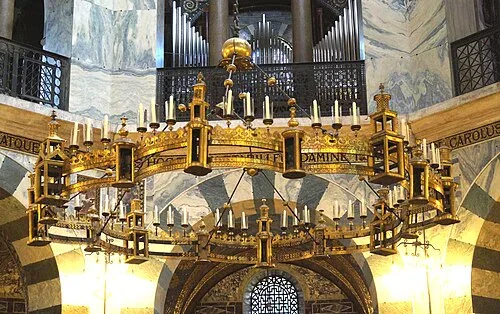 The Dome and Barbarossa Chandelier
The Barbarossa Chandelier
A wheel of gilded bronze hangs on a long chain from the dome, about four metres above the floor and more than four metres across. Emperor Frederick Barbarossa and his wife Beatrice gave it, around 1165 to 1170, and forty-eight candles burn along its rim for the great feasts of the church. The date is no accident. In 1165 Barbarossa had Charlemagne declared a saint, and Aachen was raised to be the chief church of the empire. The chandelier is the emperor's gift for that moment: a ring of light, hung directly beneath the dome.
Listen in the appPhoto: CaS2000 · CC BY-SA 3.0
07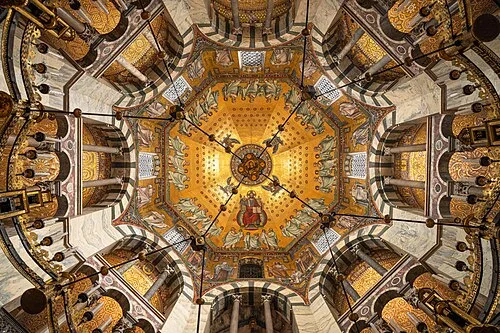 The Dome and Barbarossa Chandelier
The Dome Mosaic of Christ
At the crown of the dome, everything turns to gold. The mosaic there shows Christ as the triumphant Lord of the world, ringed by the symbols of the four Evangelists. Around him, the twenty-four elders of the Apocalypse offer up their crowns. That programme was probably first carried out around the year 800, and medieval writers described it in detail. What glitters today, though, is a nineteenth-century recreation. In 1880 and 1881 the Venetian workshop of Antonio Salviati remade the mosaic, working from plans by the Belgian architect Jean-Baptiste de Béthune, in the neo-Byzantine style. The image above is Charlemagne's vision, carried out in Venetian glass a thousand years after his craftsmen first set it.
Listen in the appPhoto: Tuxyso · CC BY-SA 4.0
08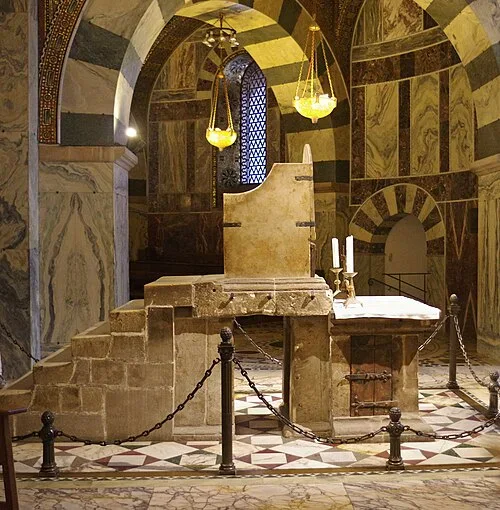 The Upper Gallery (Hochmünster)
The Throne of Charlemagne (Karlsthron)
In the western gallery, opposite the choir, stands a plain block of marble with a simple back. It looks almost rough, and the plainness is the point. This is the throne of Charlemagne, and after their anointing and coronation at the altar of Mary, each new king sat down on it. About thirty of those kings took their seat on this throne. Even rulers crowned elsewhere in the empire came to Aachen to take their position on Charlemagne's seat, because sitting where he had sat made them his heirs. His own son Louis the Pious crowned himself here, on Charlemagne's explicit instructions, the king's own hands setting the crown on his head. The marble itself is said to have come from the Church of the Holy Sepulchre in Jerusalem. Through all those coronations, the throne's appearance and its place in the chapel never changed.
Listen in the appPhoto: Kleon3 · CC BY-SA 3.0
09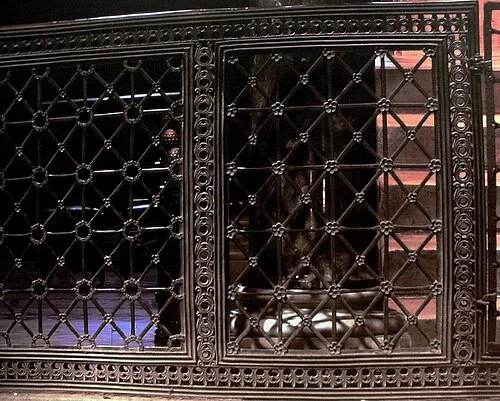 The Upper Gallery (Hochmünster)
Carolingian Bronze Gallery Screens
The bronze railings along the upper gallery are among the oldest fittings in the whole church. Each one, about a metre high, was cast in a single piece, following Roman models, around the year 800. A foundry was set up in Aachen at the close of the eighth century to serve the whole palace, pouring out bronze doors and railings. These rails have kept their place ever since, outlasting nearly everything around them. The pattern is plain and strong: crossing bars that form diamonds, with rosettes worked along the frame. Fittings like these were usually melted down or replaced long ago. Here part of the original metalwork still does its first job, closing off the openings of the gallery.
Listen in the appPhoto: Kleon3 · CC BY-SA 3.0
10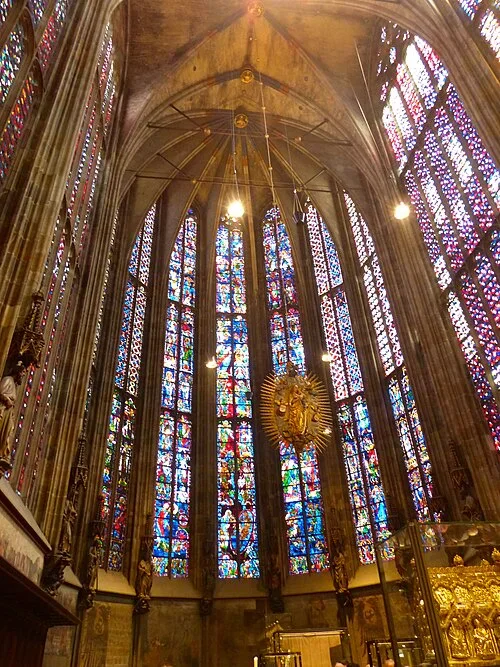 The Gothic Choir Hall ('Glashaus')
East of the octagon, the church suddenly turns to glass. This choir was begun in 1355, on the initiative of the chapter of St Mary and the mayor of Aachen, Gerhard Chorus. It was finished in 1414. The model was the Sainte-Chapelle in Paris, a royal chapel built to hold precious relics. Aachen's choir was conceived the same way, as a glass reliquary for the holy relics of Aachen and for the body of Charlemagne. The glass adds up to more than a thousand square metres. The tallest windows rise about twenty-five and a half metres. To keep the narrow stone supports from buckling under the vault, iron rods were built into the structure as it rose, leaving every possible space for window. Then there is Otto the Third. In the year 1000 the young emperor had Charlemagne's vault opened. One of the courtiers who went down with him, Otto of Lomello, recorded the event, and a chronicle written about 1026 reports it. That chronicle adds the most vivid touch, the emperor found seated as if alive, a detail historians treat with caution. Otto himself died in 1002 and was buried in this church. Once the choir stood, his sarcophagus was moved to the middle of the choir floor, where it lies today.
Listen in the appPhoto: Geolina163 · CC BY-SA 3.0
- 11
The Strahlenkranzmadonna by Jan van Steffeswert
A golden Madonna of 1524 by Maastricht's master carver, glowing against the choir windows.
- 12
The Shrine of Charlemagne (Karlsschrein)
How Charlemagne's remains travelled from an uncertain grave to the golden shrine that holds them still.
- 13
The Shrine of St. Mary (Marienschrein)
The golden shrine of St Mary, its four great relics, and the pilgrimage that returns every seven years.
- 14
The High Altar and the Pala d'Oro
Seventeen gold panels telling the life of Christ, read like a book across the high altar.
- 15
The Ambo of Henry II
A gilded pulpit a thousand years old and still in service, its ivories carved centuries before it was made.
- 16
Cloister and Paradiesbrunnen: Survival and Meaning
The war the cathedral barely survived, the young fire watch that defended it, and the long work of putting it right.
Aachener Dom
Frequently asked questions
How much does the guide cost?
Free app download. Listed guide price: $1.99. Guide price shown in the app. Audio guide only. Venue admission is separate.
Can I listen without internet?
Yes. Download the guide’s audio, images, and maps in the app before your visit. Your downloaded content is then available offline.
Can I listen in my language?
This audio guide is available in 15 languages, including English.
Do I need to follow a schedule?
No. This is a self-guided experience. Choose your stops, pause whenever you like, and return to a story at your own pace.
At your own pace
Explore Aachener Dom.
Download Stanza, then search for “Aachener Dom”.
Free app download · Guide price shown in the app
Keep exploring
Nearby audio guides
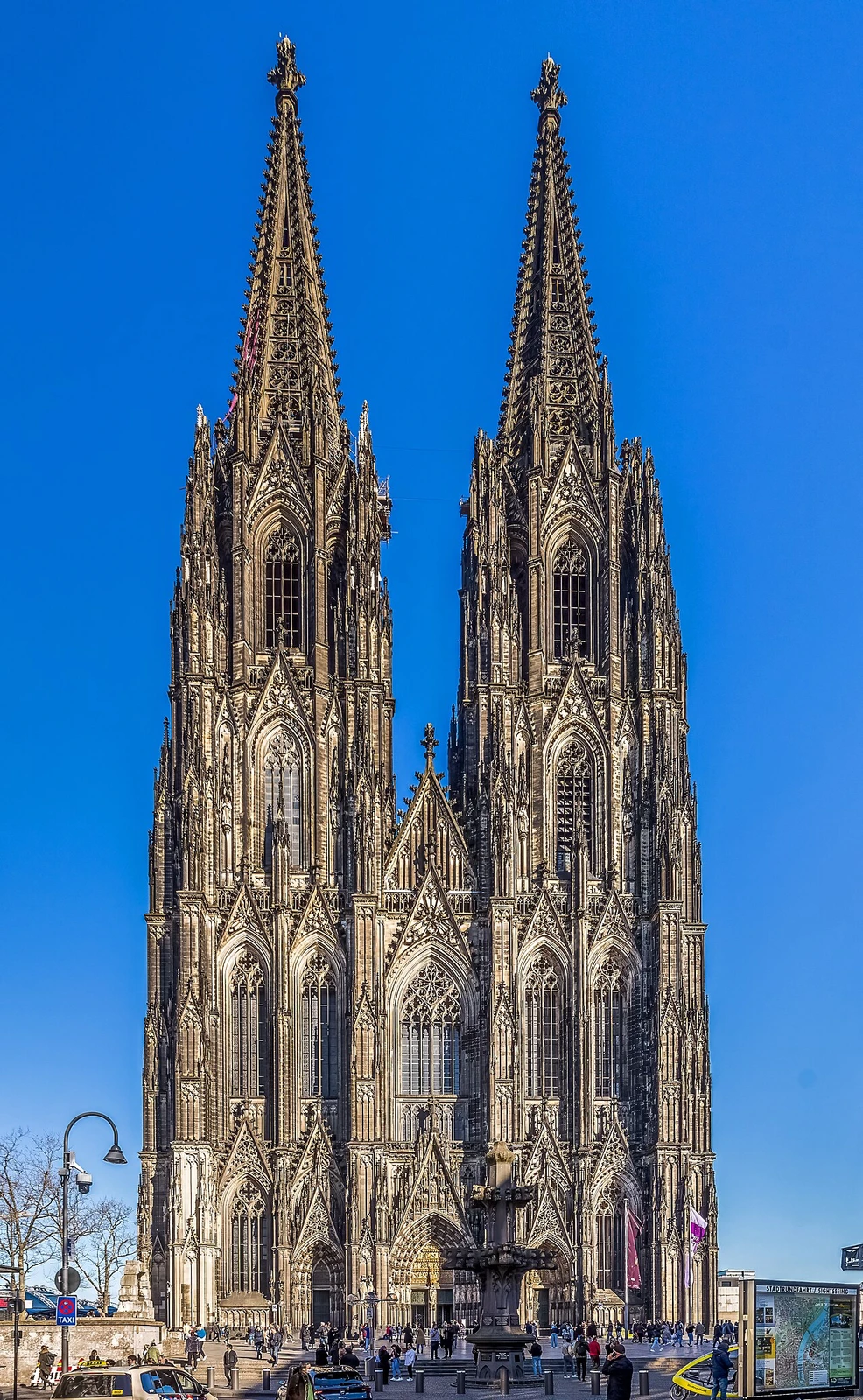
Cologne · 64 km
Cologne Cathedral
Content & sources
Raimond Spekking · CC BY-SA 4.0
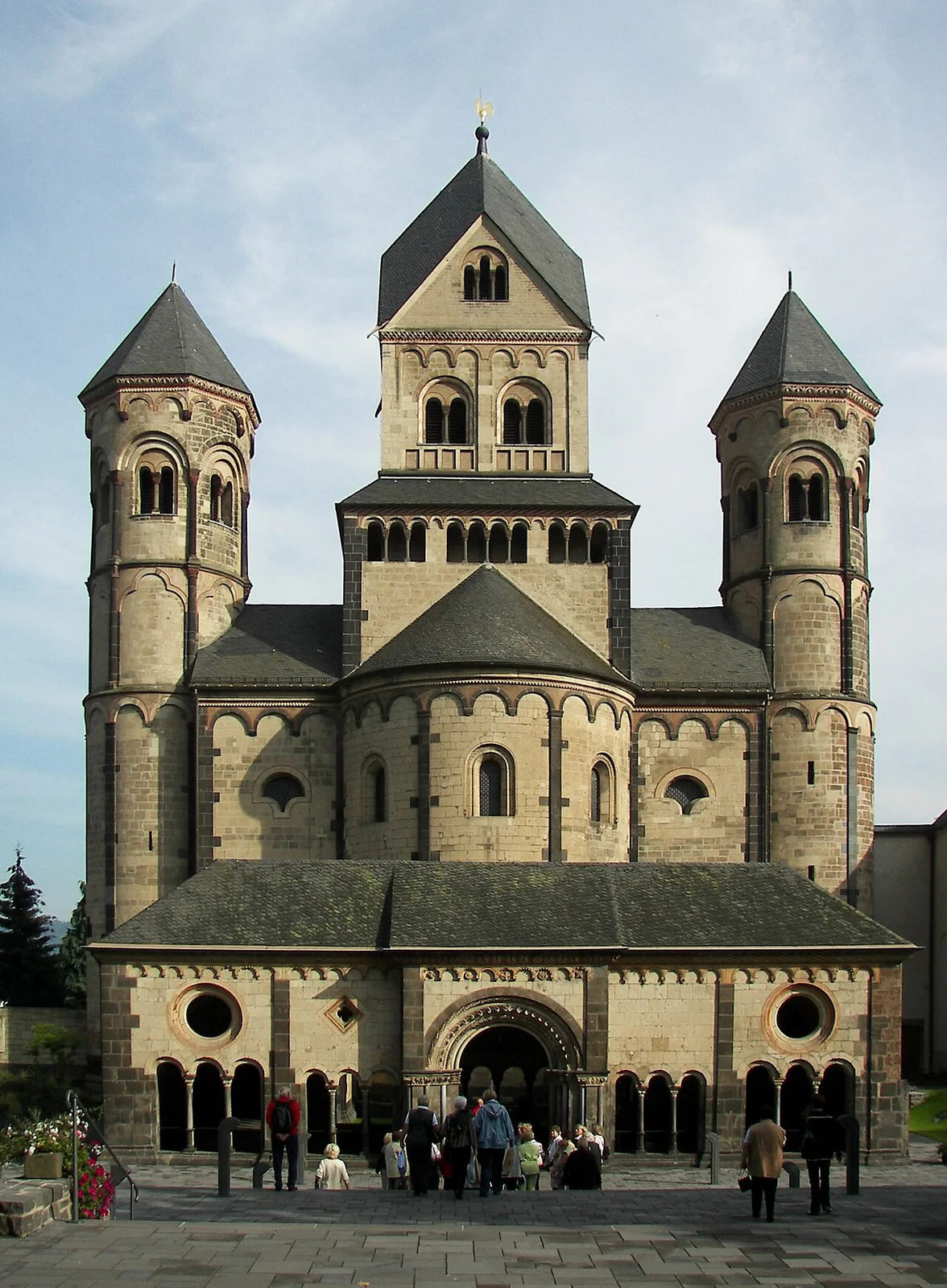
Maria Laach · 92 km
Abtei Maria Laach
Content & sources
Nikanos · CC BY-SA 2.5
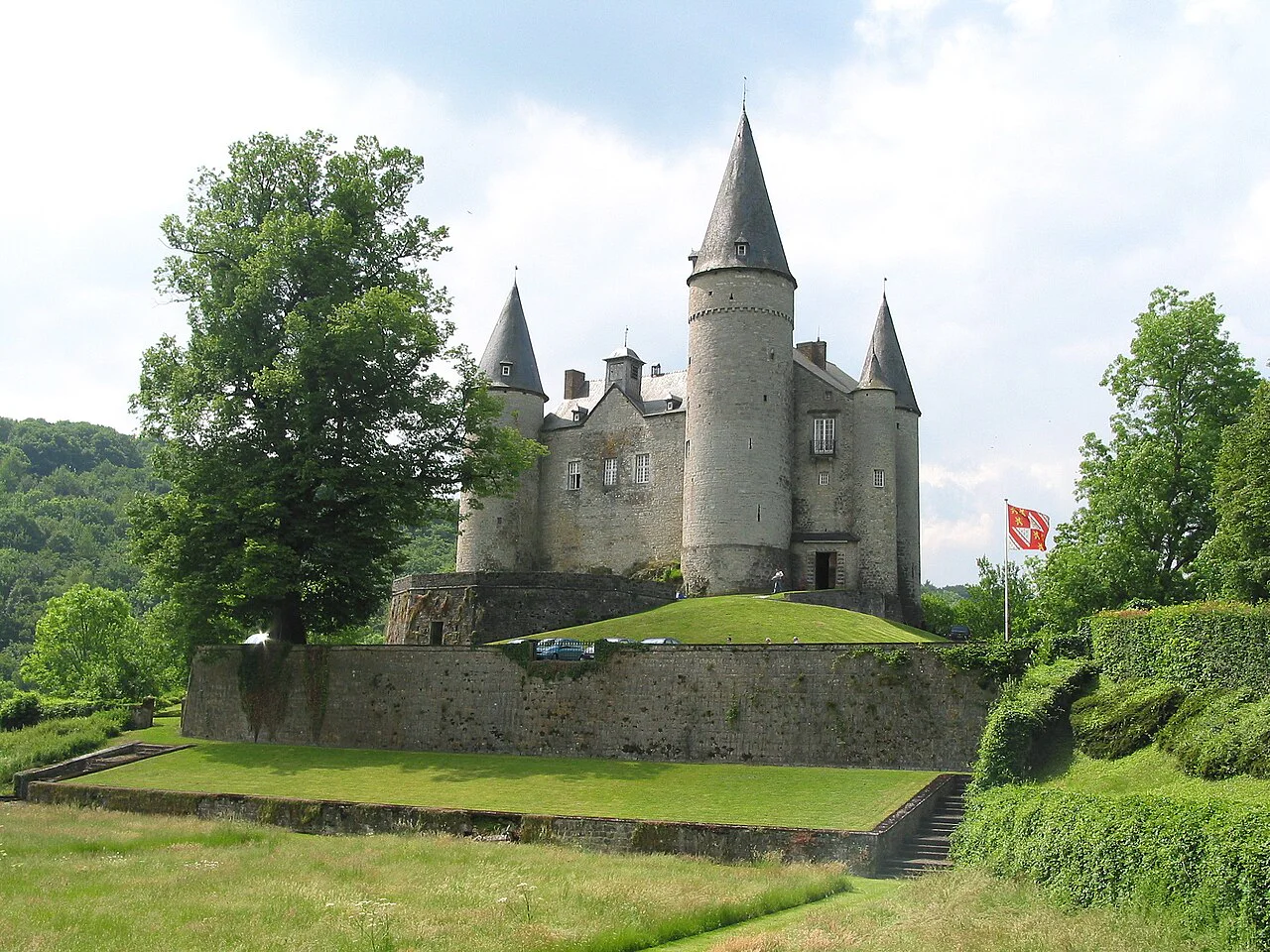
Celles · 99 km
Kasteel van Vêves
Content & sources
Photo: Jean-Pol GRANDMONT · CC BY 2.5
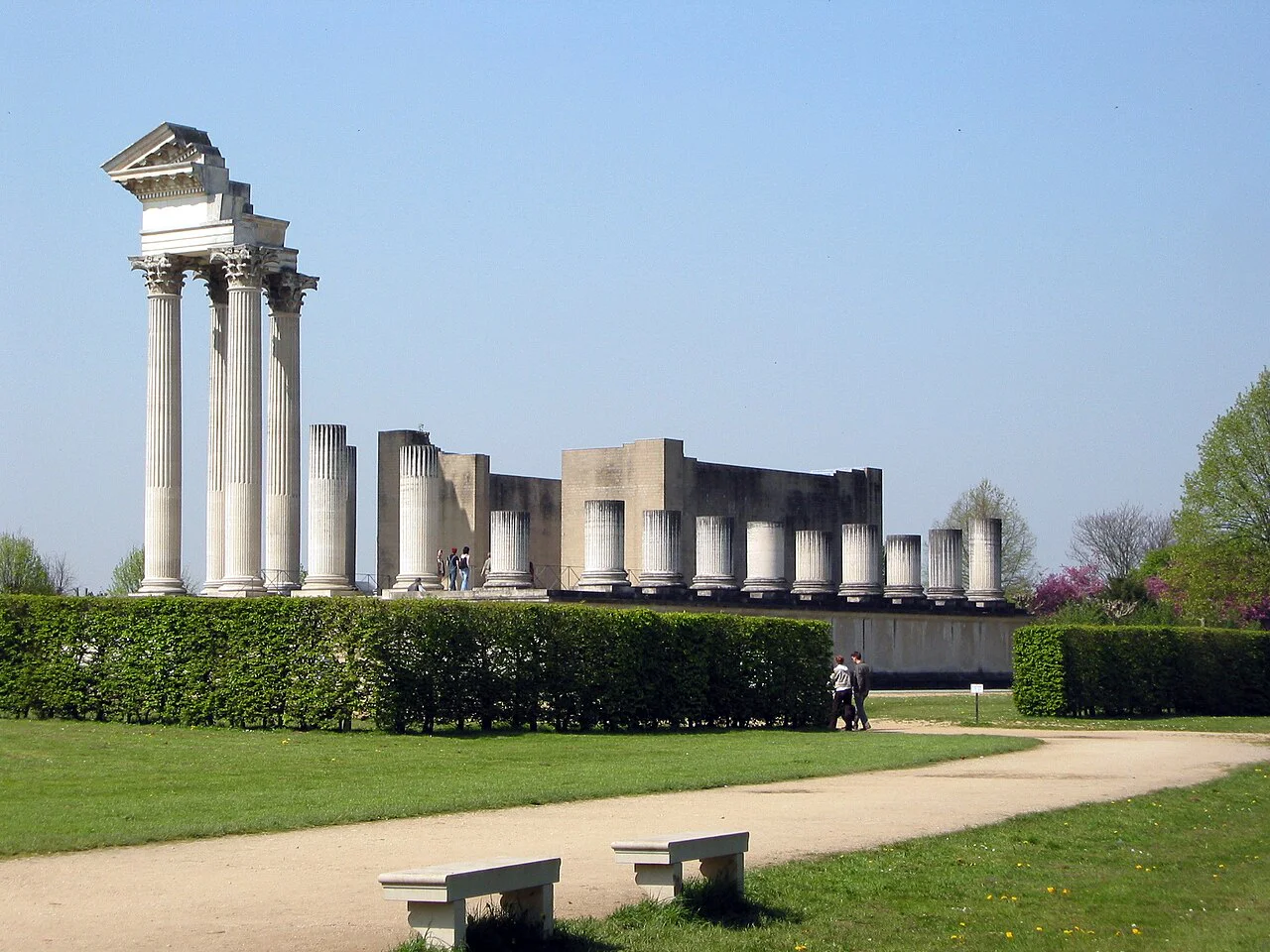
Xanten · 102 km
Colonia Ulpia Traiana
Content & sources
Photo: Magnus Manske · CC BY-SA 3.0