Languages
15Kölner Dom Audio Guide
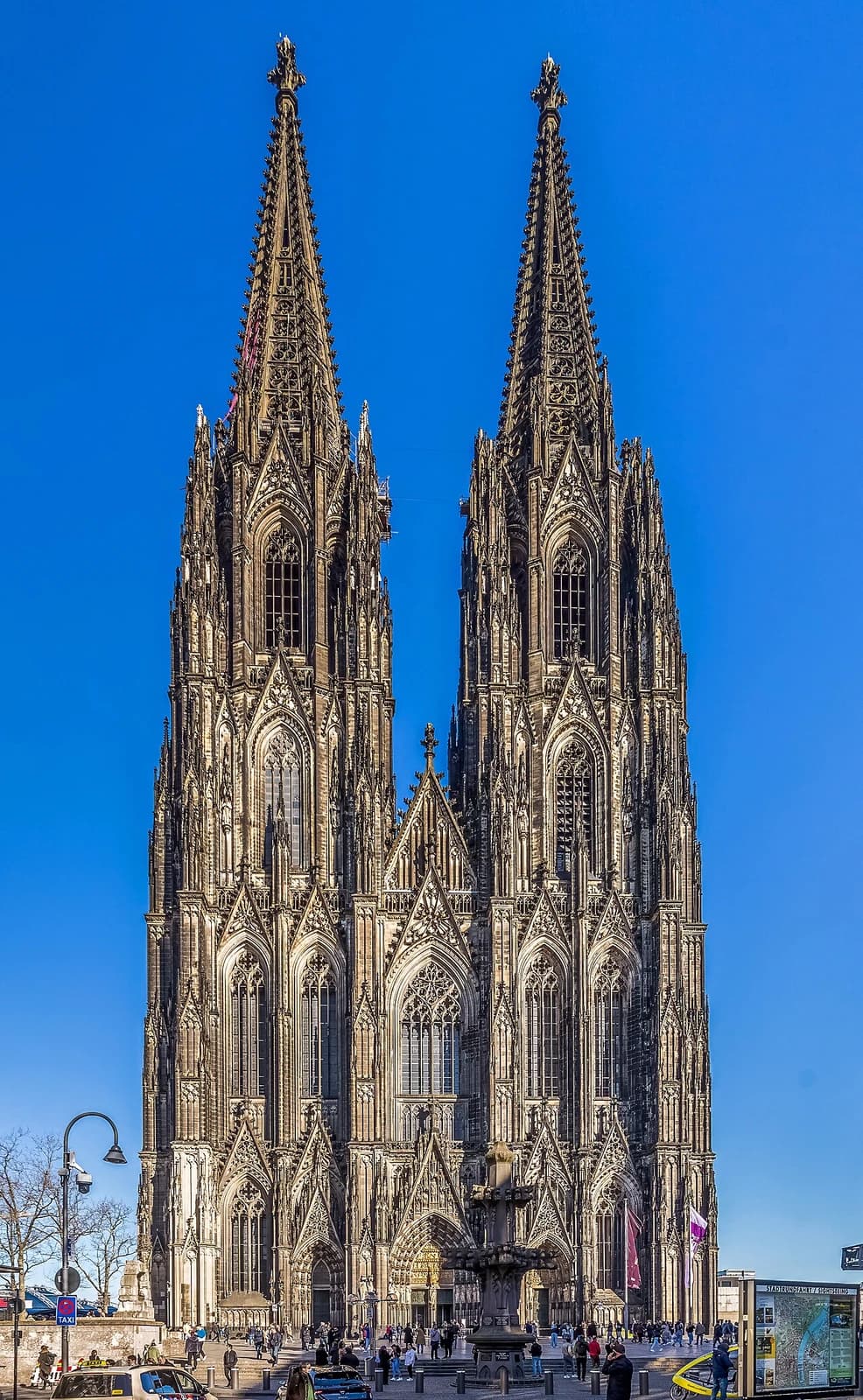
Kölner Dom is a landmark in Cologne, Germany. Explore it with Stanza's GPS-triggered offline audio guide — available in 15 languages.
Quick Facts
24
Stops
15
Languages
100%
Offline
📍 Cologne, Germany · 50.9414°N, 6.9583°E
About Kölner Dom
A magnificent Roman Catholic cathedral in Cologne, Germany, renowned for its stunning Gothic architecture. It is a UNESCO World Heritage site and one of Germany's most visited landmarks.
Kölner Dom is also known as High Cathedral of St. Peter, Hohe Domkirche Sankt Petrus, Kölner Dom.
This self-guided audio tour features 24 narrated stops organized across 9 sections. As a cathedral, Kölner Dom offers a unique cultural experience in the heart of Cologne, Germany.
The Stanza audio guide is available in 15 languages and works entirely offline — download the complete tour including audio narration, maps, and images before your visit. As you walk through Kölner Dom, GPS-triggered narration plays automatically at each point of interest.
Last updated:
What you will hear
The West Portals
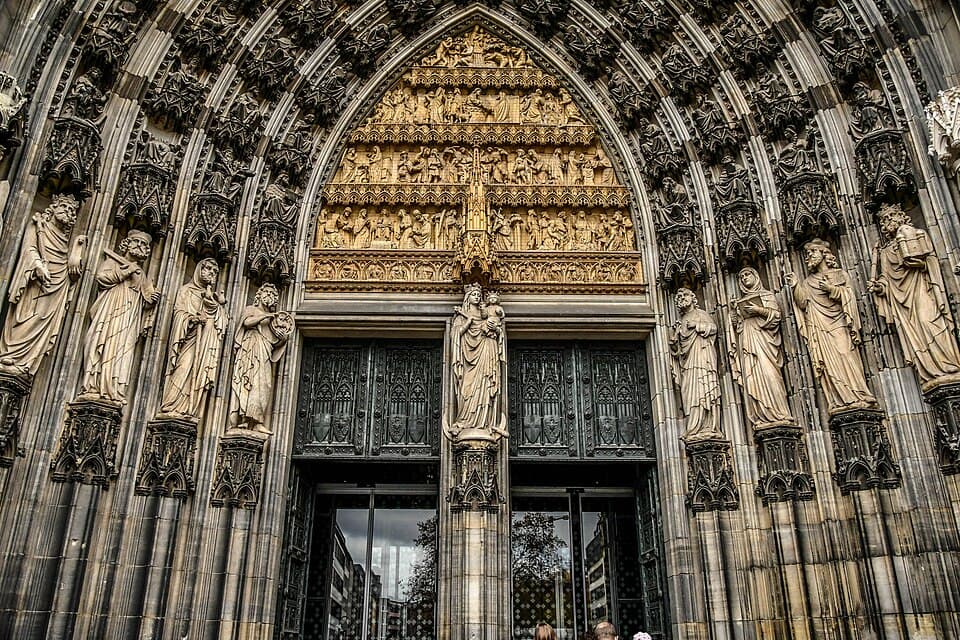
Focuses on the transition into the 'Holy City' of Cologne, featuring the intricate sculptures of the main entrance.
The Peter Portal
Standing before the Peter Portal, you are at the main entrance designed to usher visitors from the secular world into what was envisioned as a 'Holy City.' The sculptures surrounding this doorway were crafted in the 19th century, yet they possess a distinctly medieval soul. This is because the artisans of the 1800s worked from original 14th-century architectural plans that had been rediscovered, allowing them to complete the portal exactly as the medieval masters intended. These figures represent a hierarchy of faith, featuring prophets, apostles, and various saints who serve as a welcoming committee to the sanctuary. At the heart of this iconographic program is Saint Peter, the patron saint of the cathedral. His presence here emphasizes the church's ancient connection to the papacy and the early foundations of the Christian faith in Europe. Take a moment to observe the fine detail in their expressions and garments, each figure contributing to the grand narrative of salvation carved into the very walls. The portal serves as a symbolic threshold, preparing the visitor for the spiritual grandeur that lies within the cathedral's massive interior.
The Bavarian Windows
Focuses on the 19th-century stained glass donated by King Ludwig I, illustrating the revival of the cathedral's construction.
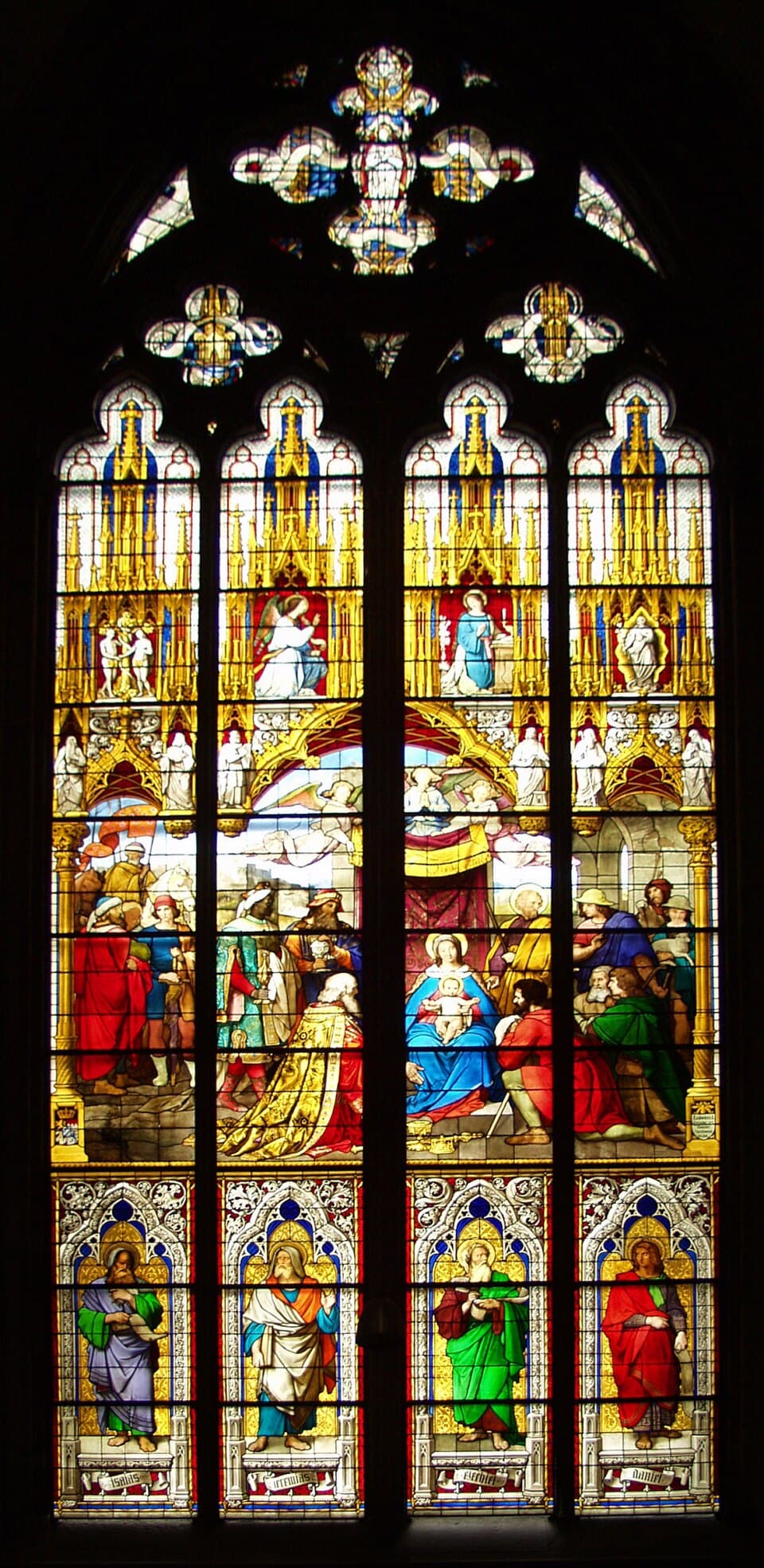
Bayernfenster
1848
The series of five brilliant windows lining the south aisle are known as the 'Bayernfenster,' or Bavarian Windows. They were a gift from King Ludwig I of Bavaria in 1848 to mark the resumption of construction after the centuries-long pause. These windows are executed in the 'Nazarene' style, which was popular in Germany during the 19th century. Unlike the fragmented, jewel-like colors of medieval glass, the Nazarene style uses large, clear panels of color to create highly detailed, painterly narrative scenes. The scenes depicted here illustrate key moments in Christian history, ranging from the life of Mary to the descent of the Holy Spirit. Notice the brightness and the clarity of the figures; they were intended to be easily read and understood by all who visited. By commissioning these works, King Ludwig I wasn't just decorating the church; he was helping to transform the cathedral into a national monument of German identity and craftsmanship during a pivotal era of European history. Their presence marks the moment when the cathedral transitioned from a neglected ruin into a symbol of a unified nation.
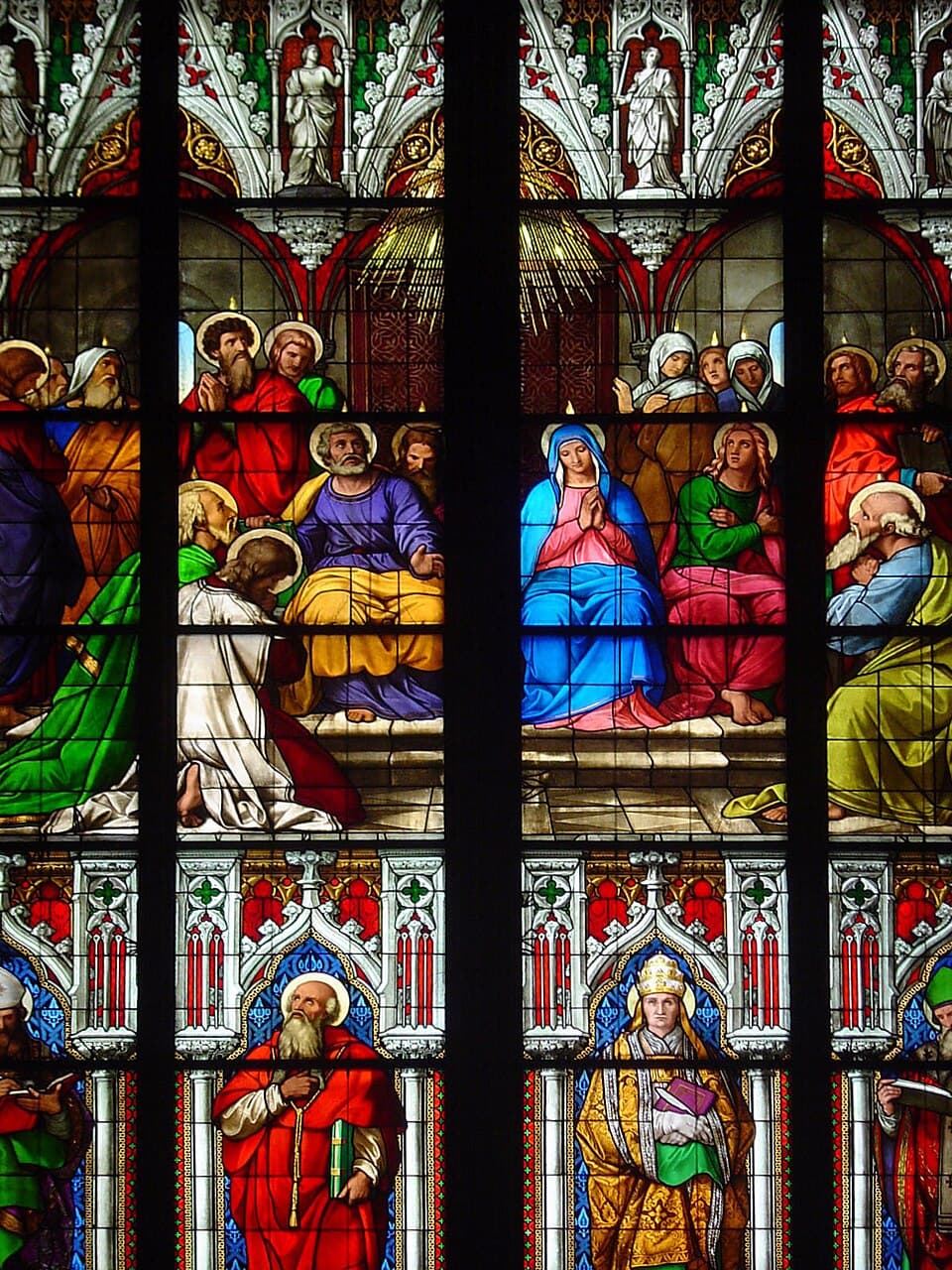
Detail of the Royal Gift
If you look toward the bottom panels of the Bavarian Windows, you will see a fascinating shift from biblical narrative to contemporary history. These lower sections often depict the donors themselves—King Ludwig I and other prominent figures involved in the 19th-century efforts to finish the cathedral. Including the portraits of patrons in religious art is an ancient tradition, but here it carried a specific political weight. After the three-hundred-year abandonment of the project, these windows served as a visual testament to the renewed commitment of the German nobility and the public. They helped reignite a sense of national pride and purpose, proving that the modern age could match the architectural grandeur of the Middle Ages. These portraits bridge the gap between the sacred scenes above and the reality of the people who made the cathedral's completion possible. They serve as a permanent record of a time when the entire nation turned its eyes toward Cologne to see its greatest landmark finally reach the sky. The juxtaposition of the holy and the royal reminds us of the cathedral's dual role as both a church and a national icon.
The Richter Window
Modernity meeting Gothic: Gerhard Richter's 11,500 colored pixels create a unique light effect in the south transept.
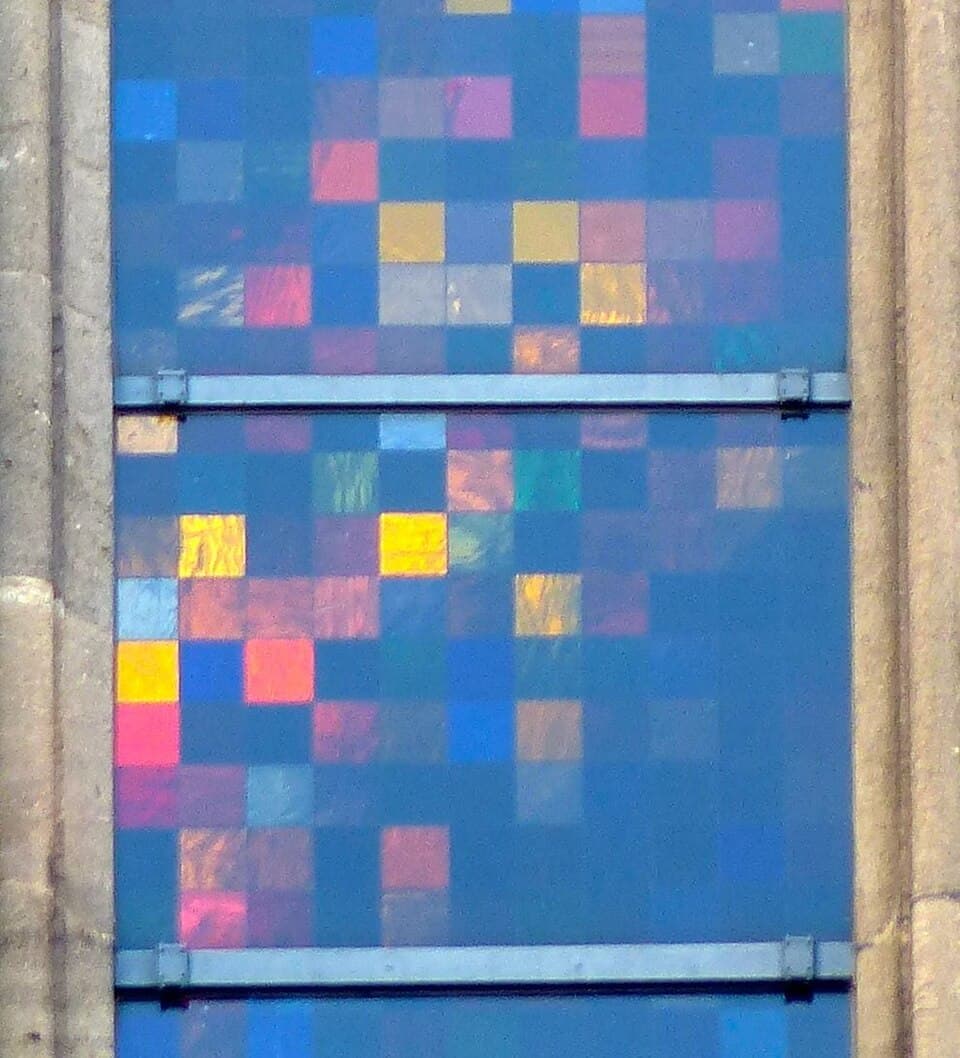
The Richter Pixel Window
The south transept houses one of the cathedral's most famous and debated modern additions: the Richter Window. Created by the world-renowned German artist Gerhard Richter, this window replaced a 19th-century glasswork that was destroyed during World War II. Richter used a computer to randomly arrange 11,500 small squares of glass in 72 different colors. The result is a vibrant, non-representational mosaic that lacks any specific religious imagery. When it was unveiled in 2007, it caused quite a stir; the Archbishop at the time famously expressed his disapproval, preferring a more traditional narrative design. However, many visitors find it deeply moving. On sunny days, the window creates a spectacular 'color bath,' casting a shifting pattern of multi-colored light across the floor and pillars of the transept. It invites a different kind of spiritual reflection—one based on the pure experience of light and color rather than a specific story. This abstract masterpiece demonstrates how the cathedral continues to engage with the best artists of the modern day, maintaining its role as a living center for artistic expression and spiritual inquiry.
The High Choir and Stalls
The liturgical heart of the cathedral, featuring the world's largest altar stone and the massive medieval choir stalls.
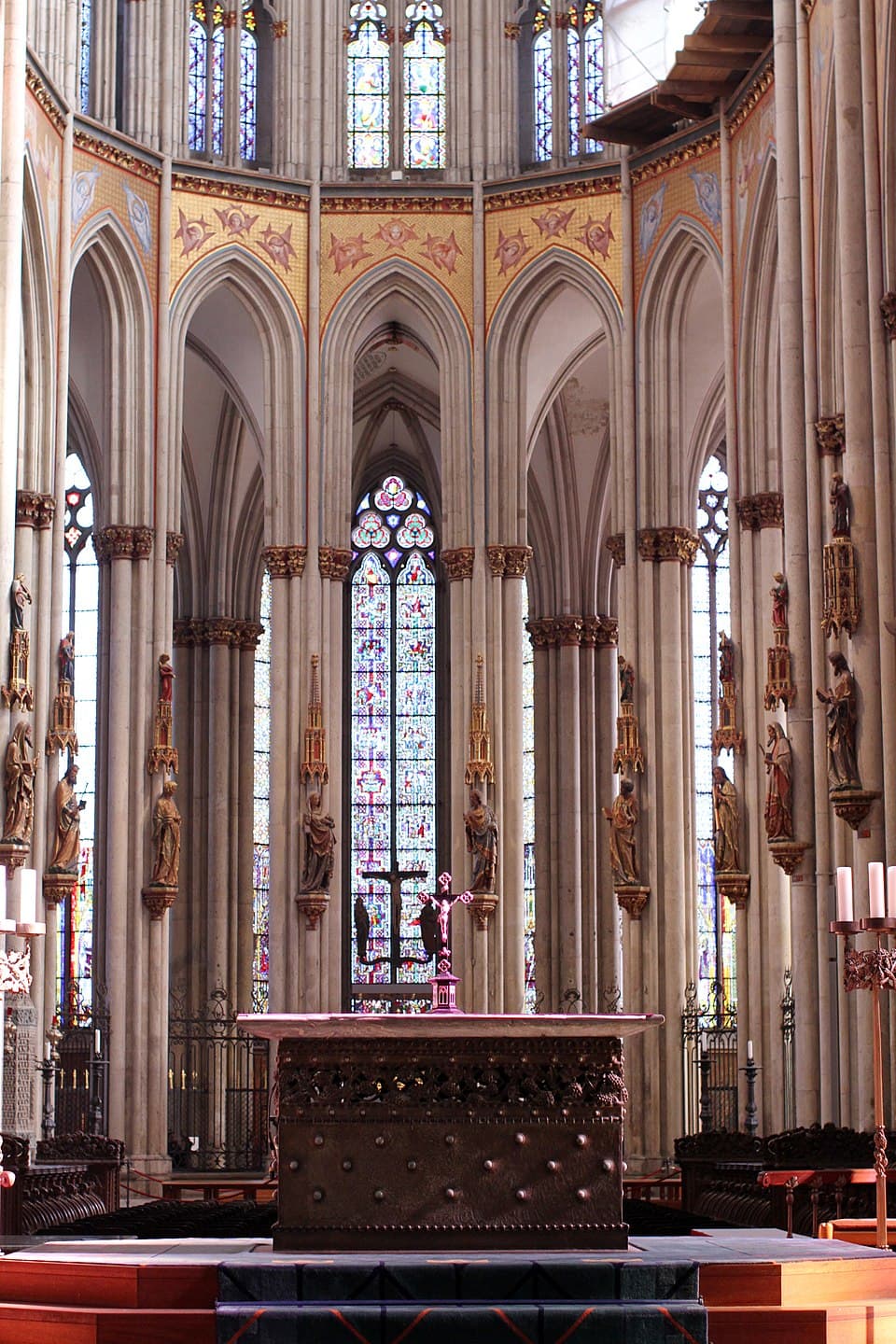
Cologne cathedral altar (Elmar Hillebrand).
Elmar Hillebrand · 1960
The high altar, dating from around 1310 to 1320, is a masterpiece of medieval stone carving. The massive top slab is carved from a single piece of black marble, measuring over four and a half meters long. This makes it the largest altar stone of its kind in the world. Around the base of the altar, you will see a series of delicate white marble niches that provide a striking visual contrast to the dark stone above. These niches house small, finely carved figures representing the apostles and scenes from the life of the Virgin Mary, most notably the Coronation of the Virgin in the center. The level of detail in these miniature sculptures is remarkable, capturing expressions and gestures with a grace that was revolutionary for the time. As the focal point of the choir, this altar was the site of the most important liturgical celebrations for centuries. Its design reflects the cathedral's dedication to both the Virgin Mary and the Saints, grounding the vast architecture in the intimate details of sacred history. It stands as a profound example of the high level of craftsmanship that defined Cologne's artistic workshops in the Middle Ages.
Shrine of the Three Kings
The spiritual reason for the cathedral's existence. The largest and most significant reliquary of the Middle Ages.
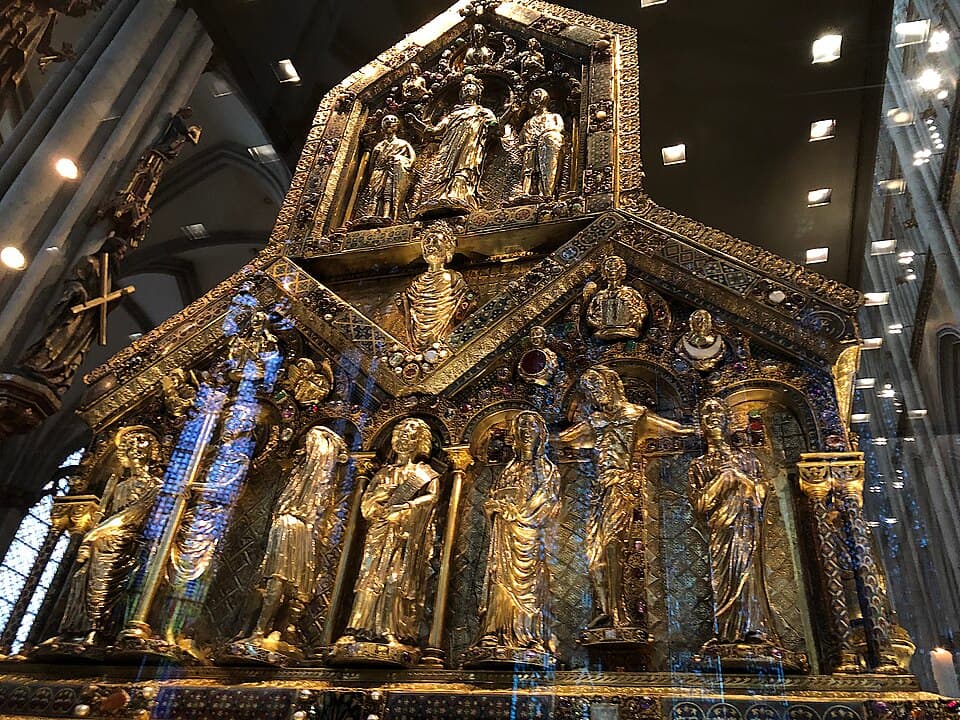
Detail of the Golden Reliquary
Take a moment to appreciate the staggering level of detail on the Shrine of the Three Kings. It was primarily the work of Nicholas of Verdun, the most famous goldsmith of the Middle Ages. The surface is a riot of gold, silver-gilt, and colorful enamel work. More than 1,000 precious gemstones and pearls are embedded into its sides, shimmering under the sanctuary lights. The shrine is populated by over 70 figures, including prophets, apostles, and scenes from the life of Christ, all rendered with a lifelike quality that was far ahead of its time. Notice how the figures seem to step out from their niches, their drapery and expressions captured with incredible precision. The triple-decker design represents the hierarchy of salvation history. The level of wealth and skill poured into this single object is difficult to overstate; it was intended to be the most beautiful and valuable object in Christendom, a fitting home for the remains of the kings who were the first Gentiles to recognize the divinity of Christ. The craftsmanship here represents the absolute peak of the Romanesque and early Gothic transitional style in metalwork.
Masterpieces of the North Aisle
Home to Stefan Lochner's 'Dombild' and the intricate Klarenaltar, showcasing the height of late Gothic painting.
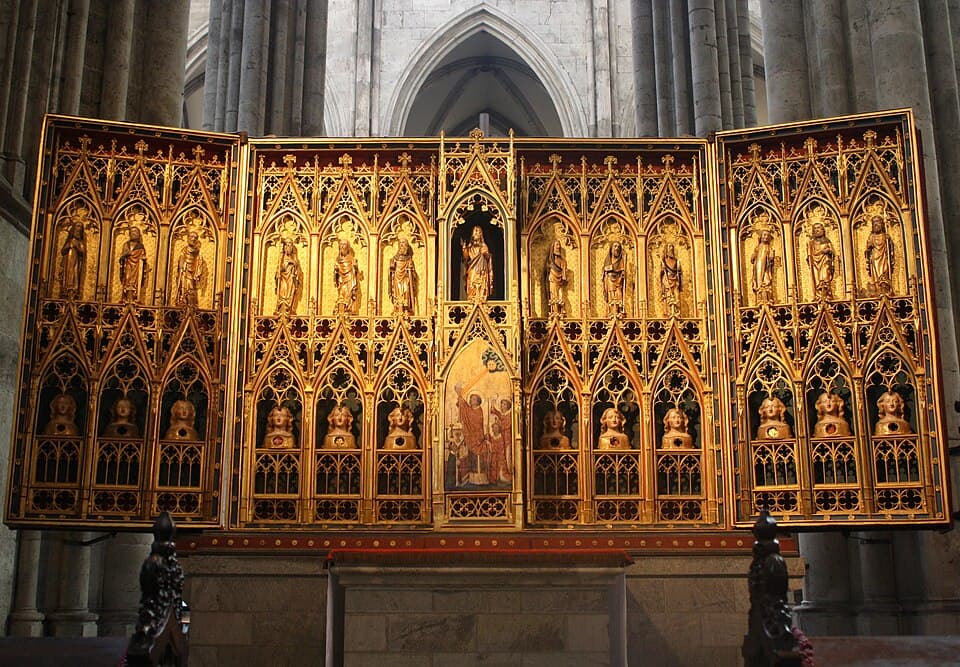
Klarenaltar
15th century
The Klarenaltar, or Saint Clare Altar, dates from roughly 1350 to 1360 and is one of the most important surviving examples of the Cologne painting tradition. This 'wing-altar' is essentially a massive, storytelling machine. It consists of multiple panels that could be opened or closed depending on the liturgical season, revealing different layers of sacred imagery to the congregation. As you look at the structure, you will notice numerous small, arched compartments. These were specifically designed to hold relics, turning the altarpiece itself into a monumental reliquary. In the Middle Ages, the presence of these physical remains of saints was believed to bring the divine closer to the earthly realm. The background of the panels is almost entirely covered in gold leaf, a technique used to symbolize the uncreated light of heaven. This shimmering surface reflects the candlelight of the cathedral, making the figures appear to glow with their own internal light. The scenes depicted across the panels tell the story of the life of Christ and the Virgin Mary, rendered with the elegant, elongated figures typical of the period. Originally located in the church of the Franciscan nuns of Saint Clare, the altar has found a permanent home here, preserving a vital link to the artistic and spiritual life of 14th-century Cologne.
The South Tower and Bells
The climb of 533 steps and the home of the 24-ton 'St. Petersglocke' (Decke Pitter).
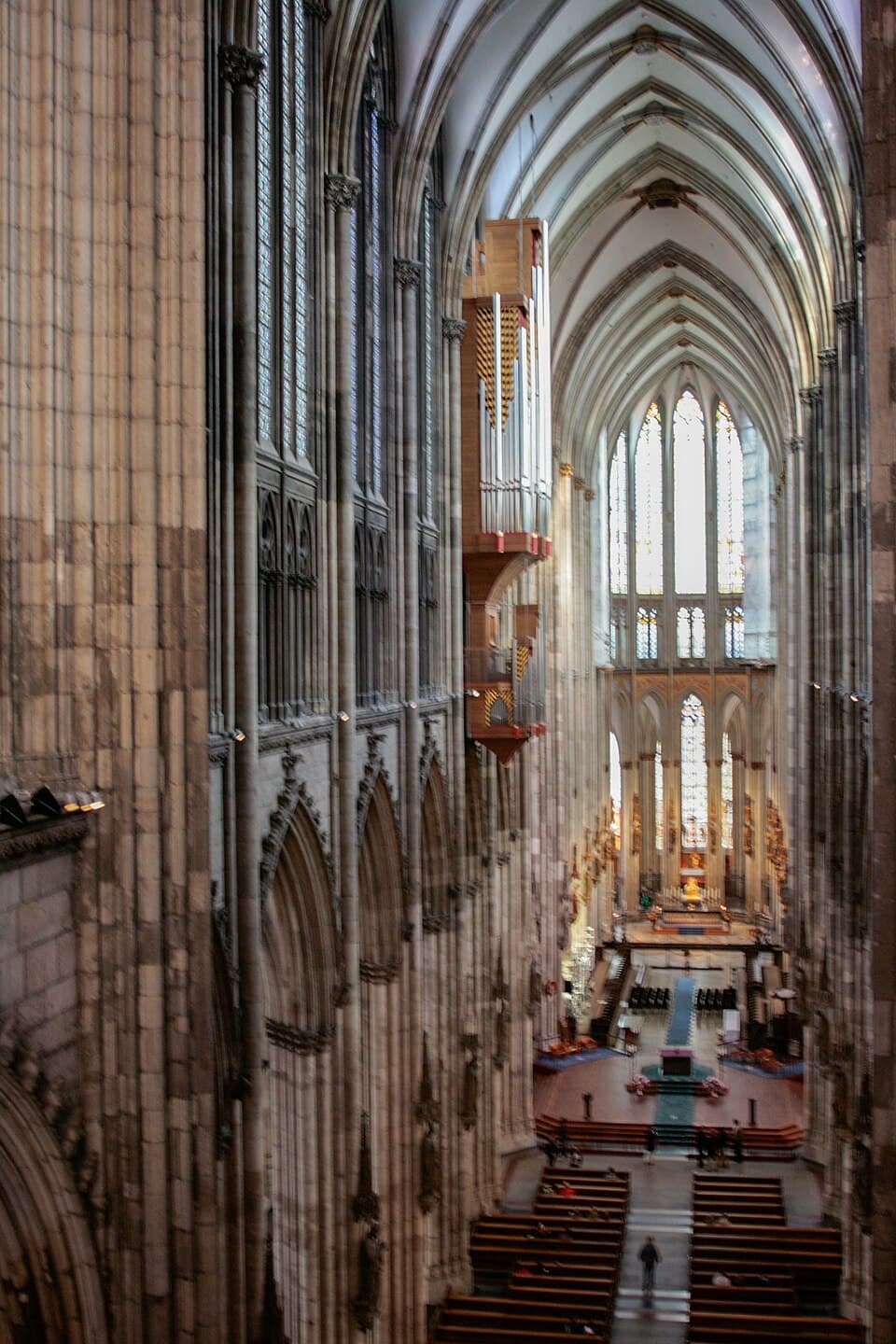
Perspective from Above
Gazing down into the nave from the upper levels of the cathedral provides a perspective that is impossible to gain from the floor. From this height, the 'stone reliquary' effect mentioned earlier becomes even more apparent. You can see the rhythmic repetition of the pillars as they rise 43 meters from the ground, branching out into the complex web of ribs that support the vaulted ceiling. This view reveals the true genius of Gothic architecture: the walls are not actually carrying the weight of the roof. Instead, the weight is channeled through these ribs, down the pillars, and eventually out to the external flying buttresses. This structural skeleton is what allowed the architects to replace solid stone walls with ten thousand square meters of glass, flooding the interior with light. From this vantage point, you can also appreciate the intricate floor patterns and the sheer length of the building, which stretches nearly 145 meters from the entrance to the high altar. The people walking below appear like small dots, emphasizing the massive scale of the space. It is a view designed to make the individual feel small while celebrating the collective human achievement of building something so vertically daring. This perspective captures the cathedral's dual nature: a heavy, grounded structure of stone that somehow feels as light and airy as a forest canopy.
The Cathedral Treasury
Located in the 13th-century cellars, this stop covers the church's most valuable liturgical objects.
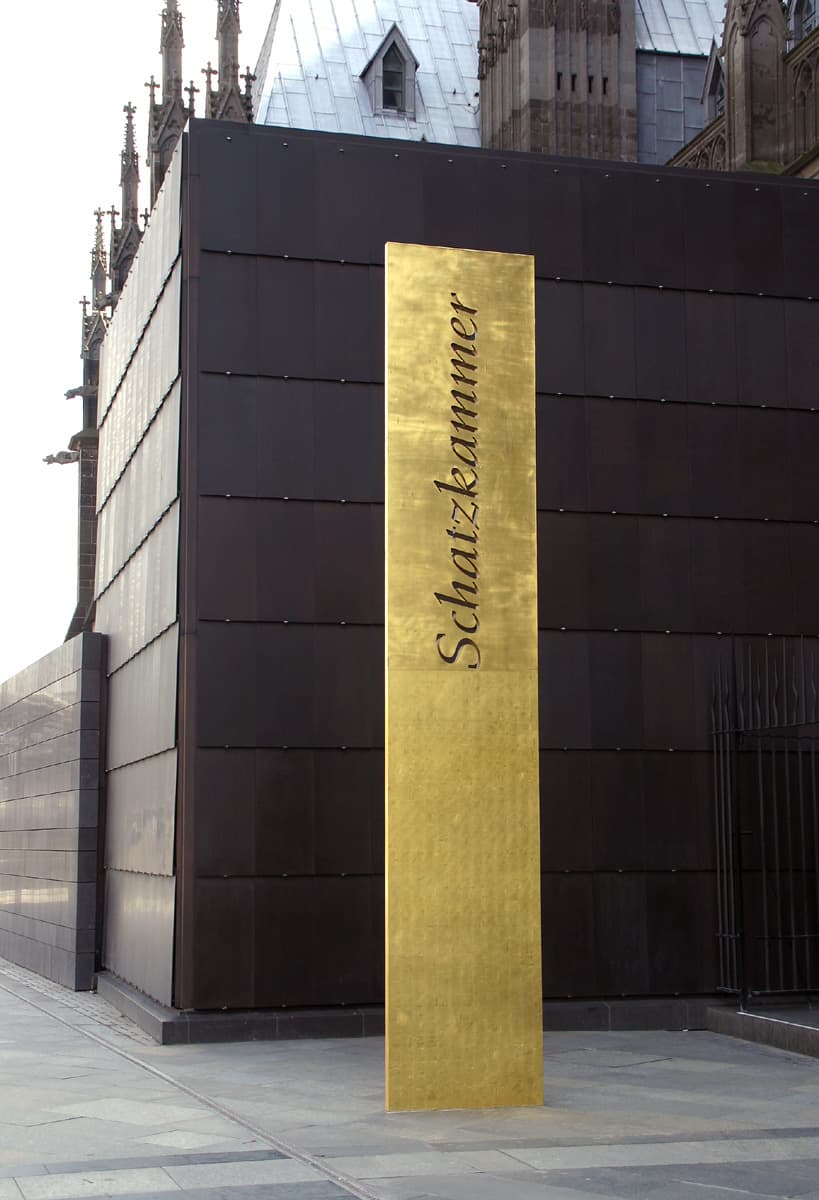
The Cathedral Treasury
The entrance to the Cathedral Treasury is marked by a sleek, modern bronze cube that sits in contrast to the ornate Gothic stonework above. This entrance leads you down into 13th-century vaulted cellars on the north side of the building. Once inside, you leave the 21st century behind to explore one of the richest collections of church treasures in Europe. The Treasury is home to a wide array of liturgical objects, from jewel-encrusted monstrances and chalices to ancient vestments and illuminated manuscripts. Among its most prized possessions is the Staff of Saint Peter, a late antique relic that served as a symbol of the Archbishop's authority for centuries. You can also see the 'Gero-Codex,' a stunningly illuminated manuscript from the 10th century. The museum’s layout is unique because it incorporates the original medieval foundations of the cathedral. As you walk between the display cases, you can see the rough-hewn stones that have supported this structure for over seven hundred years. This space serves as the cathedral’s 'safe deposit box,' protecting objects that are not only valuable for their gold and gemstones but also for their historical and spiritual significance to the city of Cologne. It is a place of quiet reflection where the artistic skill of past centuries is preserved in its original subterranean setting.
The Miracle of Survival
The 'Domplombe' repair site serves as a memorial to the cathedral's resilience during WWII bombing raids.
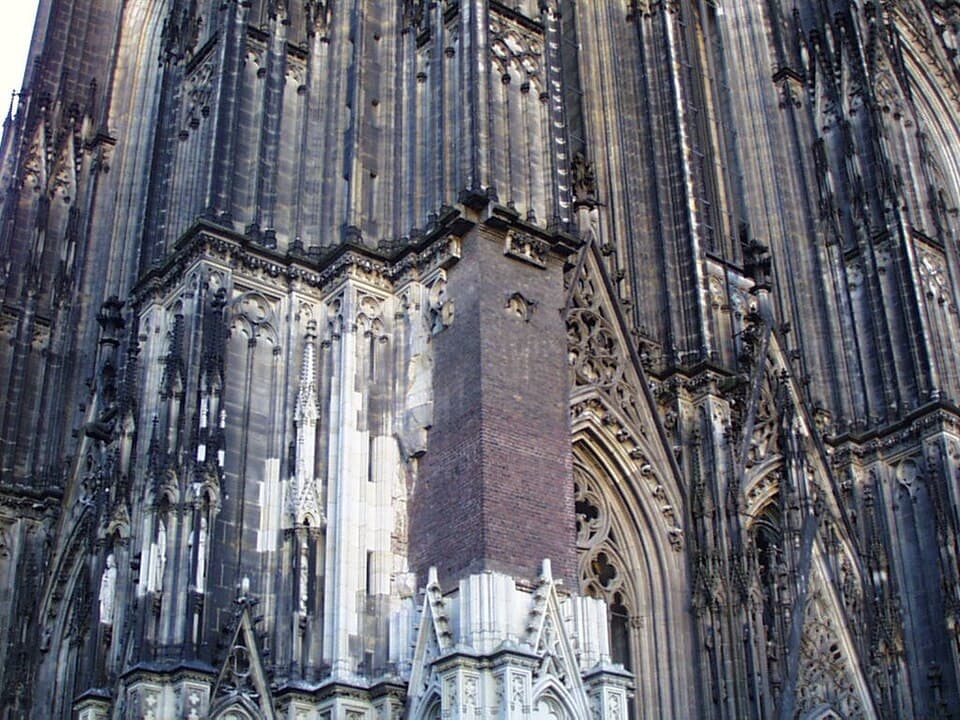
The Domplombe Scar
As we conclude our tour, it is worth reflecting on the cathedral's 'Miracle of Survival.' During World War II, the city of Cologne was almost entirely leveled by Allied bombing raids. The cathedral itself was hit by fourteen heavy aerial bombs and seventy incendiary hits. While it remained standing—a lone silhouette amidst the ruins—it suffered significant structural damage. For sixty years, one of the most visible reminders of the conflict was the 'Domplombe,' or Cathedral Filling. This was a massive repair in the north tower made of common red bricks because the matching stone was unavailable in the immediate aftermath of the war. While technically a temporary fix, the brick patch became an iconic part of the cathedral's history, serving as a powerful war memorial. It wasn't until 2005 that the bricks were finally replaced with stone that matched the original 19th-century construction. Today, the cathedral stands fully restored, yet the memory of its narrow escape remains a vital part of its identity. It is more than just a church or a tourist destination; it is a symbol of endurance and the city's ability to rebuild. As you leave this 'stone reliquary,' remember that it is a living monument that has been shaped by the hands of medieval masons, 19th-century engineers, and those who carefully restored it after the fires of war. It continues to stand as a beacon of hope and a testament to human creativity over eight centuries.
Want to hear the rest?
Download the Stanza app to unlock all 24 stops and full GPS-guided navigation.
Frequently Asked Questions
How long does the Kölner Dom audio tour take?
The Kölner Dom audio guide includes 24 narrated stops. Most visitors spend 45 minutes to 1.5 hours exploring the complete tour, though you can listen at your own pace and skip or revisit any stop.
Is the Kölner Dom audio guide available in my language?
Stanza supports 15 languages: English, Spanish, French, German, Italian, Portuguese, Russian, Japanese, Chinese, Korean, Arabic, Hindi, Polish, Dutch, Hebrew. Check the guide in the app to confirm the languages currently available for this tour.
Can I use the audio guide offline at Kölner Dom?
Yes! Download the complete Kölner Dom tour — including all audio, maps, and images — before your visit. The Stanza app works completely offline, so you don't need WiFi or mobile data at the venue.
How much does the Kölner Dom audio guide cost?
The Stanza app is free to download. The current listed price for the Kölner Dom audio guide is $2.99; app-store region and currency may affect the final price.
How do I use the Stanza audio guide at Kölner Dom?
Download the free Stanza app, search for "Kölner Dom", and download the tour. When you arrive at the venue, the app uses GPS to detect your location and automatically plays the relevant narration as you move between points of interest — completely hands-free.
What makes the Stanza audio guide different from other Kölner Dom tours?
Stanza offers GPS-triggered narration that plays automatically as you walk through Kölner Dom — no need to manually select stops. The tour is available in 15 languages, works fully offline, and includes 24 expertly narrated stops with images and historical context.
What other audio guides are available near Kölner Dom?
Stanza offers multiple audio guides in Cologne, Germany and nearby areas. After downloading the app, browse the map to discover all available tours near Kölner Dom. Each guide can be downloaded for offline use.