 Stanza / Audio guide
Content & sources
Stanza · Audio guide
Hohenzollern CastleAudio guide
A place to remember. A story to take with you.
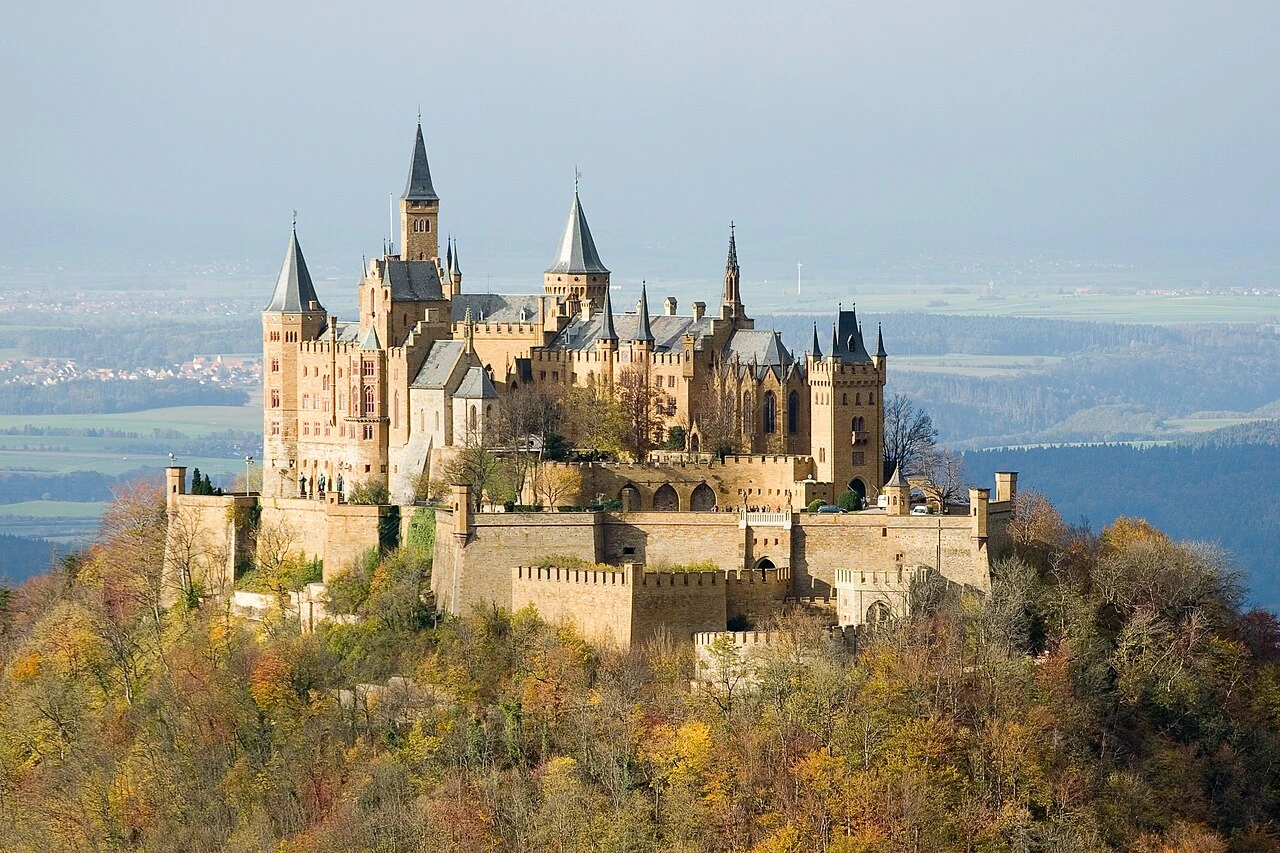
Hohenzollern Castle is the ancestral seat of the imperial House of Hohenzollern. It is located in the Swabian Alps of central Baden-Württemberg, Germany.
Download Stanza, then search for “Hohenzollern Castle”.
About the tour
One guide. Your kind of visit.
Hohenzollern Castle is the ancestral seat of the imperial House of Hohenzollern. It is located in the Swabian Alps of central Baden-Württemberg, Germany.
Ready when you are.
- 01Get the free Stanza app.
iOS & Android
- 02Find your guide.
“Hohenzollern Castle”
- 03Download before you go.
Works offline
Audio guide / 28 narrated stops
Inside the guide
Get to know a few of the stories before you go. Open a stop to read more.
01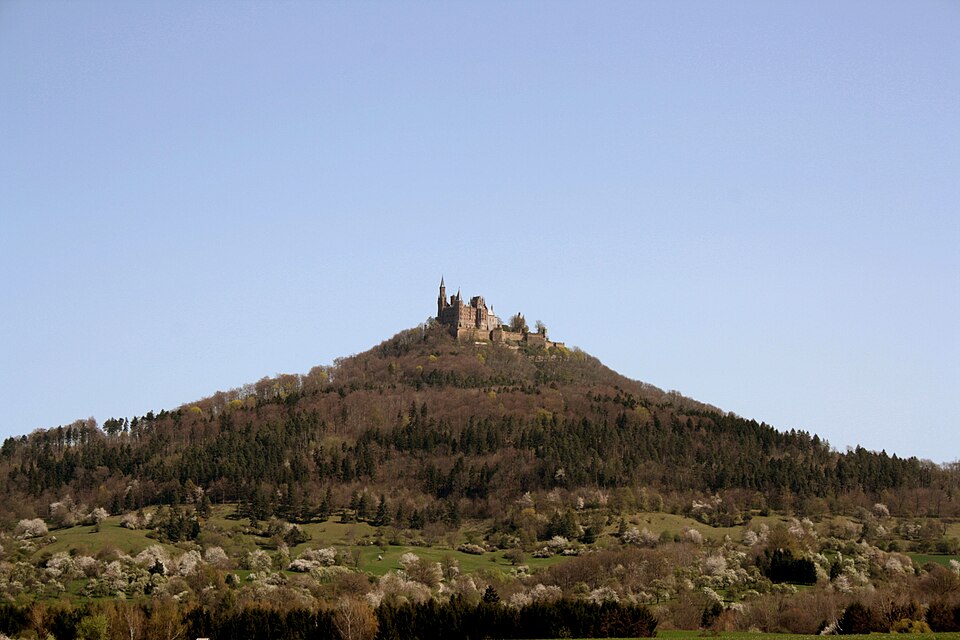 The Summit of Mount HohenzollernThe Mountain Fortress
Welcome to one of the most iconic silhouettes in Germany. Rising 855 meters above sea level, the fortress sits atop Mount Hohenzollern, providing a vantage point that once controlled the surrounding landscape. While the towers and battlements you see today evoke the image of a medieval stronghold, this is actually the third castle to stand on this site. The original fortress dated back to the 11th century but was completely destroyed in 1423. A second, larger version followed in 1454, though it eventually fell into ruin by the end of the 18th century. What remains today is a masterpiece of the mid-19th century, a reconstruction that salvaged the memory of the original ancestral seat while embracing the architectural tastes of its era. This mountaintop location was strategically chosen nearly a thousand years ago, offering natural defense on all sides. As the ancestral home of the House of Hohenzollern, the site carries immense historical weight, representing the origins of a dynasty that would eventually lead the German Empire.
Photo: Der Messer · CC BY-SA 3.0
02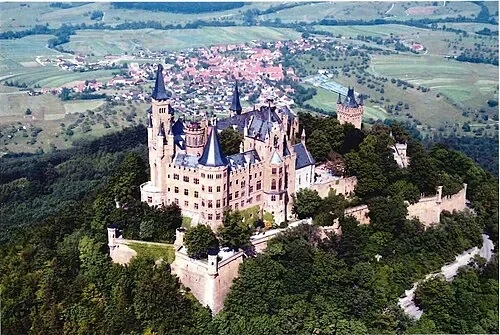 The Summit of Mount HohenzollernThe Romantic Ideal
The current castle is a quintessential example of 19th-century German Romanticism. During this period, there was a deep fascination with a stylized version of the Middle Ages, leading to the creation of 'fairytale' castles across Europe. King Frederick William IV of Prussia commissioned this version in 1850, driven by a desire to restore his family's 'cradle' to its former glory. Unlike its predecessors, which were functional military outposts meant to withstand long sieges, this castle was designed as a showpiece and a family memorial. The architects prioritized visual grandeur and historical symbolism over strategic utility. Every turret, pointed arch, and decorative battlement serves to transport the viewer back to an idealized age of knights and chivalry. Frederick William IV viewed the project as a way to anchor his family's growing power in the ancient traditions of their ancestors. Construction began during a time of significant political change in Germany, making this romanticized fortress a statement of permanence and royal continuity in a rapidly modernizing world.
Photo: Duprat40 · CC BY-SA 4.0
03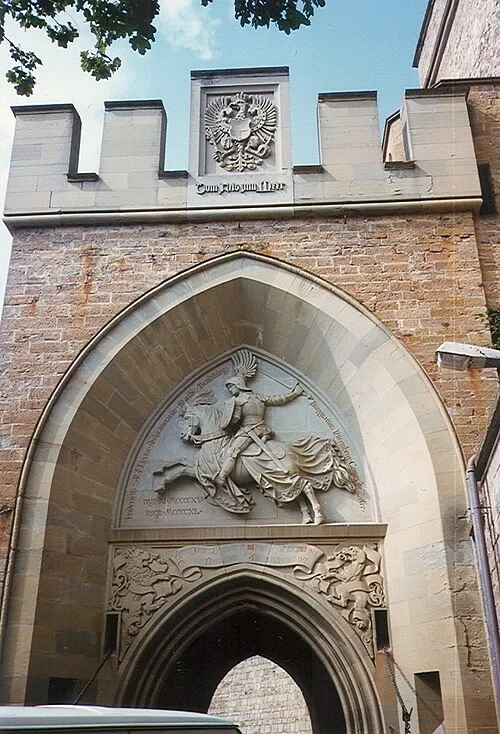 The Eagle Gate and Entrance FortificationsThe Eagle Gate
Notice the grand entrance before you, known as the Eagle Gate, or Adlertor. This gateway serves as a symbolic transition from the natural world to the regal realm of the Hohenzollerns. Above the arch, you can see a prominent relief of the heraldic eagle, a central symbol of the Prussian monarchy. This eagle represents strength, sovereignty, and the family's long history as rulers. Just below the eagle, a relief depicts a mounted knight in full armor. This figure is meant to connect the 19th-century Prussian kings to the medieval traditions of chivalry and warrior-kingship. The knight’s pose is noble and resolute, reinforcing the idea of the castle as a protector of ancient values. The intricate stonework surrounding the gate reflects the Gothic Revival style, which was chosen specifically to evoke the spirit of the castle’s original 11th-century founders. Every element of the gate was carefully planned to impress visitors with the weight of the dynasty's lineage and their deep connection to the history of the German lands.
Listen in the appPhoto: Wilkinus · CC BY-SA 3.0
04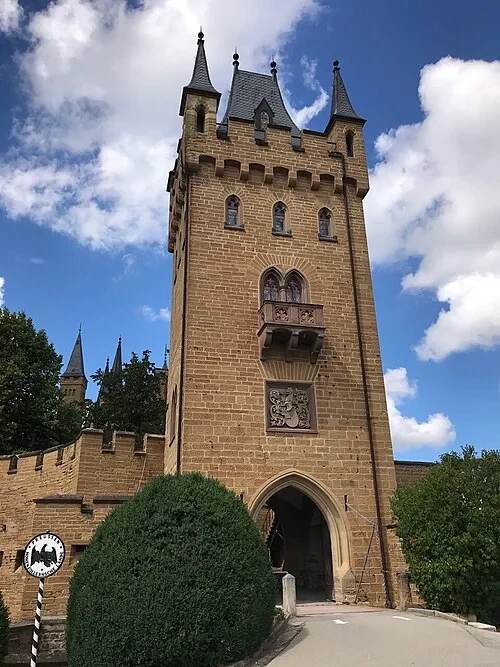 The Eagle Gate and Entrance FortificationsThe Gate Tower
The gate tower exemplifies how the castle’s architects merged functional defense with romantic aesthetics. Look for the drawbridge mechanism, which, while largely ceremonial in this 19th-century version, serves as a powerful visual reminder of the site's military past. The tower is crowned with slender turrets and machicolations—the small openings at the top through which defenders could theoretically drop projectiles on attackers. These features give the building its quintessential 'knight’s castle' appearance, though here they are executed with a level of refinement that exceeds any practical military need. The tall, narrow proportions of the tower create a sense of verticality, drawing the eye upward toward the sky, a common trait in Gothic architecture. This verticality was intended to symbolize the high status and noble aspirations of the House of Hohenzollern. The stonework is detailed with decorative moldings and carved finials, showing the transition from a rugged fortress into a refined palace. This structure acts as a guardian of the inner grounds, standing as the first major line of defense and the primary architectural statement for those arriving at the mountaintop.
Listen in the appDavid · CC0
05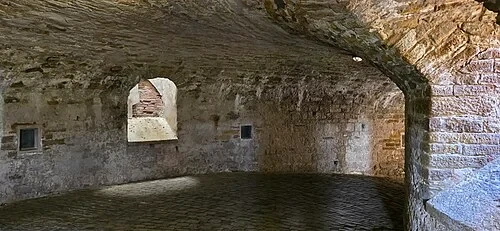 The Eagle Gate and Entrance FortificationsThe Vaulted Ramp
Entering the fortress requires passing through this dark, vaulted ramp. The heavy stonework and low, arched ceiling create a somber, imposing atmosphere. This winding tunnel was a common feature in genuine medieval fortifications, designed to neutralize the momentum of an attacking force. Because the path is steep and twists sharply, it would have been nearly impossible for a group of soldiers to move quickly or bring heavy equipment through. The lack of natural light within the passage further adds to the defensive advantage, as defenders familiar with the layout could easily ambush intruders in the shadows. For the 19th-century visitor, however, the ramp served a different purpose: it was designed to create a sense of mystery and anticipation. Emerging from the cool, dim tunnel into the bright, open courtyards above was meant to be a dramatic experience. The thick stone walls here are remarkably well-preserved, showcasing the quality of masonry used throughout the mid-century reconstruction. This passage reminds us that even in a castle built for show, the architects respected the ancient rules of fortress design.
Listen in the appPhoto: Qwertzu111111 · CC BY-SA 4.0
06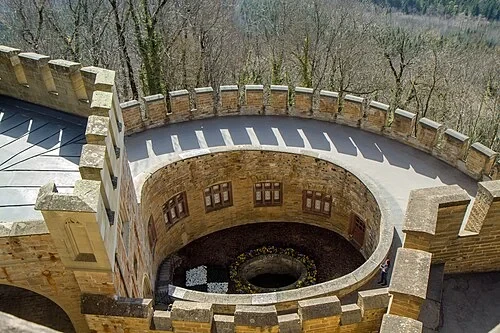 The Winding Ramp and BastionsThe Spiral Ascent
To reach the main palace area, visitors must navigate a complex four-stage winding ascent. This ramp system was a significant engineering challenge, requiring the carving and reinforcement of the steep mountain slopes. The surrounding bastions were built up alongside the path to provide structural support and to house the castle’s defensive batteries. Construction of this intricate entrance system and the rest of the fortress was a long-term commitment that took 17 years to complete. Work began in 1850 and continued until the official inauguration on October 3, 1867. The scale of the project was immense, involving the transportation of thousands of tons of stone up the 855-meter peak. The resulting path allows for a gradual and grand approach, offering changing perspectives of the battlements and towers at every turn. It is a testament to the dedication of King Frederick William IV, who insisted on a design that was both historically accurate and structurally sound for centuries to come. The bastions you see today are solid and functional, reflecting the mid-19th-century goal of creating a permanent ancestral seat that would never again fall into the decay of the previous centuries.
Listen in the appPhoto: CatalpaSpirit · CC BY-SA 4.0
07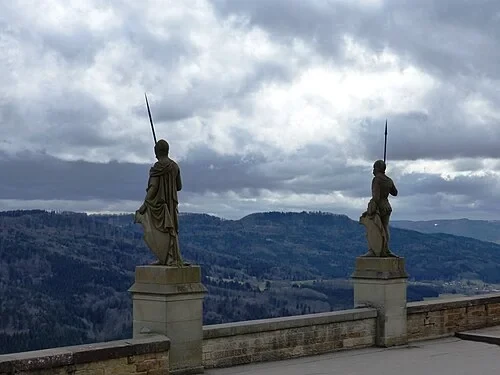 The Winding Ramp and BastionsThe Bastion Sentinels
Standing tall along the castle ramparts are several statues of prominent Prussian rulers. These figures represent the long line of the Hohenzollern family, depicted in traditional military gear and authoritative poses. Each statue serves to emphasize the castle's role as the spiritual heart and ancestral seat of the dynasty. By placing these rulers here, the architects created a literal connection between the physical fortress and the men who shaped German history. Notice the detailed armor and the firm grip on their swords or scepters, which symbolize the family’s dual roles as military leaders and sovereign monarchs. These figures don't just decorate the walls; they act as a visual pedigree, reminding all who visit of the power and longevity of the House of Hohenzollern. The choice to include these rulers in the exterior design was a key part of the 19th-century Romantic vision, which sought to heroize the past and the individuals who built the nation. The statues are positioned to overlook the valley, eternally watching over the lands they once ruled. Their presence turns the defensive bastions into a commemorative gallery, celebrating the family's rise from local nobility to the height of the German Empire.
Listen in the appblu-news.org · CC BY-SA 2.0
08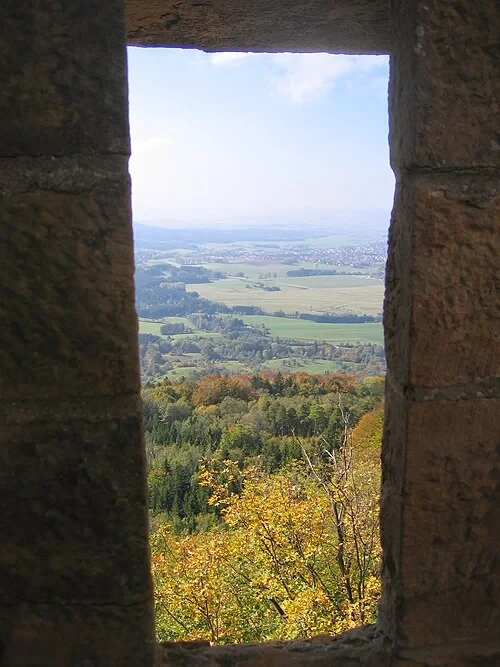 The Winding Ramp and BastionsThe Lookout Point
Look through one of the narrow stone loopholes carved into the thick fortress walls. These small vertical windows were originally designed for archers or musketeers, allowing them to fire on attackers while remaining protected behind several feet of solid stone. Today, they offer a stunning contrast between the heavy, immovable masonry of the castle and the expansive, peaceful landscape of the Swabian Alps below. From this height, the surrounding forests and fields look like a verdant tapestry, stretching toward the horizon. The view captures the isolation of Mount Hohenzollern, which rises abruptly from the plains to its 855-meter peak. You can see the small towns and winding roads in the valley, which appear tiny and quiet from this elevated vantage point. This contrast was intentionally used by Romantic-era architects to evoke a sense of the 'sublime'—the feeling of awe when confronted with the vastness of nature from a secure, man-made height. While the walls provide a sense of security and strength, the loopholes remind us that the castle’s primary purpose was once to survey and control this very landscape. The view remains one of the most celebrated features for visitors to the site.
Listen in the appPhoto: Runner1928 · CC BY-SA 3.0
09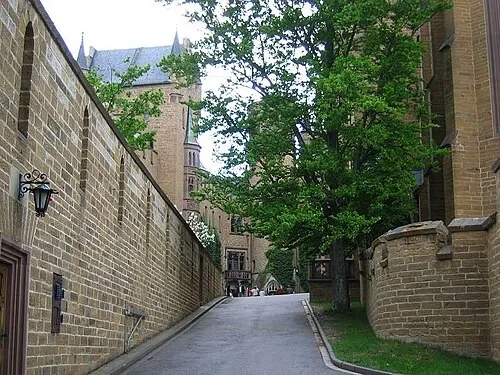 The Central CourtyardThe Central Courtyard
The central courtyard is the heart of the palace complex, where the various residential and ceremonial wings meet. It was designed by the influential architect Friedrich August Stüler, a student of the famous Karl Friedrich Schinkel. Stüler’s vision was to create a space that felt like an enclosed, self-sufficient village rather than a single massive building. This approach breaks down the scale of the fortress, making it feel more intimate and inhabited. The courtyard is surrounded by a variety of architectural features, including loggias, bay windows, and grand staircases, all rendered in the Gothic Revival style. Each wing had a specific purpose, from housing the royal family and guests to the daily operations of the household. The layout encourages exploration, with hidden corners and changing elevations that reflect the uneven terrain of the mountain peak. By organizing the space this way, Stüler captured the organic, clustered feel of true medieval castles that grew over centuries, even though this version was planned and built in a single major phase. The courtyard serves as a gathering place and a hub of activity, where the regal architecture and the practical needs of castle life intersect.
Listen in the appPhoto: Schaengel89~commonswiki · CC BY-SA 3.0
10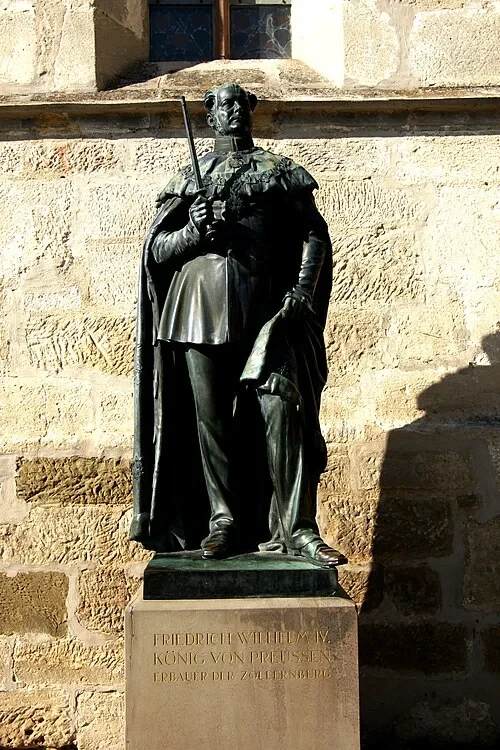 The Central CourtyardKing Frederick William IV
This statue honors King Frederick William IV of Prussia, the man whose personal passion and vision made the modern Hohenzollern Castle a reality. In the early 1800s, the king visited the ruins of the previous fortress and was deeply moved by the sight of his family's ancient seat in decay. He famously described his dream of restoring the site to its former glory as 'rebuilding the cradle of our house.' Frederick William IV was known as the 'Romantic on the Throne' due to his love for the arts, history, and medieval aesthetics. He personally influenced many of the architectural decisions, working closely with Friedrich August Stüler to ensure the new castle would be a worthy family memorial. Sadly, the king did not live to see the completion of his ambitious project. He passed away in 1861, six years before the final inauguration ceremony in 1867. The statue captures him in a moment of quiet reflection, emphasizing his role as the thinker and dreamer behind the fortress. His legacy is etched into every stone of this mountain stronghold, which remains the definitive physical expression of his romanticized vision of the Prussian past.
Listen in the appböhringer friedrich · CC BY-SA 2.5
Hohenzollern Castle
Frequently asked questions
How much does the guide cost?
Free app download. Listed guide price: $1.99. Guide price shown in the app. Audio guide only. Venue admission is separate.
Can I listen without internet?
Yes. Download the guide’s audio, images, and maps in the app before your visit. Your downloaded content is then available offline.
Can I listen in my language?
Stanza supports 15 languages. Check the app for the languages available for this guide.
Do I need to follow a schedule?
No. This is a self-guided experience. Choose your stops, pause whenever you like, and return to a story at your own pace.
At your own pace
Explore Hohenzollern Castle.
Download Stanza, then search for “Hohenzollern Castle”.
Free app download · Guide price shown in the app
Keep exploring
Nearby audio guides
Berlin
Brandenburger Tor
Content & sources
Thomas Wolf, www.foto-tw.de · CC BY-SA 3.0
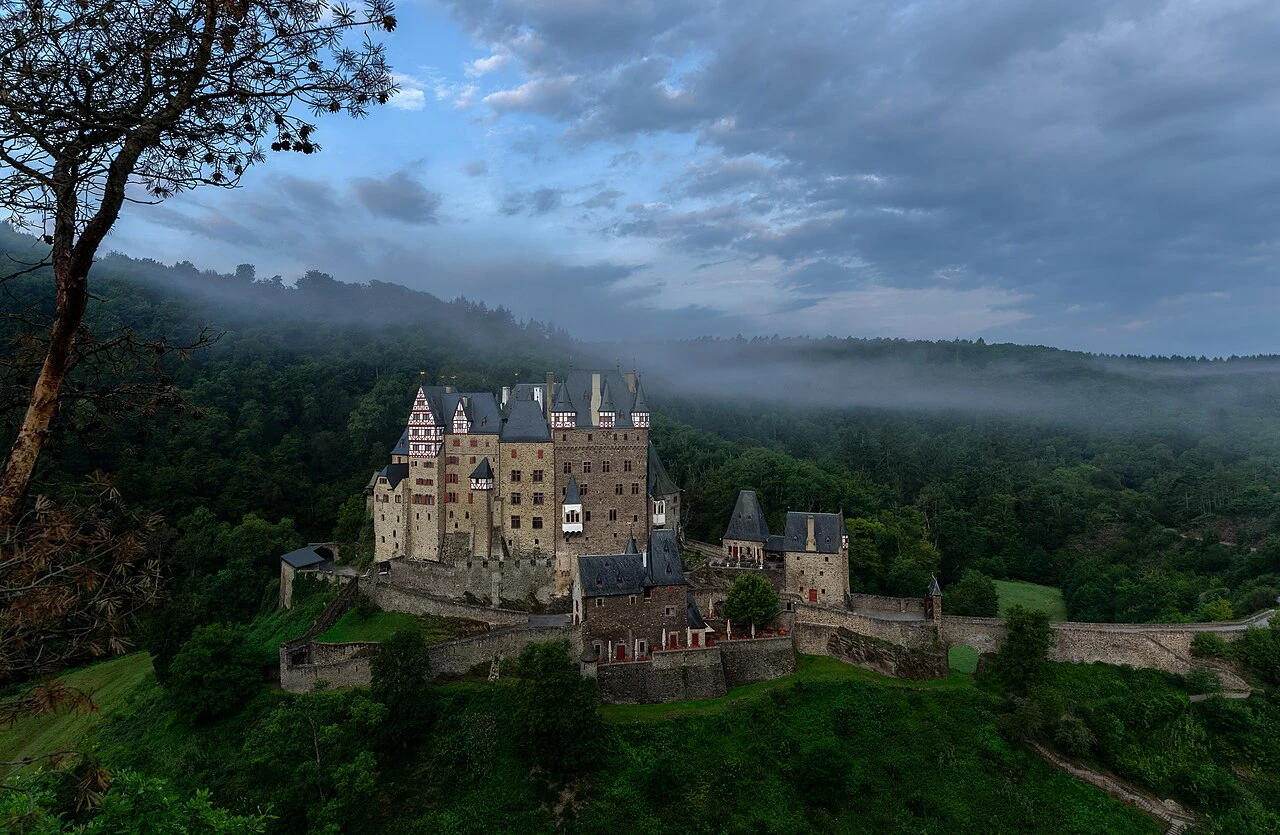
Wierschem
Burg Eltz
Content & sources
Johannes Dörrstock · CC BY-SA 4.0
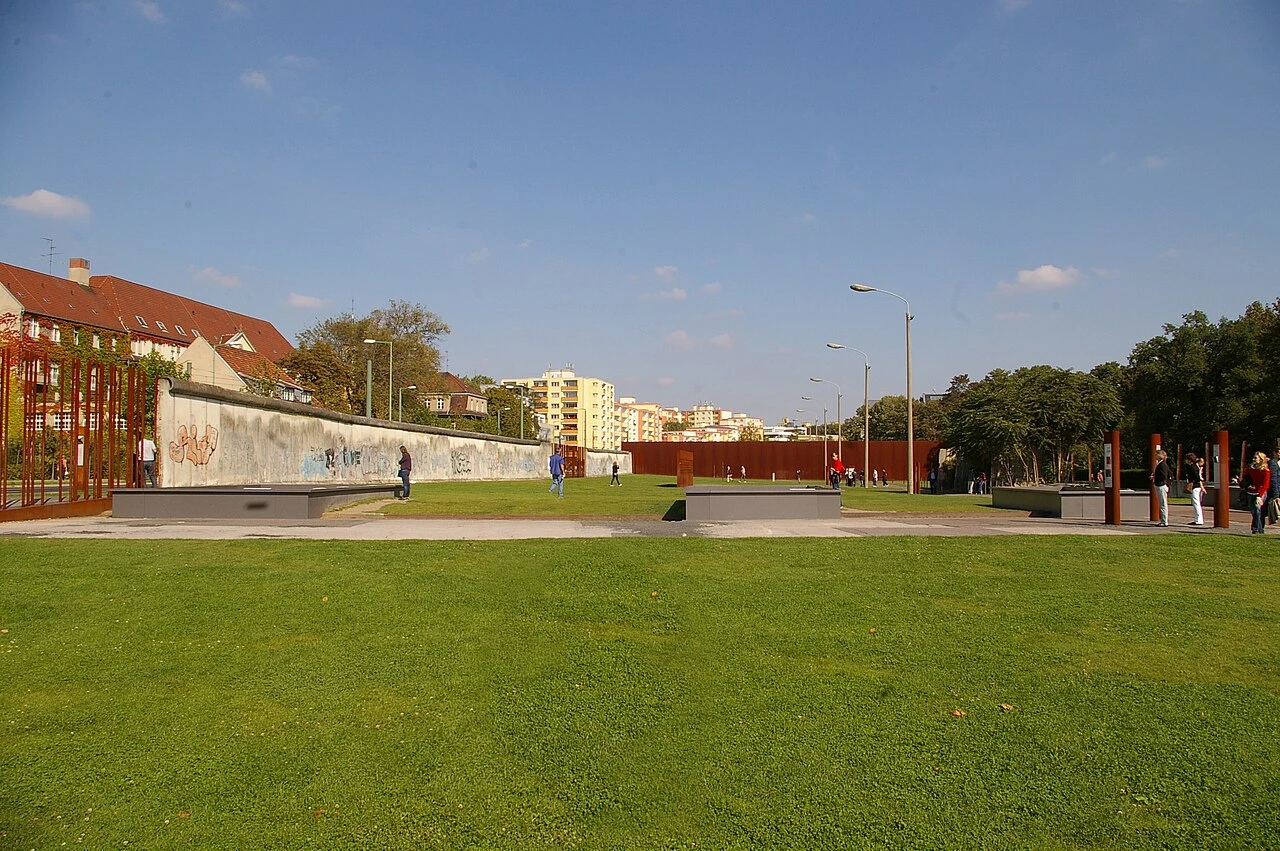
Berlin
Gedenkstätte Berliner Mauer
Content & sources
N-Lange.de · CC BY-SA 3.0
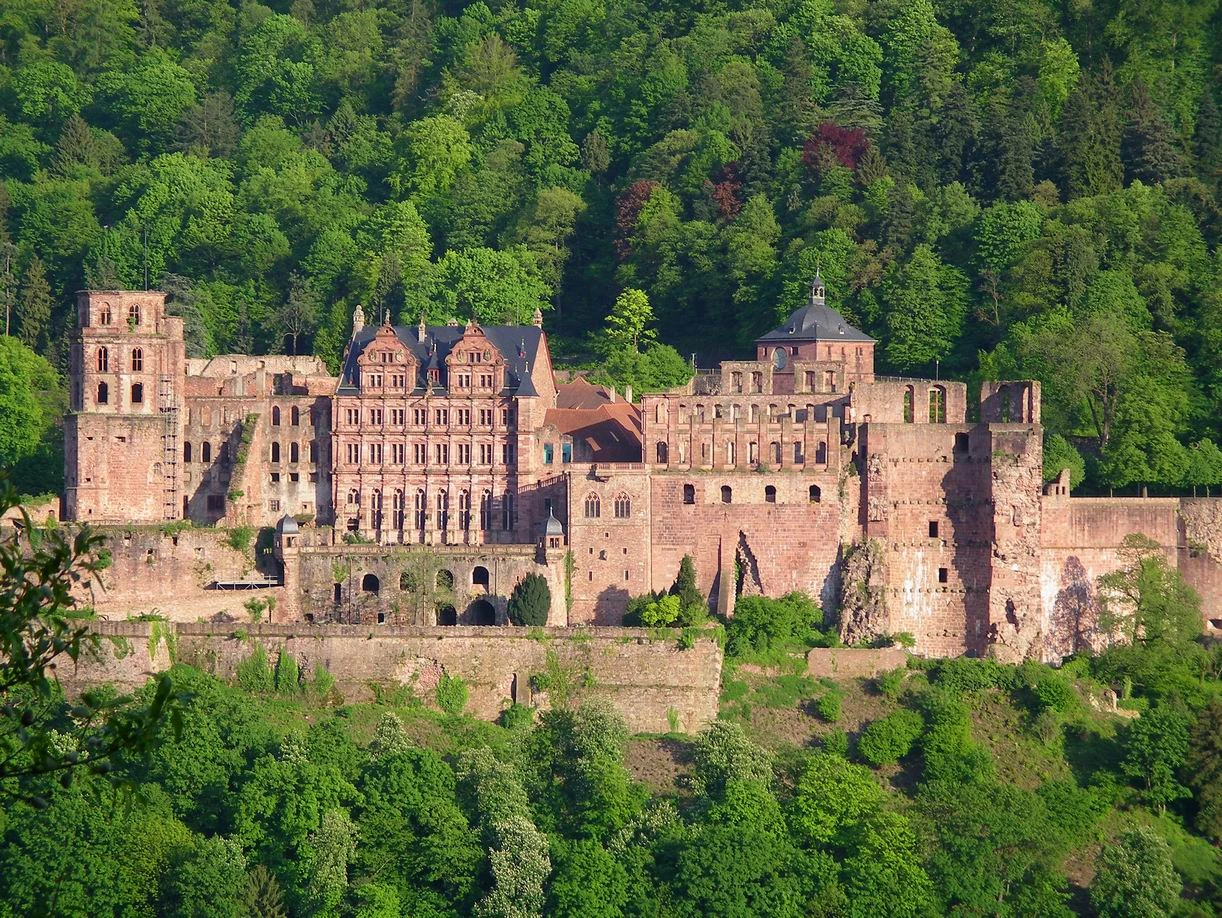
Heidelberg
Heidelberger Schloss
Content & sources
Pumuckel42 (Reinhard Wolf) at de:Wikipedia · CC BY-SA 3.0