Languages
15Nymphenburg Palace Audio Guide
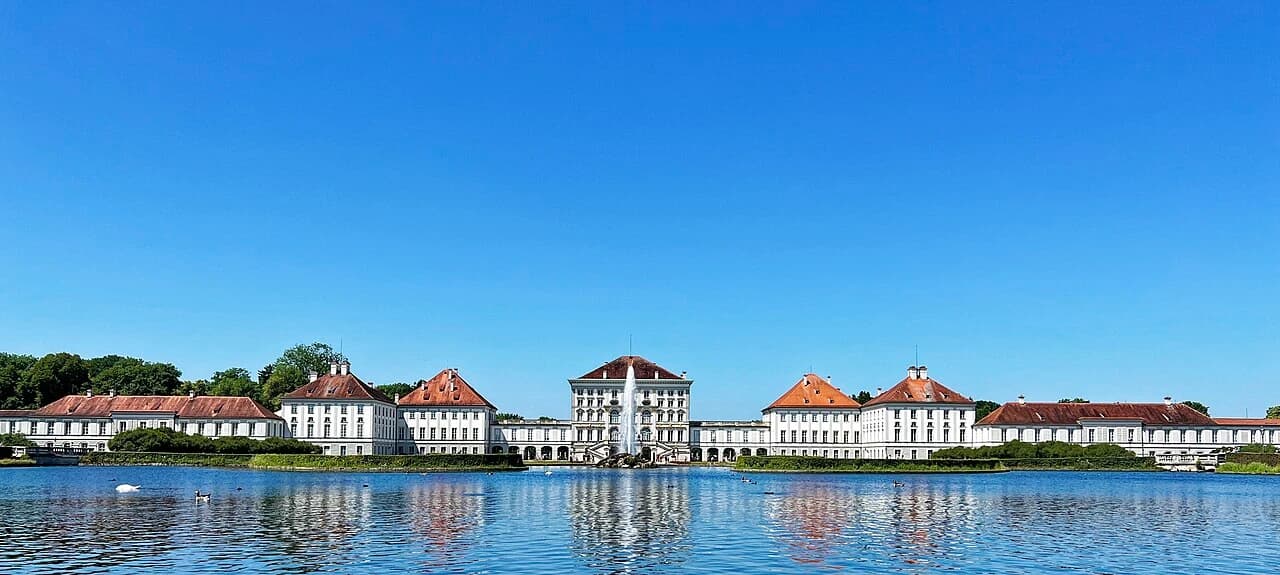
Nymphenburg Palace is a landmark in Munich, Germany. Explore it with Stanza's GPS-triggered offline audio guide — available in 15 languages.
Quick Facts
32
Stops
15
Languages
100%
Offline
📍 Munich, Germany · 48.1581°N, 11.5036°E
About Nymphenburg Palace
A grand Baroque palace in Munich, Bavaria, Nymphenburg Palace served as a summer residence for Bavarian rulers. It is also a cultural heritage ensemble and houses a museum.
Nymphenburg Palace is also known as Schloss Nymphenburg, München, Schloss Nymphenburg.
This self-guided audio tour features 32 narrated stops organized across 8 sections. As a palace, Nymphenburg Palace offers a unique cultural experience in the heart of Munich, Germany.
The Stanza audio guide is available in 15 languages and works entirely offline — download the complete tour including audio narration, maps, and images before your visit. As you walk through Nymphenburg Palace, GPS-triggered narration plays automatically at each point of interest.
Last updated:
What you will hear
The Queen’s Apartment and Ludwig II’s Birthplace
The southern pavilion contains the room where King Ludwig II, the 'Fairytale King,' was born in 1845.
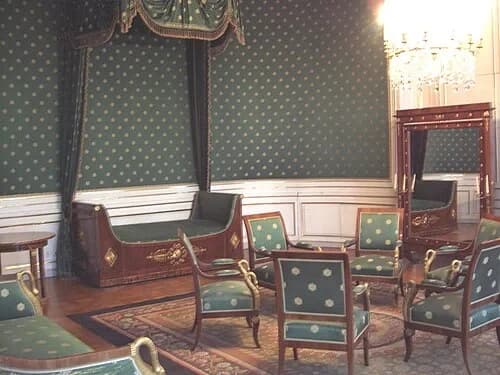
Birthplace of Ludwig II
On August 25, 1845, King Ludwig II was born in this apartment, which was then the bedroom of his mother, Crown Princess Marie. Today, the room is preserved with its mid-19th-century Empire-style decor, characterized by the rich green silk damask on the walls and the heavy, dark mahogany furniture. Compared to the eccentric and wildly extravagant castles Ludwig would later build, such as Neuschwanstein and Herrenchiemsee, this room feels remarkably sober and traditional. The furniture, with its clean lines and neoclassical motifs, reflects the more restrained tastes of his parents’ generation. Standing in the quiet birthplace of a man who would eventually become known as the 'Fairytale King' for his obsession with fantasy and isolation is a grounding experience. This space serves as a reminder that before he was a legendary figure of Bavarian history, Ludwig was a young prince raised within the strict protocols and established architectural traditions of the Nymphenburg court. The green silk remains a vivid backdrop to the early life of a monarch whose legacy continues to define the romantic image of the region. The room stands today much as it did during his infancy.
The Gallery of Beauties
King Ludwig I's famous collection of 36 portraits, including the notorious dancer Lola Montez.
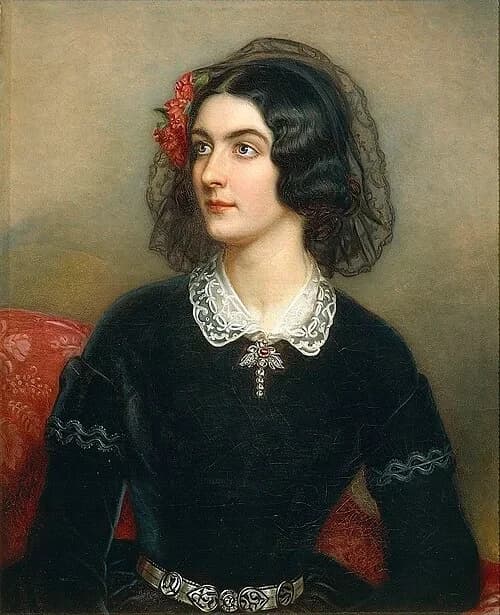
Lola Montez
Joseph Karl Stieler · 1847
One of the most famous and polarizing figures in the Gallery of Beauties is Lola Montez, born Eliza Rosanna Gilbert in Ireland. A self-styled Spanish dancer, her arrival in Munich in 1846 sparked a series of events that changed Bavarian history. King Ludwig I became so infatuated with her that he granted her a title—the Countess of Landsfeld—and allowed her an unprecedented level of influence over state affairs. This relationship, combined with her perceived arrogance and liberal political leanings, deeply offended the conservative Bavarian aristocracy and the general public. As tensions rose, the scandal became a focal point for the wider revolutionary movements sweeping through Europe. In 1848, the pressure became unbearable; massive student protests and political unrest forced the King to finally banish Lola from Munich. Broken by the scandal and the loss of public support, Ludwig I abdicated the throne later that year in favor of his son. Her portrait, showing her in a striking black dress with a red flower, captures the magnetic charm that brought a kingdom to the brink of collapse and ended a reign that had lasted over twenty years.
The Palace Chapel
A spiritual retreat within the northern pavilion, featuring a historic altar and religious art.
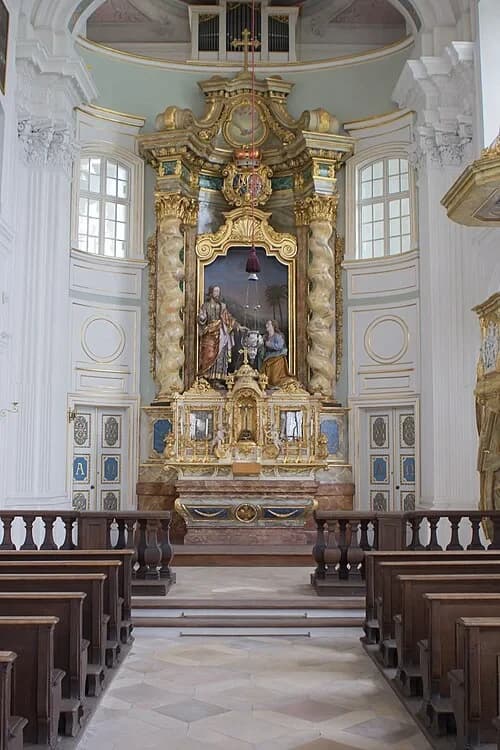
The Palace Chapel
While much of Nymphenburg Palace was designed to impress visiting dignitaries, the chapel served a more intimate and spiritual purpose. Here, the Wittelsbach family gathered for daily mass and private prayer, away from the watchful eyes of the court. The space is a fine example of late Baroque piety, dominated by an ornate historic altar that draws the eye upward. One of the most interesting features of the chapel’s decor is the use of 'scagliola.' This clever technique uses a mixture of plaster and pigments to create an imitation marble that is often difficult to distinguish from the real stone. This material allowed artists to create vibrant, multi-colored patterns that would be nearly impossible to achieve with natural marble alone. Combined with extensive gilding that catches the soft light, the interior glows with a quiet, reverent intensity. The chapel reminds us that for all their worldly power and architectural ambition, the rulers of Bavaria remained deeply connected to their Catholic faith. It provided a secluded space for reflection, providing a spiritual anchor in the middle of a life dedicated to courtly performance and political rule.
The Nymphenburg Porcelain Museum
Showcasing the world-renowned Rococo porcelain founded here in 1747.
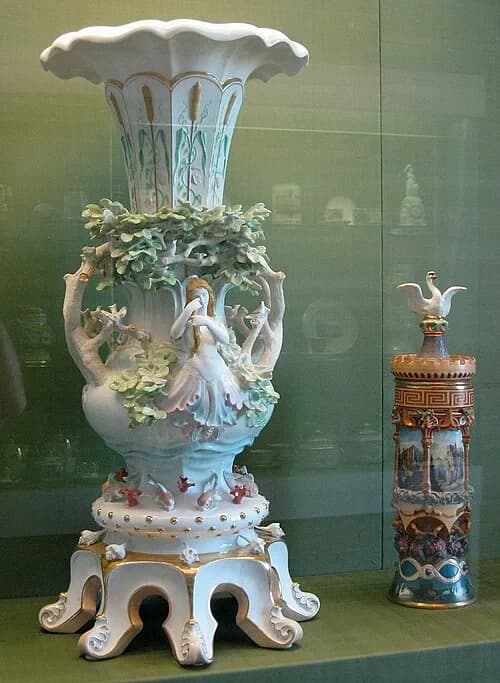
The Mermaid Vase
As artistic tastes shifted during the 19th century, the Nymphenburg Porcelain Manufactory evolved beyond the lighthearted Rococo figurines of the previous era. This mermaid vase represents a move toward more elaborate and naturalistic ornamentation. Detailed mermaid figures cling to the body of the vessel, surrounded by finely modeled floral elements that demonstrate the incredible technical precision the factory could achieve. These designs were often inspired by a romanticized view of nature, blending aquatic mythology with realistic botanical studies. The transition from the playful, stylized forms of the 18th century to this type of intricate, heavy detail reflected broader European trends in decorative arts. Master artisans at the factory painstakingly hand-painted every scale on the mermaids and every petal on the flowers, often requiring multiple firings to achieve the desired depth of color and brilliance. Such pieces were intended as grand display items, showcasing both the wealth of their owners and the undisputed skill of the Bavarian craftsmen. The vase provides a vivid example of how the factory adapted its production to remain at the forefront of European porcelain design throughout the 1800s, moving away from theatrical whimsy toward naturalistic grandeur.
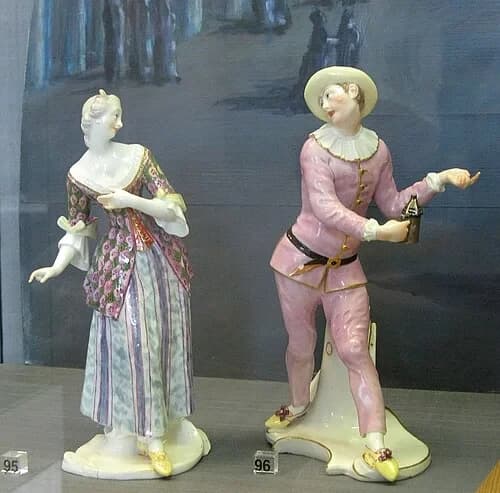
Porcelain Figurines
The Nymphenburg Porcelain Manufactory was established on this palace site in 1747, quickly becoming a prestigious source of luxury items for the Wittelsbach court. Among its most celebrated creations are the figurines from the Commedia dell'arte, a form of Italian theater characterized by masked 'types.' These specific pieces were modeled by Franz Anton Bustelli, a master whose work defined the factory’s golden age. Notice the remarkable thinness of the porcelain and the dynamic, almost fluid poses of characters like Pantalone or Colombina. Bustelli had a unique ability to imbue hard-paste porcelain with a sense of motion and emotional depth, making them appear as if they might step off their pedestals. Achieving such intricate detail required immense technical skill, as the thin sections of the figurines often warped or cracked during firing. Today, these works remain world-renowned examples of Rococo art, reflecting the refined tastes and theatrical interests of the Bavarian electors who supported the manufactory's operations within the palace grounds. They are considered some of the finest examples of 18th-century European porcelain and continue to be produced using traditional methods.
The Formal Garden and Grand Cascade
The transition from the formal French parterre to the English landscape garden.
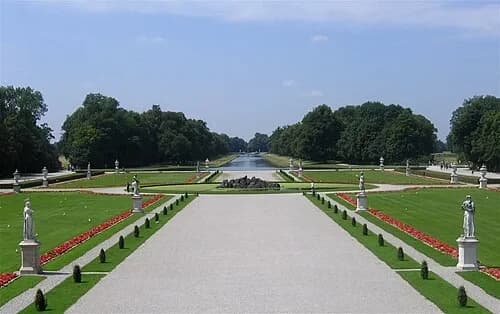
The Formal Garden
The gardens surrounding Nymphenburg Palace underwent a significant transformation that mirrors the changing relationship between European monarchs and the natural world. Near the palace, you see the formal French parterre, characterized by strict symmetry, manicured lawns, and meticulously planned gravel paths. This 18th-century design was intended to demonstrate the Elector's power to order and tame nature through human intellect and geometry. However, as you venture further into the 180-hectare park, the landscape shifts into the English style, which became popular in the 19th century. Here, the rigid lines give way to winding paths, groves of trees, and seemingly wild meadows. This later philosophy sought to embrace nature’s inherent beauty, creating a romanticized version of the countryside that appeared spontaneous rather than forced. This park served as more than just a place for fresh air; it was a complex stage for courtly festivities, hunting, and private reflection. The contrast between the disciplined flower beds near the central canal and the untamed woodland areas provides a visual history of how European landscape architecture shifted from the Age of Enlightenment to the Romantic era. Today, it remains one of the largest and most important historic garden complexes in Germany.
Amalienburg: The Rococo Hunting Lodge
Considered a masterpiece of European Rococo, built for Electress Maria Amalia.
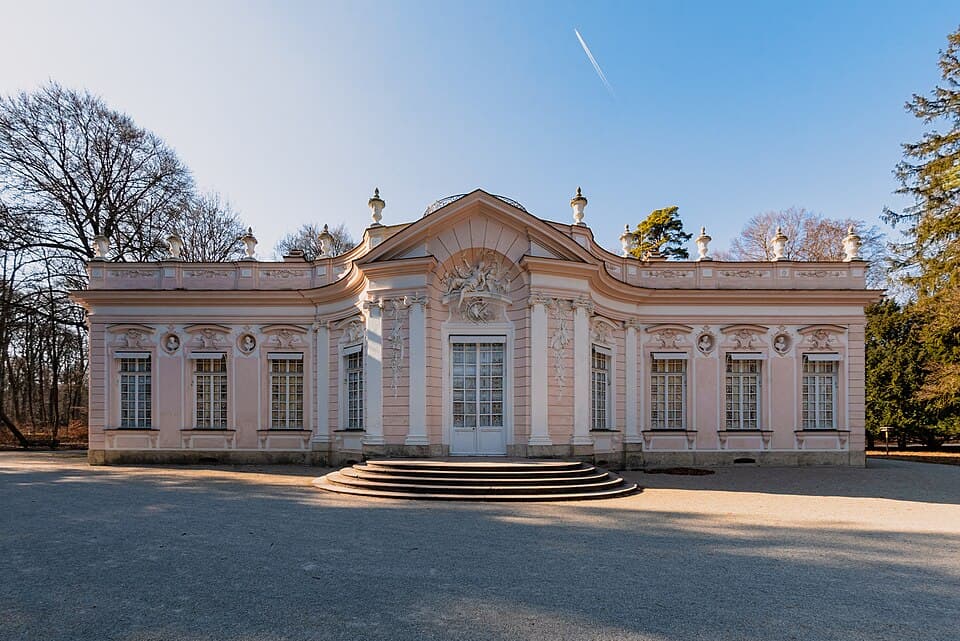
Amalienburg Lodge
Built between 1734 and 1739 by architect François de Cuvilliés, the Amalienburg was commissioned by Elector Karl Albrecht as a gift for his wife, Maria Amalia. From the exterior, its pale pink facade and single-story design suggest a relatively simple hunting lodge. However, this building is famously deceptive, housing a collection of Rococo decorations that are among the most concentrated and costly on the continent. The lodge was specifically designed as a place for the Electress to rest during hunting parties, but it quickly became a showcase for the highest levels of courtly luxury. Every room within the small footprint is a masterpiece of European craftsmanship, blending architecture, sculpture, and painting into a seamless whole. The choice of the soft pink color on the exterior serves to integrate the building into the garden landscape, while the interior spaces explode with ornamental detail. Despite its small size, the Amalienburg required a massive financial investment, reflecting the absolute wealth of the Wittelsbach family during the mid-18th century. It stands as one of the finest preserved examples of the Rococo style anywhere in the world, representing the pinnacle of decorative arts during the era of Elector Karl Albrecht.
Badenburg: The Royal Bath House
A luxury pavilion featuring a massive indoor heated pool and Chinoiserie wallpaper.
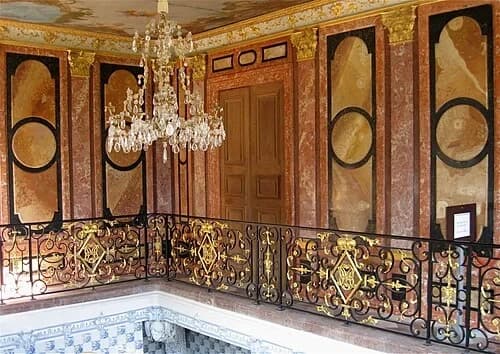
The Royal Swimming Pool
Inside the Badenburg bath house lies one of the most significant engineering marvels of the 18th century: a massive, heated indoor swimming pool. Lined with more than two thousand hand-painted Dutch tiles, the pool was a groundbreaking feat of technology, marking the first time a heated indoor bath had been constructed in Europe since the fall of the Roman Empire. The tiles depict various marine scenes, mythological figures, and landscapes, creating an immersive aquatic environment. Above the pool, a gallery allowed spectators to watch the Elector and his guests as they swam, turning even a private bath into a form of courtly performance. The water was heated by a sophisticated system located in the basement, reflecting the Wittelsbachs' commitment to integrating modern comforts into their historic residences. This space highlights the dual nature of palace life, where a seemingly private act like swimming was still part of a grand social display. The preservation of the tilework and the sheer scale of the pool provide a vivid window into the extravagant lengths taken to ensure the comfort and amusement of the Bavarian rulers during their summer retreats. It remains one of the most technically advanced features of the entire park, showing a sophisticated understanding of hydraulics and engineering.
Pagodenburg: The Chinoiserie Tea House
Reflects the 18th-century fascination with East Asia, featuring Delft-style tiles and Chinese lacquer.
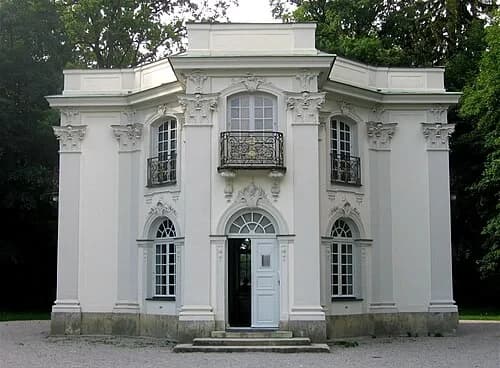
Pagodenburg Tea House
Built in 1716, the Pagodenburg stands as a charming tribute to the 'Chinoiserie' craze that swept through European courts in the early 1700s. This octagonal pavilion was designed to look like a distant, exotic structure, satisfying the royal desire for novelty and travel without leaving the palace grounds. At the time, genuine information about China and Japan was limited, leading architects to create a fictionalized and highly decorative version of East Asian culture. The Pagodenburg's exterior features multi-tiered roofs and delicate carvings that suggest the form of a traditional pagoda. Inside, the rooms are filled with lacquered furniture, silk hangings, and imported porcelain, all carefully curated to transport the visitor to an imaginary East. This pavilion was primarily used as a tea house, providing a secluded setting for the court to enjoy expensive new imports like tea and chocolate. It represents a specific moment in history when the unknown 'Orient' was seen as a source of mystery and artistic inspiration, serving as a playful and elegant backdrop for the recreational pursuits of the Bavarian electors and their guests. The structure was meticulously restored to preserve its unique decorative motifs, which combine European Baroque sensibilities with a fascination for the exotic.
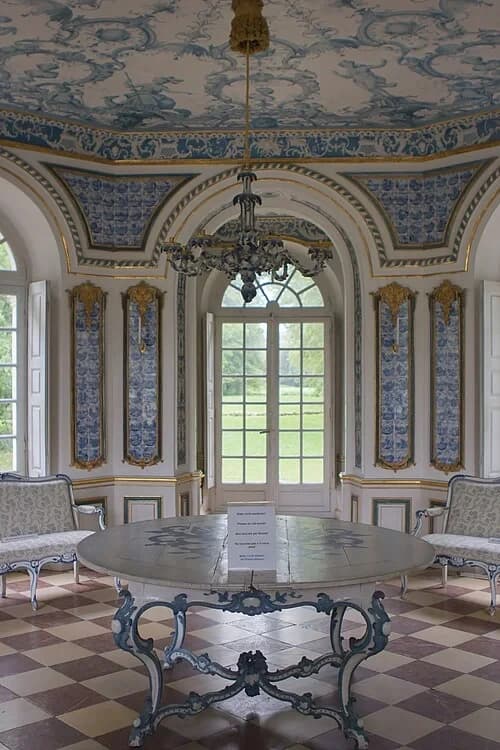
The Blue Saloon
The ground floor of the Pagodenburg contains the stunning Blue Saloon, a room entirely clad in approximately two thousand blue-and-white tiles. These tiles were imported from Delft in the Netherlands and feature a wide array of designs, ranging from pastoral Dutch landscapes to motifs that were intended to appear 'Chinese.' This dense tilework creates a distinctive, cool atmosphere that contrasts sharply with the gilded rooms of the main palace. In the 18th century, this room served as an intimate setting where the court gathered to drink tea, coffee, or hot chocolate—all of which were rare and incredibly expensive commodities at the time. The choice of blue and white was meant to evoke the look of high-quality porcelain, further reinforcing the building’s Chinoiserie theme. Even the ceiling and floor were integrated into this cohesive aesthetic, making the Blue Saloon a total work of art. Sitting in this room, members of the court could enjoy their beverages while surrounded by imagery that celebrated the global reach and sophisticated tastes of the Bavarian dynasty. It remains one of the most uniquely decorated interior spaces in the entire Nymphenburg complex, reflecting the elector's desire for a private, stylish retreat from the main palace's formality.
Want to hear the rest?
Download the Stanza app to unlock all 32 stops and full GPS-guided navigation.
Frequently Asked Questions
How long does the Nymphenburg Palace audio tour take?
The Nymphenburg Palace audio guide includes 32 narrated stops. Most visitors spend 45 minutes to 1.5 hours exploring the complete tour, though you can listen at your own pace and skip or revisit any stop.
Is the Nymphenburg Palace audio guide available in my language?
Stanza supports 15 languages: English, Spanish, French, German, Italian, Portuguese, Russian, Japanese, Chinese, Korean, Arabic, Hindi, Polish, Dutch, Hebrew. Check the guide in the app to confirm the languages currently available for this tour.
Can I use the audio guide offline at Nymphenburg Palace?
Yes! Download the complete Nymphenburg Palace tour — including all audio, maps, and images — before your visit. The Stanza app works completely offline, so you don't need WiFi or mobile data at the venue.
How much does the Nymphenburg Palace audio guide cost?
The Stanza app is free to download. The current listed price for the Nymphenburg Palace audio guide is $2.99; app-store region and currency may affect the final price.
How do I use the Stanza audio guide at Nymphenburg Palace?
Download the free Stanza app, search for "Nymphenburg Palace", and download the tour. When you arrive at the venue, the app uses GPS to detect your location and automatically plays the relevant narration as you move between points of interest — completely hands-free.
What makes the Stanza audio guide different from other Nymphenburg Palace tours?
Stanza offers GPS-triggered narration that plays automatically as you walk through Nymphenburg Palace — no need to manually select stops. The tour is available in 15 languages, works fully offline, and includes 32 expertly narrated stops with images and historical context.
What other audio guides are available near Nymphenburg Palace?
Stanza offers multiple audio guides in Munich, Germany and nearby areas. After downloading the app, browse the map to discover all available tours near Nymphenburg Palace. Each guide can be downloaded for offline use.