Stanza · Audio guide
Abtei Maria Laach Audio Guide
A place to remember. A story to take with you.
Maria Laach Abbey is a Benedictine abbey situated in Glees on the southwestern shore of the Laacher See. The abbey was built in the 11th-12th centuries and is a member of the Beuronese Congregation.
Download Stanza, then search for “Abtei Maria Laach”.
About the tour
One guide. Your kind of visit.
Maria Laach Abbey is a Benedictine abbey situated in Glees on the southwestern shore of the Laacher See. The abbey was built in the 11th-12th centuries and is a member of the Beuronese Congregation.
Ready when you are.
- 01Get the free Stanza app.
iOS & Android
- 02Find your guide.
“Abtei Maria Laach”
- 03Download before you go.
Works offline
Audio guide / 12 narrated stops
Inside the guide
Get to know a few of the stories before you go. Open a stop to read more.
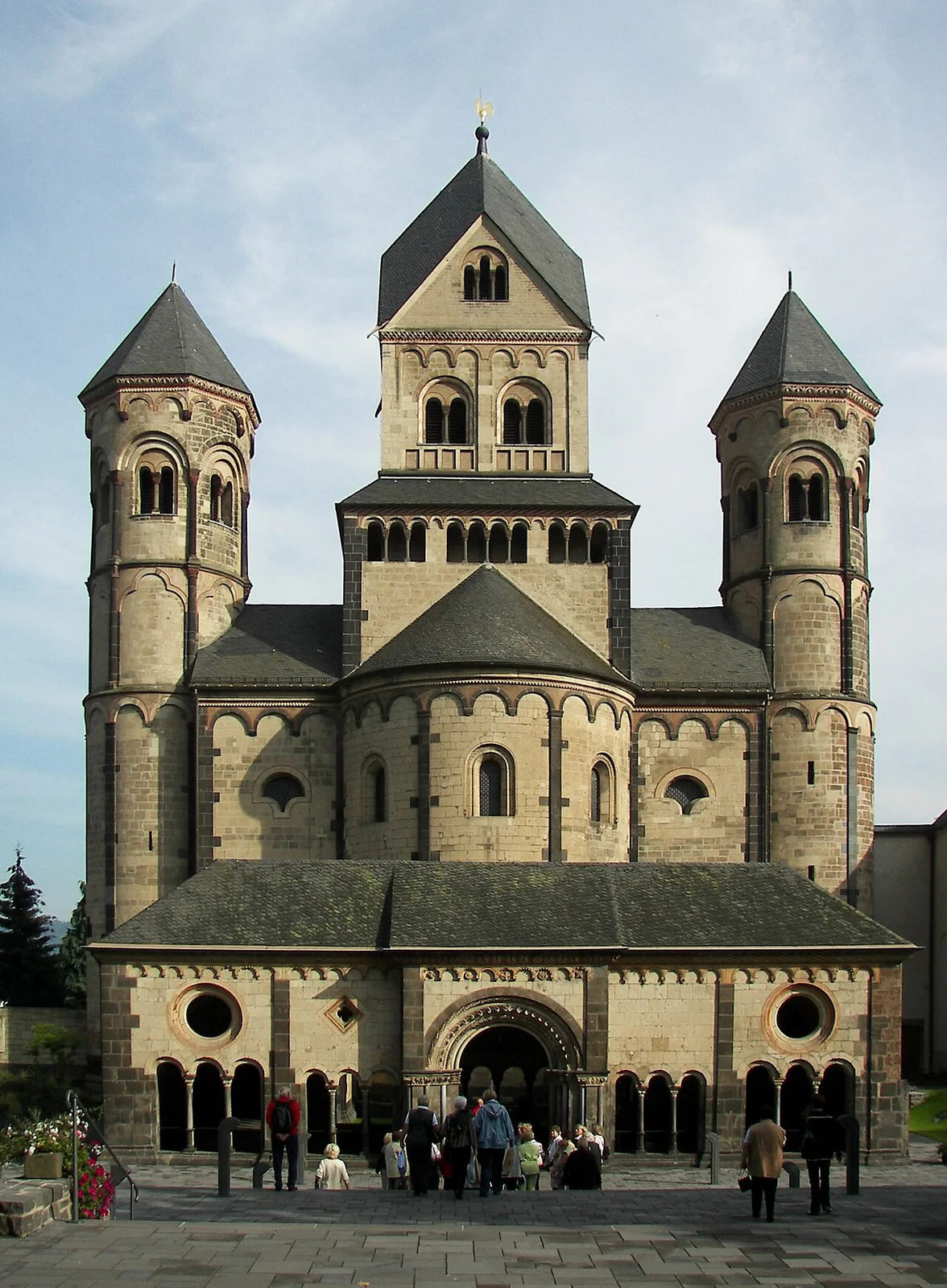
01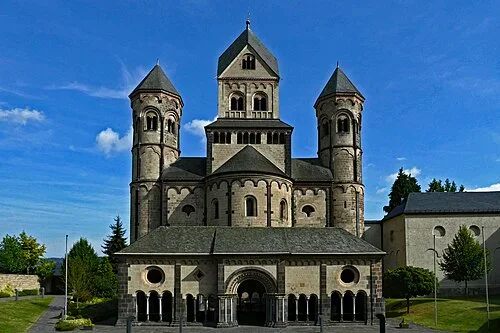 Western Forecourt: The Romanesque Gottesburg
Western Front of the Abbey Church
Abtei Maria Laach is a Benedictine abbey on the south-west shore of the Laacher See, a lake in the Eifel region of western Germany. Count Palatine Heinrich the Second of Laach and his wife, Adelaide, founded it in 1093. It began as a priory, a smaller house linked to Affligem Abbey in what is now Belgium. It became independent in 1127. Building went on over several generations. The church is considered one of the most beautiful Romanesque buildings in Germany. Romanesque is a style known for thick walls and round arches. The church belongs to the tradition of the great imperial cathedrals of the Rhine, at Speyer, Mainz and Worms. The western front rises in three towers. Two round ones stand at the sides, and a taller square one rises in the centre. Below them, a lower storey has a central doorway and rows of small arches. The name Maria came much later, when the Jesuits added it in 1862.
Photo: CatalpaSpirit · CC BY-SA 4.0
02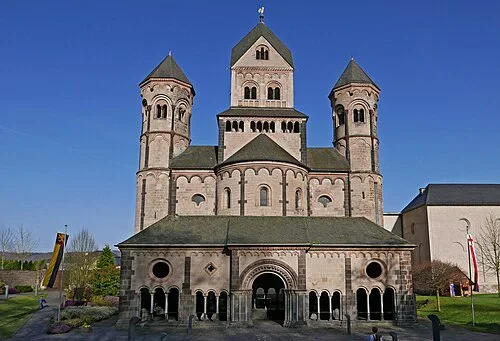 Western Forecourt: The Romanesque Gottesburg
The Six Towers and Gottesburg Silhouette
The idea of the Gottesburg, a fortress of God, shaped the outside of this church. Its outside embodies the Romanesque idea of a castle of God, and its comparatively short nave strengthens that effect. Six towers rise above the church. Two square towers stand at the east end, beside the round apse. At the west end stand the three towers you have just seen. The sixth tower rises over the crossing, where the nave meets the transept. Arched openings sit near the top of the round towers. A meaning has also been read into the plan. Its cross shape stands for Christ. The west end, facing the setting sun, stood for the nobility, who were the protectors. The east end, facing the sunrise, stood for the clergy, who were the teachers. The relatively short nave between them stood for the people, who fed and supported the other two. Whether the builders meant all this is uncertain, and it remains one reading of the design. Later Gothic builders had given some towers steeper roofs. In the twentieth century, those roofs were changed back to Romanesque forms.
Photo: Geolina163 · CC BY-SA 4.0
03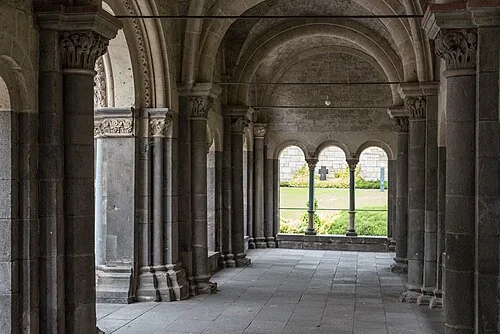 The Paradise Atrium and Lion Fountain
The Paradise: West Porch Colonnade
The Paradise, the west porch of the abbey church, is a single-storey colonnade around a small courtyard. Groups of slim columns line a vaulted walk, and round arches open onto the grass. Their carved capitals, the blocks on top of the columns, show human and mythical figures. The porch was added around 1225, and its design recalls the Early Christian basilicas. It formed the threshold before the church itself. The walled courtyard had no proper entrance, so it was kept as a garden. For a time, the Paradise also had an upper floor with about a dozen rooms for guests. The oldest known drawing that shows the upper floor dates from 1725, by the Walloon painter Renier Roidkin. The lake level fell considerably in the early nineteenth century. Serious and unexpected damage then turned up in the church's vaults and roofs. Around 1830, repairs took the upper floor down, and the Paradise returned to its original form. For a long time afterwards, the marks of the old upper floor could still be seen on the outer wall of the church.
Listen in the appPhoto: Tilman2007 · CC BY-SA 4.0
04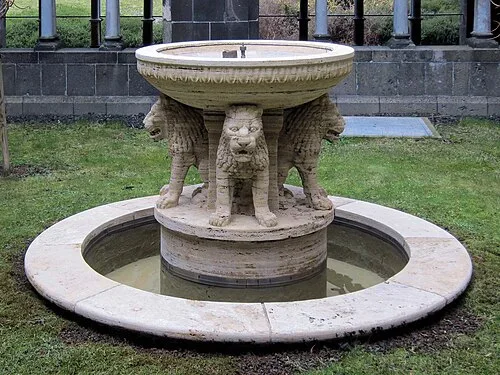 The Paradise Atrium and Lion Fountain
Lion Fountain (Löwenbrunnen), 1928
A stone basin rests on the backs of carved lions, in the middle of a lawn. Low stone edging surrounds the grass, and an iron railing stands behind. The porch encloses this green space on all sides. In general, early Christian and medieval church courtyards often held a basin for washing before people went inside. This fountain is a later addition. One account dates its addition to 1928. Another says that a monk, Father Radbod Commandeur, completed it during the restoration of 1937.
Listen in the appStefan Oemisch · CC BY-SA 4.0
05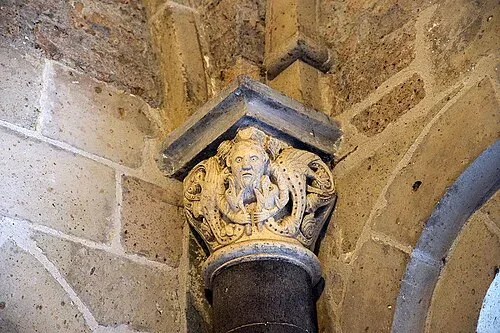 Westwork Sculptures of the Samson Master
Carved Head Capital, Attributed to the Master of the Laach Samson
The carver known as the Master of the Laach Samson goes by a label rather than a personal name. He was an imaginative mason, and his carvings turn up in Cologne as well as here. Accounts place his richly carved capitals in the Paradise porch. This capital shows a human face framed by curling leaves and scrolls, set above a dark column shaft. It is attributed to him, though its exact place in the church is not confirmed.
Listen in the appDietrich Krieger · CC BY-SA 3.0
06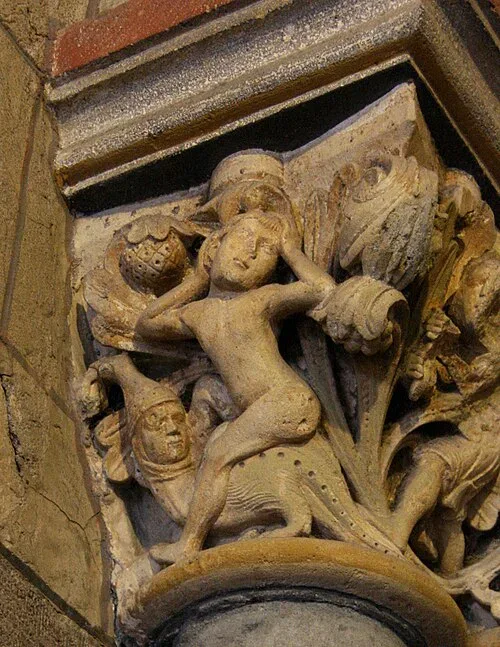 Westwork Sculptures of the Samson Master
Figural Capital with a Human Figure
A figure with both hands raised to its head fills this carved capital. Its body is bare, and a second face peers out from the left edge. Thick leaves crowd around them both. Romanesque capitals often carried biblical, moral or fabulous figures, and people below had to look up to take them in. This scene may show Eve and a devil, but the carving alone cannot settle that.
Listen in the appDietrich Krieger · CC BY-SA 3.0
07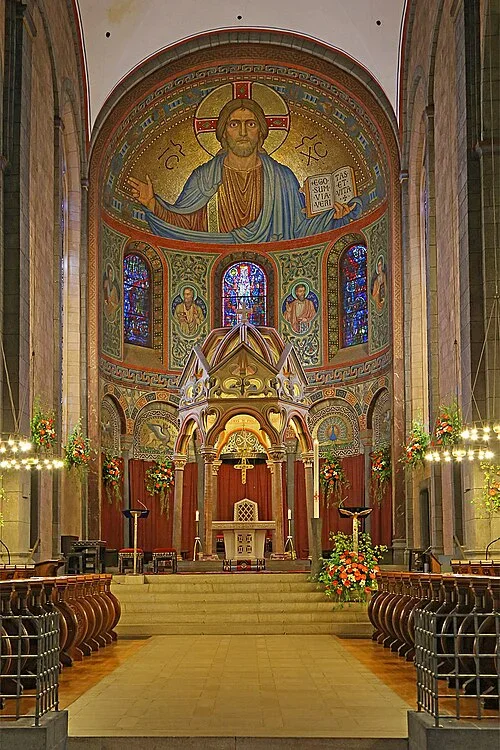 Central Nave and Historic Pillar Frescoes
Choir and Apse of the Abbey Church
The east end is where Masses are celebrated, and where the community's wooden choir stalls stand. In the first half of the twentieth century, Maria Laach became a leader in the Liturgical Movement. That movement aimed to study and renew the church's worship. Under Abbot Ildefons Herwegen, the monks began serious research into the liturgy. A publishing house, ars liturgica, was founded in the same period. A dedicated institute followed in 1948. The community reached its largest size in 1934. It then had 182 members. The abbey's scholarship had older roots, in a productive literary period after the late medieval reform. Herwegen had been a school friend of Konrad Adenauer, the later German chancellor. In 1933, the abbey gave Adenauer a year's refuge after the Nazis removed him as mayor of Cologne. He lived there as Brother Konrad.
Listen in the appPhoto: W. Bulach · CC BY-SA 4.0
08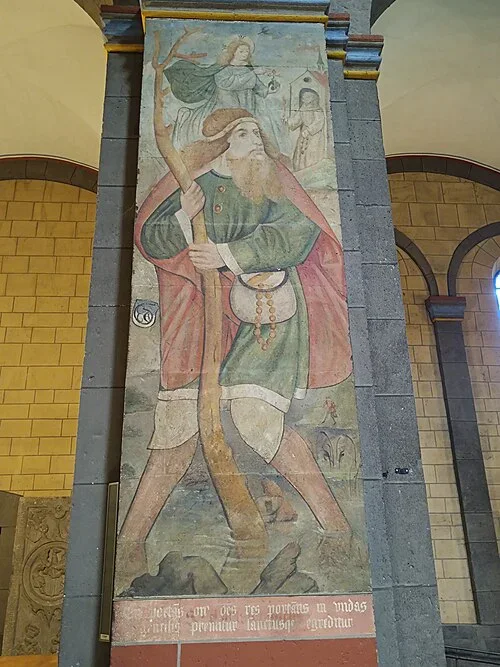 Central Nave and Historic Pillar Frescoes
16th-Century Pillar Fresco of a Bearded Saint with Staff
A bearded saint with a long staff is painted on this pillar, wearing a red cloak over a green tunic. A pouch hangs at his belt, and a smaller figure appears above him. Along the bottom runs a Latin inscription, only partly legible. Tradition links these pillar paintings to Abbot Simon von der Leyen, who led the abbey around 1500. In the sixteenth century the church had sixteen altars. Eight of them stood in the nave. The altar of the Ten Thousand Martyrs stood in the middle of the nave, close to the founder's grave. Young monks training for the priesthood often celebrated their first Mass there, with their families present. Most of these altars were removed in the seventeenth century.
Listen in the appPhoto: Immanuel Giel · CC0
09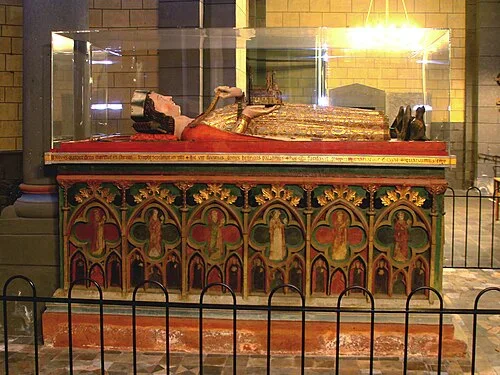 Founder's Tomb of Count Heinrich II
Tomb of Count Palatine Heinrich II
Count Palatine Heinrich the Second of Laach, the founder of this abbey, is buried in the church he endowed. His effigy lies on the tomb in gilded robes, under glass. Beneath it, a painted base holds a row of arched panels, each with a small figure. He was a prominent supporter of the emperor in the Investiture Controversy, the long dispute between popes and emperors over who could appoint churchmen. The church excommunicated him, and he stayed under that ban. The tomb dates from the thirteenth century, and one account gives 1270. It first stood in the cloister, because the nave was still unfinished. Later it was set up in the nave, in the time of Abbot Theoderich the Second. Medieval monastic foundations often paid for prayers for their founders' souls. The story goes that Heinrich and Adelaide had no children. They vowed their inheritance to God, so that monks would pray for them.
Listen in the appHolger Weinandt · CC BY-SA 3.0 de
10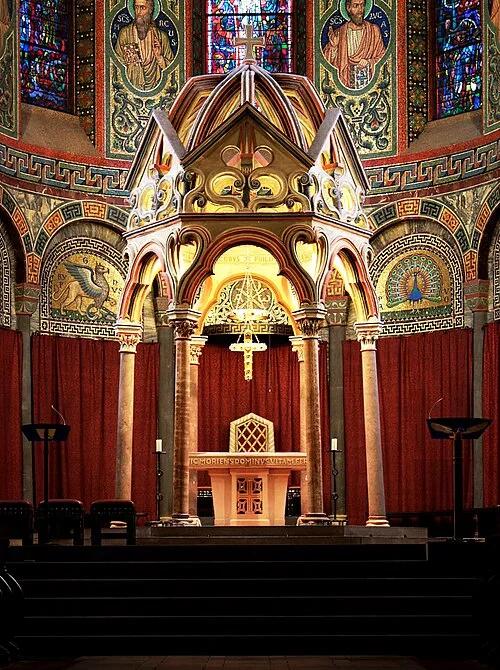 High Altar Ciborium and Apse Pantokrator
Stone Ciborium over the High Altar
A stone canopy stands over the high altar, built like a church in miniature. Slender columns carry arches, and a gabled roof rises above them. Its date and style are not settled. One description calls it Late Romanesque, a later phase of that style. Another says Abbot Theoderich the Second acquired it in 1256. Red hangings fall behind it, and it sits in the curve of the apse. Medieval altar canopies were often built on the scale of small churches. Since 1947 this one has covered the altar in the east end, though it was moved without its original small gallery.
Listen in the appPhoto: Detlef Huhn · CC BY-SA 4.0
- 11
Christ Pantokrator Mosaic in the Apse
How the German Kaiser shaped the apse mosaic, copying a cathedral in Sicily.
- 12
St. Nicholas Chapel (Nikolauskapelle)
A chapel with red-and-white arches, and a tunnel that may once have drained the lake.
Abtei Maria Laach
Frequently asked questions
How much does the guide cost?
Free app download. Listed guide price: $0.99. Guide price shown in the app. Audio guide only. Venue admission is separate.
Can I listen without internet?
Yes. Download the guide’s audio, images, and maps in the app before your visit. Your downloaded content is then available offline.
Can I listen in my language?
This audio guide is available in 15 languages, including English.
Do I need to follow a schedule?
No. This is a self-guided experience. Choose your stops, pause whenever you like, and return to a story at your own pace.
At your own pace
Explore Abtei Maria Laach.
Download Stanza, then search for “Abtei Maria Laach”.
Free app download · Guide price shown in the app
Keep exploring
Nearby audio guides
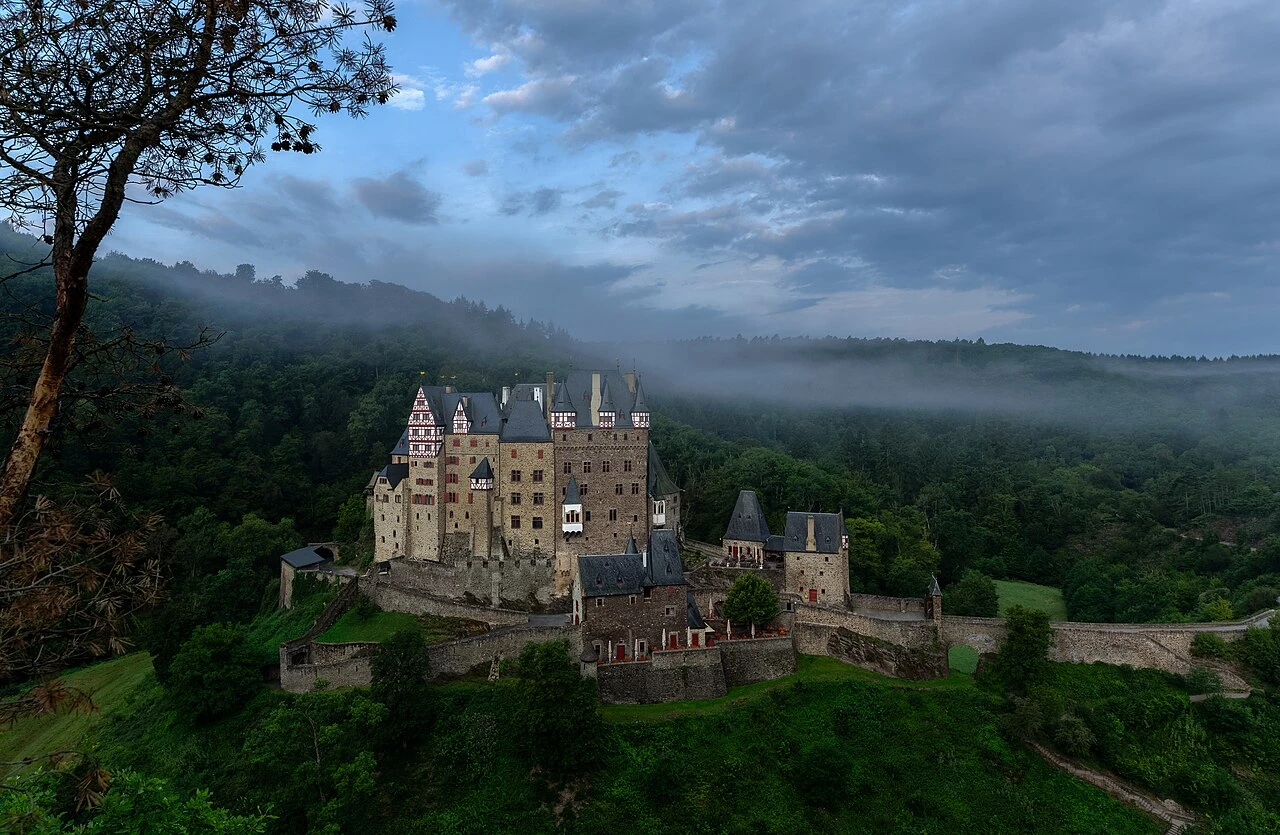
Wierschem · 23 km
Eltz Castle
Content & sources
Johannes Dörrstock · CC BY-SA 4.0
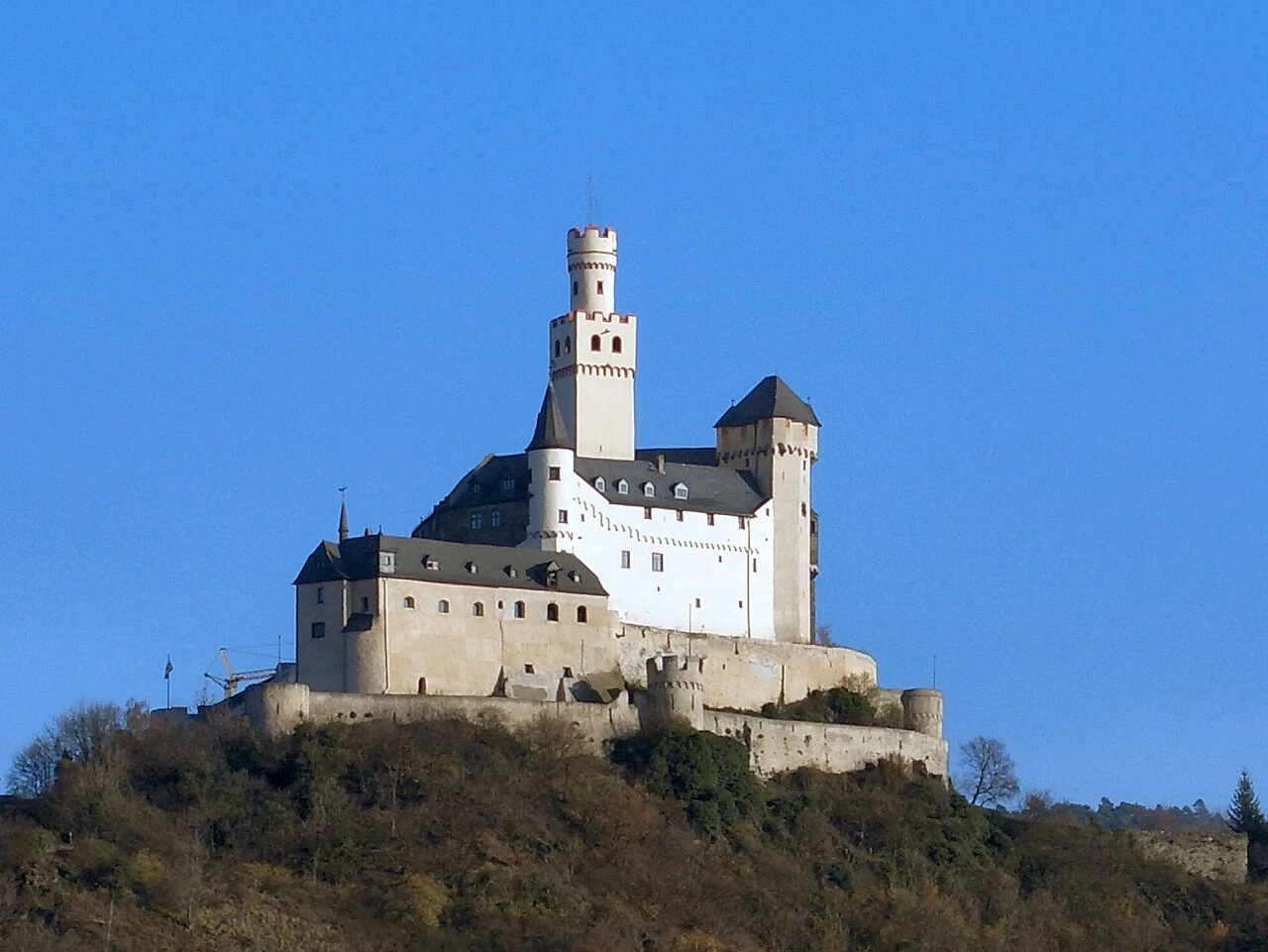
Braubach · 32 km
Marksburg
Content & sources
Holger Weinandt · CC BY-SA 3.0
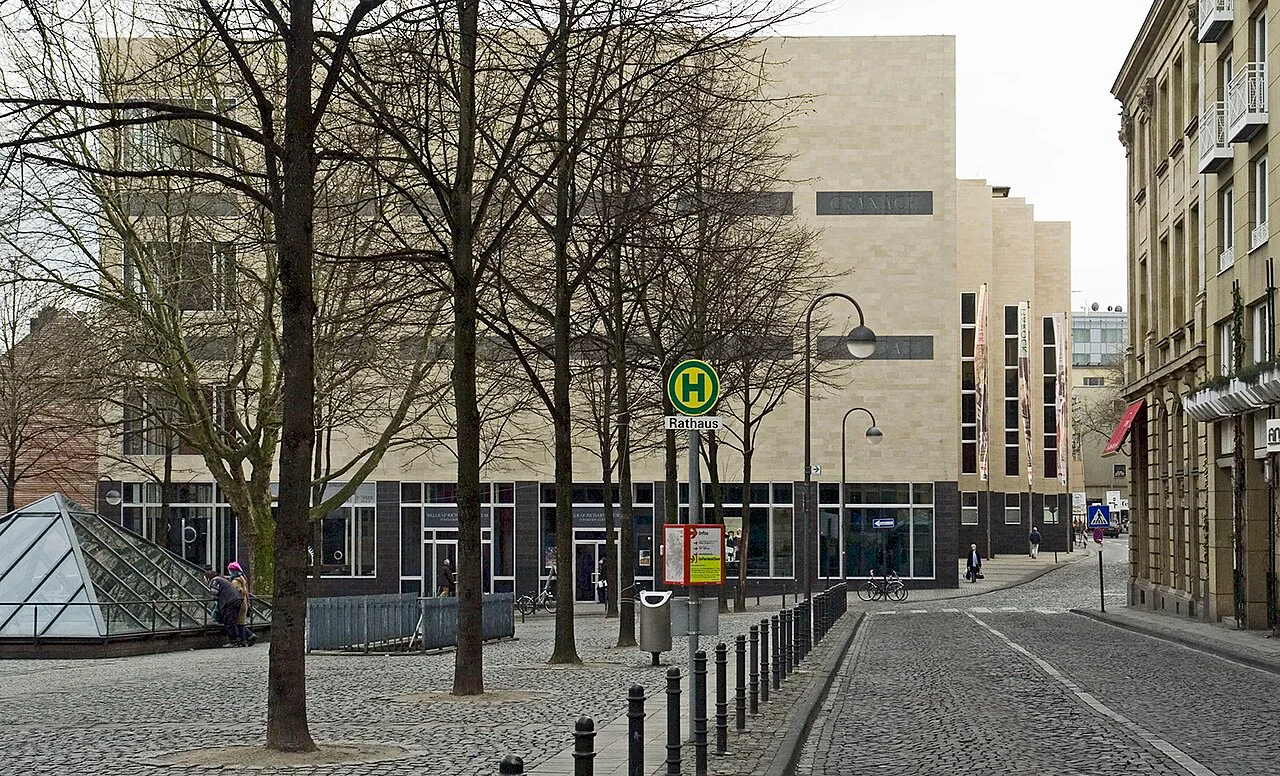
Cologne · 63 km
Wallraf-Richartz-Museum & Fondation Corboud
Content & sources
Hans Peter Schaefer - http://www.reserv-a-rt.de · CC BY-SA 3.0
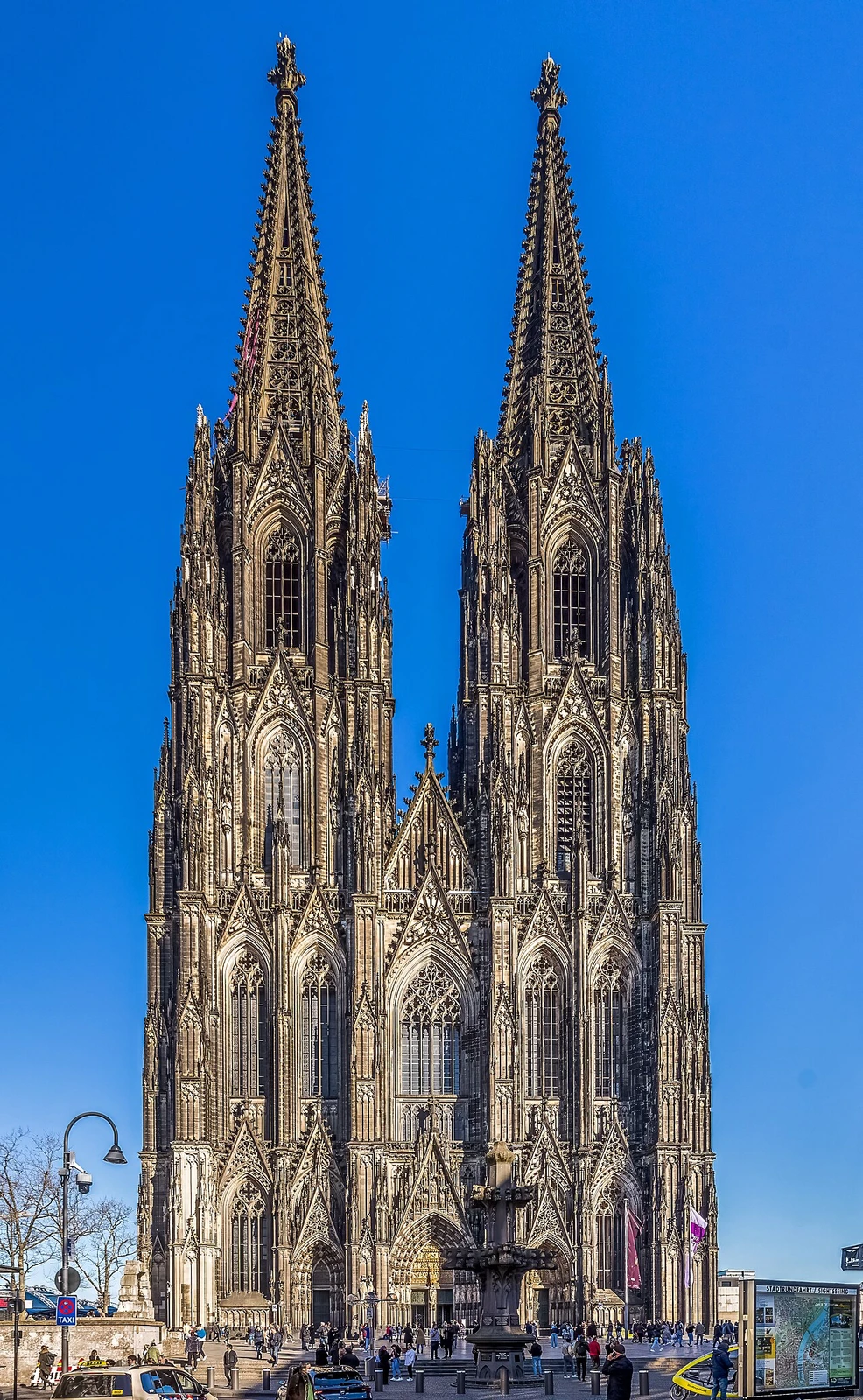
Cologne · 63 km
Cologne Cathedral
Content & sources
Raimond Spekking · CC BY-SA 4.0