Stanza · Audio guide
Marksburg Audio Guide
A place to remember. A story to take with you.
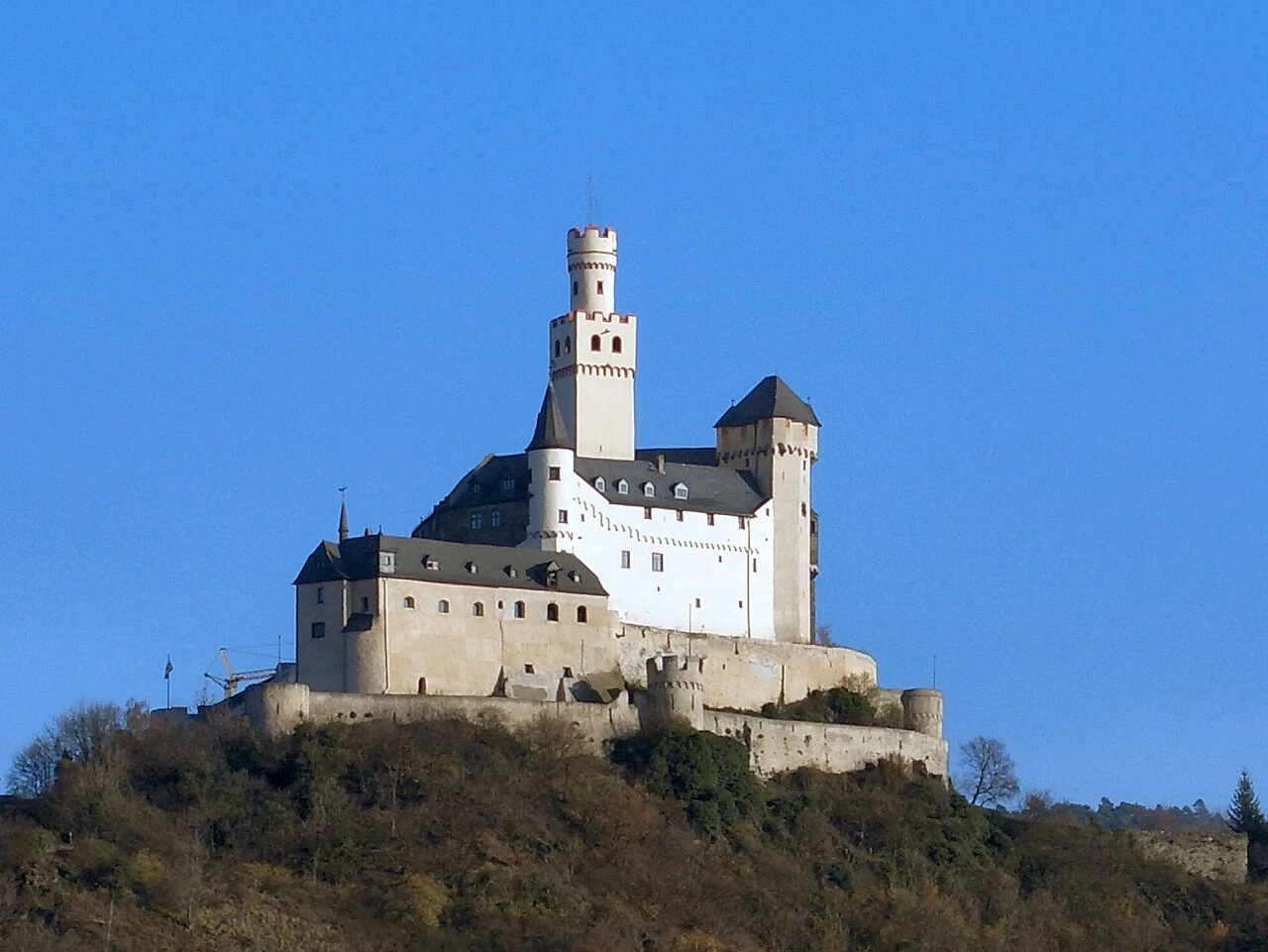
Marksburg is a historic castle situated above the town of Braubach in Rhineland-Palatinate, Germany. It is well-preserved and notably serves as the headquarters of the German Castles Association.
Download Stanza, then search for “Marksburg”.
About the tour
One guide. Your kind of visit.
Marksburg is a historic castle situated above the town of Braubach in Rhineland-Palatinate, Germany. It is well-preserved and notably serves as the headquarters of the German Castles Association.
Ready when you are.
- 01Get the free Stanza app.
iOS & Android
- 02Find your guide.
“Marksburg”
- 03Download before you go.
Works offline
Audio guide / 14 narrated stops
Inside the guide
Get to know a few of the stories before you go. Open a stop to read more.
01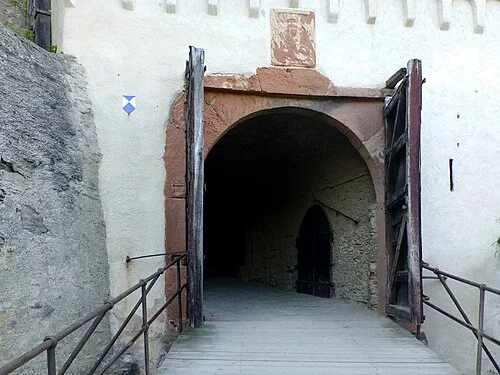 The Outer Gateways and Drawbridge
The Drawbridge Gate (Zugbrückentor)
Welcome to the Marksburg, the hilltop fortress above the town of Braubach on the Rhine. This castle was built for protection, not as a residence for royal families. It guarded the crossing of the Rhine here and the valley roads coming down from the Taunus hills. It also anchored the river tolls and served as the centre of local administration. Every visitor still enters through this outer drawbridge gate, the first of several obstacles on the way up. The oldest story begins around 1117, with a fortification raised by the noble freemen of Braubach. That first stronghold may have stood in the town below rather than on this hill. A castle on the hill itself is first named in documents in 1231, held by the Lords of Eppstein. Of the forty hill castles between Bingen and Koblenz, the Marksburg is the only one never destroyed and never left to decay. Remember that claim; one day in 1945 will test it.
Muck · CC BY-SA 4.0
02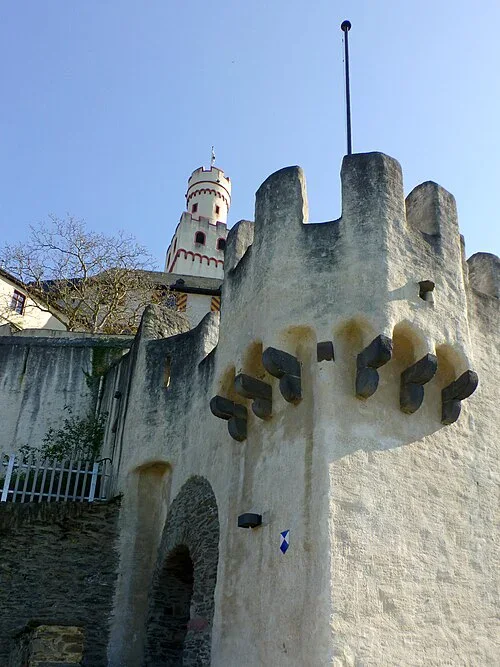 The Outer Gateways and Drawbridge
The Fox Gate (Fuchstor) and Covered Ramp
The Fox Gate was built in the fourteenth or fifteenth century, part of the great strengthening of the approach. The stone projections jutting out over the gateway are machicolations. Through the openings in their floors, defenders could drop stones and other missiles straight onto anyone below. The gate carries a covered wall-walk, so defenders could move along the ramp protected from arrows. An attacker who forced the drawbridge gate below found only another barrier here, and more beyond it. Each gateway had to be taken separately, under fire from the ones already passed. The steep path turned into a sequence of killing grounds. That layering is a large part of why this castle never had to be stormed.
Muck · CC BY-SA 4.0
03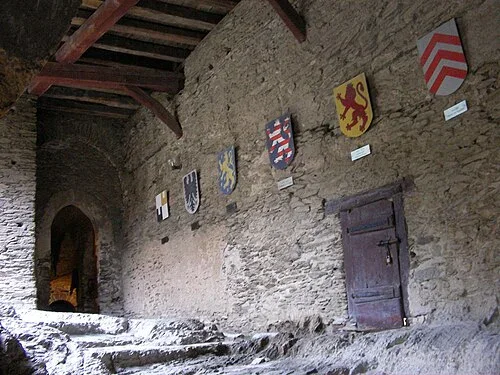 The Riders' Staircase and Central Keep
The Riders' Staircase (Reitertreppe)
This stairway was hewn directly out of the bedrock, steep enough to test both horses and riders. It is called the Riders' Staircase, and the coats of arms along its walls name the castle's rulers in order. The Eppsteins built the first true castle here, a typical Staufer-era stronghold with a keep and a simple hall inside a triangular wall. They were a powerful family; in the thirteenth century alone they provided four archbishops of Mainz. In 1283 Braubach and its castle passed to Count Eberhard the First, of the younger line of the Counts of Katzenelnbogen. The wealthy Katzenelnbogen counts created most of what stands today. Count Johann the Second began the Gothic expansion that shaped the castle's present appearance, and his son Diether the Eighth completed it. In 1479 the Katzenelnbogen line died out, and the landgraves of Hesse took over.
Listen in the appUlrich Mayring · CC BY-SA 3.0
04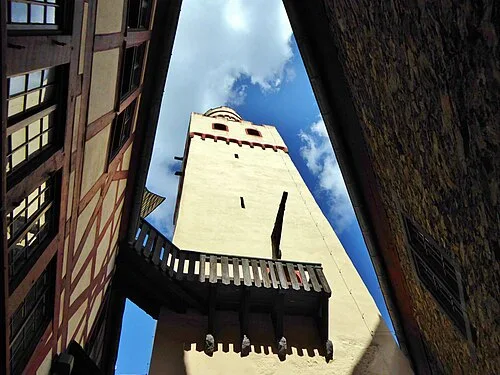 The Riders' Staircase and Central Keep
The Butter-Churn Keep (Bergfried)
The great tower rising between the timber-framed buildings is the keep, about forty metres tall. A wide square shaft carries a narrow round turret on top, shaped like an old butter churn. Builders across the Rhine Gorge used this form, and the Marksburg has one of the finest. The oldest datable parts of the whole castle are here: the base of the keep and the lower hall date to 1239, counted from the tree rings in their wooden beams. Study of the masonry shows the tower was originally considerably smaller than it is now. The main entrance sits high on the second floor, reached until the seventeenth century only by a wooden ladder that could be pulled up. The butter-churn cap was taken down in the early eighteenth century. In 1905 it was put back, the first visible act of the castle's later rescue.
Listen in the appPhoto: Medici1982 · CC BY-SA 4.0
05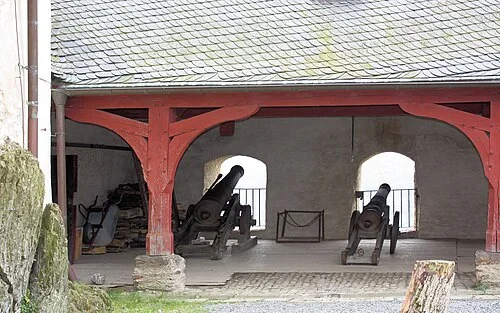 The Great Artillery Battery
The old cannons under this open shelter face the Rhine, and they mark the castle's answer to gunpowder. Early in the sixteenth century a gun house was built at the south-east corner of the north building. Between 1643 and 1645 came a far bigger modernisation: a hidden passage, a forward bastion, and the large and small batteries overlooking the river. Then the caveat to the claim you heard at the gate. On the twentieth of March 1945, American artillery fired from across the Rhine, and the butter-churn cap on the keep half-collapsed. Five days later, almost every roof on the river side had been stripped away. So the castle was never taken or torn down, but it was shelled. Repairing the cap and the upper keep took until 1961, and the roofs until about 1980.
Listen in the appPhoto: Dguendel · CC BY 3.0
06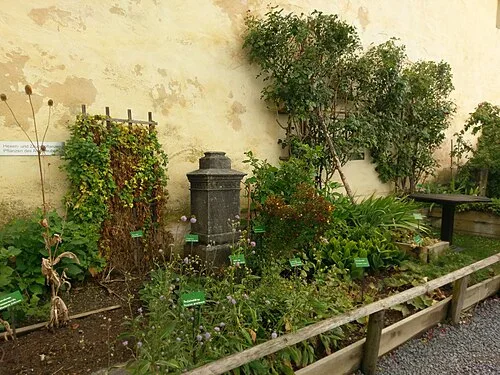 The Medieval Herb Garden
Not everything on this hill was built for war. This garden was laid out in 1969 inside the filled-in former outer ward, as a demonstration of medieval garden culture. It grows around a hundred and seventy species that people knew in the Middle Ages: herbs, medicinal plants, culinary greens and ornamental flowers. Among them are the so-called witch and magic plants of medieval belief. The beds are labelled, each plant with the name and use it carried centuries ago. The garden now belongs to the Route of World Heritage Gardens. From this terrace the Rhine opens out below, with Braubach on the near bank and Spay across the water. The view explains, once more and without words, why this height commanded the river.
Listen in the appMarion Halft · CC BY-SA 4.0
07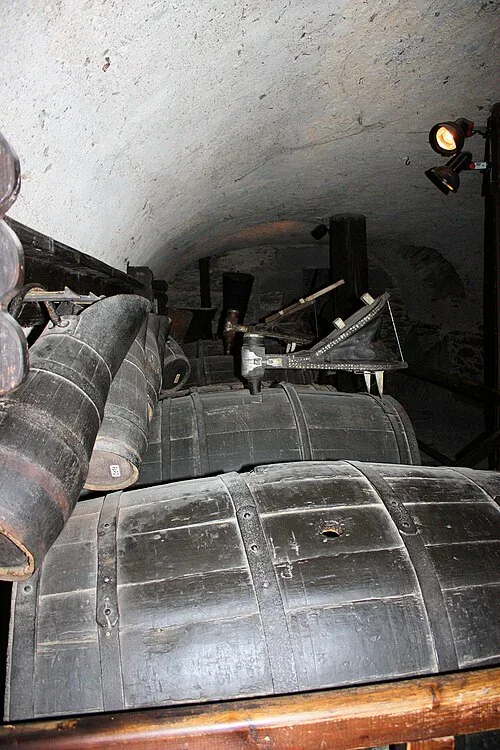 The Wine Cellar and Castle Kitchen
The Wine Cellar
Beneath the Gothic hall lies this vaulted cellar, where the fortress household kept its provisions. Dark casks rest in the shadows under the stone vaulting, holding wine in the cool and the dark. A garrison on a hill could not feed itself day to day; stores like these kept it through a siege and through winter. The cellar's named piece is the great wine press of 1767, which was brought here from Braubach itself. The town below and the castle above shared one wine economy, and the Middle Rhine has been a wine region for centuries. The press stands as a reminder that the fortress drank the same harvest as its neighbours.
Listen in the appPhoto: Dguendel · CC BY 3.0
08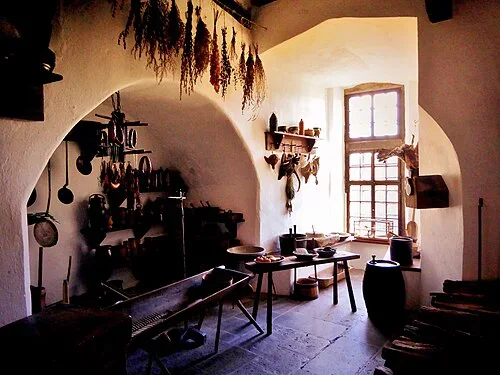 The Wine Cellar and Castle Kitchen
The Castle Kitchen
This was the workroom of the whole household, and it is a careful reconstruction from 1974. The open hearth and the rotating spit stand where the cooking fire burned. Herbs dry from the beams overhead, tied in bundles from the garden outside. Pots, troughs and barrels wait at hand, and the stores from the cellar below ended up here. Meat was preserved, grain was ground, and every meal for the hall above passed through this room. The castle guides like to add that medieval everyday life still lives on in modern German speech. To have bad luck is to 'have pitch', from the pitch used to trap and burn attackers. And to burn one's bridges behind you is said just as it was then.
Listen in the appPhoto: Medici1982 · CC BY-SA 4.0
09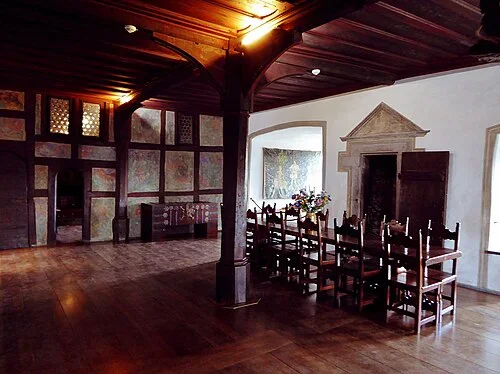 The Great Hall and Princely Chambers
The Great Hall (Rittersaal)
This was the representative heart of the castle, where the lord's household ate together, assembled and held court. The long table and high-backed chairs are set for a feast, as they would have been on a great occasion. In the late Gothic period the hall changed: its timber structure was renewed, a stone staircase was built in, and the two storeys of halls were divided into smaller living rooms. What the rooms hold today is museum furnishing, assembled since 1900 through donations and purchases. Nothing of the original inventory survives. One detail was not unusual in the Middle Ages: a latrine opens directly off this hall. It has its own story, a few steps on.
Listen in the appPhoto: Medici1982 · CC BY-SA 4.0
10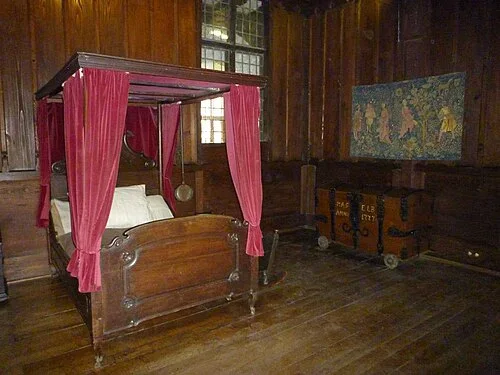 The Great Hall and Princely Chambers
The Princely Kemenate
The Kemenate was the heated chamber on the upper floor, the private comfort of the castle. The canopied bed with its red curtains was for the lord's family, a rare warmth in a stone fortress. This room is also the clearest lesson in reading a preserved interior critically. Almost nothing of the original fittings survives here. By the time repairs were ordered in 1868 under Wilhelm the First, great parts of the original inventory had already been lost. The ceiling panelling and the wall paintings you see were renewed in 1903. So the room is genuine medieval space dressed in later restoration, and knowing which layer is which is part of visiting any old castle well.
Listen in the appPhoto: Franzfoto · CC BY-SA 3.0
- 11
The Garderobe (Latrine)
A small wooden seat in the wall: the honest, unglamorous comfort of a medieval great hall.
- 12
The Chapel of Saint Mark
The painted chapel of Saint Mark that gave the castle its name, and the legend of the devilish suitor.
- 13
The Gimbel Armor Collection
Warriors from a Greek hoplite to an arquebusier: one collector's museum of how fighting equipment evolved.
- 14
The Castle Smithy and the Castle's Rescue
From the forge to the rescue: how a neglected prison became the home of Germany's castle preservation movement.
Marksburg
Frequently asked questions
How much does the guide cost?
Free app download. Listed guide price: $1.99. Guide price shown in the app. Audio guide only. Venue admission is separate.
Can I listen without internet?
Yes. Download the guide’s audio, images, and maps in the app before your visit. Your downloaded content is then available offline.
Can I listen in my language?
This audio guide is available in 15 languages, including English.
Do I need to follow a schedule?
No. This is a self-guided experience. Choose your stops, pause whenever you like, and return to a story at your own pace.
At your own pace
Explore Marksburg.
Download Stanza, then search for “Marksburg”.
Free app download · Guide price shown in the app
Keep exploring
Nearby audio guides
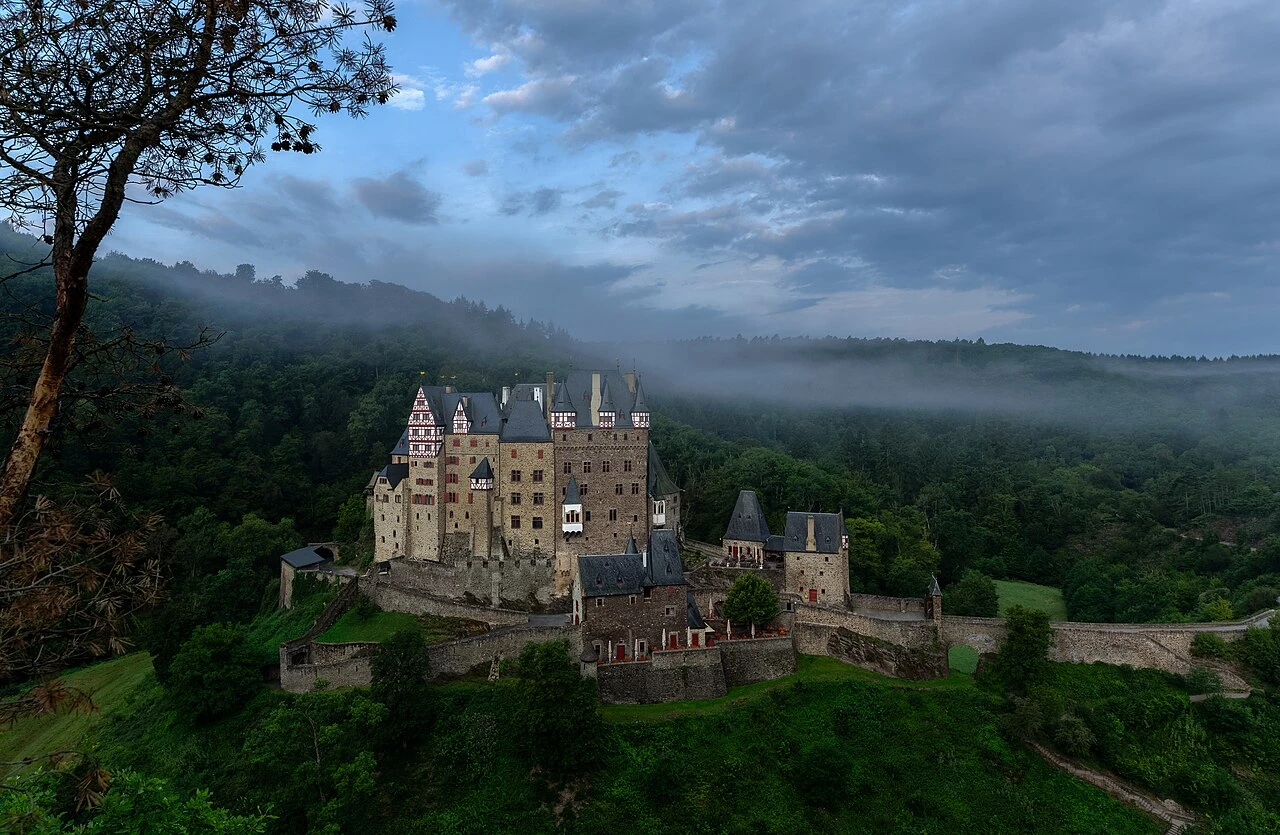
Wierschem · 23 km
Eltz Castle
Content & sources
Johannes Dörrstock · CC BY-SA 4.0
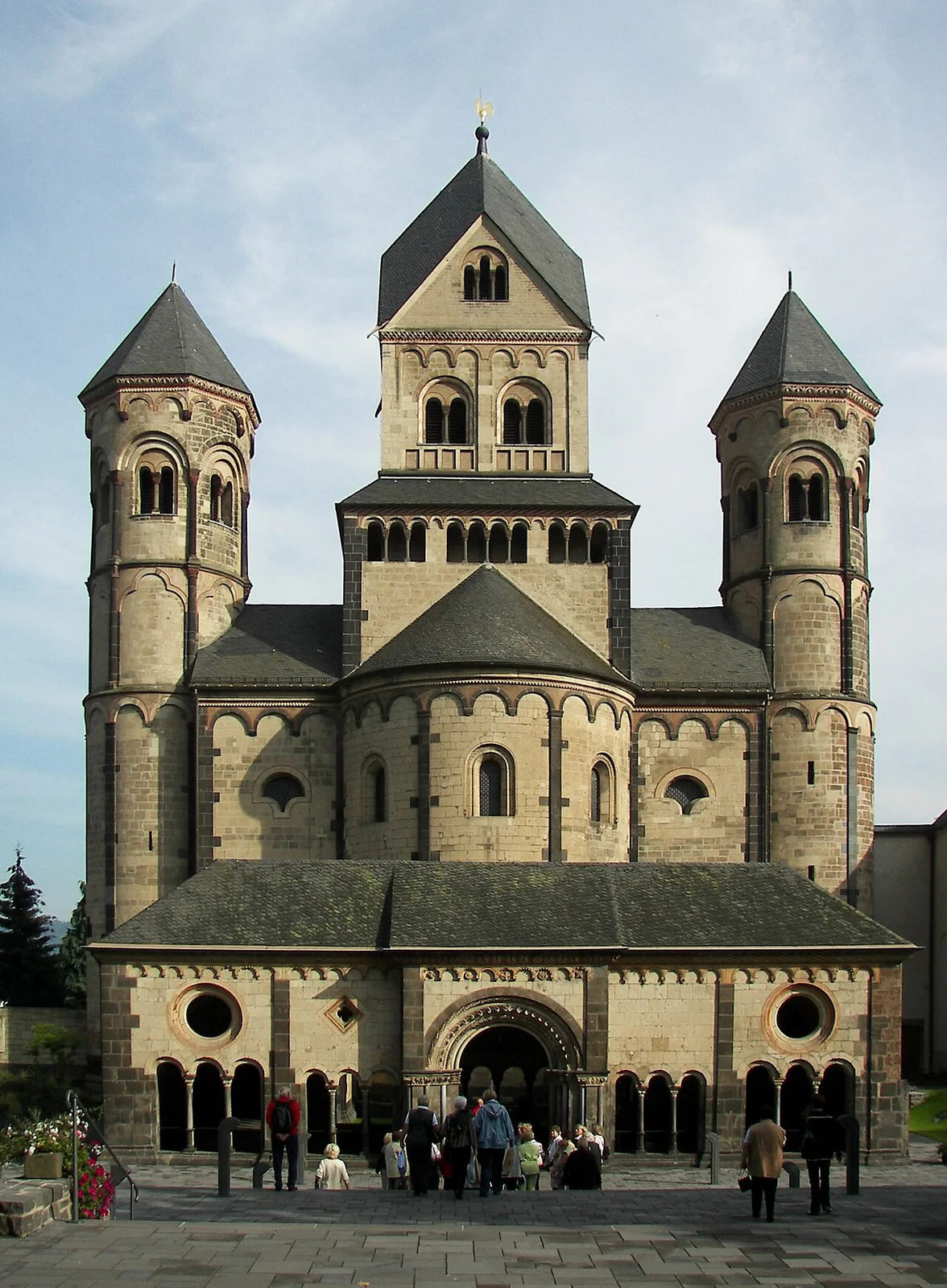
Maria Laach · 32 km
Abtei Maria Laach
Content & sources
Nikanos · CC BY-SA 2.5
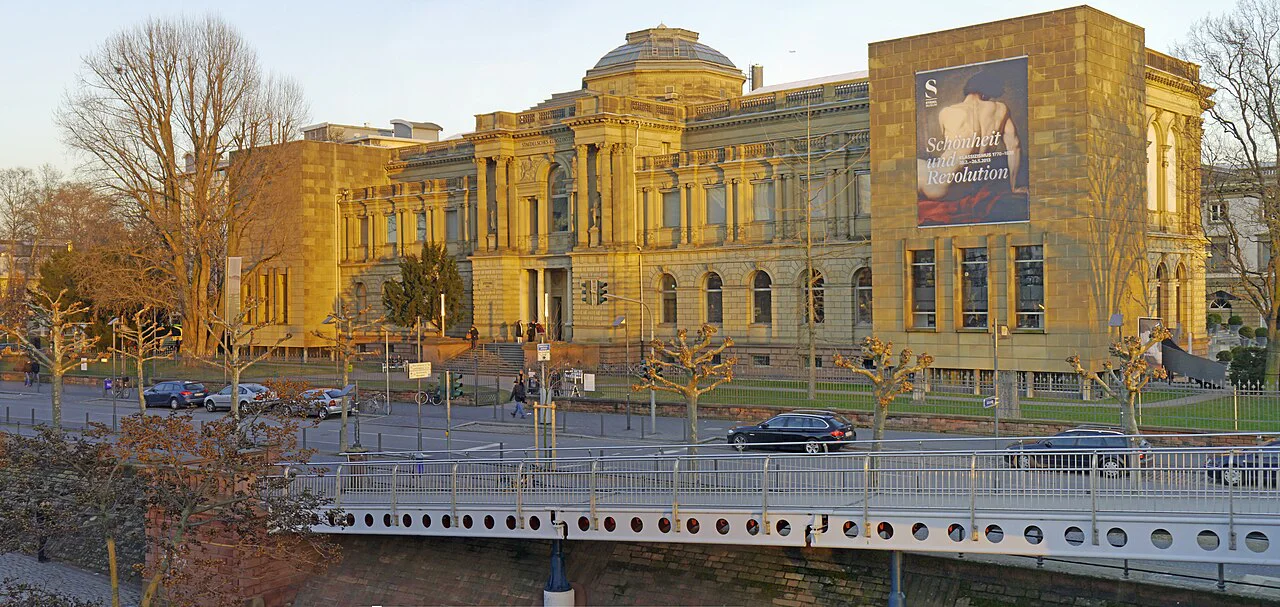
Frankfurt · 75 km
Städelsches Kunstinstitut
Content & sources
Photo: Simsalabimbam · CC BY-SA 3.0
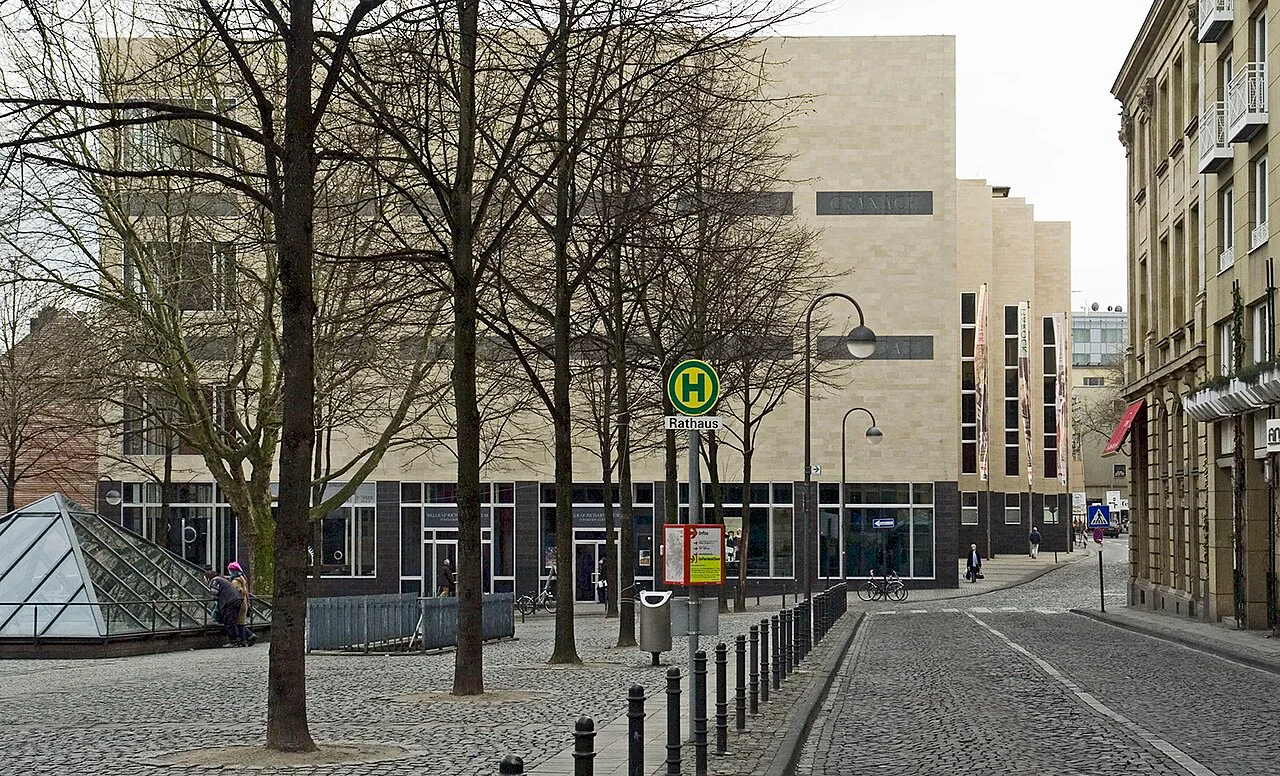
Cologne · 89 km
Wallraf-Richartz-Museum & Fondation Corboud
Content & sources
Hans Peter Schaefer - http://www.reserv-a-rt.de · CC BY-SA 3.0