Languages
15Wartburg Audio Guide
Wartburg is a landmark in Eisenach, Germany. Explore it with Stanza's GPS-triggered offline audio guide — available in 15 languages.
Quick Facts
15
Stops
15
Languages
100%
Offline
📍 Eisenach, Germany · 50.9661°N, 10.3064°E
About Wartburg
Wartburg is a historic castle located in Eisenach, Germany. It is also recognized as a museum.
Wartburg is also known as Schloss Wartburg, Wartburg Castle.
This self-guided audio tour features 15 narrated stops organized across 7 sections. As a castle, Wartburg offers a unique cultural experience in the heart of Eisenach, Germany.
The Stanza audio guide is available in 15 languages and works entirely offline — download the complete tour including audio narration, maps, and images before your visit. As you walk through Wartburg, GPS-triggered narration plays automatically at each point of interest.
Last updated:
What you will hear
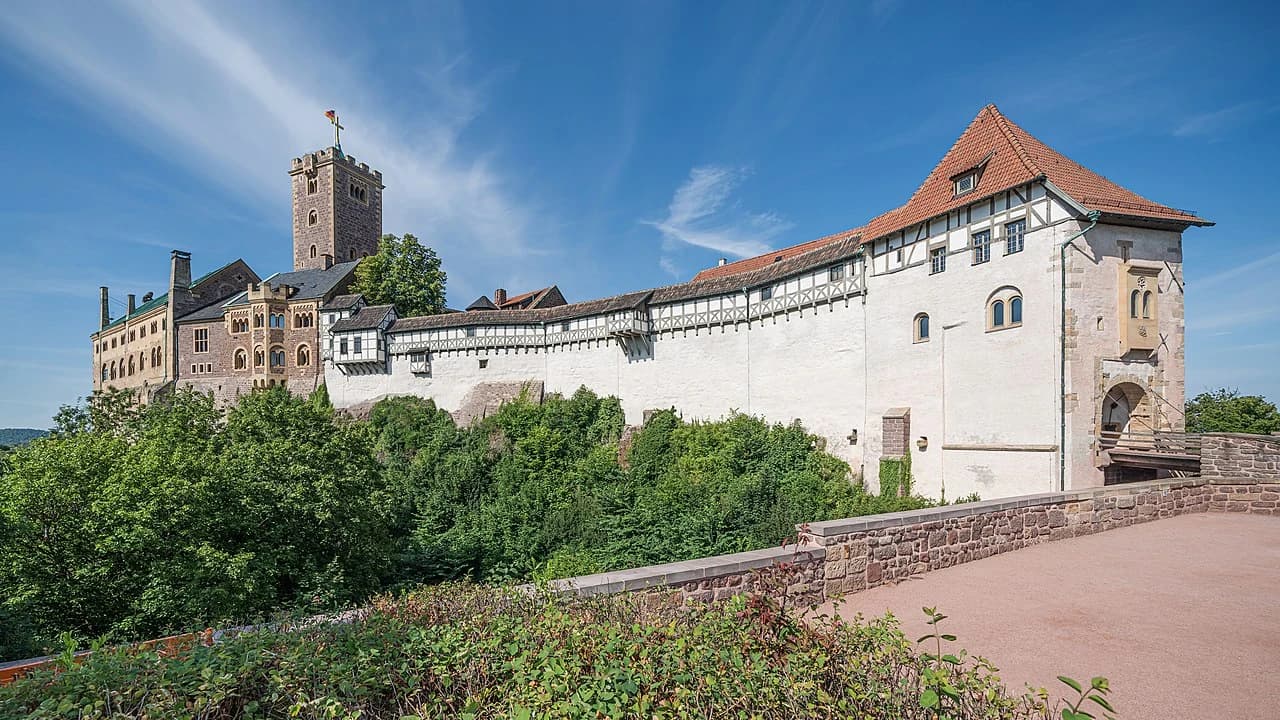
The Drawbridge and Barbican
The arrival point providing a grand view of the gatehouse and the castle's defensive entrance.
.jpg%3Fwidth%3D800&w=3840&q=75)
The Citadel on the Precipice
Welcome to Wartburg, a fortress perched 410 meters above sea level that has stood as a witness to German history since its founding in 1067. Its strategic location atop a rocky precipice provided a natural defense for centuries. Today, it is recognized as a UNESCO World Heritage site, noted for its architectural survival and its role as a profound symbol of German unity and cultural identity. As you observe the massive walls against the backdrop of the Thuringian Forest, notice the blend of eras. While the foundations are ancient, much of the cohesive medieval appearance we see today is the result of an extensive 19th-century restoration. This reconstruction was driven by a Romantic desire to preserve the castle as a monument to the national past. The sheer scale of the citadel reflected the power of the Landgraves of Thuringia, the medieval lords who ruled from this height. It serves as a physical manifestation of a transition from a rugged military stronghold to a national icon that has weathered the centuries.
The Vogtei and Luther’s Study
Combining the timber-framed exterior of the Vogtei with the simple room where Martin Luther translated the New Testament.
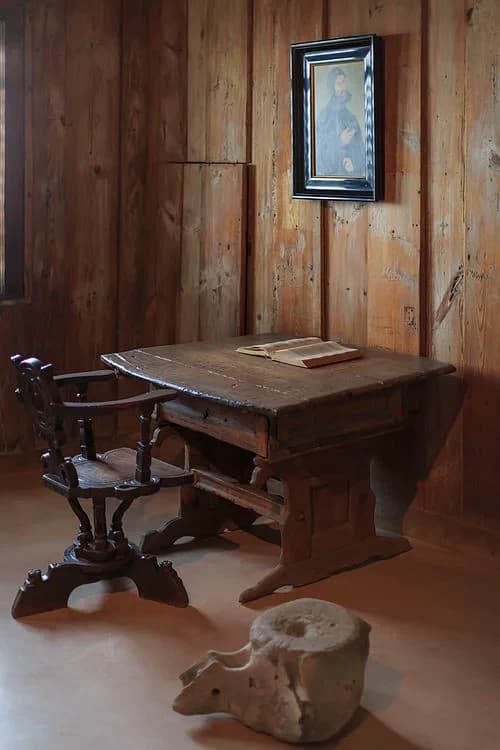
Luther’s Desk
Following his excommunication and the Edict of Worms, Martin Luther was whisked away to the safety of Wartburg in 1521. Living under the assumed identity of 'Junker Jörg,' or Knight George, he grew a beard and dressed as a nobleman to escape a death sentence. It was at this simple wooden desk that he performed a feat of immense scholarly and cultural significance. In just eleven weeks, Luther translated the New Testament from the original Greek into German. This was a religious act and a linguistic revolution. By choosing a dialect that could be understood across various German-speaking regions, Luther’s Bible helped standardize the German language itself. Before this work, the Bible was primarily available in Latin, accessible only to the educated clergy. Luther’s translation empowered common people to read and interpret the scriptures for themselves for the first time. The room remains sparse, reflecting the isolation and focus required for such a task. The work completed here spread rapidly thanks to the invention of the printing press, fundamentally altering the course of the Reformation and Western civilization.
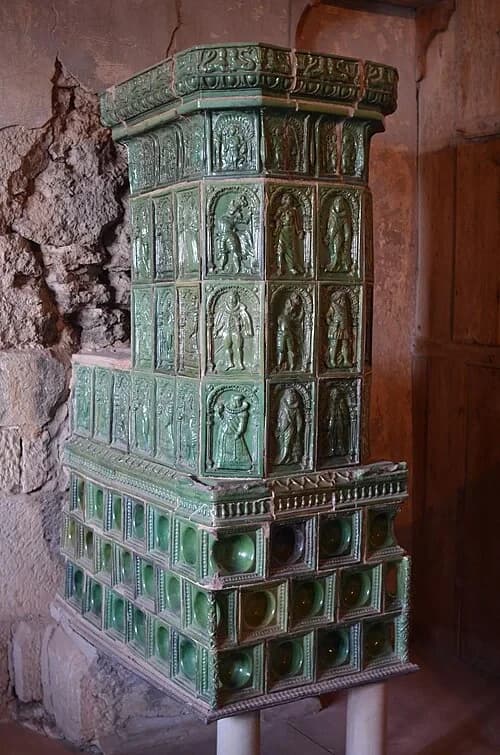
The Green Tiled Stove
While Martin Luther’s study was intentionally kept plain to help maintain his disguise, the green tiled stove provided a necessary comfort against the harsh Thuringian winters. Standing atop four sturdy legs, the stove is a fine example of 16th-century German craftsmanship. If you look closely at the individual ceramic tiles, you can see detailed relief carvings depicting various figures and scenes. Such stoves were common in wealthy households and official residences of the period, functioning as highly efficient heating systems. The ceramic material would absorb the heat from a fire and slowly radiate it into the room long after the flames died down. In a drafty stone castle perched on a mountain, this was more than a decoration; it was a survival tool. The deep green glaze was a popular choice for the time, providing a splash of color in an otherwise muted interior. The stove serves as a reminder that even during his clandestine exile, Luther was supported by the resources of the Landgrave’s castle. The quality of the relief work on the tiles illustrates the high level of artistry that even functional household items achieved during the Northern Renaissance.
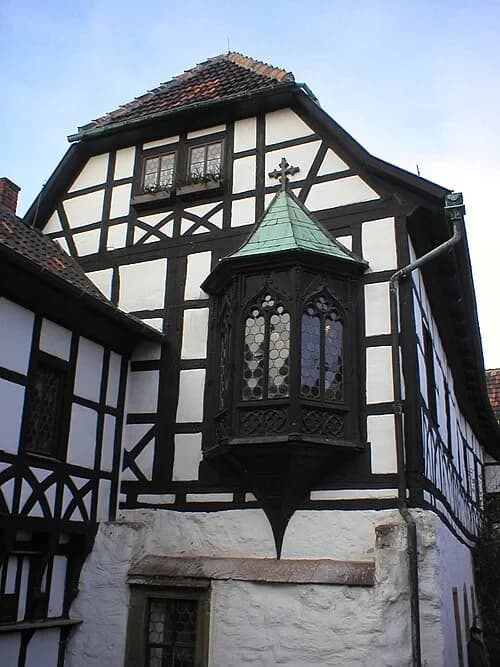
The Bailiff’s Bay Window
Rising above the courtyard is the Vogtei, or Bailiff's House, easily identified by its distinctive and ornate bay window. This dark, intricately carved feature served as an observation point for the Vogte, the administrative official who managed the castle's daily affairs and local jurisdiction. From this vantage point, the bailiff could monitor arrivals and departures, overseeing the flow of life through the lower courtyard. Beyond its administrative function, this building is historically significant as the entrance to the most renowned part of the entire site: the study of Martin Luther. The window itself reflects the high status of the bailiff, showcasing detailed craftsmanship that stands in contrast to the simpler timber-framing of the surrounding service buildings. This architectural detail marks the transition between the outer functional areas of the Vorburg and the more residential, historically dense inner sections of the palace. The bailiff was a crucial link between the ruling Landgraves and the local population, and his residence was positioned to reflect that authority. Today, the window remains a key landmark for visitors heading toward the rooms where some of the most world-changing events in European history took place.
The Second Courtyard and Bergfried
This area showcases the 19th-century reconstruction, particularly the massive tower which was rebuilt during that era.
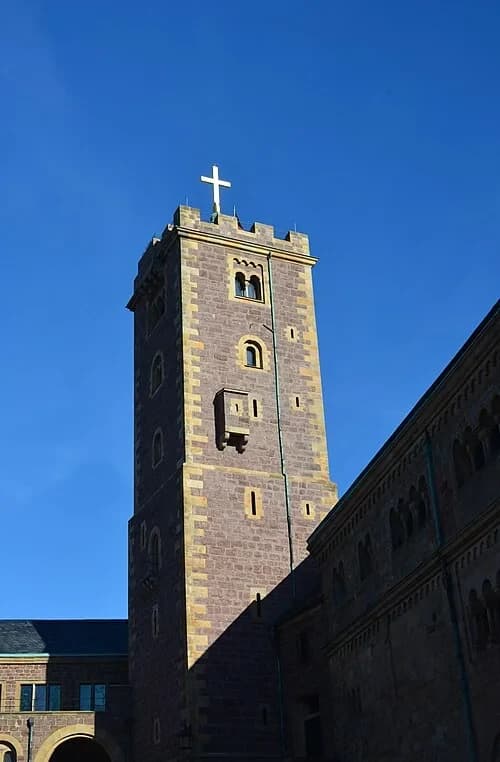
The Keep Tower
The massive stone keep, known as the Bergfried, dominates the silhouette of Wartburg. While it appears medieval, this specific tower was actually rebuilt between 1853 and 1859. The project was part of a grand restoration led by the architect Hugo von Ritgen, who aimed to revitalize the castle's grandeur in the Romantic style. The tower was constructed on the site of an earlier, ruined keep, using heavy masonry to reflect its original defensive purpose. About halfway up the tower, you can spot a small stone balcony that juts out from the facade, a common feature in medieval tower design used for observation. At the very top stands a four-meter-tall golden cross, which was added later to emphasize the castle's significant religious history, particularly its association with Martin Luther. The keep served as the ultimate refuge in a medieval fortress, designed to be the strongest and most defensible point. Today, it functions as a symbolic anchor for the complex. Its reconstruction during the 19th century reflects the era's fascination with Middle Age aesthetics and its desire to create a national monument that honored Germany's long and complex heritage.
The Elisabeth-Kemenate
Dedicated to St. Elisabeth of Hungary, this room is famous for its early 20th-century glass mosaics.
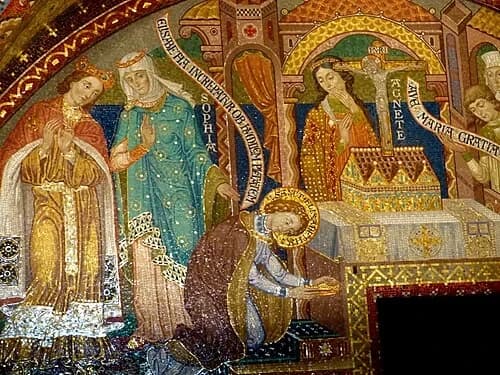
Mosaics of Charity
Within the Elisabeth Room, the mosaics focus on specific scenes from the life of Saint Elisabeth, particularly her acts of mercy. These artworks are created in a 'Neo-Byzantine' style, which is characterized by the extensive use of gold backgrounds and figures that appear somewhat stiff and reverent. This style was chosen to evoke an ancient, holy atmosphere. One prominent scene depicts Elisabeth leaving the safety of the castle to feed the hungry and care for the sick. Legend says she would carry bread hidden in her cloak, which famously turned into roses when her husband questioned her. Eventually, she renounced her royal status and wealth entirely to serve the marginalized, a move that led to her canonization shortly after her death. The figures in these mosaics are rendered with great care, using tiny glass tesserae to build up colors and textures. The heavy use of gold leaf within the glass pieces ensures that the room feels luminous even in low light. These scenes were intended to remind visitors of Elisabeth’s self-sacrifice and her enduring influence on Christian charity, presented in a style that emphasizes her divine calling and royal heritage.
The Minstrels' Hall (Sängersaal)
The legendary site of the Minstrels' Contest, featuring Romantic-era frescoes by Moritz von Schwind.
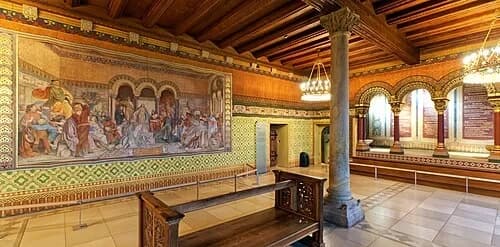
The Minstrels' Hall
The Minstrels' Hall was meticulously designed by 19th-century restorers to feel like a stage where the legends of the past could come alive. One of the most striking features is the heavy, coffered wooden ceiling, which adds a sense of immense weight and age to the room. Along the sides, you can see red-pillared arcades that mirror the Romanesque windows on the palace exterior, creating a harmonious link between the inside and outside of the building. This room was profoundly influential in the world of music and culture; after visiting Wartburg, the composer Richard Wagner was so moved by the atmosphere and the legend of the minstrels that he used this space as the inspiration for the setting of his famous opera, 'Tannhäuser.' The hall is intended to evoke the high courtly culture of the 13th century, even though its current appearance is a product of the 1800s. The combination of the dark wood, the colorful pillars, and the large-scale frescoes creates an immersive environment that transports visitors back to an idealized vision of the Middle Ages. It remains a central part of the castle's cultural identity, hosting concerts and events that continue its long tradition as a place of music.
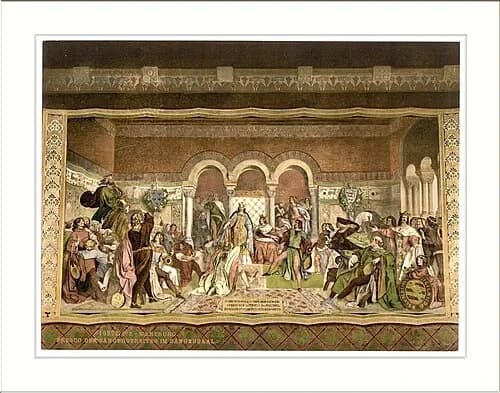
The Minstrels' Contest Fresco
This detailed fresco illustrates the legend of the Sängerkrieg, or Minstrels' Contest, which supposedly took place at Wartburg in 1206. According to the story, the most famous poets and singers of the age, including Walther von der Vogelweide, gathered here to compete in a battle of wits and musical skill. The stakes were incredibly high; tradition holds that the loser of the contest was to face execution. This specific artwork was painted in the 19th century during the Romantic period, an era that was deeply fascinated by medieval German legends and courtly traditions. The fresco captures the dramatic tension of the event, with the Landgrave and his court looking on as the minstrels perform. While historians debate the factual accuracy of the contest, its cultural impact was enormous, eventually inspiring Richard Wagner’s opera, 'Tannhäuser.' The painting uses rich colors and detailed costumes to bring the medieval scene to life for a modern audience. It reflects the 19th-century desire to visualize the castle's storied past, blending historical research with artistic imagination to create a centerpiece for the palace’s ceremonial halls.
The Lucas Cranach Gallery
Located within the museum, this collection features masterpieces by the court painter Lucas Cranach the Elder.
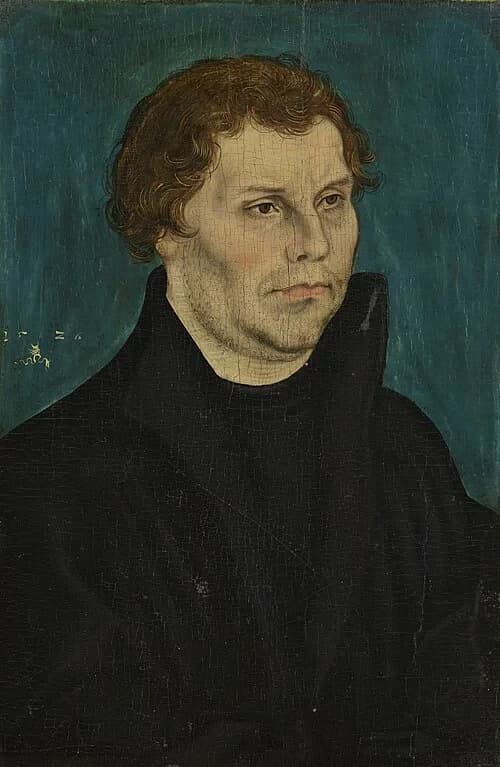
Portrait of Martin Luther
Lucas Cranach the Elder · 1526 · panel, oil paint
This portrait of Martin Luther, dating from 1526, was produced by the workshop of Lucas Cranach the Elder, a close friend of the Reformer. By this time, Luther had been away from his secret exile at Wartburg for several years and was a well-known public figure. The portrait became the definitive image of Luther, widely reproduced to spread the face of the Reformation. Notice his firm, resolute gaze and the simple black clothing he wears. This attire was a deliberate choice, signaling his total break from the elaborate and costly vestments of the Catholic Church in favor of a more modest, academic appearance. The Cranach workshop played a crucial role in the Reformation by using art as a tool for communication, creating standardized portraits of key figures that could be easily recognized by the public. The somber background and clear focus on Luther’s face emphasize his role as a scholar and a man of conviction. This painting captures him not as the hidden 'Junker Jörg,' but as the established leader of a movement that was reshaping the religious and political landscape of Europe.
The Ramparts and Schanze
A walk along the fortifications providing panoramic views of the Thuringian Forest and Eisenach.
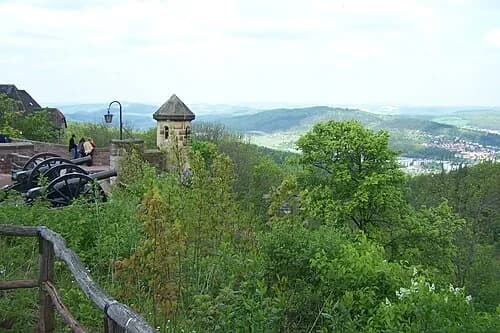
The Artillery Bastion
The tour concludes on the ramparts at the Artillery Bastion, where the castle's military past is still visible. The cannons placed here were part of the 'Schanze,' or defensive earthworks, designed to protect the fortress from attackers. From this high vantage point, you can look out over the dense green canopy of the Thuringian Forest and see the town of Eisenach situated in the valley below. This location illustrates why the spot was chosen nearly a millennium ago; the clear sightlines made it almost impossible for an enemy to approach undetected. As you stand by the stone walls, reflect on the incredible evolution of this site. It began as a rugged, defensive stronghold for medieval Landgraves, transformed into a secret spiritual refuge for Martin Luther, and finally became a restored national monument that draws visitors from around the world. Wartburg has transitioned from a place of exclusion and defense to one of inclusion and historical education. The views from these ramparts serve as a final reminder of the castle's isolation and its enduring prominence as a landmark that has witnessed and shaped the turning points of German history.
Want to hear the rest?
Download the Stanza app to unlock all 15 stops and full GPS-guided navigation.
Frequently Asked Questions
How long does the Wartburg audio tour take?
The Wartburg audio guide includes 15 narrated stops. Most visitors spend 45 minutes to 1.5 hours exploring the complete tour, though you can listen at your own pace and skip or revisit any stop.
Is the Wartburg audio guide available in my language?
Stanza supports 15 languages: English, Spanish, French, German, Italian, Portuguese, Russian, Japanese, Chinese, Korean, Arabic, Hindi, Polish, Dutch, Hebrew. Check the guide in the app to confirm the languages currently available for this tour.
Can I use the audio guide offline at Wartburg?
Yes! Download the complete Wartburg tour — including all audio, maps, and images — before your visit. The Stanza app works completely offline, so you don't need WiFi or mobile data at the venue.
How much does the Wartburg audio guide cost?
The Stanza app is free to download. The current listed price for the Wartburg audio guide is $3.99; app-store region and currency may affect the final price.
How do I use the Stanza audio guide at Wartburg?
Download the free Stanza app, search for "Wartburg", and download the tour. When you arrive at the venue, the app uses GPS to detect your location and automatically plays the relevant narration as you move between points of interest — completely hands-free.
What makes the Stanza audio guide different from other Wartburg tours?
Stanza offers GPS-triggered narration that plays automatically as you walk through Wartburg — no need to manually select stops. The tour is available in 15 languages, works fully offline, and includes 15 expertly narrated stops with images and historical context.
What other audio guides are available near Wartburg?
Stanza offers multiple audio guides in Eisenach, Germany and nearby areas. After downloading the app, browse the map to discover all available tours near Wartburg. Each guide can be downloaded for offline use.