Stanza · Audio guide
Hildesheimer Dom Audio Guide
A place to remember. A story to take with you.
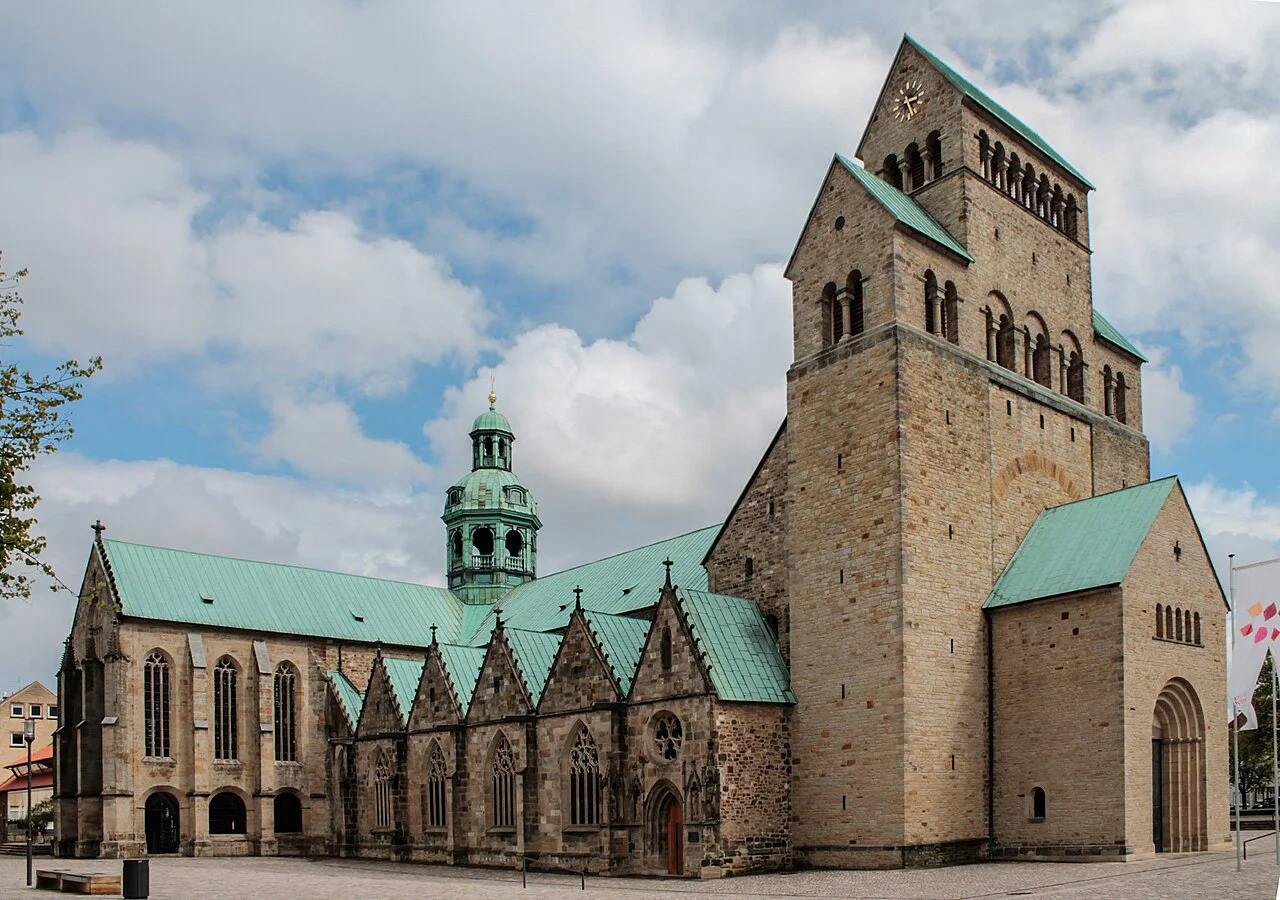
Hildesheim Cathedral is a medieval Roman Catholic cathedral located in the city centre of Hildesheim. It has been on the UNESCO World Cultural Heritage list since 1985 due to its unique art and Romanesque…
Download Stanza, then search for “Hildesheimer Dom”.
About the tour
One guide. Your kind of visit.
Hildesheim Cathedral is a medieval Roman Catholic cathedral located in the city centre of Hildesheim. It has been on the UNESCO World Cultural Heritage list since 1985 due to its unique art and Romanesque architecture.
Ready when you are.
- 01Get the free Stanza app.
iOS & Android
- 02Find your guide.
“Hildesheimer Dom”
- 03Download before you go.
Works offline
Audio guide / 13 narrated stops
Inside the guide
Get to know a few of the stories before you go. Open a stop to read more.
01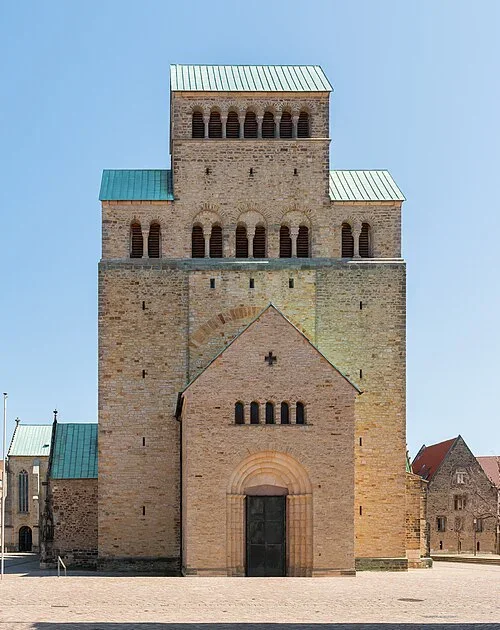 Domhof Forecourt and Saxon Westwork
The Saxon Westwork of St Mary's Cathedral
Welcome to Hildesheim Cathedral, the great Catholic church at the heart of this old Saxon city. It is dedicated to the Assumption of Mary and serves as the seat of the Diocese of Hildesheim. Together with St Michael's Church nearby, it has been on the UNESCO World Heritage list since 1985. The massive west facade belongs to a Saxon tradition called a westwork, a fortified entrance block with rooms above. Bishop Altfrid raised the first cathedral here in 872, a cruciform basilica with just such a westwork at its west end. But the stone in front of you is not all medieval. In the Second World War the cathedral was almost entirely destroyed; only the westwork and the outer walls survived, and the church was rebuilt in the 1950s. The builders chose a simplified early Romanesque form, taking the westwork of Minden Cathedral as their model, a church that had once followed Hildesheim's example. The upper storeys and side towers added in the nineteenth century were deliberately omitted. The whole building runs some eighty metres from end to end.
Photo: Tournasol7 · CC BY-SA 4.0
02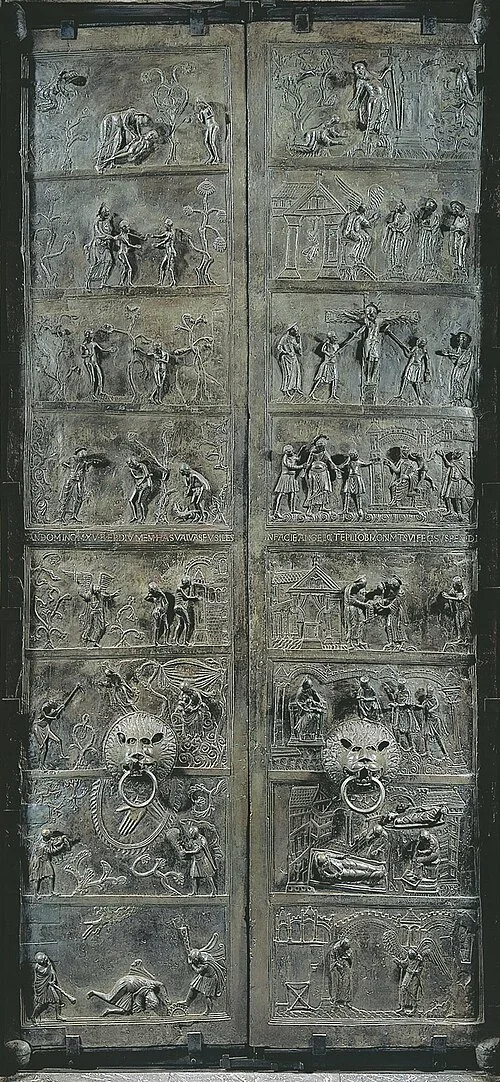 Western Portal and Bernward Doors
The Bernward Doors of 1015
The bronze doors at the west entrance are among the most famous works of the Middle Ages. They were made in 1015 for Bishop Bernward, the great artistic patron of the Ottonian diocese. Each leaf was cast as a single bronze panel, an extraordinary technical feat for the early eleventh century. On the left leaf, scenes from the Book of Genesis run downward. On the right, the life of Christ climbs upward. The heavy lion-head knockers in the middle of each leaf have greeted visitors for centuries. During the great renovation that ended in 2014, the doors were remounted facing outwards behind a western antechamber, just as Bernward had intended.
Bischöfliche Pressestelle Hildesheim (bph) · Attribution
03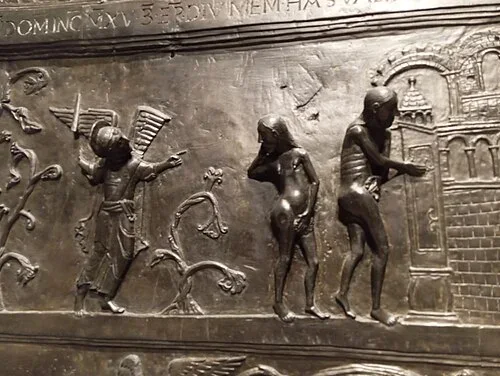 Western Portal and Bernward Doors
The Expulsion from Paradise - Reading the Doors
A close look at one panel shows how the whole door works. The scene here is the Expulsion from Paradise. An angel with a raised sword drives Adam and Eve out of the garden, and the pair moves toward the towers and walls of the world beyond. Down the left leaf runs the fall of humanity, and up the right climbs redemption. Scenes of the Fall answer scenes of Redemption, panel for panel. Medieval worshippers read the doors the way a book is read, one pair at a time.
Listen in the appPhoto: Moleskine · CC BY 4.0
04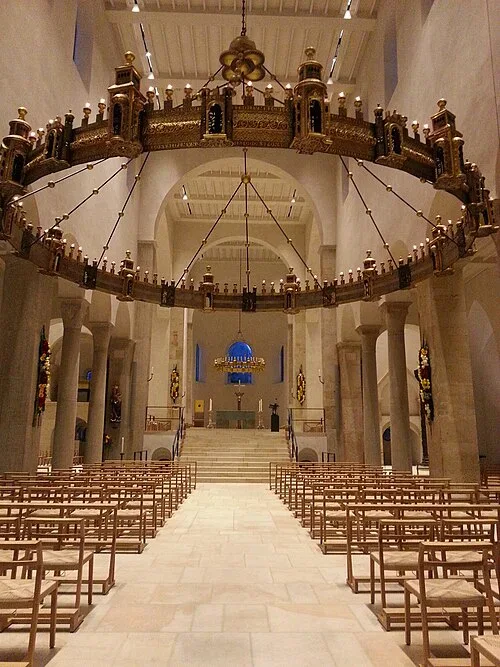 Central Nave and Hezilo Chandelier
The Nave and the Hezilo Chandelier
In 1046 fire swept through the cathedral. Bishop Azelin planned to abandon the burnt site and raise a larger church further to the west. His successor, Hezilo, gave up that plan. He built on Altfrid's old foundations, working the surviving walls into the new building. That decision fixed the Romanesque basilica shape that still defines the church. Overhead hangs the great Hezilo chandelier, a gilded ring of towers and candle mounts. It images the Heavenly Jerusalem, the city of light at the end of the pilgrim's road. Only four notable Romanesque wheel chandeliers survive anywhere, and this is one of them. Along the walls, the arcade alternates columns and square piers, a hallmark of Ottonian building in Old Saxony.
Listen in the appPhoto: Höweling · CC BY-SA 3.0 de
05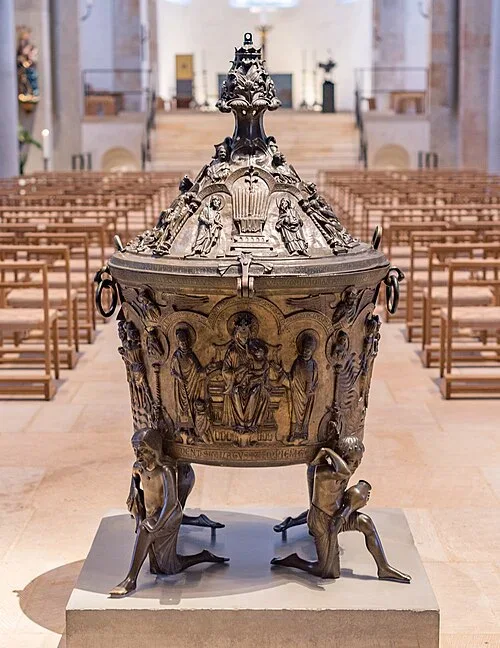 Central Nave and Hezilo Chandelier
The Bronze Baptismal Font of 1225
Standing in the central aisle is the bronze baptismal font, cast in 1225. Its bowl is ringed with reliefs, among them the Baptism of Christ in the Jordan. Kneeling figures bear the whole vessel on their shoulders. A font like this exists for a single rite, baptism, the entry of a new Christian into the church. Nearly eight hundred years after it was made, the font still does that work.
Listen in the appTilman2007 (cropped by Rabanus Flavus) · CC BY-SA 4.0
06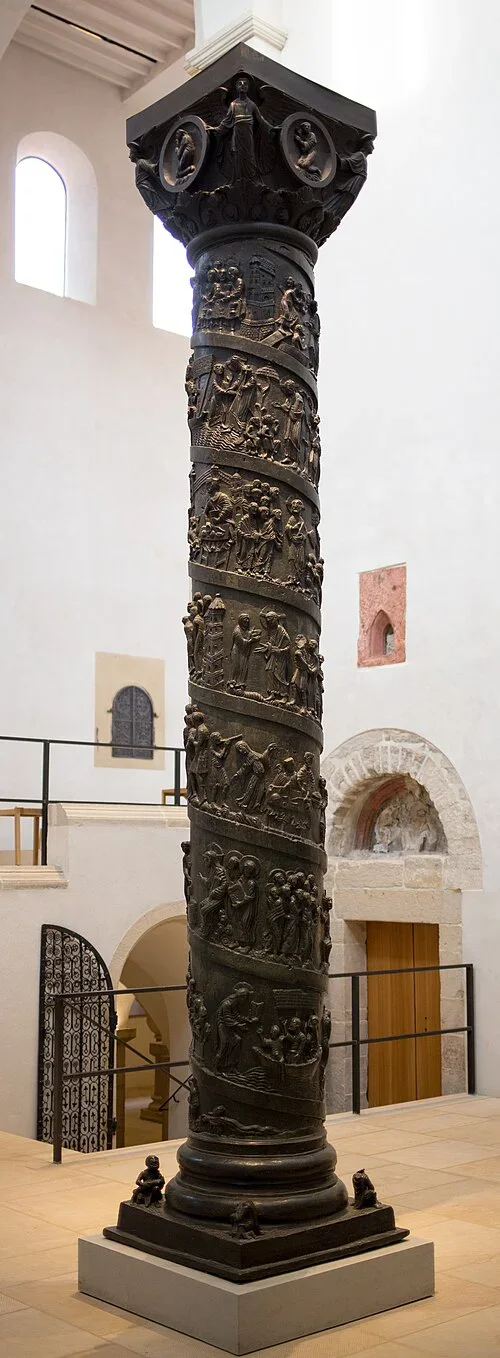 South Transept and Bernward Column
The Bernward Column (Christ's Column)
The second of Bernward's great bronzes stands in the south transept. This column was cast around 1020, its shaft wound with scenes from the life of Christ. The model was imperial Rome, where triumphal columns told the story of an emperor's campaigns. Bernward's column borrows that language of victory, but its triumphant hero is Christ. The column was first set up at St Michael's, the church where Bernward was buried. When the cathedral was being restored, it went back there for a time. In August 2014 it returned to the south transept.
Listen in the appPhoto: GodeNehler · CC BY-SA 4.0
07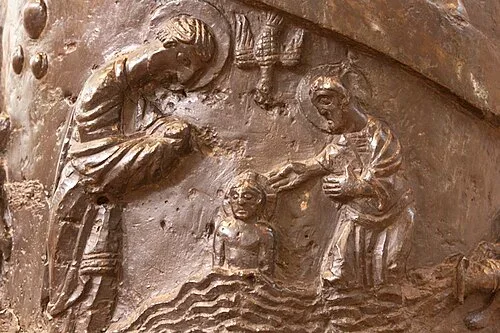 South Transept and Bernward Column
The Baptism of Christ - Reading the Column
The reliefs spiral up the shaft in a single continuous band. Each scene flows into the next, so the story of Christ's public life climbs the column like a road. Here John the Baptist stands in the river Jordan, pouring water over Christ. The dove of the Holy Spirit hovers above the two figures. The reading ends at the top, at the capital, where images of Christ take their place in triumph. A viewer once circled the column, scene by scene, following the story upward.
Listen in the appPhoto: Hildesia · CC BY-SA 3.0
08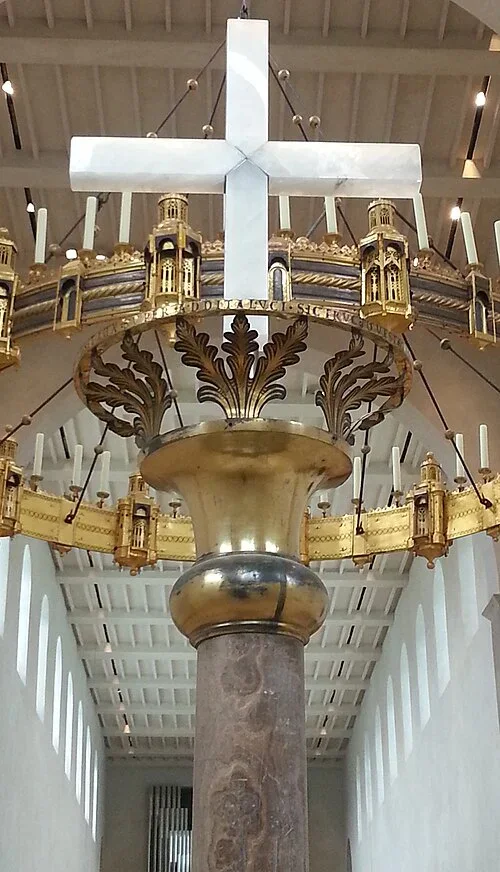 High Choir and Apse Column
High Choir: the Irmin Column and the Second Chandelier
In the apse of the high choir stands a column crowned by a cross, and with it one of the great puzzles of the cathedral. Legend says the shaft of the column was made from the core of the Irminsul, the ancient Saxon pillar said to have been destroyed under Charlemagne. Scholars have argued over that claim for a long time, and it remains a legend. Whether any part of the old pillar truly survives here, nobody can say. Above it hangs the second great wheel chandelier of the cathedral, the older companion of the one in the nave. The renovation completed in 2014 restored it to this place in the high choir.
Listen in the appSilvia Höweling · CC BY-SA 3.0
09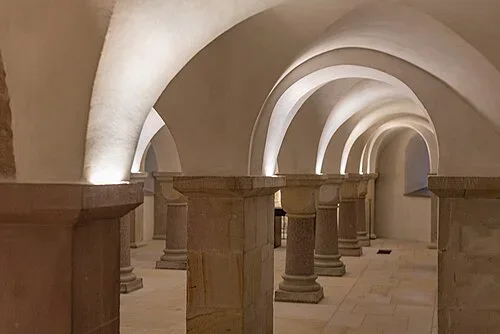 Subterranean Romanesque Crypt
The Romanesque Crypt
Below the choir, the crypt preserves the oldest stonework in the church. When the cathedral was renovated, excavators dug beneath the floor and found the foundations of the very first chapel of St Mary. It was tiny, six metres by six, built of sandstone with walls of extraordinary thickness. A small apse faced east, and the remains of the first altar still lay in place. The chapel dates to the ninth century, the first decades of the young diocese.
Listen in the appPhoto: Tilman2007 · CC BY-SA 4.0
10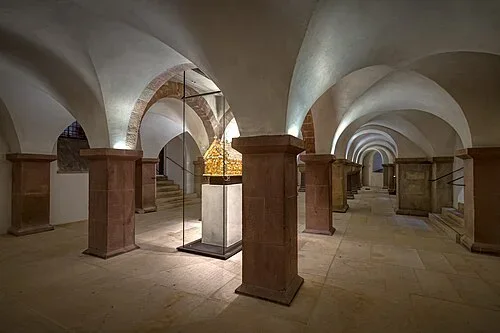 Subterranean Romanesque Crypt
The Shrine of Saint Godehard
A gilded shrine rests in a glass case among the vaulted bays, made around 1140 for the relics of Saint Godehard. A crypt like this existed to hold the remains of saints, the precious treasures around which the diocese's devotion gathered. Pilgrims and bishops came down these steps to pray at the saints' side. A second treasure rests in the north niche of the eastern transept wall, the shrine of Saint Epiphanius of Pavia, one of the cathedral's patron saints, from the first half of the twelfth century.
Listen in the appPhoto: GZagatta · CC BY-SA 4.0
- 11
The Thousand-Year Rosebush
The rose of the founding legend, burned in 1945 and blooming again from the stump.
- 12
St Anne's Chapel and the Cathedral Reborn
The Gothic chapel that survived the raid, and the cathedral that had to be consecrated anew.
- 13
The Inkpot Madonna
A small crowned Mary with an inkpot in hand, and a quiet end to a thousand-year story.
Hildesheimer Dom
Frequently asked questions
How much does the guide cost?
Free app download. Listed guide price: $0.99. Guide price shown in the app. Audio guide only. Venue admission is separate.
Can I listen without internet?
Yes. Download the guide’s audio, images, and maps in the app before your visit. Your downloaded content is then available offline.
Can I listen in my language?
This audio guide is available in 15 languages, including English.
Do I need to follow a schedule?
No. This is a self-guided experience. Choose your stops, pause whenever you like, and return to a story at your own pace.
At your own pace
Explore Hildesheimer Dom.
Download Stanza, then search for “Hildesheimer Dom”.
Free app download · Guide price shown in the app
Keep exploring
Nearby audio guides
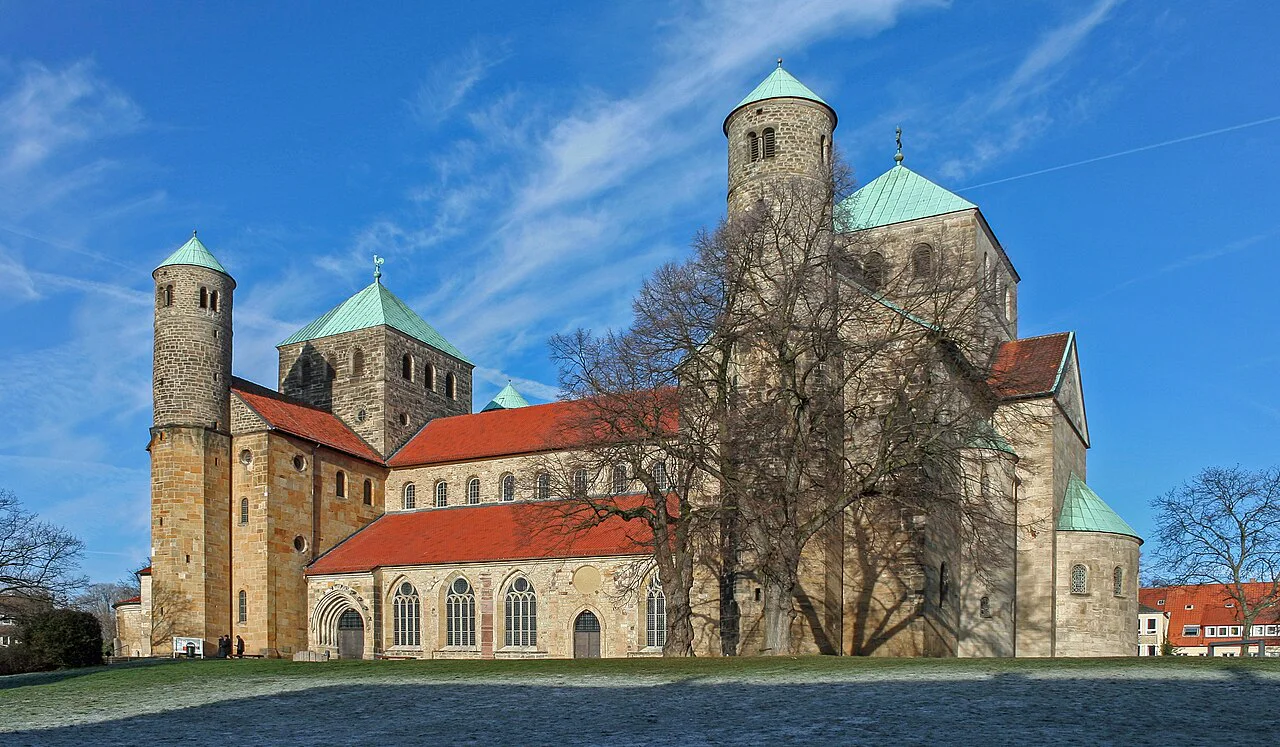
Hildesheim · 1 km
Michaeliskirche
Content & sources
Heinz-Josef Lücking · CC BY-SA 3.0 de
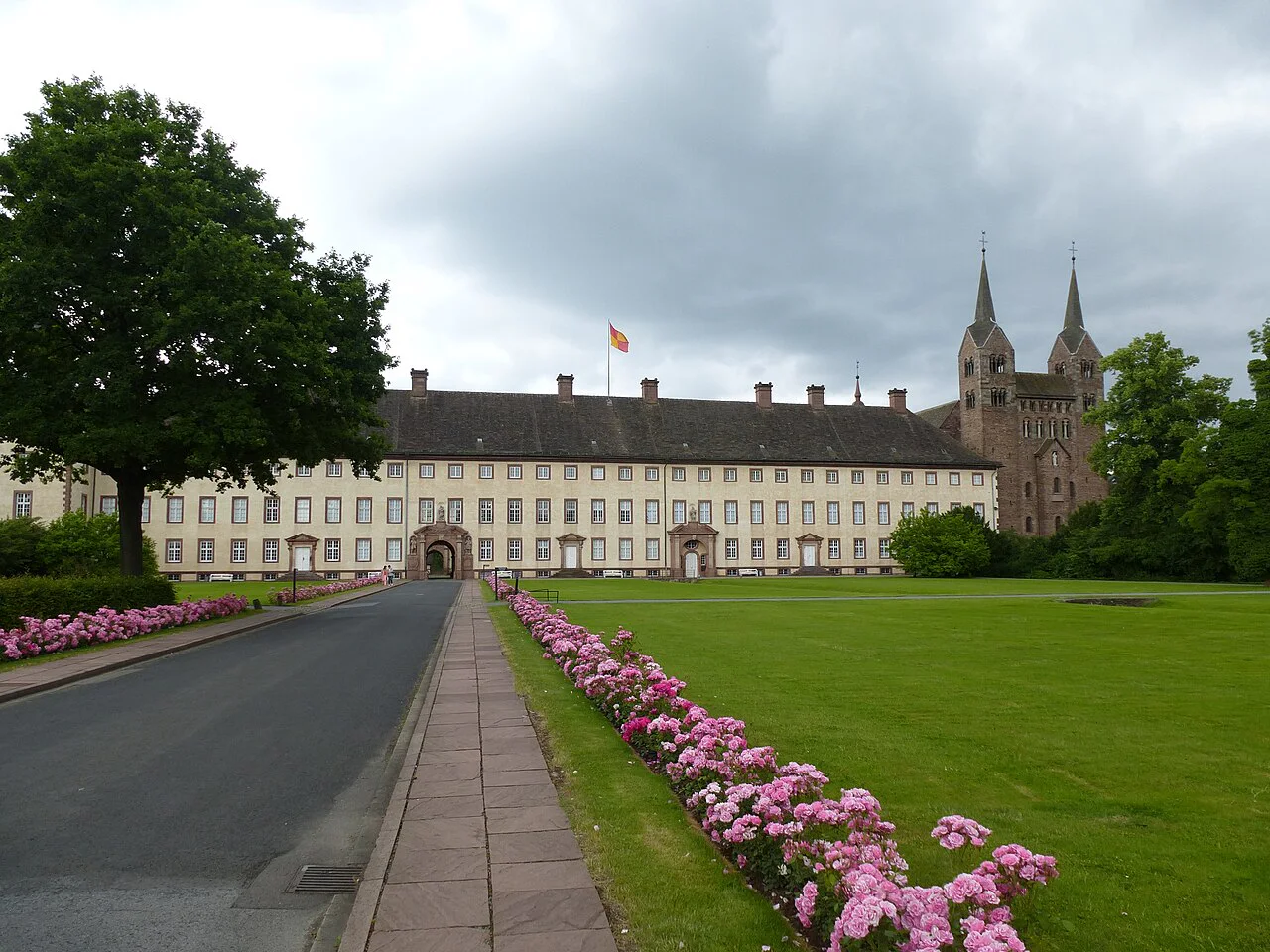
Höxter · 55 km
Corvey
Content & sources
Photo: Aeggy · CC BY 3.0
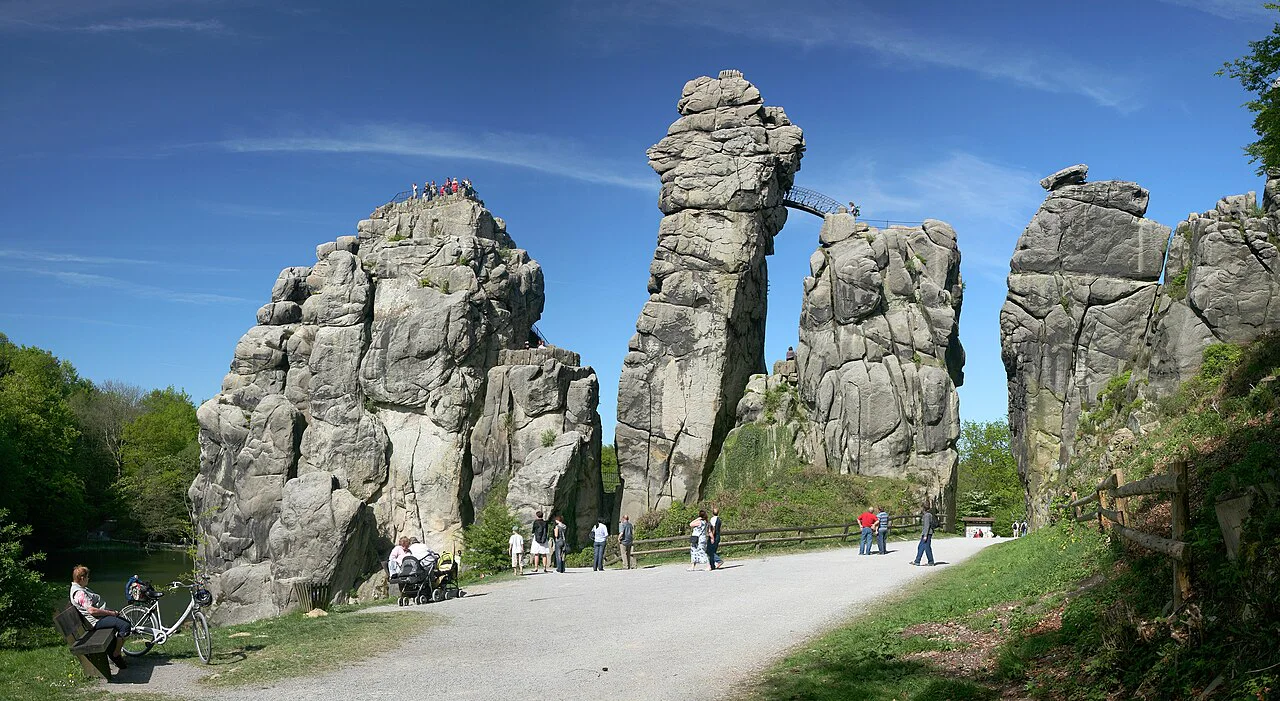
Horn-Bad Meinberg · 77 km
Externsteine
Content & sources
Daniel Schwen · CC BY-SA 2.5
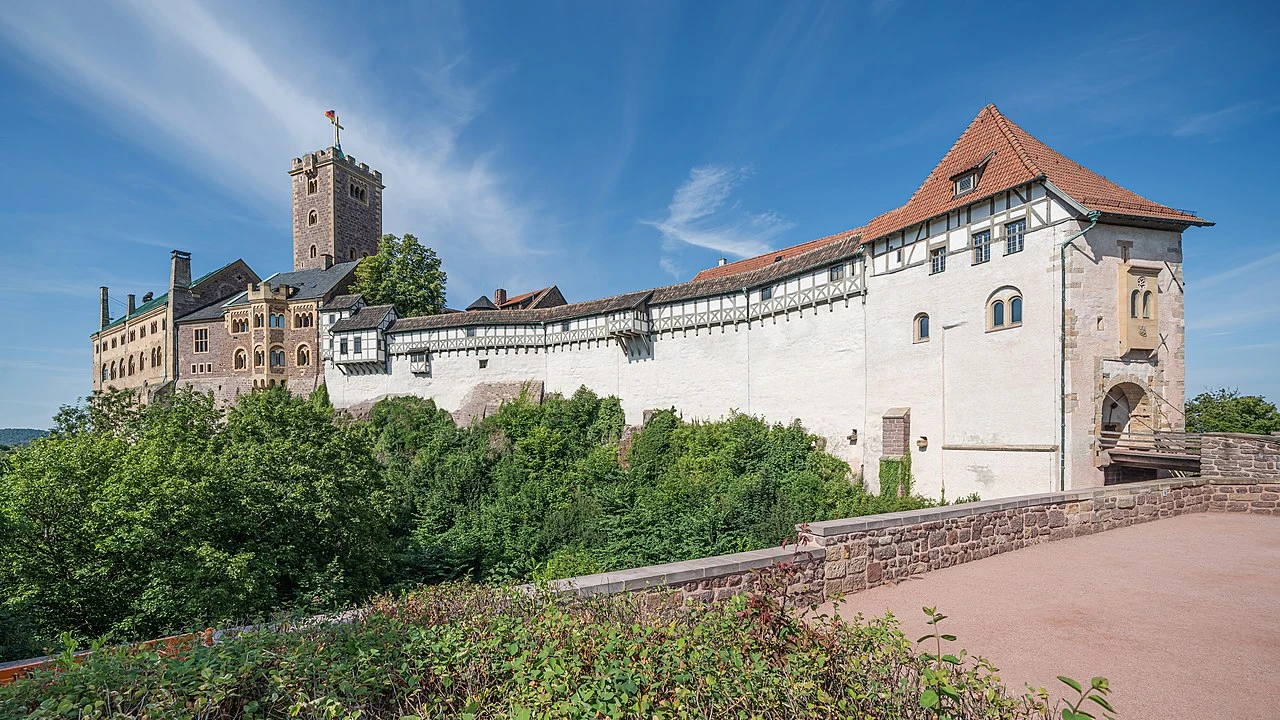
Eisenach · 134 km
Wartburg
Content & sources
Photo: A.Savin · FAL