Stanza · Audio guide
Vat Phou Audio Guide
A place to remember. A story to take with you.
Vat Phou is a ruined Khmer-Hindu temple complex located in southern Laos. The site features megalithic stone structures and pre-Angkor brick buildings that date back to as early as the second century BCE.
Download Stanza, then search for “Vat Phou”.
About the tour
One guide. Your kind of visit.
Vat Phou is a ruined Khmer-Hindu temple complex located in southern Laos. The site features megalithic stone structures and pre-Angkor brick buildings that date back to as early as the second century BCE.
Ready when you are.
- 01Get the free Stanza app.
iOS & Android
- 02Find your guide.
“Vat Phou”
- 03Download before you go.
Works offline
Audio guide / 14 narrated stops
Inside the guide
Get to know a few of the stories before you go. Open a stop to read more.
01 The Lower Barays and Processional Causeway
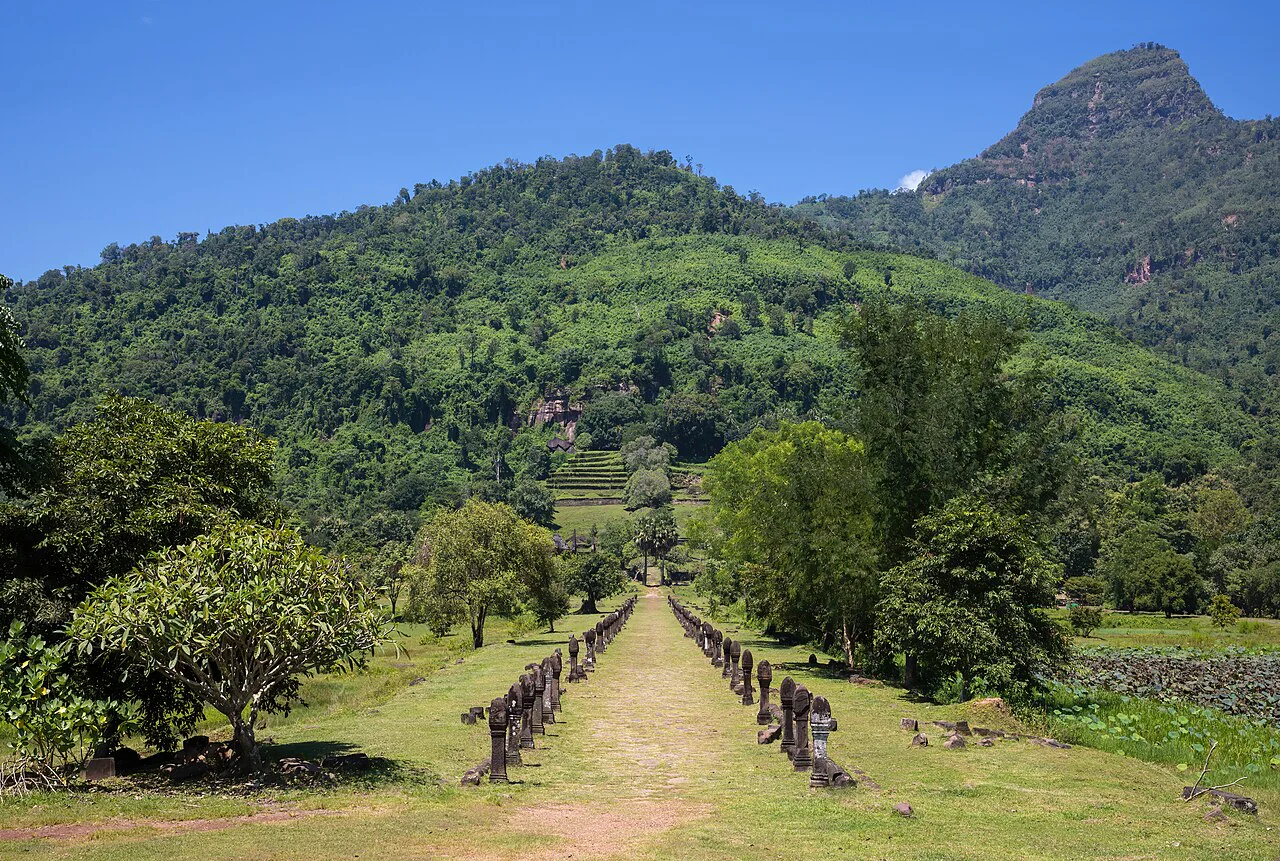
Mount Phou Khao Across the Mekong
This tour moves through the ruins of Vat Phou, a Khmer-Hindu temple complex in Champasak Province, in southern Laos. The site has been a UNESCO World Heritage Site since 2001. The mountain nearby was called Lingaparvata, which roughly means lingam mountain. Later it came to be called Phou Khao. Its summit has a natural rock shaped like a lingam, the stone symbol of the god Shiva. Because of that rock, people regarded the mountain as Shiva's home. The Mekong runs close by. People regarded the river as the ocean, or as the Ganges, the great river of India.
Michael Gunther · CC BY-SA 4.0
02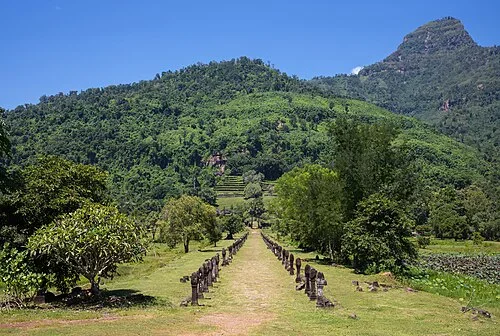 The Lower Barays and Processional Causeway
The Stone-Posted Causeway Toward the Hill
Two rows of stone posts line the causeway here, and these boundary posts have been restored. The story of this ground goes back much further than the posts. The earliest known inscription found at this site names a king called Devanika. It says he had won countless victories and came from far away to found a kingdom. In this area he established a tīrtha, which means a holy crossing or a place of pilgrimage. He also offered thousands of cattle to support a temple foundation. Not far off, on the Mekong bank, stood a city called Shrestapura, directly east of the mountain. By the late fifth century it was the capital of a kingdom. Old texts and inscriptions link that kingdom with Chenla and with Champa. A temple was built on the mountain around this time.
Photo: Basile Morin · CC BY-SA 4.0
03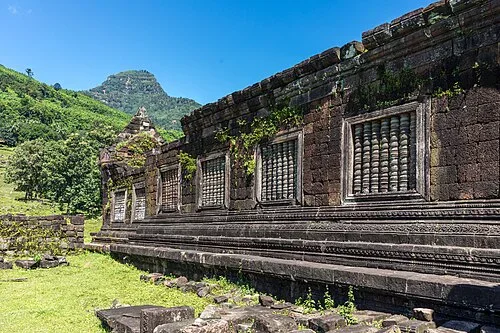 The Northern and Southern Palaces
The Northern Palace Facade
A long, low wall of carved stone forms the facade of the northern palace. A row of windows runs along it, and each window is fitted with a carved stone grille. The building rests on a stepped base, and plants have taken root on the upper courses at one corner. In 2009 a team from the Archaeological Survey of India turned its attention to this northern quadrangle. It was led by R S Jamwal. The team studied the foundations, the drainage problems, and the upper structure. They also recorded and surveyed the building. A stonemason restored the southern palace in 2010.
Listen in the appPhoto: Basile Morin · CC BY-SA 4.0
04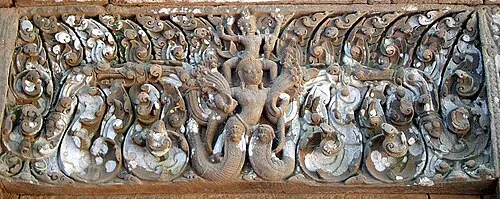 The Northern and Southern Palaces
Vishnu on Garuda
In Hindu myth, Garuda is a great bird, and he is the mount, or vehicle, that the god Vishnu rides. This carved band is said to show Vishnu on Garuda. Scrolls and leaves curl across the whole band, and a central figure rises within a carved frame. Smaller forms are packed in around it. The carvers filled nearly every part of the stone, so little of the band is left bare.
Listen in the appMichael Gunther · CC BY-SA 4.0
05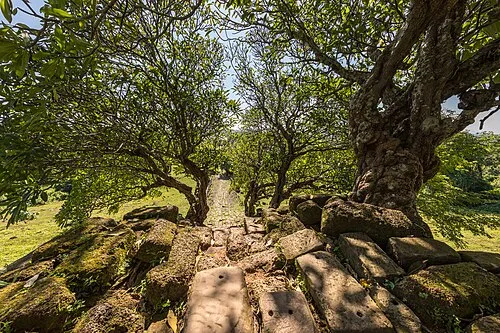 The Frangipani Terraces and Middle Stairways
Plumeria-Lined Stone Stairway
Steep stone steps climb beneath a tunnel of leaning trees. These are plumeria, also called frangipani, and their twisted trunks lean over the steps. Their branches meet overhead, making a shaded passage. The steps are irregular slabs and blocks, with low stone edges on either side. Moss and small plants grow in the gaps between the stones.
Listen in the appPhoto: Basile Morin · CC BY-SA 4.0
06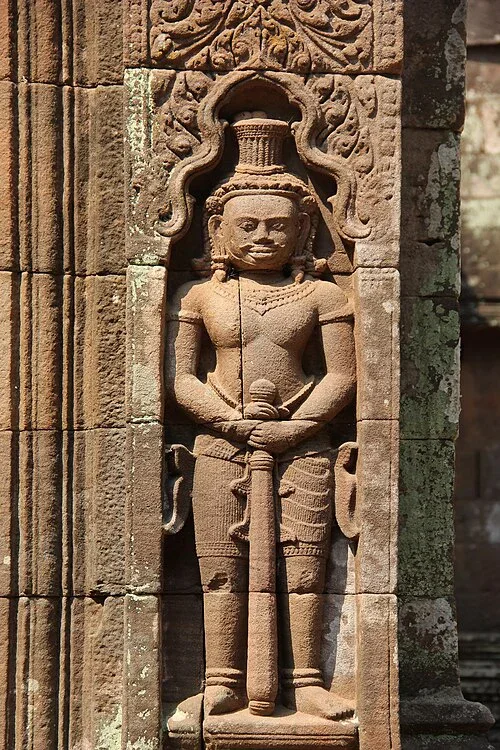 The Frangipani Terraces and Middle Stairways
Standing Guardian in a Carved Niche
The name dvarapala means doorkeeper, and Khmer temples often placed such guardians beside their doors. This figure stands in an arched niche on a stone pillar. It wears a tall crown, a short garment and a necklace. Both its hands grip a long club held upright in front of the body. The stone around the figure is weathered, but the crown and the club are still clear.
Listen in the appMattana · CC BY-SA 3.0
07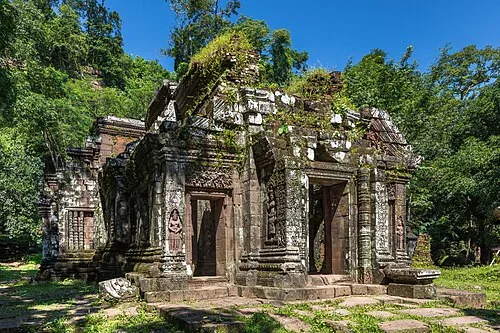 The Upper Sanctuary
Ruined Stone Shrine
This ruined shrine is the temple of Nandin, restored by an Italian mission in 2006. Nandin is the bull who serves the god Shiva. Another effort is led by the Global Heritage Fund, working with the Lerici Institute in Italy and the Lao government. It provides emergency conservation for the temple structures. Its main focus is stabilising Nandin Hall and keeping that work going over the long term. The team also works with local communities on training and development.
Listen in the appPhoto: Basile Morin · CC BY-SA 4.0
08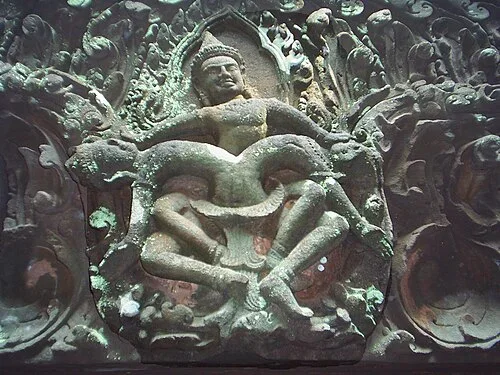 The Upper Sanctuary
Krishna Killing Kamsa
A crowned figure twists in a forceful pose inside a carved panel, called a pediment, set among dense scrolls and leaves. The carving is identified as Krishna killing the tyrant Kamsa, on the south side of the sanctuary. In Hindu tradition, Krishna is an avatar, or earthly form, of the god Vishnu. The weathered green stone makes the finer details hard to see.
Listen in the appNo machine-readable author provided. Markalexander100 assumed (based on copyright claims). · CC BY-SA 3.0
09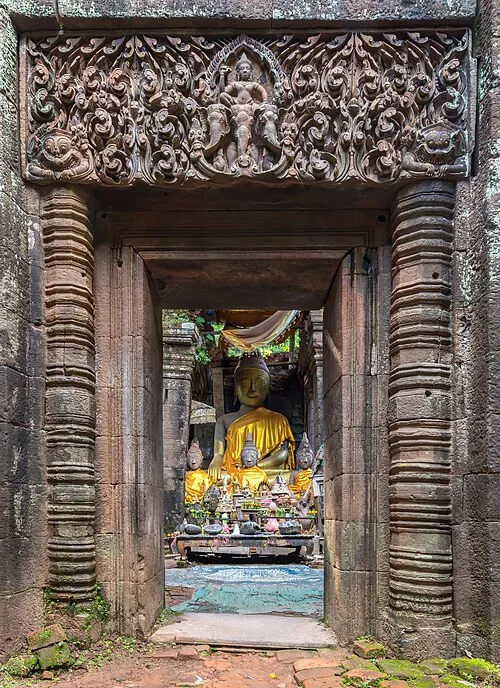 The Upper Sanctuary
Seated Buddha Framed by a Carved Doorway
People still leave offerings in front of this seated Buddha, framed by a carved doorway with ribbed columns. Gold-coloured cloth drapes the figure, and small images, bowls and flowers sit on the altar before it. Vat Phou is open to the public for religious activities and for tourist visits. A festival is held on the site each February. The site museum holds standing Buddhas in Gupta and post-Gupta style. The scholar Pierre-Yves Manguin groups them with comparable statues from Thailand and from Cham sites in central Vietnam. He places that shared style between the fifth century and the late seventh or early eighth century.
Listen in the appPhoto: Basile Morin · CC BY-SA 4.0
10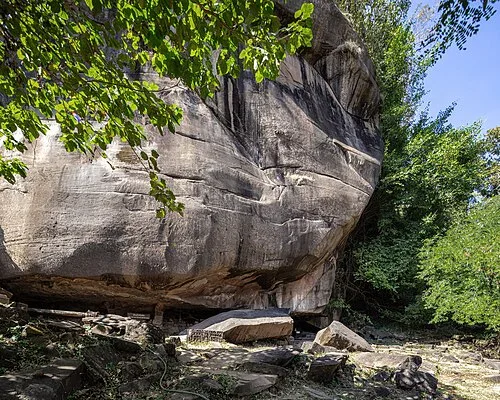 The Sacred Spring and Cliff Sanctuary
Cliff Overhang Above the Spring Site
The sanctuary here was centred on a spring. It also had an offering place for a tutelary spirit, a guardian spirit of the place. Both date back to pre-historic times. A huge grey overhang of rock leans out over a dark hollow, with stone blocks and rubble at its base. Later, a brick building put up in the seventh century became the focus for further building here.
Listen in the appThis Photo was taken by Supanut Arunoprayote. Feel free to use any of my images, but please mention me as the author and may send me a message. (สามารถใช้ภาพได้อิสระ แต่กรุณาใส่เครดิตผู้ถ่ายและอาจส่งข้อความบอกกล่าวด้วย) Please do not upload an updated image here without consultation with the Author. The author would like to make corrections only at his own source. This ensures that the changes are preserved.Please if you think that any changes should be required, please inform the author.Otherwise you can upload a new image with a new name. Please use one of the templates derivative or extract. · CC BY 4.0
- 11
Trimurti Relief Carved into the Rock
Three Hindu figures cut straight into a cliff, a sign that the rock itself carried sacred images.
- 12
The Crocodile Stone
A worn crocodile carved on a dark boulder, part of the earliest megalithic stone work at the site.
- 13
Elephant Relief with Offerings at Its Base
A carved elephant in the rock, with flowers and sticks laid at its foot.
- 14
View Over the Plain from the Hilltop
The whole complex laid out across the plain, with water, a long avenue and the ruins in one view.
Vat Phou
Frequently asked questions
How much does the guide cost?
Free app download. Listed guide price: $0.99. Guide price shown in the app. Audio guide only. Venue admission is separate.
Can I listen without internet?
Yes. Download the guide’s audio, images, and maps in the app before your visit. Your downloaded content is then available offline.
Can I listen in my language?
This audio guide is available in 15 languages, including English.
Do I need to follow a schedule?
No. This is a self-guided experience. Choose your stops, pause whenever you like, and return to a story at your own pace.
At your own pace
Explore Vat Phou.
Download Stanza, then search for “Vat Phou”.
Free app download · Guide price shown in the app
Keep exploring
Audio guides — Laos
Vientiane
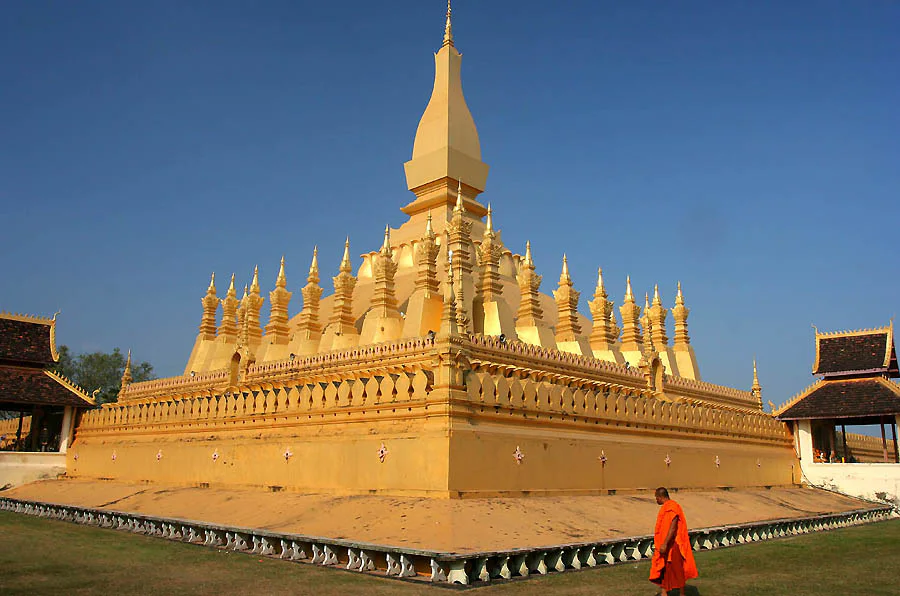
Pha That Luang
Content & sources
Jialiang Gao www.peace-on-earth.org · CC BY-SA 3.0
Phonsavan
Plain of Jars
Content & sources
Jakub Hałun · CC BY-SA 4.0