Stanza · Audio guide
Plain of Jars Audio Guide
A place to remember. A story to take with you.
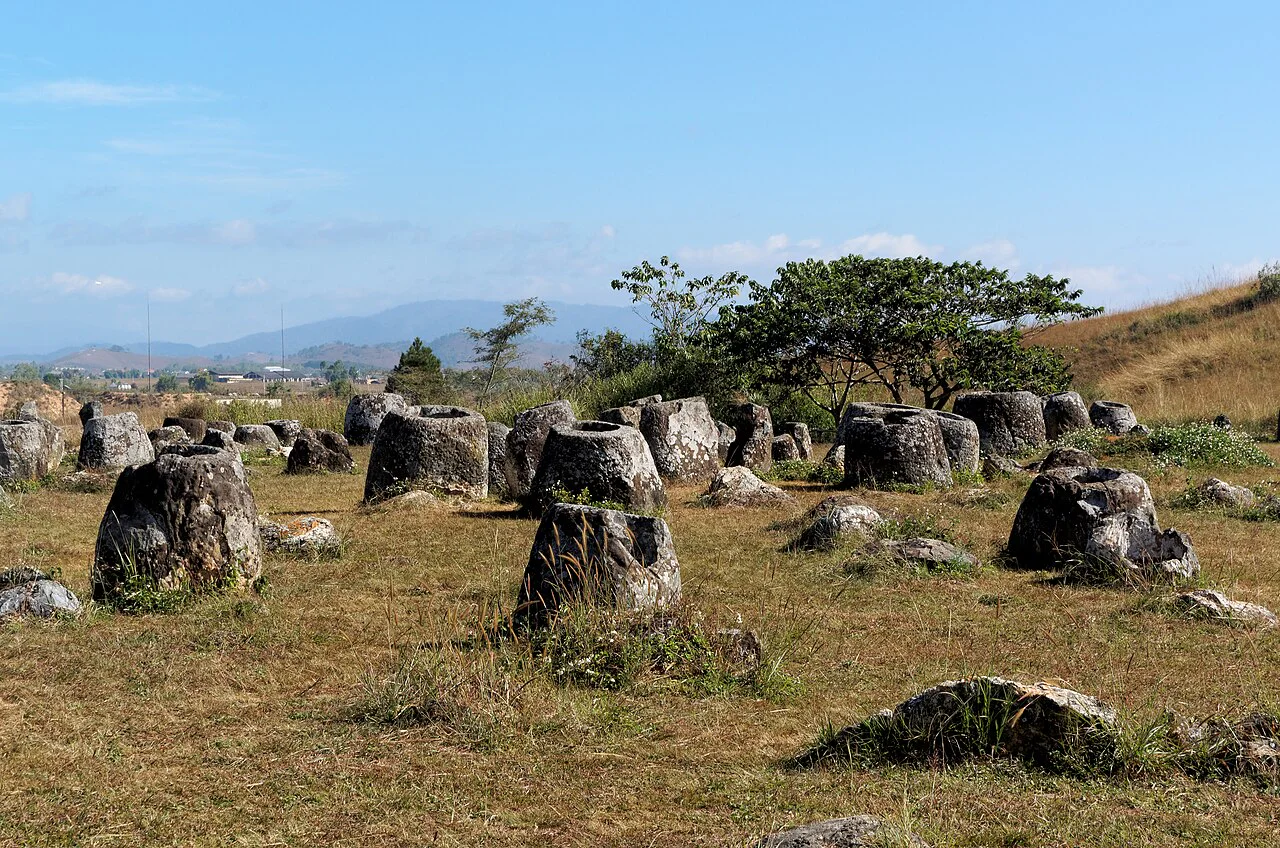
The Plain of Jars is a megalithic archaeological landscape in Laos. It consists of thousands of stone jars scattered around the upland valleys and the lower foothills of the central plain of the Xiangkhoang…
Download Stanza, then search for “Plain of Jars”.
About the tour
One guide. Your kind of visit.
The Plain of Jars is a megalithic archaeological landscape in Laos. It consists of thousands of stone jars scattered around the upland valleys and the lower foothills of the central plain of the Xiangkhoang Plateau.
Ready when you are.
- 01Get the free Stanza app.
iOS & Android
- 02Find your guide.
“Plain of Jars”
- 03Download before you go.
Works offline
Audio guide / 9 narrated stops
Inside the guide
Get to know a few of the stories before you go. Open a stop to read more.
01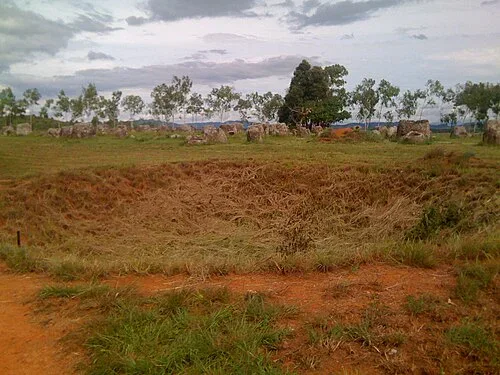 Arrival at the Scarred Landscape
Bomb Craters and the Cleared Path
Welcome to the Plain of Jars, on the Xiangkhoang Plateau in northern Laos. The grassy hollow in this view belongs to a scar the land still carries. Between May 1964 and the summer of 1969, American aircraft bombed this plateau heavily during what became known as the Secret War. Over the whole war, an estimated 270 million cluster bomblets fell on Laos, and around 80 million of them never exploded. Those buried explosives endangered local people and damaged jars, and they kept archaeologists away for decades. They are also why visitors keep to cleared paths. Between 2004 and 2005, the Mines Advisory Group cleared the most visited sites, working with UNESCO and with funding from New Zealand. More clearance in 2007 opened further jar sites. The stone jars scattered beyond these hollows are far older than any of this, and they are what the rest of this visit is about.
Matthew Summerton · CC BY-SA 3.0
02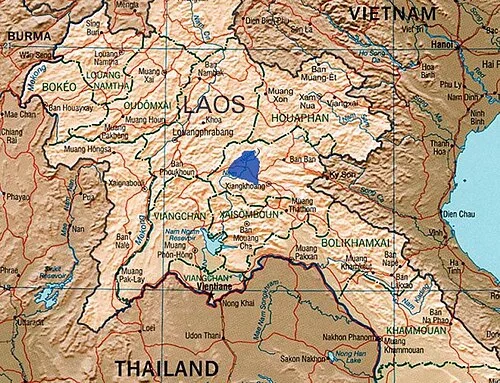 Arrival at the Scarred Landscape
The Plateau and Its Crossroads
The map explains why the jars ended up here. The Xiangkhoang Plateau sits at the northern end of the Annamite Range, the principal mountain chain of Indochina. That position offers relatively easy passage from the north and east down to the south and west. Laos has two principal iron ore deposits, and both lie in Xiangkhouang. One scholarly proposal links the jar sites to long-distance overland routes, connecting the Mekong basin with the Gulf of Tonkin. On that reading, the jars mark a network of villages along the way. Whatever drew people here, the sites share one habit: they occupy elevated ground with commanding views over the surrounding country.
Photo: Wind · Public domain
03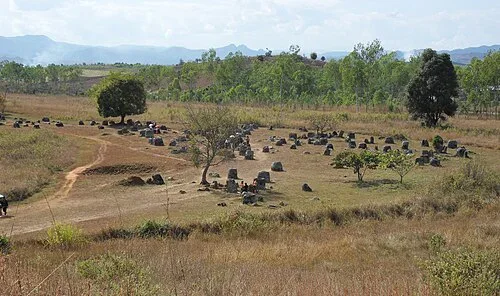 The Main Jar Field (Group A)
The Jar Field at Ban Ang
Thousands of stone jars lie scattered across these upland valleys and foothills, in clusters of one to several hundred. Researchers date their placement to between about 1240 and 660 BC, using light released from buried quartz grains to measure the time since the soil around them was last exposed. The jars of Site 1 were traced to a quarry about eight kilometres away, by reading the mineral grains in the stone itself. Other quarries, near Sites 2 and 3, hold half-carved jars still fixed in the bedrock. Some finished vessels weigh as much as fourteen tons, hauled across rugged terrain. Moving and carving them took coordinated labour and skilled craftspeople. The tools remain uncertain. Iron chisels are often assumed, but experiments have shown stone tools could shape the jars too.
Listen in the appPhoto: Chaoborus · CC BY-SA 3.0
04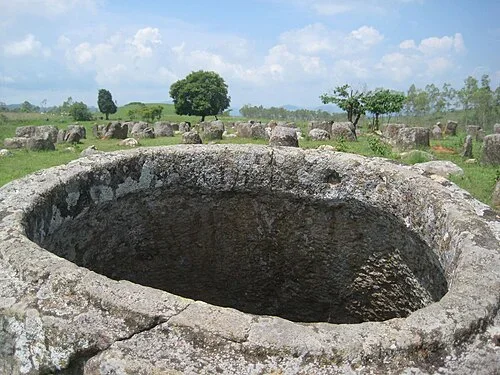 The Main Jar Field (Group A)
Inside the Urn
A jar opens like a great stone urn, and that is very likely what these were. Burnt teeth and bone fragments have been found inside the jars, while unburnt bones were buried in the ground around them. Burial goods turned up too, including glass and carnelian beads. In 2001, R. Engelhardt and P. Rogers proposed that the jars worked as vessels of transformation. In the royal funerals of Thailand, Cambodia and Laos, the body of the dead rests in an urn while the soul is believed to transform from the earthly world to the spiritual one. Cremation and a secondary burial follow. The jars may have served the same sequence. The strongest direct evidence comes from Site 75, where excavations recovered the remains of at least 37 people from a single jar. The burials date between 890 and 1160 CE, and the jar was used repeatedly over several generations.
Listen in the appPhoto: Mattun0211 · Public domain
05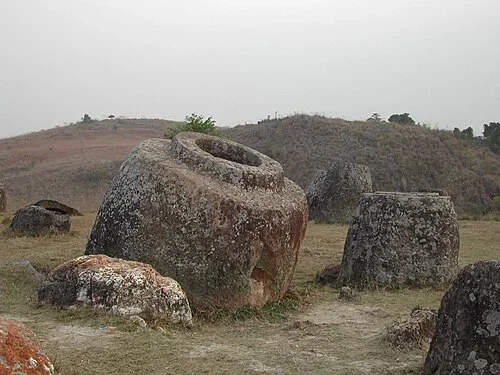 The King's Megalith
The Giant's Wine Jar
Local legend gives these jars a merrier purpose. It tells of giants who once lived on this plateau, ruled by a king called Khun Cheung, though the name changes from telling to telling. He fought a long battle against the evil king Chao Angka, and won. To celebrate, he had enormous vessels made to brew and store rice wine, known locally as lau hai — lau meaning alcohol, hai meaning jar. The largest jars went to the most important giants, and the biggest of all was kept for the king himself. Archaeology offers a quieter reading of the same idea. The largest and most elaborately crafted jars were probably reserved for the most important members of society. Either way, size marked rank.
Listen in the appChristopher Voitus · CC BY-SA 3.0
06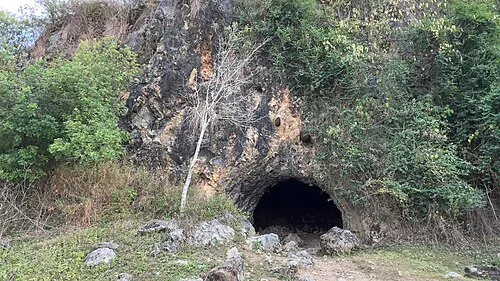 The Limestone Cave Crematorium
The Cave in the Hillside
The dark opening in this hillside is a natural limestone cave, its mouth turned to the northwest. Its story belongs to Madeleine Colani, a French researcher and the first scientist to study the Plain of Jars systematically. She documented twenty-one sites and gave each of them a name. In the early 1930s she excavated inside this cave and found burned bones and ash. That discovery led her to conclude that the whole landscape was a burial ground from the Iron Age. She published her findings in two volumes in 1935. Nearly a century later, her conclusion still underpins how the jars are understood.
Listen in the appStefan Fussan · CC BY 4.0
07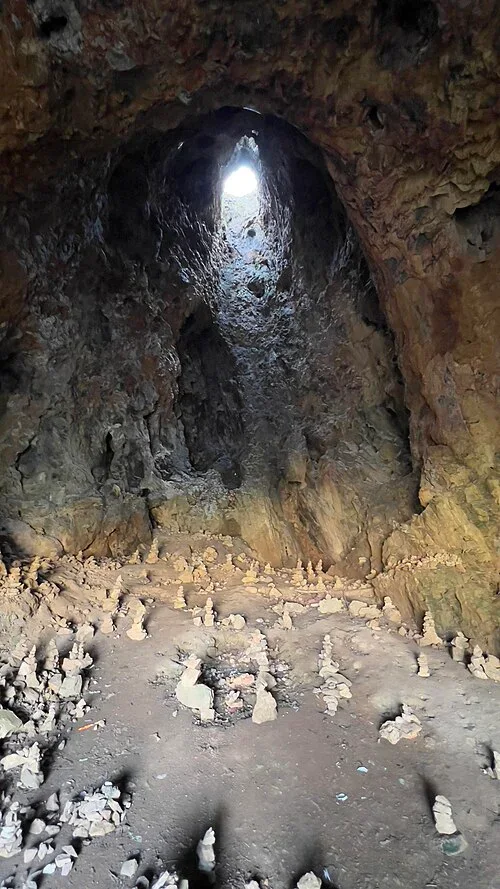 The Limestone Cave Crematorium
Chimneys of the Crematorium
Inside the cave, daylight falls through openings in the rock overhead. There are two of them, cut by human hands, and they are thought to be chimneys for a crematorium. Colani's excavation here found material supporting that theory. Across the plain, many of the human remains were cremated. The crematorium reading is the leading interpretation, though it is not settled beyond argument.
Listen in the appStefan Fussan · CC BY 4.0
08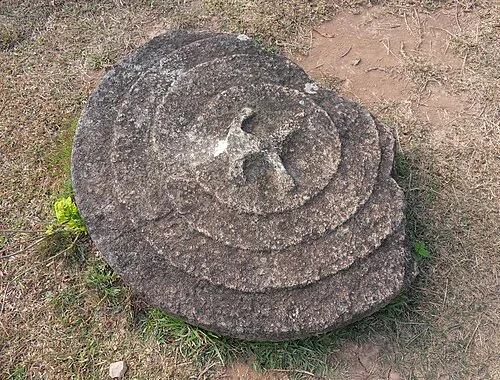 The Mystery of the Stone Discs
The Carved Disc
Flat stone discs like this one lie scattered near the jars, and for a long time people assumed they were lids. That assumption does not hold. None has ever been found on top of a jar, and none fits a jar's opening. Around two hundred discs are known. Many carry carvings: human figures with arms and legs spread wide, along with tigers, monkeys and other animals. One possibility is that they marked burials, placed on the ground over burial pits. To the north of Xiangkhouang, a Bronze Age network of standing stones marks elaborate burial pits in much the same way. What the discs meant to the people who carved them is still an open question.
Listen in the appPhoto: Chaoborus · CC BY-SA 3.0
09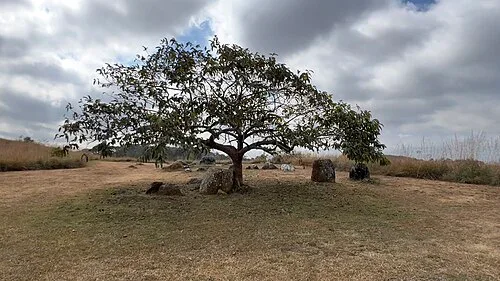 The Hillside Cluster (Group B)
A Monument Without a Name
Whoever raised these jars left no writing, no kingdom name, no chronicle of themselves. Their identity remains unknown, and the stone is the only testimony they left. Less than a tenth of the megaliths have been thoroughly investigated, because unexploded bombs still lie in the ground here. In 2019, the jar sites were inscribed as a UNESCO World Heritage Site, recognized for their cultural value. The Plain of Jars stands among the most important prehistoric sites in Southeast Asia, and most of it is still waiting to be understood.
Listen in the appStefan Fussan · CC BY 4.0
Plain of Jars
Frequently asked questions
How much does the guide cost?
Free app download. Listed guide price: $0.99. Guide price shown in the app. Audio guide only. Venue admission is separate.
Can I listen without internet?
Yes. Download the guide’s audio, images, and maps in the app before your visit. Your downloaded content is then available offline.
Can I listen in my language?
This audio guide is available in 15 languages, including English.
Do I need to follow a schedule?
No. This is a self-guided experience. Choose your stops, pause whenever you like, and return to a story at your own pace.
At your own pace
Explore Plain of Jars.
Download Stanza, then search for “Plain of Jars”.
Free app download · Guide price shown in the app
Keep exploring
Audio guides — Laos
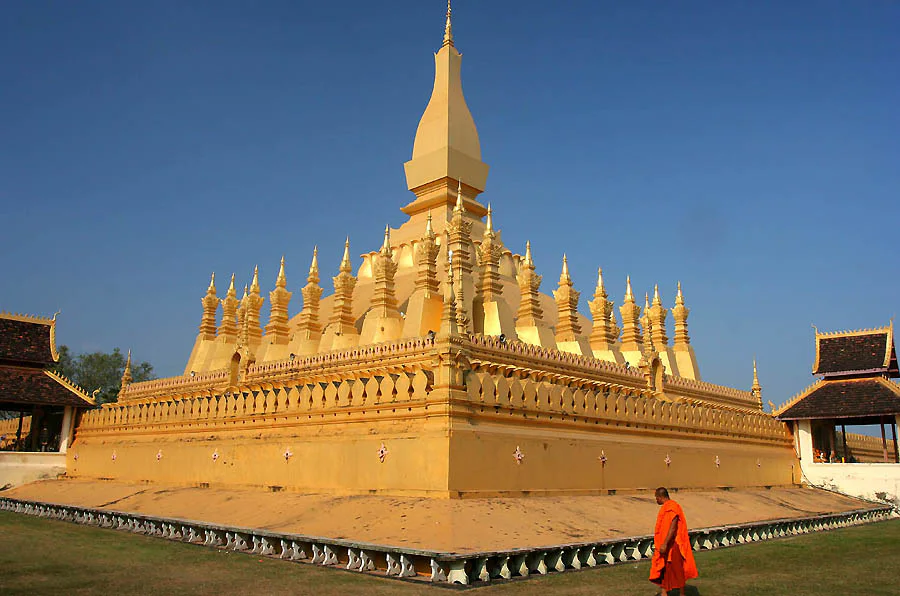
Vientiane
Pha That Luang
Content & sources
Jialiang Gao www.peace-on-earth.org · CC BY-SA 3.0
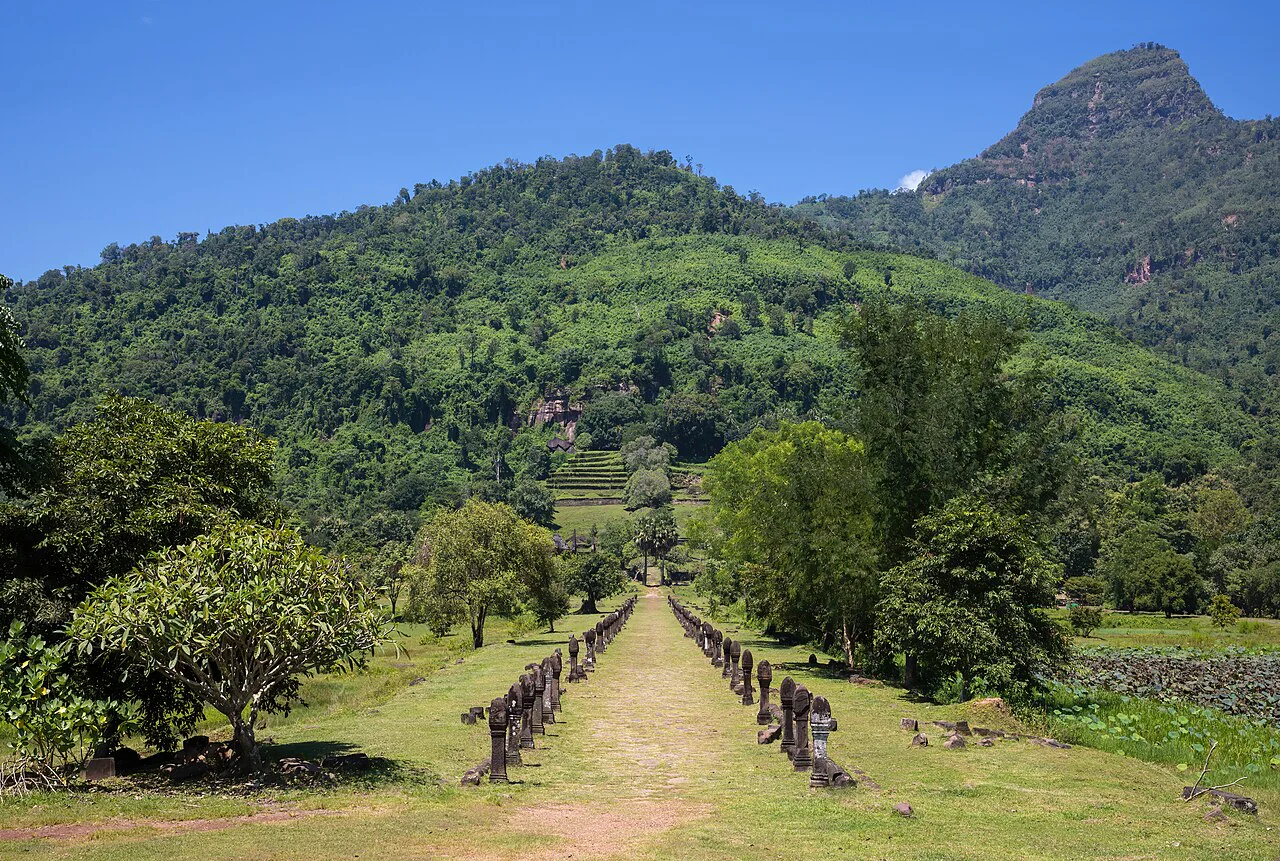
Champassack District
Vat Phou
Content & sources
Photo: Basile Morin · CC BY-SA 4.0