Stanza · Audio guide
Pha That Luang Audio Guide
A place to remember. A story to take with you.
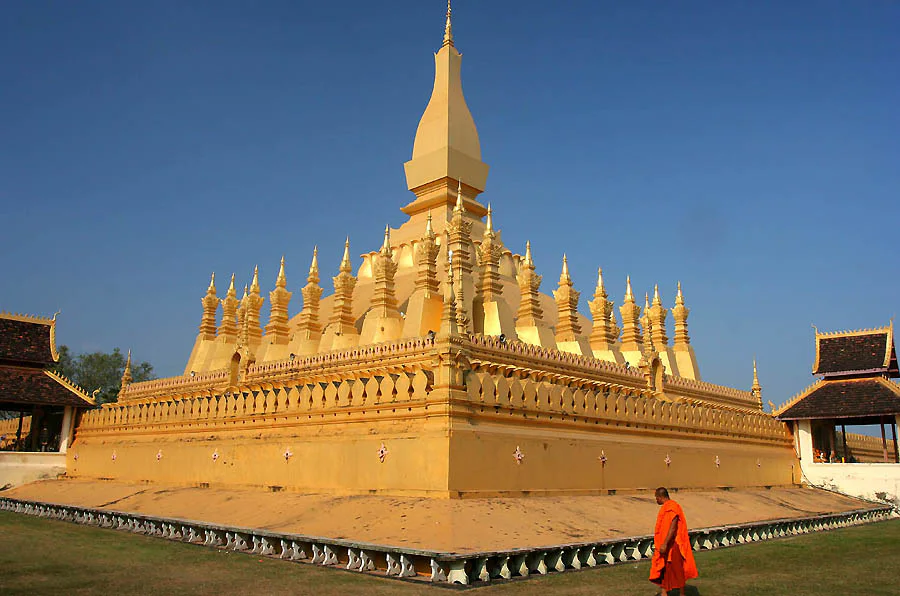
Pha That Luang is a gold-covered Buddhist stupa located in Vientiane. It is a significant site that has undergone several reconstructions since its initial establishment in the 3rd century AD.
Download Stanza, then search for “Pha That Luang”.
About the tour
One guide. Your kind of visit.
Pha That Luang is a gold-covered Buddhist stupa located in Vientiane. It is a significant site that has undergone several reconstructions since its initial establishment in the 3rd century AD.
Ready when you are.
- 01Get the free Stanza app.
iOS & Android
- 02Find your guide.
“Pha That Luang”
- 03Download before you go.
Works offline
Audio guide / 8 narrated stops
Inside the guide
Get to know a few of the stories before you go. Open a stop to read more.
01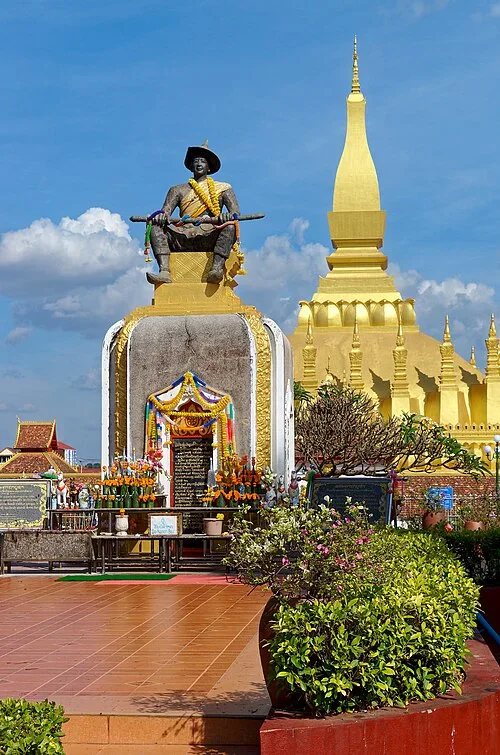 Grand Plaza and King Setthathirat Statue
King Setthathirat Statue, Grand Western Plaza
Welcome to Pha That Luang, the great golden stupa of Vientiane, an ancient monument that is a symbol of Laos. For Lao people it is both the spiritual heart of the country and a sign of its sovereignty, and it appears on the national seal. In the sixteenth century, King Setthathirat moved his capital from Luang Prabang down to Vientiane. In 1566 he ordered a grand stupa built on this ground, the great golden version whose silhouette rises behind his statue here. The bronze king sits on his pedestal with garlands around his neck, facing the monument he founded. From the ground to the tip of its spire, the stupa reaches about forty-five metres. Everything else around it, the walls, the temples and the gardens, grew up in service of that one golden spire.
Jakub Hałun · CC BY-SA 4.0
02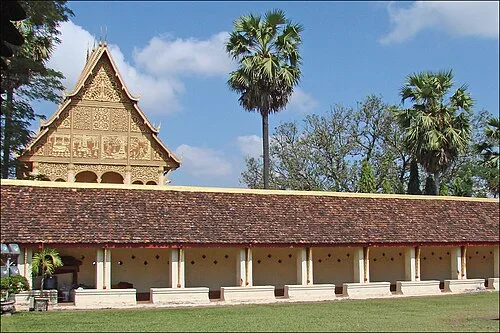 Outer Cloister Gallery and Sacred Sculptures
Outer Cloister Gallery
This long shaded gallery with its tiled roof runs along the inside of the compound wall. It looks serene, but it is proof of a violent story. In 1828 a Siamese invasion levelled Vientiane, and the once-magnificent stupa was left a ruin, abandoned to the jungle. It stayed that way for most of the nineteenth century. In 1867 the French explorer and architect Louis Delaporte drew the ruins in careful detail, and those drawings later became the blueprint for everything that followed. The French colonial government began restoring the stupa in 1900, but that first attempt failed, and its shape came out wrong. A bigger campaign ran from 1929 to 1935, repairing the spire, the cloister and the fire-damaged small stupas. Some elders in Vientiane say the 1900 restorers even took gold away from the top of the stupa; the story is still told locally, though it is hard to confirm.
Jean-Pierre Dalbéra from Paris, France · CC BY 2.0
03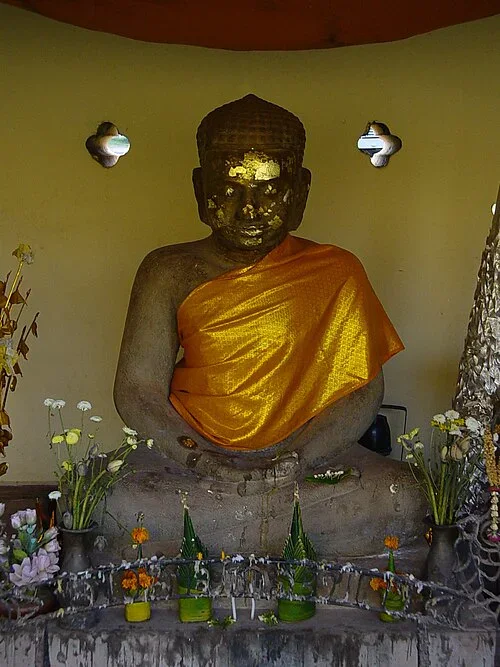 Outer Cloister Gallery and Sacred Sculptures
Ancient Sculpture of King Jayavarman VII
Among the sculptures sheltered by the cloister gallery sits a weathered stone figure with a golden cloth draped over one shoulder. It is associated with Jayavarman the Seventh, the great king of the Khmer Empire, whose realm once stretched across much of mainland Southeast Asia. Its presence here shows how far Khmer Buddhist art travelled, reaching the precinct of a Lao stupa hundreds of years later. The statue is no museum piece behind glass. Flowers stand in vases at its base, and small offerings are laid out across the platform in front of it. People still bow here, exactly as they would at any shrine in the compound.
Listen in the appChaoborus at French Wikipedia · CC BY-SA 2.5
04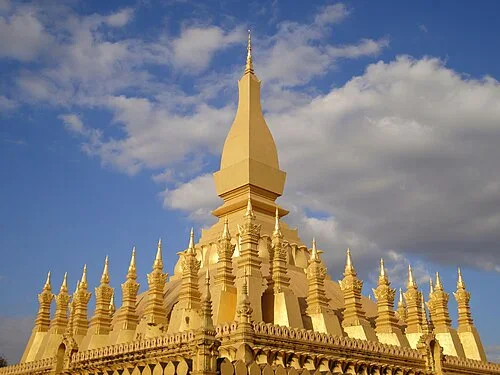 The Three-Tiered Golden Stupa
The Great Stupa and the Sacred Relic
The name itself is simple: That Luang means Great Stupa. But the reason this exact spot is sacred goes back, by tradition, more than two thousand years. The Urangkhathat chronicle tells how Buddhist missionaries came from the Mauryan Empire, sent by Emperor Ashoka. Five Arahant monks, holy men who had returned from studying the dharma, travelled with a figure remembered as King Chanthabury Pasithisak. They carried a relic believed to be the breastbone of the Buddha himself, brought across the Jambudvipa continent. Here they enshrined it, and the first monument raised over it was nothing grand, just a simple stone covering, square in shape and modest in height. That is the foundation story Buddhism honours here: a legend, held as the reason every later king built on this same ground.
Listen in the appRomain Pontida · CC BY-SA 2.0
05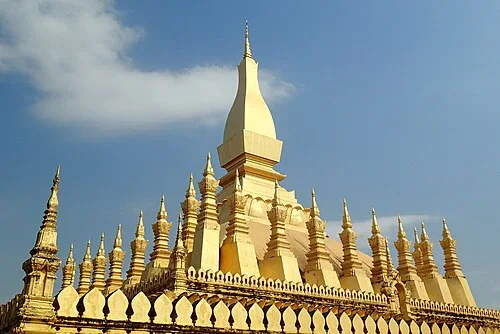 The Three-Tiered Golden Stupa
The Three Tiers and the Thirty Perfections
The stupa rises in three stepped tiers, each smaller than the one below, like a golden pyramid climbing to the spire. Around the central monument stands a ring of thirty small stupas. Each one represents one of the thirty Parami, the core Buddhist perfections that a person cultivates on the path to enlightenment. The old Lao chronicle records that King Setthathirat placed four baht of solid gold inside each small stupa, along with a palm-leaf manuscript inscribed with Pali scriptures in gold. In 1641 the Dutch East India Company sent an envoy named Gerrit van Wuysthoff to Vientiane, and King Sourigna Vongsa received him ceremonially at this temple. Wuysthoff wrote that he was impressed by the enormous pyramid, and that its top was covered with gold leaf weighing about four hundred and fifty kilograms.
Listen in the appFrançois Bianco · CC BY-SA 2.0
06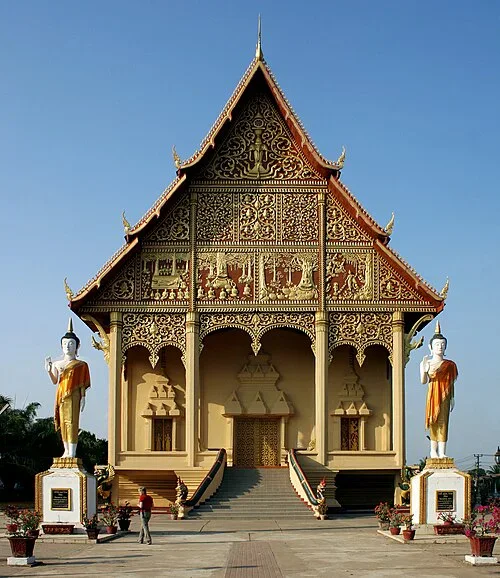 Surrounding Monastic Precinct
Wat That Luang Neua
Beside the stupa stands Wat That Luang Neua, a working monastery. Its ordination hall, the sim, is the building with the steep carved gable and the two standing Buddhas flanking the stairs. The gable panels are covered in dense golden carving, scenes and patterns worked into the woodwork in the classic Lao manner. The standing Buddhas wear saffron sashes, dressed the way devotees dress images they revere. This is what the precinct is actually for. The stupa was built to guard a relic, and here next door the worship it was meant to anchor carries on, day after day.
Listen in the appPhoto: Gerd Eichmann · CC BY-SA 4.0
07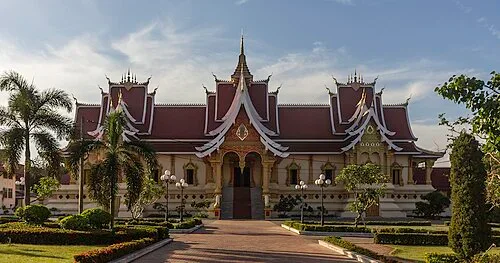 Surrounding Monastic Precinct
Hor Thammasapha
The grounds around the stupa hold more than temples. This grand hall, the Hor Thammasapha, stands among formal gardens and clipped hedges, its sweeping tiered roofs rising over an ornate central spire. It is built in deliberately classical Lao style, echoing the architecture of the sacred precinct around it. Buildings like this show how the monument works as an anchor. The great stupa sits at the centre, and around it gathers a whole precinct of religious and civic life, all designed to defer to the golden spire.
Listen in the appPhoto: DerFussi · CC BY-SA 3.0
08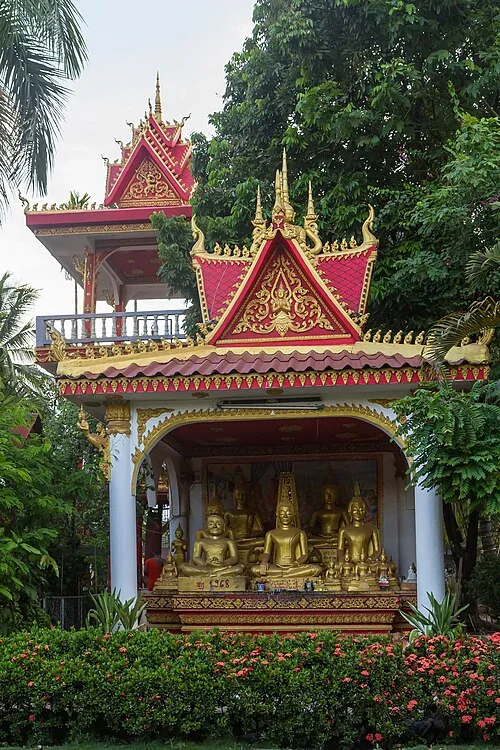 Surrounding Monastic Precinct
Wat That Luang Tai - Closing Reflection
In the garden of the southern monastery, Wat That Luang Tai, a red-and-gold canopy shelters a row of seated golden Buddhas. Flowering shrubs crowd around the shrine, and the spires of the canopy rise into the trees. Here the whole arc of the place comes together quietly. A site that began, by tradition, with a relic carried across a continent has been built, plundered, destroyed and rebuilt, and still the gold shines and offerings are laid at its feet. Pha That Luang embodies both the Buddhist faith and Lao sovereignty, and its survival shows how a people keep a sacred centre alive across centuries of change.
Listen in the appStefan Fussan · CC BY-SA 3.0
Pha That Luang
Frequently asked questions
How much does the guide cost?
Free app download. Listed guide price: $0.99. Guide price shown in the app. Audio guide only. Venue admission is separate.
Can I listen without internet?
Yes. Download the guide’s audio, images, and maps in the app before your visit. Your downloaded content is then available offline.
Can I listen in my language?
This audio guide is available in 15 languages, including English.
Do I need to follow a schedule?
No. This is a self-guided experience. Choose your stops, pause whenever you like, and return to a story at your own pace.
At your own pace
Explore Pha That Luang.
Download Stanza, then search for “Pha That Luang”.
Free app download · Guide price shown in the app
Keep exploring
Audio guides — Laos
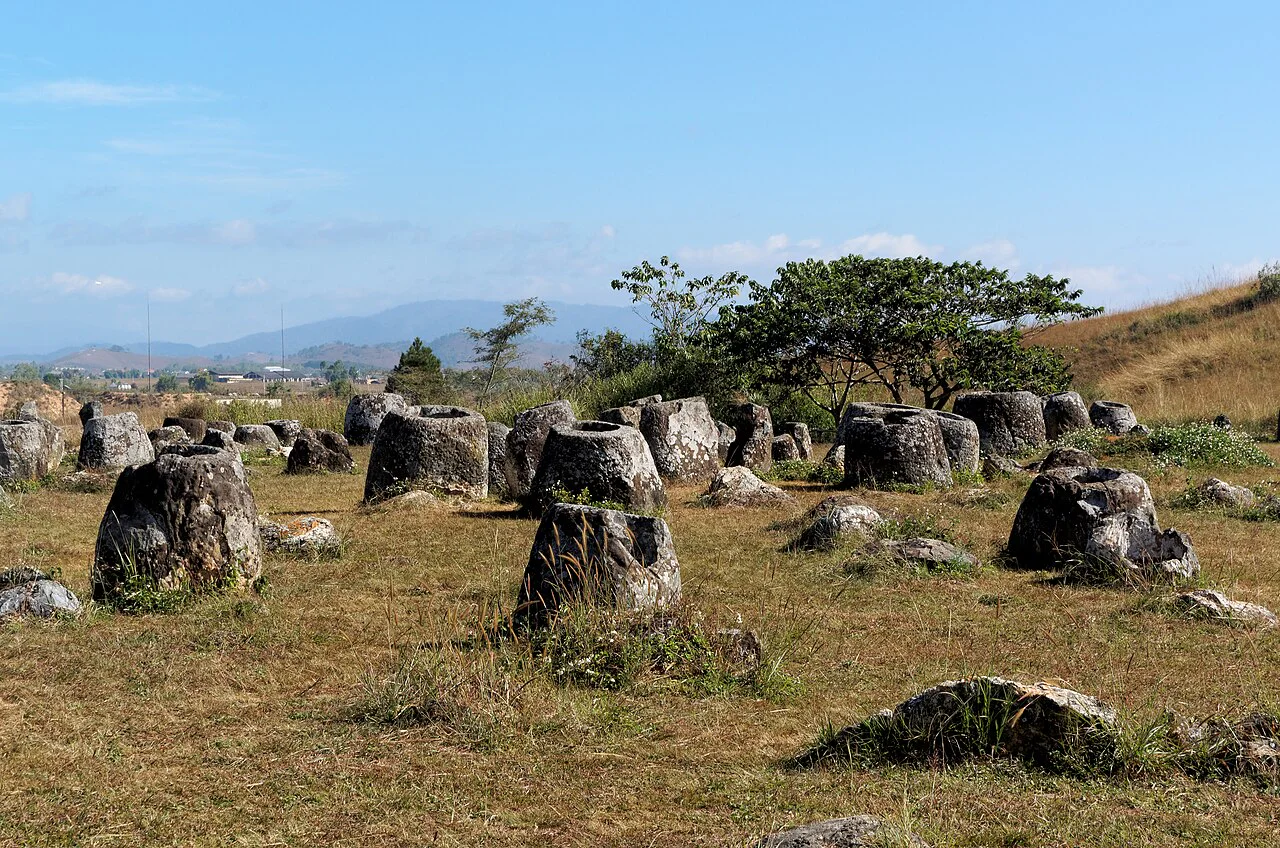
Phonsavan
Plain of Jars
Content & sources
Jakub Hałun · CC BY-SA 4.0
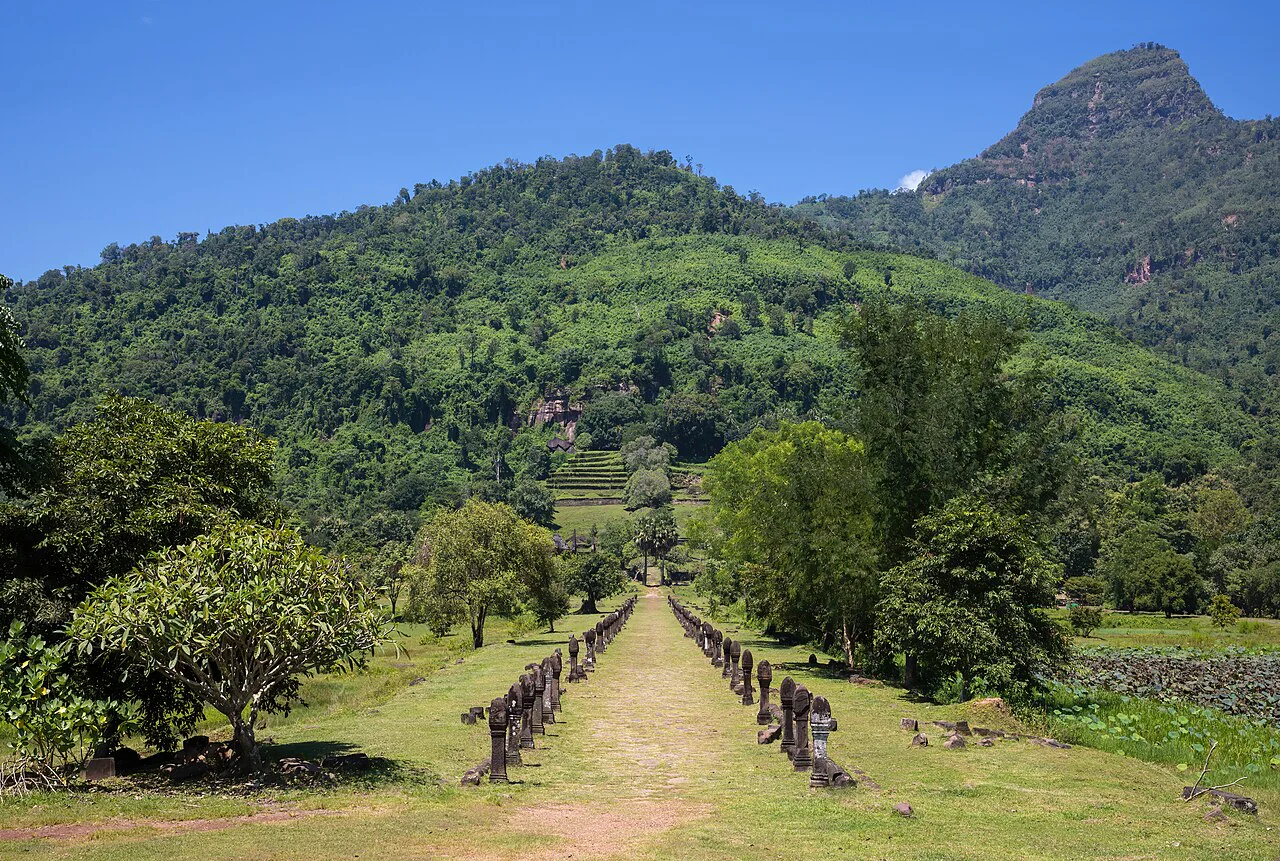
Champassack District
Vat Phou
Content & sources
Photo: Basile Morin · CC BY-SA 4.0