Stanza · Audio guide
Beiteddine Palace Audio Guide
A place to remember. A story to take with you.
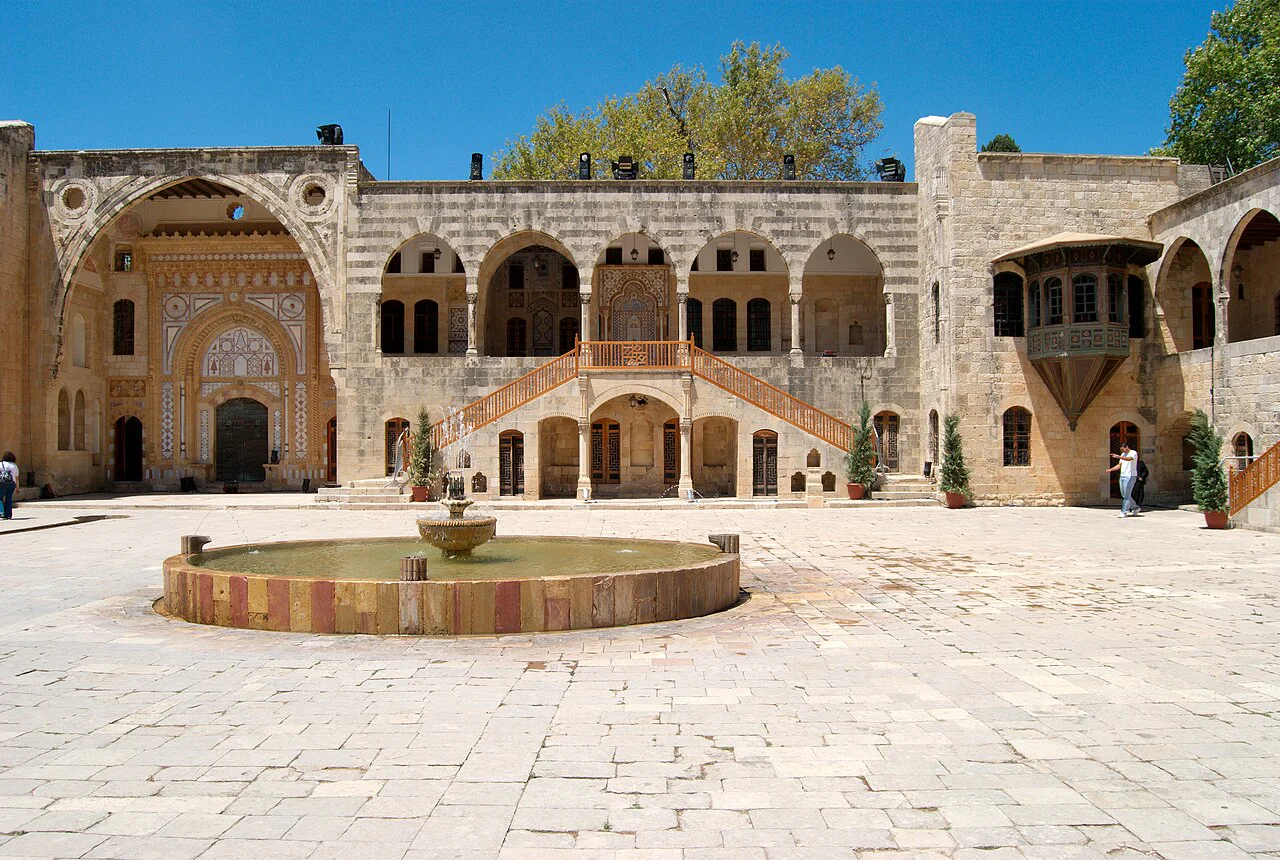
Beiteddine Palace is an 18th-century palace in Beiteddine, Lebanon, built by Bashir II. The palace hosts the annual Beiteddine Festival and the Beiteddine Palace Museum, and serves as the summer residence of…
Download Stanza, then search for “Beiteddine Palace”.
About the tour
One guide. Your kind of visit.
Beiteddine Palace is an 18th-century palace in Beiteddine, Lebanon, built by Bashir II. The palace hosts the annual Beiteddine Festival and the Beiteddine Palace Museum, and serves as the summer residence of the President of Lebanon.
Ready when you are.
- 01Get the free Stanza app.
iOS & Android
- 02Find your guide.
“Beiteddine Palace”
- 03Download before you go.
Works offline
Audio guide / 13 narrated stops
Inside the guide
Get to know a few of the stories before you go. Open a stop to read more.
01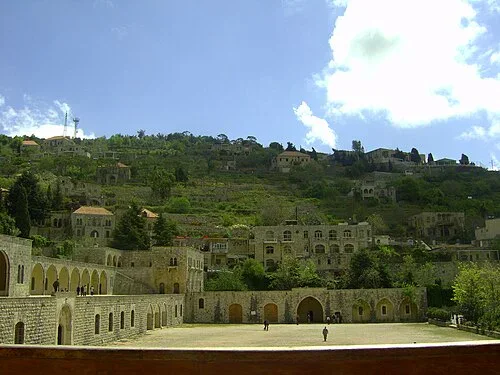 Al-Midan Courtyard and Entrance Gate
Beiteddine Palace and the Chouf Hillside
Welcome to Beiteddine Palace, high in the Chouf mountains of Lebanon. This tour follows one building through three worlds, from a public courtyard to the private rooms of a ruler. Emir Bashir the Second of the Shihab dynasty began the palace in 1788, on the site of a Druze hermitage. He finished thirty years later, having made it the seat of his Mount Lebanon emirate. The terraced hillside village behind the court still climbs the slope as it did then. Builders of his generation left a palace now counted a fine example of early nineteenth-century Lebanese architecture. The plan works like a filter. The great outer court receives crowds and guests. Beyond it, the middle palace handles the emirate's business. Deepest of all lie the family quarters, the Dar El Harim.
W.LAHHAM · CC BY 3.0
02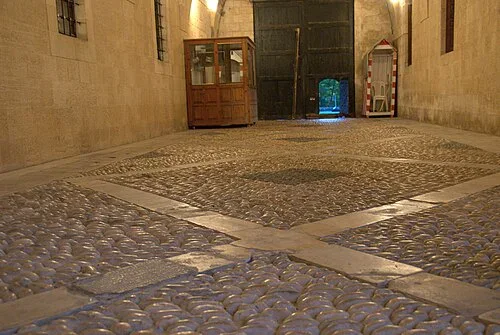 Al-Midan Courtyard and Entrance Gate
The Entrance Passage and Al-Midan
Through this vaulted passage the floor is paved with pebbles, laid out in bands and diamonds underfoot. It leads into the great outer court, a hundred and seven meters long. It runs forty-five meters wide, a field of stone built for ceremony. Along one side stands the Al-Madafa, a two-story wing once used for receiving guests. This court was the public stage of the emirate. Delegations arrived here, and horses gathered for review. In the late 1830s it held something larger. Mountain chieftains gathered at Beiteddine with their fighters, mustered for Ibrahim Pasha's incursion into Syria. William Henry Bartlett engraved the palace, and Letitia Elizabeth Landon wrote a poem on the gathering for the 1839 scrapbook. The passage beneath these vaults is the way guests and fighters once entered that scene.
Serge Melki from Indianapolis, USA · CC BY 2.0
03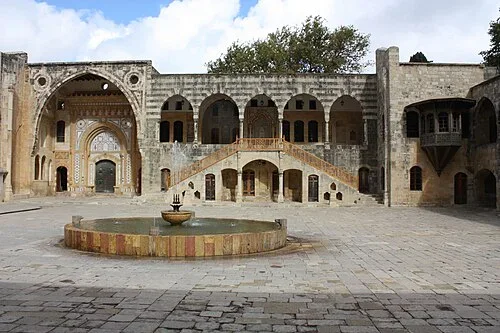 Dar El Wousta (The Middle Palace and Ceremonial Courtyard)
Dar El Wousta Courtyard and Double Staircase
A fountain stands at the center of this court, and a double staircase rises behind it. Beyond that stairway, at the far western end of the outer court, lies Dar El Wousta, the middle palace. The plain stonework of the outside gives way here to something finer. Arcades, fountains and carved facades mark the crossing from public ground into the emirate's working heart. The rooms behind these arches served as offices and reception salons. Here the business of Mount Lebanon was conducted. Taxes were settled, disputes heard, and orders issued in the Emir's name. The double staircase made every official arrival a small ceremony.
Listen in the appArian Zwegers · CC BY 2.0
04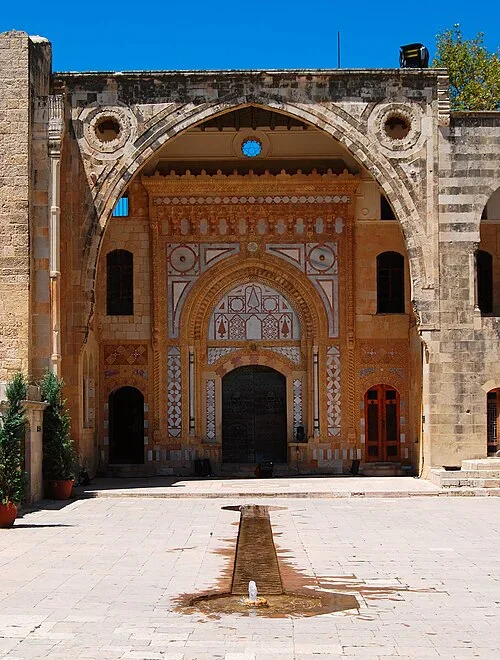 Dar El Wousta (The Middle Palace and Ceremonial Courtyard)
The Decorated Entrance Portal
Layered arches frame the entrance door, one inside the other, carved from honey-colored stone. Around the doorway the ornament turns to color, with circles and star patterns set in contrasting inlay. The palace is known for exactly this blend, Lebanese masonry enriched by notable Italian influence. Craftsmen came to Bashir's court from Damascus, Aleppo and Italy, and their work speaks in this facade. A mountain ruler wanted the building itself to carry his claim. Stonework like this told visiting delegates that Beiteddine was no provincial house. A thin channel of water runs down the courtyard toward the threshold, a last touch of ceremony before the door.
Listen in the appPhoto: Peripitus · CC BY-SA 3.0
05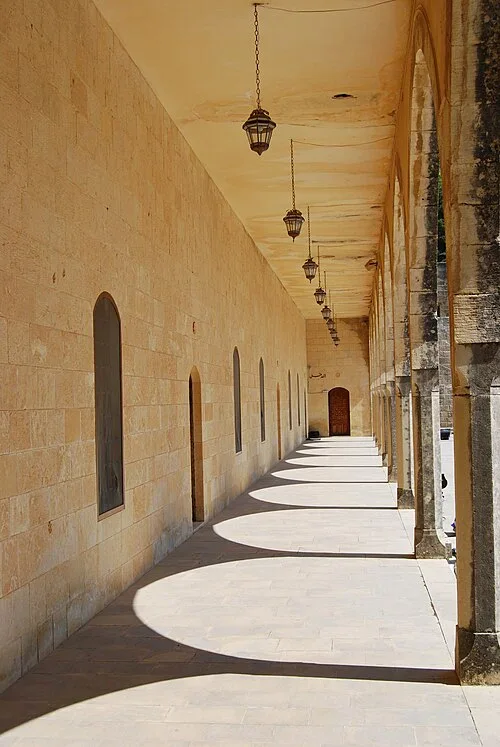 Dar El Wousta (The Middle Palace and Ceremonial Courtyard)
Arcades of the Middle Palace
Sunlight strikes the outer wall of this arcade, and the arches throw their shadows across the floor in long, repeated curves. Along the line of arches the light breaks into rhythm, bright, shaded, bright again. This is the architecture the palace turns to once the austere outer court is left behind. There are arcades, fountains and facades, and the mandaloun balconies are closed in behind intricate wooden latticework. Lanterns on long chains hang from the vaulted ceiling. The pattern is practical as much as beautiful. Deep arcades keep the sun off the stone and hold the cool of the mountain air. Levantine palaces have staged movement this way for centuries, from harsh light into cooled shade.
Listen in the appPhoto: Peripitus · CC BY-SA 3.0
06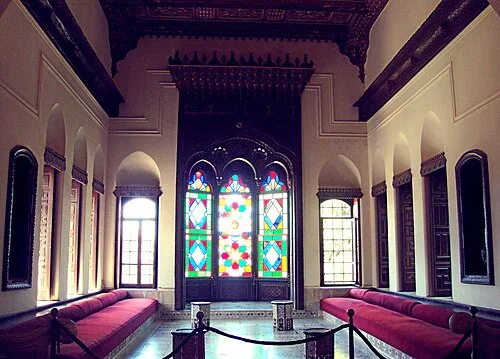 Reception Salons and Levantine Artistry
The Reception Salon
Red divans run along the walls of this salon, and above them arched windows glow with stained glass in green, red and blue. Rooms like this were the diplomatic engine of the palace. Foreign visitors reached Beiteddine and were received here, seated along the divans with the light filtered through colored glass. One caller left a trace. In 1823 the Reverend Lewis Way, an English clergyman, interviewed the Emir of Mount Lebanon. An English churchman talking with the ruler of these mountains shows how far the palace's reputation traveled. Hospitality was politics here. A guest well received was an ally gained. Albert Way, who recorded the interview, wrote the meeting down for readers at home.
Listen in the appPhoto: Christina.Ayoub98 · CC BY-SA 3.0
07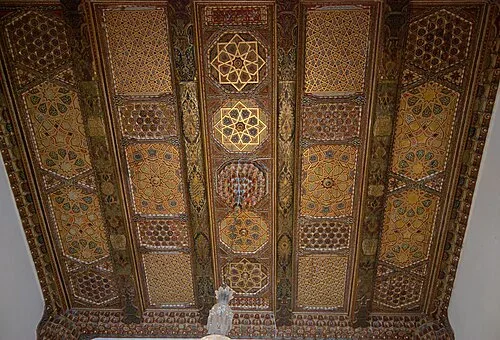 Reception Salons and Levantine Artistry
Painted Cedar Ceiling
Overhead the ceiling is cedar, carved into coffers and painted in gold, green and red. Stars, rosettes and geometric panels repeat across the wood, each one bordered with fine carved patterns. Cedar grows on these mountains, and the wood became the palace's signature material. Some panels carry Arabic calligraphy worked into the ornament, the written word used as decoration. Carving, painting and gilding on this scale took specialist hands and long months. Rooms embellished with carved and painted cedar wood are what the palace is remembered for. The interplay holds the eye longest, painted panel against carved border, gold against dark wood.
Listen in the appPhoto: Peripitus · CC BY-SA 3.0
08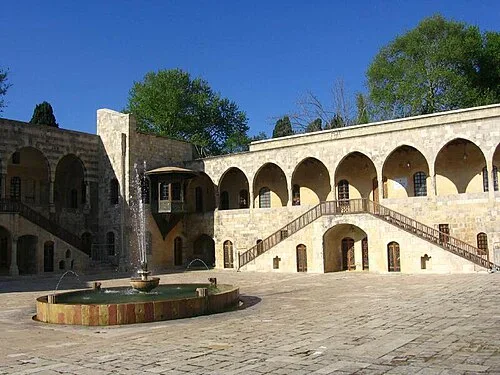 Dar El Harim (The Private Family Quarters)
Dar El Harim Inner Courtyard
A fountain cools this quieter court, and the arcades around it belong to the most private part of the palace. Dar El Harim rises at the far end of the visit, the seat of the household. Its parts were a richly decorated facade, an Upper Harem, a selamlik, a Lower Harem and the kitchens. Here only family and household pass. Each step inward shut the world out a little more. Privacy was not an afterthought at Beiteddine. It was the organizing idea, written in courtyards and gates.
Listen in the appFrédéric Blancart · CC BY-SA 3.0
09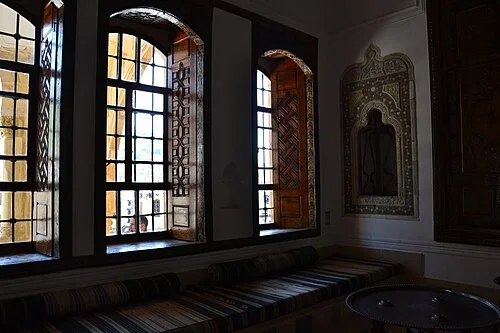 Dar El Harim (The Private Family Quarters)
Private Apartments
Behind carved wooden screens, light enters these rooms softened and divided. The windows face outward through latticework, so the household could see the courtyards while staying unseen. These rooms belong to the harem side of the palace, where the Emir's family lived away from every official eye. Furniture here meant cushions running along the walls, covered in striped cloth for sitting and resting. Beside the salons and their diplomatic splendor, the scale is domestic. An ornate recessed panel on the wall is the one note of display. The screens, the dim light and the low seating all serve one purpose, keeping the household's life to itself.
Listen in the appFrédéric Blancart · CC BY-SA 3.0
10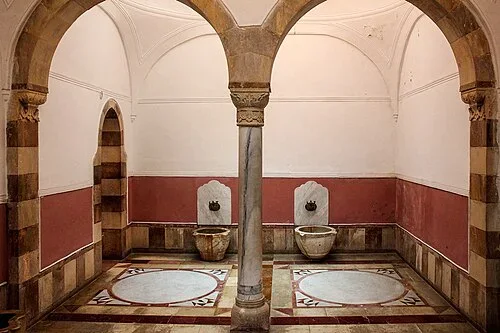 The Imperial Ottoman Hammam
The Hammam Chamber
At the northern edge of the Dar El Harim section sits the palace hammam. Twin marble basins stand against the wall, each with a carved fountain spout, set into an arched chamber floored in marble. A bath at Beiteddine followed Ottoman palace practice, a suite of connected chambers rather than a single room. Bathers moved through spaces of growing heat, washing, steaming and resting in turn. Wall fountains like these supplied water at each stage. In a mountain court, a hammam of this finish was a luxury borrowed from the great Ottoman houses.
Listen in the appPhoto: Clemens Schmillen · CC BY-SA 4.0
- 11
Dome of Glass Bullseyes
The engineering trick above the steam: a dome pierced with glass bullseyes that turns sunlight into soft, scattered light.
- 12
Gardens and the Tomb of Emir Bashir II
The shaded garden where Emir Bashir and his wife lie, and the exile that ended his emirate in 1840.
- 13
Garden Mosaics and the Living Palace
An ancient mosaic on the lawn, and the palace's modern lives: president's summer residence, museum, festival stage and protected site.
Beiteddine Palace
Frequently asked questions
How much does the guide cost?
Free app download. Listed guide price: $0.99. Guide price shown in the app. Audio guide only. Venue admission is separate.
Can I listen without internet?
Yes. Download the guide’s audio, images, and maps in the app before your visit. Your downloaded content is then available offline.
Can I listen in my language?
This audio guide is available in 15 languages, including English.
Do I need to follow a schedule?
No. This is a self-guided experience. Choose your stops, pause whenever you like, and return to a story at your own pace.
At your own pace
Explore Beiteddine Palace.
Download Stanza, then search for “Beiteddine Palace”.
Free app download · Guide price shown in the app
Keep exploring
Nearby audio guides
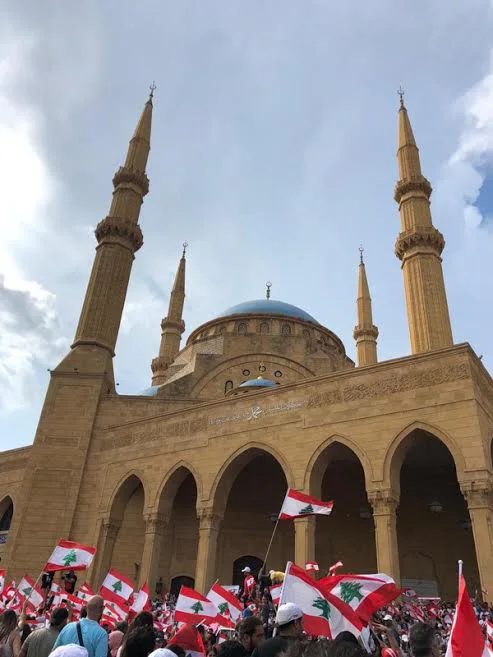
Beirut · 23 km
Mohammad Al-Amin Mosque
Content & sources
Photo: NicolasGaron · CC BY-SA 4.0
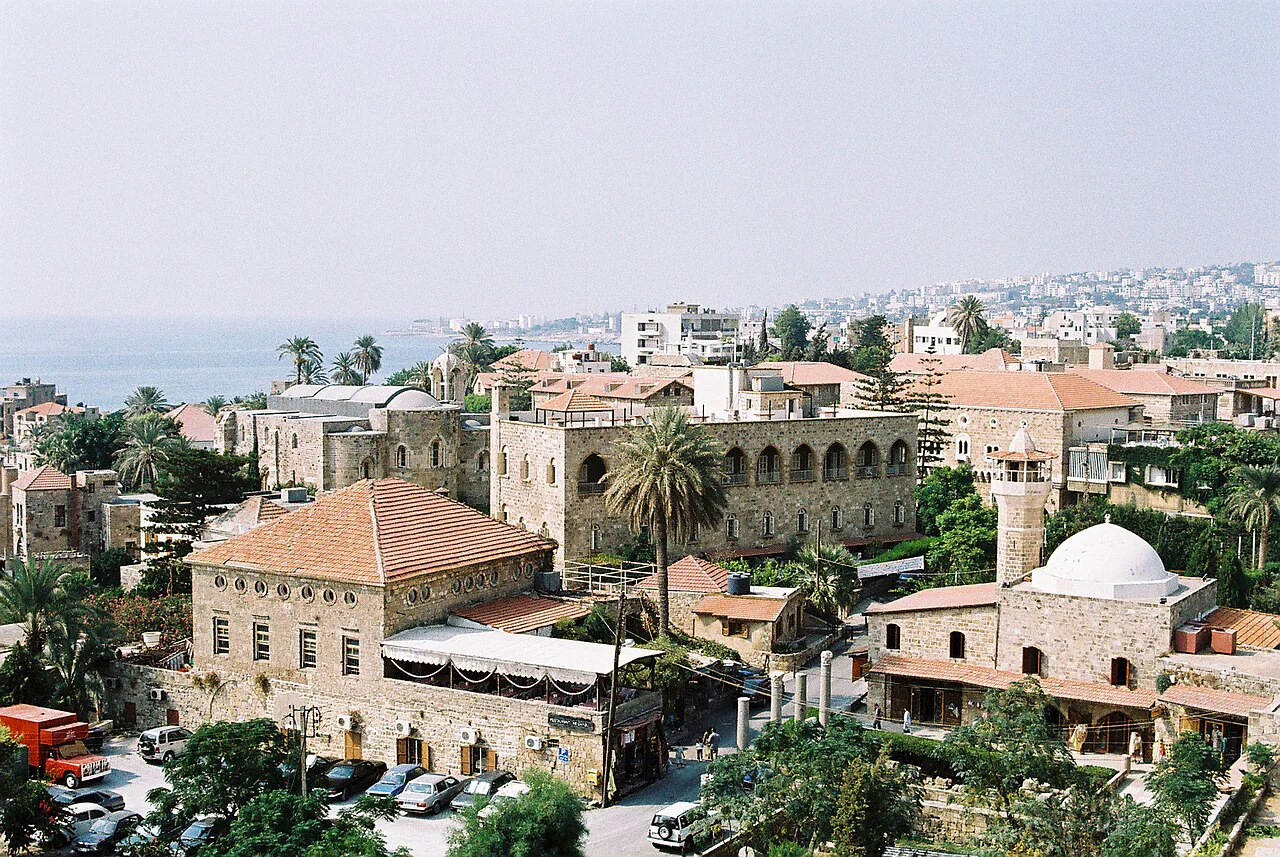
Jbeil · 47 km
Byblos
Content & sources
Orient at de.wikipedia · CC BY-SA 2.0 de
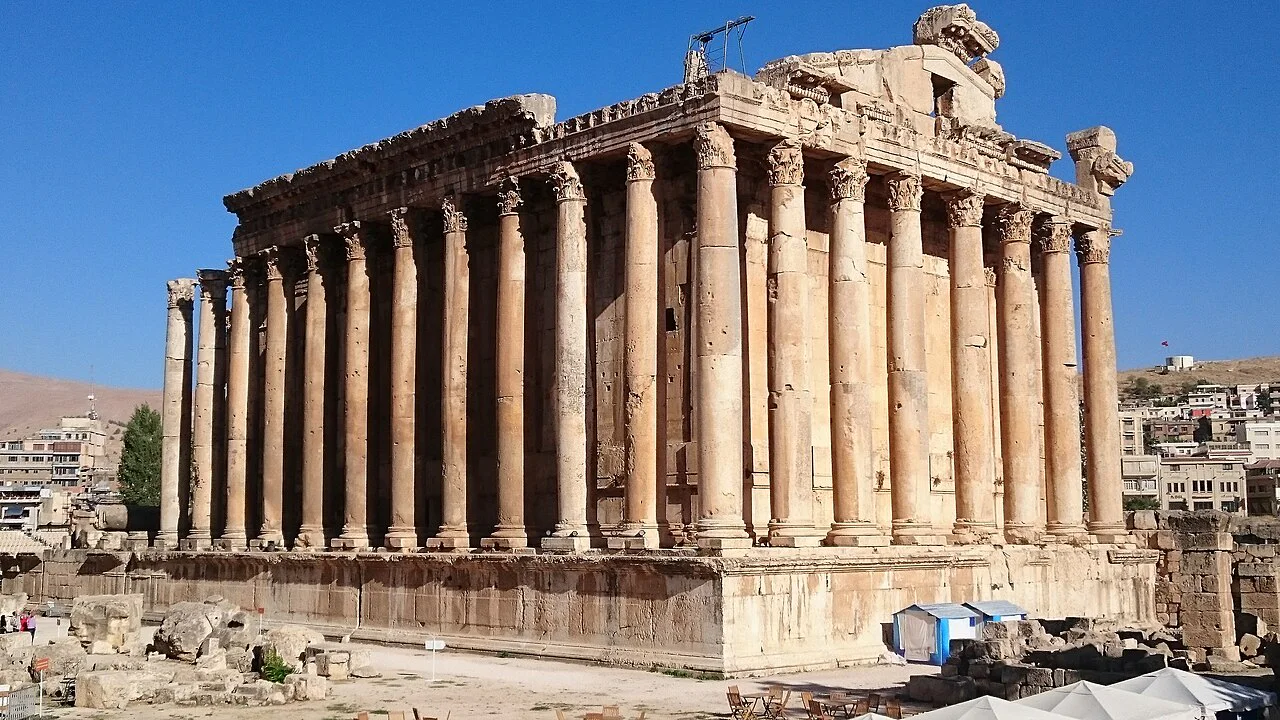
Baalbek · 68 km
Baalbek
Content & sources
Saadedine AL SAIDI · CC BY-SA 4.0
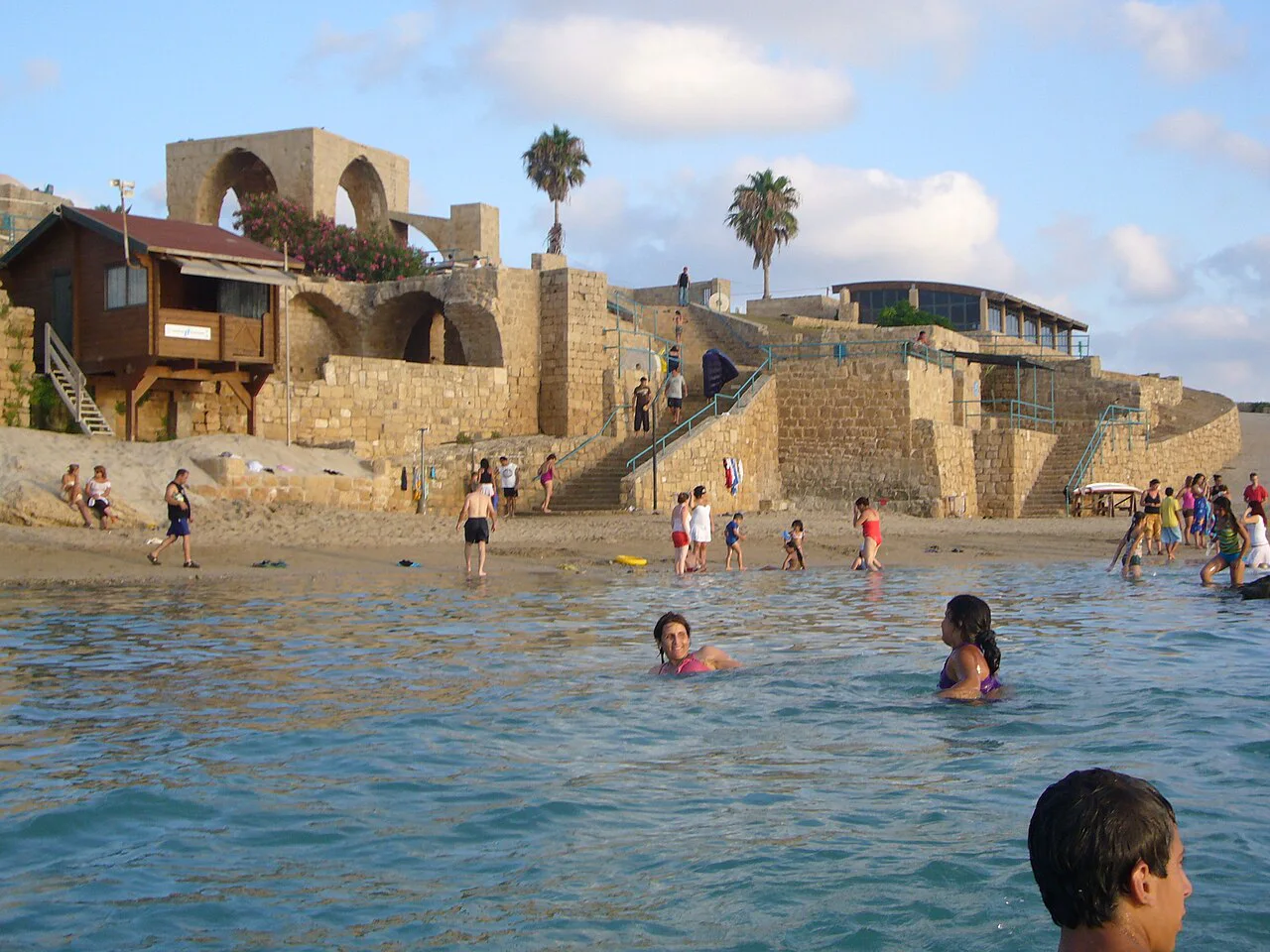
Mate Asher Regional Council · 85 km
Achziv
Content & sources
Al Ameer son (talk) 19:03, 11 August 2008 (UTC) · Public domain