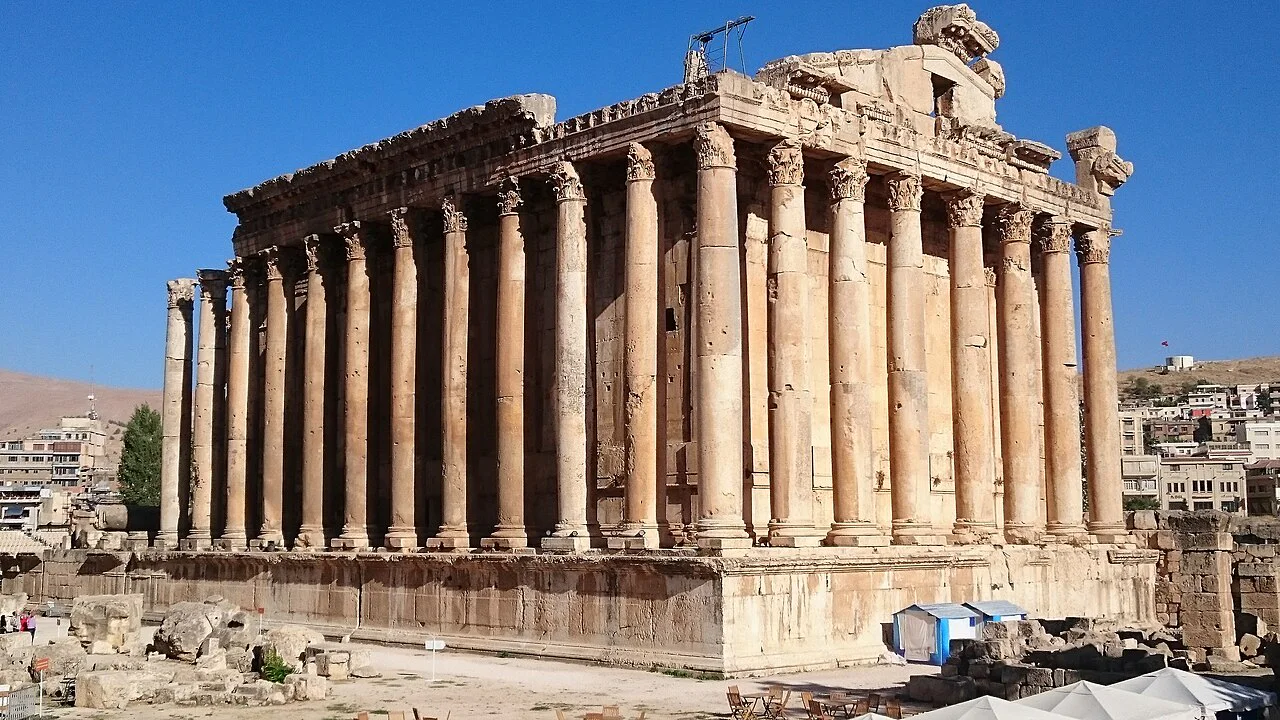
Stanza · Audio guide
Baalbek Audio Guide
A place to remember. A story to take with you.
Baalbek is a city located east of the Litani River in the Beqaa Valley of Lebanon. It serves as the capital of the Baalbek-Hermel Governorate.
Download Stanza, then search for “Baalbek”.
About the tour
One guide. Your kind of visit.
Baalbek is a city located east of the Litani River in the Beqaa Valley of Lebanon. It serves as the capital of the Baalbek-Hermel Governorate.
Ready when you are.
- 01Get the free Stanza app.
iOS & Android
- 02Find your guide.
“Baalbek”
- 03Download before you go.
Works offline
Audio guide / 17 narrated stops
Inside the guide
Get to know a few of the stories before you go. Open a stop to read more.
01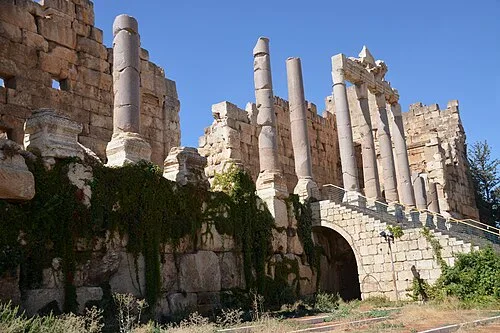 The Propylaea
: Entering the Sanctuary
Welcome to Baalbek, in Lebanon's Beqaa valley — the city the Romans called Heliopolis, the Sun City. The name honoured a solar cult that reached back long before them. People had worshipped the local god Baal Haddu here for ages, and the Greeks and Romans matched him with their own sky god, Jupiter. Around him grew a triad of gods: Jupiter, Venus and Bacchus, Roman names for much older local deities. The sanctuary grew from the early reign of Augustus, late in the first century BC, until Christianity rose in the fourth century. It became one of the largest temple complexes of the Roman empire. Pilgrims came from far and wide, and the sanctuary was famous as a place to consult the god. Inscriptions to him have been found in Athens, in Rome, in Gaul, and even near the frontier wall in Britain. The entrance here was once a broad staircase, rising about six metres to an arcade of columns, flanked by towers on either side. Up those stairs the ancient visitors climbed, into the sacred precinct. This tour follows the pilgrim's path, from the eastern gateway westward to the temple of Jupiter, and ends at the quarry where the sanctuary's giant stones were cut.
Carole Raddato · CC BY-SA 2.0
02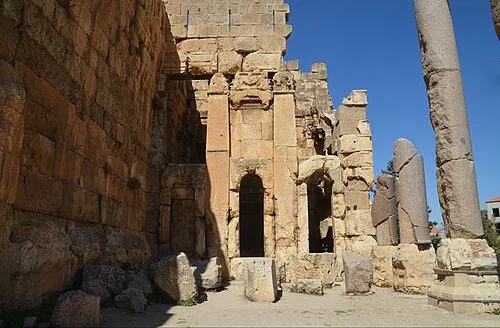 The Propylaea
Tower of the Propylaea
A tower flanked each side of the gateway, and one of them still shows its niches, each backed by a carved seashell. Statues once stood in those niches, though which figures they were is hard to say now. The seashells alone tell how rich this entrance was meant to look to a pilgrim arriving from the plain. A Latin inscription on the column bases adds another layer. It records that Longinus, a lifeguard of the First Parthian Legion, and Septimius, a freedman, paid to gild the capitals with bronze. They gave the money in gratitude for the safety of the young Caracalla and the empress. Most of the entrance columns have since been toppled. The staircase was entirely dismantled, its stones carried off for a later wall nearby.
Carole Raddato · CC BY-SA 2.0
03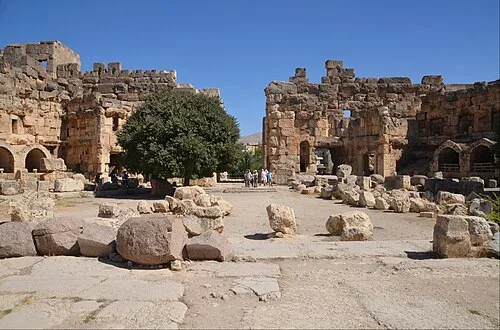 The Hexagonal Forecourt
Behind the gateway opens a courtyard with six sides, reached through a threefold entrance. It was added in the middle of the third century by the emperor Philip the Arab, as the sanctuary kept expanding. Traces remain of the two rows of columns that once encircled it. What the court was actually for is a genuine puzzle. An early student of the ruins, Donne, reckoned it the town's forum. Badly preserved coins of the era led others to call it a sacred cypress grove. Better specimens showed a single stalk of grain instead, and the grove idea faded. The surest thing is its position: a grand six-sided threshold between the entrance and the immense sacred courts ahead.
Listen in the appCarole Raddato · CC BY-SA 2.0
04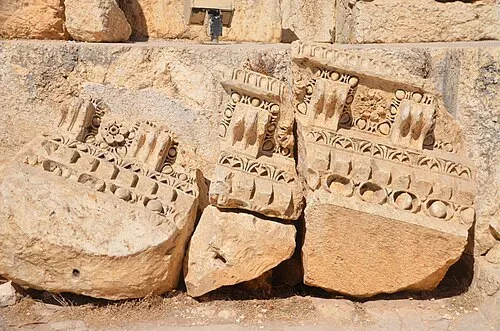 The Hexagonal Forecourt
Fallen Entablature of the Forecourt
These carved blocks, lying where they fell, once carried the forecourt's roof. They are pieces of the entablature, the stonework that rested on the columns and held the roof above them. Even broken, the carving is fine work. There are little niches, hanging garlands, and miniature buildings, all cut into the limestone. This was no bare, empty plot. The six-sided court was roofed and richly finished, and these fragments are what survives of that finish.
Listen in the appCarole Raddato · CC BY-SA 2.0
05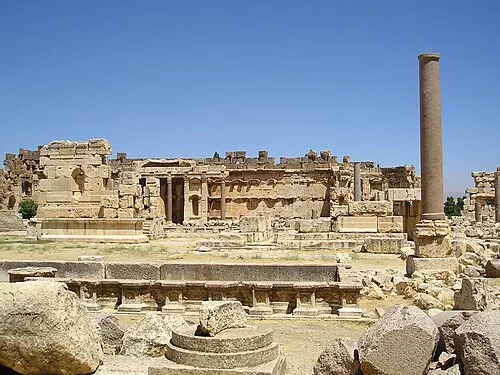 The Great Court and Sacrificial Altars
The Great Court
The Great Court was the working heart of the sanctuary, an open plaza covering about one and a half hectares. At its centre stood the main altar for burnt offering. To the north and south lay lustration basins for ritual washing, their floors laid in mosaic. Corinthian porticoes ran around the whole court, one of which was never completed. Beneath the plaza, three underground passageways run through the structure, wide and high enough to walk through. Inscriptions found in them suggest Roman soldiers occupied the passages. The sanctuary's oracle drew powerful visitors, and the emperor Trajan consulted it twice. The first time, he handed in a sealed question, unopened, and asked for a written reply. The answer came back blank, and Trajan was delighted, because his own paper had been empty too. The second time he asked whether he would return alive from his wars against Parthia. The reply was a centurion's vine staff, broken into pieces. Centuries later the court changed faiths. Under the emperor Theodosius, a Christian basilica was built westward-facing over the altar, and was later rearranged to face east, like most churches.
Listen in the appPhoto: Heretiq · CC BY-SA 2.5
06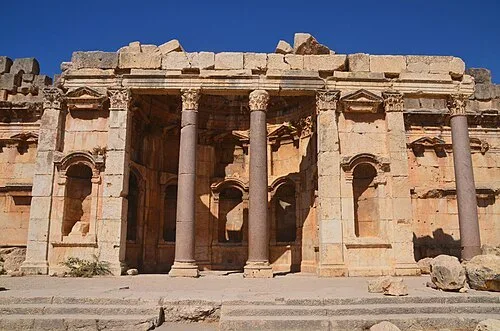 The Great Court and Sacrificial Altars
Northern Portico of the Great Court
The court was ringed by porticoes, and their columns made a statement. The shafts are single stones of highly polished red Egyptian granite, each a little over seven metres tall. That rock was carried across the Mediterranean from quarries far to the south of here. Only the bases and the capitals are local limestone. Of an original 128 columns, just six are still standing. Inscriptions record that the court once carried portraits of emperors and imperial figures, dedicated by the city's Roman colonists. A visitor here stood among images of the powerful, inside a colonnade built from the stone of an empire's southern edge.
Listen in the appCarole Raddato · CC BY-SA 2.0
07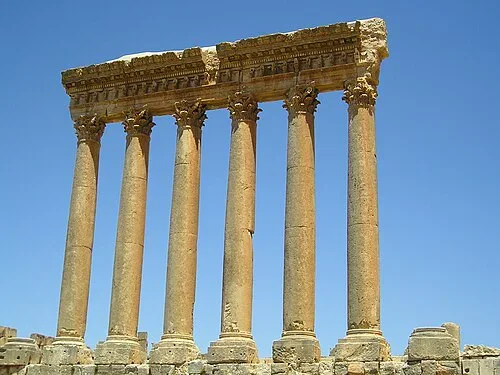 The Temple of Jupiter and the Six Columns
The Temple of Jupiter: Six Columns Against the Sky
At the western end of the Great Court, the Temple of Jupiter crowned the whole sanctuary. It stood on its own platform, raised another seven metres above the court and reached by a wide staircase. A colonnade of unfluted Corinthian columns circled the temple, more than fifty in all. Ten faced each end. Nineteen ran along each side. The blocks of the entablature above them weigh up to sixty tonnes apiece, and one corner block more than a hundred, all held nineteen metres above the ground. Under Justinian, eight of those Corinthian columns were taken apart and shipped to Constantinople, to be built into the church of Hagia Sophia. Earthquakes did further damage, and the ruins were pillaged for stone. Three more columns fell in the late eighteenth century. Six remain standing on the south side, with their entablature still in place. Their capitals are nearly perfect on the sheltered southern face. The winter winds of the Beqaa have worn the northern faces almost bare. A sixth-century chronicler, John Malalas, credited most of the complex to the emperor Antoninus Pius, though his account is hard to rely on.
Listen in the appPhoto: Heretiq · CC BY-SA 2.5
08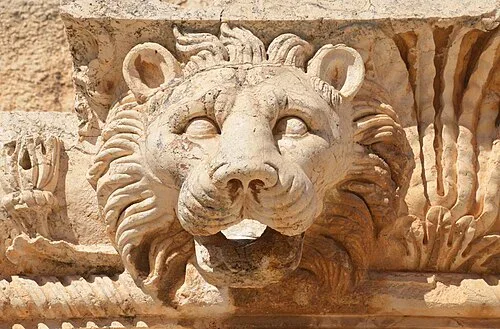 The Temple of Jupiter and the Six Columns
Lion Waterspout of the Jupiter Temple
Even a temple of this size had to deal with rain. Carved into its entablature was this lion's head, working as a waterspout. Water running off the roof poured through the lion's open mouth and was thrown clear of the stonework below. The mane, the eyes and the teeth are all cut with care into a functional corner of a colossal building. The great temple was finished with working sculpture, not just sheer size.
Listen in the appCarole Raddato · CC BY-SA 2.0
09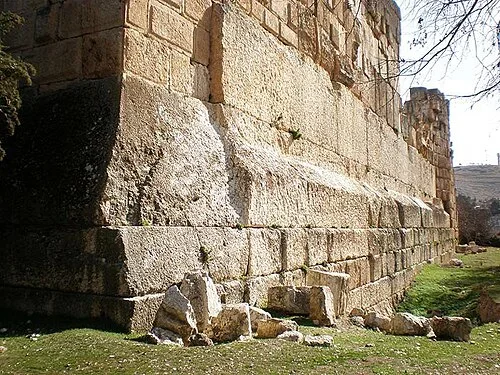 The Megalithic Trilithon
The Trilithon
The wall changes character on the western side of the Jupiter platform. Its foundations were built from about two dozen monoliths, the lowest of them weighing roughly three hundred tonnes each. Above those, in the second course of the tallest retaining wall, lie the famous Three Stones. They gave the temple its Byzantine name, the Trilithon. Each block is over nineteen metres long. Each weighs about eight hundred tonnes. They count among the largest stones people have ever moved and set in place. The quarry where they were cut sits slightly higher up the slope, so the giants could begin their journey downhill without any lifting at all. The same quarry holds stones even bigger than these, left there unused.
Listen in the appPhoto: Brattarb · CC BY-SA 3.0
10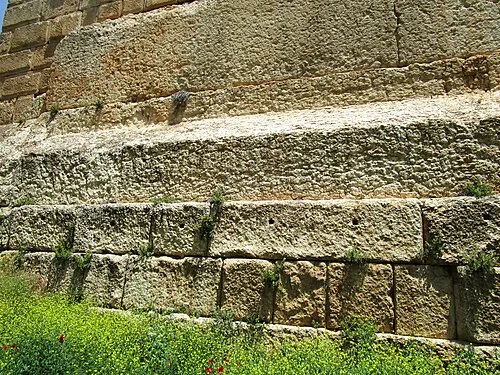 The Megalithic Trilithon
Reading the Retaining Wall
These stones raise a question the Romans never answered in writing: how were they moved? In 1977, the engineer Jean-Pierre Adam worked out one possibility. He proposed shifting a block of over five hundred tonnes on rollers, using capstans and pulley blocks, winches that crews could turn by hand. His calculation put the workforce at around five hundred people, hauling in unison. It is a modern reconstruction from physics, not a memory handed down from the builders.
Listen in the appLodo27 from Moscow, Russia · CC BY-SA 3.0
- 11
The Temple of Bacchus
The sanctuary's best-preserved temple, saved by its own fallen ruins, and the puzzle of what to call it.
- 12
The Great Doorway and the 1759 Earthquakes
How the 1759 earthquakes shifted the great lintel, and the rough column that has held it ever since.
- 13
Inside the Temple of Bacchus
Inside the only complete temple interior at Baalbek, a staged walk towards the god's own sanctuary.
- 14
The Medieval Citadel
When the temples became a fortress, and the legend of Solomon's palace built by jinn.
- 15
The Temple of Venus
The round little temple of Venus, later a church, and once called the gem of Baalbek.
- 16
The Stone of the Pregnant Woman
In the ancient quarry, a thousand-tonne block cut free from bedrock and never moved.
- 17
The Unfinished Giant
The 2014 discovery of a stone block suggested to be the largest ever carved by human hands, still partly buried.
Baalbek
Frequently asked questions
How much does the guide cost?
Free app download. Listed guide price: $2.99. Guide price shown in the app. Audio guide only. Venue admission is separate.
Can I listen without internet?
Yes. Download the guide’s audio, images, and maps in the app before your visit. Your downloaded content is then available offline.
Can I listen in my language?
This audio guide is available in 15 languages, including English.
Do I need to follow a schedule?
No. This is a self-guided experience. Choose your stops, pause whenever you like, and return to a story at your own pace.
At your own pace
Explore Baalbek.
Download Stanza, then search for “Baalbek”.
Free app download · Guide price shown in the app
Keep exploring
Nearby audio guides
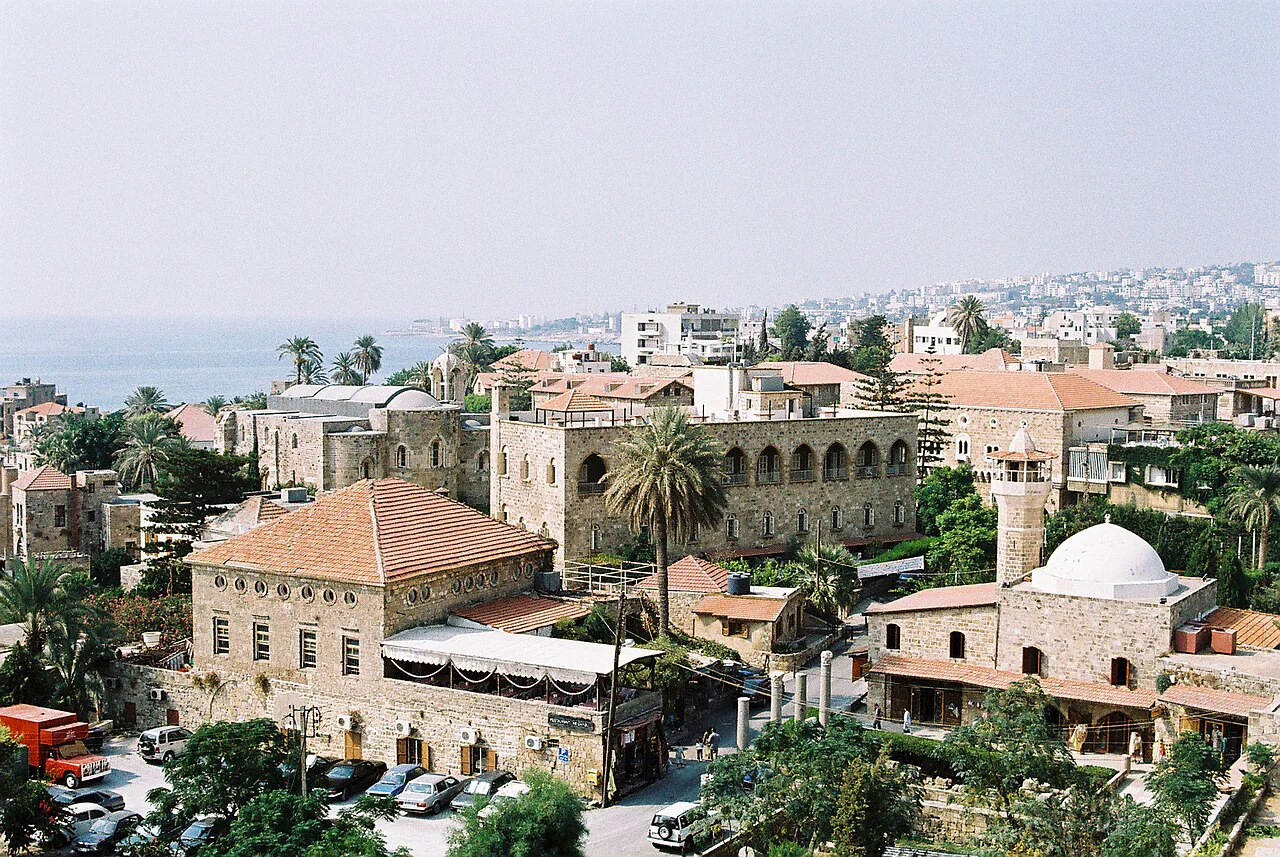
Jbeil · 53 km
Byblos
Content & sources
Orient at de.wikipedia · CC BY-SA 2.0 de
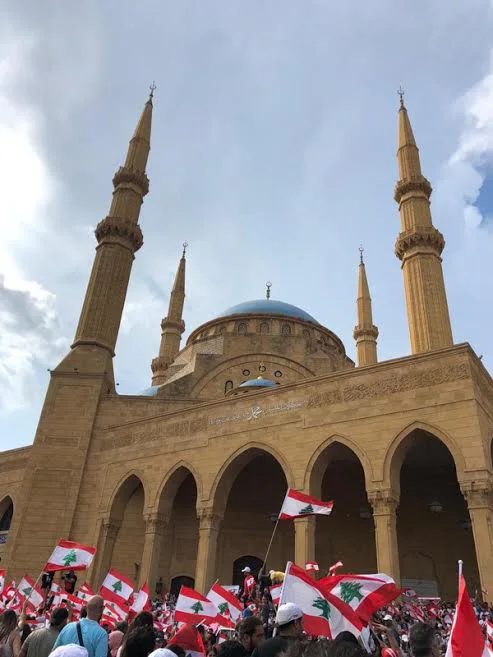
Beirut · 66 km
Mohammad Al-Amin Mosque
Content & sources
Photo: NicolasGaron · CC BY-SA 4.0
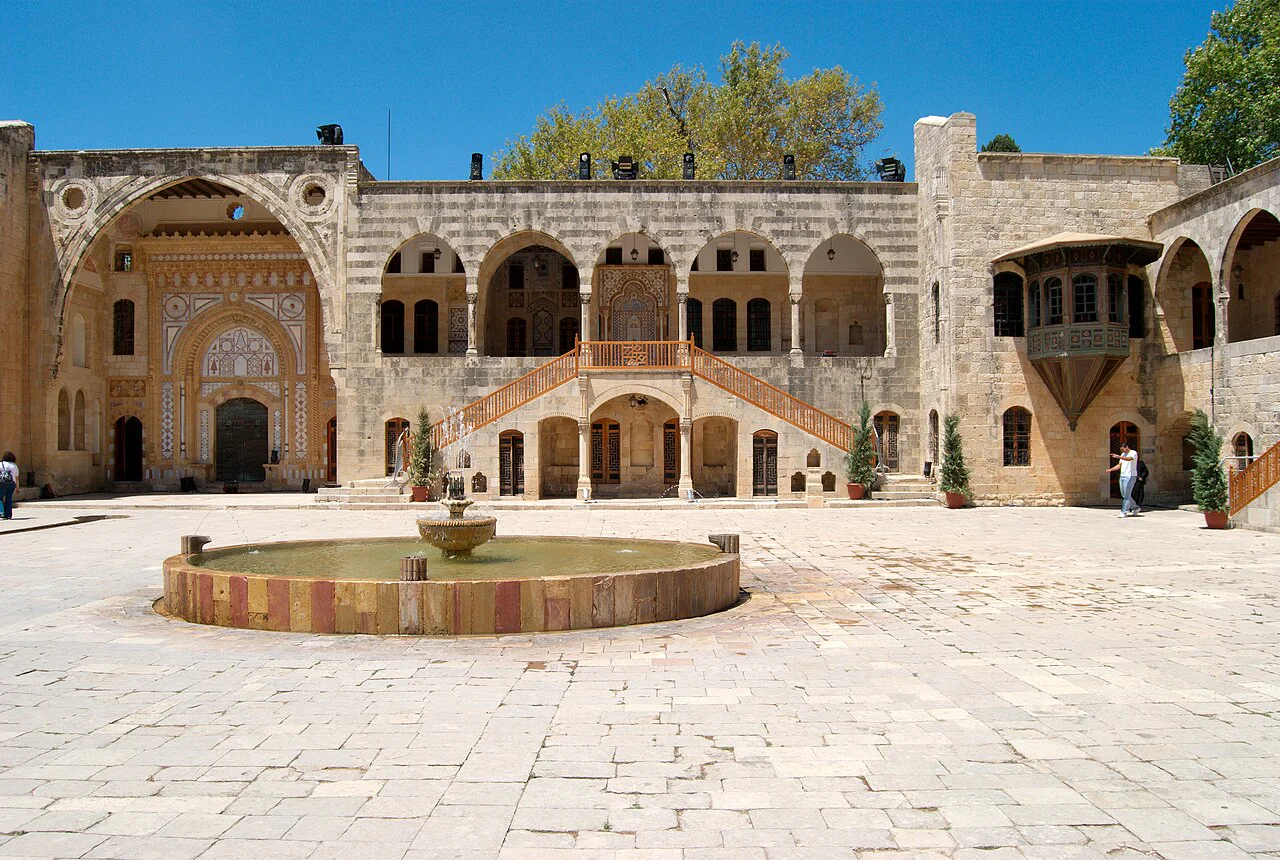
Beit ed-Dine · 68 km
Beiteddine Palace
Content & sources
Photo: Peripitus · CC BY-SA 3.0
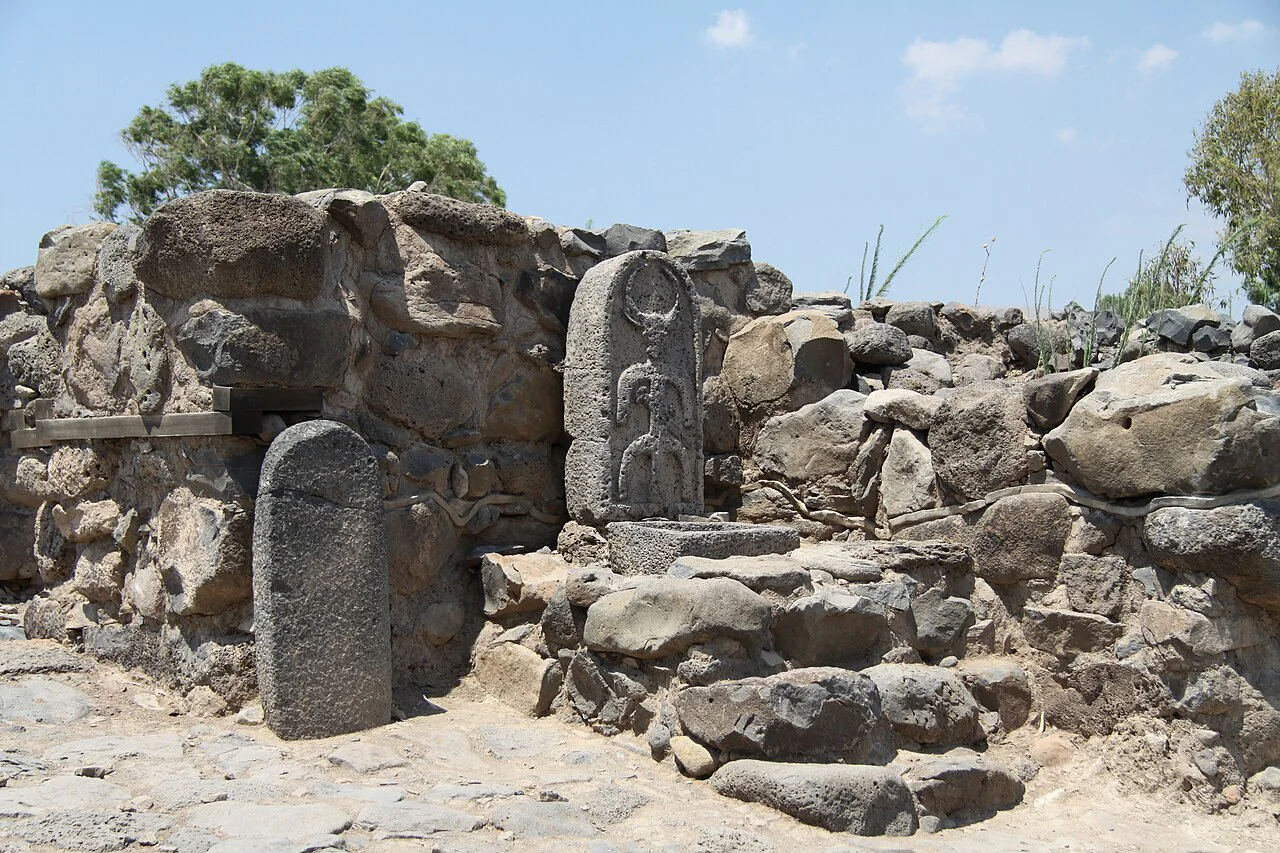
Golan Regional Council · 133 km
Bethsaida
Content & sources
Photo: Chmee2 · CC BY 3.0