Stanza · Audio guide
Bonampak Audio Guide
A place to remember. A story to take with you.
Bonampak is an ancient Maya archaeological site located in the Mexican state of Chiapas. The site is well known for its three-roomed Structure 1, which contains some of the best-preserved Maya murals.
Download Stanza, then search for “Bonampak”.
About the tour
One guide. Your kind of visit.
Bonampak is an ancient Maya archaeological site located in the Mexican state of Chiapas. The site is well known for its three-roomed Structure 1, which contains some of the best-preserved Maya murals.
Ready when you are.
- 01Get the free Stanza app.
iOS & Android
- 02Find your guide.
“Bonampak”
- 03Download before you go.
Works offline
Audio guide / 11 narrated stops
Inside the guide
Get to know a few of the stories before you go. Open a stop to read more.
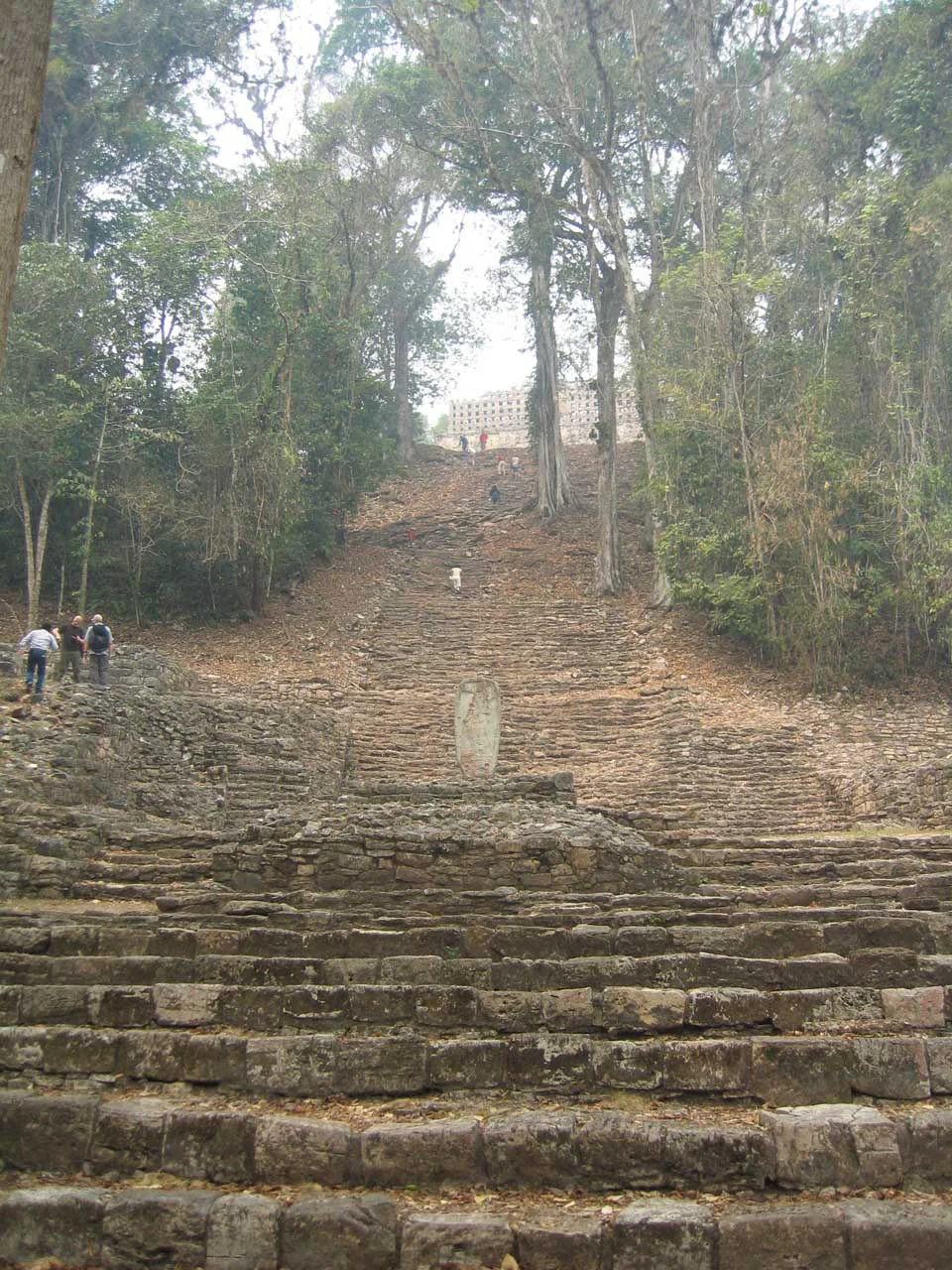
01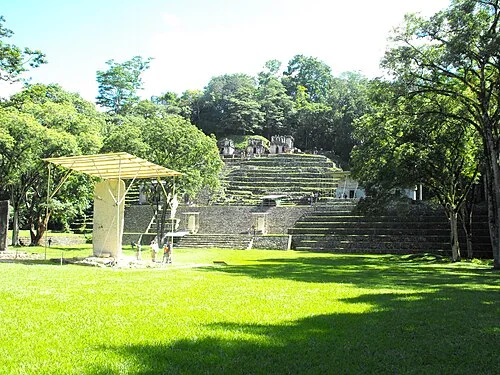 Gran Plaza Entrance & Rainforest Discovery
Arriving at the Gran Plaza
Bonampak is a small Maya city in the rainforest of Chiapas, in southern Mexico. Its buildings went up in the Late Classic period, between roughly 580 and 800 AD. The Gran Plaza is a broad ceremonial space, about ninety by a hundred and ten meters, ringed by low stepped platforms with the Acropolis rising at its south end. For all its modest size, Bonampak holds some of the best-preserved murals the Maya ever made. They fill the three rooms of Structure 1, the Temple of the Murals, up on that Acropolis. The story of how outsiders reached them begins with the Lacandon Maya. They never forgot the place, and kept coming to pray in its old temples. In 1946 they guided several visitors here, among them the travelers Carlos Frey and John Bourne, and the photographer Giles Healey. Healey was the first to be shown the painted rooms. Today the discovery itself is credited to two of the Lacandon men, José Pepe Chambor and Acasio Chan. The paintings they revealed tell one royal story, from the presentation of an heir to battle and finally a victory rite.
diego_cue · CC BY-SA 3.0
02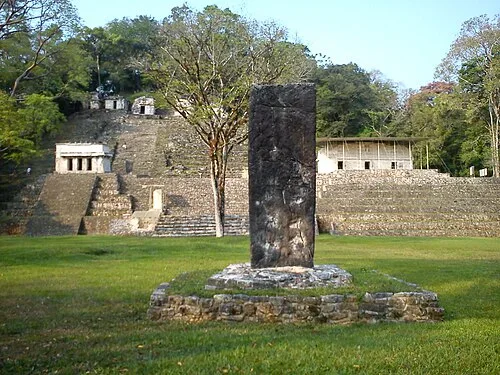 Stele 1 & The Gran Plaza
Stele 1: Chan Muwan II in Stone
In the center of the plaza stands Stele 1, one of the tallest monuments in the Maya world. It rises almost six meters, cut from a single slab of limestone of very little thickness. The carvers managed the whole thing without a single fracture. The figure on the stone is Chan Muwan the Second, shown at the height of his power, standing with a ceremonial cane. The carved pupil of his eye gives his gaze unusual force. At the bottom of the stele, the earth monster opens, and the faces of the young maize god emerge from it. A band of glyphs beneath the ruler's feet names his genealogy. Another vertical band carries the emblem glyph of Bonampak itself. It is dynastic power set in stone, and the painted rooms above carry the same message.
Photo: Ihiroalfonso · CC BY-SA 3.0
03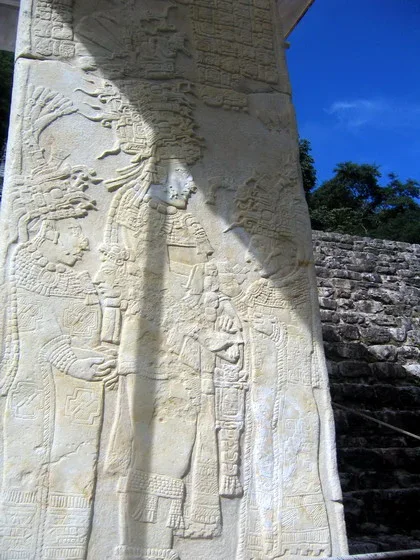 Acropolis Lower Terraces & Stele 2
Stele 2 and the Yaxchilán Connection
This finely carved stela stands where Bonampak's political story begins. By around 600 AD the city had become a satellite of Yaxchilan, a larger capital about thirty kilometers away. The king of Yaxchilan installed Yajaw Chan Muwaan the First as lord here, and later rulers rebuilt the site to face the metropolis. Around 790, King Shield Jaguar the Third oversaw the installation of Chan Muwaan the Second. He sealed the alliance by marrying his sister, Lady Yax T'ul, to the new lord. Then he hired artisans from Yaxchilan to commemorate it, commissioning them to paint the walls of Structure 1. Those hired painters created the murals that made Bonampak famous.
Listen in the appmomo · CC BY 2.0
04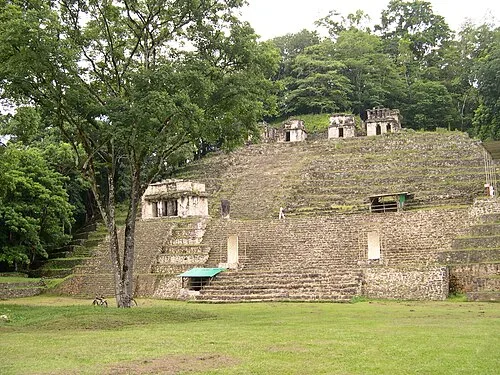 Structure 1 Facade & Carved Entrance Lintels
The Acropolis and Structure 1
The building that made Bonampak famous sits on the Acropolis terraces. Structure 1, the Temple of the Murals, was built at the end of the eighth century. It runs about sixteen meters long and four meters deep, rising seven meters from a T-shaped platform. Structurally it is symmetrical and balanced, composed of three separate rooms. Some speculate it may once have carried a roofcomb, like one visible at Yaxchilan, though there is no evidence for it. What is certain is the paint. The whole exterior glowed with Maya blue, blue-green, red and yellow. A band of some eighty glyphs once wrapped around the building. Small niches above each room held seated figures, likely images of ruling lords. Inside, even the floors were painted black, and only the tops of the benches stayed bare. The artists framed the lower course of the walls like a painted Maya vase in the codex style of the Petén.
Listen in the appPhoto: Jacobolus · CC BY 2.0
05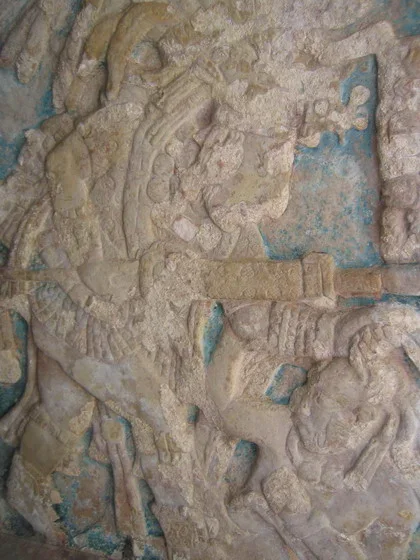 Structure 1 Facade & Carved Entrance Lintels
The Carved Lintels and the Bowing Doorway
Over the doorway to each room runs a carved lintel, and this relief still carries its original Maya blue background. Each lintel shows a warrior subduing a captive. The doorways themselves stand only about one and three-quarter meters high, and roughly ninety centimetres wide. A Maya noble in full regalia could never have entered without a bow of deferential respect. The carvings also carry dates. Lintel 1, over the first room, shows the ruler Yajaw Chaan Muwan capturing an enemy on January 12, in the year 787. Lintel 2 probably shows the Yaxchilan overlord Shield Jaguar, four days later that same January. Lintel 3 displays Aj Sak Teles, probably from 780. The bound figures carved in stone are a preview of the painted captives waiting inside.
Listen in the appmomo · CC BY 2.0
06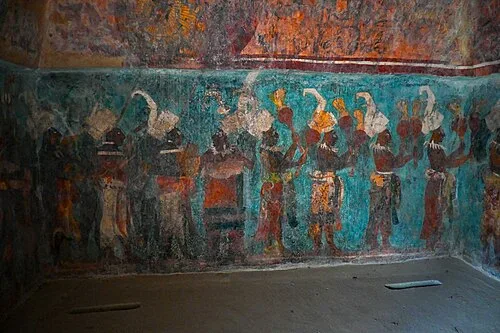 Room 1: Court Life and Royal Heir
Room 1: The Heir Presented at Court
Inside the first room, the murals begin where the story begins: at court. Room 1 holds seventy-seven human figures, gathered for tribute, dressing, dance, mummery and musical performance. At its heart is a regal event. The ruler, Yajaw Chaan Muwan, acknowledges before the court and visiting dignitaries that his son has the right to rule. That son dances at the center of the south wall, between his brothers Bird Balam and Aj Balam. The three young heirs wear large feathered back-racks trimmed with jaguar, quetzal and serpent elements, heels raised in mid-step. To their other side stand eight sajals, the regional governors. One of them holds a long thin cigarette with an air of pure boredom. Across all three rooms the painters depicted two hundred and eighty-one human figures, and about a third of them carry name captions. The art historian Mary Miller wrote that perhaps no single artifact from the ancient New World offers as complex a view of Prehispanic society as these paintings.
Listen in the appPhoto: ProtoplasmaKid · CC BY-SA 4.0
07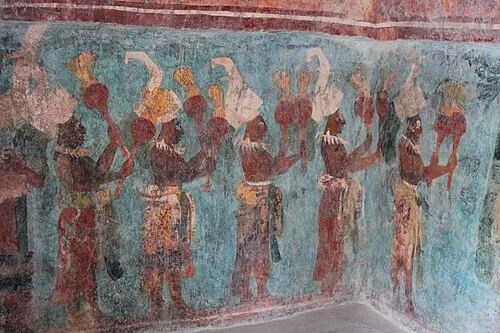 Room 1: Court Life and Royal Heir
The Musicians of Room 1
Along one wall of Room 1, a procession of musicians fills the painted court with sound. They shake rattles, beat drums, and strike turtle shells. On the lower register of the north wall, more musicians blast long trumpets skyward, while other performers parade in costume, one of them dressed as a crocodile. Above the middle register runs the Initial Series text, a passage set off as if it were spoken aloud. Those glyph brackets are the only quotation marks in all of the pre-Columbian New World.
Listen in the appArian Zwegers from Brussels, Belgium · CC BY 2.0
08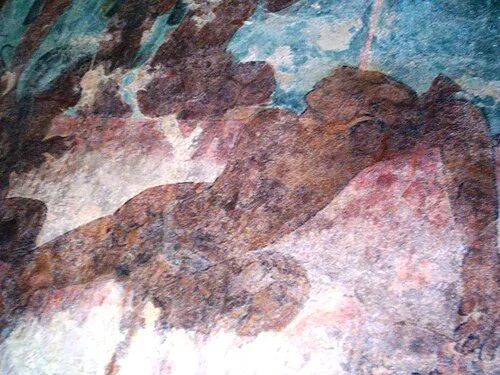 Room 2: Maya Warfare and Graphic Sacrifice
Room 2: Battle and Its Prisoners
Room 2 is the largest of the three, and it holds what has been called the greatest battle scene in all of Maya art. One hundred and thirty-nine figures fight across the south, east and west walls, bodies intertwined on two registers while trumpets blast. The painters marked victory and defeat with deliberate signs. The Maya read left-handedness as a sign of weakness, so the defeated are shown left-handed, some even given two left hands. Those still dressed wear elements of the bird, the mark of defeat. The victors wear the jaguar, and several are given two right hands, doubling their strength. At the center, Yajaw Chan Muwaan grips a jaguar-skin spear in a jaguar headdress, jerkin and boots. Early archaeologists had long pictured the Maya as a peaceful people devoted to religion and astronomy. These walls ended that idea. Mary Miller called the scene official historical portraiture, not by any means a photographic glimpse of Maya warfare. Bonampak's version is propaganda, and the losers' costumes give it away: no one intending to win would dress for defeat.
Listen in the appPhoto: BIOLOGO JORGE AYALA · CC BY-SA 4.0
09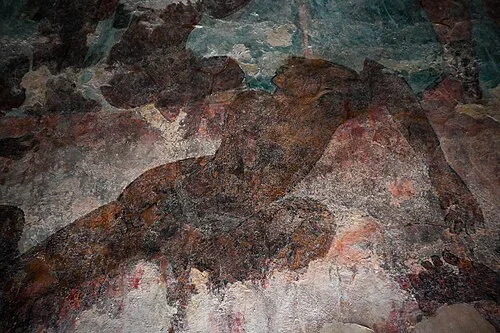 Room 2: Maya Warfare and Graphic Sacrifice
The North Wall and the Tomb Below
The north wall of Room 2 continues the battle to its end. Captives, stripped to loin cloths, are shown in deep agony as their fingernails are torn off and their wounds bleed. One has already expired, and one is only a severed head. Yajaw Chan Muwaan stands over them in a variant of his battle costume, while warriors and nobles observe, among them his wife. A visitor of the time would have sat on the south bench above bound captives, becoming part of the scene. Below the floor, another story came to light in 2010, when a radar survey found a tomb beneath this room. It held one man between thirty-five and forty-two years old, his skeleton complete except for the cranium, lost to erosion rather than beheading. He was buried with jade earrings, a necklace and bracelets, a spondylus shell pendant, two polychrome plates, a perforated alabaster vase and a stone knife. The vase and the knife lead some to think he was one of the sacrifice victims painted above. Others call him a wounded warrior, or a relative of the ruler, since his jewelry matches that of the nobles in Room 1. The tomb was part of the building's original construction, not added later.
Listen in the appPhoto: ProtoplasmaKid · CC BY-SA 4.0
10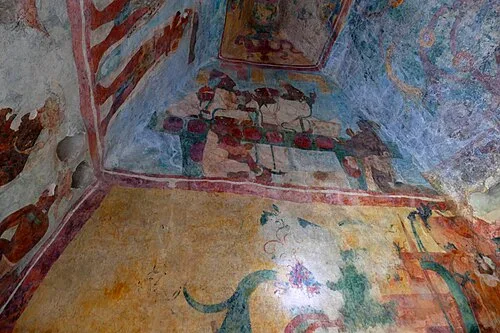 Room 3: Victory Celebration and Bloodletting
Room 3: Victory Dance and Bloodletting
The last room celebrates. Room 3 holds sixty-five human figures caught in a victory dance that engulfs the viewer, with more musicians raising their instruments skyward. The three brothers from Room 1 return at its center, now in tall green quetzal-feather headdresses and dancers' wings. Each holds a femur bone modified into a ritual ax. In 1996 a team from Yale led by Mary Miller began the Bonampak Documentation Project, making a detailed photographic record of the murals with infrared light. Artists Heather Hurst and Leonard Ashby turned those images into reproductions that recovered details lost to erosion and to failed, sometimes damaging, preservation attempts. The infrared work settled one mystery. A kneeling figure below the heir holds something in his left hand that the naked eye can no longer see. It is the still-beating heart of a sacrificial victim, who is being dragged down the pyramid steps by two attendants. Above, on the east wall, noblewomen perform ritual bloodletting, and in the vault directly over them a supernatural entity spews blood.
Listen in the appBernard DUPONT from FRANCE · CC BY-SA 2.0
- 11
From the Acropolis: What Bonampak Means
From the high terraces: the ninth-century abandonment, and why the murals survived to show the Maya as they portrayed themselves.
Bonampak
Frequently asked questions
How much does the guide cost?
Free app download. Listed guide price: $0.99. Guide price shown in the app. Audio guide only. Venue admission is separate.
Can I listen without internet?
Yes. Download the guide’s audio, images, and maps in the app before your visit. Your downloaded content is then available offline.
Can I listen in my language?
This audio guide is available in 15 languages, including English.
Do I need to follow a schedule?
No. This is a self-guided experience. Choose your stops, pause whenever you like, and return to a story at your own pace.
At your own pace
Explore Bonampak.
Download Stanza, then search for “Bonampak”.
Free app download · Guide price shown in the app
Keep exploring
Audio guides — Mexico
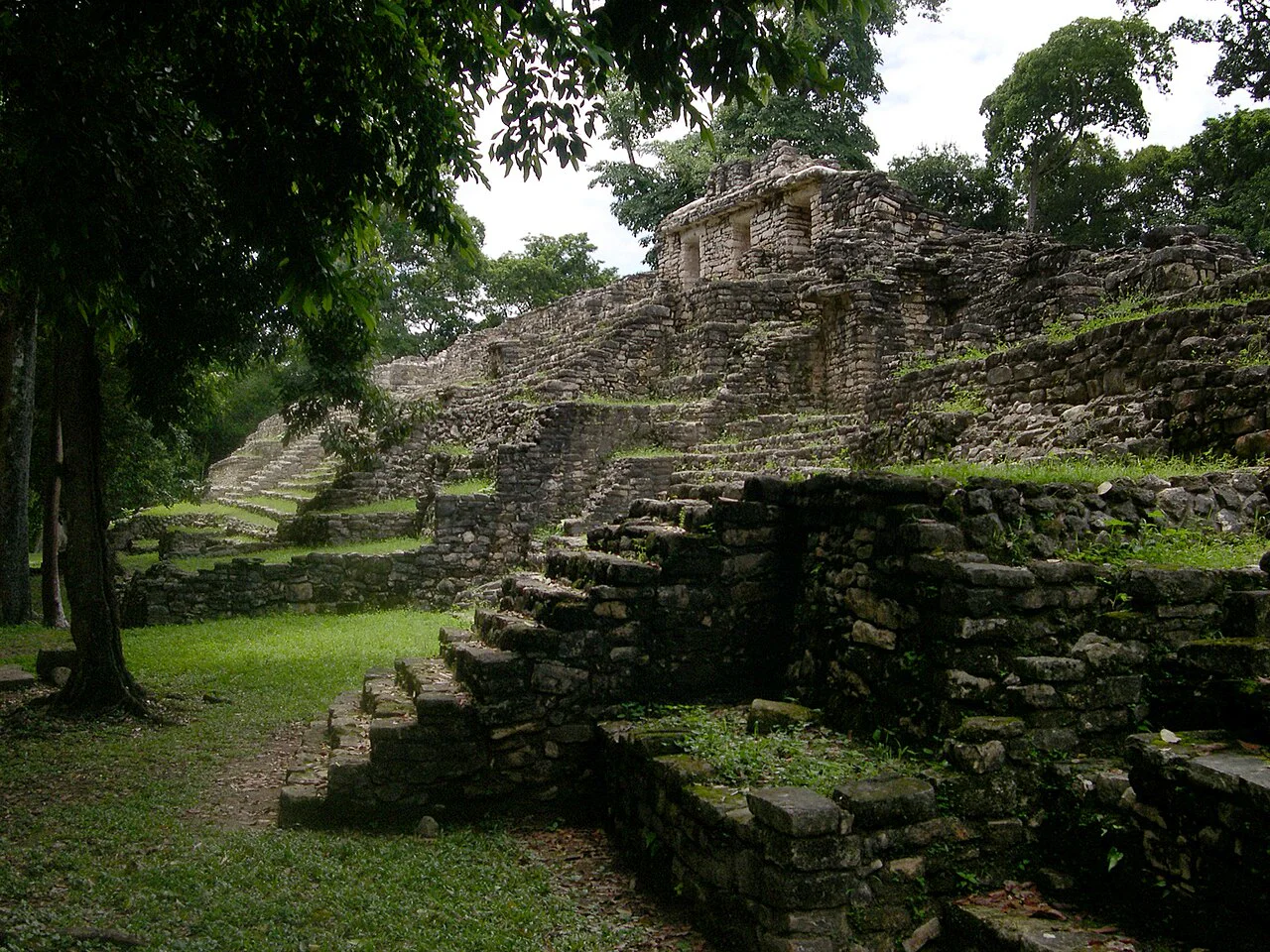
Ocosingo · 24 km
Yaxchilán
Content & sources
Jacob Rus · CC BY-SA 2.0
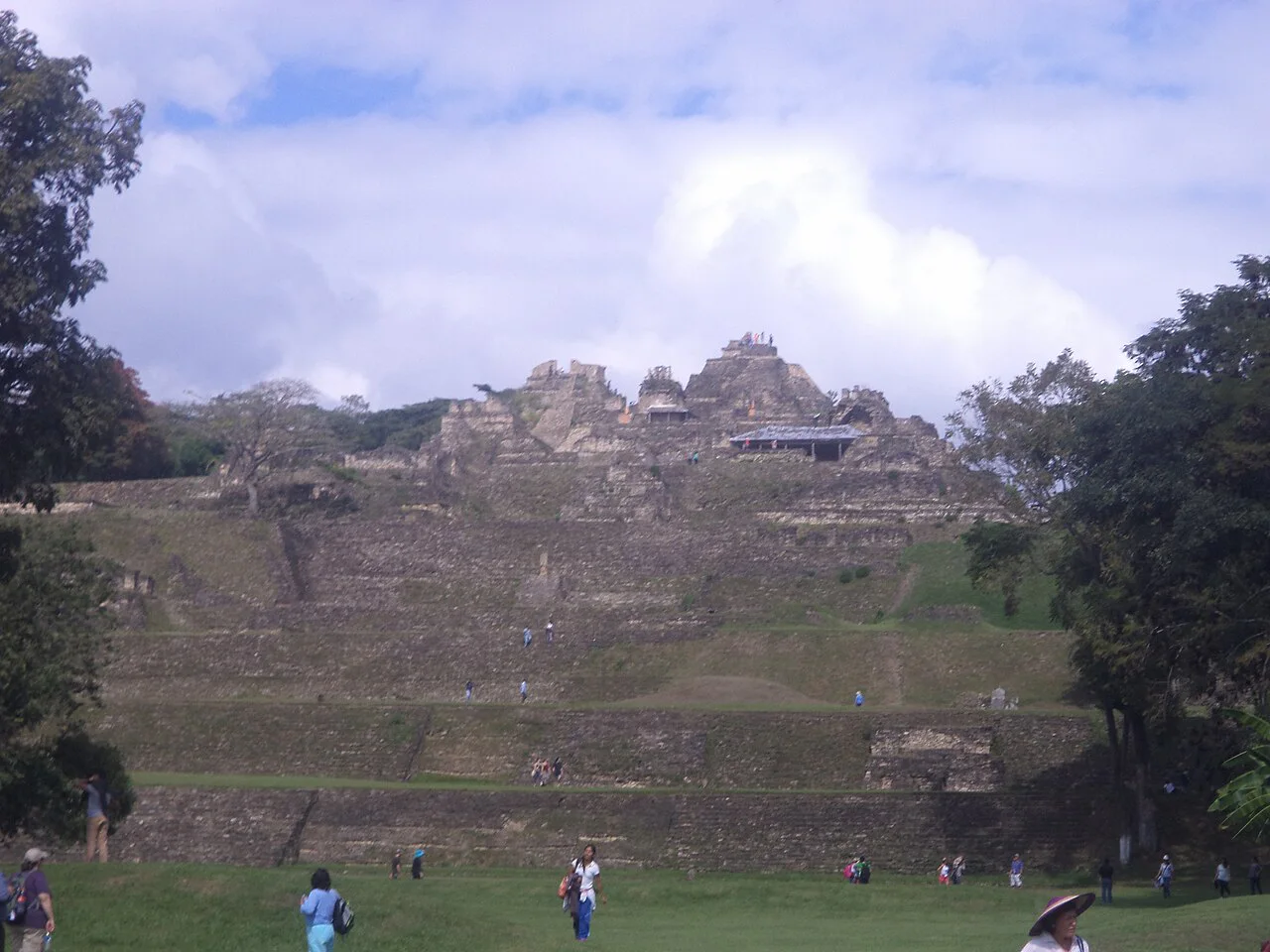
Ocosingo · 103 km
Toniná
Content & sources
Photo: Dge · CC BY-SA 4.0
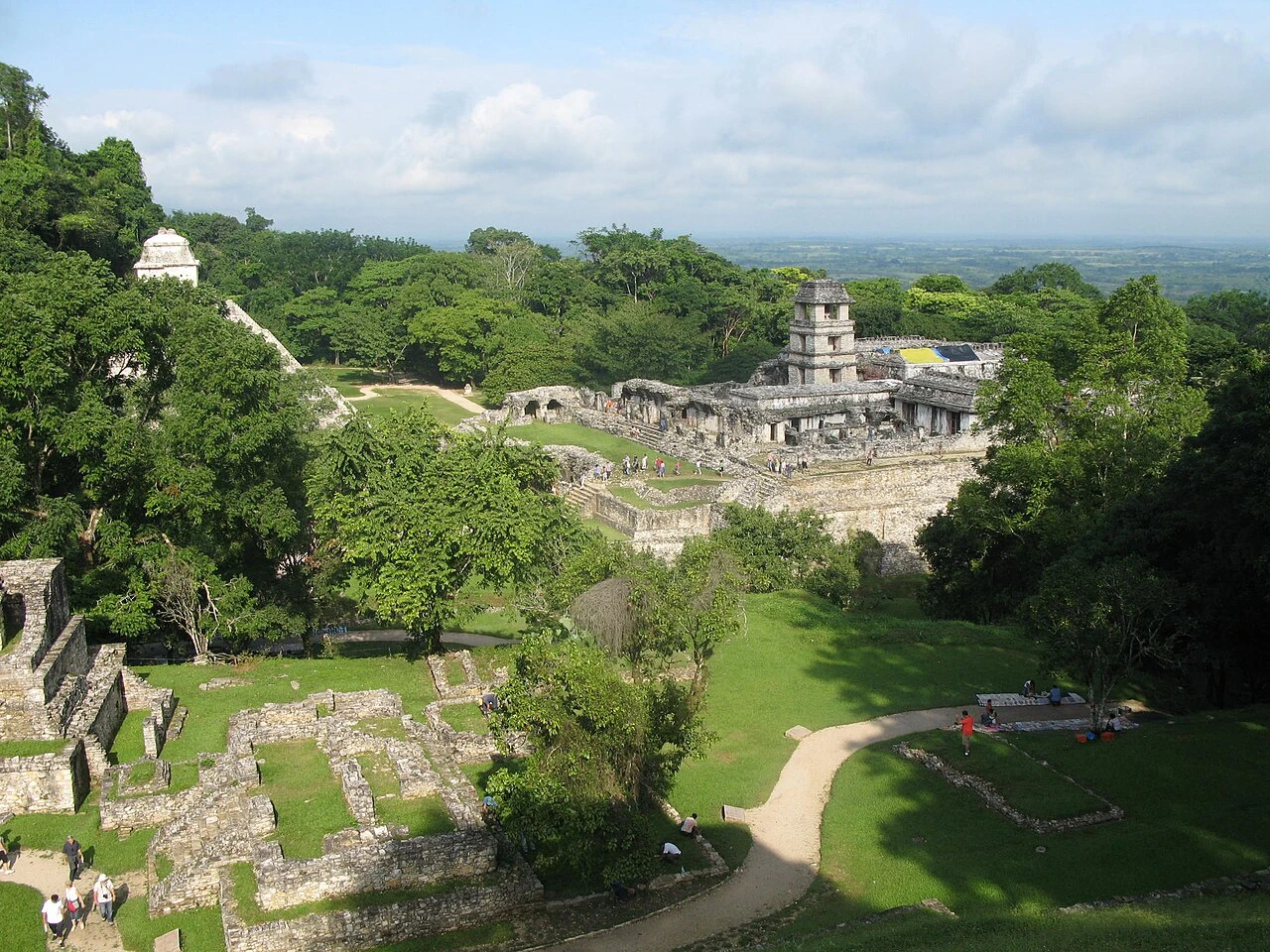
Palenque · 136 km
Palenque
Content & sources
Ljuba brank at Slovenian Wikipedia · CC BY-SA 3.0
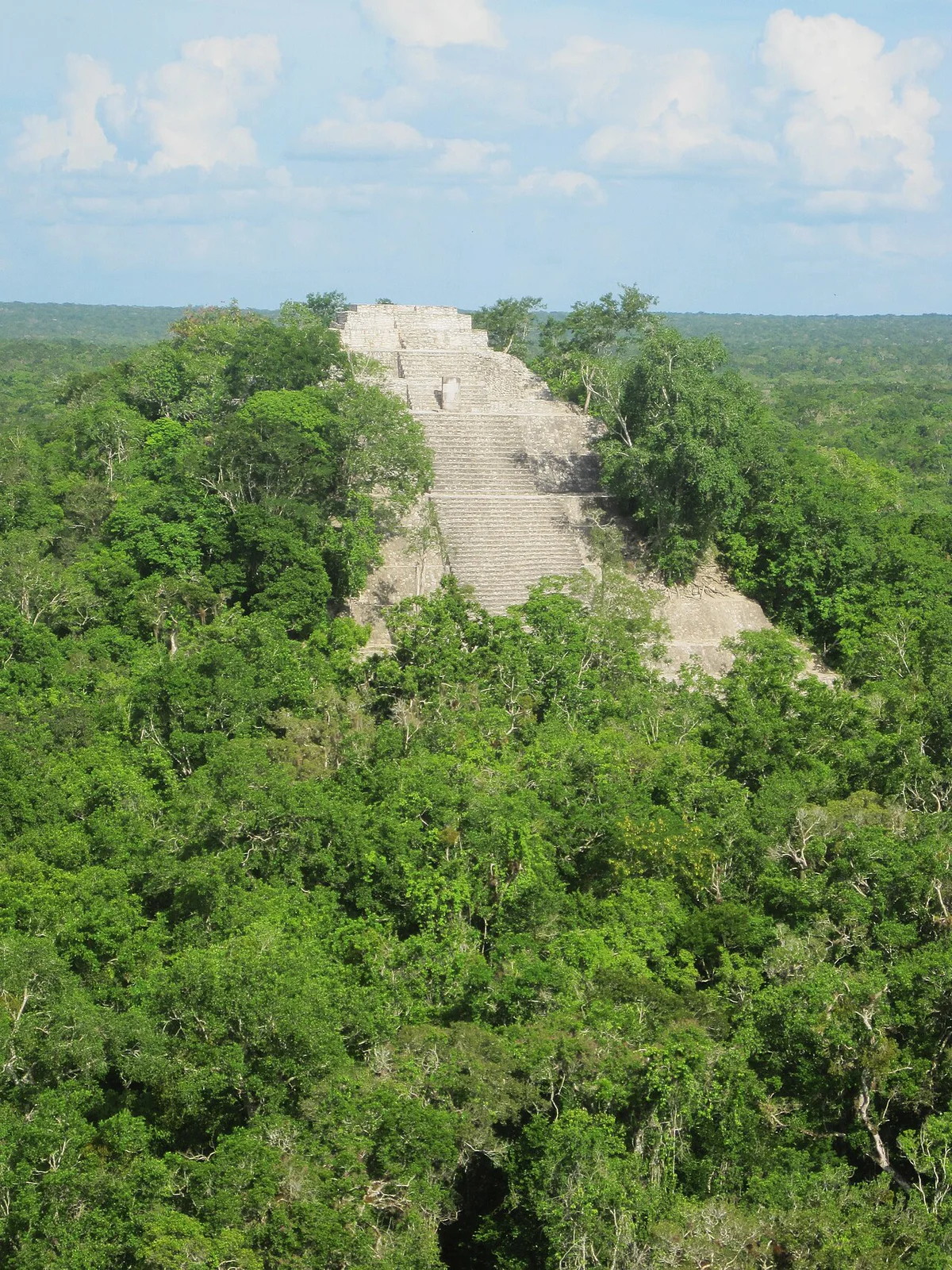
Calakmul
Calakmul
Content & sources
Pavel Kirillov from St.Petersburg, Russia · CC BY-SA 2.0