Stanza · Audio guide
Yaxchilán Audio Guide
A place to remember. A story to take with you.
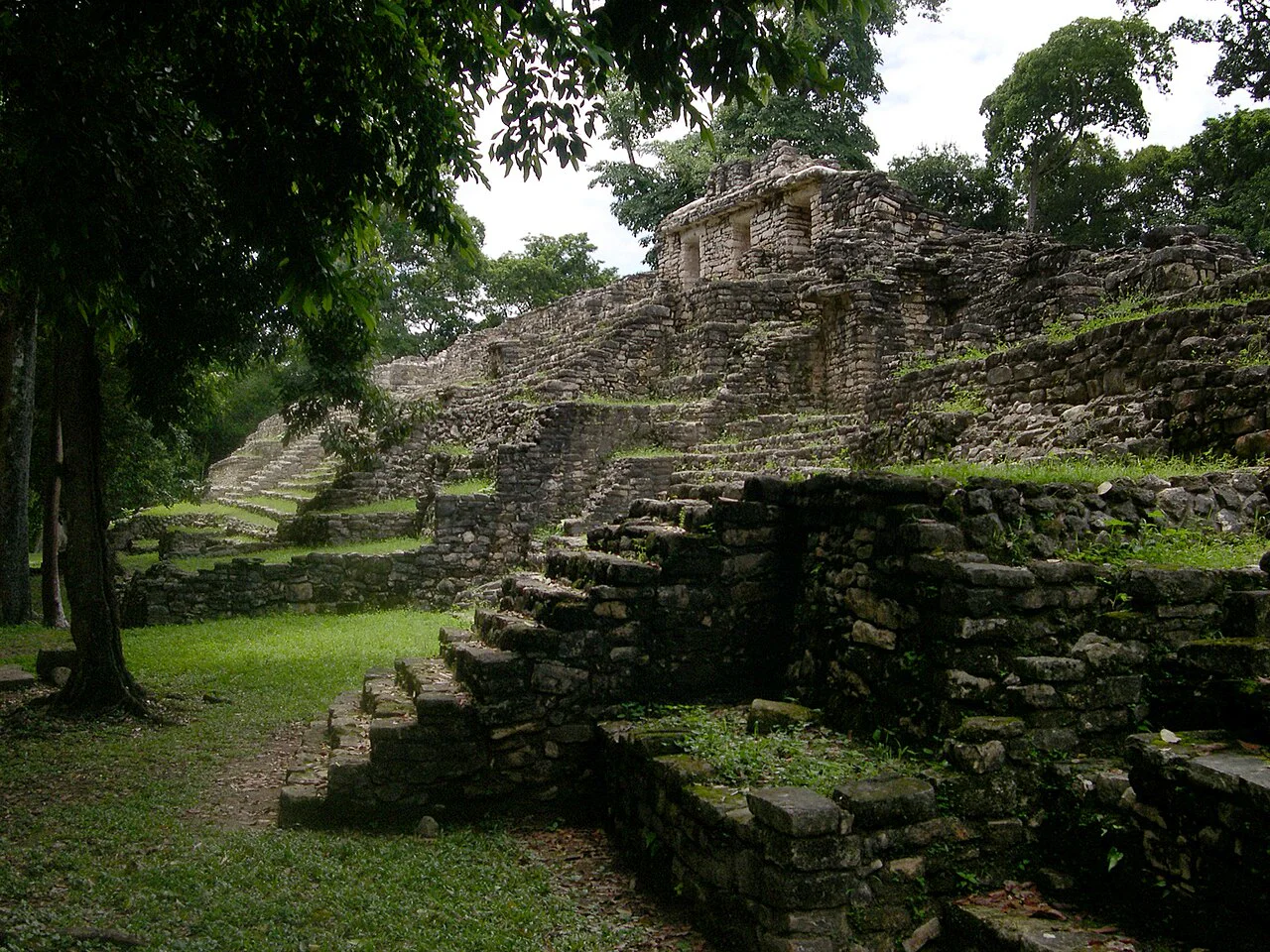
Yaxchilan is an ancient Maya city located on the bank of the Usumacinta River in the state of Chiapas, Mexico. During the Late Classic Period, it was one of the most powerful Maya states along the river.
Download Stanza, then search for “Yaxchilán”.
About the tour
One guide. Your kind of visit.
Yaxchilan is an ancient Maya city located on the bank of the Usumacinta River in the state of Chiapas, Mexico. During the Late Classic Period, it was one of the most powerful Maya states along the river.
Ready when you are.
- 01Get the free Stanza app.
iOS & Android
- 02Find your guide.
“Yaxchilán”
- 03Download before you go.
Works offline
Audio guide / 16 narrated stops
Inside the guide
Get to know a few of the stories before you go. Open a stop to read more.
01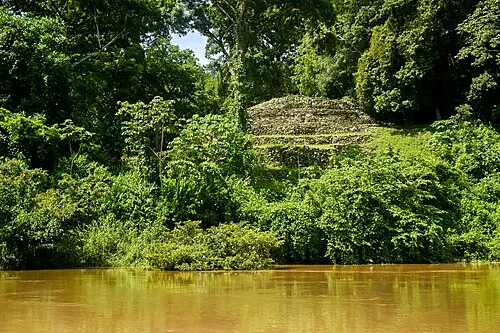 Usumacinta Riverboat Landing and Natural River Defense
The Usumacinta Riverbank Approach
Yaxchilán sits on the south bank of the Usumacinta River, in the Mexican state of Chiapas. Here the river loops in a horseshoe, and the city stands at the tip of the bend. That loop defends the site on all sides except one narrow land approach, from the south. The boat ride down from Frontera Corozal takes about an hour. The river was also a trade route. In the Late Classic period, Yaxchilán was one of the most powerful Maya states along its course. Its major rival was Piedras Negras, about forty kilometres upriver. Both cities struggled to dominate the trade route. That rivalry had already begun by the fifth century. In 460, a king named Moon Skull is credited with a victory over Piedras Negras. He is also credited with capturing the enemy king, known only as Ruler A.
Photo: ProtoplasmaKid · CC BY-SA 4.0
02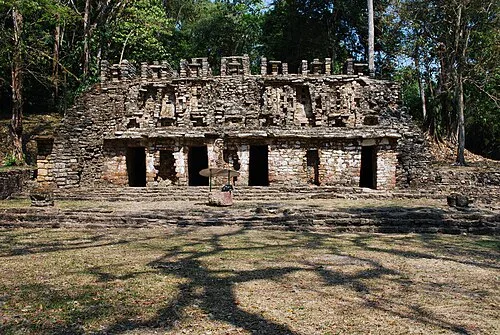 Structure 19 (The Labyrinth)
: Front Facade
Structure Nineteen is a temple on the western edge of the Central Acropolis. It is also known as the Labyrinth. Its front has four doorways across the lower wall. Between them are three niches, each the same size as a doorway. Carved decoration runs across the upper part of the front. The building still has remains of a perforated roof comb, a stone crest along the roofline with openings cut through it. Two sculptured altars stand in front of the building.
Photo: Thelmadatter · CC BY-SA 3.0
03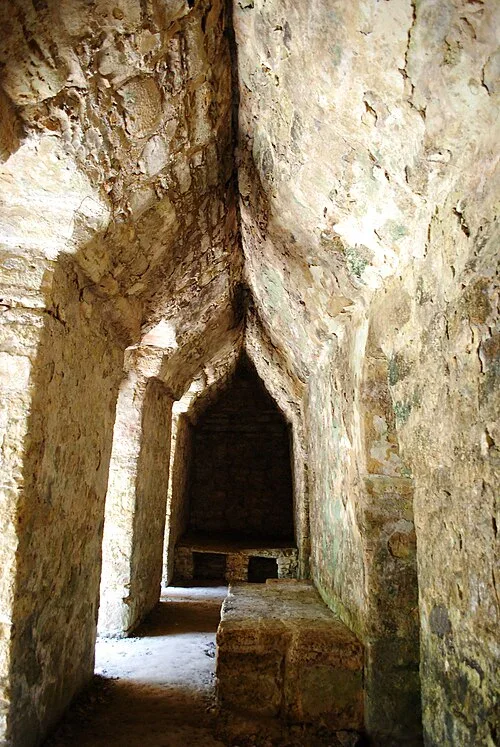 Structure 19 (The Labyrinth)
: Interior Passage
Inside Structure Nineteen, the rooms are spread over three levels, and interior stairways link them. This corridor is narrow and dim. Its walls lean inward as they rise, and they meet in a pointed vault overhead. That is a corbelled vault. Maya builders roofed spaces this way, stepping each row of stone a little further inward than the one below. Eventually the gap closes at the top. A low stone bench runs along one side. At the far end, a dark opening sits in shadow.
Listen in the appThelmadatter · CC BY-SA 3.0
04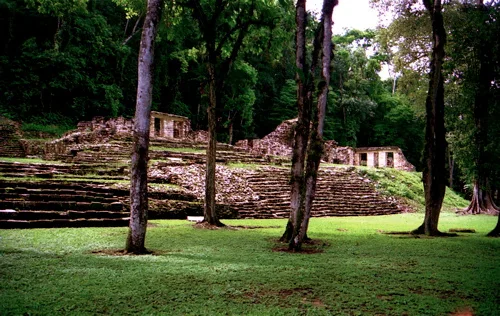 The Main Plaza and Northwestern Ballcourt (Structure 14)
The Main Plaza
Yaxchilán has its origins in the Preclassic period. Much of what is known of the city's Classic history comes from hieroglyphic texts, the Maya writing carved in stone by its kings. The known history starts with Yopaat B'alam the First, who most likely took the throne in 359. Yaxchilán was still a minor site then. He founded a long dynasty, one that lasted into the early ninth century. Today the Main Plaza is a grassy open space. Palaces and temples border it, on a terrace above the Usumacinta River. Stepped stone platforms rise at the back, and two small buildings with doorways sit on top.
Listen in the appRoberto LIebig from Cancun , Mexico · CC BY 2.0
05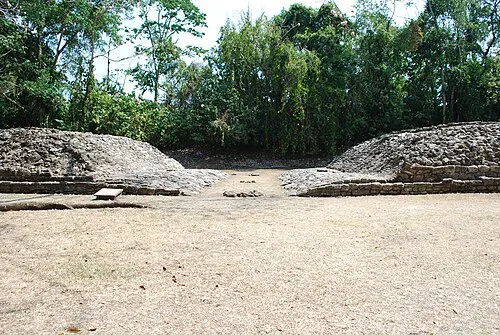 The Main Plaza and Northwestern Ballcourt (Structure 14)
Northwestern Ballcourt (Structure 14)
Structure Fourteen is the northwest ballcourt, and it lies on the Main Plaza. Ballcourts were built across Mesoamerica for a ballgame, though how this game was played here is not clear. The court is a flat, open alley between two sloping banks. Five sculpted ballcourt markers were found here. Three were set along the playing area, and one stood on each of the two platforms at the sides. One of the five has been taken from the site. The rest are broken and eroded.
Listen in the appPhoto: Thelmadatter · CC BY-SA 3.0
06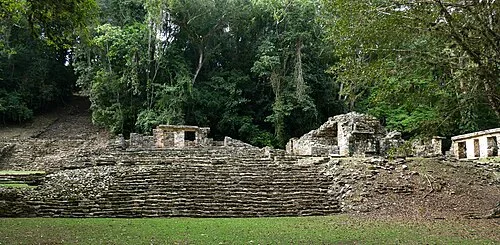 Structure 23 (Palace of Lady K'ab'al Xook and the Sacred Lintels)
Structures 22 and 23
Structure Twenty-Three stands on the Central Acropolis, overlooking the Main Plaza. It was built during the reign of Itzamnaaj B'alam the Second. He took the throne in October 681 and ruled for more than sixty years. In the last third of that reign, he oversaw a huge building programme that changed the centre of the city. This building was the first major construction after a gap of a hundred and fifty years. It is dedicated to Lady K'ab'al Xook, a wife of the king. Its three doorways once carried carved stone lintels. The lintels seem to have been meant to reinforce the king's line and his right to rule.
Listen in the appBernard DUPONT from FRANCE · CC BY-SA 2.0
07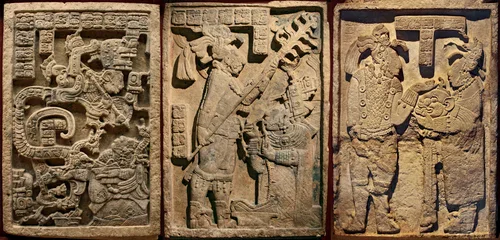 Structure 23 (Palace of Lady K'ab'al Xook and the Sacred Lintels)
Lintels 24, 25 and 26 from Structure 23
These three carved lintels were once a set, spanning the doorways of Structure Twenty-Three. Explorers Alfred Maudslay and Désiré Charnay arrived at Yaxchilán within days of each other in 1882. Maudslay ordered several lintels removed from the site. Lintels Twenty-Four and Twenty-Five were taken at the end of the nineteenth century, and they are now in the British Museum, in London. Lintel Twenty-Six is in the National Museum of Anthropology in Mexico City. It dates to 726 and carries a portrait of Itzamnaaj B'alam the Second.
Listen in the appLinteau 25 => ShadowgateFile:British Museum (6424926723).jpg ; Linteau 24 => Michel walFile:Yaxchilan Lintel 24.jpg ; Linteau 26 => Gary ToddFile:Maya Lintel (9756677072).jpg · CC BY-SA 4.0
08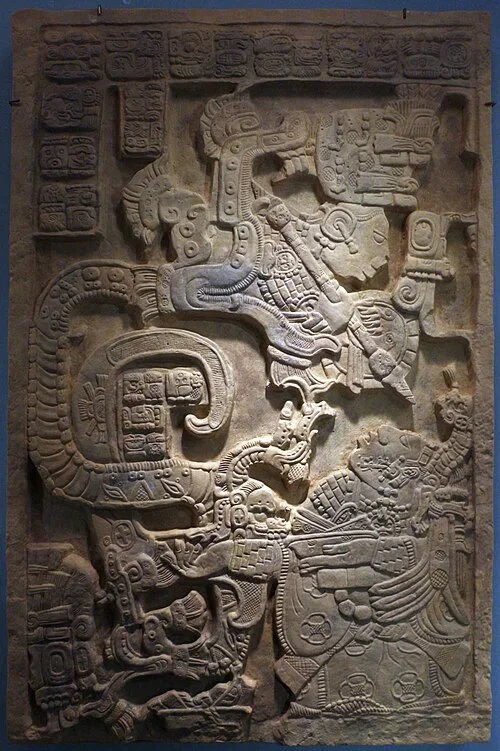 Structure 23 (Palace of Lady K'ab'al Xook and the Sacred Lintels)
Lintel 24: The Bloodletting Ritual
Lintel Twenty-Four is regarded as a masterpiece of Maya art. It is carved from limestone and once spanned the southeast doorway of Structure Twenty-Three. It shows a sacred bloodletting ritual, in which blood is drawn from the body. The ceremony took place on the twenty-eighth of October, 709. Itzamnaaj B'alam the Second stands holding a burning torch over his wife, Lady K'ab'al Xook. She kneels and pulls a spiked rope through her tongue. A screenfold book lies in a basket before her. It is a book folded back and forth, like a folding screen. The stone still carries traces of red and blue pigment.
Listen in the appPhoto: Sailko · CC BY 3.0
09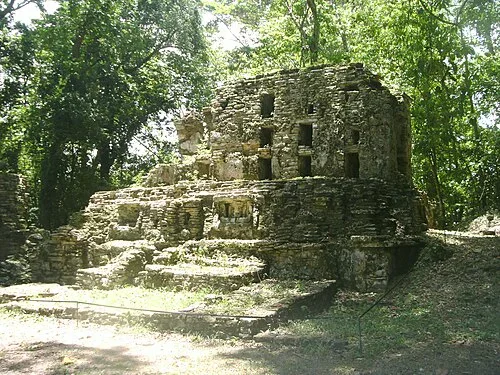 Riverside Palaces and Glyphic Inscriptions
Structure 6
Structure Six was changed after it was first built, and its doorways show it. There are six doorways in all. Three face the Main Plaza, and the rest were cut into the sides of the building. The plaza doorways were blocked up in ancient times. The reason the old ones were closed is not known. The plaza front still keeps its frieze, a carved band that includes a sculpted head. A perforated roof comb survives as well. Its lower part is a stepped stone base, and its upper wall is marked by rows of niches. It is believed to date to the Early Classic period.
Listen in the appPhoto: Noche de la pena · CC BY-SA 3.0
10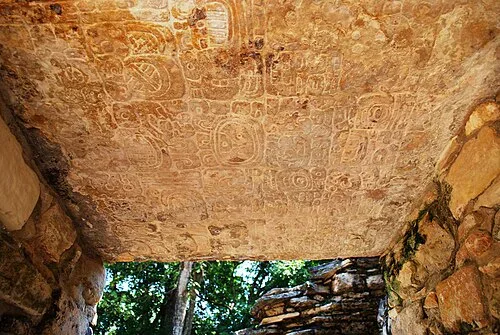 Riverside Palaces and Glyphic Inscriptions
Inscribed Lintel (Glyph Panel)
This inscribed lintel carries a hieroglyphic text, one of many at Yaxchilán about the city's history. Tatiana Proskouriakoff was a Mayanist, a scholar of Maya culture, and she did pioneering work on reading those texts. Working from the inscriptions of Yaxchilán, she identified the glyphs for death, for capture and for captor. Her volumes, titled Historical Data in the Inscriptions of Yaxchilán, came out in 1963. Peter Mathews and others have expanded on her early work since then.
Listen in the appPhoto: Thelmadatter · CC BY-SA 3.0
- 11
The Great Stairway to Structure 33
A steep stone stairway lifts a temple above the plaza, and its top step is carved.
- 12
Hieroglyphic Stairway 2: Ballgame Panel
The carvings on the front of the top step are linked to the ballgame, and one section is dated to 757.
- 13
Structure 33 (Temple Dedicated by Bird Jaguar IV)
This temple has three carved doorways, a roof comb full of openings, and a view over the river.
- 14
Headless Figure in the Structure 33 Niche
A headless sculpture in a dim niche is probably Bird Jaguar the Fourth, and some Lacandon Maya still make pilgrimages to the site.
- 15
West Acropolis Building
A tall wall of small openings rises above tree roots on the forested West Acropolis.
- 16
Stela 11
A carved monument shows a king and his father, and it raises the question of how the past was rewritten.
Yaxchilán
Frequently asked questions
How much does the guide cost?
Free app download. Listed guide price: $1.99. Guide price shown in the app. Audio guide only. Venue admission is separate.
Can I listen without internet?
Yes. Download the guide’s audio, images, and maps in the app before your visit. Your downloaded content is then available offline.
Can I listen in my language?
This audio guide is available in 15 languages, including English.
Do I need to follow a schedule?
No. This is a self-guided experience. Choose your stops, pause whenever you like, and return to a story at your own pace.
At your own pace
Explore Yaxchilán.
Download Stanza, then search for “Yaxchilán”.
Free app download · Guide price shown in the app
Keep exploring
Nearby audio guides
Ocosingo · 24 km
Bonampak
Content & sources
Photo: Oleksii0 · CC BY-SA 3.0
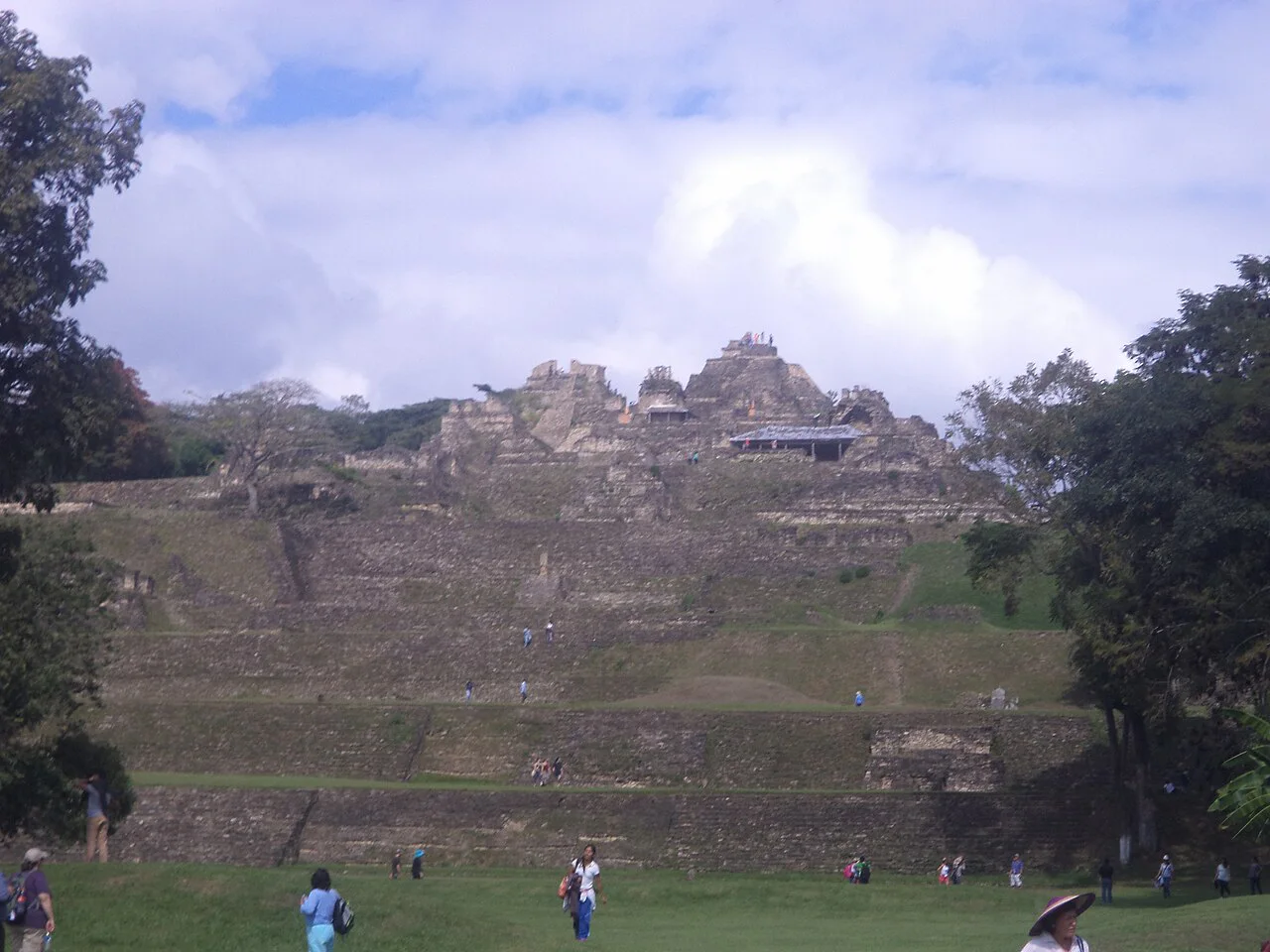
Ocosingo · 111 km
Toniná
Content & sources
Photo: Dge · CC BY-SA 4.0
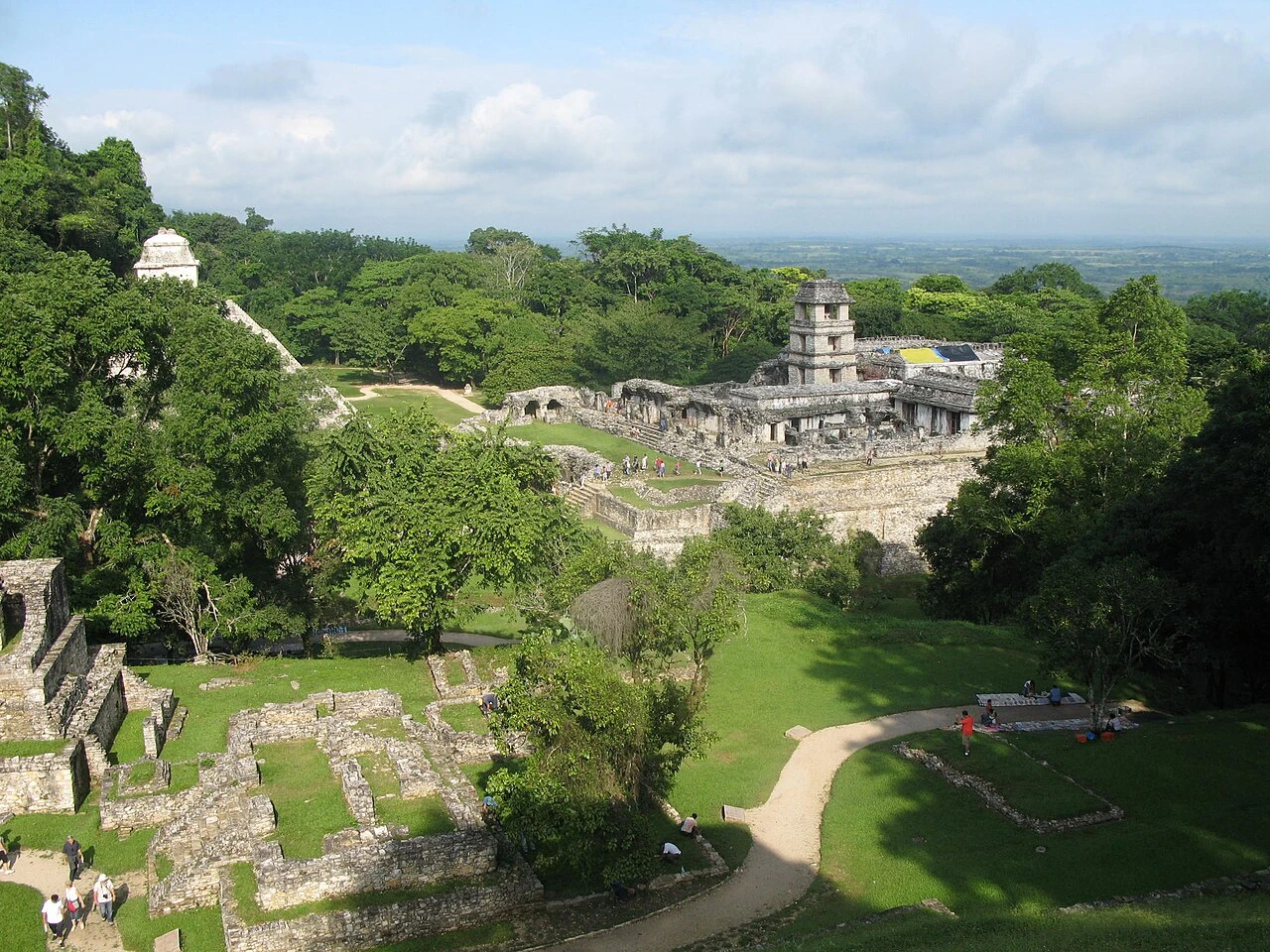
Palenque · 132 km
Palenque
Content & sources
Ljuba brank at Slovenian Wikipedia · CC BY-SA 3.0
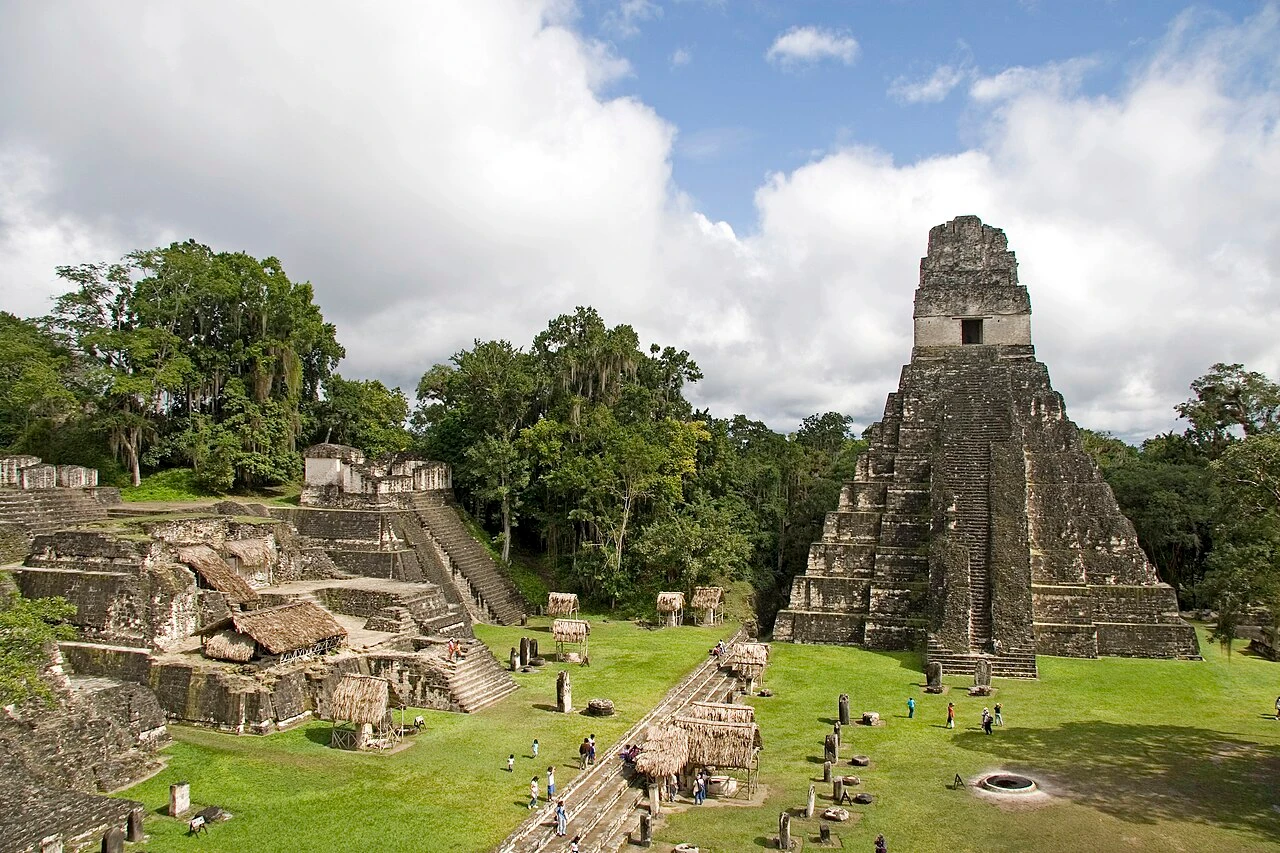
Flores · 147 km
Tikal
Content & sources
Photo: Mundo Maya · CC BY-SA 4.0