Stanza · Audio guide
Nidaros Cathedral Audio Guide
A place to remember. A story to take with you.
Nidaros Cathedral is a Church of Norway cathedral located in Trondheim. It is built over the burial site of King Olav II and serves as the site for the consecration of new Norwegian monarchs.
Download Stanza, then search for “Nidaros Cathedral”.
About the tour
One guide. Your kind of visit.
Nidaros Cathedral is a Church of Norway cathedral located in Trondheim. It is built over the burial site of King Olav II and serves as the site for the consecration of new Norwegian monarchs.
Ready when you are.
- 01Get the free Stanza app.
iOS & Android
- 02Find your guide.
“Nidaros Cathedral”
- 03Download before you go.
Works offline
Audio guide / 15 narrated stops
Inside the guide
Get to know a few of the stories before you go. Open a stop to read more.
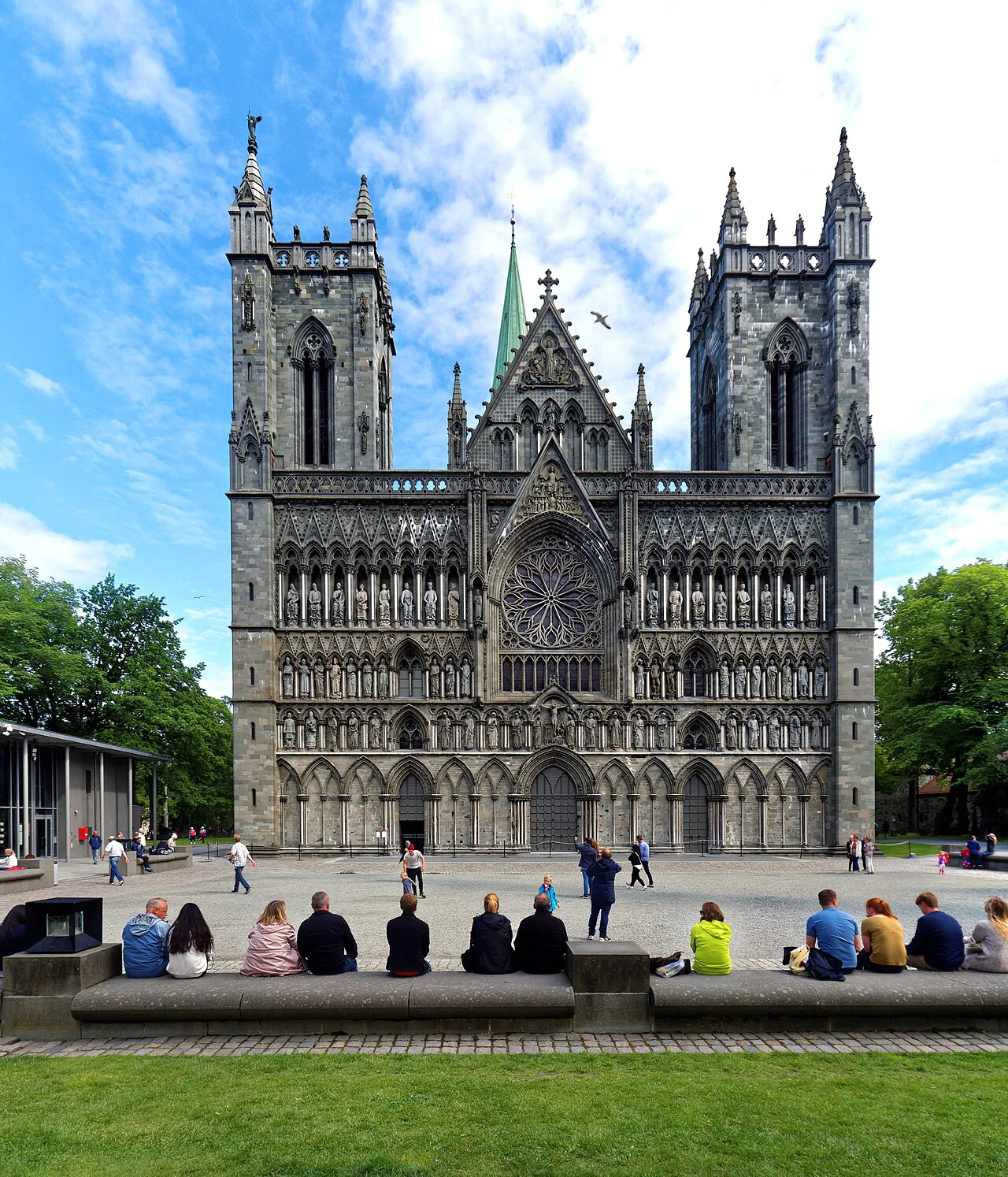
01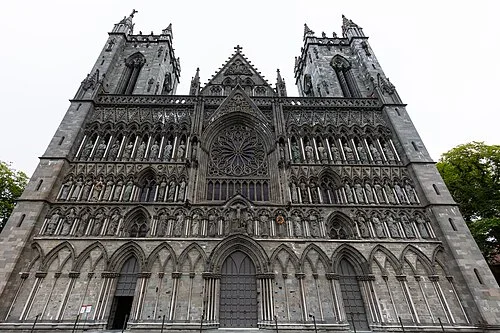 The West Front Facade
Nidaros Cathedral: The West Front and the Shrine of Saint Olav
Welcome to Nidaros Cathedral, and to the story of the king buried beneath it. Olav Haraldsson fell at the Battle of Stiklestad in the year 1030. His body was laid to rest by the river Nidelva, near the market town that would grow into Trondheim. A year later he was declared a saint, and pilgrims began coming to his grave. Around 1070 his nephew, King Olav Kyrre, started a large stone church on the spot. It was dedicated to the Holy Trinity, but people simply called it Kristkirken, the Christ church. That first building is gone, yet over two centuries it grew into the cathedral here. The church became the seat of a Catholic archdiocese in 1152, and was substantially finished around 1300. It is reckoned the northernmost medieval cathedral in the world. The walls are built of soapstone, a soft grey stone that takes fine carving. On the west front, ranks of figures climb in tiers toward the twin towers. The tour follows the carved saints outside, then the vaults and stained glass within, and finally the eight-sided chamber where the saint's shrine once stood. Almost everything here, in stone and glass, tells of Olav, the king who brought Christianity to Norway and became its patron saint.
Diego Delso · CC BY-SA 4.0
02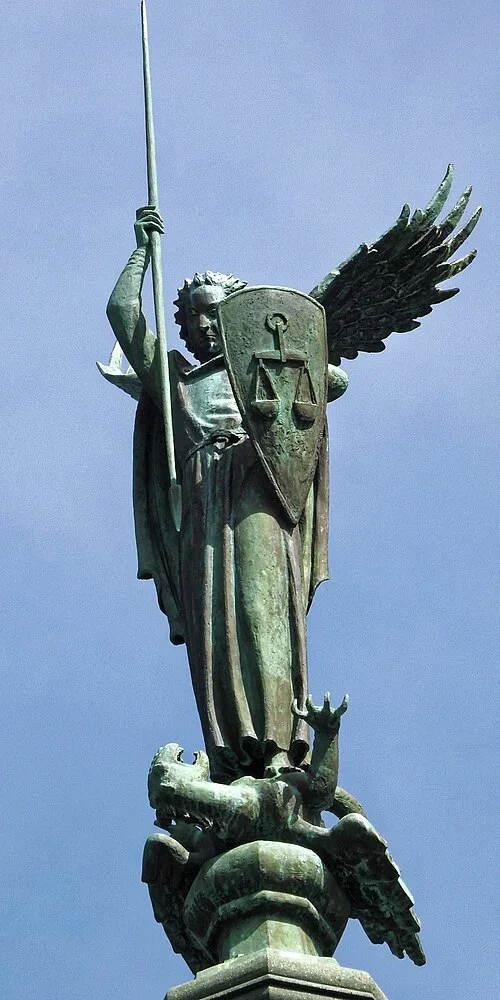 The West Front Facade
The Archangel Michael and the Restoration Sculptors
High on the north-west tower stands a bronze Archangel Michael, spear raised and wings spread, one foot on a beaten dragon. His shield carries a set of scales, for Michael weighs souls at the Last Judgment. The face holds a surprise. The sculptor Kristofer Leirdal gave the angel the features of Bob Dylan. The year was 1969, and Leirdal meant it as a quiet statement against war. Many figures on the towers are portraits of people the sculptors knew. Saint Clement, higher up the front, carries the face of the poet Olav Aukrust. Unlike the anonymous masons of the Middle Ages, these modern artists left their own time written on the stone.
Photo: Holger Uwe Schmitt · CC BY-SA 4.0
03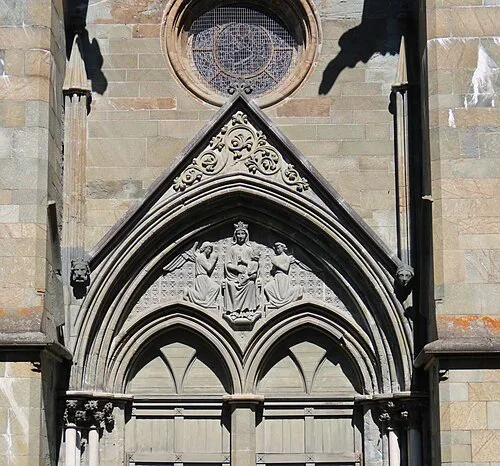 The West Front Facade
The West Front Screen: A Wall of Statues
Look at the whole west front. The whole west front works as a screen wall, filled with three tiers of carved figures. Apostles, bishops and patriarchs stand here, together with saints bound to Norway, among them Olav and Sunniva, and the kings of the land. In all, the front holds seventy-six statues. Only five of them survive from the Middle Ages. The rest were carved when the front was rebuilt, in a style deliberately imitating medieval work. The sculpture set in the arch above the door carries the same idea. Read from bottom to top, the facade becomes a summary of Christian and Norwegian history, gathered in stone over the entrance.
Listen in the app[[User:Ad Meskens|Ad Meskens You are free to use this picture for any purpose as long as you credit its author, Ad Meskens. Example: © Ad Meskens / Wikimedia Commons If you use this work outside of the Wikimedia projects, a message or a copy is very much appreciated. This image is not in the public domain. A statement such as "From Wikimedia Commons" or similar is not by itself sufficient. If you do not provide clear attribution to the author you do not comply with the terms of the file's license and you may not use this file. If you are unable or unwilling to provide attribution you should contact Ad Meskens to negotiate a different license. ]] · CC BY-SA 4.0
04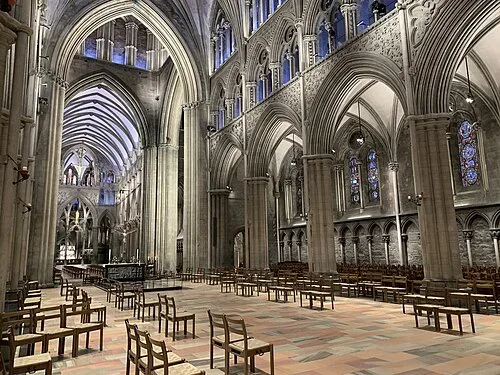 The Nave, Rose Window, and Steinmeyer Organ
The Nave: A Ruin Reborn
The nave holds the cathedral's strangest story. Fires damaged the building in 1327, and in 1531 the nave burned outright. What followed is hard to picture now. The nave stood as a roofless, grass-covered ruin for nearly four hundred years. The choir and the octagon took less damage from the later fires, but in 1708 the whole cathedral burned except the outer walls, and the western half of the church lay open to the sky. Only in the early twentieth century was the nave rebuilt. The ribbed vaults overhead rise about twenty-one metres, and they are modern masonry, laid to recreate the medieval design. So the Gothic look of this hall is honest in form but young in fabric.
Listen in the appCasey Brown · CC BY-SA 4.0
05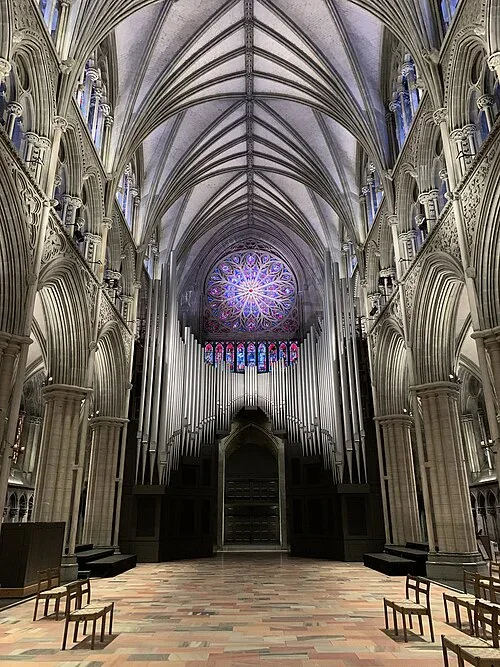 The Nave, Rose Window, and Steinmeyer Organ
The Steinmeyer Organ Beneath the Rose
Beneath the rose window, the pipes of the great organ rise against the west wall. In 1930 the cathedral commissioned it from the German firm Steinmeyer. It was built to mark nine hundred years since the Battle of Stiklestad. When finished, it had four manuals and a pedal. And it carried more than a hundred and twenty stops. Most of the cost was covered by donations, above all by Elias Anton Cappelen Smith. In 1962 came a heavy rebuilding. The organ was moved to a new gallery at the west end, and many stops were removed. Some of them went into a new choir organ. That rebuilding broke much of the instrument's unity, and organists argued about it for years. The organ was fully restored in 2014, and reinaugurated that May as Norway celebrated the constitution's jubilee.
Listen in the appCasey Brown · CC BY-SA 4.0
06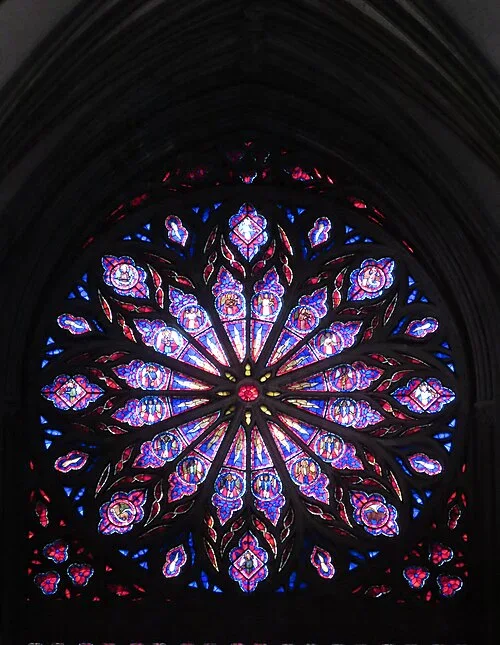 The Nave, Rose Window, and Steinmeyer Organ
The Rose Window and Gabriel Kielland's Glass
The great window at the west end is a rose of stained glass, and every piece of glass in this cathedral is modern, all of it dating from the rebuilding. Gabriel Kielland designed the glass, and worked on it from 1908 to 1934. The west window shows the Day of Judgment, turned toward the setting sun. Its addition to the medieval front was hotly contested, a quarrel some called the War of the Roses. The rest of the glass follows a pattern. On the north side, scenes from the Old Testament glow against blue. On the south side, scenes from the New Testament glow against red. The north rose shows the Virgin with the child, ringed by ancestors and kings of the Old Testament, with the prophets in the windows beneath. The south rose shows the risen Christ with scenes from the gospels, and the apostles below.
Listen in the app[[User:Ad Meskens|Ad Meskens You are free to use this picture for any purpose as long as you credit its author, Ad Meskens. Example: © Ad Meskens / Wikimedia Commons If you use this work outside of the Wikimedia projects, a message or a copy is very much appreciated. This image is not in the public domain. A statement such as "From Wikimedia Commons" or similar is not by itself sufficient. If you do not provide clear attribution to the author you do not comply with the terms of the file's license and you may not use this file. If you are unable or unwilling to provide attribution you should contact Ad Meskens to negotiate a different license. ]] · CC BY-SA 4.0
07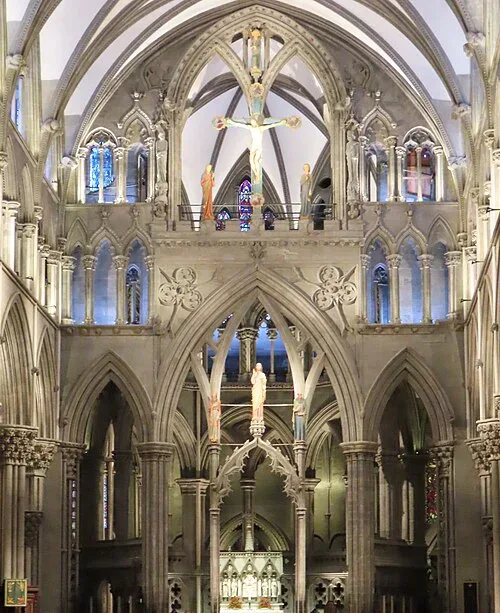 The Transept Crossing and Wagner Organ
The Choir Screen and the Emigrants' Crucifix
A stone screen fills the entire east side of the choir. Its principal arch divides into three smaller arches, and the central one frames a statue of Christ the Teacher. Above, in the space beneath the vault, stands a crucifix by the sculptor Gustav Vigeland, set between the Virgin Mary and the Apostle John. Below the screen, at the crossing, is the second of the cathedral's two principal altars. It bears a large modern silver crucifix. Norwegian emigrants to America commissioned and paid for it in the early twentieth century. Its design recalled a similar silver crucifix that had stood in the medieval church. A gift, in other words, from emigrant Norway back to the national sanctuary.
Listen in the app[[User:Ad Meskens|Ad Meskens You are free to use this picture for any purpose as long as you credit its author, Ad Meskens. Example: © Ad Meskens / Wikimedia Commons If you use this work outside of the Wikimedia projects, a message or a copy is very much appreciated. This image is not in the public domain. A statement such as "From Wikimedia Commons" or similar is not by itself sufficient. If you do not provide clear attribution to the author you do not comply with the terms of the file's license and you may not use this file. If you are unable or unwilling to provide attribution you should contact Ad Meskens to negotiate a different license. ]] · CC BY-SA 4.0
08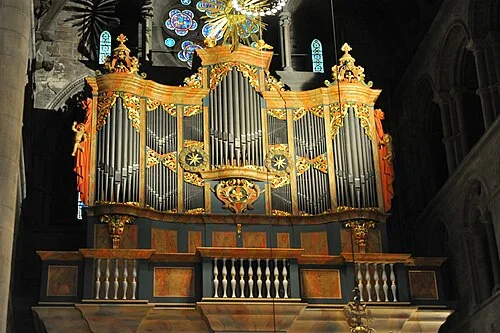 The Transept Crossing and Wagner Organ
The Baroque Wagner Organ
The organ in the north transept is the cathedral's oldest voice. It was built by the German organ maker Joachim Wagner, and set up in 1741 by his journeyman Peter Migend. It has thirty stops, and stands on a gallery in the north transept. In 1930 it was taken down and stored inside the church. The organ builder Jürgen Ahrend restored it and put it back in place in 1994. It is the only eighteenth-century instrument in a building otherwise shaped by modern restoration.
Listen in the appGünter Schnell · CC BY 3.0
09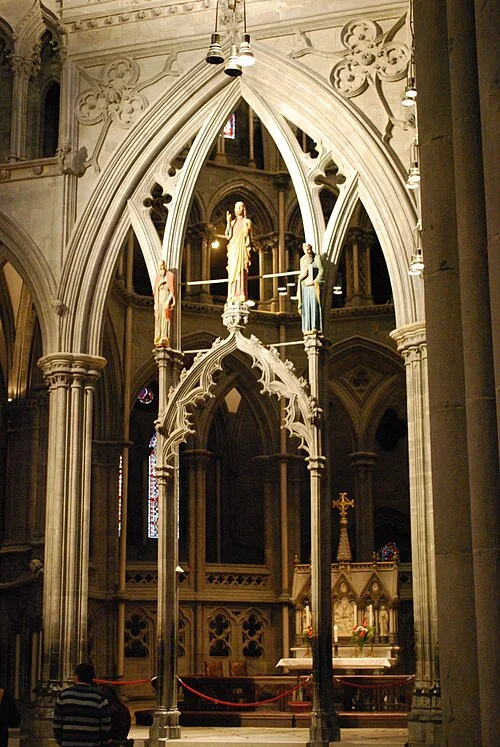 The High Choir and Saint Olav's Octagon
The High Choir and English Gothic Models
The high choir is where this cathedral's Gothic architecture is most fully developed. Scholars hear English accents here. The choir appears to have been modeled on the Angel Choir of Lincoln Cathedral. The octagon beyond may have been inspired by the Corona of Canterbury, though eight-sided shrine chambers have a long history in Christian architecture. These are comparisons of influence, not certainties. There is a French note as well. The walls in Trondheim are thinner than Lincoln's, which is more typical of the great French churches.
Listen in the appPhoto: Concierge.2C · CC BY-SA 3.0 no
10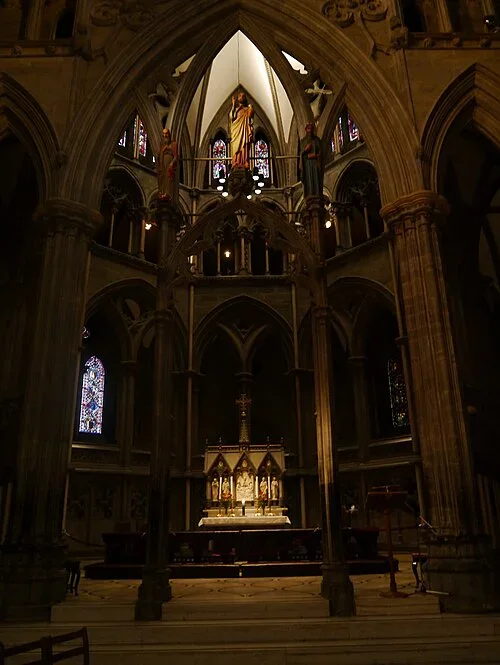 The High Choir and Saint Olav's Octagon
The Octagon: Shrine of Saint Olav
The eight-sided chamber at the east end is the reason the whole cathedral exists. The octagon and the walkway around it, the ambulatory, are the oldest parts of the building. The medieval high altar stood here, and behind it the silver reliquary casket holding the remains of Saint Olav. Pilgrims could walk in a ring around the shrine, close to the saint. The casket was shaped like a church, with dragon heads on its gables, like the gables of Norwegian stave churches. After the Reformation of 1537, in the reign of King Christian III, it was carried off to Copenhagen and melted down for coinage. The saint's remains were then buried again, in a place still unknown, somewhere under the cathedral. One relic is known to survive, a thigh bone in a silver-gilt case given by Queen Josephine to the Catholic cathedral in Oslo. The present altar stands where the medieval one stood. Its marble sculpture was designed to recall the form of the lost casket. The baroque altar it replaced was moved to Vår Frue church in town.
Listen in the appPhoto: Zairon · CC BY-SA 3.0
- 11
The Saint Olav Antemensale: Legend in Images
The altar frontal, and the legend of the saint's uncorrupted body.
- 12
The Bishop and His Cathedral
A bishop with a church in his hands, and the 1161 inscription that declared independence.
- 13
The Coronation Church: Haakon VII and Queen Maud, 1906
The coronation church, and the last crowned king and queen of Norway in 1906.
- 14
The Octagon from Outside and Saint Olav's Spring
The oldest stonework in the cathedral, and the healing spring of Saint Olav.
- 15
A National Sanctuary Restored
The great restoration that made the cathedral a national project, and its life today.
Nidaros Cathedral
Frequently asked questions
How much does the guide cost?
Free app download. Listed guide price: $1.99. Guide price shown in the app. Audio guide only. Venue admission is separate.
Can I listen without internet?
Yes. Download the guide’s audio, images, and maps in the app before your visit. Your downloaded content is then available offline.
Can I listen in my language?
This audio guide is available in 15 languages, including English.
Do I need to follow a schedule?
No. This is a self-guided experience. Choose your stops, pause whenever you like, and return to a story at your own pace.
At your own pace
Explore Nidaros Cathedral.
Download Stanza, then search for “Nidaros Cathedral”.
Free app download · Guide price shown in the app
Keep exploring
Audio guides — Norway
Luster
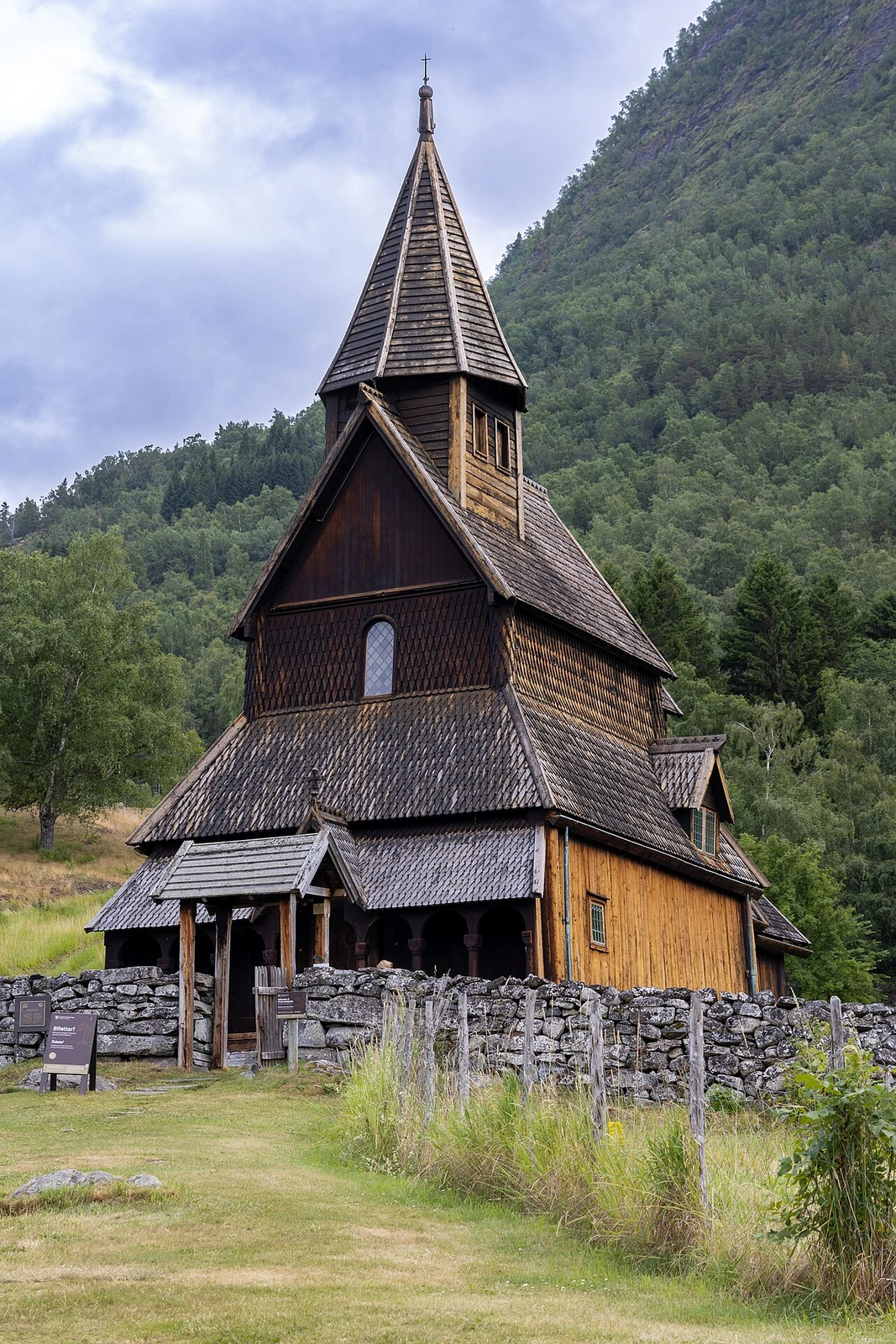
Urnes Stave Church
Content & sources
Photo: Superbass · CC BY-SA 4.0
Borgund
Borgund Stave Church
Content & sources
mendhak · CC BY-SA 2.0
Tromsø
Arctic Cathedral
Content & sources
Jma · CC BY-SA 4.0