Stanza · Audio guide
Sultan Qaboos Grand Mosque Audio Guide
A place to remember. A story to take with you.
The Sultan Qaboos Grand Mosque is a Friday mosque located in Muscat. It is the largest mosque in the country and can accommodate 20,000 worshipers.
Download Stanza, then search for “Sultan Qaboos Grand Mosque”.
About the tour
One guide. Your kind of visit.
The Sultan Qaboos Grand Mosque is a Friday mosque located in Muscat. It is the largest mosque in the country and can accommodate 20,000 worshipers.
Ready when you are.
- 01Get the free Stanza app.
iOS & Android
- 02Find your guide.
“Sultan Qaboos Grand Mosque”
- 03Download before you go.
Works offline
Audio guide / 12 narrated stops
Inside the guide
Get to know a few of the stories before you go. Open a stop to read more.
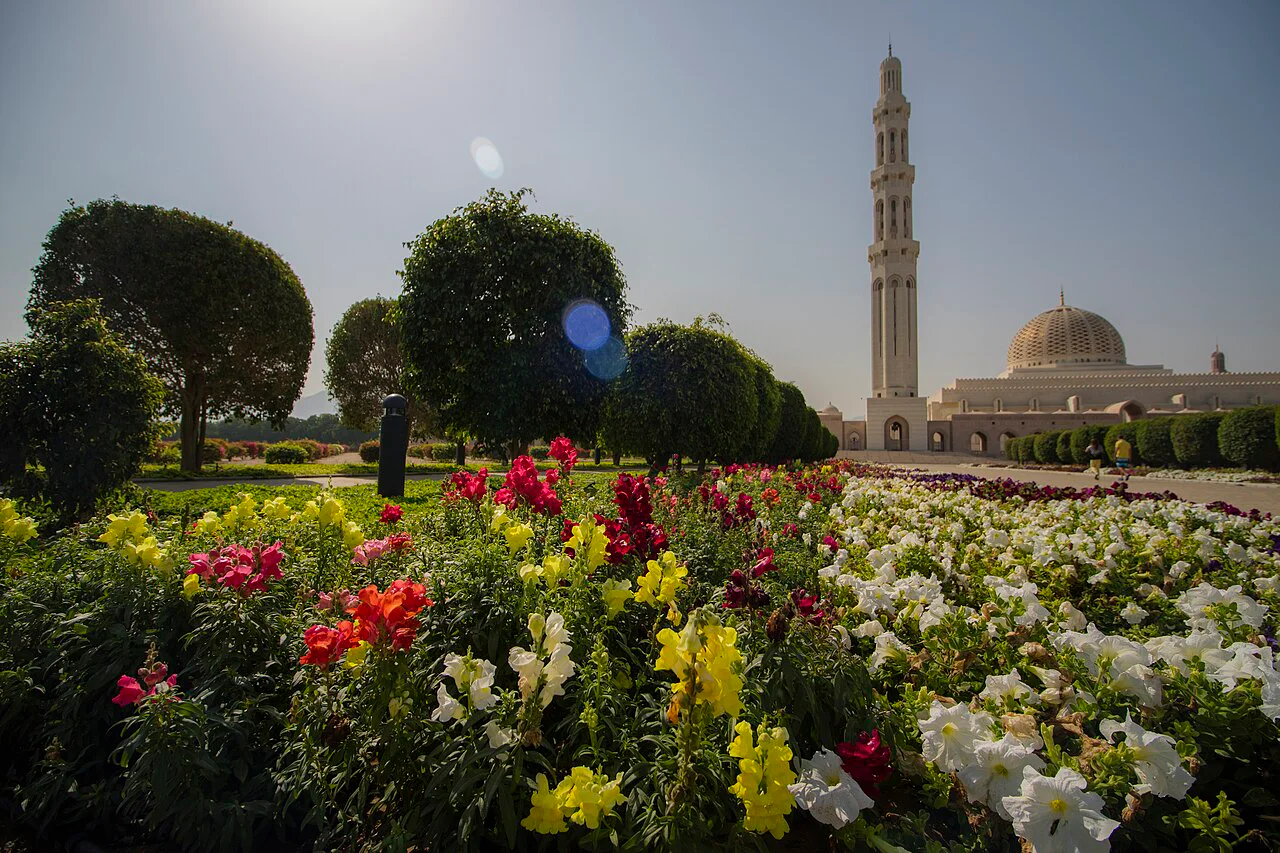
01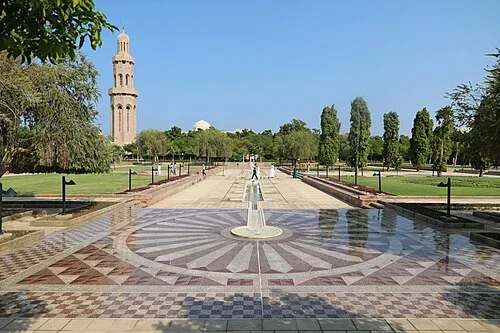 Main Entrance, Gardens, and Minarets
Arrival Gardens and Central Minaret
Welcome to the Sultan Qaboos Grand Mosque, the largest mosque in Oman and its national Friday mosque. The story begins in 1992, when Sultan Qaboos bin Said directed that his country should have a Grand Mosque. A design competition followed the next year, and the commission went to builders who broke ground at Bausher in December 1994. It took six years and five months to finish. The gardens around the building were laid out as part of that plan, with long walks, lawns and fountains leading the eye toward the mosque itself. The slender tower rising above the trees is the central minaret, and behind it waits a complex of courtyards and prayer halls. On the fourth of May 2001, the Sultan inaugurated the completed mosque, celebrating thirty years of his reign. What began as his directive had become the country's principal place of worship.
Francesco Bini · CC BY-SA 4.0
02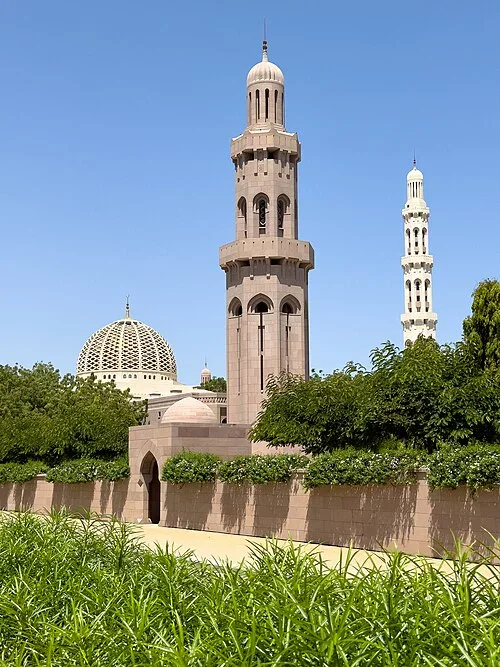 Main Entrance, Gardens, and Minarets
The Minarets
Five minarets rise around this mosque, and together they are its chief feature from the outside. The tallest stands about ninety metres, while the four that flank the building reach half that height. In the traditional mosque there are no bells. Instead, a caller climbs, or nowadays speaks from, the minaret to give the adhan, the call to prayer that sounds five times a day. Many visitors hear a meaning in the number five, reading the minarets as an echo of the five pillars of Islam, though that is an interpretation offered by admirers rather than a stated plan. The round dome visible behind the main minaret belongs to the prayer hall, and its decorated inside is a major attraction of the complex.
"dronepicr" · CC BY 2.0
03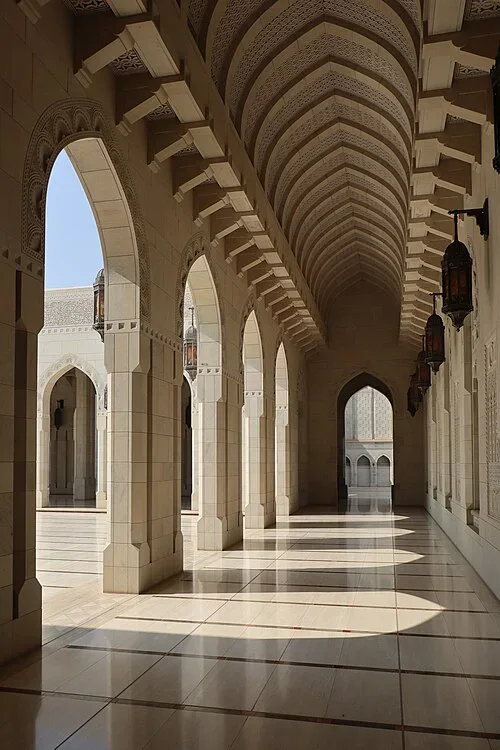 Outer Courtyard and Arcaded Passageways
The Outer Sahn Arcade
These arcaded galleries are not decoration. On Friday, the main day of congregational prayer, crowds fill the mosque beyond its halls, and every shaded passage becomes a place to kneel. The outer paved courtyard alone holds eight thousand worshippers, and with the inner courts and passageways like this one, the mosque can gather some twenty thousand people at once. The stone around you travelled a long way to be here. Some two hundred and seventy thousand tonnes of Indian sandstone were imported for the building, cut and dressed into arches, piers and paved floors. The arches repeat in a steady rhythm down the gallery, throwing cool shadow across the polished floor even at midday.
Listen in the appFrancesco Bini · CC BY-SA 4.0
04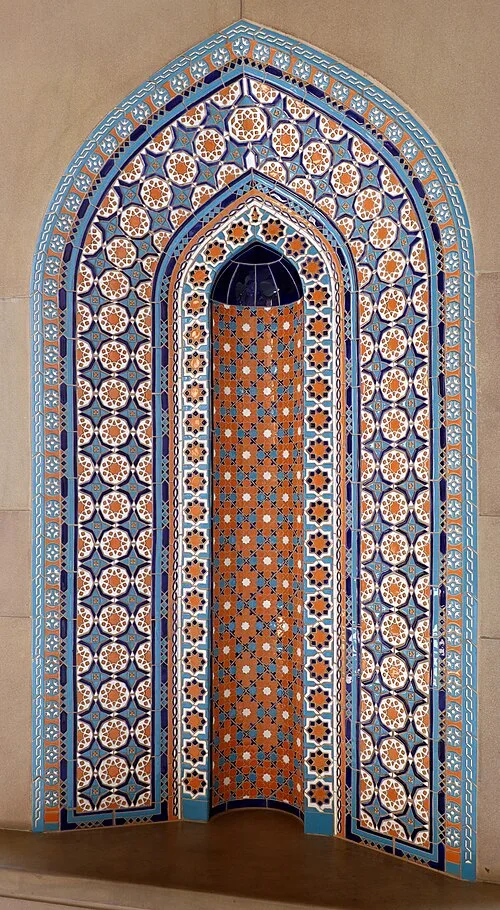 Outer Courtyard and Arcaded Passageways
Persian-Style Tilework Niche
Set into the arcade wall is a niche lined with tiles in a Persian style, its pointed arch crowded with stars, rosettes and interlacing bands in blue, orange and white. It has no grand function. Its work is to be beautiful, and to make a point. This mosque was conceived as a gathering of the Islamic world's artistic traditions in one place. Persian tilework here, Persian carpet weaving under the main roof, European crystalwork in the chandeliers, Indian stone in the walls. Each craft speaks the language of a different region, and the building quotes them all at once. Walk on and the same idea keeps returning in new materials.
Listen in the appFrancesco Bini · CC BY-SA 4.0
05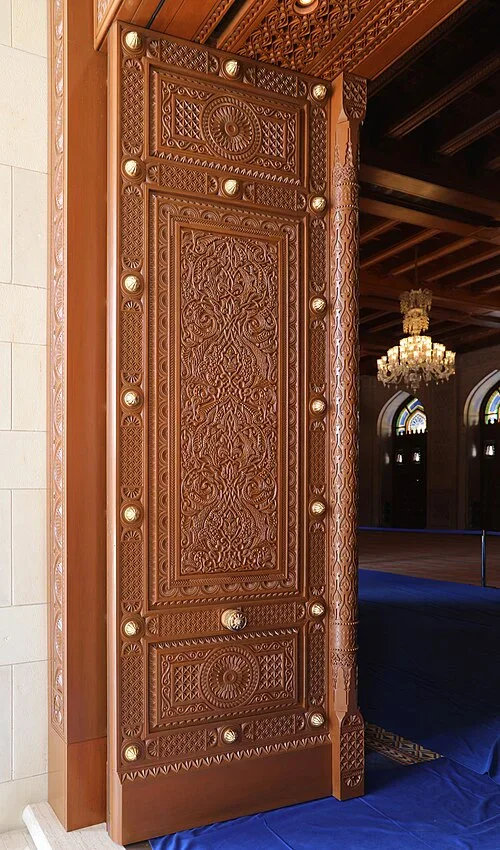 Women's Prayer Hall and Anteroom
Carved Door to the Women's Musalla
Every door, window and embellishment in this mosque is made of wood and glass, and this one shows what that meant in skilled hands. Its panels are carved deep with geometric fields, rosettes and trailing ornament, each band different from the last, and the frame around it is carved just as densely. The door leads to the anteroom of the women's prayer hall, a musalla set aside entirely for women at prayer. It can accommodate seven hundred and fifty worshippers. The same wood-and-glass craft runs through the whole building, from doors like this one to the coffered ceilings overhead.
Listen in the appFrancesco Bini · CC BY-SA 4.0
06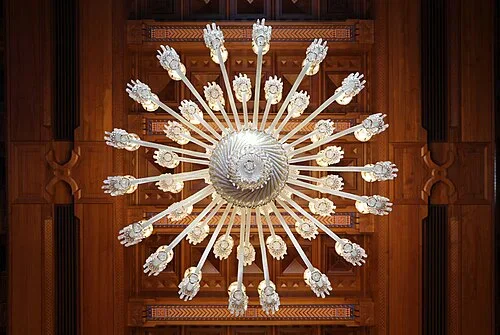 Women's Prayer Hall and Anteroom
Anteroom Chandelier
Against the carved wooden ceiling of this anteroom hangs a chandelier shaped like a burst of light, its arms radiating from a central sphere like the rays of a sun. It is no one-off. Thirty-four smaller chandeliers of the same design hang in other parts of the building, so the same family of light fixtures runs through the whole complex, from the smallest prayer rooms to the grandest spaces. Each one repeats the form of the monumental version suspended in the main prayer hall, where it dwarfs everything around it. The idea was consistency: one design, scaled to fit every room it was asked to light.
Listen in the appFrancesco Bini · CC BY-SA 4.0
07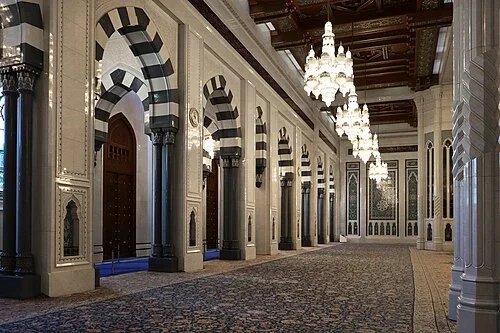 Main Prayer Hall Architecture
The Main Prayer Hall
The heart of the mosque is this square prayer hall, the main musalla, with outside walls about seventy-four metres on each side and more than five thousand square metres of floor within. Its arcades of striped marble arches rise in black and white bands toward carved wooden ceilings, and rows of smaller chandeliers recede into the distance. More than six thousand five hundred worshippers can pray here, and every Friday the hall fills for the congregational midday prayer. The interior was designed by Edgard Bali, working alongside the exterior team of Quad Design with Mohamed Makiya. Between them they gave the hall its calm geometry: arch, column, ceiling and carpet, repeated in perfect order.
Listen in the appFrancesco Bini · CC BY-SA 4.0
08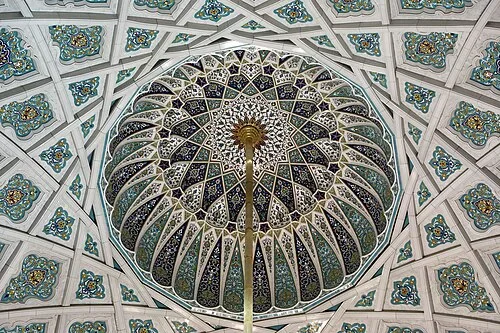 The Central Dome and Grand Chandelier
The Central Dome
Directly overhead, the central dome rises fifty metres above the prayer hall floor. Its inside is built up from marble ribs and piers that cross in pointed arches, each arch faced with panels of glazed ceramic, and stained glass set among them. The whole reads as a blue-and-gold canopy, dense with geometric pattern, over the hall below. At its crown sits a lantern, and from that lantern the great chandelier of the mosque is hung, so the two masterworks meet at a single point in the air. The effect was meant to be seen from everywhere in the hall, drawing every eye upward at once.
Listen in the appFrancesco Bini · CC BY-SA 4.0
09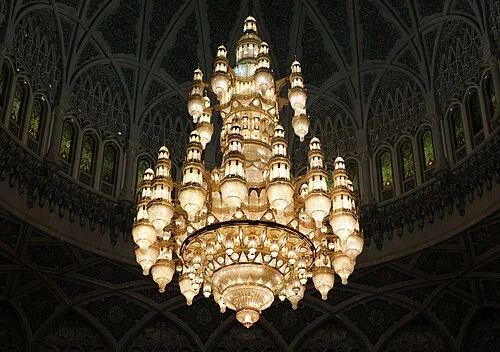 The Central Dome and Grand Chandelier
The Grand Chandelier
Hanging from the dome is the chandelier that made this mosque famous, built by the Munich firm Faustig. It stands fourteen metres tall, holds some six hundred thousand crystals, and for years it was the largest chandelier in the world, until the Sheikh Zayed Mosque in Abu Dhabi was completed and took the title. With the dome rising fifty metres above the floor, even a chandelier this size looks proportional within that vast space. Its best secret is human. A staircase runs up inside the chandelier itself, so that maintenance workers can climb into the middle of it to clean the crystals and change the bulbs. When the lamps are lit and dimmed through their system, the whole dome glitters above the hall.
Listen in the appFrancesco Bini · CC BY-SA 4.0
10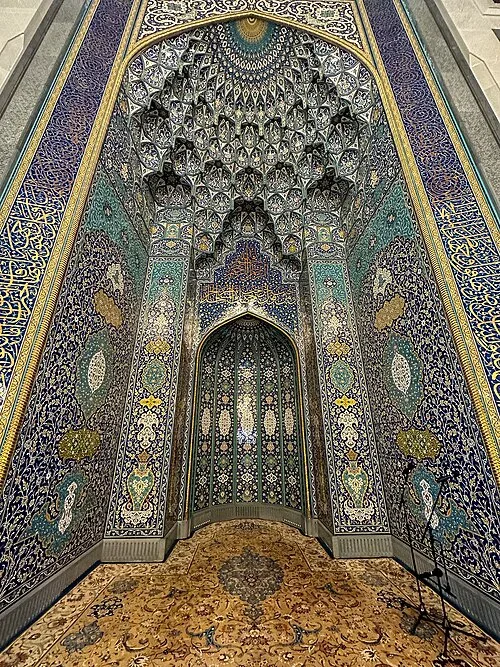 The Mihrab and Monumental Persian Carpet
The Mihrab
Every mosque has one wall that matters more than the rest: the qibla wall, which faces Mecca, the direction of prayer. Set into it is the mihrab, the prayer niche, and here it is a tour de force of tile and mosaic. Above the niche the vaulting rises in tiers of honeycomb-like cells, and every surface around it is covered in calligraphy and pattern in blue, gold and white. To its right stands the minbar, the carved marble pulpit from which the Friday sermon is delivered. The main prayer hall is recorded as holding close to eight million mosaic pieces, and a great share of them crowd this one wall.
Listen in the app"dronepicr" · CC BY 2.0
- 11
The Monumental Persian Carpet
One carpet, four years in the weaving, made by six hundred women in Iran and stitched together on this floor.
- 12
A Place of Learning
A quiet book niche that brings the tour back to what a grand mosque is for.
Sultan Qaboos Grand Mosque
Frequently asked questions
How much does the guide cost?
Free app download. Listed guide price: $0.99. Guide price shown in the app. Audio guide only. Venue admission is separate.
Can I listen without internet?
Yes. Download the guide’s audio, images, and maps in the app before your visit. Your downloaded content is then available offline.
Can I listen in my language?
This audio guide is available in 15 languages, including English.
Do I need to follow a schedule?
No. This is a self-guided experience. Choose your stops, pause whenever you like, and return to a story at your own pace.
At your own pace
Explore Sultan Qaboos Grand Mosque.
Download Stanza, then search for “Sultan Qaboos Grand Mosque”.
Free app download · Guide price shown in the app
Keep exploring
Audio guides — Oman
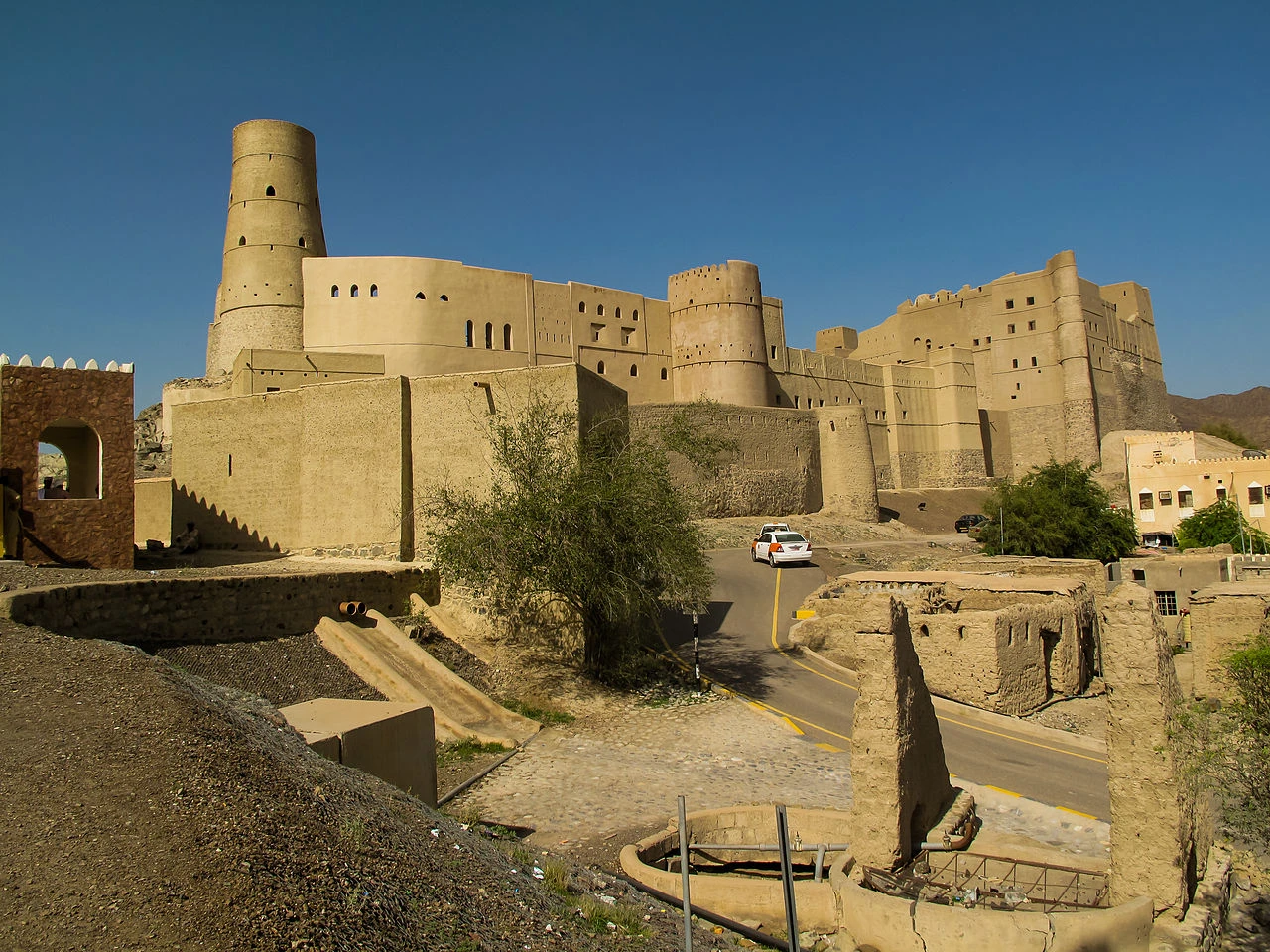
Bahla Province · 131 km
Bahla Fort
Content & sources
Francisco Anzola · CC BY 2.0
Abu Dhabi
Sheikh Zayed Grand Mosque
Content & sources
Photo: PotatoWitch · CC BY-SA 4.0