Stanza · Audio guide
Sacsayhuamán Audio Guide
A place to remember. A story to take with you.
Sacsayhuamán is a citadel located on the northern outskirts of Cusco, Peru. The site is an important example of Inca architecture.
Download Stanza, then search for “Sacsayhuamán”.
About the tour
One guide. Your kind of visit.
Sacsayhuamán is a citadel located on the northern outskirts of Cusco, Peru. The site is an important example of Inca architecture.
Ready when you are.
- 01Get the free Stanza app.
iOS & Android
- 02Find your guide.
“Sacsayhuamán”
- 03Download before you go.
Works offline
Audio guide / 15 narrated stops
Inside the guide
Get to know a few of the stories before you go. Open a stop to read more.
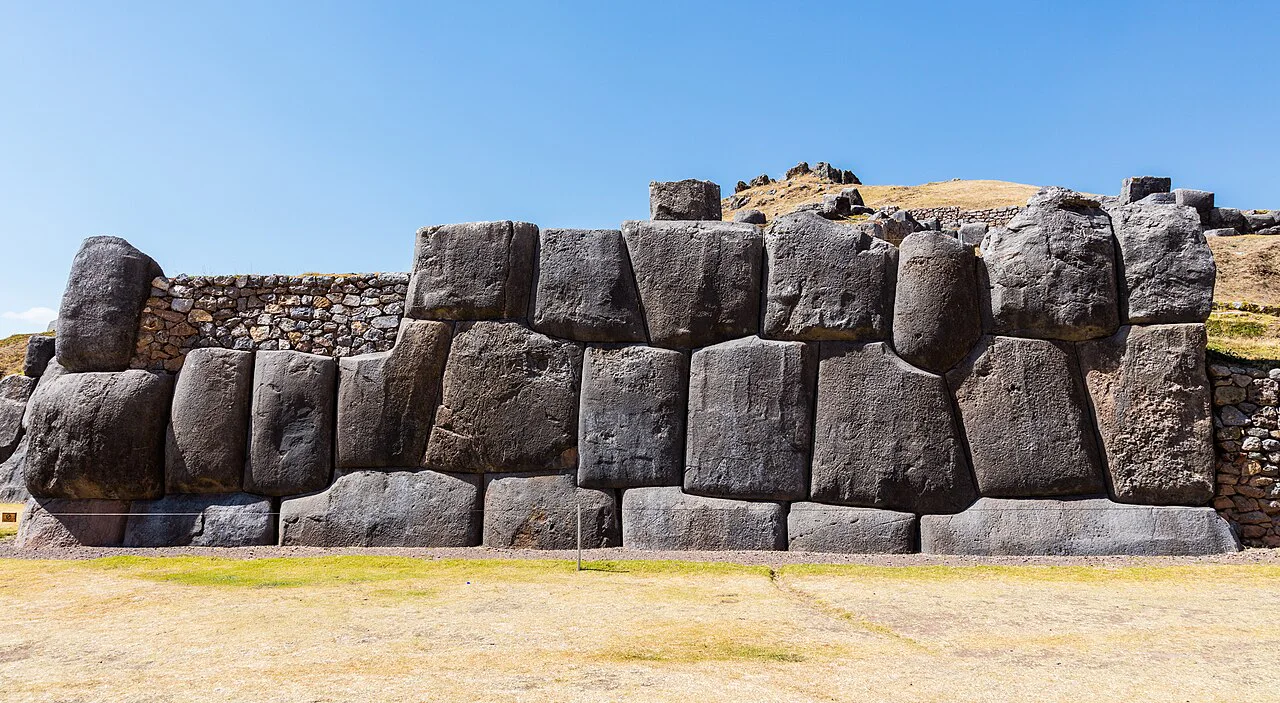
01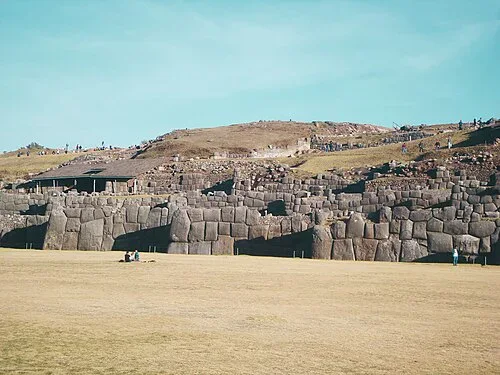 The Great Ceremonial Esplanade
Sacsayhuamán from the Great Esplanade
Sacsayhuamán crowns a steep hill on the northern edge of Cusco, the old capital of the Inca Empire. The site sits at an altitude of about three thousand seven hundred metres. One translation gives its Quechua name as fortress of the royal falcon or hawk, and translations differ. The big question is what the place was for. It is thought to have been a military fortress, where warriors trained. But its design could also point to a religious purpose, a great temple to the Sun God. Studies of pottery picked up from the surface suggest the earliest signs of use on this hilltop date to around the year 900. It has also been suggested that the site was first built during the Killke period, which came before the Inca, though that remains a theory. Sacsayhuamán is an important example of Inca architecture, and it was listed as a World Heritage Site, together with Cusco, in 1983.
Listen in the appPhoto: Estuardo02 · CC BY-SA 4.0
02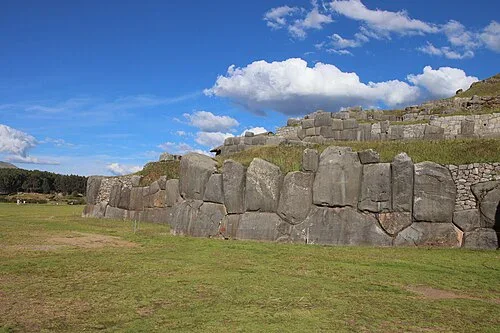 The Great Ceremonial Esplanade
The Ceremonial Plaza Below the Walls
The wide grassy field in front of the walls is the great plaza of Sacsayhuamán. It could hold thousands of people, and it was designed for communal ceremonies. The Spanish chronicler Pedro Cieza de León wrote about the place in 1553. He recorded that the local people called it the House of the Sun, while the Spaniards named it the Fortress. The Incas worshipped the sun here, and for the special festivals tens of thousands of people are thought to have gathered, bringing offerings and making pilgrimages. Several of the large structures at the site may also have been used during rituals. The custom has not died out. Every year on the twenty-fourth of June, Peruvians celebrate Inti Raymi, the Inca festival of the winter solstice and new year, near Sacsayhuamán. Another festival, Warachikuy, is held at the site every year on the third Sunday of September. The Inca repeated the pairing of a capital and a ceremonial site far away in Chile, where the ceremonial site of Chena stood before the Spanish city of Santiago grew up.
Listen in the appPhoto: Draceane · CC BY-SA 4.0
03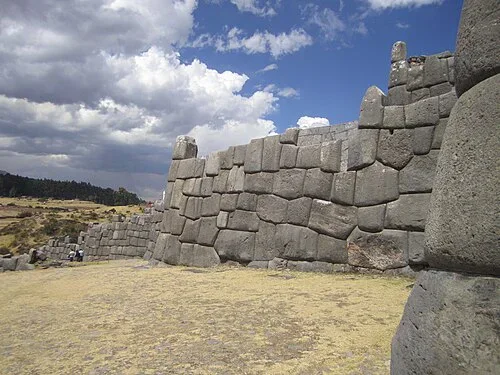 Lower Megalithic Rampart
Enormous Blocks and the Labour Behind Them
Estimates for the weight of the largest limestone block at Sacsayhuamán start at about one hundred and twenty-eight tonnes. Some estimates go as high as almost two hundred. These stones were moved an estimated thirty-five kilometres from Rumicolca. A chronicler wrote that the Inca ordered the provinces to send about twenty thousand men. They were not kept at the work all the time. They worked for a limited stretch, then other workers took over, so that no group felt the full demand. If a man fell sick, another took his place, and he went home. About four thousand men quarried and got the stones out. Six thousand more hauled them with great cables of leather and plant fibre. Others opened the ground and prepared the foundations. The chronicler said the master builders had been well trained.
Listen in the appPhoto: Carolina Huamàn · CC BY-SA 4.0
04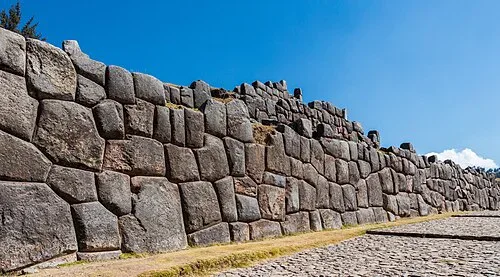 Lower Megalithic Rampart
The Three Zigzag Terrace Walls
Three massive terrace walls run along the slope, and each one zigzags with the hill. The longest is about four hundred metres. The walls stand about six metres tall. In the fifteenth century the Inca expanded the settlement with dry stone walls built of huge stones. Spanish chroniclers wrote that Inca oral history links the fortress to Pachacuti and his successors, Túpac Yupanqui and Huayna Cápac. Accounts do not agree on who began the walls. One Spanish-language account says the work began under Túpac Yupanqui and took about fifty years.
Listen in the appDiego Delso · CC BY-SA 4.0
05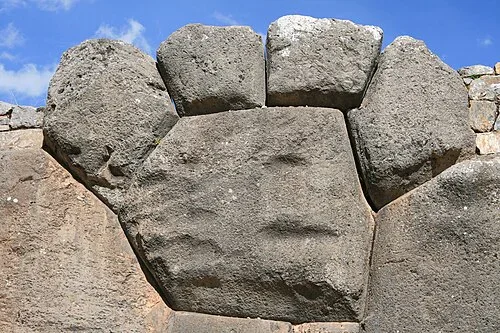 Lower Megalithic Rampart
Interlocking Joints and Rounded Corners
Look at how the stones meet. They are irregular, and each one was cut to fit the ones around it. No mortar holds them together, and a single sheet of paper will not fit between many of the stones. The Spaniards who saw the walls remarked on the same thing. Pedro Pizarro, one of those who entered Cusco, wrote that the stones were so close together and so well fitted that the point of a pin could not be inserted in a joint. Cieza said that not even a rial, a Spanish coin, could be put between two of them. The blocks were cut roughly to shape in the quarry and given their final shaping at the building site. Vince Lee, an author, architect and explorer, has suggested that the joints were carved ahead of time to fit prepared pockets in the wall, and that each block was lowered into place on a stack of logs, which were removed one at a time. The corners of the blocks are rounded, their shapes interlock in many ways, and the walls lean inward. These features are thought to have helped the ruins survive the devastating earthquakes of Cusco.
Listen in the appRAF-YYC from Calgary, Canada · CC BY-SA 2.0
06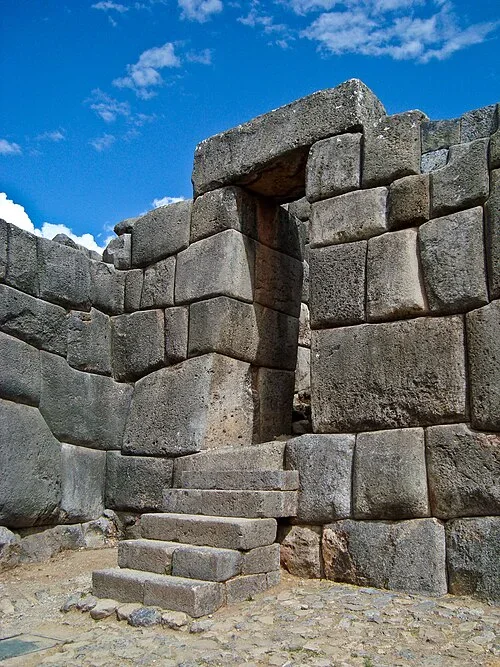 Ascending Terraces and Trapezoidal Gateways
Trapezoidal Doorway with Steps
The opening in this wall is shaped like a trapezoid, wider at the foot than at the top. A heavy stone slab forms the lintel, and a short flight of stone steps leads up to it. A chronicler called the principal entrance a thing worthy of contemplation, and praised how its walls were arranged so that one commanded the other. It is not known whether this doorway is that entrance. Walls set out that way could let defenders cover an approach from more than one side.
Listen in the appPhoto: CEllen · CC BY-SA 4.0
07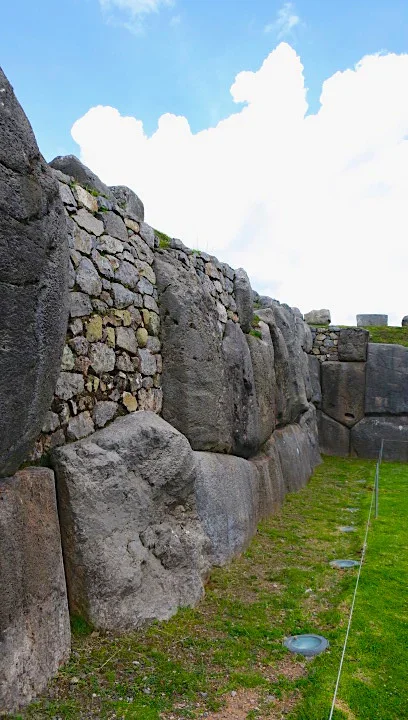 Ascending Terraces and Trapezoidal Gateways
Tall Blocks and Mixed Courses
The largest stones sit in the lower part of this wall. Some accounts put the tallest of the great blocks at about nine metres. The Spaniards who saw the lower wall could hardly believe it. Pizarro wrote that the stones there were so large and thick that it seemed impossible human hands could have set them in place. Cieza gave sizes: some stones were twelve feet wide and more than twenty long, and others were thicker than a bullock. Near the fortress he also saw a huge stone, which the local people said had grown tired at that spot, so that the workers could not move it any further. Cieza wrote that he would not have believed people could bring it there, had he not seen that it had been shaped by hand. Higher up, some of the rougher walls are modern. Retaining walls were added to some upper sections to control erosion, once the site became a popular tourist destination, and these walls are missing from photographs of the early nineteen hundreds. Some of them carry modern dates etched into them.
Listen in the appPhoto: AlisonRuthHughes · CC BY-SA 4.0
08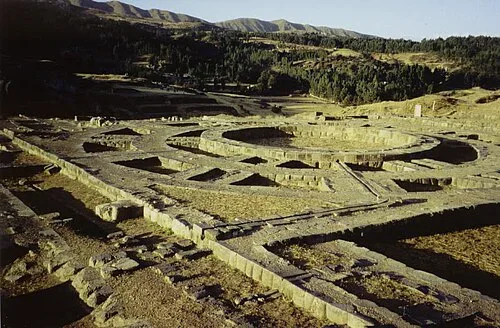 Summit Plateau and Muyuq Marka Tower
Summit Storehouses and the Armoury
Pedro Pizarro described what the Spaniards found after they entered Cusco, and he wrote in detail about the storerooms inside the complex. One chronicler wrote that the rooms were filled with arms: lances, arrows, clubs and large oblong shields. Among them were stretchers in which lords travelled, like litters. Other writers add large stores of food and weapons. It is not clear which of the surviving foundations held those stores. The complex also had channels for distributing water.
Listen in the appPapiermond · CC BY-SA 3.0
09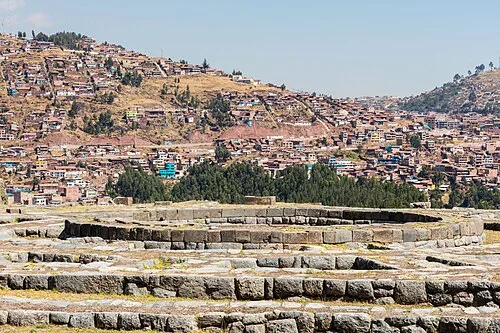 Summit Plateau and Muyuq Marka Tower
Muyuq Marka Tower Foundations
Here a round stone foundation sits on the summit, built as rings set one inside another. Beyond it the red roofs of Cusco climb the hillside. The name Muyuq Marka goes with this round ruin. The tower is said to have stood about four storeys high, though its purpose is not confirmed. A chronicler wrote of two very high round towers at the fortress, and it is not known whether this ruin is one of them. During the conquest the fortress proved useful for defending the city. Then Manco Inca's uprising in 1536 led to a siege of Cusco. Afterwards the Spanish took the walls and towers apart, so that the fortress could not be used in a future attack like that uprising.
Listen in the appDiego Delso · CC BY-SA 4.0
10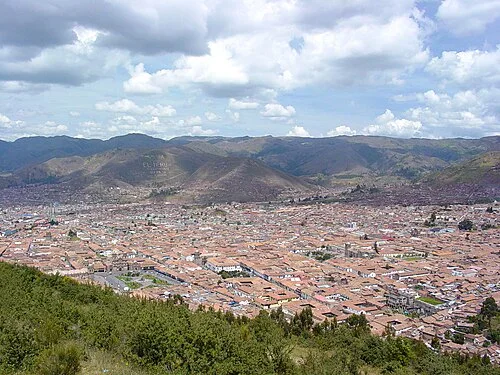 Imperial Cusco Overlook
Overlook of Cusco and the Puma City
Cusco spreads across its valley in a mass of red roofs. Pachacuti, the ninth Sapa Inca, is said to have reshaped the city as a crouching puma, an animal that guards earthly things. A chronicler wrote that Pachacuti had called Cusco the lion city. The tail was where two rivers join, the body was the great square with the houses around it, and the head was missing. Modern accounts describe a crouching puma, while the chronicler says lion, so the animal itself is uncertain. Some people link that missing head to the fortress on the northern hill.
Listen in the appAdam Jones from Kelowna, BC, Canada · CC BY-SA 2.0
- 11
Blocks Left Behind by the Dismantling
Garcilaso de la Vega on the smooth stones that went into the houses of Cusco, and why much of the complex is gone.
- 12
The Inca's Throne and the Fight for the Fortress
A royal seat cut from one living rock, where the sovereign is said to have presided over festivals and given orders.
- 13
Carved Niches in the Rock Outcrop
Stepped recesses cut into a great boulder, and a possible link to the worship of water.
- 14
Rodadero Rock Slopes
Rounded, grooved slopes of bedrock, and one named sector among several in the Sacsayhuamán area.
- 15
Underground Rooms and Those Who Saw Them
A dark opening into the rock, possibly one of the chincanas whose purpose is still unknown.
Sacsayhuamán
Frequently asked questions
How much does the guide cost?
Free app download. Listed guide price: $1.99. Guide price shown in the app. Audio guide only. Venue admission is separate.
Can I listen without internet?
Yes. Download the guide’s audio, images, and maps in the app before your visit. Your downloaded content is then available offline.
Can I listen in my language?
This audio guide is available in 15 languages, including English.
Do I need to follow a schedule?
No. This is a self-guided experience. Choose your stops, pause whenever you like, and return to a story at your own pace.
At your own pace
Explore Sacsayhuamán.
Download Stanza, then search for “Sacsayhuamán”.
Free app download · Guide price shown in the app
Keep exploring
Audio guides — Peru
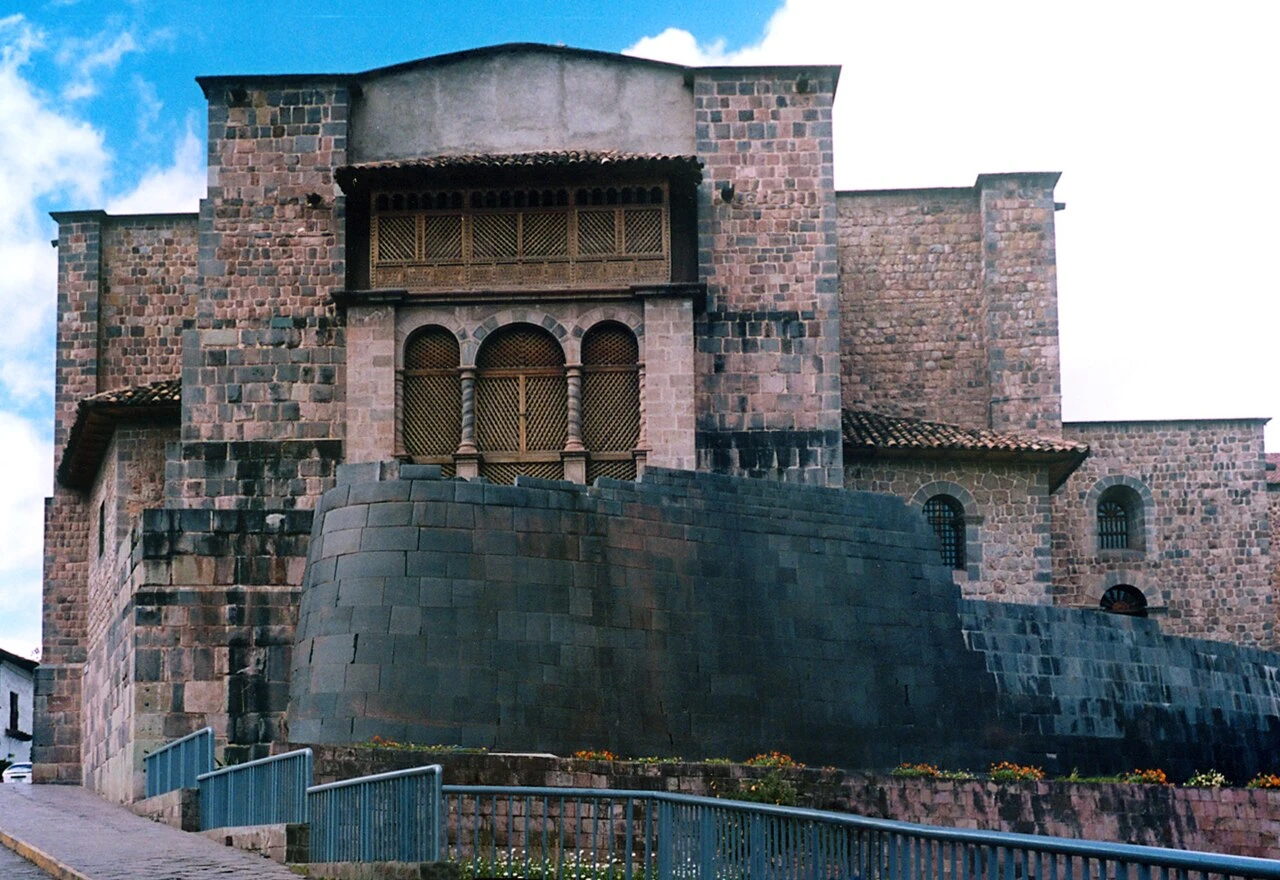
Cuzco · 2 km
Qorikancha
Content & sources
Håkan Svensson (Xauxa) · CC BY 2.5
Huarocondo · 31 km
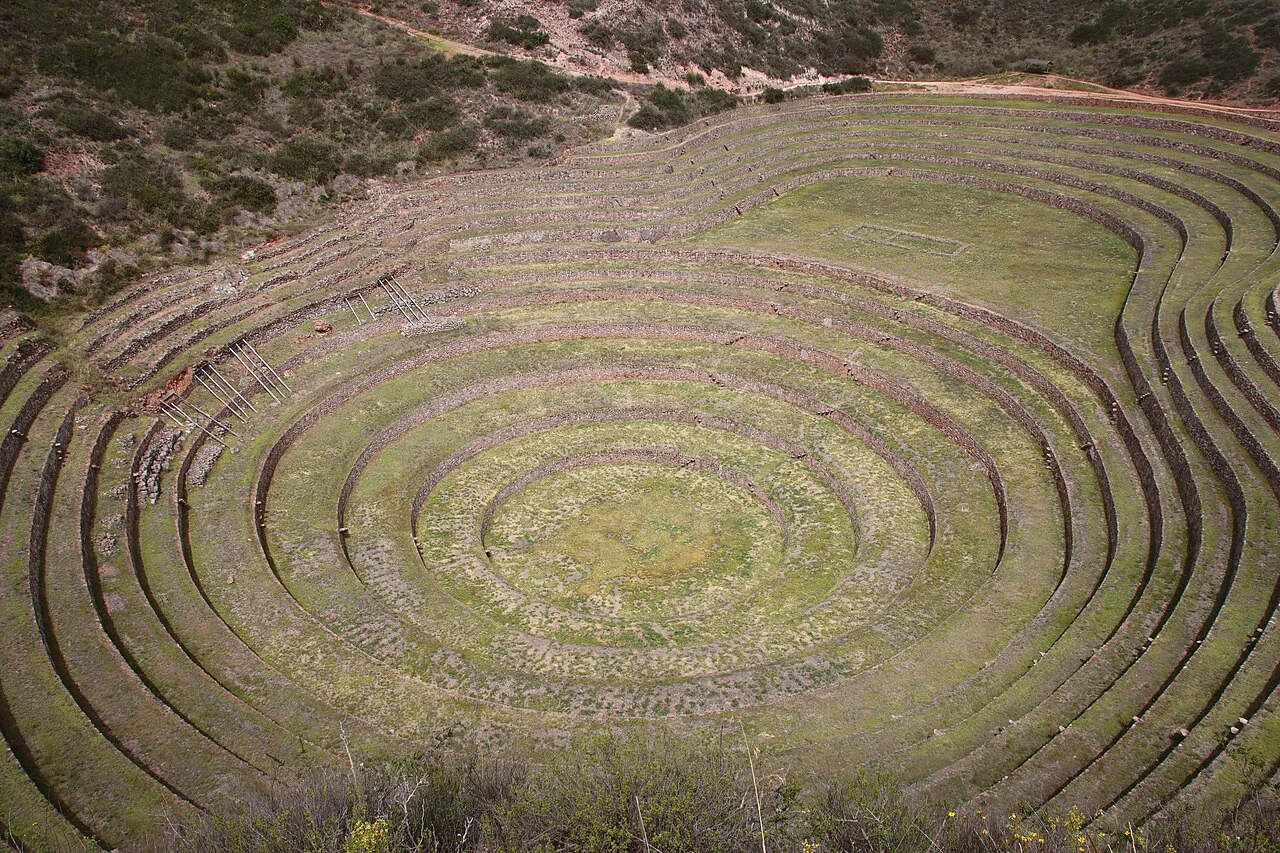
Moray
Content & sources
Photo: Draceane · CC BY-SA 4.0
Machupicchu · 72 km
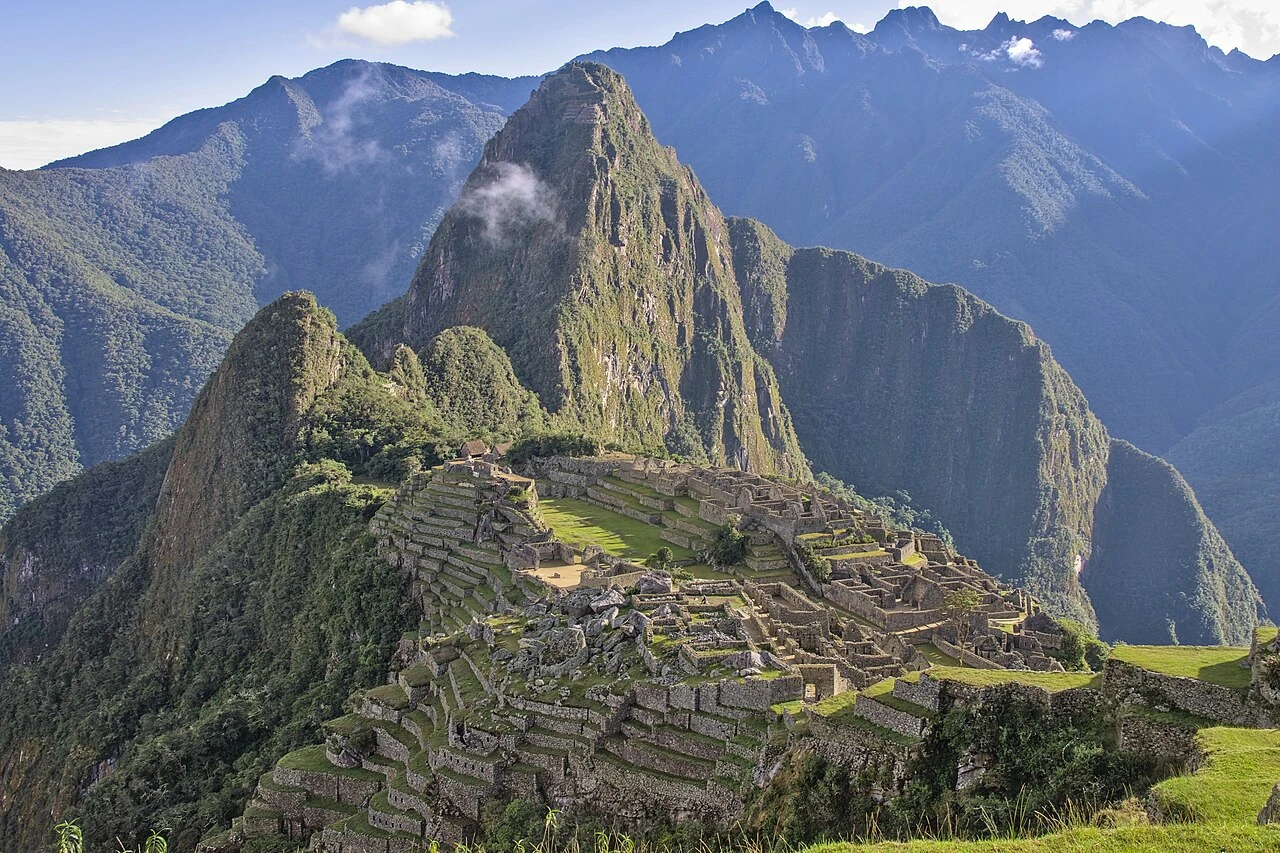
Machu Picchu
Content & sources
Photo: Draceane · CC BY-SA 4.0
Puno
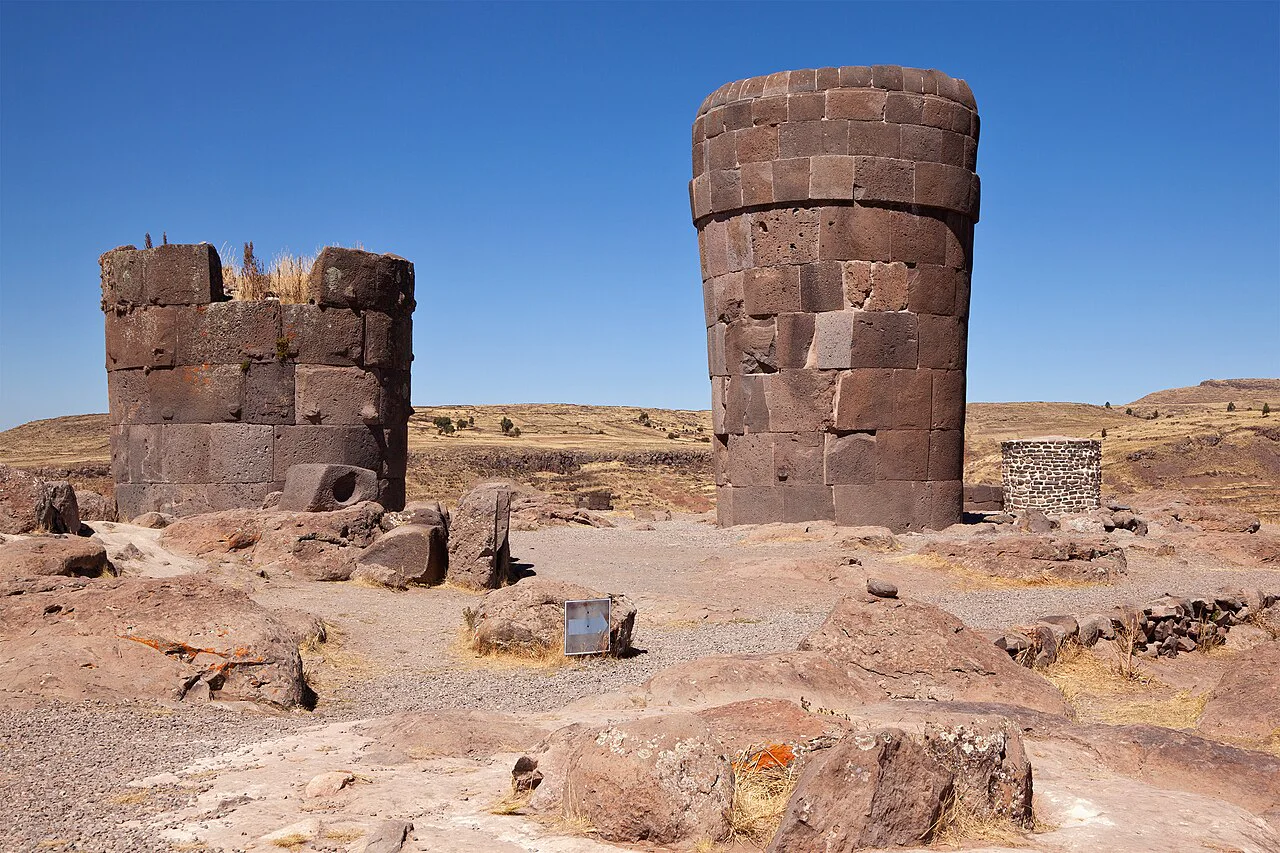
Sillustani
Content & sources
Photo: Unukorno · CC BY 3.0