Stanza · Audio guide
Royal Palace of Aranjuez Audio Guide
A place to remember. A story to take with you.
The Royal Palace of Aranjuez is one of the royal sites of the Spanish Crown, historically used as a spring residence by the Spanish Royal Family. It is a grand palace also functioning as a museum.
Download Stanza, then search for “Royal Palace of Aranjuez”.
About the tour
One guide. Your kind of visit.
The Royal Palace of Aranjuez is one of the royal sites of the Spanish Crown, historically used as a spring residence by the Spanish Royal Family. It is a grand palace also functioning as a museum.
Ready when you are.
- 01Get the free Stanza app.
iOS & Android
- 02Find your guide.
“Royal Palace of Aranjuez”
- 03Download before you go.
Works offline
Audio guide / 15 narrated stops
Inside the guide
Get to know a few of the stories before you go. Open a stop to read more.
01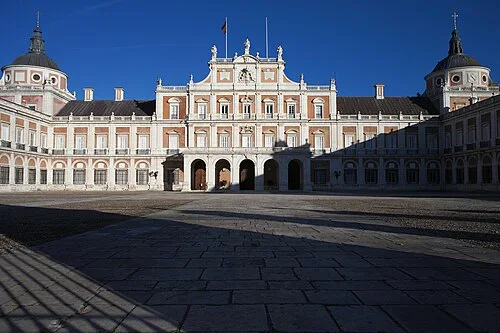 Cour d'Honneur and the Grand Facade
Cour d'Honneur and Grand Facade
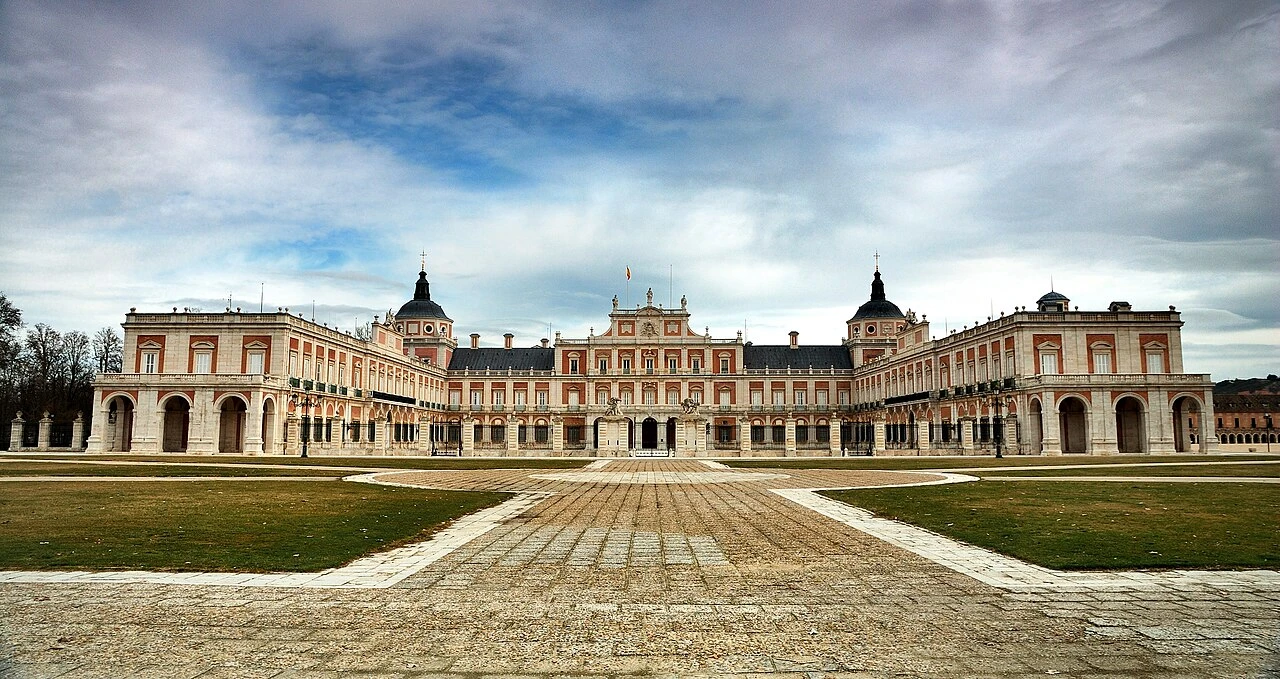
The Royal Palace of Aranjuez is one of the official residences of the Spanish royal family. It stands where the Tagus and Jarama rivers meet. The ground began as hunting land. In the twelfth century, the Order of Santiago set aside an exclusive hunting reserve beside the Tagus. In 1523, Charles the First took possession of the area and named it the Royal Woods and House of Aranjuez. He wanted it for entertaining guests during the springtime hunting season. Under Philip the Second, the palace became one of four seasonal seats of the court. The other three were Rascafría, El Escorial and the Royal Alcázar in Madrid. The palace and its gardens now form part of the Aranjuez Cultural Landscape, a UNESCO World Heritage Site since 2001. The courtyard in front is an oval lawn surrounded by monumental stone benches, and buildings enclose three of its sides. The architect Francesco Sabatini designed the two west wings. The walls are reddish, trimmed with pale stone. Royal guests traditionally came in by a road that crossed the river to the west. That road is now closed. They entered through the Plaza de Armas and the central portico. Public access today is from the east, by the M-305 road.
Javier Perez Montes · CC BY-SA 4.0
02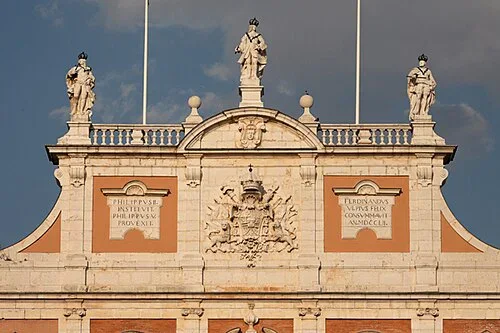 Cour d'Honneur and the Grand Facade
Central Pediment with Royal Arms and Inscribed Panels
The palace's builders left their names carved high on the central pediment. A royal coat of arms sits at the centre, with an inscribed panel on each side. Three statues stand along the top edge. The left panel says that Philip the Second started the work and Philip the Fifth carried it on. Philip the Second died in 1598, and by then only parts were finished. The royal apartments, the chapel, a south tower and part of the west front were complete. Then came an economic and political crisis, and eventually the Spanish Habsburg dynasty ended. The project was abandoned. Philip the Fifth, the first Bourbon king of Spain, took up the work again in 1700. He wanted Aranjuez to rival Versailles. He added a north tower and completed the west front, which set the basic layout of the palace. The right panel says that Ferdinand the Sixth finished the work in 1752.
Photo: PMRMaeyaert · CC BY-SA 4.0
03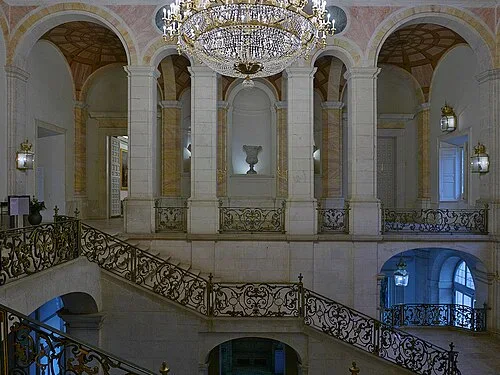 Imperial Vestibule and Grand Staircase
Grand Staircase by Giacomo Bonavía
Giacomo Bonavía is credited with the palace's grand central staircase. Accounts differ on who commissioned it. One says Ferdinand the Sixth ordered it. Another places the work under Philip the Fifth. The stair is reached through a hall that opens from the central portico. Its balustrade is black iron with gold trim, in the Rococo fashion of its day. A large crystal chandelier hangs from the ceiling, in the Empire style, which came after the Rococo. Above the stairs, columns and arches frame the upper hall.
Listen in the appPhoto: Jl FilpoC · CC BY-SA 4.0
04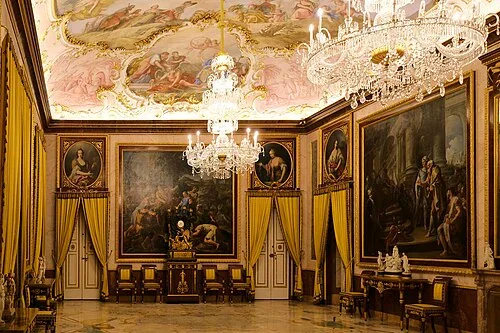 The Gala Dining Room
Gala Dining Room (Comedor de Gala)
Jacopo Amigoni painted this vault around 1750, filling it with allegories, which are figures that stand for ideas. Father Time is surrounded by women trying to clip his wings, so that time cannot fly away. Truth appears as a matron of the angels, while Wisdom pays her homage. The monarchy appears through its virtues, among them justice, bounty and an angel of peace holding an olive branch. Faith and charity are shown too, with charity as a woman protecting children. The room began as a place for conversation and debate under Ferdinand the Sixth. Later it became a hall for gala banquets. A series of grisaille panels, painted only in shades of grey, shows parts of the world where the monarchy had possessions.
Listen in the appHerbert Frank from Wien (Vienna), AT · CC BY 2.0
05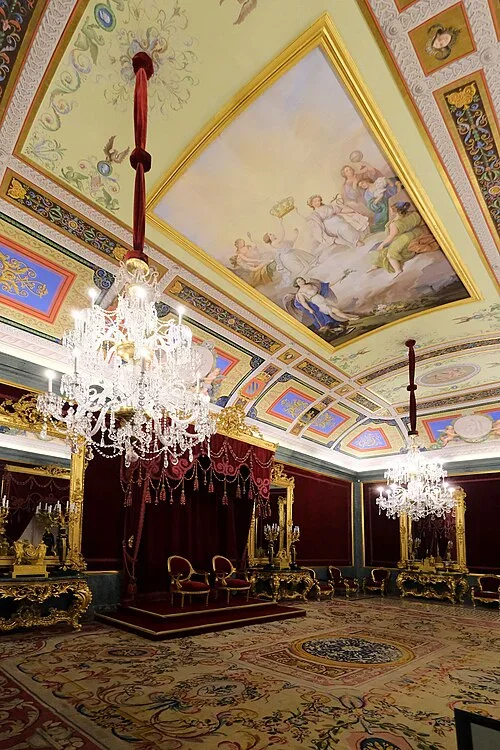 Salón del Trono (The Throne Room)
Throne Room (Salón del Trono)
In March 1808, a mutiny at Aranjuez led to a change of king. Rumours of a French invasion were spreading at the time. Two gilt chairs sit under a crimson canopy on a raised platform, and kings carried out formal ceremonies in this hall. Charles the Fourth gave up the throne here, in favour of his son, Ferdinand the Seventh. Godoy, the king's favourite and prime minister, was living at the Palace of Osuna in town when a crowd of Ferdinand's supporters found him hiding in an attic. He was taken prisoner, and later exiled. Ferdinand himself gave up the throne in May.
Listen in the appHerbert Frank from Wien (Vienna), AT · CC BY 2.0
06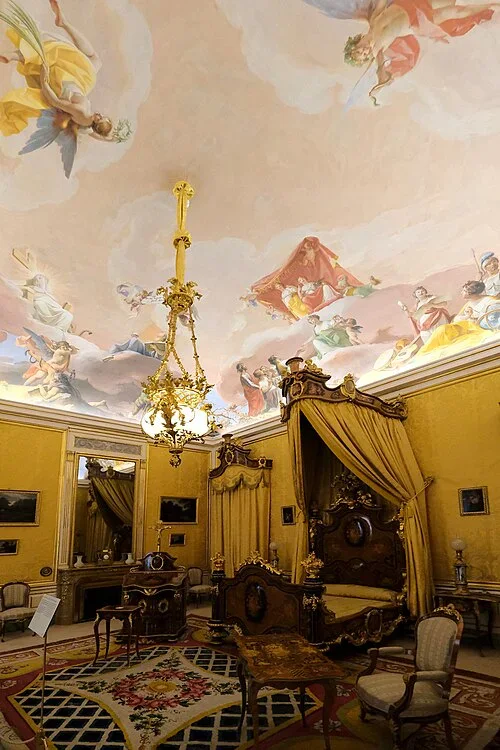 Queen's State Bedroom and Private Apartments
Queen's Bedchamber (Dormitorio de la Reina)
A canopy bed with yellow-gold hangings stands at the centre of this room. Its dark carved wood is decorated with gilt. The walls are yellow, and small wooden tables are set around the floor. Above, figures drift among painted clouds across the ceiling. Compared with the ceremonial halls, this room is far more private. It is usually called the queen's bedchamber. A gilt lantern hangs from the ceiling on a long stem.
Listen in the appHerbert Frank from Wien (Vienna), AT · CC BY 2.0
07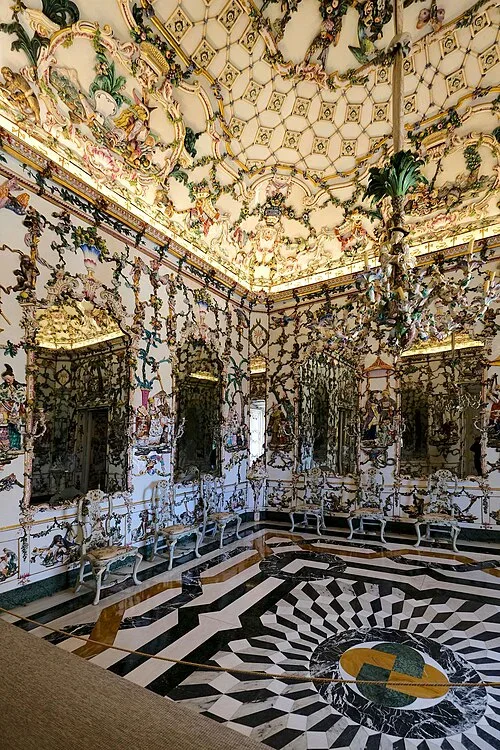 The Porcelain Cabinet (Gabinete de Porcelana)
Porcelain Cabinet (Gabinete de Porcelana)
The walls and ceiling of this room are completely covered in porcelain. Charles the Third commissioned the room, and the Royal Porcelain Factory of Buen Retiro in Madrid made it. Giuseppe Gricci made the work between 1760 and 1765. The white plaques are screwed to wooden walls, and their raised designs show garlands, fruit, birds and dragons. Mirrors on the walls multiply the decoration. It was Charles the Third's favourite retreat, and the room was used as a games room. At the centre of the ceiling hangs a lamp shaped like a palm tree. The floor is marble, in a black and white pattern with a round medallion at its centre.
Listen in the appHerbert Frank from Wien (Vienna), AT · CC BY 2.0
08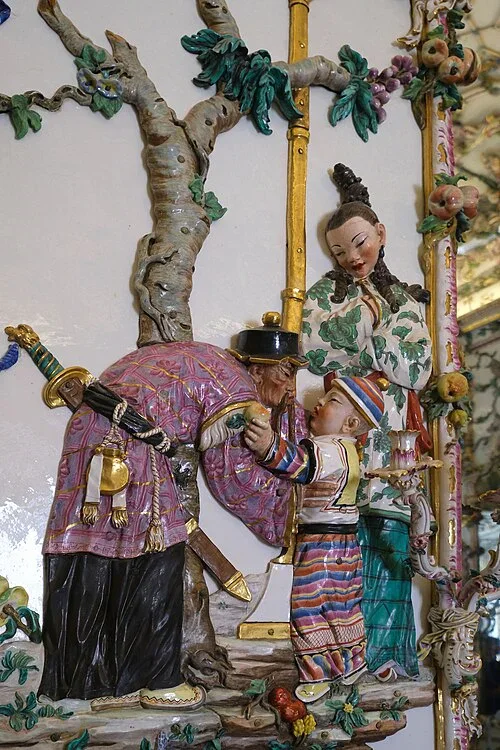 The Porcelain Cabinet (Gabinete de Porcelana)
Porcelain Relief with Figures and Tree
An older man bends low beneath a tree, and a child in striped clothes reaches up toward him. The man wears a pink, patterned robe, with a sword at his side. Beside them, a woman in a leaf-patterned jacket stands with her dark hair pinned up. Scenes like this belong to European chinoiserie, an eighteenth-century fashion that imagined daily life in East Asia. The figures are decorative rather than a scene from one particular moment. Grapes and apples hang from the branches above them.
Listen in the appHerbert Frank from Wien (Vienna), AT · CC BY 2.0
09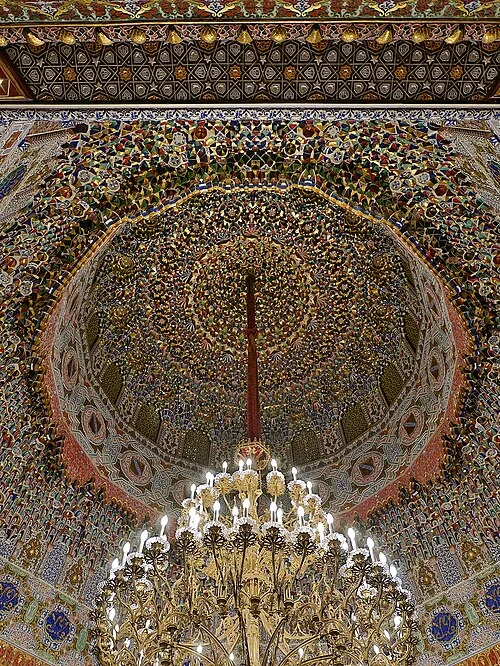 The Arab Cabinet (Salón Árabe)
Arab Cabinet Dome (Salón Árabe)
Queen Isabella the Second had this room made in the years around 1850. Its style is a nineteenth-century Moorish revival, inspired by the Hall of the Two Sisters in the Alhambra. Rafael Contreras led the work, and he was a restorer of the Nasrid palace. The dome above is covered in dense patterns of many colours. A bronze and crystal lamp hangs beneath it. The two most admired sights in the palace are this room and the porcelain cabinet.
Listen in the appPhoto: Jl FilpoC · CC BY-SA 4.0
10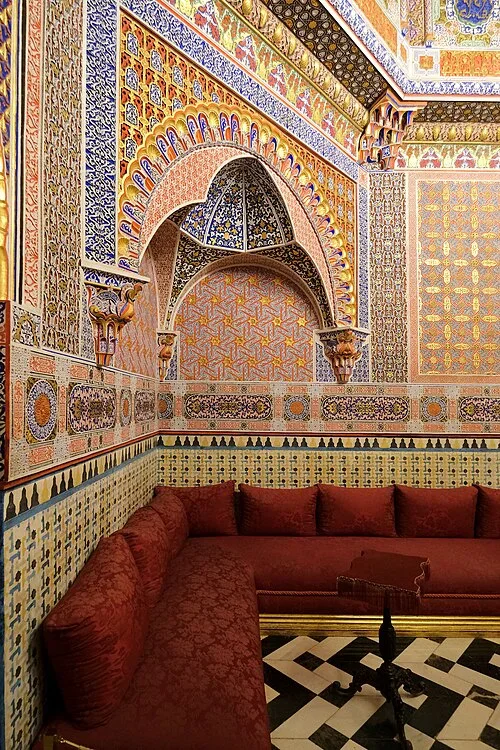 The Arab Cabinet (Salón Árabe)
Arab Cabinet Alcove and Wall Seating (Salón Árabe)
Men mostly used this room as a smoking room. A pointed arch frames an alcove, and its plasterwork is painted in bright colours. The lower walls are lined with stucco that imitates patterned tiles in blue and yellow. The floor is checkered marble. Along the walls runs a low bench, upholstered in deep red.
Listen in the appHerbert Frank from Wien (Vienna), AT · CC BY 2.0
- 11
Royal Palace Chapel
The chapel where, in 1808, a formal ceremony set up the Supreme Central Junta.
- 12
Casa de Caballeros y Oficios and the Plaza de las Parejas
The working buildings beside the plaza, with a kitchen-house and about two hundred royal dromedaries.
- 13
Las parejas reales (Royal Couples), Luis Paret y Alcázar, 1770
A painted equestrian festival from 1770, and the reason the sandy square is called the Plaza de las Parejas.
- 14
Palace Facade and River Weir
Water tumbles over a stepped weir beside the palace, and gilded boats once sailed the Tagus.
- 15
Fountain of Hercules and Antaeus
A fountain of Hercules and Antaeus, and a king who turned part of his estate into an experimental farm.
Royal Palace of Aranjuez
Frequently asked questions
How much does the guide cost?
Free app download. Listed guide price: $1.99. Guide price shown in the app. Audio guide only. Venue admission is separate.
Can I listen without internet?
Yes. Download the guide’s audio, images, and maps in the app before your visit. Your downloaded content is then available offline.
Can I listen in my language?
This audio guide is available in 15 languages, including English.
Do I need to follow a schedule?
No. This is a self-guided experience. Choose your stops, pause whenever you like, and return to a story at your own pace.
At your own pace
Explore Royal Palace of Aranjuez.
Download Stanza, then search for “Royal Palace of Aranjuez”.
Free app download · Guide price shown in the app
Keep exploring
Nearby audio guides
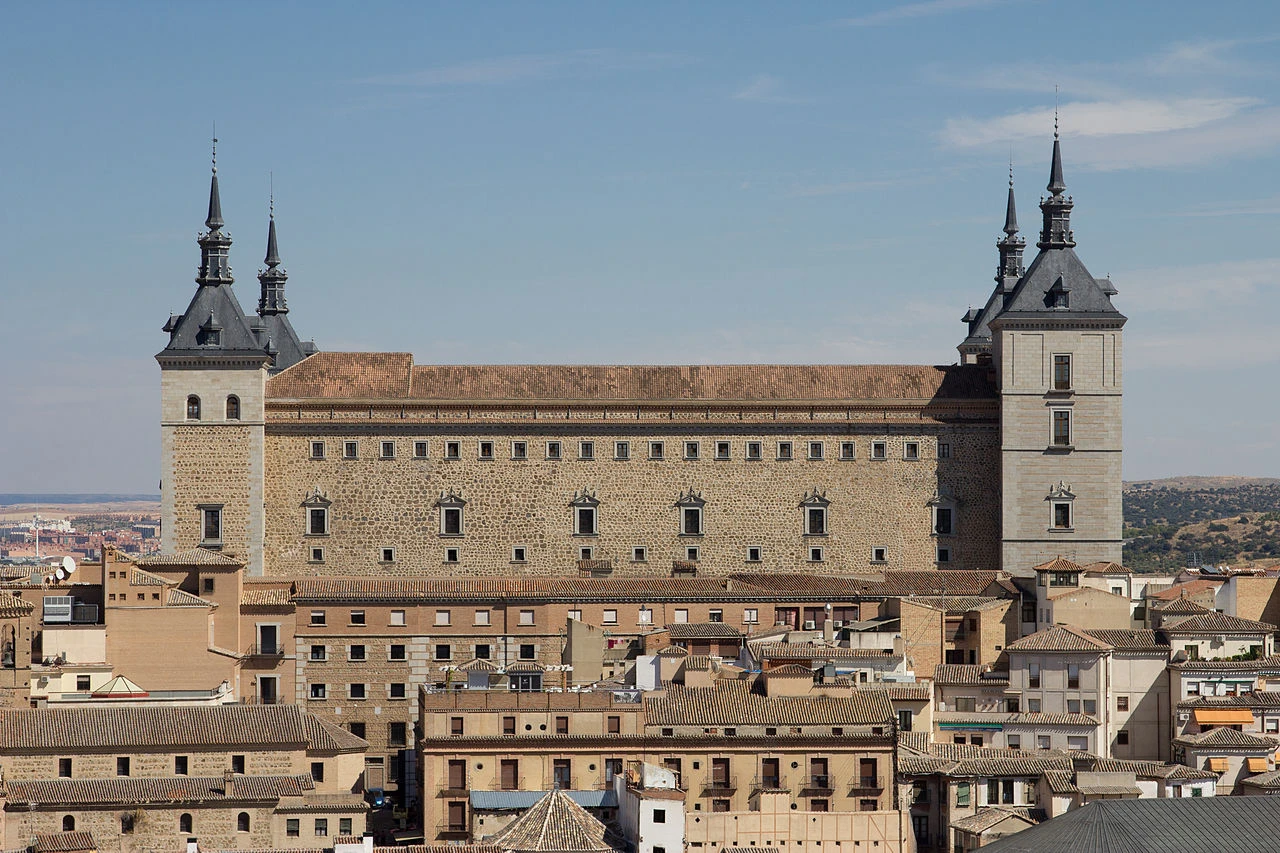
Toledo · 40 km
Alcázar of Toledo
Content & sources
Carlos Delgado · CC BY-SA 3.0 es
Toledo · 41 km
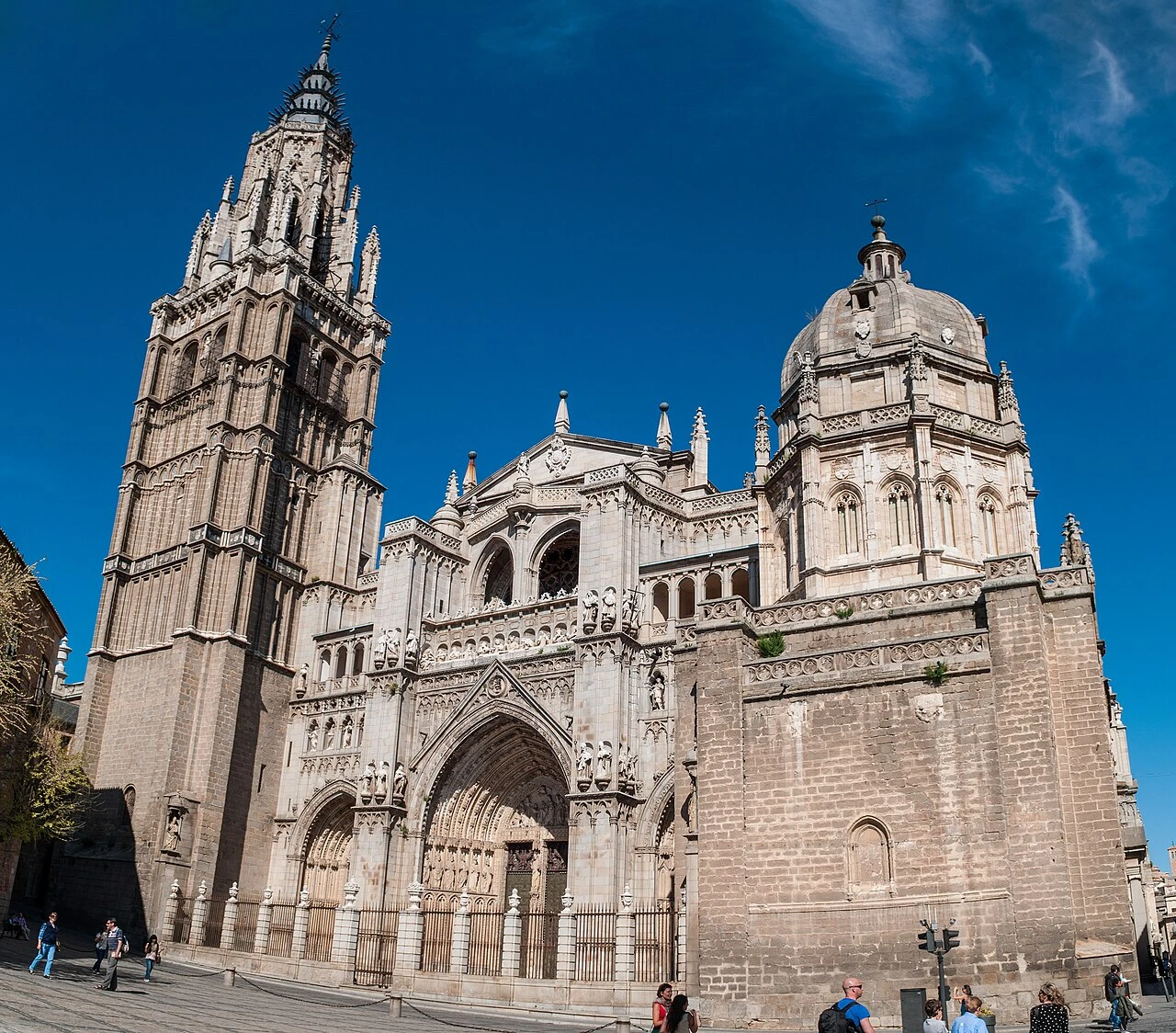
Toledo Cathedral
Content & sources
Michal Osmenda from Brussels, Belgium · CC BY 2.0
Madrid · 43 km
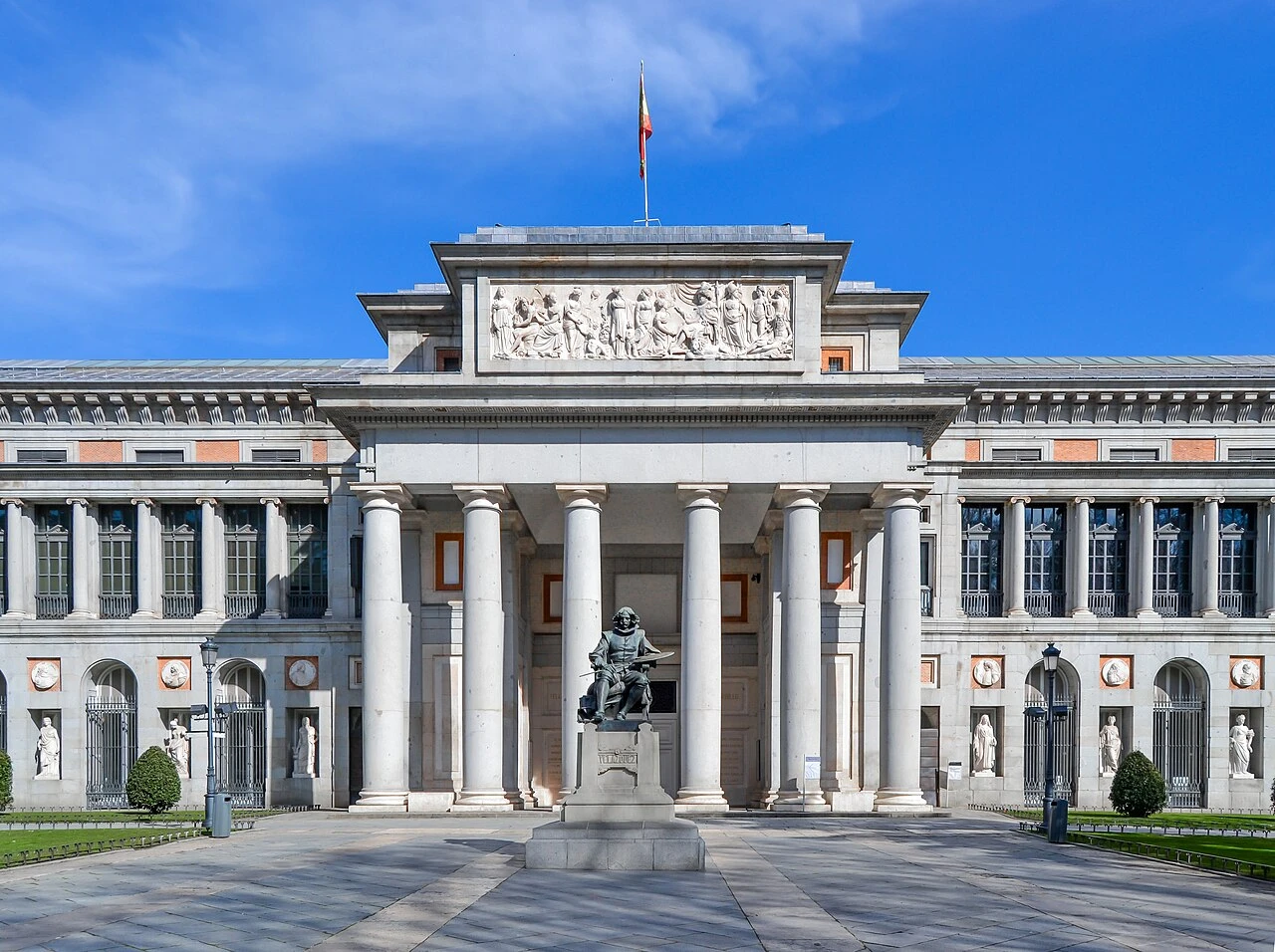
Prado Museum
Content & sources
Emilio J. Rodríguez Posada · CC BY-SA 2.0
Madrid · 43 km
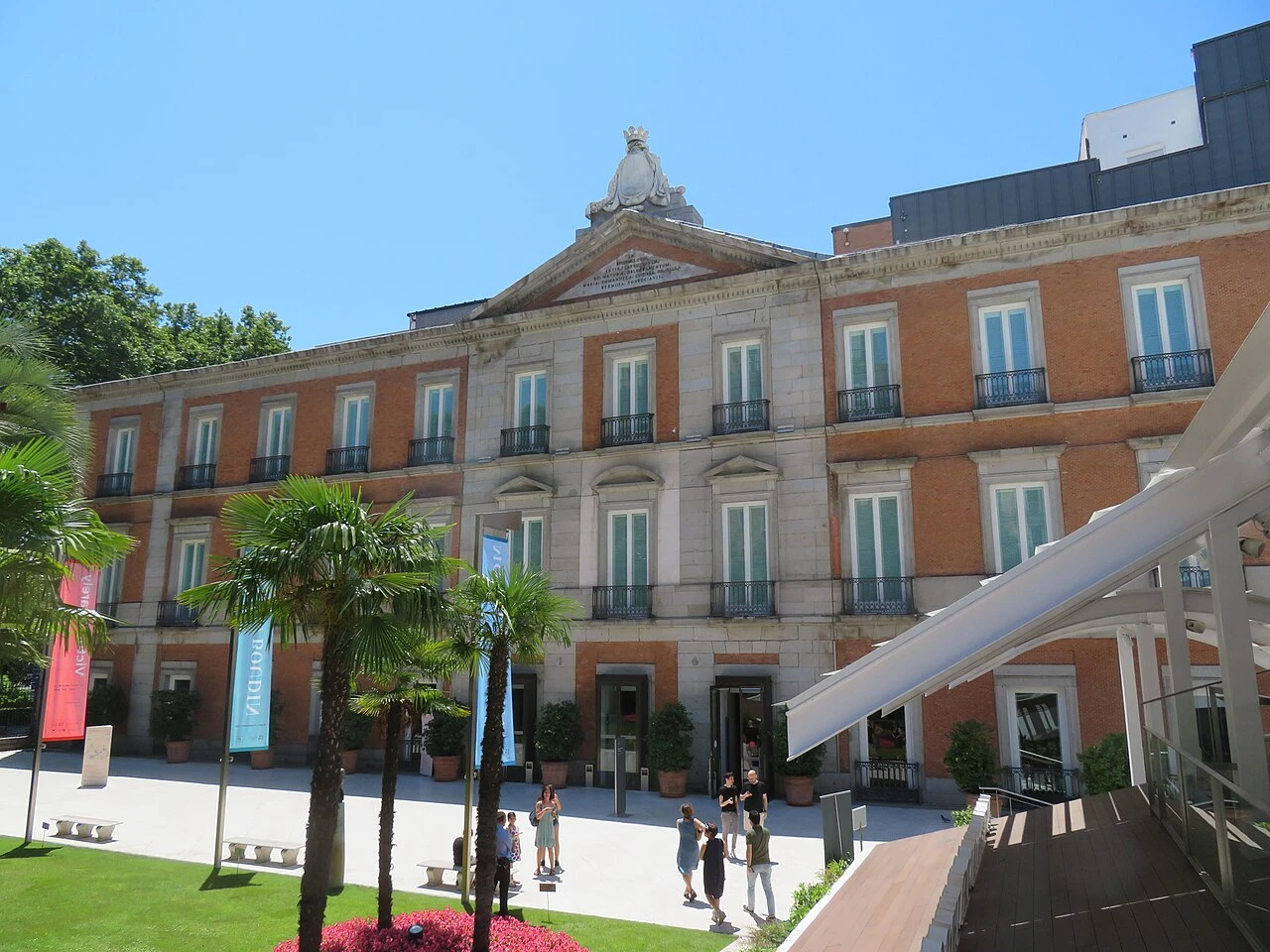
Thyssen-Bornemisza Museum
Content & sources
Kyle Magnuson from Los Angeles, United States · CC BY 2.0