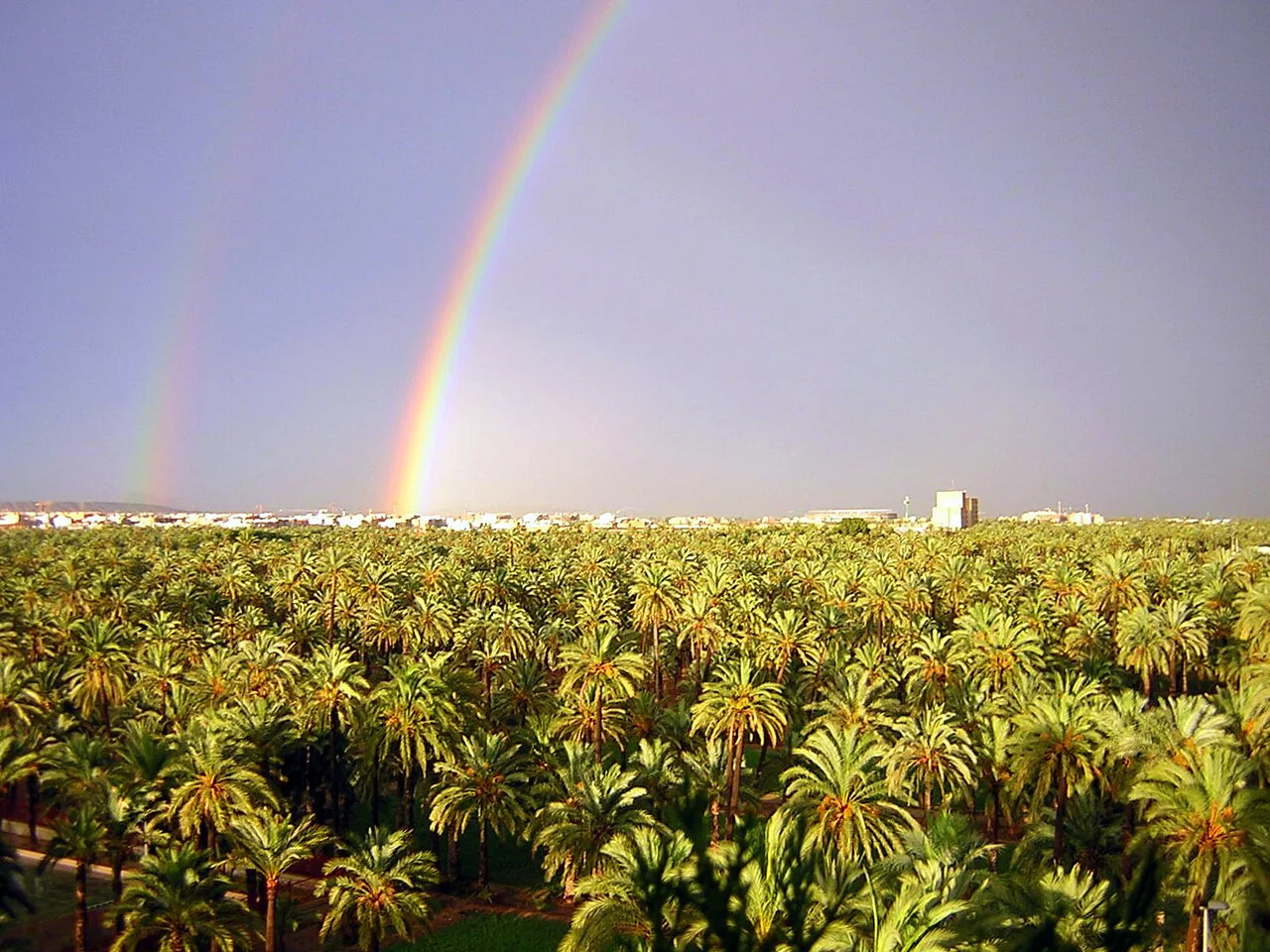
Stanza · Audio guide
Palmeral de Elche Audio Guide
A place to remember. A story to take with you.
The Palmeral of Elche is a system of date palm orchards located in the city of Elche, Spain. It is a historic palm grove that was inscribed as a UNESCO World Heritage Site in 2000.
Download Stanza, then search for “Palmeral de Elche”.
About the tour
One guide. Your kind of visit.
The Palmeral of Elche is a system of date palm orchards located in the city of Elche, Spain. It is a historic palm grove that was inscribed as a UNESCO World Heritage Site in 2000.
Ready when you are.
- 01Get the free Stanza app.
iOS & Android
- 02Find your guide.
“Palmeral de Elche”
- 03Download before you go.
Works offline
Audio guide / 13 narrated stops
Inside the guide
Get to know a few of the stories before you go. Open a stop to read more.
01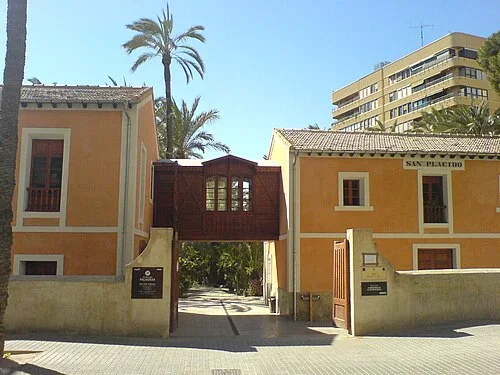 Palm Grove Museum and Traditional Heritage
Palm Grove Museum at Huerto de San Plácido
Welcome to the Palmeral of Elche, a forest of date palms growing in the middle of a Spanish city. In the tenth century, the Caliphate of Córdoba moved Elche to its present spot and began planting palm groves here. The rulers brought oasis techniques from North Africa and built canals to tame a dry, salty landscape. What grew was an agricultural oasis, a working landscape of fruit trees sheltered under palms. In December 2000, UNESCO listed the palm grove as a World Heritage Site. The museum itself is two traditional nineteenth-century houses, joined by a wooden skybridge over the path. From here, the Route of El Palmeral runs through the orchards, about two and a half kilometres of easy walking. Keep one thing in mind as the visit unfolds: this was farmland first, and a garden only second.
Photo: Josecarlosdiez · CC BY-SA 3.0
02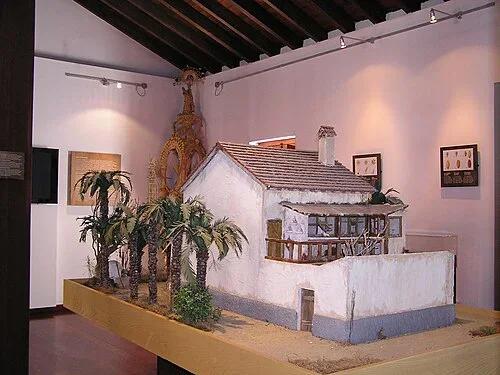 Palm Grove Museum and Traditional Heritage
Model of a Traditional Huerto
Inside the museum sits a scale model of a whitewashed farmhouse among palms, and it explains the whole layout of the oasis. The basic unit here is the huerto, a rectangular orchard plot. Palms were planted in single or double rows along the edges of each rectangle, in a strict grid. The boundaries were fences of plaited dried palm leaves, called cascabots, or low plastered walls of rough stone. None of these palms were ornamental. They gave timber, fibres for baskets, and material for thatching roofs. Their shade and their shelter from the wind protected the crops grown inside the plot, and livestock fed there too. The model house stands for the many such dwellings that once sat among the groves, at the centre of their own small farm.
Photo: Etnacila · Public domain
03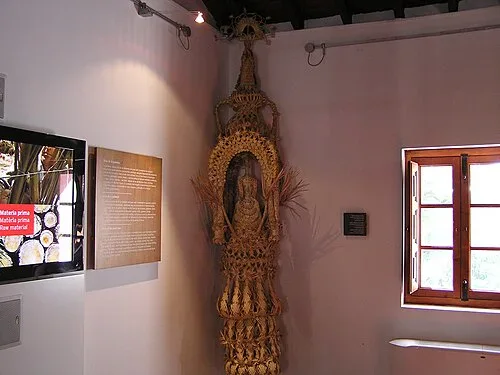 Palm Grove Museum and Traditional Heritage
The White Palm of Palm Sunday
Rising almost to the ceiling is a tall figure woven entirely from palm leaves. After Christian rulers took Elche in the thirteenth century, residents began weaving dried, bleached palm fronds into decorative pieces. These white palms were carried in the Palm Sunday procession, and the tradition has never stopped. The craft is plaiting: fronds are dried, lightened, then woven into intricate patterns. Palmereros, the palm workers, still demonstrate the technique inside this museum. There are older roots to the story, too. Carthaginian settlers planted the first date palms at Elche in the fifth century before Christ. But the woven white palm belongs to the Christian era, and the city's Palm Sunday parade still carries it today.
Listen in the appPhoto: Etnacila · Public domain
04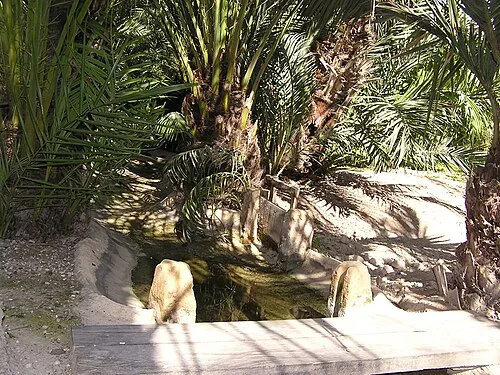 The Agricultural Oasis and Acequia Network
Acequia Channel and Stone Partidor
A narrow channel of green water runs between stone banks, with low stone dividers set across it. This is a small example of the engineering that keeps the oasis alive. The main canal, the Acequia Mayor, carries water from the Vinalopó River, and that water is brackish. The canal has more than twenty branches, feeding secondary channels that reach the crop fields. The stone and wood dividers are called partidores, and they split the flow by proportion alone. One share was diverted into Elche for drinking, bathhouses and small industries like oil and soap making. The rest ran south to irrigate the fields. The medieval Islamic engineers who designed the system treated water as a social good, and built it to waste as little as possible.
Listen in the appPhoto: Espencat · Public domain
05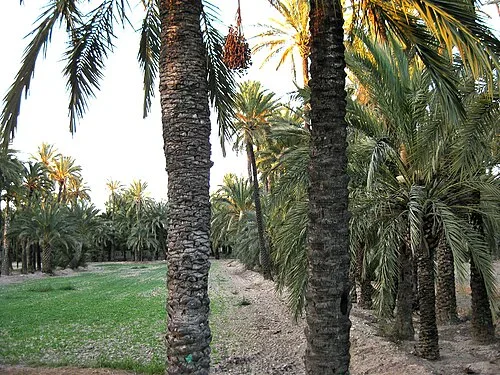 The Agricultural Oasis and Acequia Network
Inside the Huerto: The Oasis Microclimate
The trunks rise in straight lines, and between them lies a plot of green cultivation. That order is the design. The canopy cuts the scorching sun, slows evaporation, and keeps the soil from washing away in the rare heavy rains. The conditions here are harsh: summer temperatures regularly climb past thirty degrees, and yearly rainfall falls below two hundred and fifty millimetres. Under the palms, farmers grew cereals and forage plants, along with fruit trees such as pomegranates, for both people and livestock. The palm rows turned an arid plain into a working oasis.
Listen in the appPhoto: Espencat · Public domain
06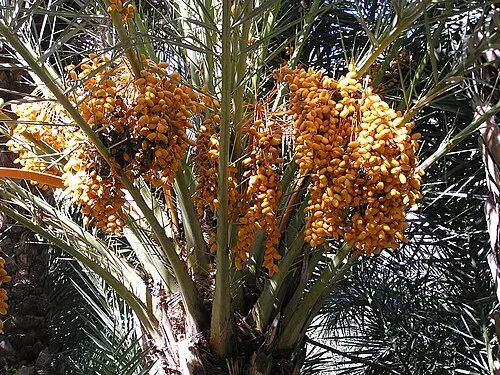 The Agricultural Oasis and Acequia Network
The Date Harvest
The clusters hang in their dozens, heavy with yellow fruit. The date palm grows at a patient pace: about ten years to add a single metre of trunk. In return it lives a very long time, on average two hundred and fifty to three hundred years. Some trees in the older groves are thought to be past three hundred. The fruit ripens in winter, and the harvest still comes each November and December. What has changed is the purpose. Since the late twentieth century, date growing here has survived mainly as a heritage activity, sold in the local marketplace rather than shipped out as an industry.
Listen in the appPhoto: Etnacila · Public domain
07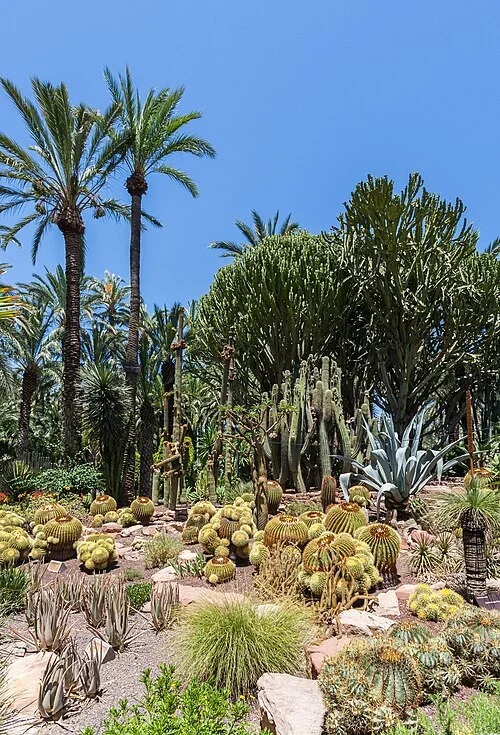 Huerto del Cura and the Imperial Palm
Huerto del Cura National Artistic Garden
Among the palms here grow cacti, agaves and towering euphorbias, under a wide blue sky. This is the Huerto del Cura, the most celebrated garden within the Palmeral and a designated National Artistic Garden. It keeps the old working layout of groves and plots, but layers an ornamental collection over it. There are ponds, sculptures and a garden house among the planting. The palm collection alone holds some seventy different species, though the date palm, Phoenix dactylifera, remains the leading tree. Olive trees and citrus grow here as well. It shows one direction the agricultural oasis could evolve: from a farm that fed the city into a garden made for wonder.
Listen in the appDiego Delso · CC BY-SA 4.0
08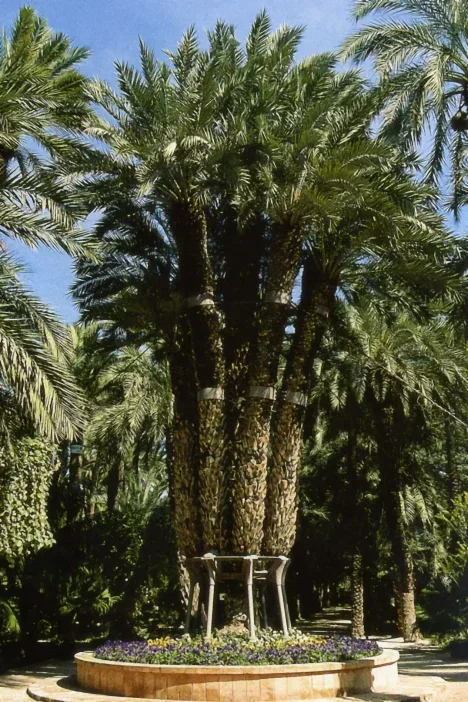 Huerto del Cura and the Imperial Palm
The Palmera Imperial
A single date palm stands in a circular bed, but it does not look like one tree. Seven massive stems rise from the same base, spreading in the shape of a candelabra. A date palm normally grows as one trunk, so a single root producing seven full stems is a botanical rarity. The tree is a male Phoenix dactylifera, reckoned to be about a hundred and eighty years old. Its own weight is the danger. Wooden crutches prop the stems from below, and rings bind them together higher up, carrying the load the trunk alone cannot. Gardeners have kept this balancing act going for generations.
Listen in the appJavier martin at Spanish Wikipedia · CC BY-SA 3.0
09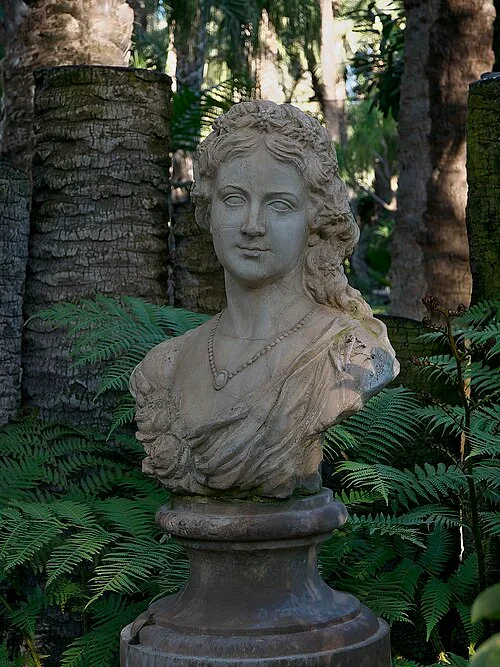 Huerto del Cura and the Imperial Palm
Bust of Empress Elisabeth of Austria
A stone bust of a young woman with a pearl necklace stands among the ferns. She is Elisabeth of Austria, the empress known to the world as Sissi. In autumn 1894 she visited the Huerto del Cura while travelling the Mediterranean coast. The chaplain who owned the garden, José María Castaño, showed her the seven-stemmed palm. She was astonished, and told him the tree was majestic enough to be worthy of an empire. Castaño took her at her word. He christened the palm the Palmera Imperial in her honour, and the name has stayed with it ever since.
Listen in the appJosé Luis Filpo Cabana · CC BY-SA 4.0
10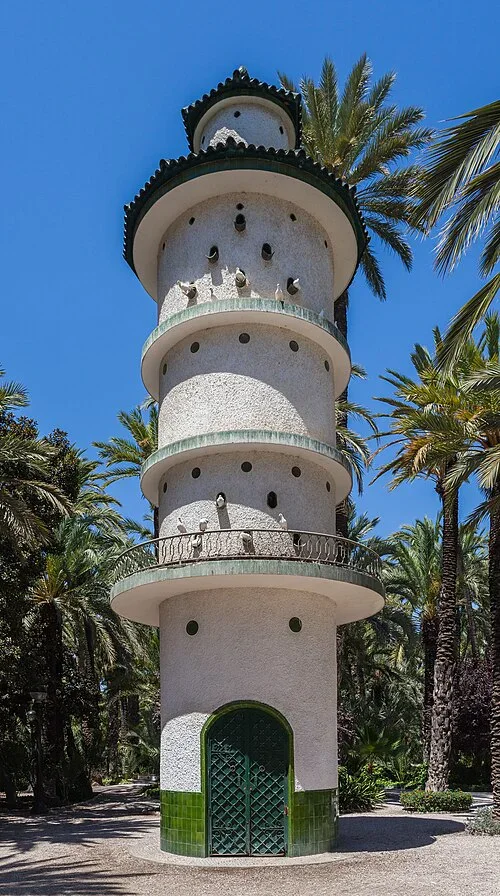 Parque Municipal and Torre El Palomar
Parque Municipal and the White Dovecote Tower
A slender white tower rises in tiers, each round balcony edged in green, with small openings punched through the walls. It stands in the Municipal Park, six hectares of green at the centre of Elche. The park also holds the Huertos del Colomer garden and the Hort de Baix amphitheatre, and the city council maintains it outside the World Heritage perimeter. This is the Torre El Palomar, the white dovecote tower, an ornament of that green. The idea behind it runs deep. Elche's residents have long prized their gardens as refuge from the arid land around them. In the Islamic period, gardens symbolized paradise, and poets used them as metaphors for love, loss, memory and the passing of time. The tradition reached Iberia in the eighth century, when the Umayyad prince Abd al-Rahman fled from Syria to Córdoba and brought the garden-estate idea with him.
Listen in the appchisloup · CC BY 3.0
- 11
Fuente La Gloriera: The Division of the Waters
A long symmetric pool that remembers the day the water was divided between two peoples.
- 12
Molí del Real: The Royal Water Mill
The royal mill on the ravine, where canal water once ground the city's flour.
- 13
Panorama of the Palmeral from the Basílica Tower
A sea of two hundred thousand palms, and the long fight to keep it.
Palmeral de Elche
Frequently asked questions
How much does the guide cost?
Free app download. Listed guide price: $0.99. Guide price shown in the app. Audio guide only. Venue admission is separate.
Can I listen without internet?
Yes. Download the guide’s audio, images, and maps in the app before your visit. Your downloaded content is then available offline.
Can I listen in my language?
This audio guide is available in 15 languages, including English.
Do I need to follow a schedule?
No. This is a self-guided experience. Choose your stops, pause whenever you like, and return to a story at your own pace.
At your own pace
Explore Palmeral de Elche.
Download Stanza, then search for “Palmeral de Elche”.
Free app download · Guide price shown in the app
Keep exploring
Audio guides — Spain
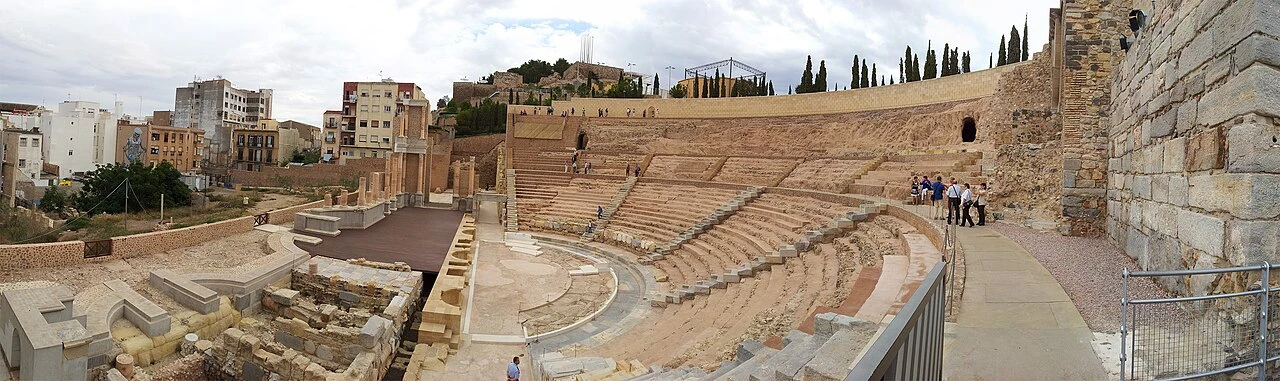
Cartagena · 79 km
Roman Theatre of Cartagena
Content & sources
Photo: Akstyo · CC BY-SA 4.0
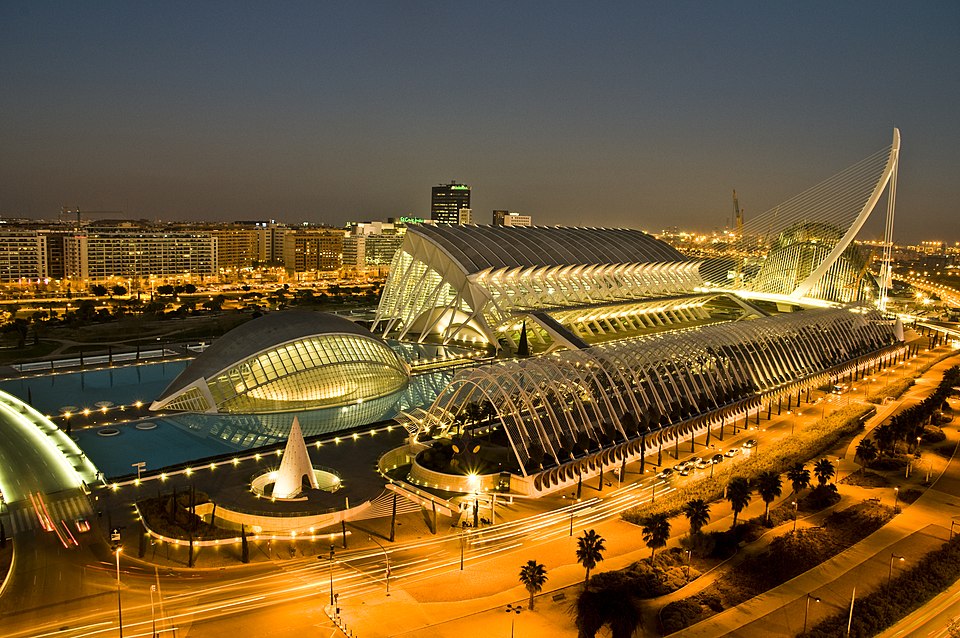
Valencia · 135 km
City of Arts and Sciences
Content & sources
Photo: Jcca76 · CC BY-SA 4.0
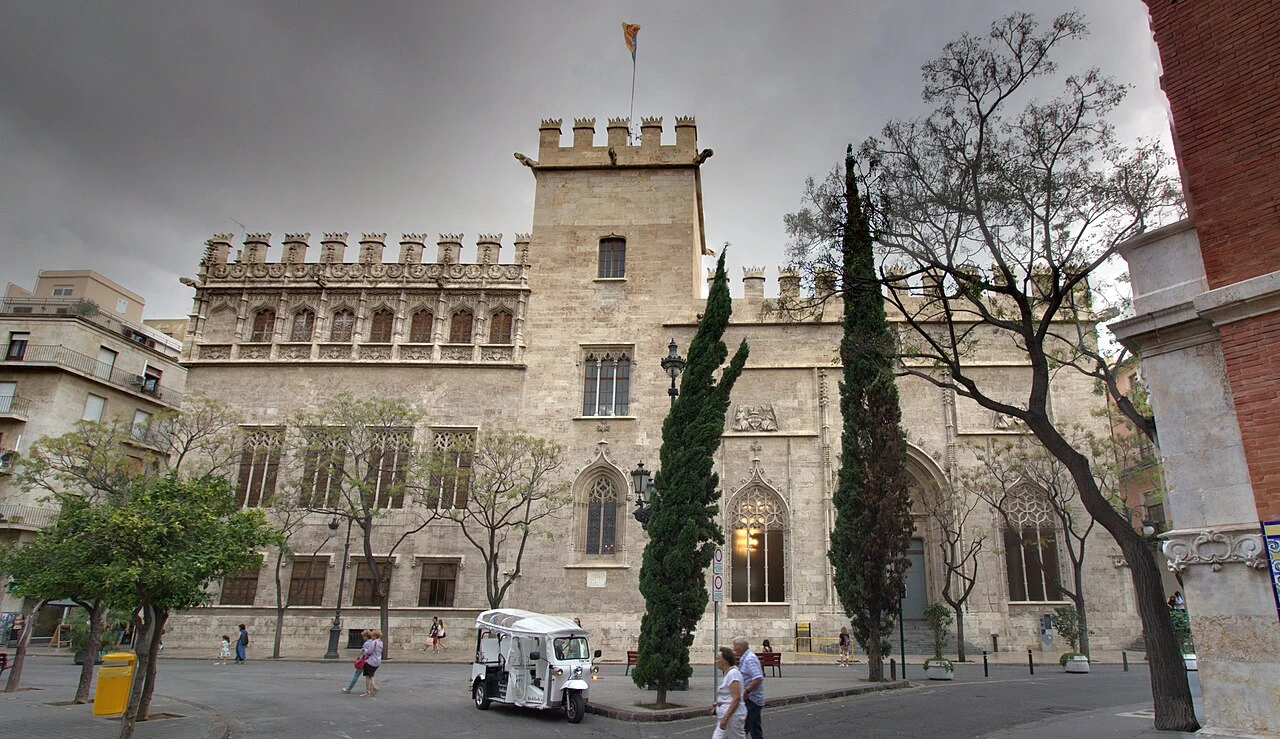
Valencia · 137 km
Llotja de la Seda
Content & sources
Photo: Juan Mayordomo · CC BY-SA 4.0
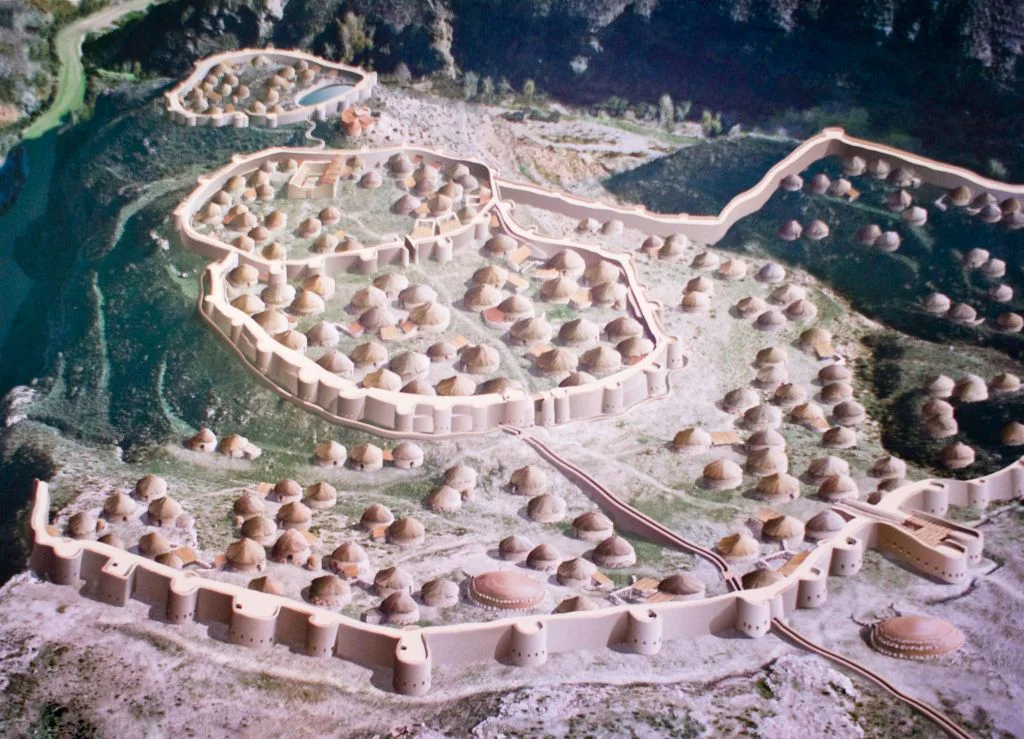
Santa Fe de Mondújar
Los Millares
Content & sources
Jose Mª Yuste, de la fotografía (Tuor123). Miguel Salvatierra Cuenca, autor de la ilustración · CC BY-SA 4.0