Languages
15Ciutat de les Arts i les Ciències Audio Guide
Ciutat de les Arts i les Ciències is an archaeological site in Valencia, Spain. Explore it with Stanza's guided offline audio tour — narrated in 15 languages.
Quick Facts
27
Stops
15
Languages
100%
Offline
📍 Valencia, Spain · 39.4545°N, -0.3504°E
About Ciutat de les Arts i les Ciències
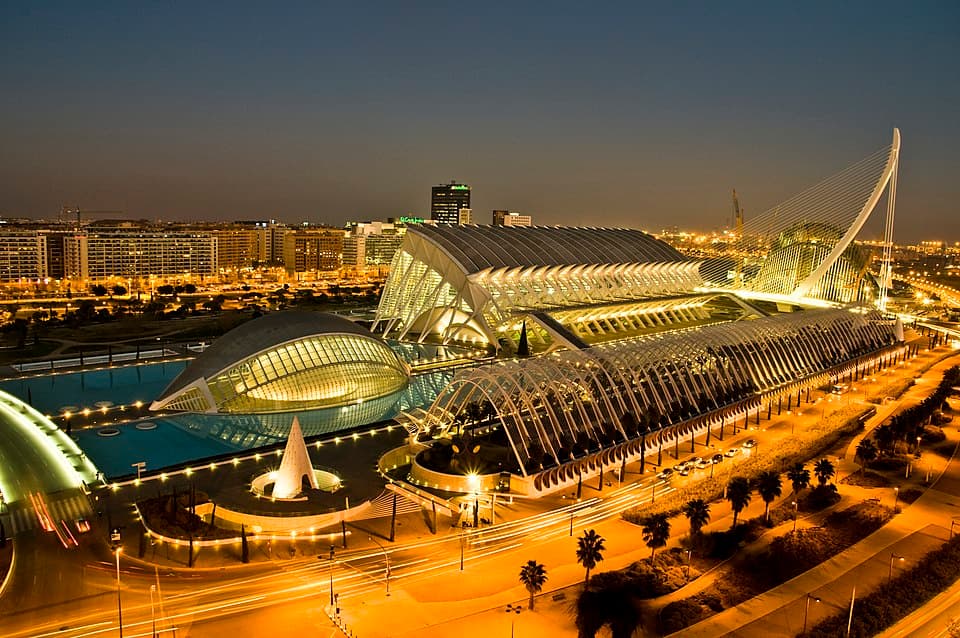
A vast cultural and architectural complex located in Valencia, Spain. It features several buildings dedicated to arts, sciences, and entertainment, functioning as a major tourist attraction.
This self-guided audio tour features 27 narrated stops organized across 8 sections. As a cultural center, Ciutat de les Arts i les Ciències offers a unique cultural experience in the heart of Valencia, Spain.
The Stanza audio guide is available in 15 languages and works entirely offline — download the complete tour including audio narration, maps, and images before your visit. As you walk through Ciutat de les Arts i les Ciències, GPS-triggered narration plays automatically at each point of interest.
Last updated:
What you will hear
Queen Sofia Palace of the Arts
One of the world's most striking opera houses, this building resembles a futuristic helmet and serves as a global center for music and performing arts.
The Upper Gallery View
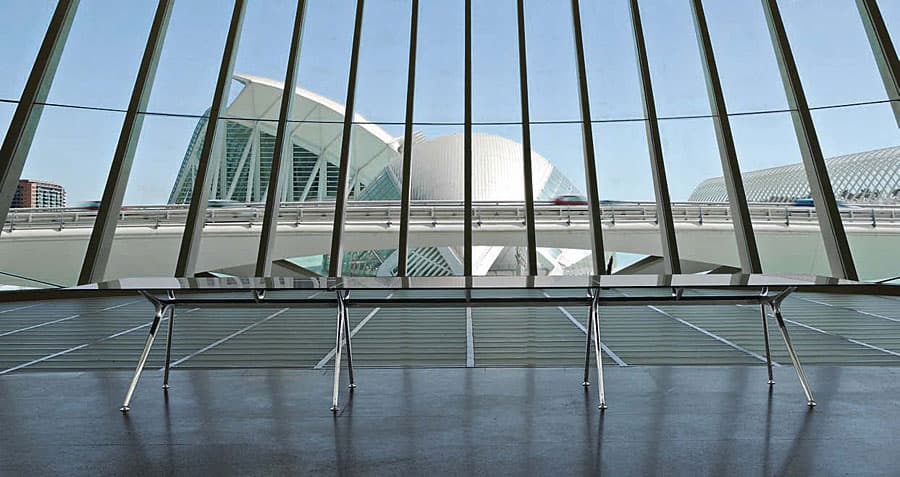
The upper gallery serves as a stunning transition point between the intimate, focused interior of the opera house and the grand, open-air scale of the surrounding park. Notice the massive vertical structural ribs that soar above you. These aren't just for support; they are spaced to allow floods of natural light to reach deep into the building’s core, changing the atmosphere of the space as the sun moves throughout the day. While you take in the view toward the rest of the complex, take a moment to look at the furniture in this area. These pieces were custom-designed specifically for this building, featuring the same lean, aerodynamic aesthetic as the architecture itself. The furniture feels less like decor and more like an extension of the building’s structural language. From here, you can see how the palace integrates with the larger landscape of the City of Arts and Sciences, acting as a protective shell that still feels light, airy, and inextricably connected to its environment.
Montolivet Bridge
Connecting the old city with the new complex, this bridge offers one of the best panoramic viewpoints for photographing the entire City of Arts and Sciences.
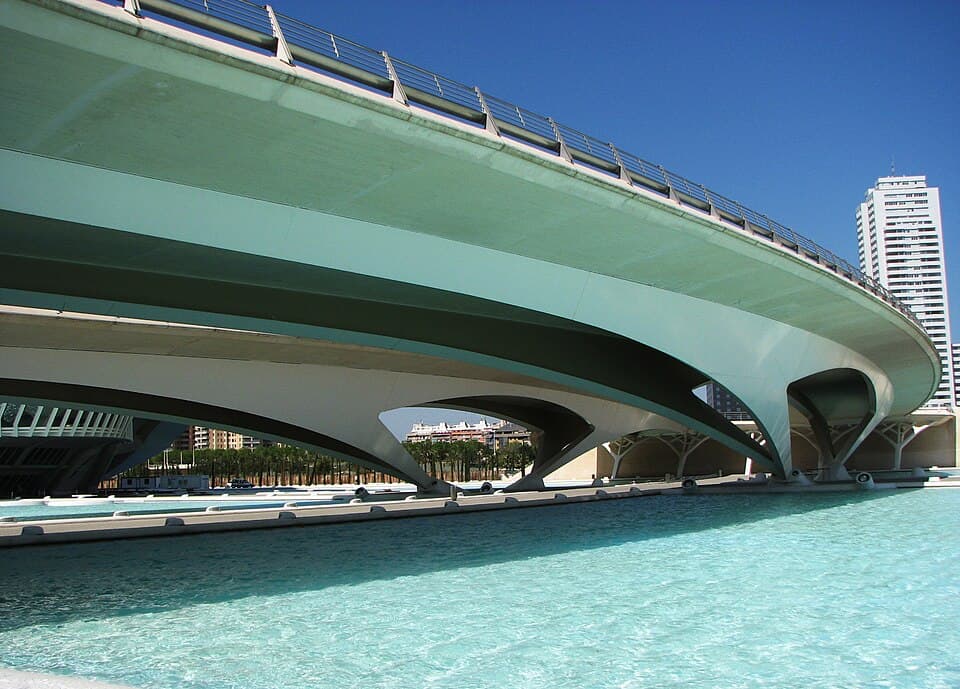
Pont de Montolivet
The Pont de Montolivet is more than just a transit route; it is the physical threshold where the old city meets the new. As you pass over or near it, pay attention to the signature white concrete ribs on the underside of the span. These structural elements are designed to look like the expansive, skeletal belly of a whale, continuing the biological theme found throughout the valley. This bridge was designed by Santiago Calatrava to replace a more traditional crossing that once stood here. By integrating the bridge into the overall design of the complex, the architect ensured that every element of the visitor’s journey—even the act of driving or walking across the riverbed—contributes to the feeling of entering a 'City of the Future.' The bridge spans the wide, green park that was once the Turia River, acting as a modern landmark that signals your arrival into a space where architecture and engineering are celebrated as art forms. Its clean lines and white surfaces act as a visual prelude to the grand buildings that lie just ahead.
The Hemisfèric
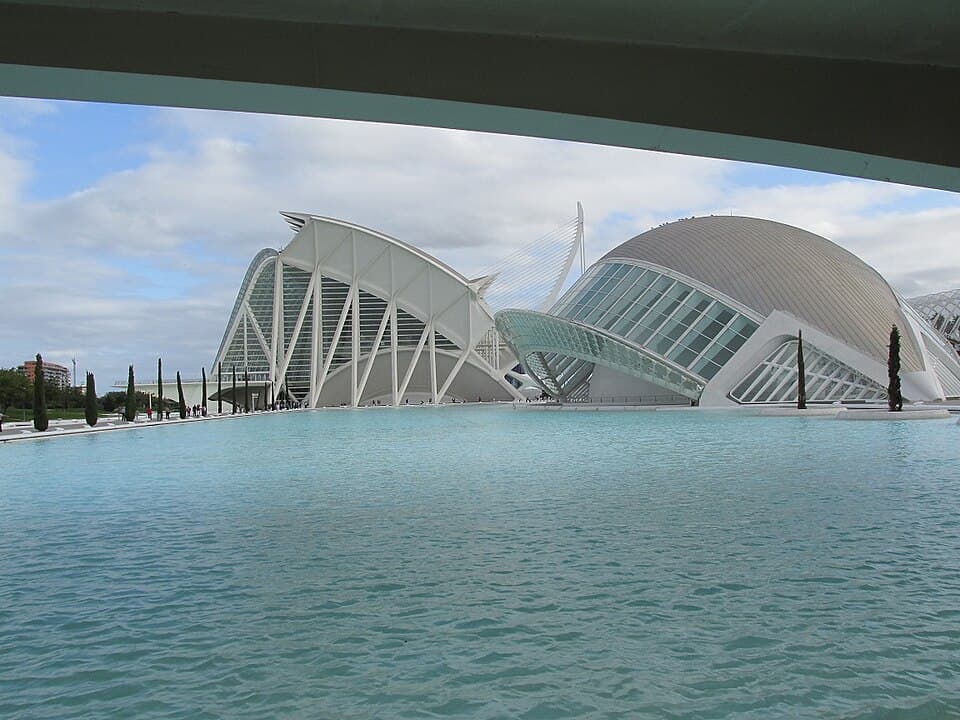
Designed to resemble a giant human eye, this building contains an IMAX cinema and planetarium, reflecting perfectly in the surrounding pool to complete the 'pupil'.
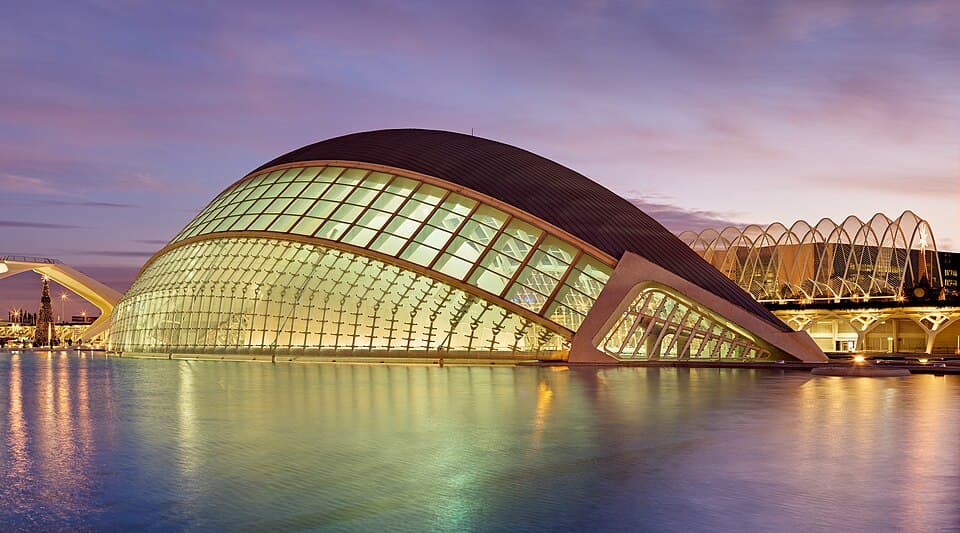
L'Hemisfèric
Opened in 1998, L'Hemisfèric was the pioneering structure of this entire cultural complex. Its design is based on the poetic concept of an 'Eye of Wisdom,' observing the world through the lens of science and film. Inside the massive shell, you will find a state-of-the-art IMAX theater. The theater itself is housed within a giant sphere, which represents the pupil of this architectural eye. One of the most fascinating features of the building is its 'eyelid.' The outer structure of glass and steel shutters is not static; it is equipped with hydraulic lifts that can actually raise and lower segments of the shell, much like a human eye blinking. This kinetic element allows the building to interact with the light and the surrounding environment. As the first piece of the puzzle to be completed, L'Hemisfèric set the tone for the entire project, demonstrating how architecture could be used to create literal metaphors for the human experience and the pursuit of knowledge. It remains one of the most photographed and recognizable landmarks in Spain.
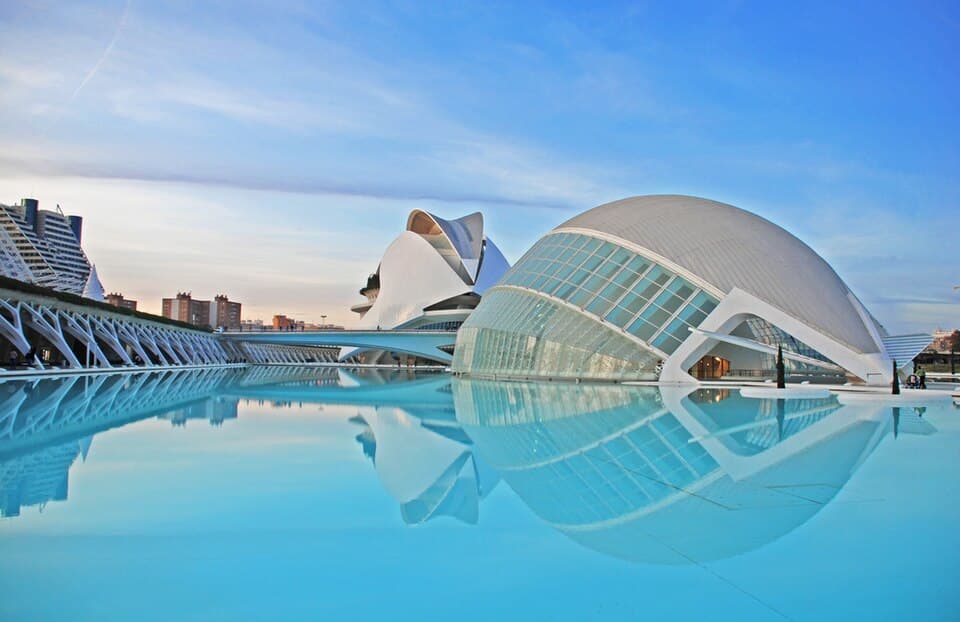
The Eye Reflection
To truly appreciate the design of L'Hemisfèric, you must look at it in conjunction with the reflecting pool. Architect Santiago Calatrava intentionally designed the building as a semi-sphere, knowing that the water would provide the missing half. When the surface of the pool is still, the reflection perfectly aligns with the physical structure, completing the circular shape of a human eye. Without this watery mirror, the architectural metaphor of the 'Eye of Wisdom' would be incomplete. Framing the top of the 'eye' is a sweeping structural 'eyebrow' that protects the glass-enclosed walkways below. These pathways allow visitors to stroll right alongside the water's edge, feeling the cool breeze off the pool while looking into the 'pupil' of the theater. This interplay between solid concrete, transparent glass, and reflective water creates a sense of perfect symmetry and balance. It is a reminder that in this complex, the landscape is not just a setting for the buildings—it is an essential part of the architecture itself.
The Umbracle
A landscaped walk filled with plant species indigenous to Valencia, covered by a series of 55 fixed arches and 50 floating arches.
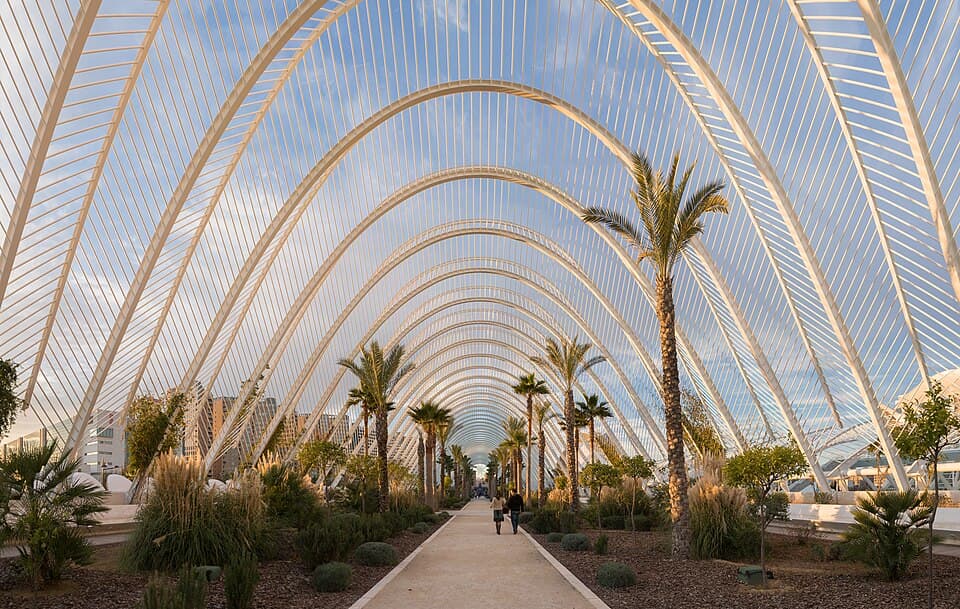
L'Umbracle
L'Umbracle is a striking open-air promenade defined by a series of 55 fixed arches and 50 floating arches that create a rhythmic, skeletal canopy. This is more than just a walkway; it is a carefully curated botanical garden designed to showcase the diverse plant life of the Valencia region. As you stroll through, you will see a variety of indigenous species, including tall palm trees, fragrant bitter orange trees, and bushes of aromatic lavender that fill the air with scent. The structure was designed with a long-term vision in mind: the arches serve as a massive trellis for climbing plants. Over time, these vines are intended to completely cover the white steel ribs, transforming the promenade into a living, breathing green tunnel that provides natural shade. This fusion of rigid engineering and organic growth is a central theme of the park. It offers a peaceful, shaded retreat where you can appreciate the Mediterranean flora while surrounded by the futuristic skyline of the City of Arts and Sciences.
Prince Felipe Science Museum
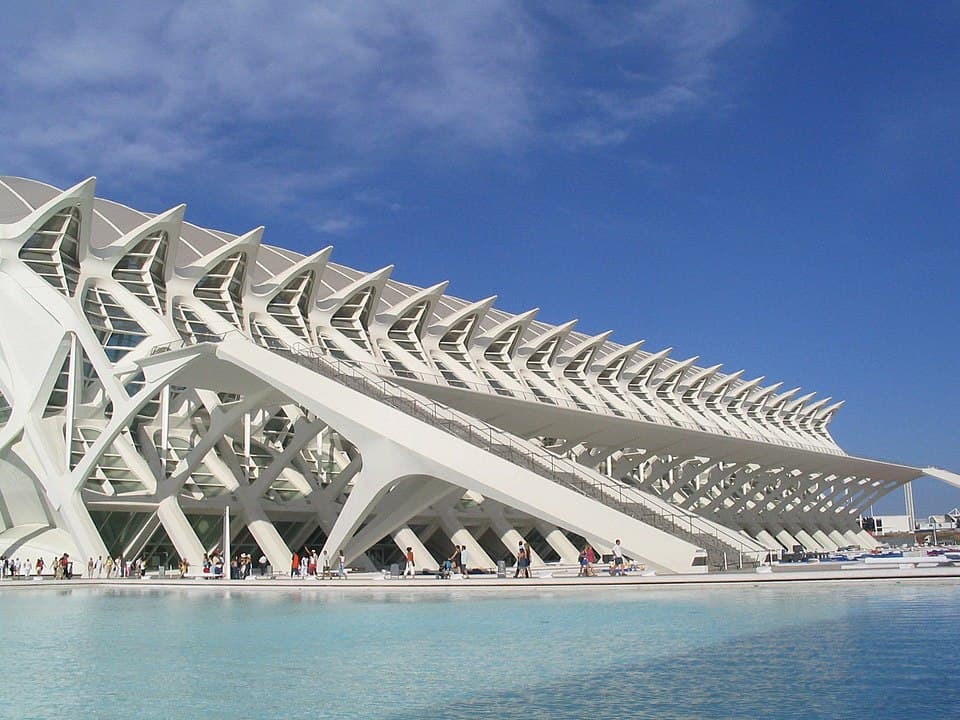
Resembling the skeleton of a whale, this interactive museum is designed around the philosophy 'Not touching is prohibited'.
Museu de les Ciències Príncipe Felipe
Stretching over 220 meters in length, the Museu de les Ciències Príncipe Felipe is one of the most impressive structures in the complex. Its jagged, rhythmic form is intended to evoke the skeleton of a prehistoric whale, a theme that continues as you enter the building. Inside, the massive white concrete 'ribs' you saw on the exterior are mirrored to create a soaring, cathedral-like space dedicated to human knowledge. This museum operates under a very specific and unusual rule: 'Not touching is prohibited.' Unlike traditional museums where artifacts are kept behind glass, this is a fully interactive environment. Visitors are encouraged to engage directly with the exhibits, turning science into a hands-on experience. The sheer scale of the building allows it to house an incredible variety of displays, from space exploration to the mysteries of the human body. By combining the grand, spiritual feel of a cathedral with the curiosity of a laboratory, the museum celebrates the wonder of discovery, making complex scientific concepts accessible and exciting for people of all ages.
The Sundial
A large, modern sundial located on the plaza outside the museum, demonstrating the intersection of art, geometry, and time.
The Museum Plaza
Looking back toward L'Hemisfèric from this vantage point, you can see the master plan of the entire complex. All the buildings are perfectly aligned on a single axis that follows the original, winding path of the Turia River. This monumental project was a massive political and financial gamble for the city of Valencia, costing nearly one billion Euros over two decades of construction. At the time, critics questioned whether such an expensive undertaking was necessary. However, the gamble paid off. The City of Arts and Sciences successfully transformed Valencia from a regional port city into a major global tourist destination and a center for modern architecture. What was once a flood-prone riverbed is now an internationally recognized landmark. This plaza serves as a gathering space where you can appreciate the harmony between the different structures, each with its own unique personality, yet all united by a common design language of white concrete, glass, and water.
Assut de l'Or Bridge
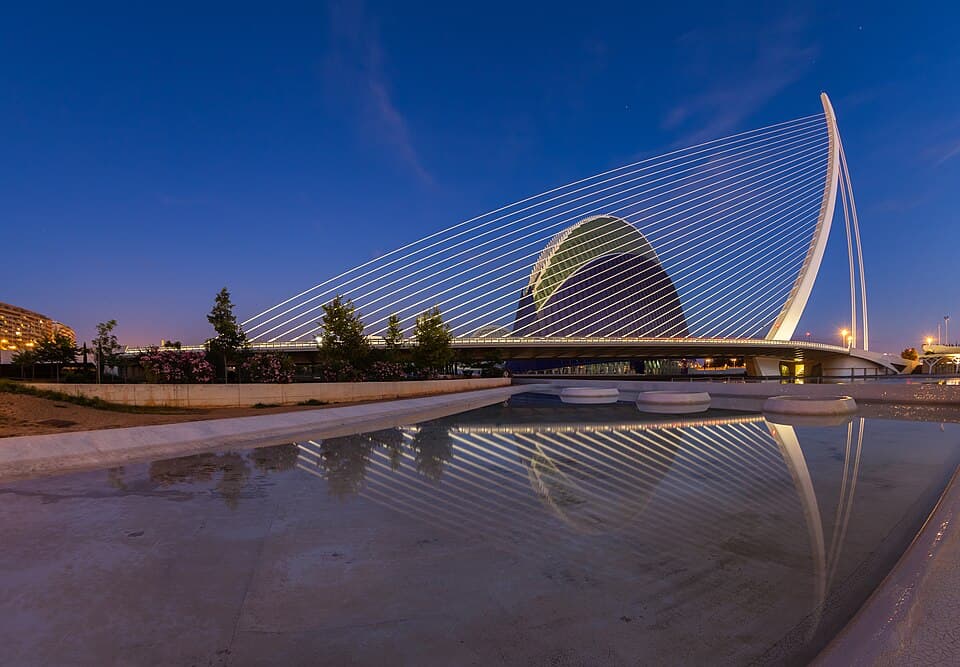
At 125 meters high, the pylon of this cable-stayed bridge is the highest point in the city, designed to look like a giant harp.
Assut de l'Or Bridge
Looking across the complex, you’ll notice the towering white pylon that defines the skyline. This is the Assut de l'Or bridge, a masterwork of modern engineering. At its peak, the pylon reaches 125 meters, making it the highest point in the entire city of Valencia. Because of its distinctive, asymmetrical shape and the way its cables fan out, locals have given it several affectionate nicknames. Some call it "The Harp," while others refer to it as "El Jamonero," which translates to the ham stand—a nod to the traditional wooden holders used for carving Spanish serrano ham. Beyond its role as a transportation link, the bridge serves a celestial purpose. Its massive pylon acts as the gnomon of a giant sundial; as the sun moves across the Mediterranean sky, the bridge casts a long shadow that travels across the green expanses of the nearby park, marking the passage of time on a monumental scale. It is a perfect example of how the city’s functional infrastructure has been elevated into a piece of public art that interacts directly with the environment and the people who enjoy it.
The Oceanogràfic
Europe's largest aquarium, featuring iconic lily-shaped buildings designed by Félix Candela that house ecosystems from the world's main seas and oceans.
The Jellyfish Gallery
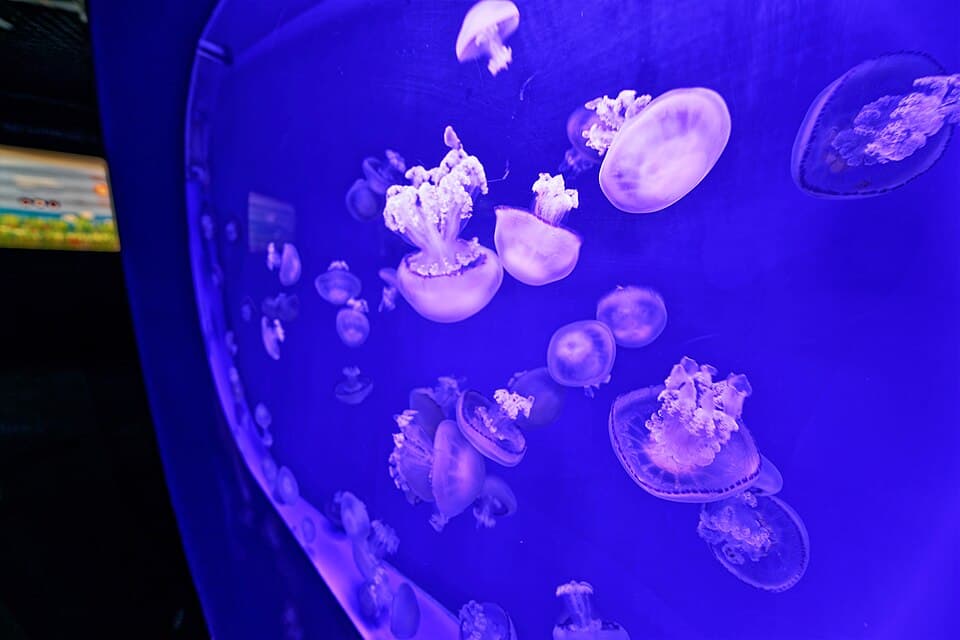
In this gallery, the world seems to slow down as you watch the mesmerizing, rhythmic movement of the jellyfish. These creatures are true survivors; they have existed in our oceans for over 500 million years, meaning they predated the dinosaurs and have survived multiple mass extinctions. What is perhaps most incredible is their biological simplicity: they thrive without a brain, a heart, or a skeletal system. Instead, they rely on a simple nervous system to navigate their watery environment. To enhance the experience, the gallery uses specialized lighting designed to highlight the translucent bodies of the jellies. This is especially important because many of these species are bioluminescent in the wild, producing their own light in the darkness of the deep ocean. As they drift through the water, their glowing forms create a living light show. This exhibit invites you to appreciate the delicate beauty of these ancient animals, whose basic design has remained virtually unchanged for half a billion years, proving that sometimes, simplicity is the ultimate key to survival in one of the planet's harshest environments.
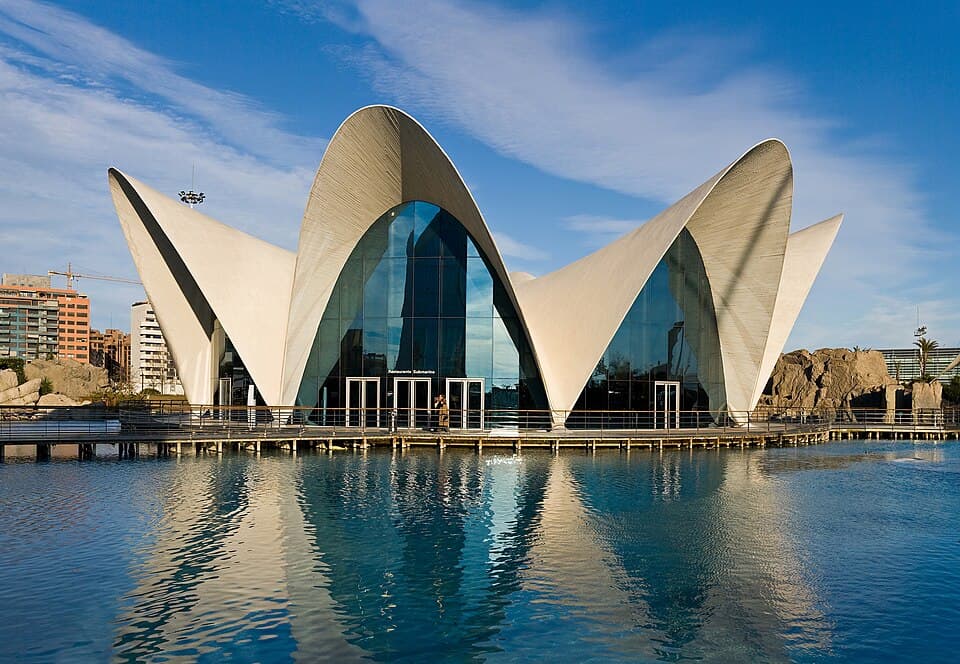
Oceanogràfic
As we move toward the eastern end of the complex, you will notice a distinct change in architectural style. This elegant building, which resembles a blooming water lily, was designed by the renowned architect Félix Candela rather than Calatrava. The shape is known as a "hyperbolic paraboloid," a signature of Candela’s work. What makes this structure truly remarkable is the technical precision of its construction; the concrete roof is incredibly thin, measuring only a few centimeters thick at its outer edges. This delicate-looking shell serves as the dramatic entrance to the Oceanogràfic, the largest aquarium in Europe. Within this vast facility, more than 42 million liters of water provide a home for thousands of marine animals. The building’s organic, fluid form perfectly sets the stage for the underwater wonders waiting inside, moving away from the skeletal, bone-like shapes of the museum and opera house toward a design that evokes the gentle curves of aquatic life. It stands as a testament to Candela’s ability to turn heavy concrete into something that appears as light and graceful as a flower floating on a pond.
Want to hear the rest?
Download the Stanza app to unlock all 27 stops and the complete guided audio tour.
Frequently Asked Questions
How long does the Ciutat de les Arts i les Ciències audio tour take?
The Ciutat de les Arts i les Ciències audio guide includes 27 narrated stops. Most visitors spend 45 minutes to 1.5 hours exploring the complete tour, though you can listen at your own pace and skip or revisit any stop.
Is the Ciutat de les Arts i les Ciències audio guide available in my language?
Stanza supports 15 languages: English, Spanish, French, German, Italian, Portuguese, Russian, Japanese, Chinese, Korean, Arabic, Hindi, Polish, Dutch, Hebrew. Check the guide in the app to confirm the languages currently available for this tour.
Can I use the audio guide offline at Ciutat de les Arts i les Ciències?
Yes! Download the complete Ciutat de les Arts i les Ciències tour — including all audio, maps, and images — before your visit. The Stanza app works completely offline, so you don't need WiFi or mobile data at the venue.
How much does the Ciutat de les Arts i les Ciències audio guide cost?
The Stanza app is free to download. The current listed price for the Ciutat de les Arts i les Ciències audio guide is $3.99; app-store region and currency may affect the final price.
How do I use the Stanza audio guide at Ciutat de les Arts i les Ciències?
Download the free Stanza app, search for "Ciutat de les Arts i les Ciències", and download the tour. When you arrive at the venue, the app uses GPS to detect your location and automatically plays the relevant narration as you move between points of interest — completely hands-free.
What makes the Stanza audio guide different from other Ciutat de les Arts i les Ciències tours?
Stanza offers GPS-triggered narration that plays automatically as you walk through Ciutat de les Arts i les Ciències — no need to manually select stops. The tour is available in 15 languages, works fully offline, and includes 27 expertly narrated stops with images and historical context.
What other audio guides are available near Ciutat de les Arts i les Ciències?
Stanza offers multiple audio guides in Valencia, Spain and nearby areas. After downloading the app, browse the map to discover all available tours near Ciutat de les Arts i les Ciències. Each guide can be downloaded for offline use.