Languages
15Aqueduct of Segovia Audio Guide
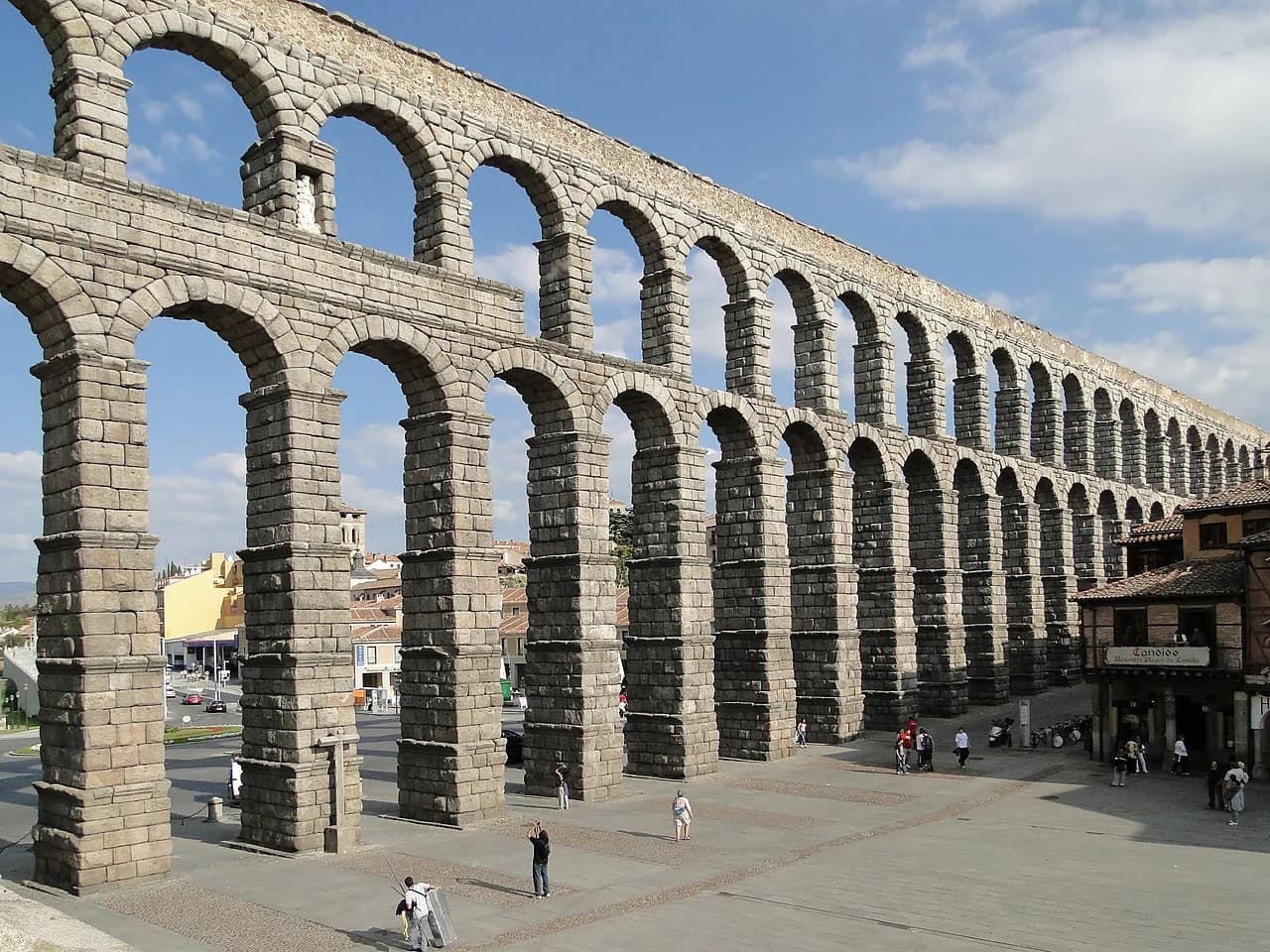
Aqueduct of Segovia is a landmark in Segovia, Spain. Explore it with Stanza's GPS-triggered offline audio guide — available in 15 languages.
Quick Facts
17
Stops
15
Languages
100%
Offline
📍 Segovia, Spain · 40.9480°N, -4.1177°E
About Aqueduct of Segovia
The Aqueduct of Segovia is an ancient Roman aqueduct bridge located in Segovia, Spain. This architectural heritage monument is a prominent example of a stone and arch bridge.
Aqueduct of Segovia is also known as Old Town of Segovia and its Aqueduct, Azoguejo, Acueducto Declarado Patrimonio de la Humanidad en 1985 junto con la ciudad antigua., Acueducto de Segovia.
This self-guided audio tour features 17 narrated stops organized across 7 sections. As a bridge, Aqueduct of Segovia offers a unique cultural experience in the heart of Segovia, Spain.
The Stanza audio guide is available in 15 languages and works entirely offline — download the complete tour including audio narration, maps, and images before your visit. As you walk through Aqueduct of Segovia, GPS-triggered narration plays automatically at each point of interest.
Last updated:
What you will hear
The Engineering of the Pillars
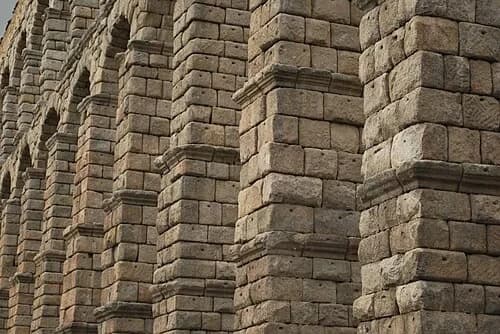
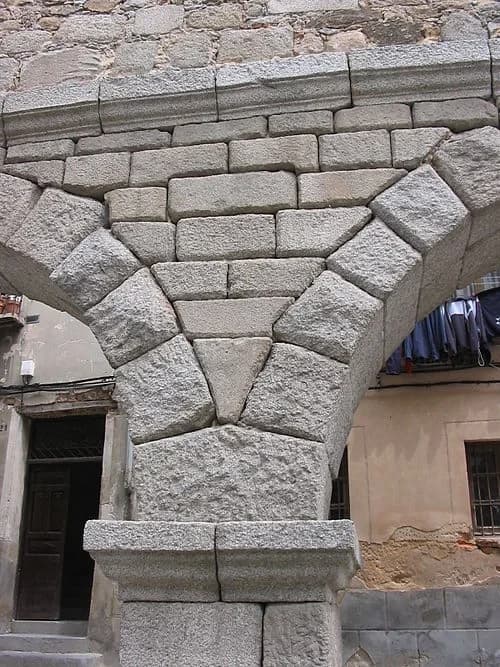
This stop focuses on the signature mortarless dry-stone construction. Close-up details of the granite blocks are essential to show how gravity alone holds the 20,400 stones in place.
Granite Block Details
The rough-hewn texture of the granite tells the story of the labor required to move more than 20,400 individual blocks. These massive stones were quarried from nearby hills and transported to the site using a sophisticated system of pulleys and wooden cranes. If you examine the surfaces of many blocks, you will notice small, circular indentations. These marks were left by iron lifting tongs, known as 'lewis' bolts or 'wolf's teeth,' which gripped the stones as they were hoisted high into the air. Rather than smoothing the faces of every block, the Romans left the exterior texture rugged, which adds to the structure’s imposing, powerful appearance. The use of local granite was a practical choice, as the material is incredibly hard and resistant to erosion, which has helped preserve the sharpness of these lifting marks for thousands of years. Each block was custom-fitted for its specific position in the arch, showing that the quarrying and construction processes were tightly integrated. These indentations serve as a direct link to the anonymous laborers and engineers who spent years physically hauling these multi-ton blocks into place using little more than muscle and simple mechanics.
The 15th-Century Restoration
While the structure appears uniform at first glance, some sections feature slightly sharper edges or different stone tones. These represent the thirty-six arches that were rebuilt in the late 15th century. This major restoration project was undertaken by the monks of the nearby El Parral monastery under the orders of Queen Isabella I. The repairs were necessary to fix significant damage inflicted centuries earlier in 1072, when Moorish forces attacked the city and destroyed several spans of the Roman monument to disrupt the water supply. The 15th-century masons went to great lengths to match the original Roman style, following the same dry-stone construction methods to maintain the structural integrity of the bridge. This restoration is an early example of historic preservation, showing how much the city valued the aqueduct even five hundred years ago. By comparing the slightly weathered Roman stones with the somewhat cleaner lines of the 15th-century blocks, you can trace the timeline of Segovia’s turbulent history. These rebuilt sections ensure that the water channel could continue its journey into the city, bridging a gap that had stood for several centuries following the medieval siege.
Mortarless Stone Joints
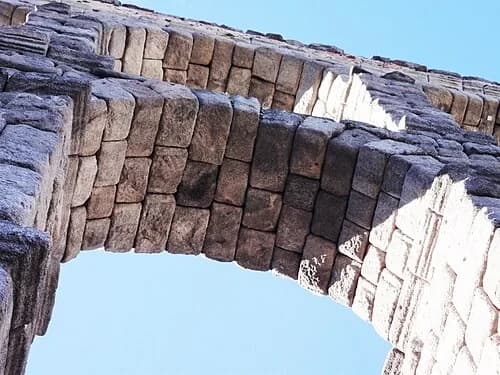
Focusing on the engineering of the joints reveals the most astonishing aspect of the structure: it is a dry-stone construction. No cement, mortar, or lead was used to bind these blocks. Instead, the entire monument relies solely on the precise balance of weight and the laws of gravity. Each block was carved with such accuracy that they lock together through friction and pressure alone. To achieve this, Roman masons carved the stones with slight tapers, ensuring that as each block was placed, its own weight would tighten the connection to its neighbor. This method allowed the structure a small degree of flexibility, which helped it survive tremors and thermal expansion over the centuries. Because there is no mortar to crack or wash away, the structure has proved more durable than many modern buildings. The precision required meant that if one stone were slightly out of alignment, the stability of the entire arch could be compromised. This reliance on pure geometry and mass represents the pinnacle of Roman construction techniques, where the master masons transformed rough granite into a self-supporting stone puzzle that has resisted the elements for nearly twenty centuries.
The Virgin's Niche
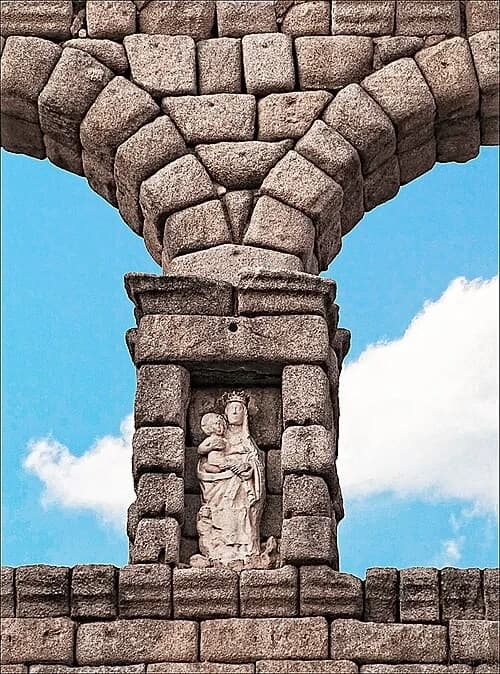
Located at the highest point of the structure, these niches represent the religious history of the monument. This stop highlights the 16th-century replacement of a Hercules statue with the Virgin of Carmen.
The Virgin's Niche
In the center of the upper tier, you can see a small niche containing a statue. This spot has undergone a symbolic transformation over the centuries. Originally, during the Roman era, the alcove is believed to have held a statue of Hercules. In local mythology, Hercules was considered the founder of Segovia, and placing his image at the highest point of the aqueduct was a way to honor the city’s origins. However, in the 16th century, the Catholic Monarchs decided to 'Christianize' the pagan monument. They replaced the ancient figure with this image of the Virgin of Carmen, also known as the Virgin of the Fuencisla. This was a common practice during the period, intended to reclaim Roman structures for the Christian faith. The statue you see today is a replica of that 16th-century addition. By placing a religious icon in such a prominent location, the city ensured that the first thing travelers saw as they approached was a symbol of divine protection. This shift in iconography reflects the broader cultural transition of Spain from a Roman province to a centerpiece of the Catholic world, turning an engineering marvel into a spiritual landmark.
Niche Placement
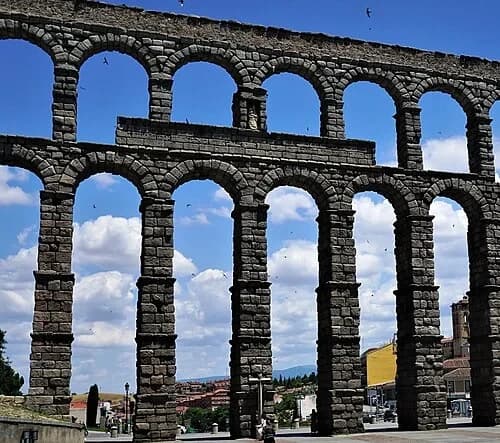
The placement of the niche roughly 18 meters above the ground was a deliberate choice by the city's 16th-century planners. Standing at this height, the figure was clearly visible to anyone approaching the city walls from the surrounding Guadarrama mountains. In an era before GPS or detailed maps, the towering arches of the aqueduct served as a massive navigational landmark. The religious figure in the niche added a layer of symbolic meaning to this navigation, greeting weary travelers and pilgrims as they neared the city's gates. It functioned much like a lighthouse, but for land travelers rather than sailors. The altitude of the statue also protected it from vandalism and the everyday grime of the busy market square below. From this height, the Virgin appears to watch over the crowds in the Plaza del Azoguejo, a silent witness to the city's growth. The logistical challenge of installing a statue at such a height in the 1500s demonstrates the high level of importance the Catholic Monarchs placed on this specific visual rededication of the ancient Roman structure.
Legend of the Devil: Calle San Juan
This area connects the monument to local folklore. While explaining the pact between the girl and the devil, we look toward the Calle San Juan where the modern 'Selfie-Taking Devil' statue is located.
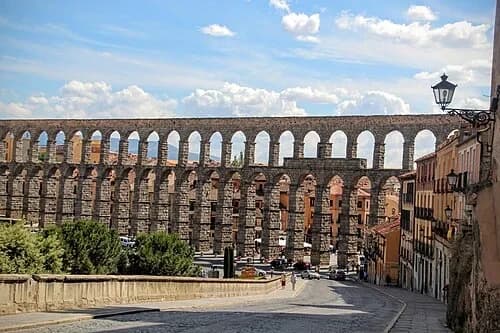
The Devil's Viewpoint
While history credits Roman engineers, local tradition tells the 'Legend of the Devil’s Bridge.' According to the story, a young girl tired of hauling water up the city's steep hills offered her soul to the devil if he could bring the water to her door by dawn. The devil agreed and set to work through the night. However, the girl quickly regretted her choice and prayed for salvation. As the first ray of sun hit the horizon, the devil was just about to place the very last stone. Because the sun rose before he finished, the contract was voided, and the girl’s soul was saved. Legend says the small holes in the stones are the marks of the devil’s claws. Today, this folklore is celebrated with a modern bronze statue of a cheerful-looking devil nearby, which has become a popular spot for visitors. This story highlights how the massive scale of the monument seemed so impossible to medieval residents that they could only explain it through divine or demonic intervention. It remains one of Segovia's most beloved tales, adding a layer of whimsy to the serious business of Roman engineering.
The Postigo Ascent
To see the aqueduct from above, visitors must climb the steep stone stairs. This stop captures the transition from the plaza floor to the hillside viewpoints.
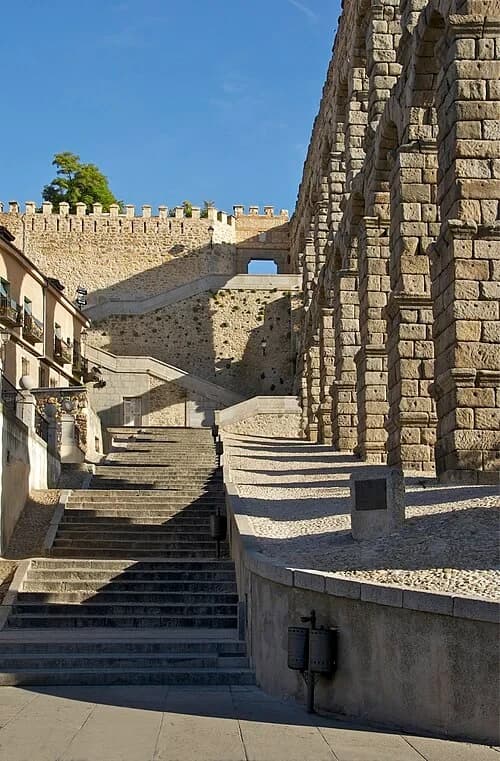
The Postigo Stairs
As you begin your ascent, you are walking the Postigo del Consuelo, a historic staircase and gateway. In centuries past, this path was a vital artery for the city's residents. It served as the primary connection between the lower commercial district—the marketplace you just left—and the upper administrative and religious heart of Segovia. The name 'Postigo' refers to a small door or gate in the city walls. Climbing these stairs allowed citizens to move quickly between the bustling trade stalls and the government buildings located within the fortified upper town. This route highlights the vertical nature of Segovia’s geography, where different social and economic functions were separated by the steep slopes of the terrain. The stairs also provide an increasingly dramatic perspective on the aqueduct's pillars, which seem to grow taller and more imposing with every step you take. This path was not just a convenience but a strategic necessity for managing the flow of people and goods into the secure upper city. The worn stones underfoot have been smoothed by centuries of merchants, soldiers, and officials making this same climb between the lower and upper worlds of the city.
Postigo del Consuelo: The Panoramic Summit
This is the 'climax' viewpoint of the tour, offering a look down the entire length of the arches toward the mountains. It reveals the top of the structure where the water once flowed.
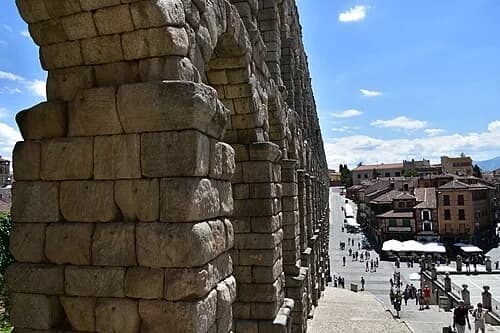
The Alignment
Looking down the long alignment of the bridge, you are seeing a feat of ancient surveying. The water didn't just start here; it traveled 17 kilometers from the Fuenfría spring in the nearby mountains. To keep the water moving without the use of pumps, Roman engineers maintained a remarkably consistent slope of about one percent throughout the entire journey. This gradient was carefully calculated to ensure the water flowed at a steady, manageable pace—fast enough to prevent stagnation and the growth of algae, but slow enough that the force of the water wouldn't erode the stone channel or the lead pipes. Achieving this level of accuracy over such a long and varied distance required sophisticated tools like the 'groma' for straight lines and the 'chorobates' for leveling. This precise slope is what allowed the system to function effectively for nearly two thousand years with minimal intervention. Standing here, you can see how the structure slices through the landscape in a perfectly straight line, a testament to the Roman obsession with order and efficiency. It is a masterclass in hydraulic engineering that remained unsurpassed in complexity and reliability for many centuries after the fall of Rome.
The Water's Journey: Calle de los Cañuelos
Tracing the water back to its entry into the urban arquería. This area shows the lower, single-tiered arches and the regulation house where the 17km journey from the mountains transitions into the city.
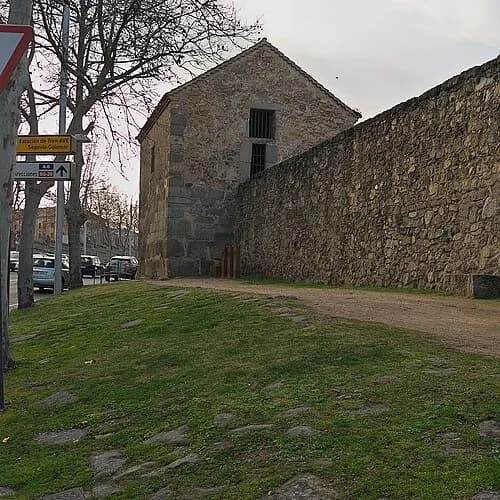
The Decanting Tower
The small stone building you see here, often called the 'Casa de Aguas' or House of Waters, played a critical role in the aqueduct’s engineering. Before the water could enter the city's distribution pipes, it had to be cleaned. This building housed a decanting chamber, a large tank where the fast-moving water from the mountains was allowed to slow down. As the water sat in the tank, gravity did the work: sand, pebbles, and other heavy sediments settled to the bottom. Only the clean, clear water at the top was allowed to overflow into the next section of the pipe system. This was an essential process for protecting the city's urban plumbing, as sediment could easily clog the smaller lead pipes that carried water to public fountains and private homes. Maintenance crews would regularly enter this building to shovel out the accumulated mud and debris, ensuring the system remained efficient. The 'Casa de Aguas' is a prime example of how the Romans prioritized public health by including water purification as a fundamental part of their infrastructure design. It remains a sturdy, functional reminder of the sophisticated management required to keep an ancient city supplied with clean drinking water.
Integration with the Old Town Walls
The tour concludes where the Roman engineering meets the medieval city defenses. This stop illustrates how the aqueduct enters the historic center through the city walls.
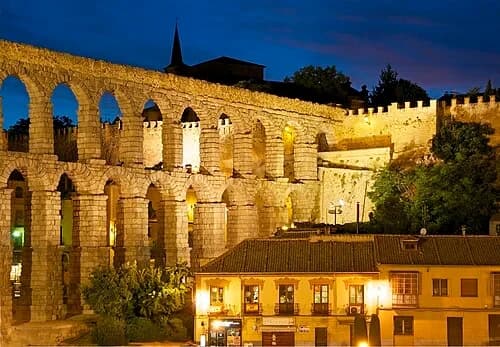
Arches and Medieval Walls
Look at the point where the soaring Roman arches meet the heavy, solid masonry of the medieval city walls. This intersection is a physical timeline of Segovia’s history. When the city's defenders began constructing these fortified walls in the Middle Ages, they did not see the aqueduct as an obstacle to be removed. Instead, they recognized it as an immovable and vital part of the urban landscape. The Roman engineering was so structurally sound that it was easier to build their defensive perimeter around and into the existing granite pillars rather than trying to reroute or replace them. This layering of architecture demonstrates how different eras utilized the same space. The Roman water system provided the lifeblood for the city, while the medieval walls provided its protection. You can see where the rougher, darker stones of the medieval fortifications butt up against the precision-cut granite blocks of the Roman era. This transition marks the boundary between the lower city and the upper old town, known as the Casco Viejo. The way the arches pierce through the heavy stone walls serves as a reminder that the original Roman design was far too robust for later civilizations to ignore or destroy.
Want to hear the rest?
Download the Stanza app to unlock all 17 stops and full GPS-guided navigation.
Frequently Asked Questions
How long does the Aqueduct of Segovia audio tour take?
The Aqueduct of Segovia audio guide includes 17 narrated stops. Most visitors spend 45 minutes to 1.5 hours exploring the complete tour, though you can listen at your own pace and skip or revisit any stop.
Is the Aqueduct of Segovia audio guide available in my language?
Stanza supports 15 languages: English, Spanish, French, German, Italian, Portuguese, Russian, Japanese, Chinese, Korean, Arabic, Hindi, Polish, Dutch, Hebrew. Check the guide in the app to confirm the languages currently available for this tour.
Can I use the audio guide offline at Aqueduct of Segovia?
Yes! Download the complete Aqueduct of Segovia tour — including all audio, maps, and images — before your visit. The Stanza app works completely offline, so you don't need WiFi or mobile data at the venue.
How much does the Aqueduct of Segovia audio guide cost?
The Stanza app is free to download. The current listed price for the Aqueduct of Segovia audio guide is $2.99; app-store region and currency may affect the final price.
How do I use the Stanza audio guide at Aqueduct of Segovia?
Download the free Stanza app, search for "Aqueduct of Segovia", and download the tour. When you arrive at the venue, the app uses GPS to detect your location and automatically plays the relevant narration as you move between points of interest — completely hands-free.
What makes the Stanza audio guide different from other Aqueduct of Segovia tours?
Stanza offers GPS-triggered narration that plays automatically as you walk through Aqueduct of Segovia — no need to manually select stops. The tour is available in 15 languages, works fully offline, and includes 17 expertly narrated stops with images and historical context.
What other audio guides are available near Aqueduct of Segovia?
Stanza offers multiple audio guides in Segovia, Spain and nearby areas. After downloading the app, browse the map to discover all available tours near Aqueduct of Segovia. Each guide can be downloaded for offline use.