Languages
15Casa de las Conchas Audio Guide
Casa de las Conchas is a landmark in Salamanca, Spain. Explore it with Stanza's GPS-triggered offline audio guide — available in 15 languages.
Quick Facts
20
Stops
15
Languages
100%
Offline
📍 Salamanca, Spain · 40.9629°N, -5.6658°E
About Casa de las Conchas
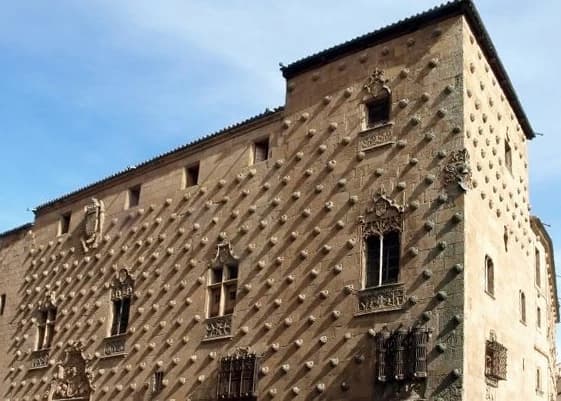
The Casa de las Conchas is a historic Gothic and Plateresque mansion located in Salamanca, Spain. Built between 1493 and 1517, it is famous for its facade adorned with over 300 scallop shells.
Casa de las Conchas is also known as Casa de las Conchas de Salamanca.
This self-guided audio tour features 20 narrated stops organized across 7 sections. As a noble house, Casa de las Conchas offers a unique cultural experience in the heart of Salamanca, Spain.
The Stanza audio guide is available in 15 languages and works entirely offline — download the complete tour including audio narration, maps, and images before your visit. As you walk through Casa de las Conchas, GPS-triggered narration plays automatically at each point of interest.
Last updated:
What you will hear
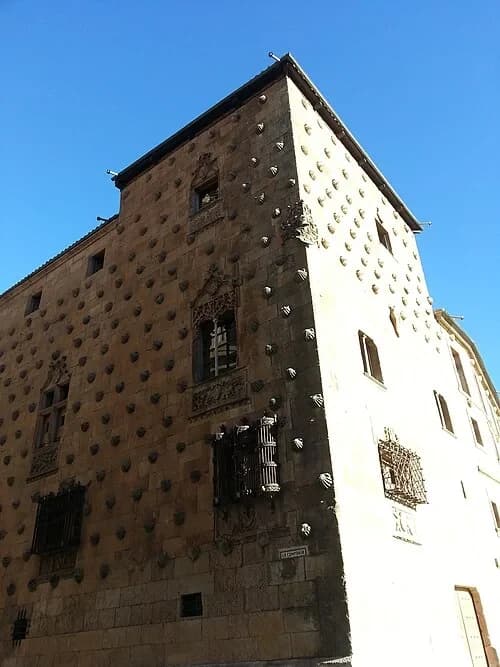
The Truncated Tower
Focus on the building's corner to discuss the 'desmochada' tower and the political conflict between the Maldonado family and King Carlos I.
The Plateresque Windows
Focus your attention on the ornate window frames that punctuate the heavy stone walls. These are prime examples of the Plateresque style, a movement unique to the Spanish Renaissance. The term comes from the Spanish word for silversmith, 'platero', because the intricate stone carvings resemble the delicate, detailed work of precious metal artisans. If you examine the patterns, you will see a complexity that contrasts sharply with the massive, fortress-like nature of the surrounding walls. This style often incorporates floral motifs, mythical figures, and geometric patterns, all carved with extraordinary precision. Notice how the windows are not uniform; each one displays different decorative elements, showcasing the creativity of the master masons who worked here. The upper windows often feature more elaborate crests and finials, intended to draw the eye upward and create a sense of vertical elegance. This 'stone lace' was a way for the wealthy to soften the appearance of their urban fortresses, signaling that the interior was a place of refinement and culture. The contrast between the rugged, shell-studded surface and these finely detailed frames creates a visual rhythm that is a hallmark of Salamanca’s most celebrated buildings, blending strength with a newfound Renaissance appreciation for delicate ornamentation.
The Main Entrance Portal
Move to the main doorway to examine the Plateresque stone carvings and the Maldonado coat of arms. Introduce the legend of the family name's French origin.
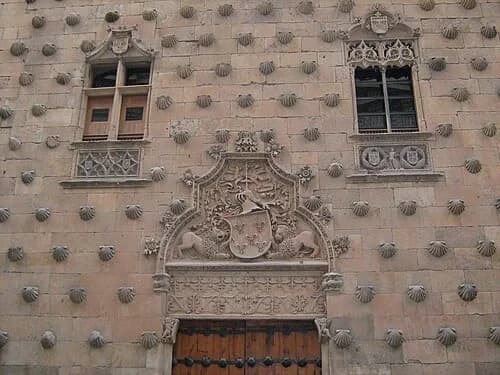
The Maldonado Coat of Arms
High above the main entrance sits the intricate heraldry of the Maldonado family, a display of power and lineage. The crest is guarded by two stone lions, traditional symbols of strength and honor, and is filled with fleurs-de-lis. These flowers point to a colorful family legend regarding the origin of their name. Tradition holds that an ancestor once saved a French prince during a duel. Grateful for his life, the King of France reportedly bestowed a title upon the man. In the story, the King meant to say the man was 'well given' or 'well gifted', but due to a mispronounced phrase in French, it sounded like 'Maldonado'. The family supposedly adopted the name and the French lilies as a badge of pride, linking their lineage to royalty through this act of chivalry. Beyond the legend, the placement of the coat of arms right over the entrance was a standard practice for noble houses, serving as a signature and a warning of the family's high status. The carving here is deep and detailed, designed to be seen clearly from the street below. Every element, from the fierce posture of the lions to the precise shape of the lilies, was intended to remind passersby of the proximity of this family to the highest circles of power and their deep roots in European nobility.
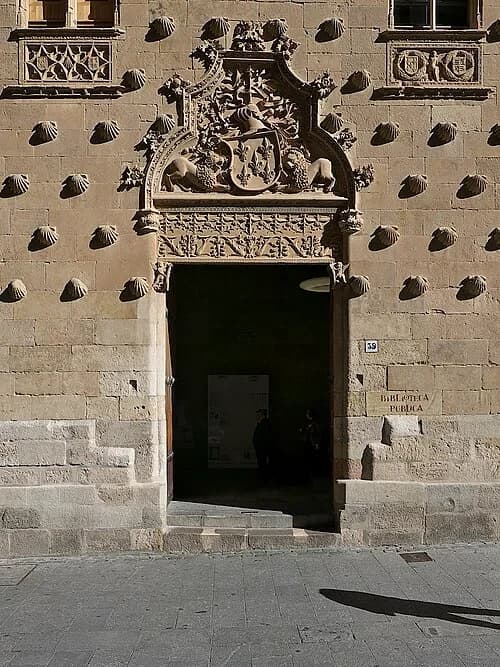
The Main Entrance
As you move through the main entrance, you leave the noise of the modern street behind and enter a portal that has seen over five centuries of history. Look for the sign indicating the 'Biblioteca Publica' or Public Library. While this site was once the private stronghold of a powerful family, it has undergone a remarkable transformation in recent decades. In 1993, the palace opened its doors to the public as a State Library, ensuring that its grand halls would be used for education and culture rather than remaining a closed monument. This transition was made possible by a fascinating legal arrangement in 1967. The building was leased by the Spanish state to the city of Salamanca for the symbolic annual fee of just one gold peseta. This 'token' payment allowed for the preservation and restoration of the site, turning it into a living space where locals and visitors alike can interact with history daily. Passing under the heavy stone archway, you can feel the shift in atmosphere. The thick walls provide a natural silence and a cool temperature, creating an ideal environment for reading and study. This entrance marks the beginning of the building's second life, where the prestige once reserved for a few is now accessible to all who enter.
The Interior Courtyard
Step inside to the central patio to see the fusion of Gothic and Mudéjar styles. Point out the mixtilinear arches and the coat of arms carvings.
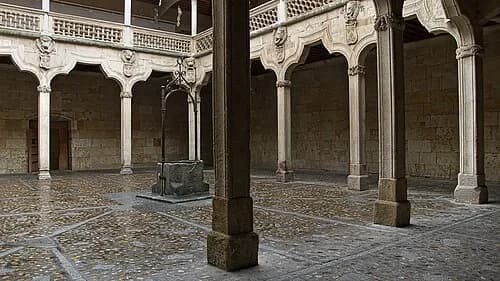
The Interior Courtyard
Entering the central patio brings you to the heart of the palace. This space measures approximately 18.80 by 16.80 meters and was designed to be the 'lungs' of the house. In an era before modern ventilation, the open courtyard provided essential light and fresh air to the rooms that surrounded it on both floors. What makes this particular courtyard world-famous is its blend of three distinct artistic styles. You can see the influence of the Gothic in the pointed shapes and structural elements, the Renaissance in the proportions and elegant columns, and the Mudéjar style in the intricate decorative details. Mudéjar refers to the work of Muslim artisans who remained in Christian-conquered territories, bringing their unique geometric and floral patterns to Spanish architecture. This fusion creates a visual harmony that is quintessentially Spanish. Look at the rhythm created by the columns and arches; it creates a sense of peaceful order away from the bustle of the city outside. This was the social center of the home, where the family would walk, entertain guests, and conduct business. The courtyard’s design ensures that even on the hottest Salamanca summer days, the ground floor remains cool and shaded, while the open sky above allows for a constant change in the play of light across the stone surfaces.
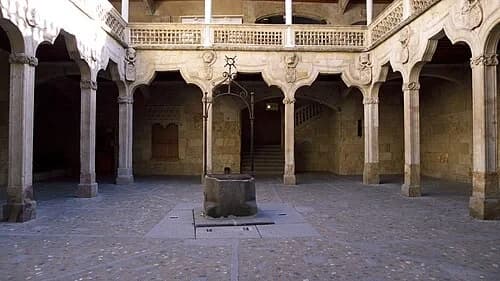
The Mixtilinear Arches
Notice the distinctive shapes of the arches that support the lower gallery. These are known as 'mixtilinear' arches, a complex design characteristic of the late Spanish Gothic period. Unlike the simple semicircular arches found in much of Europe, these combine straight segments and curved lines to create a more dynamic, flowing silhouette. This design creates a rhythmic border around the courtyard that feels almost musical in its repetition. These arches demonstrate the advanced geometric skills of the master masons, as each stone had to be precisely cut to maintain the structural integrity of such a complex form. The result is a space that feels more ornate and sophisticated than a standard colonnade. This style was often favored by the wealthy elite in 15th-century Spain because it was difficult to execute and visually striking, marking the building as a cutting-edge piece of architecture. As you look around the gallery, observe how the light interacts with the various angles of the arches. This complex geometry was not just for beauty; it also helped distribute the weight of the upper floor across the columns more effectively. These arches remain one of the most celebrated features of the courtyard, illustrating a period of great experimental confidence in Spanish stonework before the simpler lines of the High Renaissance took hold.
The Central Well and Student Prison
Focus on the central stone well to discuss the building's history as a university prison and its former residents.
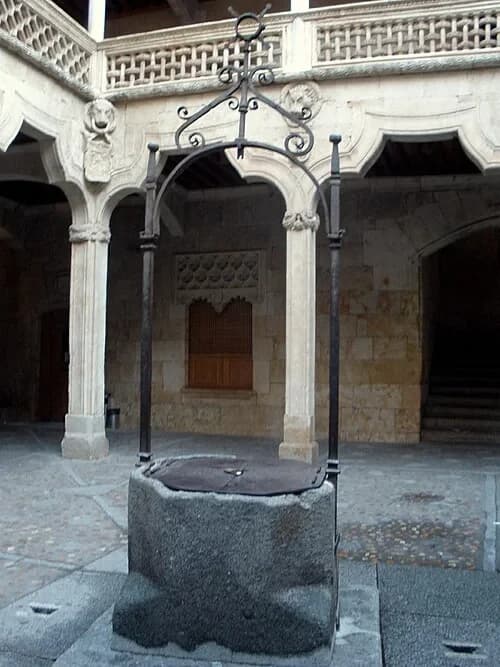
The Central Well
In the center of the patio stands a stone well, which was once the primary water source for the entire household. Beyond its functional role, this area is tied to a more somber chapter of the building's history. For a time, the palace served as the 'cárcel del estudio', or the university prison. In centuries past, the University of Salamanca had its own legal jurisdiction, and students or professors who violated academic or moral rules were confined within these walls. Imagine the hushed atmosphere of that time, with the sound of water dripping into the well echoing off the surrounding stone. Captive scholars might have spent their days in the nearby rooms, perhaps looking out into this very courtyard during their brief moments of exercise. The presence of the well reminds us that for all its noble grandeur, this was a place of daily functional life and, occasionally, strict discipline. The well’s simple, rugged form contrasts with the delicate carvings of the surrounding arches, grounding the space in the practical necessities of the past. It serves as a quiet center for the courtyard, a place where people once gathered to draw water and share news, much like students and visitors do today in the modern library that now occupies these historic halls.
The Ceremonial Staircase
Examine the stone staircase and its symbolic carvings of lions and dogs, representing the protection of the family's honor and privacy.
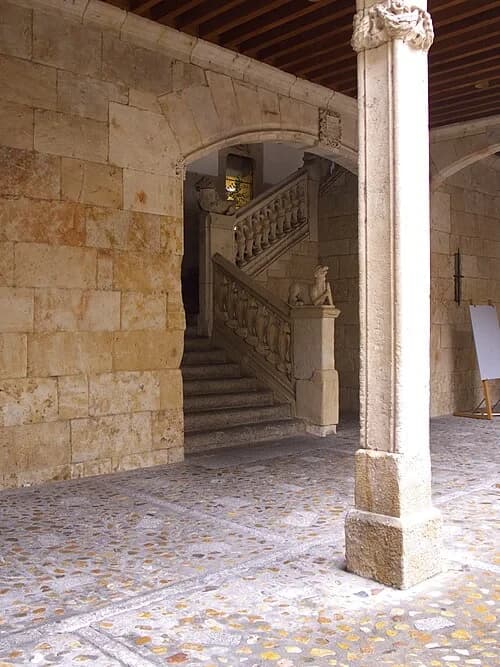
The Ceremonial Staircase
The transition between floors is handled by a grand ceremonial staircase, which was designed to impress anyone ascending to the family’s private quarters. At the base of the balustrades, look for the stone figures of a dog and a lion. These aren't just decorative animals; they carry deep symbolic meaning in the heraldic tradition of the time. The dog, often shown in a watchful or loyal posture, represents the faithfulness of the family and their role in protecting the privacy and honor of the household. Opposite the dog is the lion, the universal symbol of courage, strength, and nobility. Together, these figures served as silent guardians, welcoming friends while subtly reminding everyone of the virtues and power of the house of Maldonado. The stairs themselves are wide and shallow, allowing for a graceful, slow ascent that was typical of noble ceremonies. The stonework here is exceptionally fine, with the banister featuring intricate carvings that match the Plateresque style seen elsewhere in the building. As you walk up, you are following the path once taken by bishops, nobles, and university rectors. This staircase was a stage for the social life of the 16th century, where every step was a display of status, leading from the functional ground floor to the more elegant and private gallery above.
The Upper Gallery and Library
Ascend to the upper floor to see the Carrara marble columns and the modern transformation into a public library.
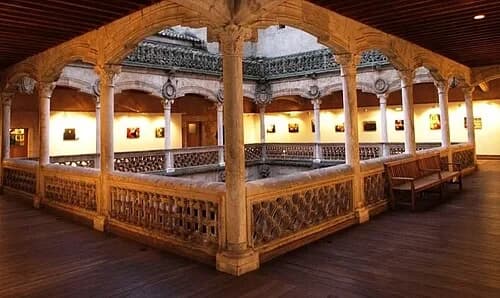
The Upper Gallery
When you reach the upper gallery, you will notice a distinct change in the architectural feeling of the space. The columns here are made of white Carrara marble and are significantly slimmer and more elegant than the heavy stone supports on the ground floor. This technique of 'lightening' the architecture as you move upward is a classic Renaissance principle. By using thinner columns and more delicate arches on the top level, the architects made the courtyard feel more open, airy, and grounded in the sky rather than the earth. This design reflects the Renaissance ideal of human-centered spaces that emphasize proportion and light. From this vantage point, you can also see the intricate decorative details on the interior of the parapet more clearly. The upper gallery was a place for leisure and observation, offering a better view of the sky and the overall geometry of the patio. The use of imported marble also signaled the owner's immense wealth, as transporting such material from Italy was an enormous undertaking. This space represents the highest point of refinement in the palace, where the defensive, fortress-like qualities of the exterior are completely forgotten in favor of elegance and architectural grace. It is here that the building most clearly embraces the artistic shifts that were transforming Europe in the early 1500s.
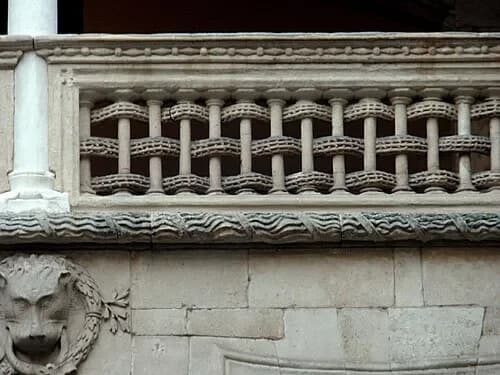
The Basket-Weave Parapet
Look closely at the balustrades lining the upper floor of the courtyard. The stone here has been worked into a complex, interlocking pattern known as basket-weave. This design is a clear indicator of Mudéjar influence, where artistic techniques from Al-Andalus were preserved and adapted by Christian craftsmen long after the Reconquista. By mimicking the structure of woven wicker or fabric, the artisans managed to soften the appearance of the solid stone, giving the balcony a lightness that complements the slender marble columns on this level. This geometric precision creates a rhythmic border that draws the eye around the perimeter of the courtyard. In the light of the afternoon sun, the deep undercutting of the weave creates sharp shadows, making the pattern appear almost three-dimensional. This style of ornamentation was highly prized in late 15th-century Spain, as it combined the structural strength of Gothic architecture with the sophisticated decorative sensibilities of Islamic art. It represents a period where different cultural aesthetics overlapped, resulting in the unique architectural language seen here today. The railings are capped with a simple molded rail that frames the busy texture of the weave below.
The Rivalry: View of La Clerecía
Conclude the tour by looking across the street at the massive La Clerecía. Discuss the rivalry between the Maldonado family and the Jesuits, and the symbolic 'one gold peseta' lease.
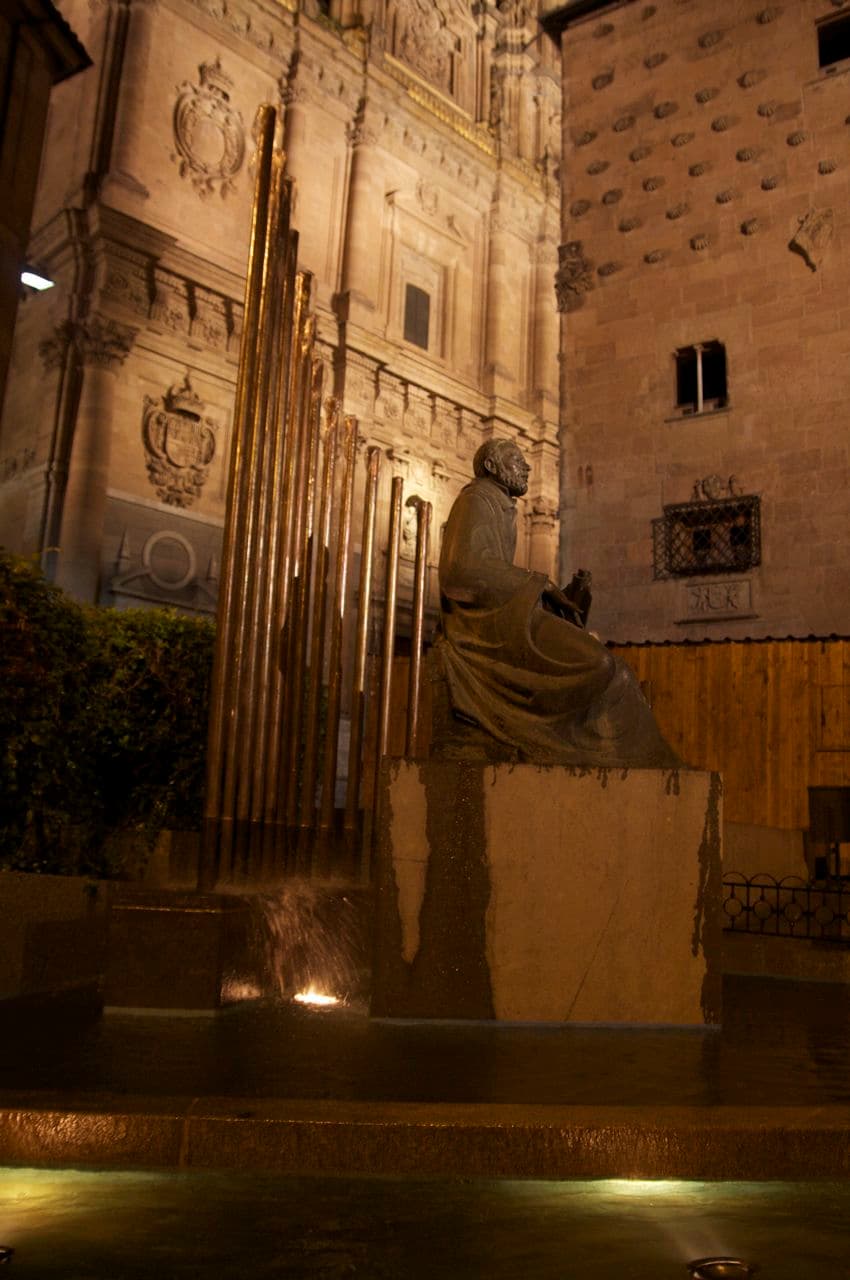
The Music of Salamanca
Near the palace stands a quiet tribute to one of the university’s most brilliant figures: Francisco Salinas. A blind musician and professor who taught here in the 16th century, Salinas was renowned for his profound understanding of musical theory and his skill on the organ. This statue serves as a final human connection to the stone walls you’ve explored. Salamanca is more than just a collection of impressive facades and historic shells; it is a city built by the intellect and creativity of people like Salinas, who lived and worked within these very neighborhood walls. His presence here highlights the city's long-standing tradition as a center of learning where physical sight was less important than the vision of the mind. As you look at the figure of the scholar, think of him navigating these same narrow streets centuries ago. Perhaps he paused in this very spot to listen to the rhythmic tolling of the bells from the nearby cathedral, finding harmony in the sounds of the city just as we find it in the architecture. This legacy of scholarship and art continues to thrive in the students who fill the library today, ensuring that the spirit of Salinas remains a living part of the city.
Want to hear the rest?
Download the Stanza app to unlock all 20 stops and full GPS-guided navigation.
Frequently Asked Questions
How long does the Casa de las Conchas audio tour take?
The Casa de las Conchas audio guide includes 20 narrated stops. Most visitors spend 45 minutes to 1.5 hours exploring the complete tour, though you can listen at your own pace and skip or revisit any stop.
Is the Casa de las Conchas audio guide available in my language?
Stanza supports 15 languages: English, Spanish, French, German, Italian, Portuguese, Russian, Japanese, Chinese, Korean, Arabic, Hindi, Polish, Dutch, Hebrew. Check the guide in the app to confirm the languages currently available for this tour.
Can I use the audio guide offline at Casa de las Conchas?
Yes! Download the complete Casa de las Conchas tour — including all audio, maps, and images — before your visit. The Stanza app works completely offline, so you don't need WiFi or mobile data at the venue.
How much does the Casa de las Conchas audio guide cost?
The Stanza app is free to download. The current listed price for the Casa de las Conchas audio guide is $1.99; app-store region and currency may affect the final price.
How do I use the Stanza audio guide at Casa de las Conchas?
Download the free Stanza app, search for "Casa de las Conchas", and download the tour. When you arrive at the venue, the app uses GPS to detect your location and automatically plays the relevant narration as you move between points of interest — completely hands-free.
What makes the Stanza audio guide different from other Casa de las Conchas tours?
Stanza offers GPS-triggered narration that plays automatically as you walk through Casa de las Conchas — no need to manually select stops. The tour is available in 15 languages, works fully offline, and includes 20 expertly narrated stops with images and historical context.
What other audio guides are available near Casa de las Conchas?
Stanza offers multiple audio guides in Salamanca, Spain and nearby areas. After downloading the app, browse the map to discover all available tours near Casa de las Conchas. Each guide can be downloaded for offline use.