Stanza · Audio guide
Catedral de León Audio Guide
A place to remember. A story to take with you.
Santa María de Regla de León Cathedral is a Catholic church and the episcopal see of the diocese of León in north-western Spain. It was the first monument declared by the Royal Order of Spain on 28 August 1844.
Download Stanza, then search for “Catedral de León”.
About the tour
One guide. Your kind of visit.
Santa María de Regla de León Cathedral is a Catholic church and the episcopal see of the diocese of León in north-western Spain. It was the first monument declared by the Royal Order of Spain on 28 August 1844.
Ready when you are.
- 01Get the free Stanza app.
iOS & Android
- 02Find your guide.
“Catedral de León”
- 03Download before you go.
Works offline
Audio guide / 14 narrated stops
Inside the guide
Get to know a few of the stories before you go. Open a stop to read more.
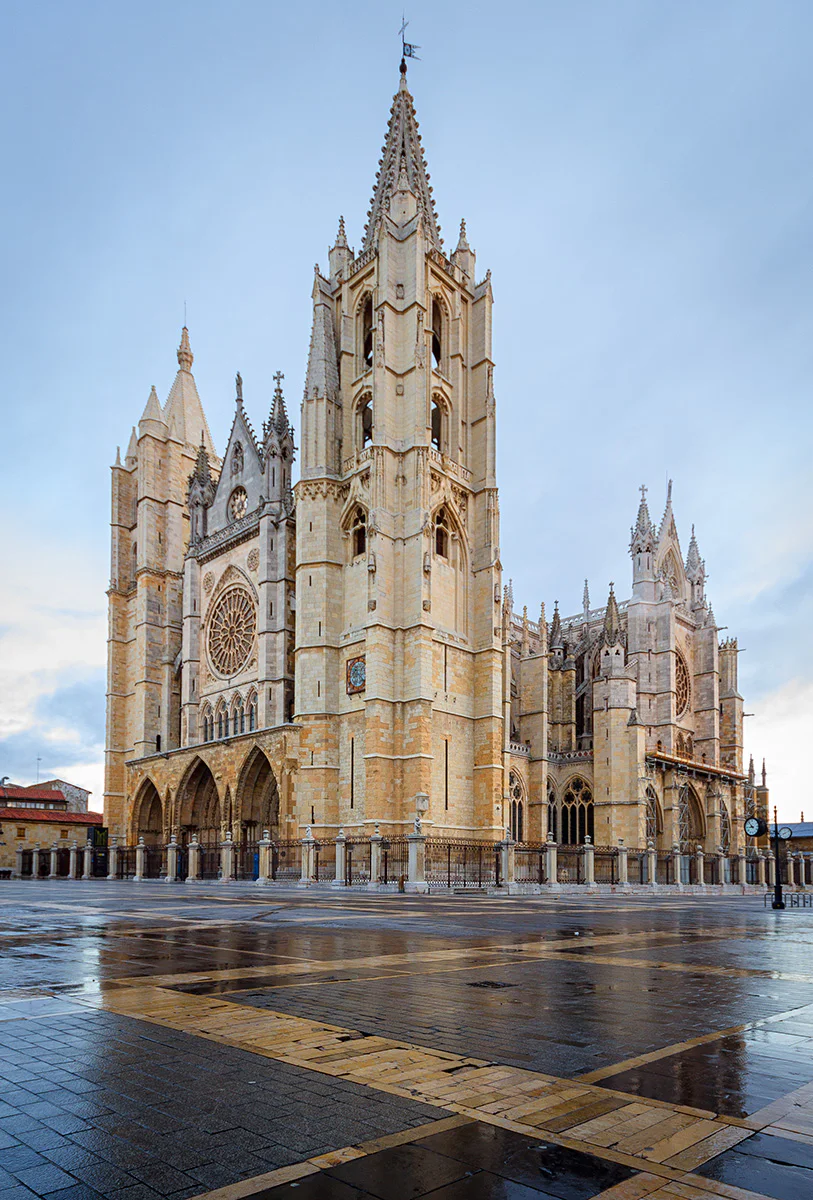
01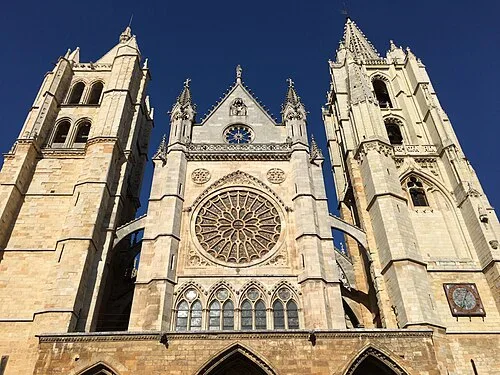 Plaza de Regla and the West Facade
The West Facade of the Pulchra Leonina
Welcome to the Pulchra Leonina, the Beautiful Leonese, the name people give to the cathedral of Santa María in León. Its plan follows Reims Cathedral in France, on a somewhat smaller scale, and its design is credited to a master mason called Enrique, probably a Frenchman who had worked at Burgos. Builders began around 1205, though foundation trouble stopped the work for years before it resumed. By 1302 the essential structure stood complete, and that speed gave the church a great unity of style. The result earned it the title of the most French of Spanish cathedrals, a genuine trans-Pyrenean building far from the Hispanic current. It stands on the Way of Saint James, one of the three great pilgrim churches of the route, alongside Burgos and Santiago de Compostela. In 1844 a royal order made it the first monument so declared in Spain.
Miguel Hermoso Cuesta · CC BY-SA 4.0
02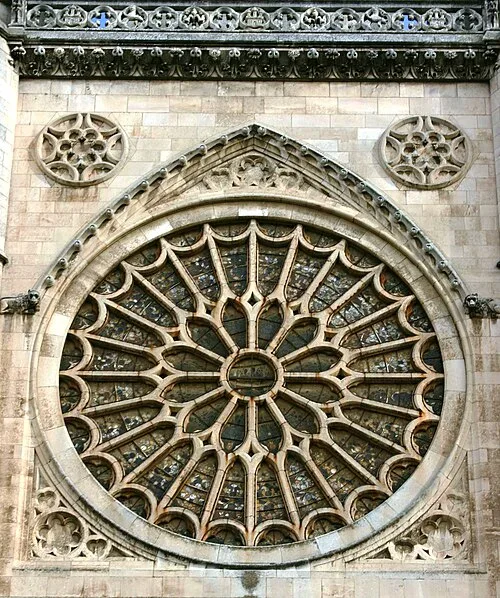 Plaza de Regla and the West Facade
The West Rose Window and the 19th-Century Rescue
The great rose window at the center of the west front has watched this building come close to dying. Its stones were of mediocre limestone, and much of the site rests on old Roman remains that complicated every foundation. In 1857 stones began falling from the nave and the crossing, and fear of total ruin spread through Spain and the rest of Europe. The government handed the works to Matías Laviña in 1859. Trained in classical architecture, he did not grasp how a Gothic building carries its weight. He dismantled the dome and its pinnacles, then the crossing and the whole south facade, and the danger of collapse only grew. The criticism that followed him lasted until his death in 1868. Juan de Madrazo then took charge, a friend of Viollet-le-Duc with a deep knowledge of French Gothic. He built a complex timber structure to hold the vaults in place while he rebuilt. When the supports came away in 1878 and the building stood firm, the original Gothic balance had been recovered. The stained glass, dismantled and stored for years, was restored after 1895. The cathedral finally reopened in 1901.
José Luiz · CC BY-SA 3.0
03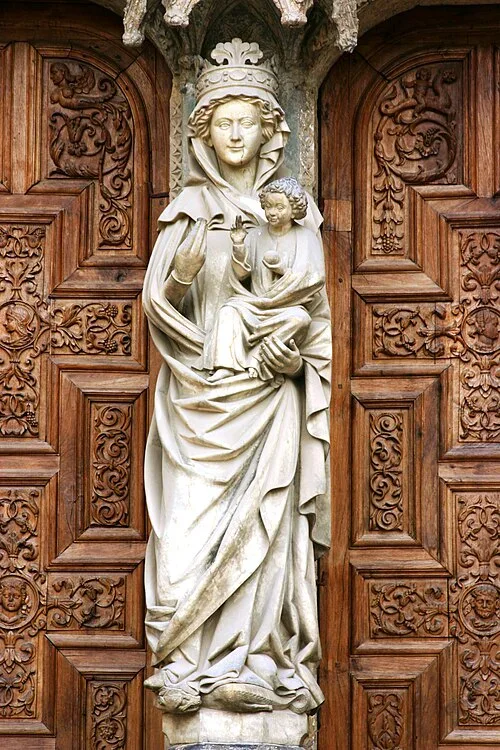 The Portals of the West Facade
The Virgen Blanca
A crowned Virgin holds the Christ Child on the post between the central doors, and she is smiling. Sculptors carved her around 1270, and the smile is the whole point. Gothic art of that moment was replacing the symbolism and stillness of the Romanesque with naturalism: drapery falling in soft folds, each face given its own character, a real sense of movement. Her humanity reminded writers of the smiling Angel of the Annunciation at Reims, the very French cathedral this building echoes. The figure on the portal today is a copy, carved by Andrés Seoane, which took the place of the original in 1954.
Listen in the appJosé Luiz · CC BY-SA 3.0
04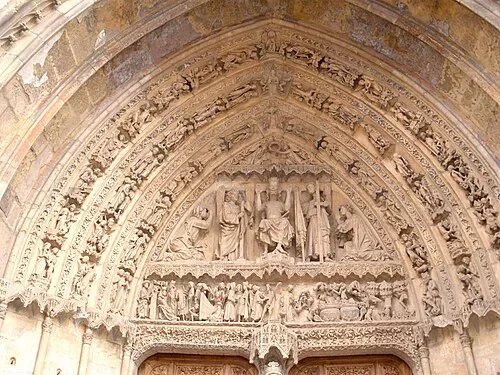 The Portals of the West Facade
The Last Judgment Portal
Over the central doorway, ranks of carved figures climb the arches toward Christ in judgment. This tympanum, the carved semicircle above the door, was made around 1270 as the great image of the west front: the Last Judgment, the moment Christian belief assigns to Christ as judge of the living and the dead. It was a theological program, not mere ornament. The facade carries three portals, the sides dedicated to Saint Francis and to Saint John the Baptist. The open ground before it had a civic role too, under the name Locus Appellatione, the place of summons, where justice was imparted in the medieval city.
Listen in the appPhoto: Zarateman · CC0
05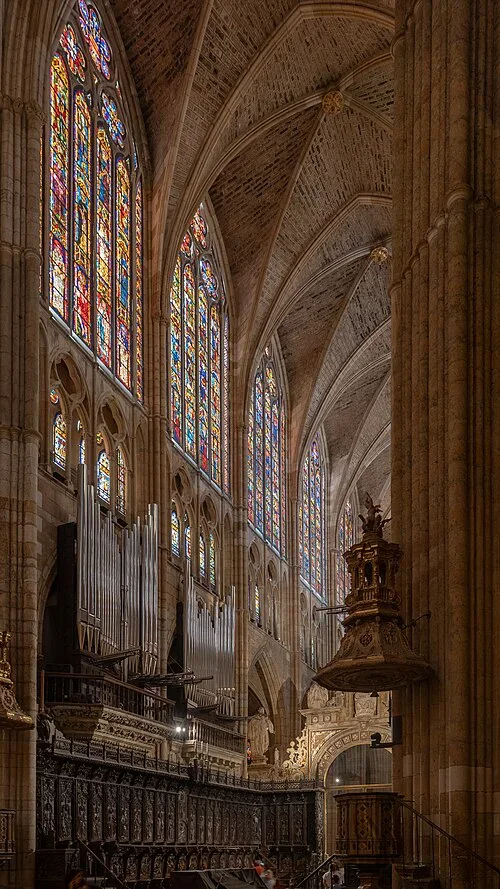 The Nave and the Claristorio Stained Glass
The Nave and the Medieval Glass
León's architects pushed Gothic logic to its limit: the walls reduced to a skeleton of slender pillars. Pointed arches and rib vaults concentrate the roof's weight onto certain points, and flying buttresses carry the thrust outside the building, so the walls no longer need to bear anything. That is what allowed them to be opened into glass. The nave holds about 125 window openings. Together they carry nearly 1,800 square meters of stained glass, and the great majority of it is medieval, from the thirteenth to the fifteenth century. That makes it one of the largest collections of medieval glass in the world. The program was meant to be read by side. On the darker north side, cooler tones and scenes from the Old Testament; on the sunlit south, warmer glass telling the New Testament.
Listen in the appPhoto: C messier · CC BY-SA 4.0
06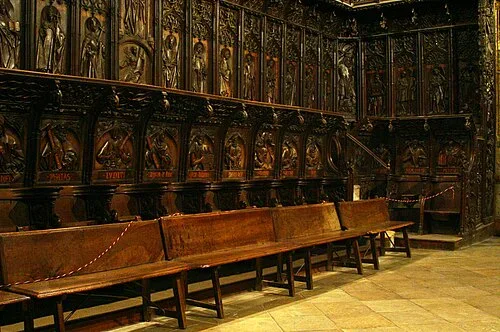 The Central Choir Stalls
The Walnut Choir Stalls
In the middle of the nave stand the choir stalls, cut from walnut between 1461 and 1481 in the Gothic style. They count among the oldest choir stalls in Spain. A carpenter called maestre Enrique planned the work, and the imagers Juan de Malinas and the master Copín carved the principal figures. The ranks mix the sacred with the irreverent. Prophets of the Old Testament and the saints hold the most visible places, set against profane figures of a burlesque, everyday tone that came into fashion from the north. The carvers did not spare the clergy: satirical scenes use clerics to mock vices, at times to the point of obscenity. The choir originally stood at the head of the church, before the high altar, and was moved to the center of the nave in 1746.
Listen in the appJosé Luiz · CC BY-SA 3.0
07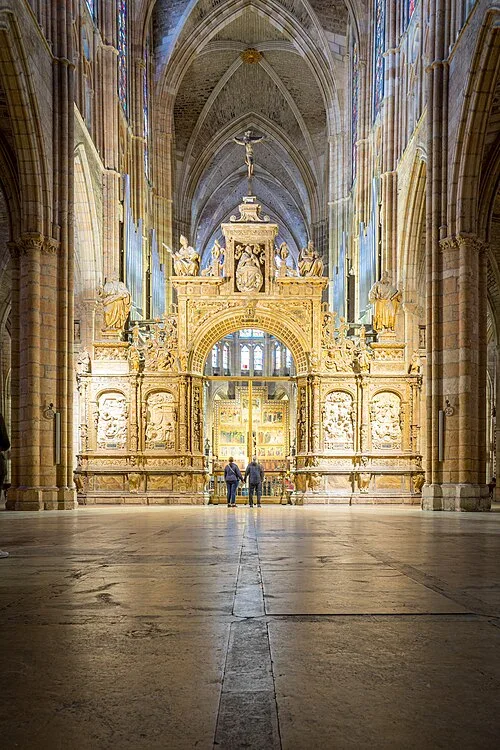 The Plateresque Retrochoir
Approaching the Trascoro
The Renaissance answered this Gothic church with a wall. The trascoro, the ornate screen closing the choir on the altar side, was traced by Juan de Badajoz el Mozo in the Plateresque style of the Spanish Renaissance. The work was finished between 1560 and 1590, in the full tide of the Counter-Reformation, when the Church answered the Protestant reform with assertive art of its own. Badajoz raised the structure with lateral figures and a great triumphal arch. Seen from the west end of the nave, its gilded carving forms a Renaissance proclamation set against thirteenth-century stone and glass.
Listen in the appPhoto: Fernando · CC BY-SA 4.0
08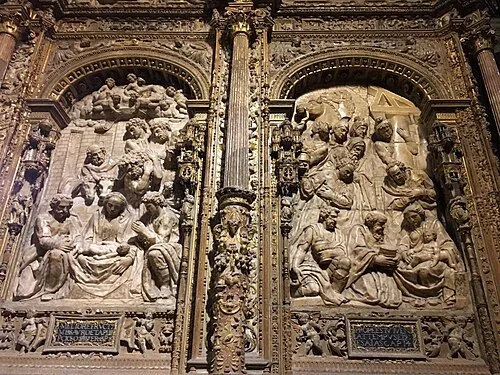 The Plateresque Retrochoir
Esteban Jordán's Alabaster Reliefs
Set into the trascoro are four alabaster reliefs by Esteban Jordán, carved with scenes of the Annunciation, the Nativity and the Adoration. For centuries, accumulated dirt and damp rising from the ground hid what the sculptor had done. A recent campaign of cleaning and consolidation, presented as the completion of the trascoro's full restoration, worked through the reliefs panel by panel. It recovered original polychromy, the paint that had stayed hidden under grime and the damage of historic moisture. The pale stone reads very differently now that its color has come back to light.
Listen in the appMiguel Hermoso Cuesta · CC BY-SA 4.0
09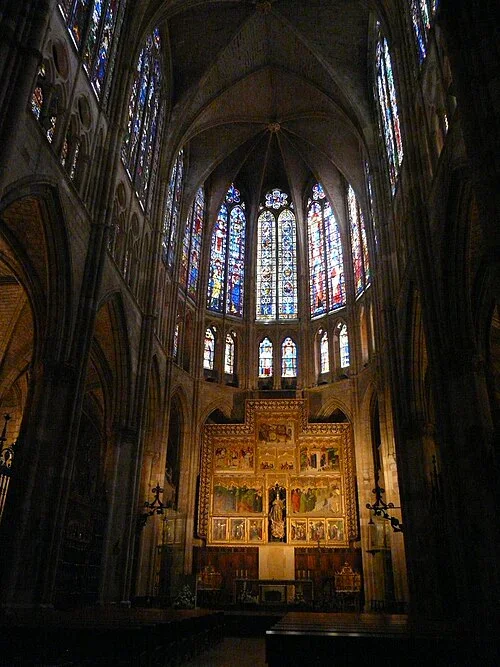 The Main Altar and San Froilán Shrine
The Main Altar, Retablo and San Froilán Shrine
The high altar sits ringed by the glass of the apse. Its great retablo today is Neo-Gothic, mounted by Juan Bautista Lázaro around five surviving panels from a lost altarpiece that Nicolás Francés made in the mid-fifteenth century. The panels show the life of San Froilán, the city's patron saint, together with the translation of the body of Saint James and the Presentation of the Virgin, in a blend of international Gothic and Flemish style. The Descendimiento on the left side is especially admired. Below stands the ark of San Froilán, a silver reliquary by the platero Enrique de Arfe, made between 1519 and 1522 and later touched with baroque modifications. A Plateresque grille closes the altar, the work of Juan de Badajoz el Mozo, the same architect behind the trascoro.
Listen in the appNacho Traseira · CC BY-SA 4.0
10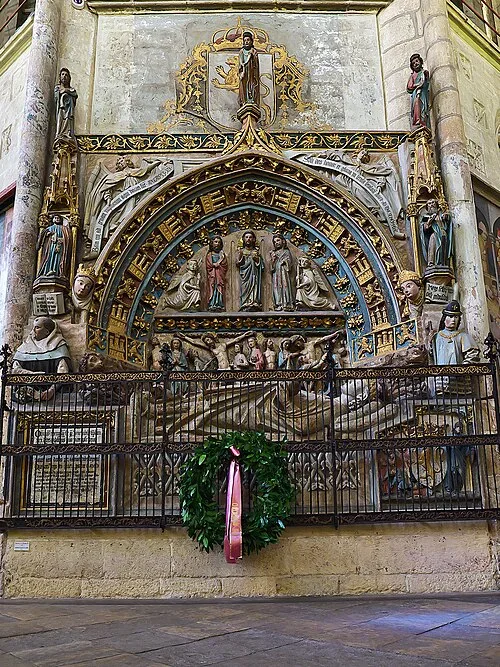 The Ambulatory and the Tomb of King Ordoño II
The Tomb of King Ordoño II
This tomb holds the reason a cathedral stands here at all. The Roman legion Legio VII Gemina built baths on this spot larger than the present church, and centuries later those baths served as a royal palace. In 916 Ordoño II had recently taken the throne of León when he defeated Muslim forces at the battle of San Esteban de Gormaz. In gratitude to God for the victory, he gave up his palace to build the first cathedral, transformed into a sacred place under Bishop Fruminio II. Ordoño died in Zamora in 924. Christian tradition buried inside its temples those who embodied authority as coming from God, so the king came to rest in his own foundation. During the great nineteenth-century restoration, workers found remains of the Roman baths beneath the building, and the hypocaust, the underfloor heating, still lies under the site. A fine Plateresque reja, or iron screen, stands behind the sepulcher.
Listen in the appJosé Luis Filpo Cabana · CC BY 3.0
- 11
The Chapel of the Virgen Blanca
The chapel behind the high altar that keeps the original Virgen Blanca from the west portal.
- 12
The Gothic Cloister
The cloister walk: ribbed vaults, carved capitals and the quiet side of cathedral life.
- 13
The Nicolás Francés Frescoes
Nicolás Francés's cloister murals, a great narrative cycle faded by weather and brought back.
- 14
The Portal of the Virgen del Dado
The painted portal of the Virgen del Dado, the Middle Ages still in color.
Catedral de León
Frequently asked questions
How much does the guide cost?
Free app download. Listed guide price: $0.99. Guide price shown in the app. Audio guide only. Venue admission is separate.
Can I listen without internet?
Yes. Download the guide’s audio, images, and maps in the app before your visit. Your downloaded content is then available offline.
Can I listen in my language?
This audio guide is available in 15 languages, including English.
Do I need to follow a schedule?
No. This is a self-guided experience. Choose your stops, pause whenever you like, and return to a story at your own pace.
At your own pace
Explore Catedral de León.
Download Stanza, then search for “Catedral de León”.
Free app download · Guide price shown in the app
Keep exploring
Nearby audio guides
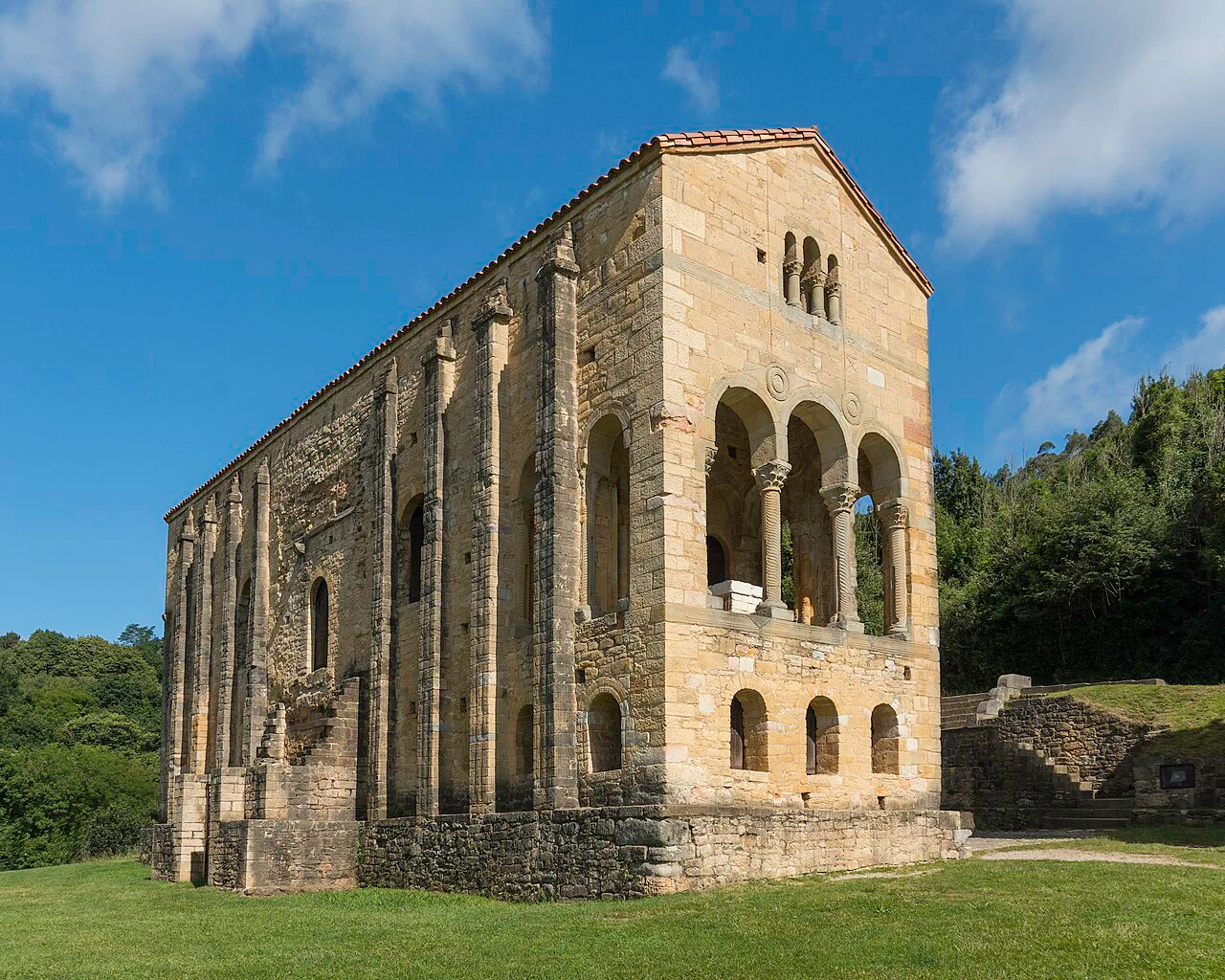
Oviedo · 90 km
Santa María del Naranco
Content & sources
Photo: Fernando · CC BY-SA 4.0
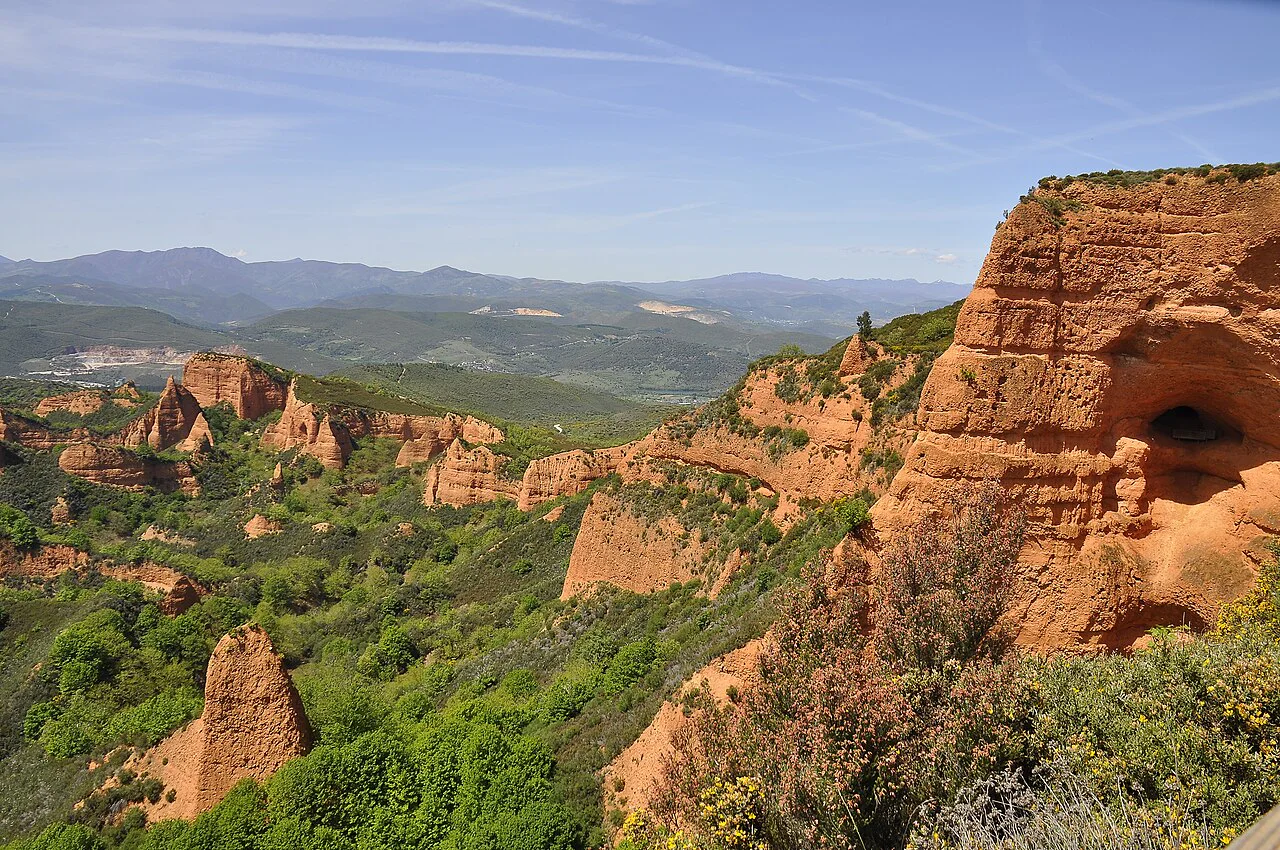
Carucedo · 99 km
Las Médulas
Content & sources
Frayle from Salamanca, España · Public domain
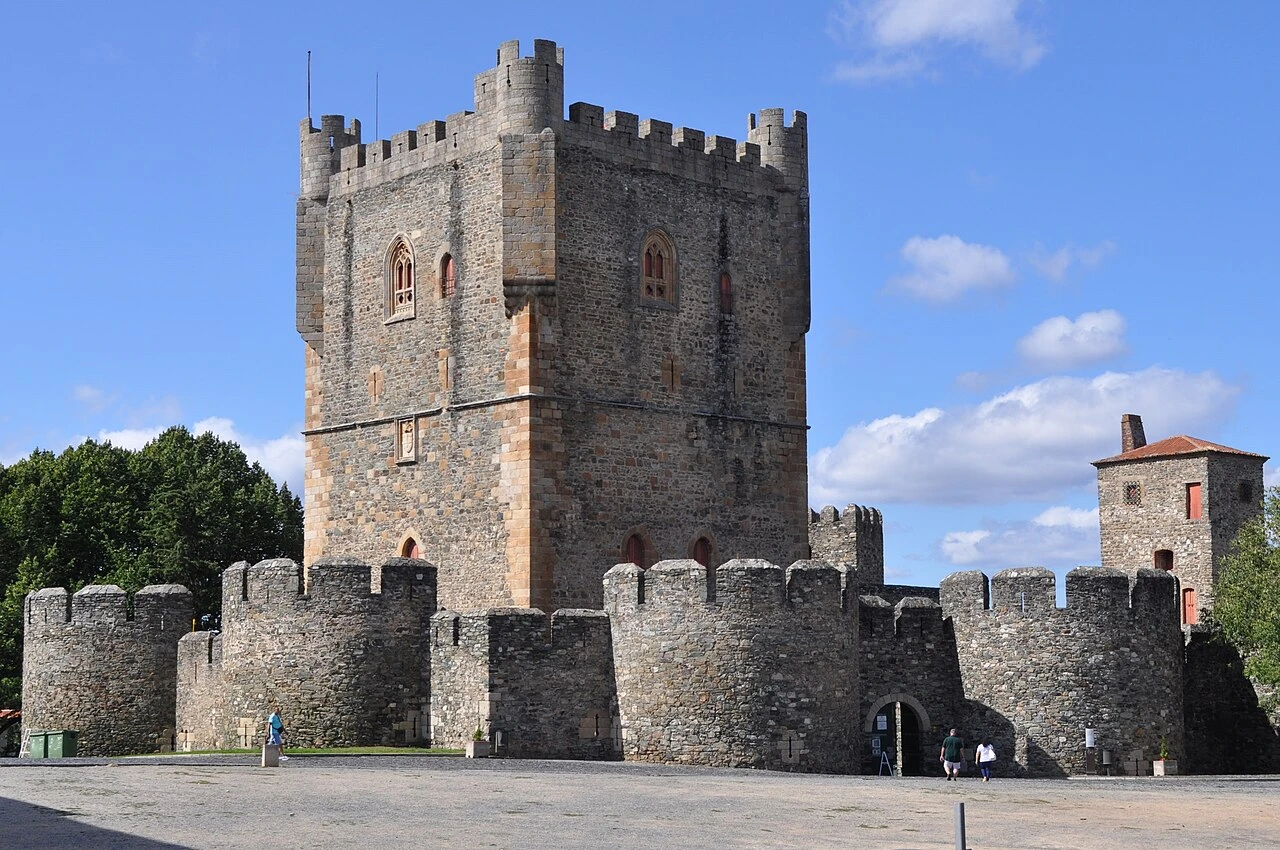
Bragança · 132 km
Castelo de Bragança
Content & sources
Photo: Lídia Maria Faria · CC BY-SA 4.0
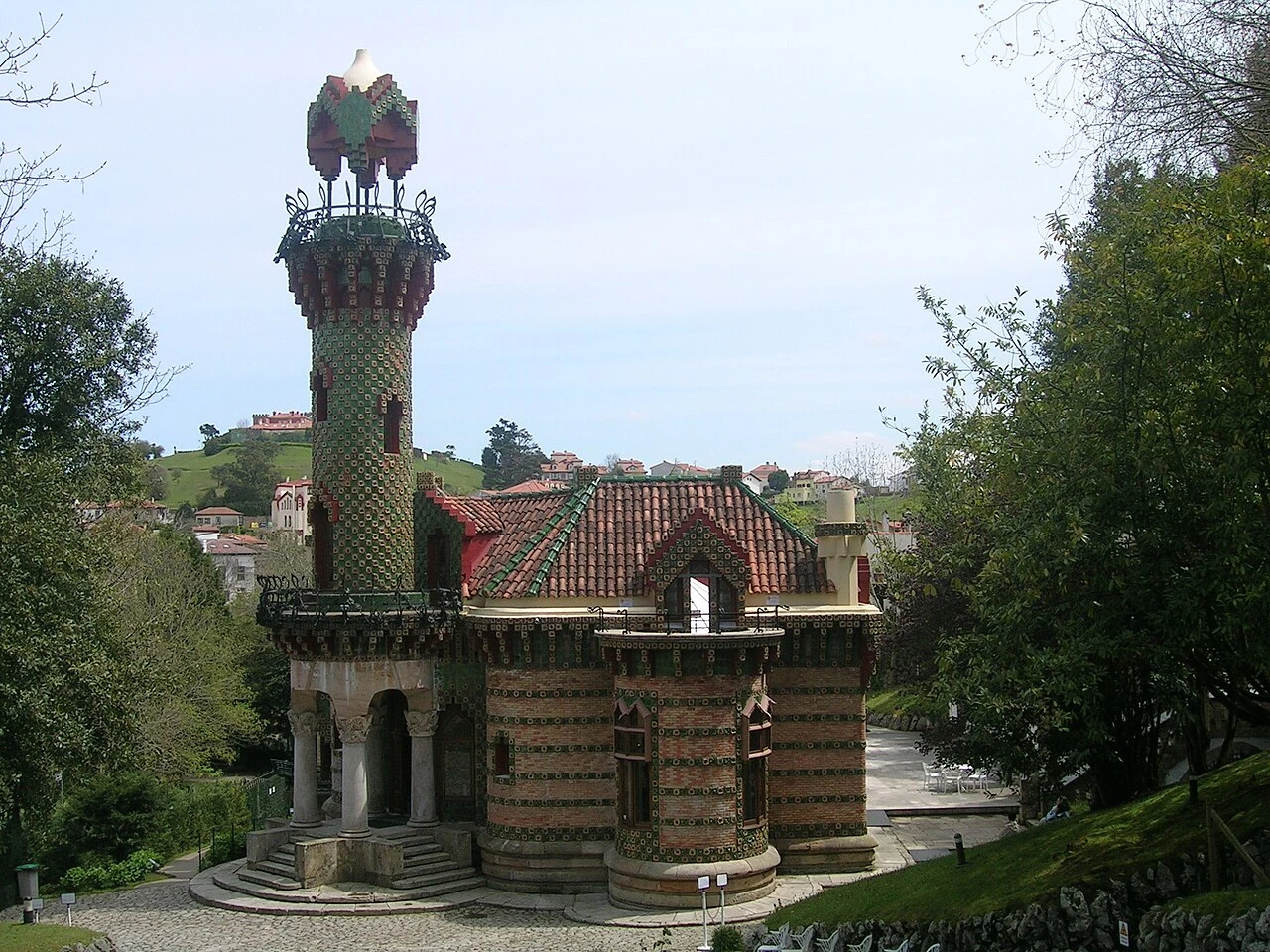
Comillas · 135 km
El Capricho de Gaudí
Content & sources
Photo: Cotarelo75 · CC BY-SA 3.0