Stanza · Audio guide
Catedral de la Almudena Audio Guide
A place to remember. A story to take with you.
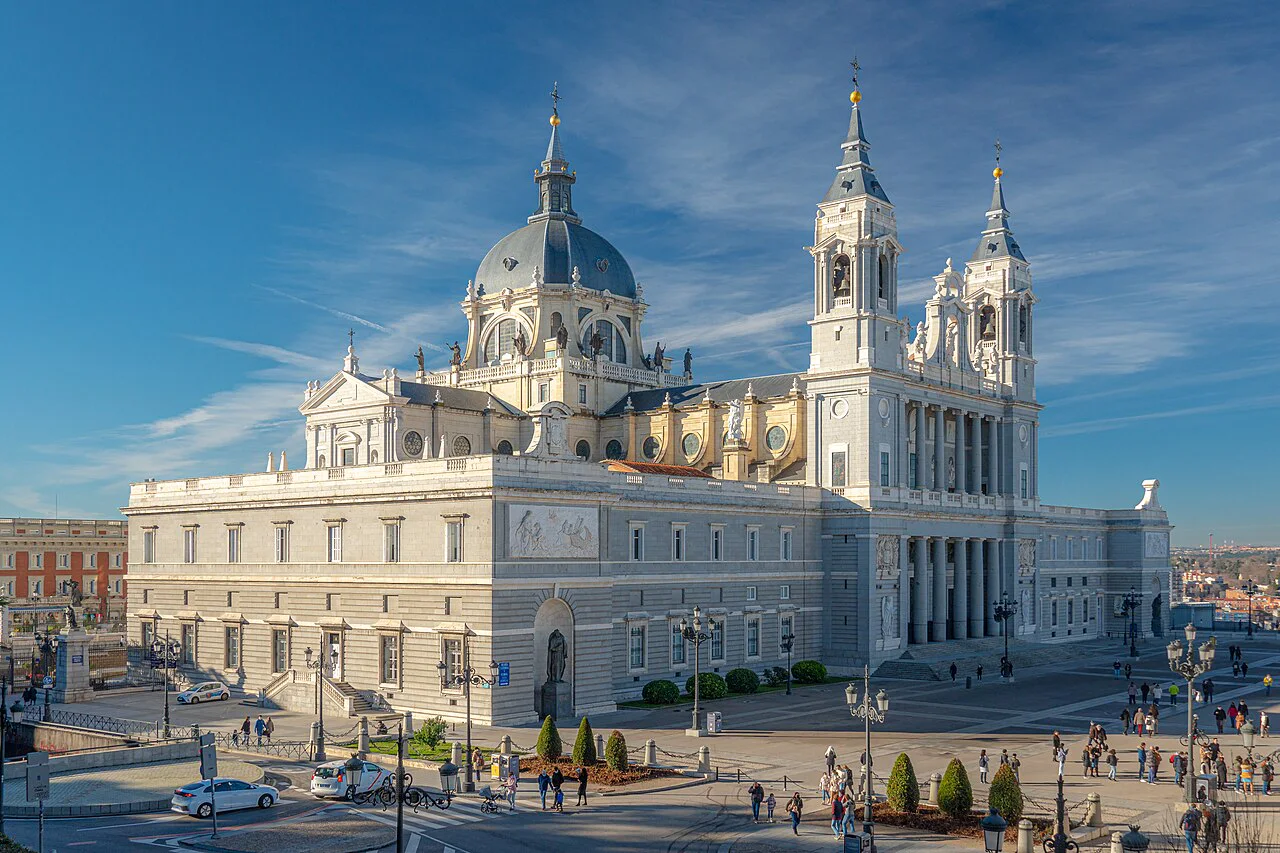
The Almudena Cathedral is a Catholic cathedral located in Madrid, Spain. It serves as the seat of the Archdiocese of Madrid and was consecrated by Pope John Paul II in 1993.
Download Stanza, then search for “Catedral de la Almudena”.
About the tour
One guide. Your kind of visit.
The Almudena Cathedral is a Catholic cathedral located in Madrid, Spain. It serves as the seat of the Archdiocese of Madrid and was consecrated by Pope John Paul II in 1993.
Ready when you are.
- 01Get the free Stanza app.
iOS & Android
- 02Find your guide.
“Catedral de la Almudena”
- 03Download before you go.
Works offline
Audio guide / 14 narrated stops
Inside the guide
Get to know a few of the stories before you go. Open a stop to read more.
01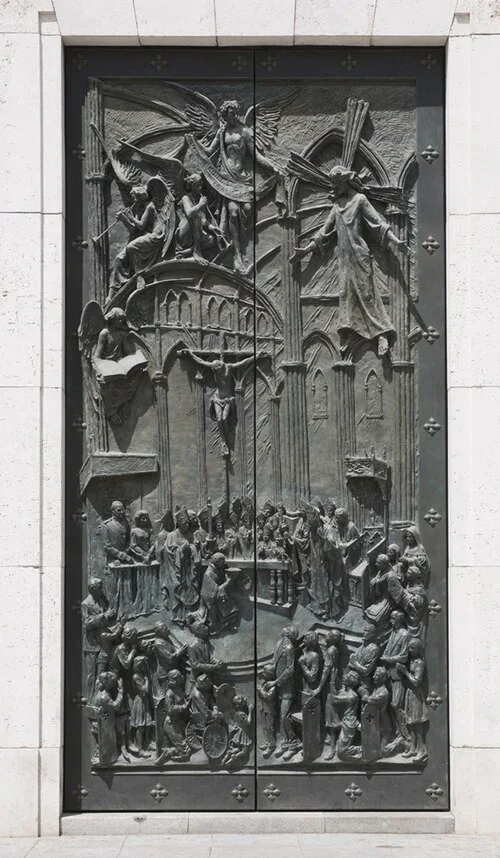 Plaza de Juan Pablo II and East Bailén Portal
The Bronze Doors on Calle de Bailén
Welcome to Almudena Cathedral, the mother church of Madrid. The bronze doors of the Bailén entrance tell its story in relief: angels making music above, Christ on the cross at the center, a crowd of the faithful below. Madrid became Spain's capital in 1561, but the seat of the Church stayed in Toledo. So the new capital had no cathedral of its own. Plans for one, dedicated to the Virgin of Almudena, were discussed as early as the sixteenth century. In that same century Spain built more than forty cities overseas, along with cathedrals and fortresses. The cost of the empire came first, and Madrid's cathedral kept waiting. Only on 4 April 1883 did King Alfonso XII lay the foundation stone. The finished building took more than a century.
Photo: PMRMaeyaert · CC BY-SA 3.0 es
02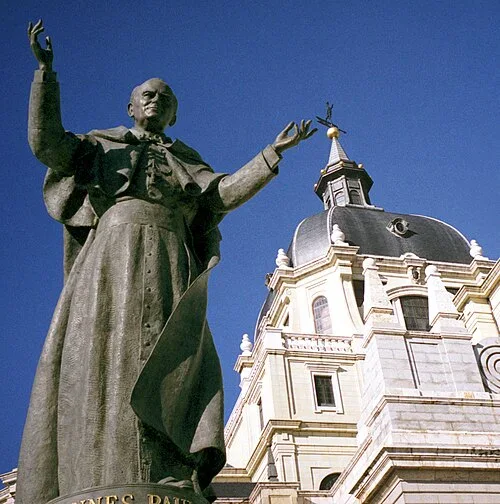 Plaza de Juan Pablo II and East Bailén Portal
Statue of Pope John Paul II
The bronze figure in the plaza shows Pope John Paul II with both arms raised in greeting. It stands more than three meters tall, the work of the sculptor Juan de Ávalos. The dome of the cathedral rises just behind it. On 15 June 1993, during his fourth journey to Spain, the pope consecrated this church as a cathedral. The kings of Spain, Juan Carlos I and Sofía, attended the ceremony, along with the government of the president, Felipe González. The plaza now carries the pope's name, set with four fountains and period lampposts. Madrid had waited more than four hundred years for that single ceremony.
Photograph by Greg O'Beirne · CC BY 2.5
03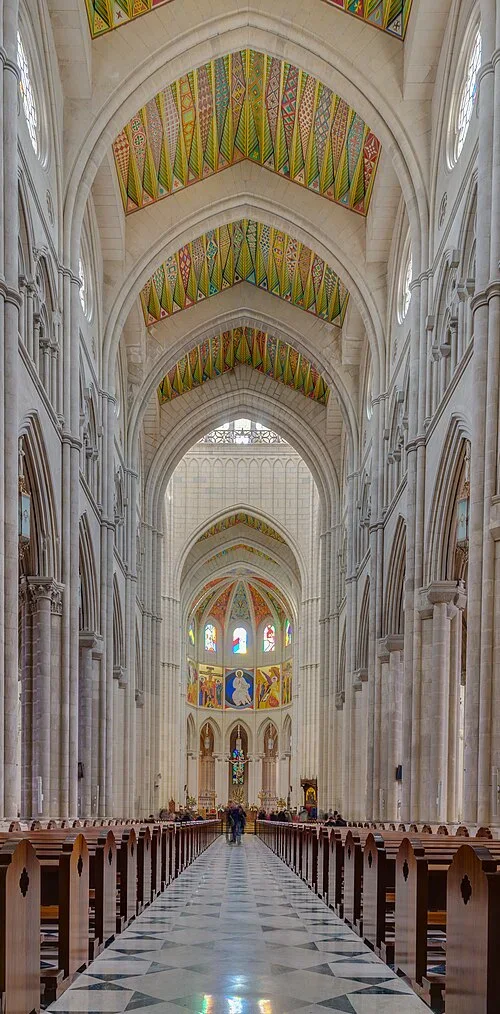 The Central Nave and Geometric Ceiling Vaults
The Central Nave
Inside, the central nave runs eighty-two meters, straight toward a blaze of color at the far end. The architecture itself was designed by Francisco de Cubas. His first plan was modest, a parish church. Then in 1885 Pope Leo XIII issued a bull creating the bishopric of Madrid-Alcalá. A parish would no longer serve, and the plans grew into a Gothic Revival cathedral. The style was the fashion of the day across Europe, with pointed arches and tall stone columns rising the length of the nave. Money ran short, however, and the work stopped almost entirely in 1965. Nearly twenty years passed before a patronage body gathered public and private support, and building resumed.
Listen in the appDiego Delso · CC BY-SA 4.0
04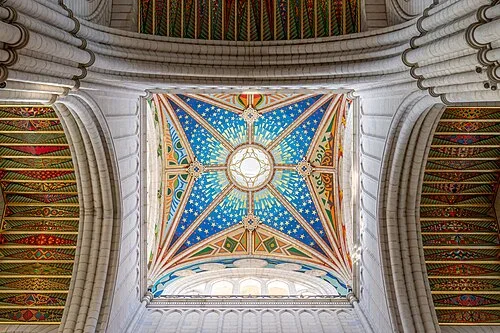 The Central Nave and Geometric Ceiling Vaults
The Painted Vault of the Crossing
The ceiling of the nave is not the stone ribbing of Gothic vaults. It is an alveolar concrete structure, a honeycomb of hollow cells that cut cost and labor. Over it runs geometric painted decoration by José Luis Galicia, in color ranges set hard against each other. The style recalls the old Mudejar wooden ceilings of Spain, above all in the lavish use of pan de oro, gold worked into the paint. The crossing vault carries a starry canopy at its center, deep blue and scattered with stars. Galicia also painted the dome, where four figures of the elements, earth, sea, fire and air, hold up the vault of heaven.
Listen in the appPhoto: Fernando · CC BY-SA 4.0
05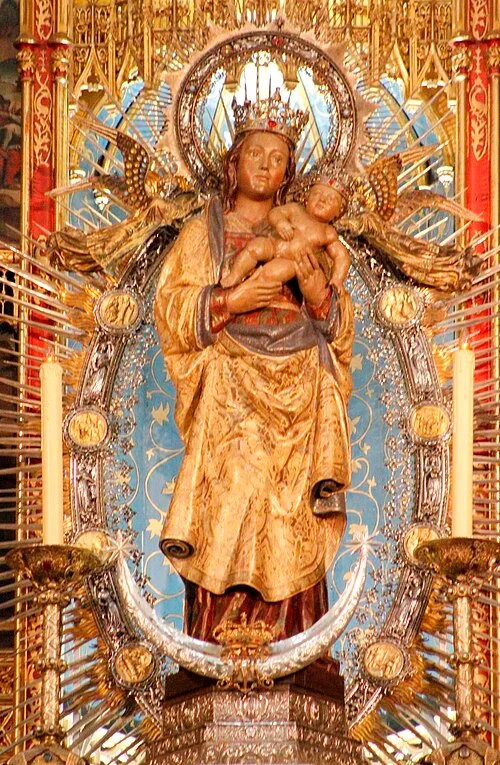 The Raised Altar of the Virgin and Royal Tomb
The Raised Altar of the Virgen de la Almudena
Madrid's patroness has her altar in the right transept, facing the Bailén entrance. It is raised well above the floor, reached by twin staircases with bronze railings. The statue is carved and painted wood in the Gothic style, the Virgin holding the Child in her arms. It stands in the central niche of a retablo made by Juan de Borgoña at the end of the fifteenth century. Eighteen panels around it show scenes from the lives of Jesus and Mary, in fresh and pleasant color. The framing and the base beneath the panels are modern work in the Neo-Gothic taste. Below the statue the light catches silver: a seventeenth-century pedestal, with candlesticks and rays of the same metal and the same period. All of it was a gift from the Villa de Madrid, the old name of the city itself, to its Virgin.
Listen in the appJosé Luiz · CC BY-SA 3.0
06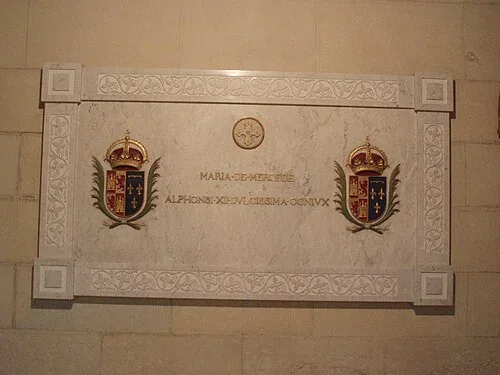 The Raised Altar of the Virgin and Royal Tomb
The Tomb of Queen María de las Mercedes
Under the arch formed by those staircases rests a white marble tomb. It holds Queen María de las Mercedes of Orleans, first wife of Alfonso XII. She died in 1878, still very young. She had been the great driving force behind the cathedral project, deeply devoted to the Virgin of Almudena. Through her mediation, the royal patrimony granted the land on which the church now rises. Her own wish was to be buried at the feet of the Virgin. Her remains waited at El Escorial until the cathedral was finished. On 8 November 2000 they were brought here, into the funerary chapel beneath the Virgin's altar. The Latin inscription on the marble names her simply as the wife of Alfonso XII, flanked by two crowned coats of arms.
Listen in the appElena F D · Public domain
07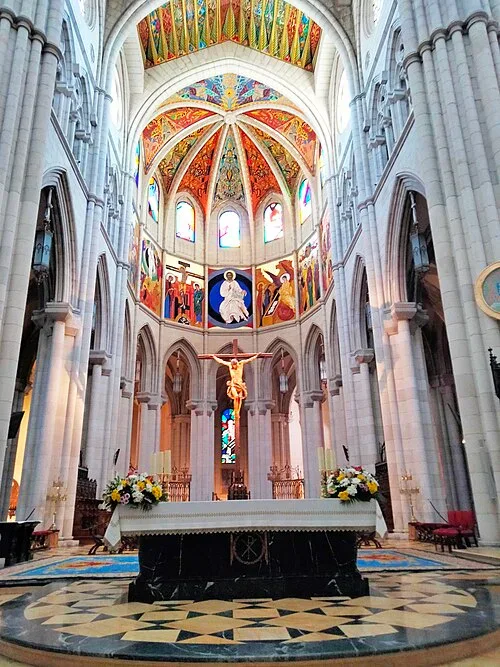 The Main Presbytery and Contemporary Apse
The Presbytery and the Apse of Kiko Argüello
The high altar stands at the crossing, a slab of green marble. Behind it the apse blazes with murals commissioned from Kiko Argüello, a religious artist and founder of the Neocatechumenal Way. Cardinal Rouco Varela, archbishop of Madrid, blessed the paintings and the windows in April 2004. Read across from left to right: the Baptism, the Transfiguration, the Crucifixion, then Christ Pantocrator at the center, followed by the Resurrection, the Ascension and Pentecost. The Pantocrator presides over the whole church, shown as Jesus in his Second Coming. In the open book he holds, the painted words read: Love your enemies. I am coming soon. Above the murals run seven stained-glass windows, abstract rather than figurative, each giving the Word of God in another tongue: Verbum in Latin, Logos in Greek, Dabar in Hebrew, and Palabra in Spanish, with the name of María at the center. Not everyone has loved the ensemble, and its taste and its place here have been openly questioned. A few weeks after the blessing, the church hosted a royal wedding. On 22 May 2004 the future King Felipe VI married Letizia Ortiz here. Some twelve hundred guests attended, with representatives of all the royal houses of Europe. It was the first royal wedding in the capital in ninety-eight years.
Listen in the appPhoto: Enric · CC BY 4.0
08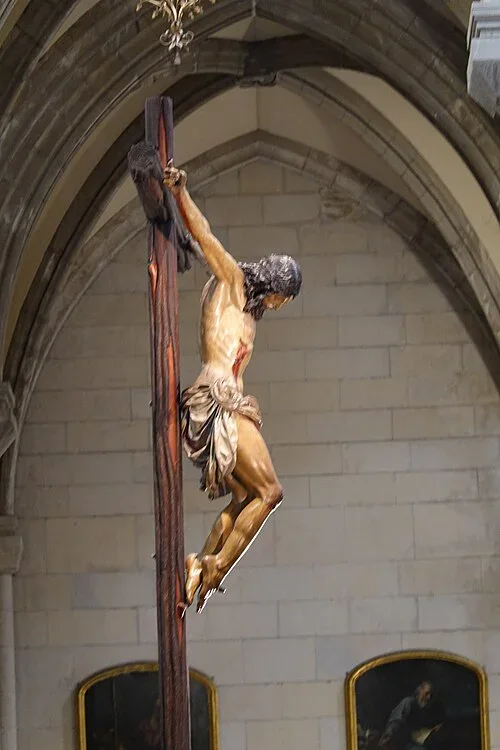 The Main Presbytery and Contemporary Apse
The Crucified Christ by Juan de Mesa
Behind the main altar presides a crucified Christ of a very different spirit. It is the work of Juan de Mesa, a celebrated sculptor from Córdoba of the early seventeenth century. He carved it in 1620, on commission from the Colegio Imperial, for the church of San Isidro. The crucifix later came to this cathedral from that colegiata, the church that served Madrid as its provisional cathedral. The piece is counted a key work of Spanish baroque sculpture. The body sags with weight, the head fallen forward, the drapery cut deep and polished smooth. It came through hard times: the sculpture suffered damage in the Spanish Civil War and had to be restored. Now it hangs directly behind the green marble altar, a seventeenth-century figure beneath the modern murals.
Listen in the appPhoto: Joseolgon · CC BY 4.0
09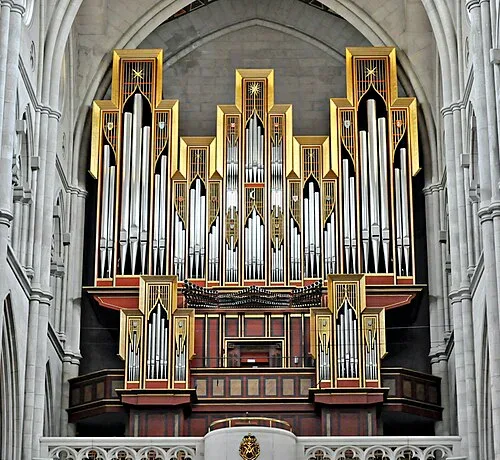 The Choir Loft and Gerhard Grenzing Organ
The Grenzing Organ
At the far end of the nave, up in the choir loft, stands the cathedral's grand organ. Gerhard Grenzing, an organ builder, completed it in 1999. The case is modern, but its stepped, gilded towers of pipes are shaped like the retablos of Gothic altarpieces. Inside are some five thousand pipes, most of them of a tin alloy. They speak through seventy voices, played from four manuals and a pedal keyboard. From the loft at the foot of the church, its sound carries down the full length of the nave.
Listen in the appHans-Jörg Gemeinholzer · CC BY-SA 4.0
10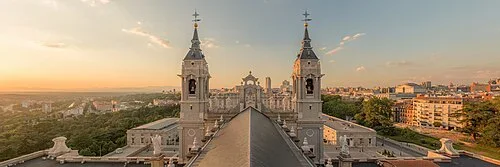 The Dome Gallery and Madrid Panorama
The Dome Gallery over Madrid
The dome gallery gives the building its measure. The roof ridge runs level between the two bell towers, each sixty meters tall to its weathervane. The dome climbs higher still, seventy-three meters up to the top of its crowning cross. From end to end the whole church stretches a hundred and two meters. The drum that carries the dome is ringed with twelve statues of the Apostles. Below, the panorama opens across the western edge of old Madrid, the ground this church was placed to command beside the palace.
Listen in the appFernando Pascullo · CC BY-SA 4.0
- 11
The Plaza de la Armería Façade
The neoclassical portico facing the Royal Palace, crowned by a baroque niche and four saints by Ramón Chaparro.
- 12
Cathedral and Royal Palace
Why the cathedral runs north to south, and how the Civil War pause led to a palace-matching exterior.
- 13
The Neo-Romanesque Crypt
The oldest finished part of the cathedral: four hundred unique carved capitals and walls of the old city nearby.
- 14
The Hidden Virgin: Legend and Devotion
The legend of the Virgin hidden in the citadel wall, revealed when a section collapsed before King Alfonso VI.
Catedral de la Almudena
Frequently asked questions
How much does the guide cost?
Free app download. Listed guide price: $0.99. Guide price shown in the app. Audio guide only. Venue admission is separate.
Can I listen without internet?
Yes. Download the guide’s audio, images, and maps in the app before your visit. Your downloaded content is then available offline.
Can I listen in my language?
This audio guide is available in 15 languages, including English.
Do I need to follow a schedule?
No. This is a self-guided experience. Choose your stops, pause whenever you like, and return to a story at your own pace.
At your own pace
Explore Catedral de la Almudena.
Download Stanza, then search for “Catedral de la Almudena”.
Free app download · Guide price shown in the app
Keep exploring
Nearby audio guides
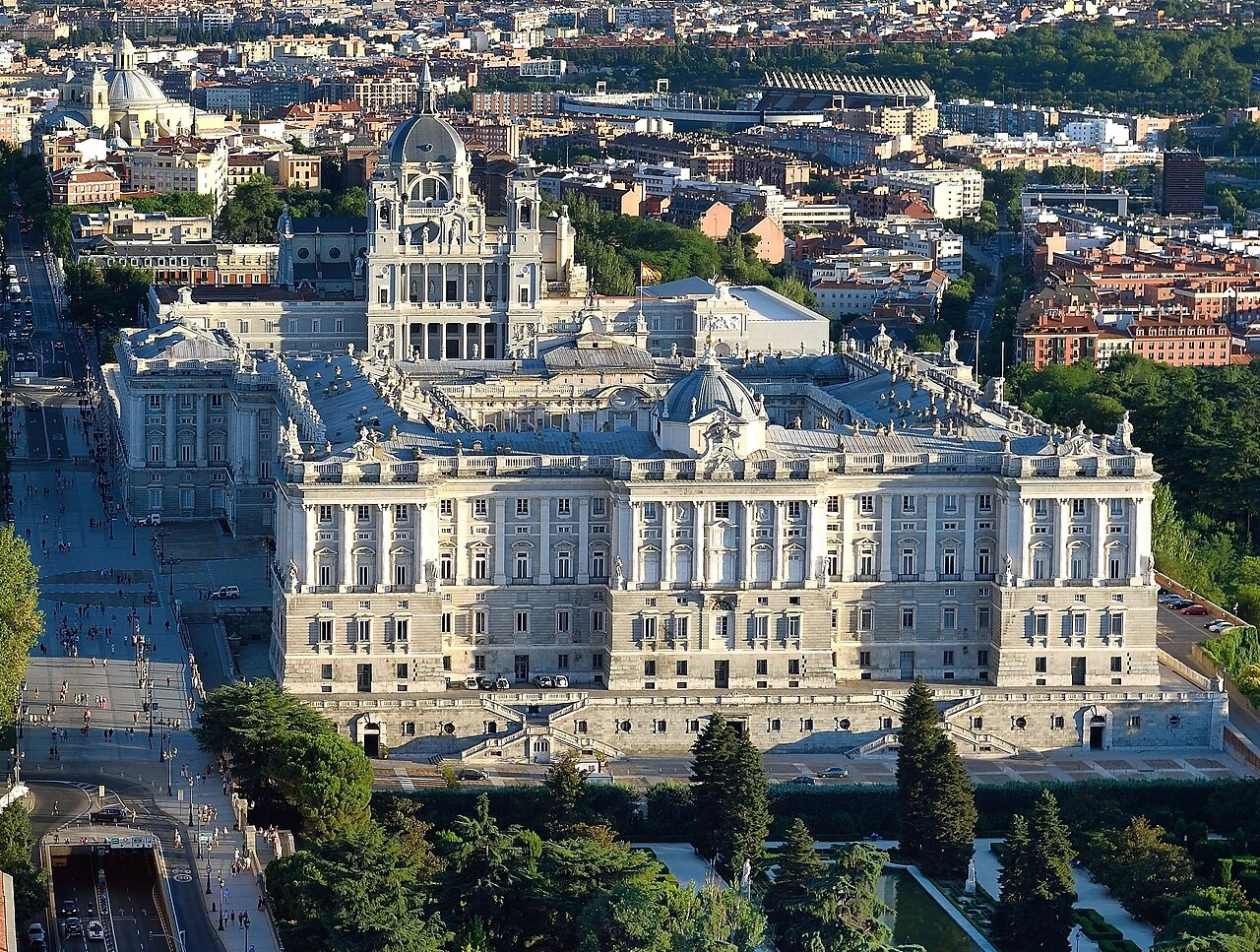
Madrid · 1 km
Royal Palace of Madrid
Content & sources
Tim Adams · CC BY-SA 4.0
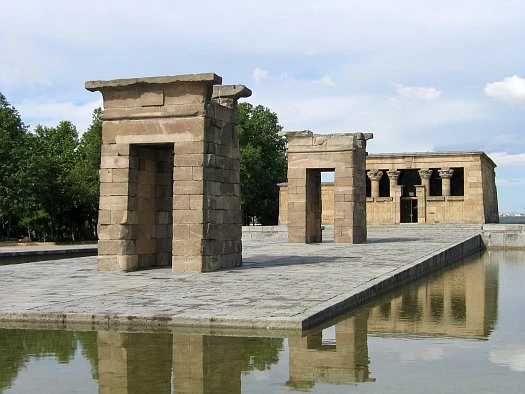
Madrid · 1 km
Temple of Debod
Content & sources
Photo: OsvaldoGago · CC BY-SA 2.0
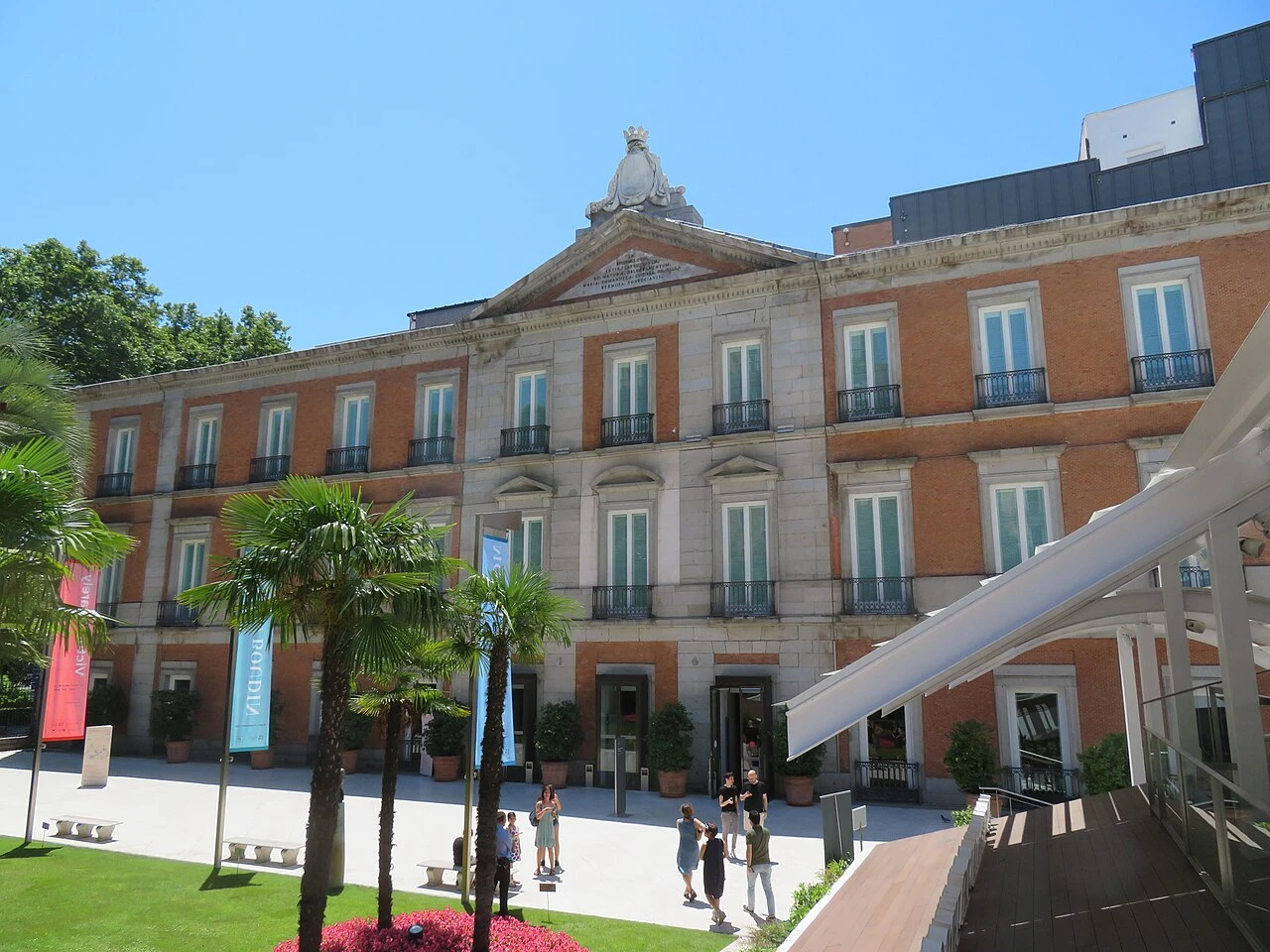
Madrid · 2 km
Thyssen-Bornemisza Museum
Content & sources
Kyle Magnuson from Los Angeles, United States · CC BY 2.0
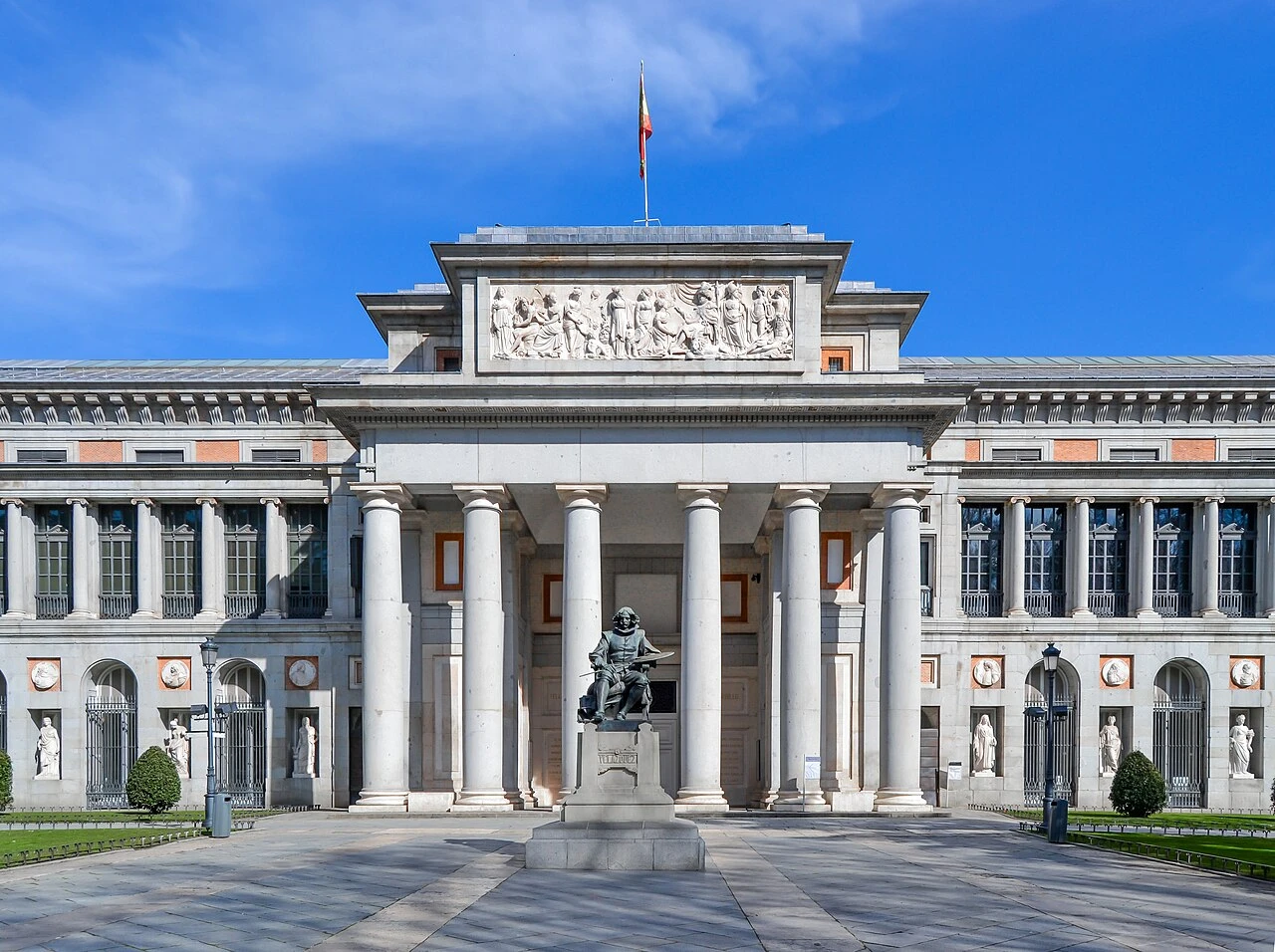
Madrid · 2 km
Prado Museum
Content & sources
Emilio J. Rodríguez Posada · CC BY-SA 2.0