Stanza · Audio guide
Temple of Debod Audio Guide
A place to remember. A story to take with you.
The Temple of Debod is an ancient Egyptian temple that was dismantled and rebuilt in Madrid, Spain. Originally from the Nile Valley, it was donated to Spain to save it from flooding after the construction of…
Download Stanza, then search for “Temple of Debod”.
About the tour
One guide. Your kind of visit.
The Temple of Debod is an ancient Egyptian temple that was dismantled and rebuilt in Madrid, Spain. Originally from the Nile Valley, it was donated to Spain to save it from flooding after the construction of the Aswan High Dam.
Ready when you are.
- 01Get the free Stanza app.
iOS & Android
- 02Find your guide.
“Temple of Debod”
- 03Download before you go.
Works offline
Audio guide / 9 narrated stops
Inside the guide
Get to know a few of the stories before you go. Open a stop to read more.
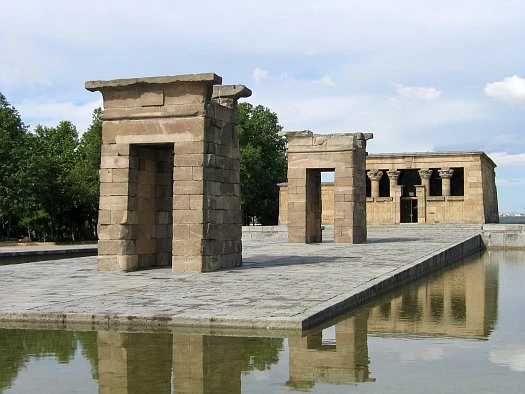
01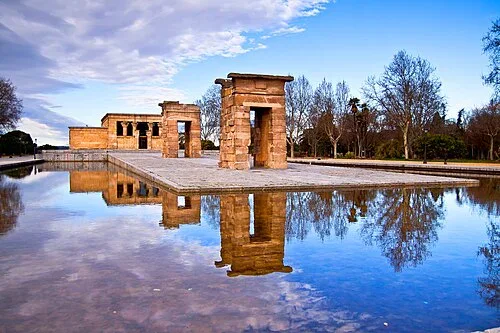 Parque de la Montaña Esplanade and Reflecting Pool
The Temple of Debod and its Reflecting Pool
Welcome to the Temple of Debod. The temple is about two thousand two hundred years old. It was built some fifteen kilometres south of Aswan, close to the first cataract of the Nile, a stretch of rapids. In 1968 Egypt gave it to Spain, as thanks for Spain's help in saving the monuments of Nubia. It is one of the few ancient Egyptian buildings moved outside Egypt, and the only one of its kind in Spain. Beside the long reflecting pool, its stones are doubled in the still water. The rebuilding in Madrid kept roughly the same east-to-west alignment the temple had in Nubia.
Photo: Choniron · CC BY-SA 3.0 es
02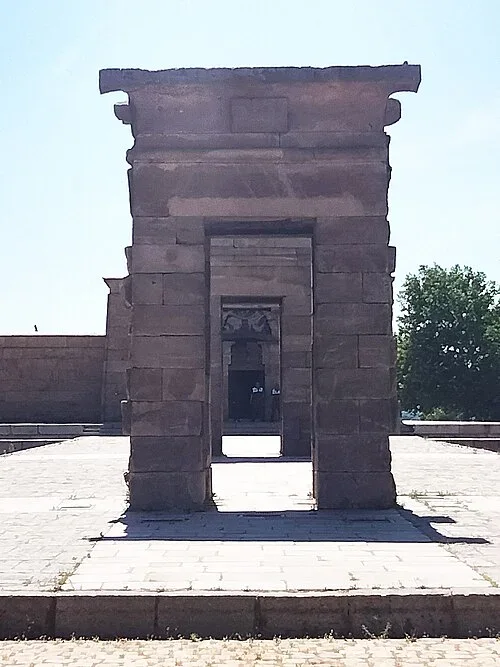 The Monumental Pylon Gateways
The Processional Gateways
The approach to the Temple of Debod began at the quay, along a long processional way, a route made for ceremonies. It crossed a stone enclosure wall and passed through three stone pylons, tall monumental gateways set one behind another. Their doorways line up, so that each one frames the next. Only then did the way reach the temple itself. When the temple was rebuilt in Madrid, the three gateways were set up in a different order from the original. In the original setting, the gateway topped by a sun flanked by serpents was not the one nearest the temple.
Photo: Enric · CC BY-SA 4.0
03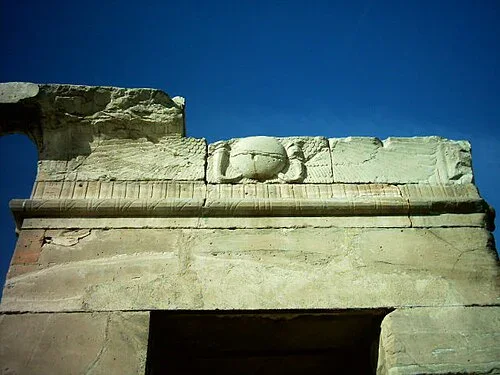 The Monumental Pylon Gateways
The Sun Disc over the Gateway
Above a doorway, a winged sun disc is carved into the stone. Sun discs like this often appeared over Egyptian entrances, a sign of the sun god. The top of the stone is broken and chipped, and the edges of the disc have softened with time. The wings are worn, but their shape is still clear.
Listen in the appTuválkin from Lisboa, Portugal · CC BY-SA 2.0
04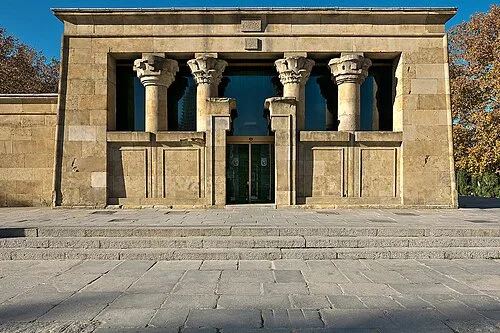 Hypostyle Vestibule and Portico Columns
The Roman Facade and Hypostyle Vestibule
The temple took shape over centuries, starting in the early second century BC. By the time the front hall was built, Rome ruled Egypt. The emperors Augustus and Tiberius completed the expansion. They added a front hall called a hypostyle, a hall whose roof rests on columns. Four columns with flower-shaped capitals stand across its front. Two of those capitals were never finished. Next to the temple, a side building has traditionally been called a mammisi, a birth house. In 1868 the front hall collapsed, the same year an earthquake damaged the temple. It is now lost at the original site. In Madrid it was raised again in the early 1970s.
Listen in the appJosé Luis Filpo Cabana · CC BY 3.0
05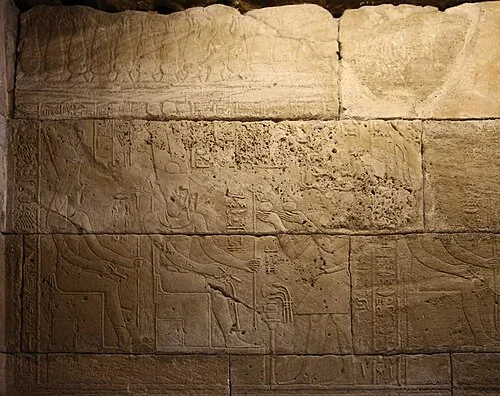 The Chapel of Adikhalamani
The Chapel Reliefs of the Meroitic Phase
Inside the temple stands a small one-room chapel, the first part of the building to be built. It dates to the early second century BC. Most scholars credit it to the Kushite king Adikhalamani, though some think the Egyptian king Ptolemy the Fourth began the core. Its walls are carved in bands of figures and rows of hieroglyphs. The scenes show royal rituals for the god Amun, who was called Amani in the Kushite language. One inscription says the king ordered the monument built for his father, Amun. Another says that Amun dwells in Debod.
Listen in the appFrancesco Bini · CC BY-SA 4.0
06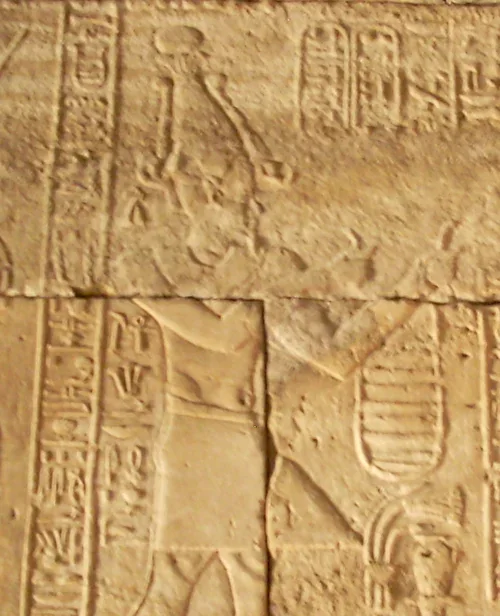 The Chapel of Adikhalamani
King Adikhalamani of Meroë
The king shown in these carvings is Adikhalamani, a Kushite king of Meroë, in what is now Sudan. He is shown making offerings to the gods. His tomb is pyramid number nine at Meroë. Debod lay in Lower Nubia, a border zone disputed between Egyptian and Meroitic rulers. In 205 BC Upper Egypt broke away from Ptolemaic rule. The breakaway lasted about twenty years, and Upper Egypt had kings of its own. In that gap, the Kushites pushed north to Philae, taking a stretch of Nubia along the river called the Dodekaschoenos. That explains how Kushite power reached Debod too. On a massive lintel, the stone beam over a doorway, among the temple's blocks, the king's titles include the phrase 'beloved of Apedemak'. Apedemak was a lion-headed war god, the chief god of the Meroitic pantheon. Bringing him this far north was a way for the king to claim the land. The scholar Žabkar called this the northernmost mention of that god.
Listen in the appSimon Burchell · CC BY-SA 3.0
07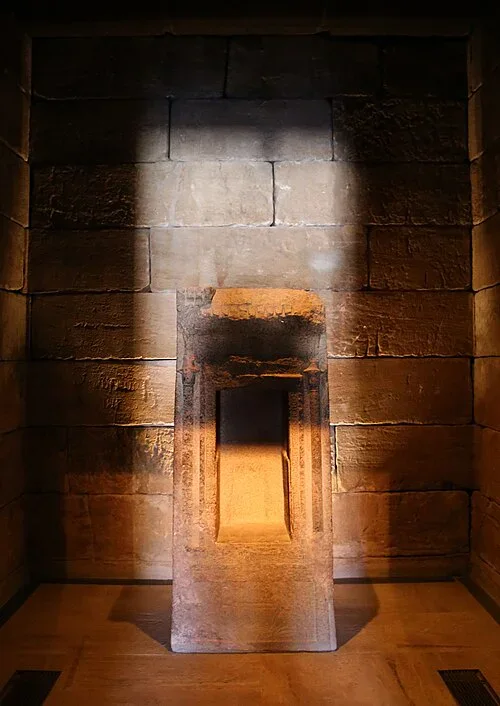 Sanctuary of the Naoi
The Sanctuary of the Naos
The central sanctuary of the temple was built in the Ptolemaic period, after the temple had been extended. It was dedicated to Isis and to Amun of Debod. Inside stands a naos, a stone shrine made to hold a god's statue, kept out of public view. Only one naos survives here. A second stone shrine of this kind was lost in the nineteenth century. Stairs in the side rooms led up to the roof. Today a beam of light slants down across the stone walls.
Listen in the appFrancesco Bini · CC BY-SA 4.0
08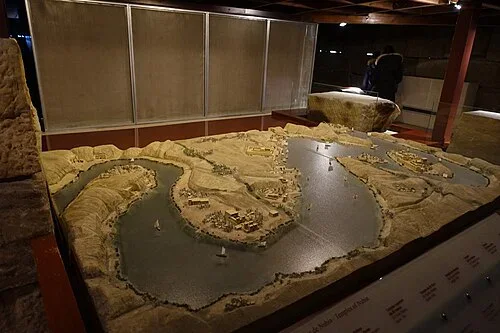 Upper Gallery and the Nubian Salvage
The Model of Lower Nubia and the Great Rescue
A large model of Lower Nubia shows the river and the land around it, the setting the temple once had. In 1960 the Aswan High Dam was being built, and its reservoir threatened many monuments along the Nile. UNESCO called for an international rescue. Spain formed its own committee that year, led by the archaeologist Martín Almagro Basch. Egypt later gave four temples to countries that had answered the call. Dendur went to the United States, Ellesiya to Italy, Taffa to the Netherlands, and Debod to Spain. Jambrina has shown that the negotiation was harder than official accounts admit. Money and prestige were at its centre. Polish archaeologists took the temple apart in 1961, and its stones were stored on Elephantine Island, beside Aswan. In June 1970 the crates were loaded onto the ship Benisa, which carried them to Valencia. Trucks then took them to Madrid, where they were stored on the site of the old Montaña barracks, destroyed in the Spanish Civil War. Almagro Basch's team had only a plan, a sketch of the front, and little else from Egypt. Some two thousand three hundred pieces had to be fitted together. More than a hundred blocks had lost their numbers. The team rebuilt the temple by anastylosis, reassembling its original stones. It opened to the public in 1972.
Listen in the appJeremy Thompson from Los Angeles, California · CC BY 2.0
09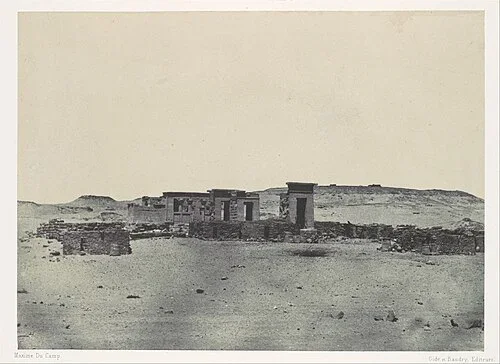 Upper Gallery and the Nubian Salvage
Debod on the Nile: The Original Site
Its original setting was the bank of the Nile in Lower Nubia, close to Philae, the great sanctuary of the goddess Isis. Ruined walls surround it. In 1813 the Swiss explorer Johann Ludwig Burckhardt wrote the first exact description of the building to reach Europe. Champollion, the decipherer of hieroglyphs, visited too and left a brief note. In spring 1821 a Russian professor, Joseph Ssenkowsky, described it as a small temple, only seventy-five feet long, in very good condition. He thought it was probably the ancient Parembole, a place about sixteen thousand paces from Aswan. Later travellers and Egyptologists described its slow decline. The first Aswan dam, known as the low dam, was completed in 1907. After that the temple lay under the Nile for about nine months of each year. The flooding caused the loss of much of its painted colour and damaged some of its reliefs. Today the temple stands in Madrid, rebuilt from its original stones, which once lay under the Nile for much of the year, with new stone added for missing parts.
Listen in the appMaxime Du Camp / Louis Désiré Blanquart-Evrard · CC0
Temple of Debod
Frequently asked questions
How much does the guide cost?
Free app download. Listed guide price: $0.99. Guide price shown in the app. Audio guide only. Venue admission is separate.
Can I listen without internet?
Yes. Download the guide’s audio, images, and maps in the app before your visit. Your downloaded content is then available offline.
Can I listen in my language?
This audio guide is available in 15 languages, including English.
Do I need to follow a schedule?
No. This is a self-guided experience. Choose your stops, pause whenever you like, and return to a story at your own pace.
At your own pace
Explore Temple of Debod.
Download Stanza, then search for “Temple of Debod”.
Free app download · Guide price shown in the app
Keep exploring
Nearby audio guides
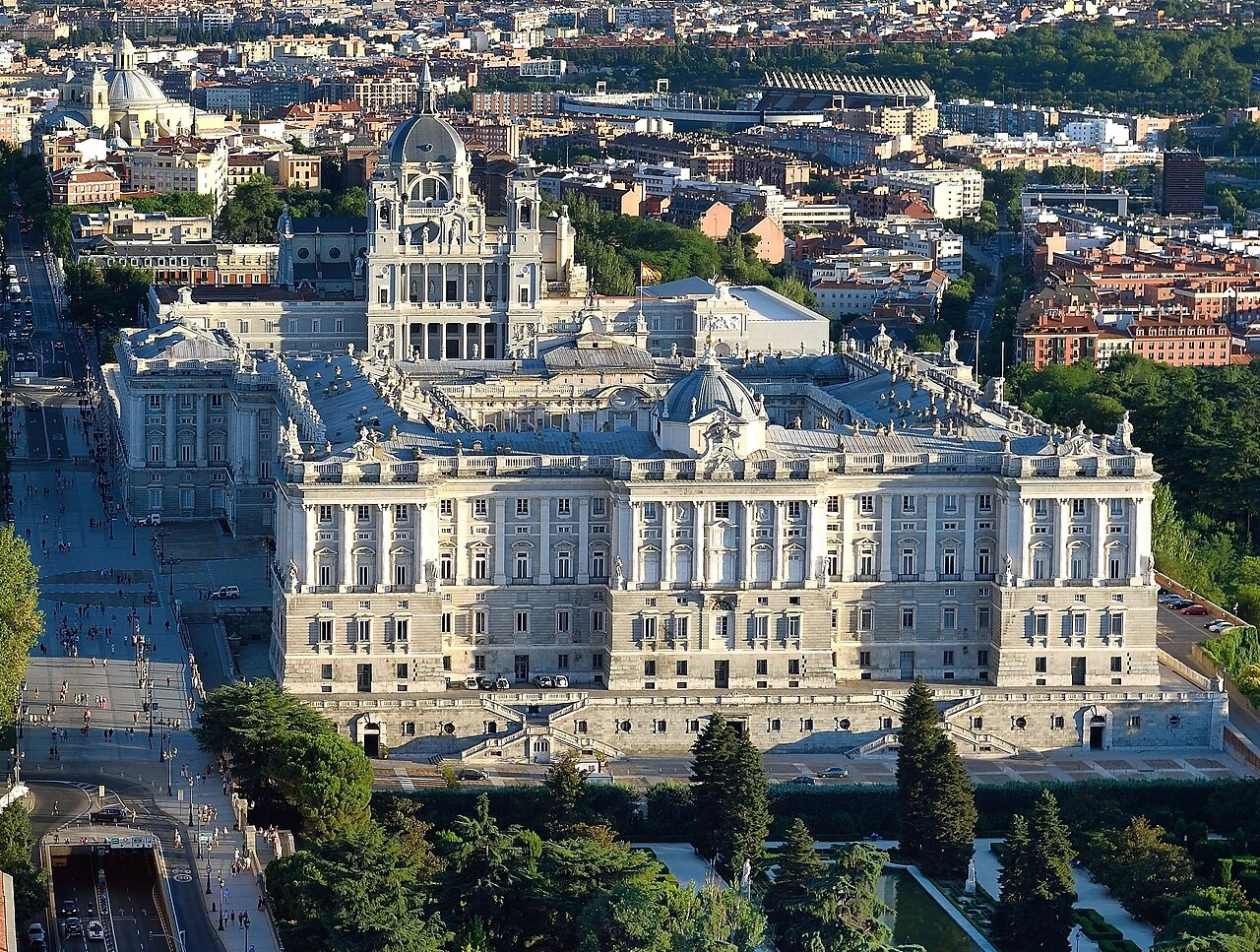
Madrid · 1 km
Royal Palace of Madrid
Content & sources
Tim Adams · CC BY-SA 4.0
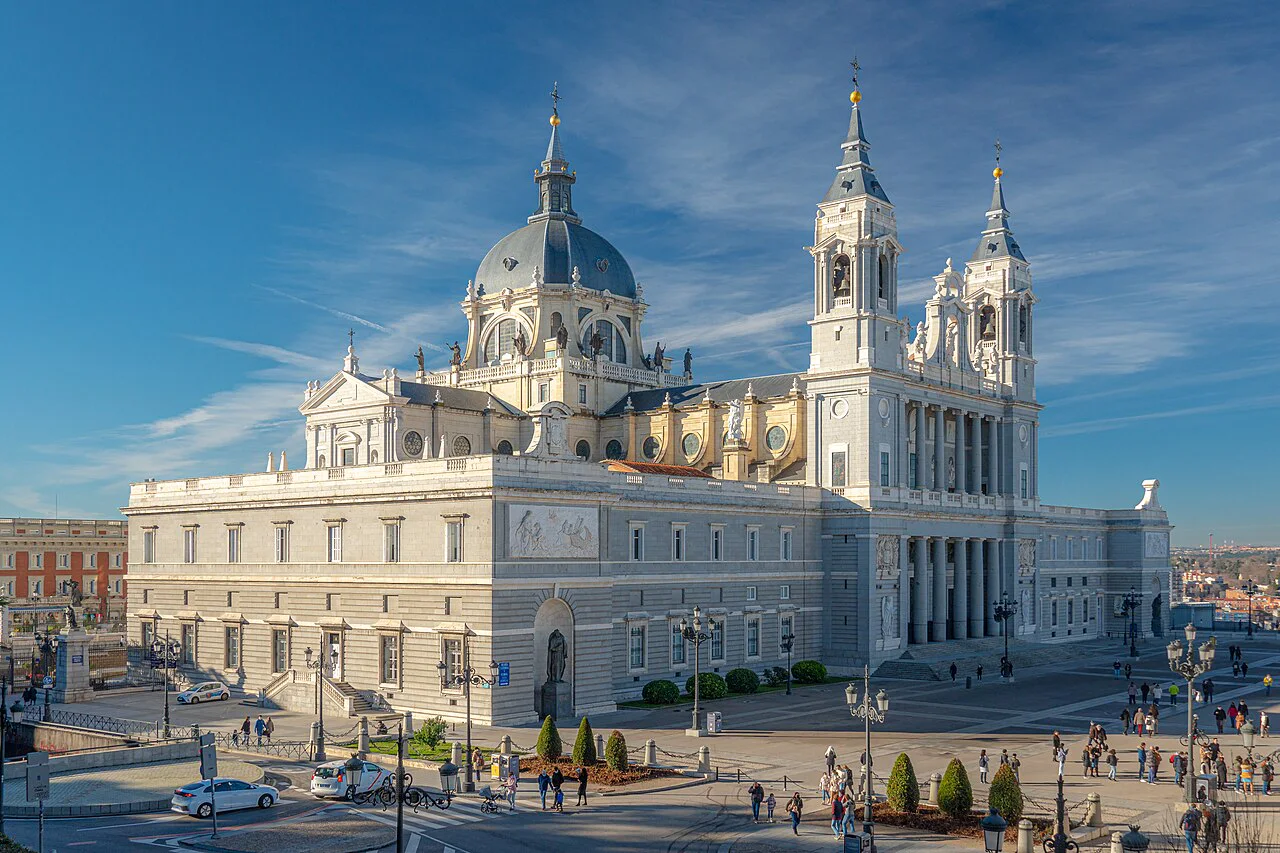
Madrid · 1 km
Catedral de la Almudena
Content & sources
Photo: Fernando · CC BY-SA 4.0
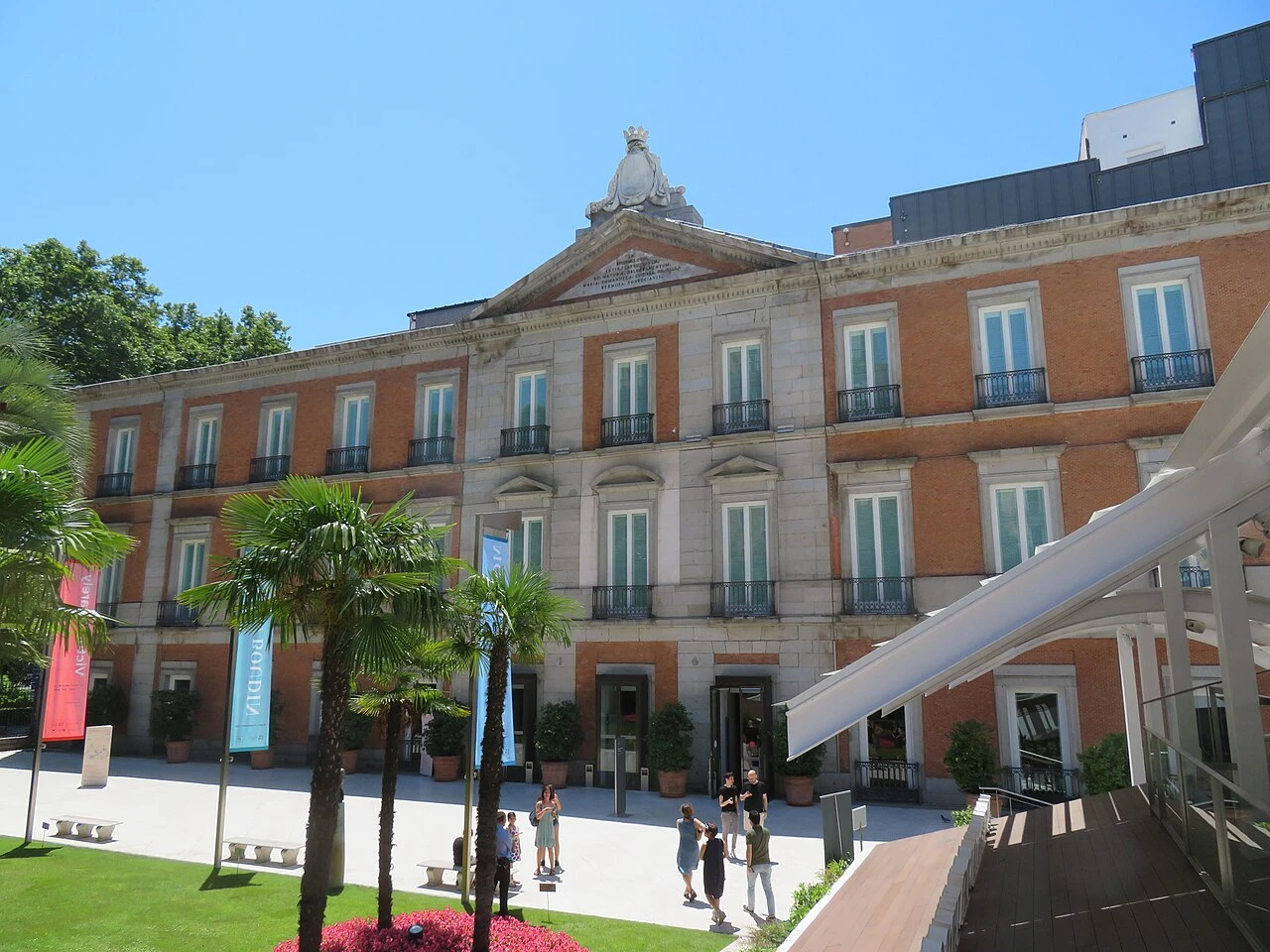
Madrid · 2 km
Thyssen-Bornemisza Museum
Content & sources
Kyle Magnuson from Los Angeles, United States · CC BY 2.0
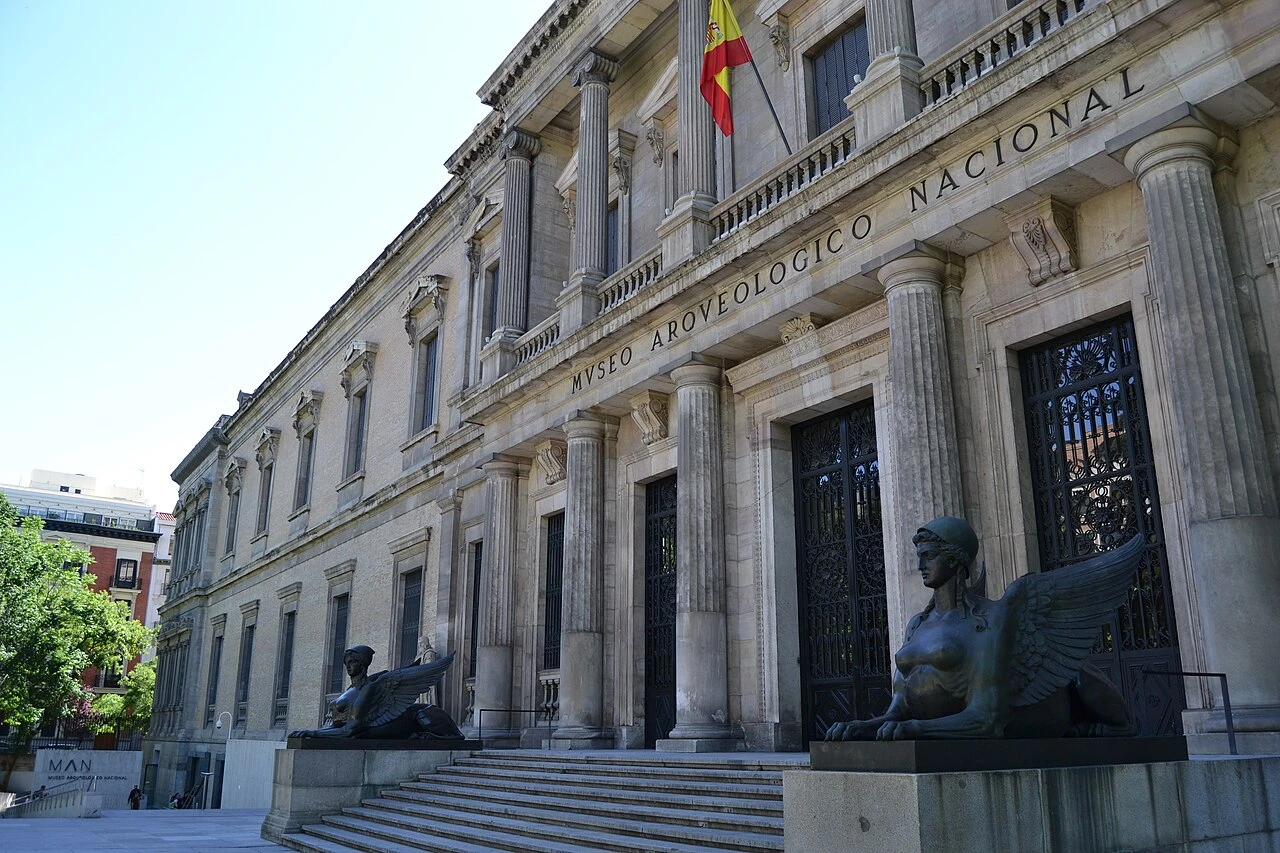
Madrid · 2 km
National Archaeological Museum of Spain
Content & sources
Emilio J. Rodríguez Posada · CC BY-SA 2.0