 Stanza / Audio guide
Stanza · Audio guide
Kerkouane Audio Guide
A place to remember. A story to take with you.
Kerkouane is an ancient Punic city located in north-eastern Tunisia near Cape Bon. It was one of the most important Punic cities and existed for almost 400 years before being abandoned during the First Punic…
Download Stanza, then search for “Kerkouane”.
About the tour
One guide. Your kind of visit.
Kerkouane is an ancient Punic city located in north-eastern Tunisia near Cape Bon. It was one of the most important Punic cities and existed for almost 400 years before being abandoned during the First Punic War.
Ready when you are.
- 01Get the free Stanza app.
iOS & Android
- 02Find your guide.
“Kerkouane”
- 03Download before you go.
Works offline
Audio guide / 13 narrated stops
Inside the guide
Get to know a few of the stories before you go. Open a stop to read more.
01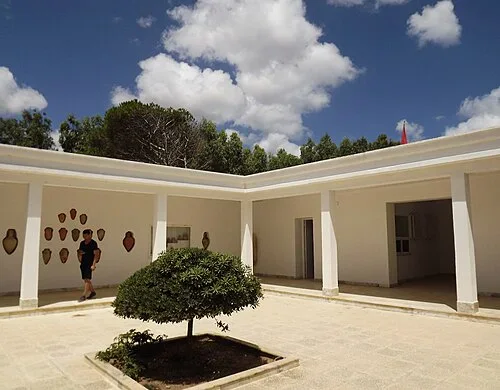 Kerkouane Archaeological Museum
Welcome to Kerkouane, a small Punic town on the coast of north-eastern Tunisia, near Cape Bon. The visit begins in this museum, among finds gathered from the town and its nearby necropolis. In 1985, UNESCO listed Kerkouane as a World Heritage Site, and the reason is unusual. These remains are cited as the only example of a Phoenicio-Punic city to have survived. The museum holds the small things the town left behind, and a model of the whole settlement. Beyond the courtyard with its white columns and potted tree, the ruins of the town lie open to the sky. The museum itself opened in 1987.
Youssefbensaad · CC BY-SA 4.0
02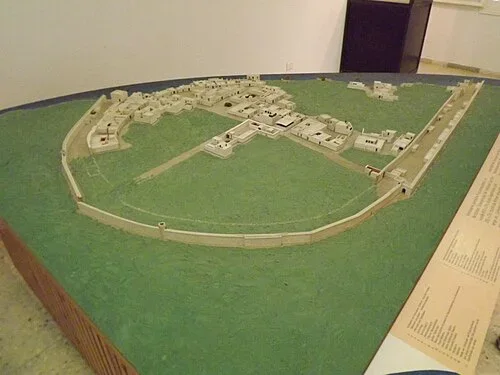 Kerkouane Archaeological Museum
Scale model of the Punic town
A scale model in the museum shows the whole town at a glance. The shape is a walled wedge of houses, laid out on a grid with wide streets and public squares. Every house follows a standard plan, the mark of a town designed as one project rather than grown piecemeal. Kerkouane was never large. It probably never held more than about twelve hundred people, mostly fishermen and craftsmen. The town existed for almost four hundred years, though the coins and ruins found in the excavations belong mostly to its last two centuries. The model stands here among the exhibits, but the same streets lie open on the ground, and the next stops follow them.
Photo: Youssefbensaad · CC BY-SA 4.0
03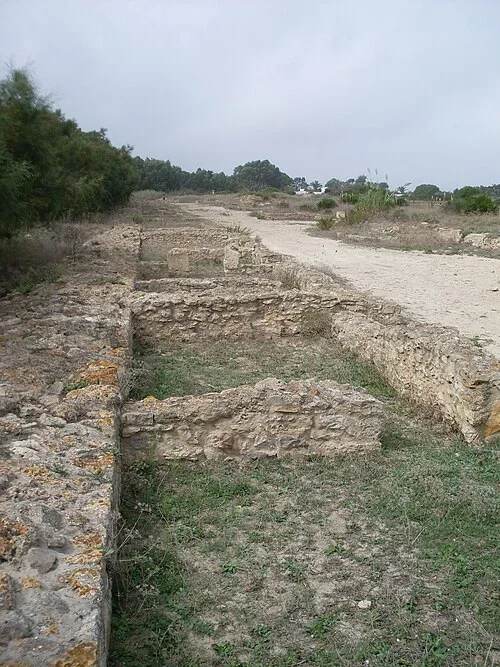 External Fortifications and City Gate
Outer defensive wall
Low walls of rough stone run along the edge of the town, the line of the outer enclosure that once defended it. Around the middle of the third century before Christ, war reached this coast. The First Punic War set Carthage against Rome, and the town was attacked twice. Tradition blames the Roman consul Regulus, and puts the destruction in 256 BC. After that, Kerkouane was abandoned around 250 BC. The story goes that the surviving inhabitants fled west and founded a new place called Tamezrat. What matters most is what the Romans never did: they did not rebuild here. The ruins lay untouched for more than two thousand years, and a whole Punic town survived as a result.
Listen in the appPhoto: Rais67 · Public domain
04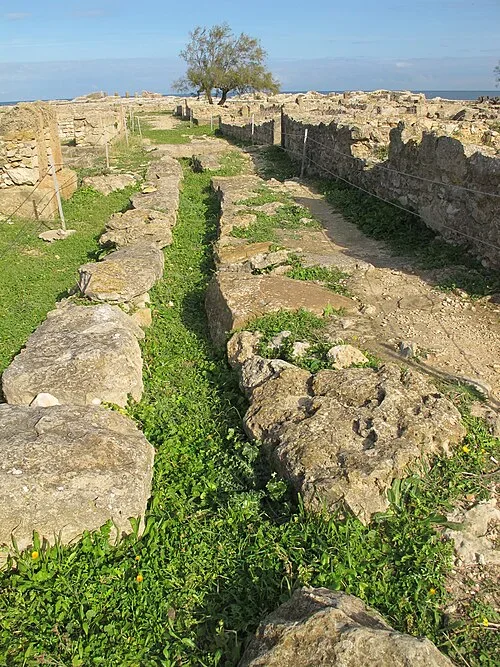 External Fortifications and City Gate
Main drainage channel
A long channel of cut stone runs down the middle of a street, and it is exactly what it looks like: the town's main sewer. Water from the houses drained into channels like this one, which carried it away along the street grid. Drainage at Kerkouane was planned for the whole town at once, not added house by house. It is one of the clearest signs of the sophisticated town planning the museum's model shows in miniature. The channel still runs its straight course between the ruined walls.
Listen in the appPhoto: Kritzolina · CC BY-SA 4.0
05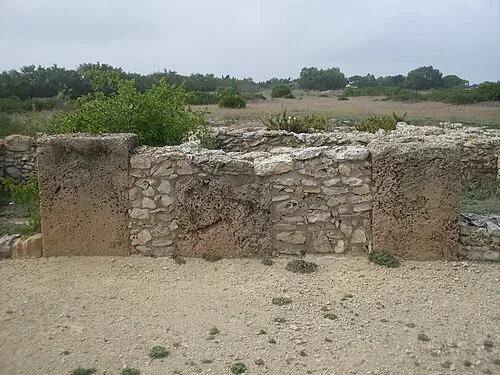 Urban Layout and Punic Architecture
Punic wall construction (opus Africanum)
The walls here are built in a way that gives the technique its name: opus Africanum, the African style. Tall upright blocks of stone stand at intervals, and the wall between them is filled with smaller rubble masonry. The big blocks carry the load, so the wall itself can be lighter. Builders across the Punic world worked this way, and Kerkouane is one of the best places to see it. On many house facades the coloured clay finish is still visible. These walls were not bare stone when people lived here. They were finished, plastered and painted.
Listen in the appPhoto: Rais67 · Public domain
06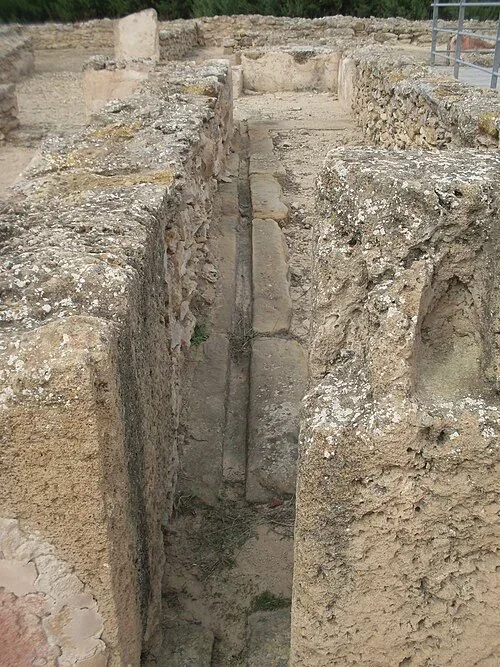 Urban Layout and Punic Architecture
House water conduit
Between two walls, a narrow channel of stone slabs runs through the house. This is household plumbing, the link between the town's mains and the private bathrooms of the residential quarter. The same system that served the streets served the house. The ruins also hold one later story. In the courtyard of a Punic house, excavators came upon a hidden cache of Roman oil lamps, buried in a prepared hiding place. Those lamps were made centuries after the town fell. They suggest that travelers or squatters sheltered in the ruins long after Kerkouane was empty. No one knows which courtyard held the cache.
Listen in the appPhoto: Rais67 · Public domain
07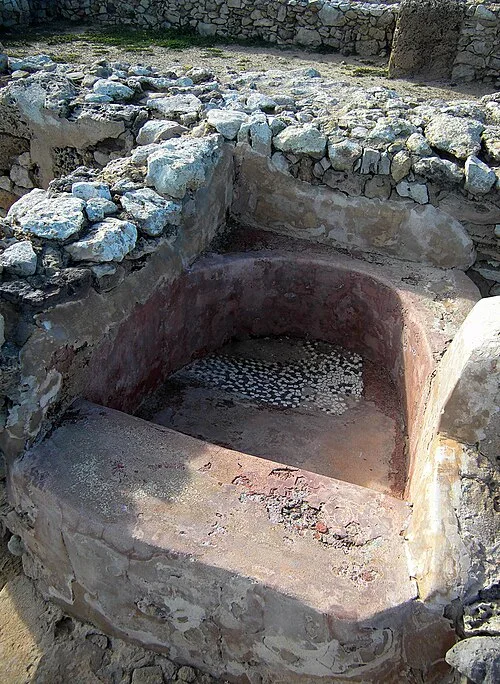 Residential Quarters and Private Bathtubs
Punic sit-down bathtub with pebble floor
Set into the floor of a house, a private bathtub survives almost whole, coated in pink plaster. The plaster was made waterproof, so the tub could be filled and used again and again. Its floor is paved with tiny pebbles set in mosaic, easy under a bather's feet. Private bathtubs like this one are a signature of Kerkouane, found inside the town's houses. Many homes here had a bathroom of their own, a mark of comfort in a small Punic town. The pink is the waterproof coating itself, still clinging to the masonry more than two thousand years later.
Listen in the appEna Tounes · CC BY 2.0
08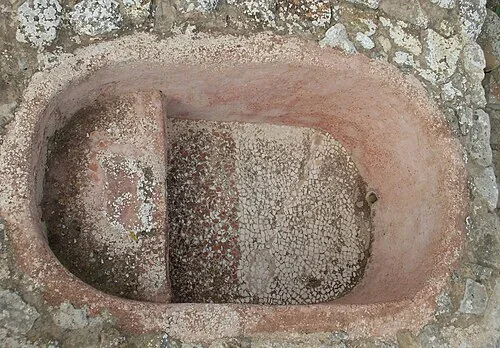 Residential Quarters and Private Bathtubs
Slipper-shaped bathtub
A second bathtub, seen from above, shows why these are called slipper tubs. One end is broad and open, the other curves down to a narrow foot, like a shoe lying on its side. A seat is built in at the head end. A bather sat there and stretched their legs toward the foot, where the floor is paved in mosaic. The same pink waterproof plaster coats the inside. The shape is strikingly close to a modern sit-down bath.
Listen in the appPhoto: Rais67 · Public domain
09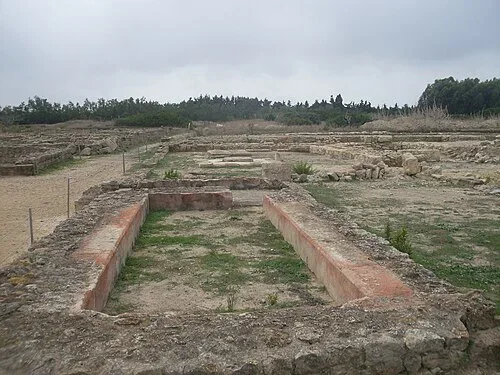 The Central Sanctuary of Unknown Deities
The Central Sanctuary
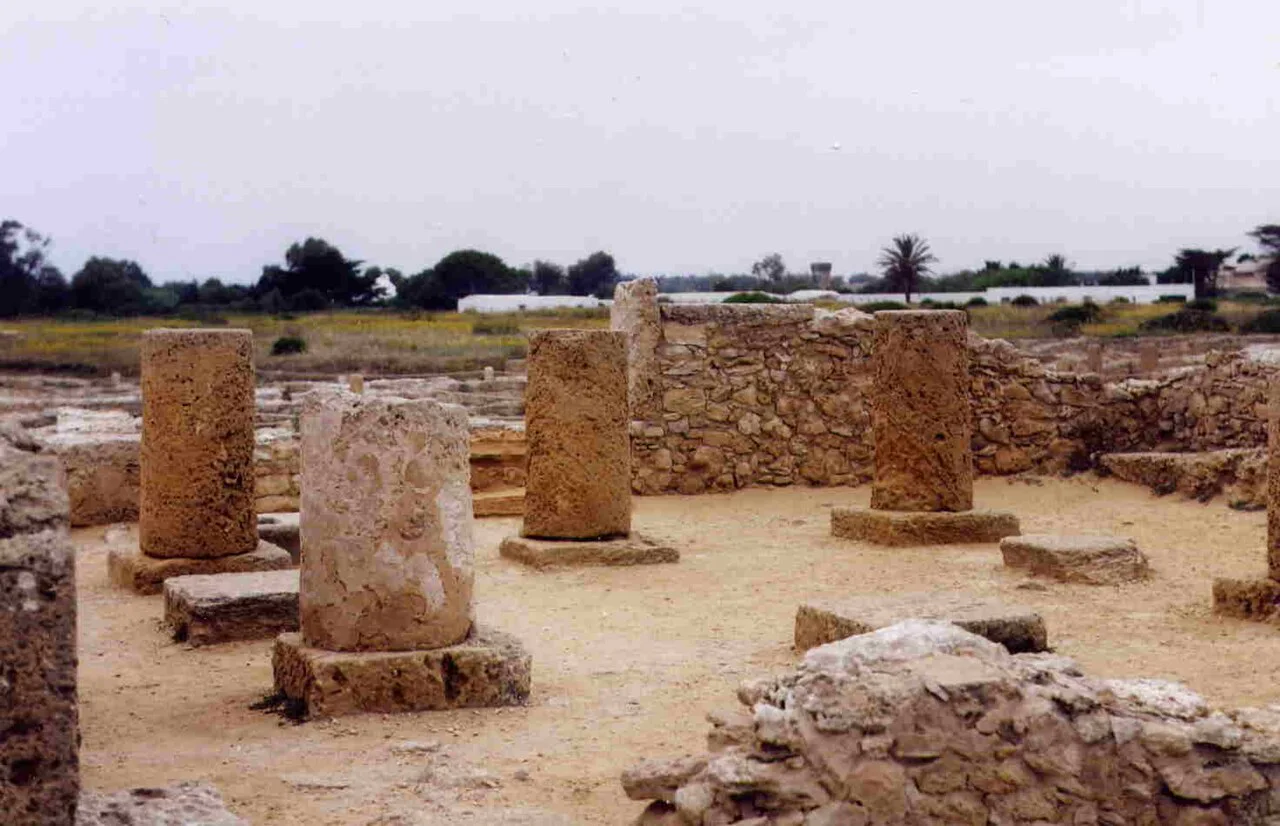
This broad open compound was the town's sanctuary, its main religious complex. Some of its columns are still standing, and a small atrium keeps parts of its mosaic floor. One area served ritual banquets, and a sacrificial altar received the offerings. The open question is which gods were worshipped here, because nothing recovered names them. Archaeologists speculate from the finds that it may have been Melqart, Sid, or Tanit. Among those finds are terracotta heads of two males wearing conical hats. They resemble images of Sid and Melqart known from the Temple of Antas in Sardinia. The identification rests on objects like these, and the question stays open.
Listen in the appPhoto: Rais67 · Public domain
10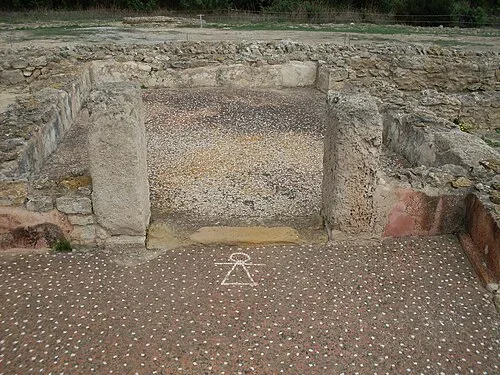 The Central Sanctuary of Unknown Deities
Sign of Tanit in the sanctuary pavement
A slender emblem is worked into the mosaic pavement between two pillar bases, a triangle with a circle above it and outstretched arms. This is the sign of Tanit, the emblem of the great Carthaginian goddess. Her cult spread across the Punic world, and here her mark is set into the floor itself. The emblem in the pavement shows that her worship reached this small town by the sea.
Listen in the appPhoto: Rais67 · Public domain
- 11
House with peristyle courtyard
A wealthy house with Greek-style columns around its courtyard, and imported pottery that reached this coast by sea.
- 12
Coastal edge and the purple dye trade
The sea that made the town rich with purple dye, salt and garum, and now threatens its remains.
- 13
The Punic necropolis
Rock-cut tombs, red ochre burials, and a town whose real name is still lost, and whose ruins came to light by chance in the early 1950s.
Kerkouane
Frequently asked questions
How much does the guide cost?
Free app download. Listed guide price: $1.99. Guide price shown in the app. Audio guide only. Venue admission is separate.
Can I listen without internet?
Yes. Download the guide’s audio, images, and maps in the app before your visit. Your downloaded content is then available offline.
Can I listen in my language?
This audio guide is available in 15 languages, including English.
Do I need to follow a schedule?
No. This is a self-guided experience. Choose your stops, pause whenever you like, and return to a story at your own pace.
At your own pace
Explore Kerkouane.
Download Stanza, then search for “Kerkouane”.
Free app download · Guide price shown in the app
Keep exploring
Audio guides — Tunisia
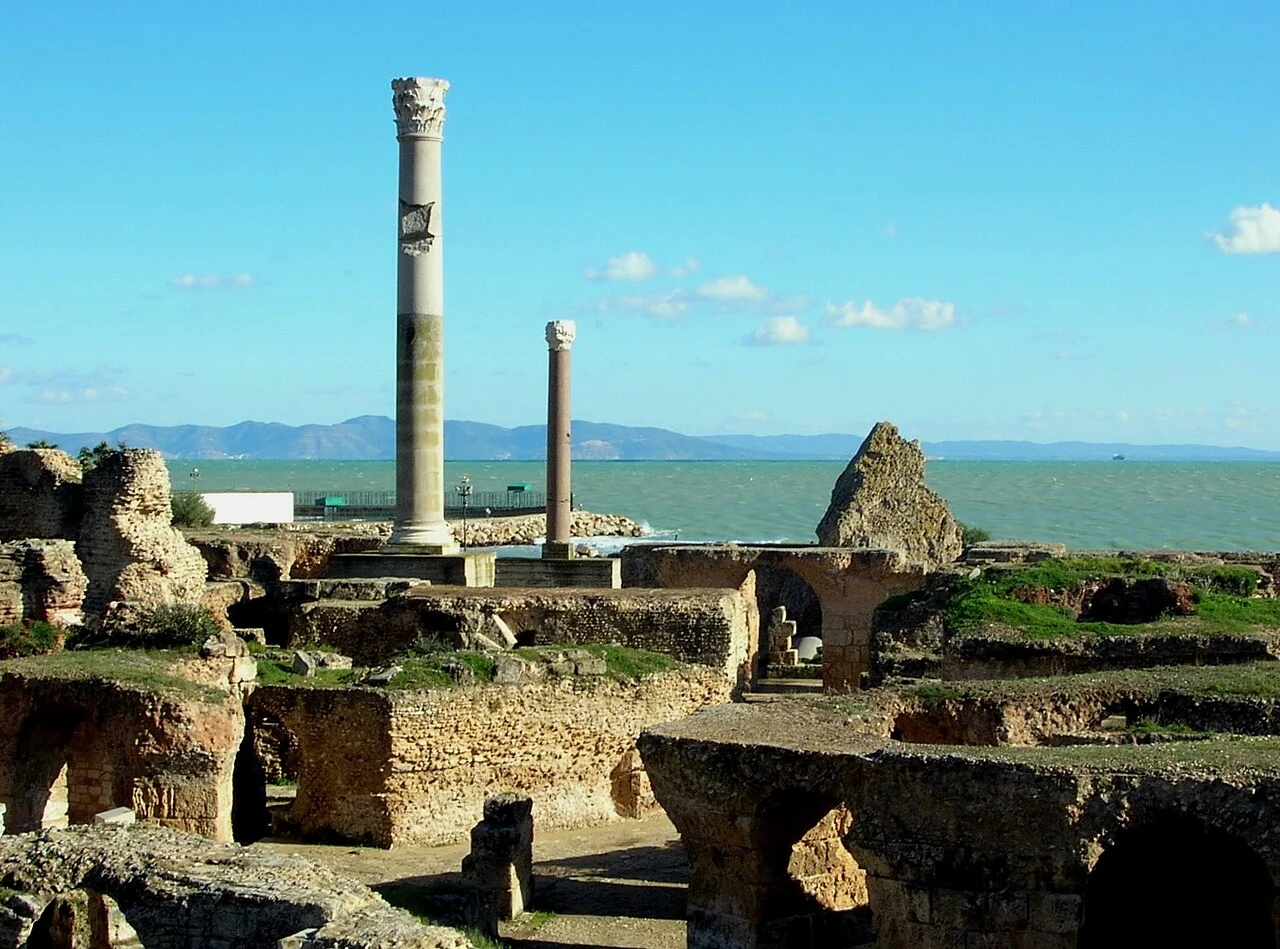
Tunis · 69 km
Thermes d'Antonin
Content & sources
Bernard Gagnon · CC BY-SA 3.0
Tunis · 84 km
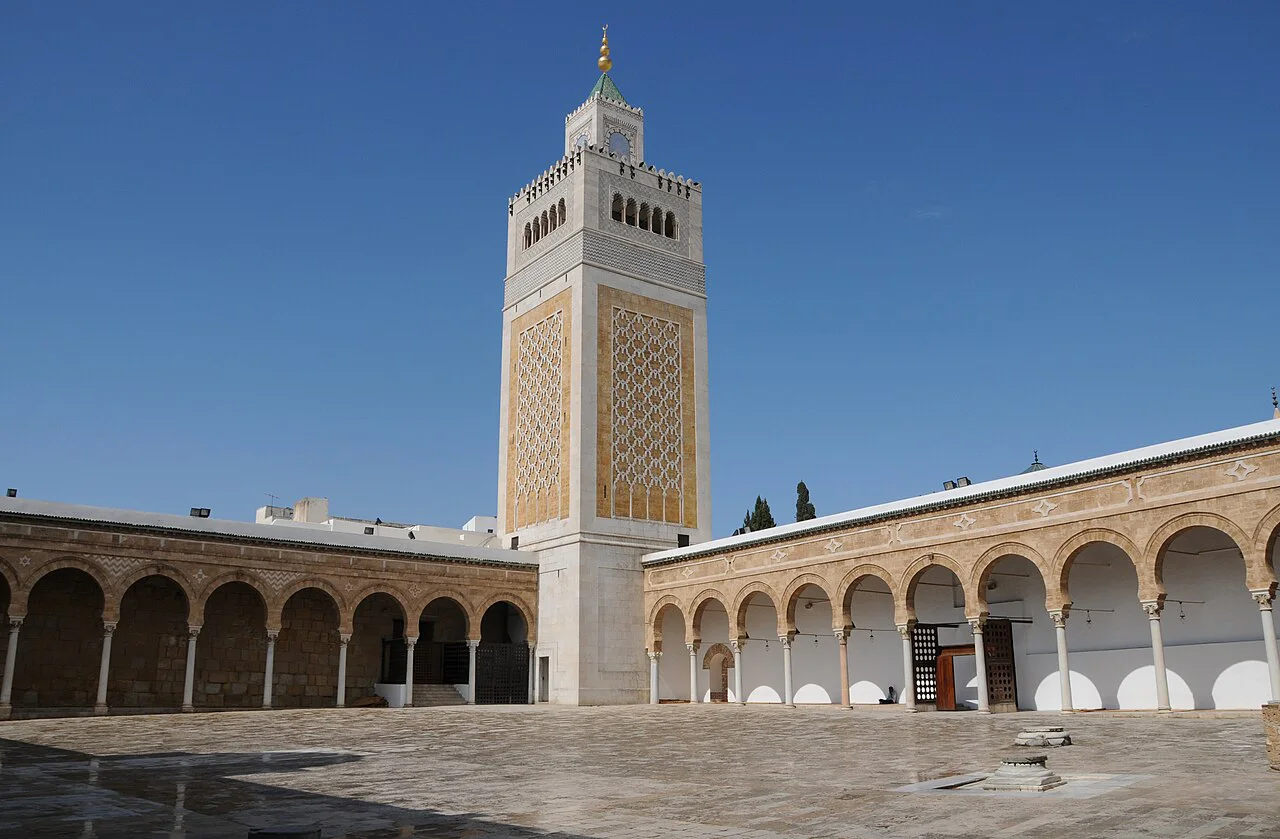
Al-Zaytuna Mosque
Content & sources
Photo: Citizen59 · CC BY-SA 3.0
Kairouan
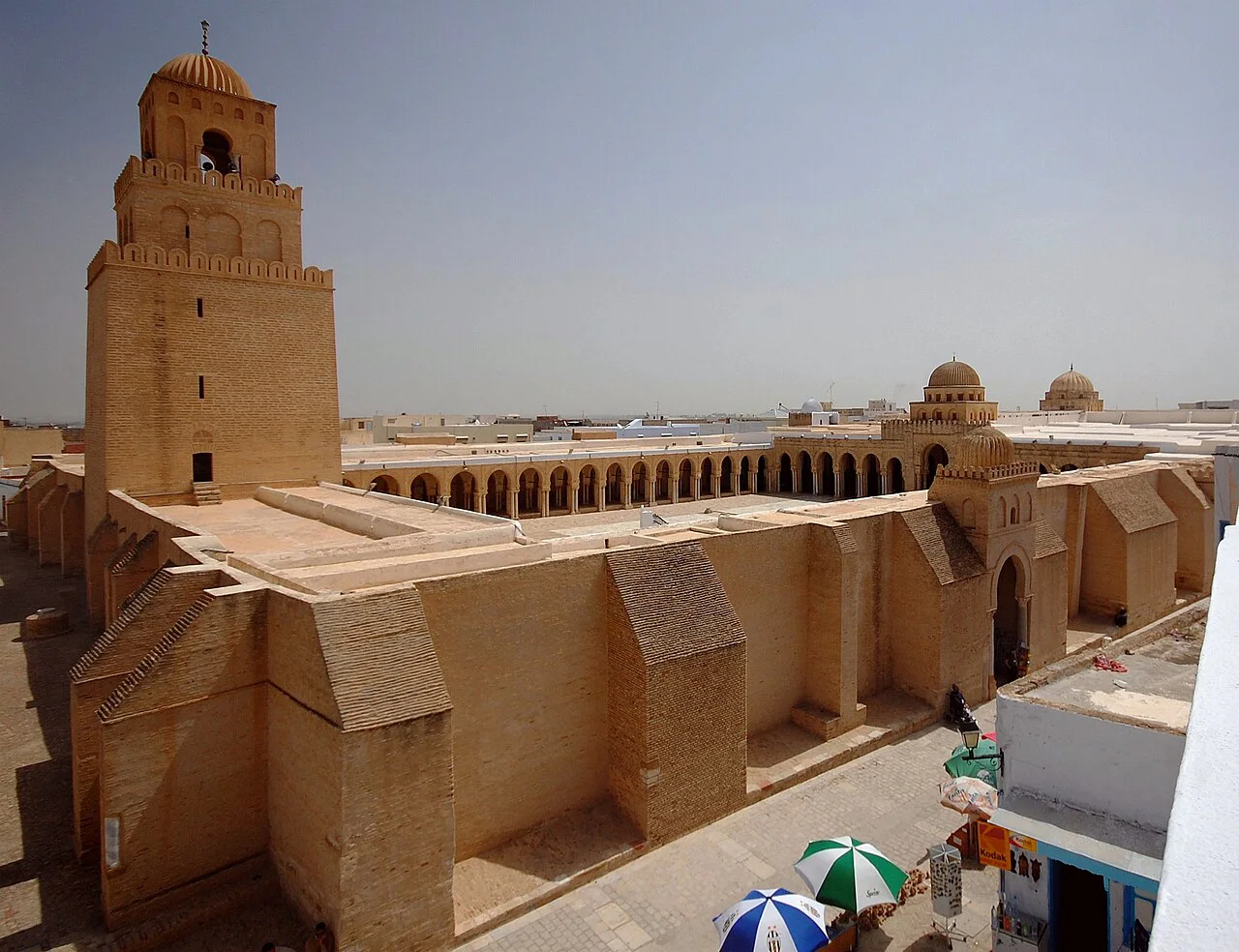
Great Mosque of Kairouan
Content & sources
weetoon66 · CC BY-SA 2.0
El Jem
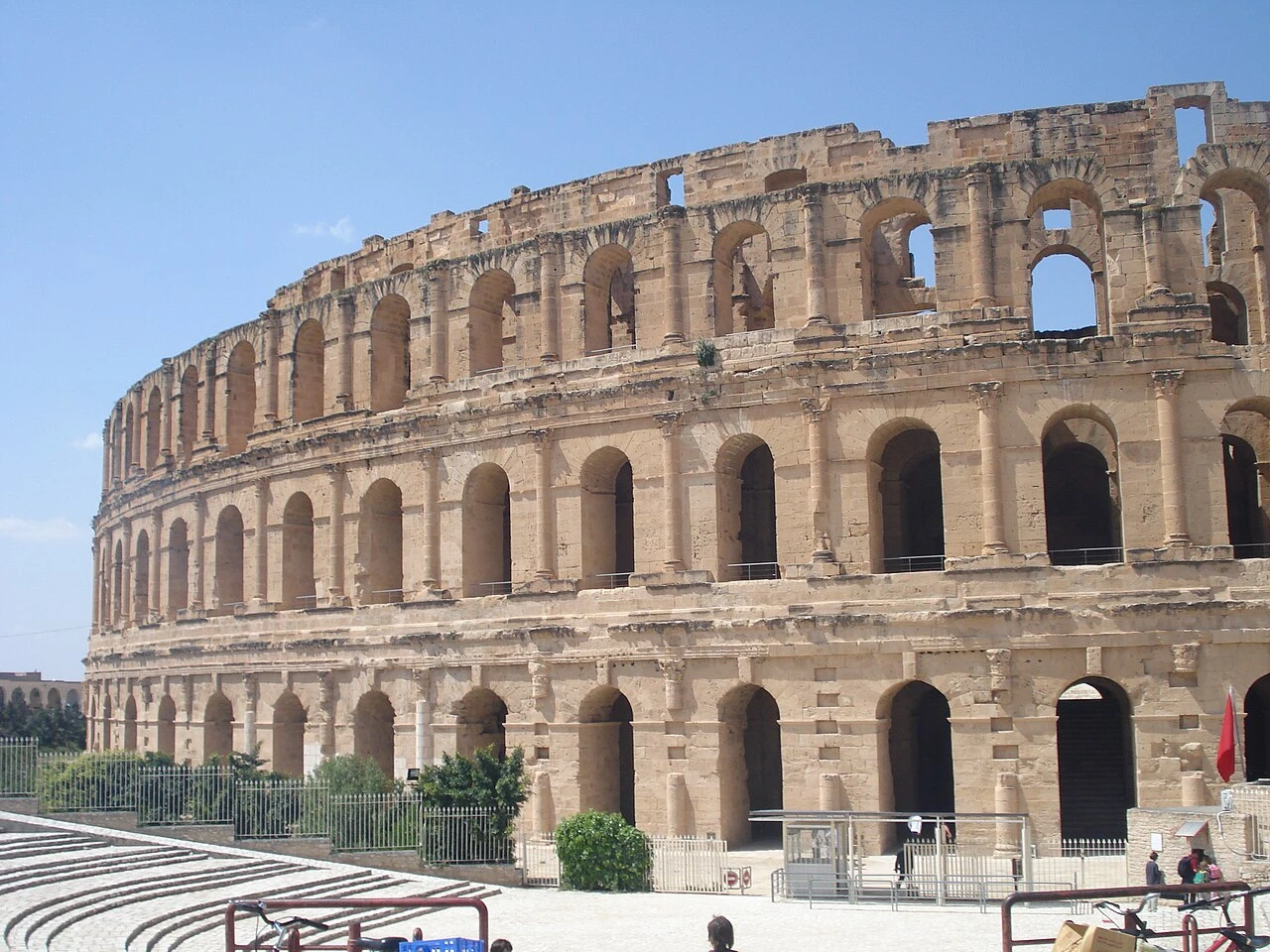
Amphitheatre of El Jem
Content & sources
Photo: Cimoi · CC BY-SA 3.0