Stanza · Audio guide
Great Mosque of Kairouan Audio Guide
A place to remember. A story to take with you.
The Great Mosque of Kairouan is a mosque located in the town of Kairouan, Tunisia. It is one of the largest Islamic monuments in North Africa.
Download Stanza, then search for “Great Mosque of Kairouan”.
About the tour
One guide. Your kind of visit.
The Great Mosque of Kairouan is a mosque located in the town of Kairouan, Tunisia. It is one of the largest Islamic monuments in North Africa.
Ready when you are.
- 01Get the free Stanza app.
iOS & Android
- 02Find your guide.
“Great Mosque of Kairouan”
- 03Download before you go.
Works offline
Audio guide / 12 narrated stops
Inside the guide
Get to know a few of the stories before you go. Open a stop to read more.
01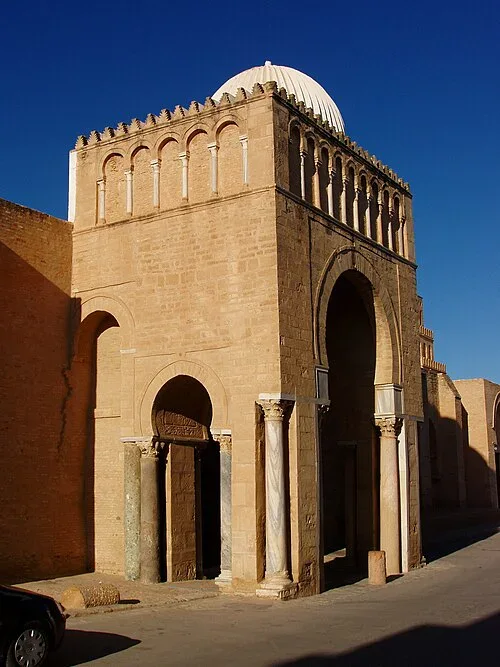 Fortress Walls and Bab Lalla Rihana Gateway
Bab Lalla Rihana, the Fortress Gate
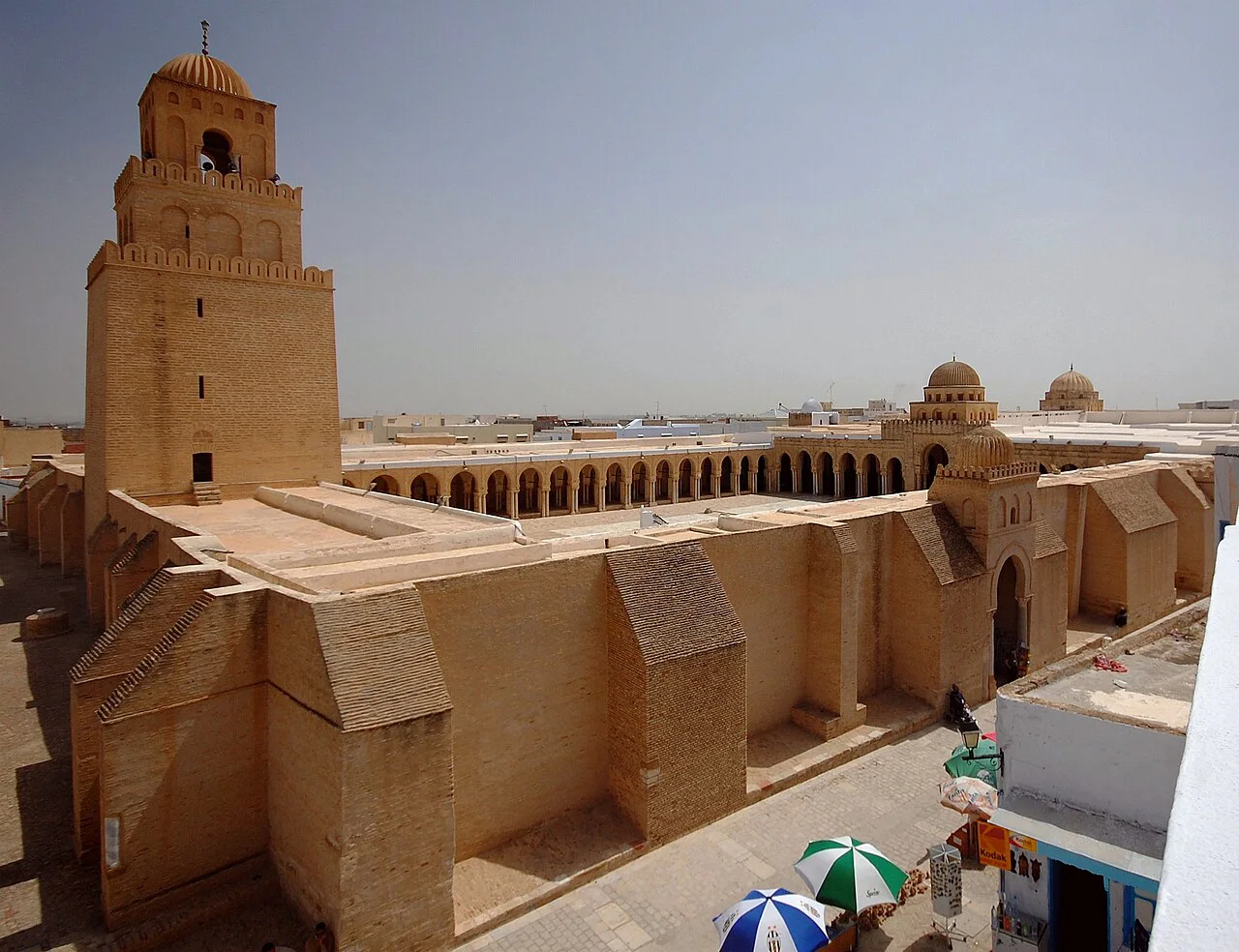
Welcome to the Great Mosque of Kairouan, and to the story written on its walls. From the street the building reads as a fortress: ocher walls nearly two metres thick, corner towers braced by solid projecting buttresses. Those buttresses are not decoration. The ground here is soft, and they hold the whole mosque steady. Within these walls, in the year 670, the Arab general Uqba ibn Nafi founded both a city and a mosque. Kairouan grew around that first sanctuary, and this building became the congregational heart of the whole region. The gate before you, Bab Lalla Rihana, came much later, in 1293, under the Hafsid sovereign Abu Hafs Umar ibn Yahya. A great horseshoe arch rests on ancient marble columns, crowned by a sawtooth fringe of merlons and a dome. Thirteenth-century work, yet it blends so well with the older fabric that it might belong to the ninth-century building itself. From this gate the tour moves inward: courtyard, minaret, and at last the prayer hall with its ninth-century treasures.
damian entwistle · CC BY-SA 2.0
02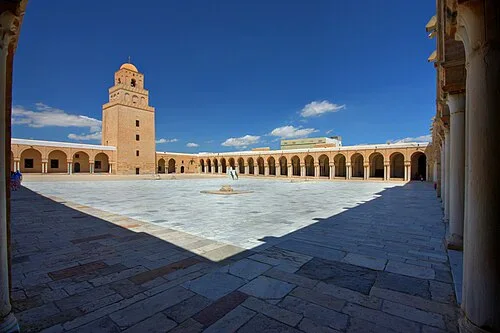 The Great Marble Courtyard and Rainwater Basin
The Great Marble Courtyard
Nine thousand square metres: that is the scale of the Mosque of Uqba, as it is also called. The whole complex forms a slightly irregular quadrilateral, its enclosure running some four hundred and five metres around. The prayer hall lies to the south, the courtyard to the north, and the minaret stands at the middle of the north side. The courtyard, the sahn, stretches roughly ninety metres including its galleries. Its width, with the surrounding arcades, reaches about seventy-two metres. Most of the floor is laid with white marble slabs, with flagstones toward the northern end. A side gateway in the fortress wall opens straight into this expanse, with nothing in between. When the mosque was built in 670 it stood at the centre of the city. The town later spread southwards, and the mosque now occupies its eastern quarter, close against the city walls.
Andrew Watson · CC BY-SA 2.0
03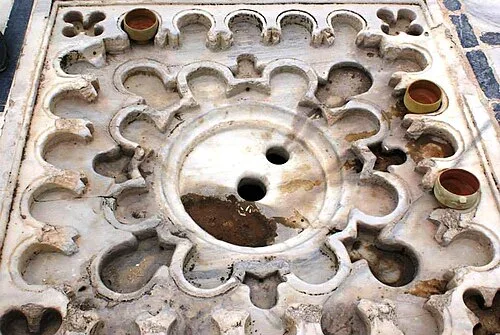 The Great Marble Courtyard and Rainwater Basin
The Rainwater Basin and Underground Cistern
Rain rarely falls gently here, and the builders planned for the days it does. The marble courtyard slopes almost imperceptibly, shedding storm water toward a central basin. The rim of that basin is carved with a ring of horseshoe-arch openings in white marble. Water passes through them, freed of its impurities, and flows down into an underground cistern. Pillars some seven metres high hold up the roof of that reservoir. The whole device, called an impluvium, is probably the work of the Muradid bey Mohamed Bey al-Mouradi, who reigned from 1686 to 1696. Nearby stand wells placed side by side, their rims cut from the lower parts of ancient columns, with grooves to guide the bucket ropes. Those reused columns are a first hint of a habit that returns, on a far grander scale, inside the prayer hall.
Listen in the appPhoto: TAKOUVI · CC BY-SA 3.0
04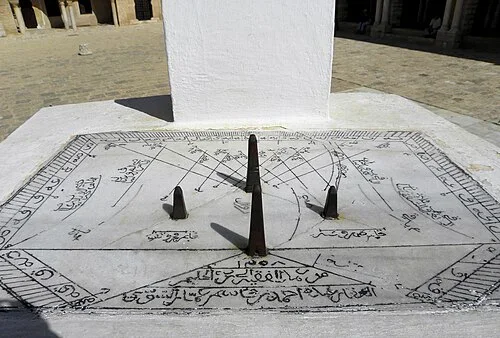 The Courtyard Horizontal Sundial
The Horizontal Sundial
A sundial lies set into the courtyard paving, reached by a little staircase. Its naskhi inscription is dated 1258 in the Muslim calendar. That corresponds to the year 1843, and its task was to fix the times of prayer. Timekeeping was never a side concern here. Between the ninth and eleventh centuries the mosque was also a university, the leading intellectual centre of North Africa. Scholars taught Maliki law alongside mathematics, astronomy, medicine and botany. Jurists such as Sahnun ibn Sa'id and Asad ibn al-Furat carried Maliki thought across the Maghreb. In medicine, Ibn al-Jazzar's reputation travelled far beyond Kairouan. One comparison keeps recurring: the mosque's role then resembled that of the University of Paris in the Middle Ages. When the city declined from the mid-eleventh century, the centre of learning shifted to the Zaytuna mosque in Tunis.
Listen in the appKeith Roper · CC BY 2.0
05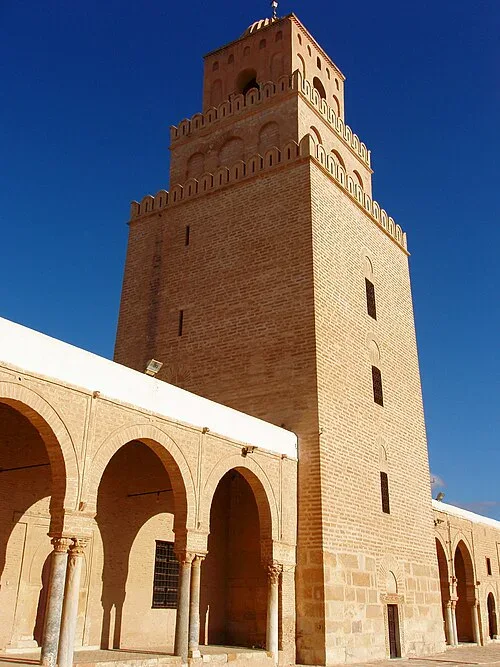 The Great Minaret: Prototype of the Maghreb
The Oldest Minaret in the Islamic World
Rising from the north side of the courtyard stands the oldest minaret in the Muslim world. Its great square shaft, largely in present form since about 836, climbs three tapering tiers to thirty-one and a half metres. The base alone measures nearly eleven metres on each side. Rounded merlons crown the upper stories, pierced with arrowslits, and a small ribbed dome tops the whole, most probably a later addition. The tower served two purposes at once: a watchtower, and the place from which the faithful were called to prayer. Its courtyard face is opened with windows for light and ventilation, while the other three faces keep their narrow arrowslit openings. From here the model spread. Minarets across North Africa and Andalusia, for centuries, followed its square form.
Listen in the appdamian entwistle · CC BY-SA 2.0
06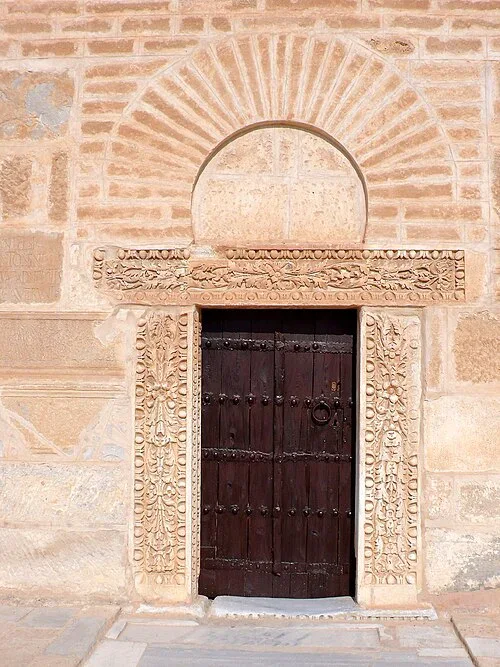 The Great Minaret: Prototype of the Maghreb
The Minaret Door and Its Reused Stones
The door at the tower's base opens onto a staircase of one hundred and twenty-nine steps, running under a barrel vault up to the terraces and the first tier. The minaret stands entirely inside the enclosure, so it has no entrance from outside at all. The masonry around the doorway tells its own story. The lintel and jambs are assembled from carved fragments of antique origin, and stone blocks from the Roman period, bearing Latin inscriptions, were reused at the base of the tower. That recycling probably goes back to about 725, to work under the Umayyad governor Bishr ibn Safwan. The greater part of the tower itself, in regular courses of carefully cut stone, belongs to the Aghlabid princes of the ninth century. Older monuments, it turns out, are built into the very bones of this mosque.
Listen in the appMichel Guilly · CC BY 2.0
07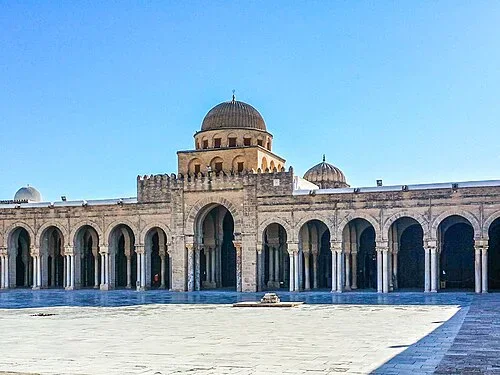 The South Portico and Fluted Entrance Dome
South Portico and the Entrance Dome
A ribbed dome rises at the middle of the south portico, over the entrance to the central nave. Beneath it a great pointed horseshoe arch, nearly seven metres high, rests on columns of white-veined marble with Corinthian capitals. A medieval chronicle records the work in a single line: he built in the mosque of Kairouan the cupola that rises over the entrance to the central nave, together with the two colonnades which flank it, and then made the mihrab. The builder was the emir Abu Ibrahim, who enlarged the oratory around 862 and 863. Under his dynasty, the Aghlabids, extensive ninth-century works gave the mosque essentially the form it keeps today. The chronicle ends with the mihrab, the prayer niche at the far end of the nave.
Listen in the appMonaam Ben Fredj · CC BY-SA 4.0
08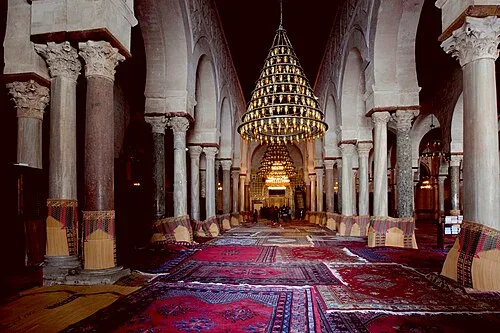 The Hypostyle Prayer Hall and Forest of Antique Columns
The Hypostyle Prayer Hall
Through the carved wooden doors, the prayer hall opens into a cool shadow of arches. The hall divides into seventeen aisles. Each runs eight bays deep, carried on columns under horseshoe arches. The central nave is wider than the rest, and so is the bay along the qibla wall, the wall facing Mecca. Where the two cross, in front of the mihrab, they form a T-shaped plan. The same device appears in the great mosques of Samarra in Iraq, and from here it was adopted across North Africa and Andalusia. The horseshoe arch itself found its first Islamic use in this building. The hall's interior is reserved for worship, but its doors stand open for viewing, and the courtyard with its arcades remains open to visitors.
Listen in the apppaul_in_herts · CC BY-SA 2.0
09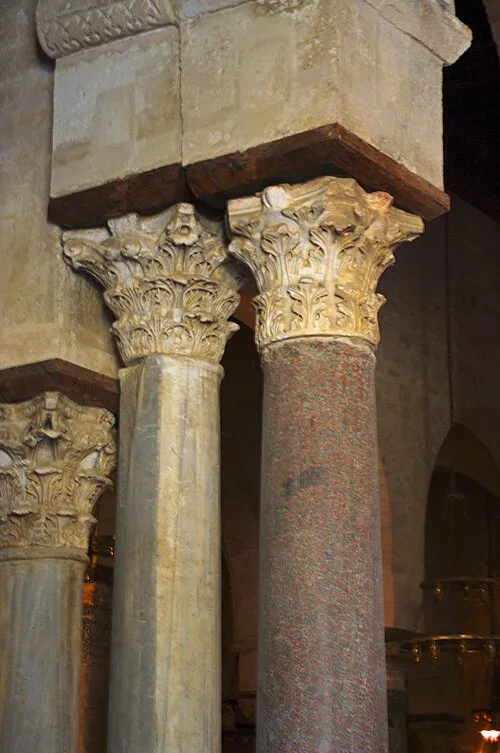 The Hypostyle Prayer Hall and Forest of Antique Columns
A Forest of Reused Columns
Four hundred and fourteen columns hold up the prayer hall, and more than five hundred serve the mosque altogether. Marble, granite and porphyry, they were brought from ancient sites across the country: Sbeitla, Carthage, Hadrumetum and Chemtou. Some capitals were carved for the mosque, but others came from Roman and Byzantine buildings of the second to sixth centuries. The shafts tell their own geography. White marble came from Italy, red porphyry from Egypt, and the pink and greenish stone from the quarries of Chemtou. Since no two shafts match in height, the builders levelled them with variable bases, capitals and crossbeams, many of cedar, tied together by wooden rods. Kairouan keeps a legend about this forest: whoever counts the columns will go blind. One modern scholar, Christian Ewert, has argued that the columns around the mihrab follow a deliberate scheme, symbolically tracing the plan of the Dome of the Rock. That remains his interpretation, not a settled fact.
Listen in the apppaul_in_herts · CC BY-SA 2.0
10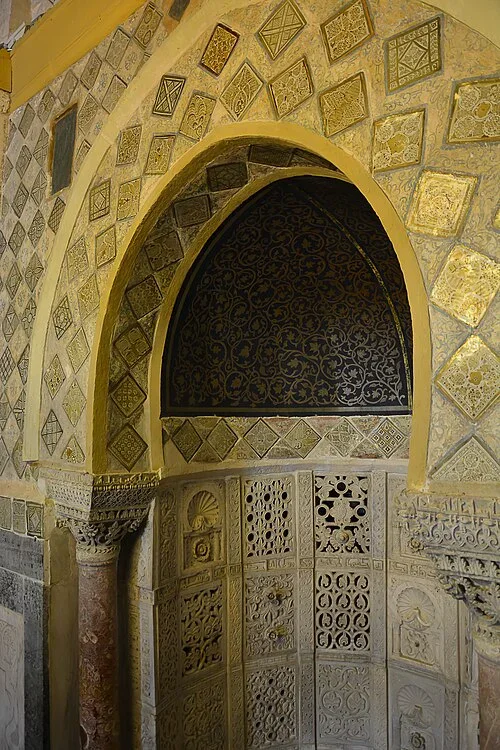 The Mihrab and Baghdad Lusterware Tiles
The Mihrab and the Luster Tiles
The chronicles tell that Uqba ibn Nafi, unsure of the direction of Mecca, was guided in a dream to follow a divine banner, and to build where it came to rest. The qibla wall of this mosque follows that spot, so the story goes. At its middle stands the mihrab, the oven-shaped niche before which the imam leads the prayer. In its present state it dates from 862 to 863, and it is considered the oldest example of a concave mihrab. Around its upper arch run one hundred and thirty-nine lusterware tiles with a metallic sheen. Each measures about twenty-one centimetres square, laid on the diagonal like a chessboard, their colours shifting from light gold to deep brown. Where they were made is still disputed: Baghdad, or Kairouan by a Baghdadi artisan. Below the tiles, carved white marble panels cover the wall with vines, flowers and shells, and a painted wooden half-cupola closes the niche above.
Listen in the appPhoto: IssamBarhoumi · CC BY-SA 4.0
- 11
The 9th-Century Teak Minbar
The teak pulpit of 862, oldest surviving minbar in the Muslim world, still standing in its original place.
- 12
The Zirid Maqsura - and What This Place Means
The 11th-century cedar maqsura, the mosque that became the model for the western Islamic world, and Paul Klee's epiphany.
Great Mosque of Kairouan
Frequently asked questions
How much does the guide cost?
Free app download. Listed guide price: $0.99. Guide price shown in the app. Audio guide only. Venue admission is separate.
Can I listen without internet?
Yes. Download the guide’s audio, images, and maps in the app before your visit. Your downloaded content is then available offline.
Can I listen in my language?
This audio guide is available in 15 languages, including English.
Do I need to follow a schedule?
No. This is a self-guided experience. Choose your stops, pause whenever you like, and return to a story at your own pace.
At your own pace
Explore Great Mosque of Kairouan.
Download Stanza, then search for “Great Mosque of Kairouan”.
Free app download · Guide price shown in the app
Keep exploring
Audio guides — Tunisia
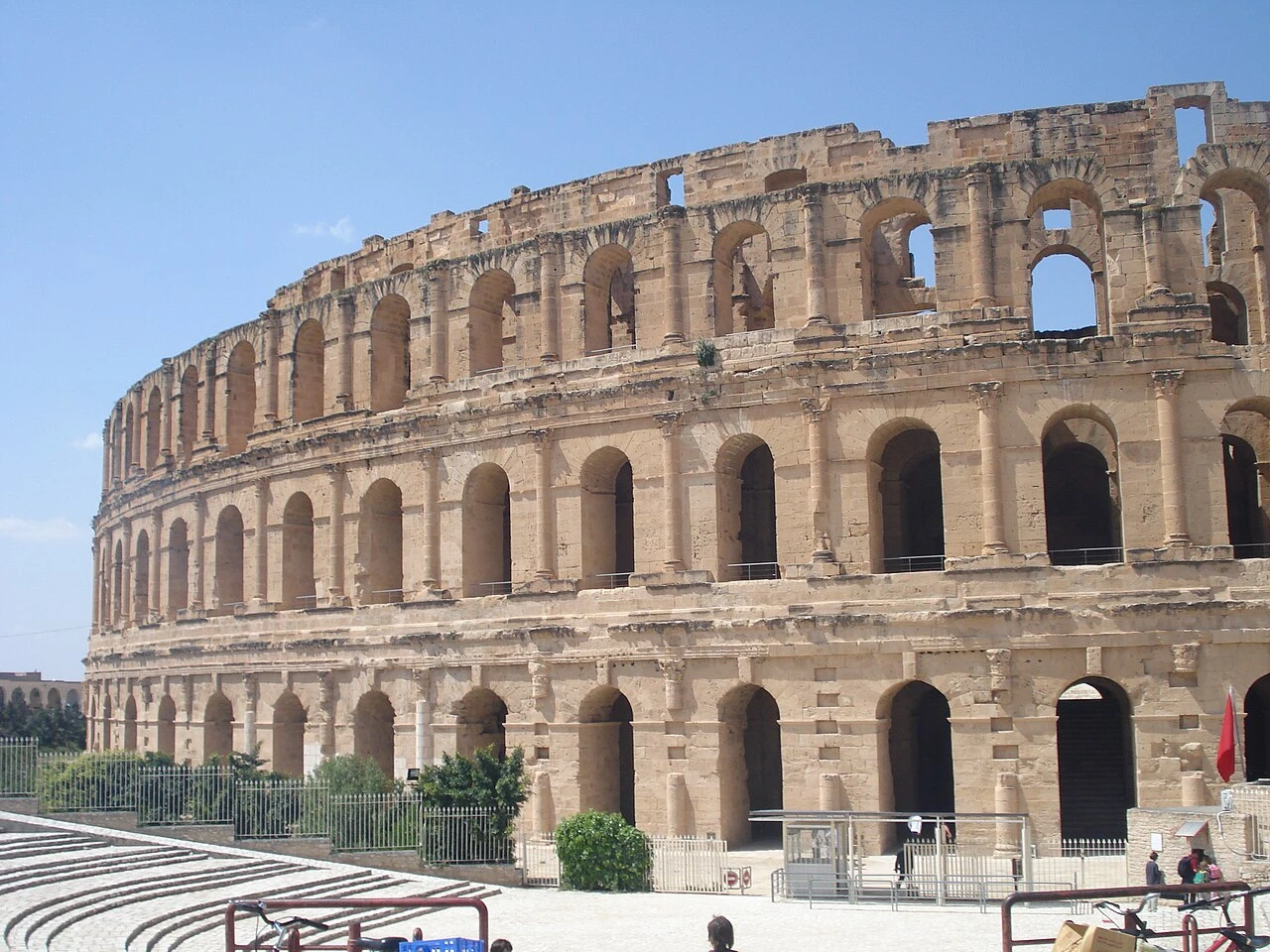
El Jem · 69 km
Amphitheatre of El Jem
Content & sources
Photo: Cimoi · CC BY-SA 3.0
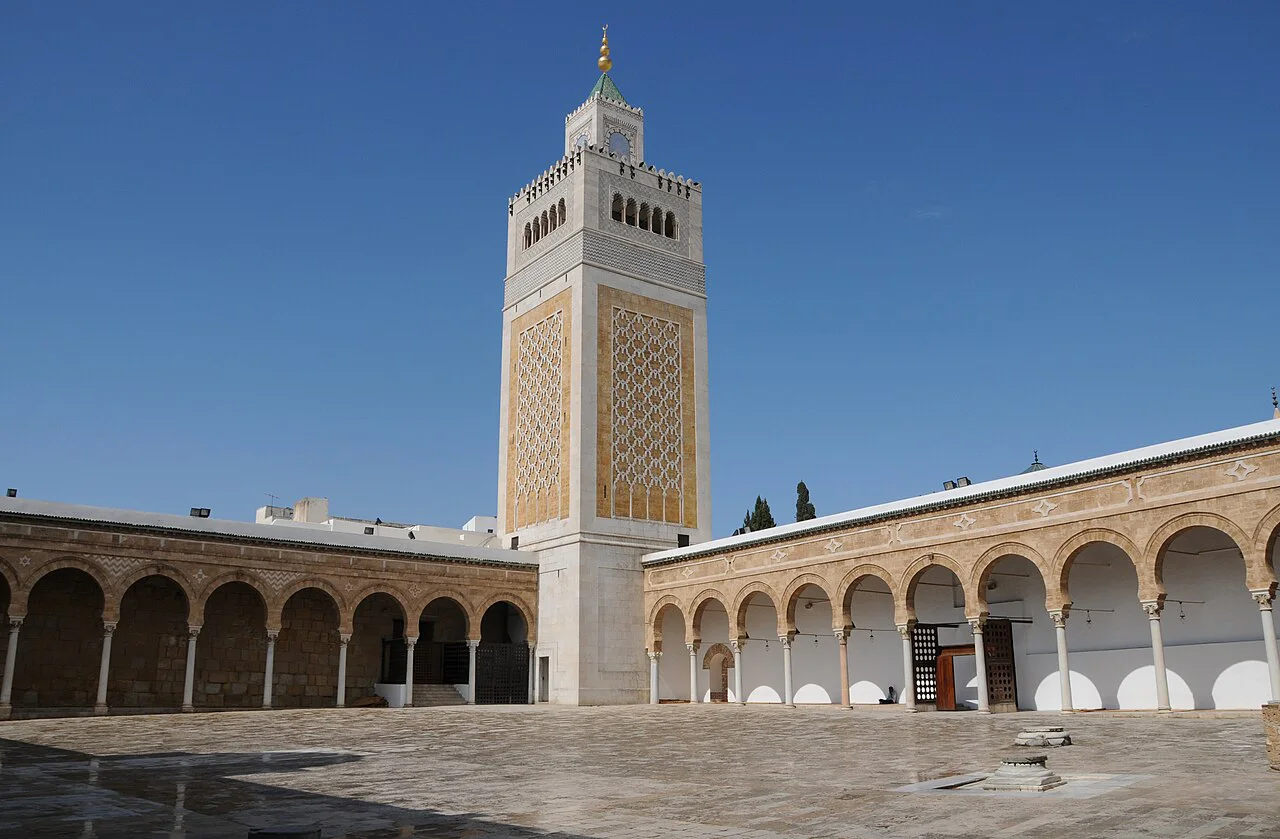
Tunis · 124 km
Al-Zaytuna Mosque
Content & sources
Photo: Citizen59 · CC BY-SA 3.0
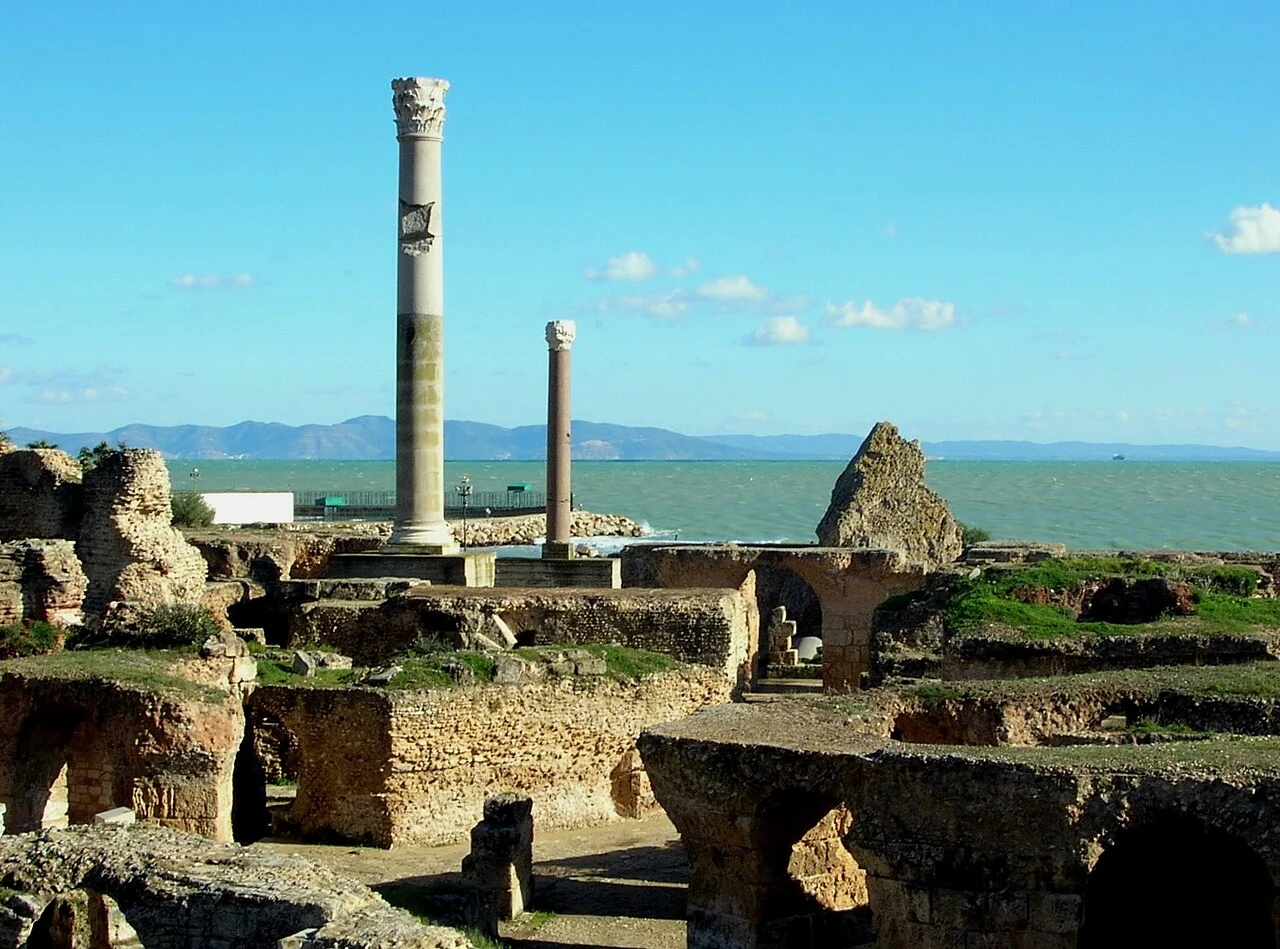
Tunis · 132 km
Thermes d'Antonin
Content & sources
Bernard Gagnon · CC BY-SA 3.0
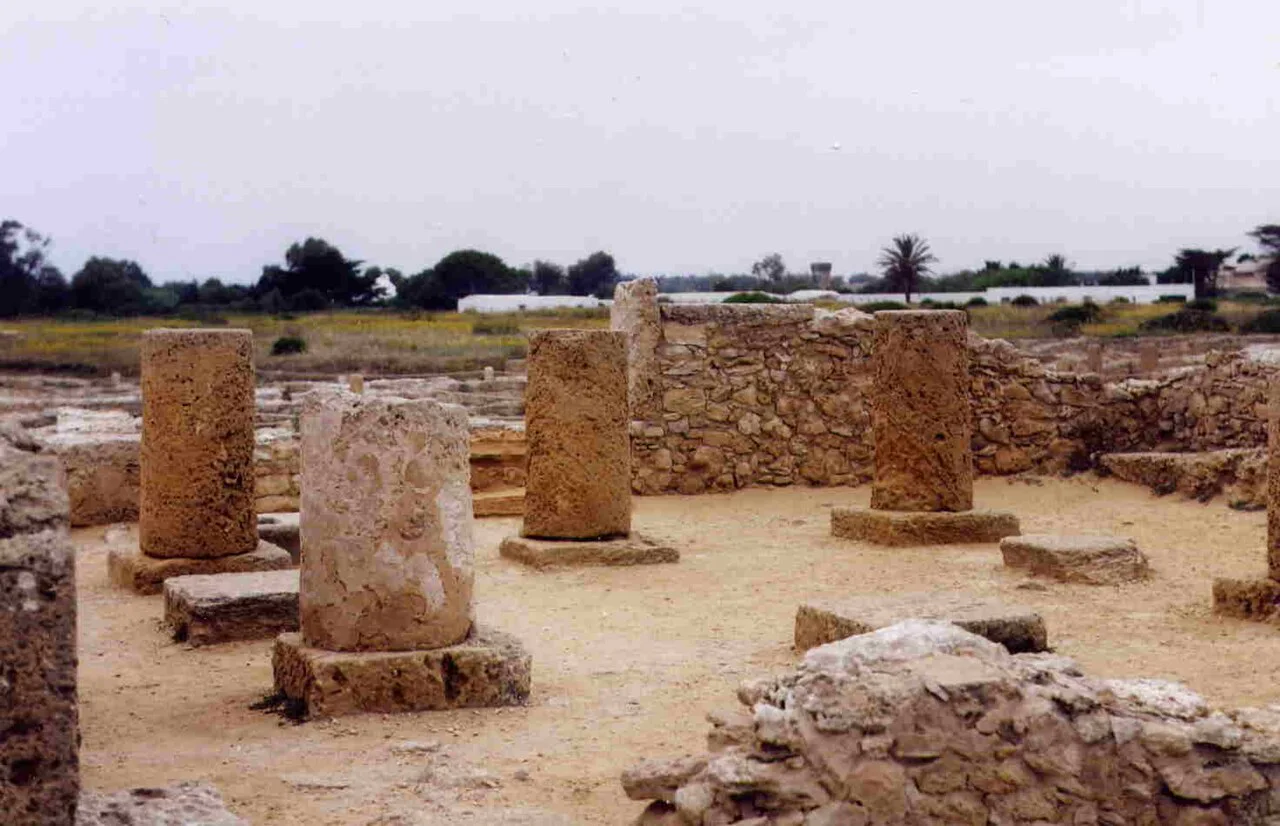
Dar Allouch
Kerkouane
Content & sources
No machine-readable author provided. Udimu assumed (based on copyright claims). · CC BY-SA 3.0