Stanza · Audio guide
Amphitheatre of El JemAudio guide
A place to remember. A story to take with you.
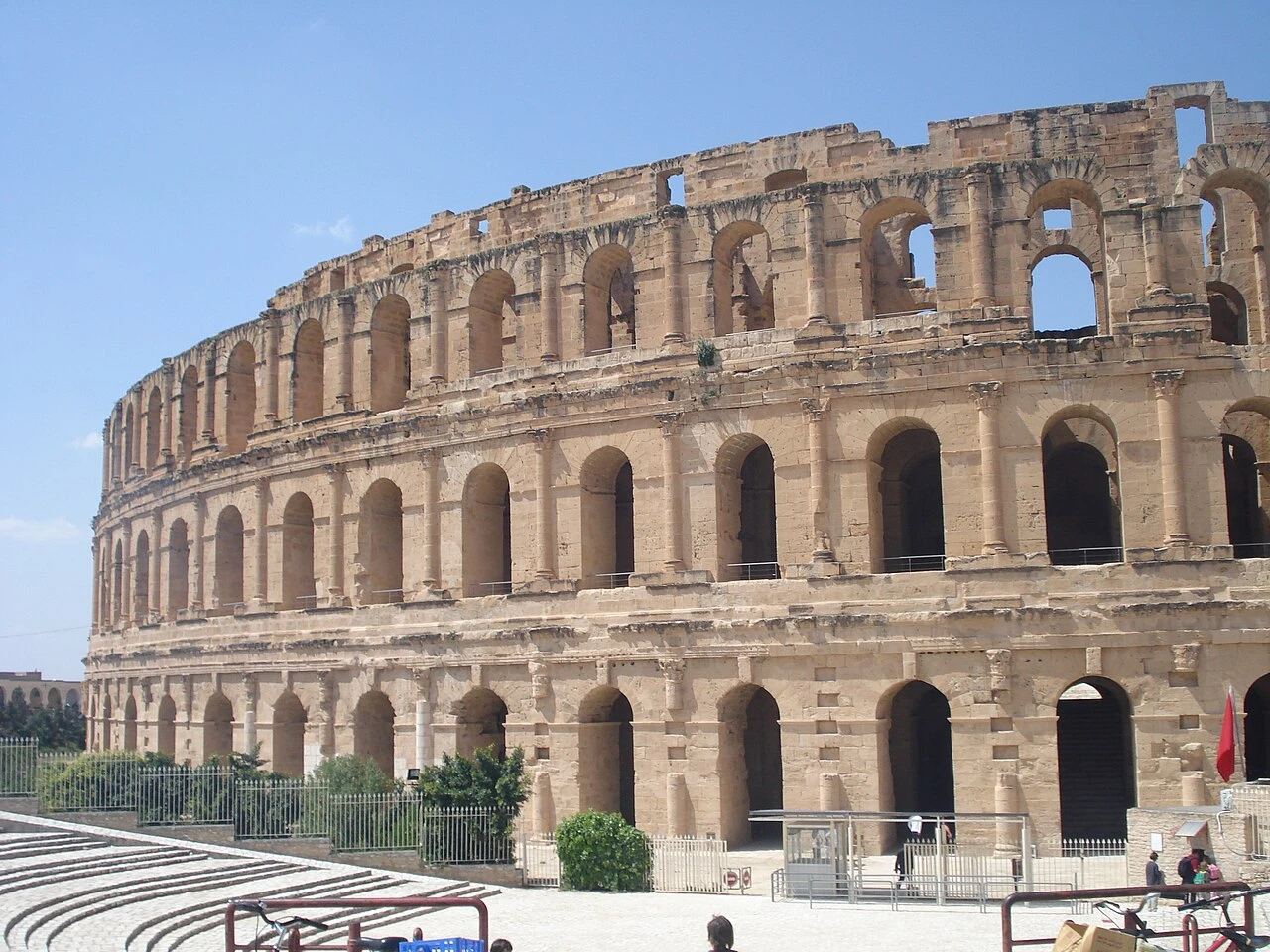
This exceptionally well-preserved Roman amphitheatre is one of the largest in the world, capable of seating up to 35,000 spectators. It is a UNESCO World Heritage site renowned for its impressive…
Download Stanza, then search for “Amphitheatre of El Jem”.
About the tour
One guide. Your kind of visit.
This exceptionally well-preserved Roman amphitheatre is one of the largest in the world, capable of seating up to 35,000 spectators. It is a UNESCO World Heritage site renowned for its impressive architectural integrity and historical significance.
Ready when you are.
- 01Get the free Stanza app.
iOS & Android
- 02Find your guide.
“Amphitheatre of El Jem”
- 03Download before you go.
Works offline
Audio guide / 14 narrated stops
Inside the guide
Get to know a few of the stories before you go. Open a stop to read more.
01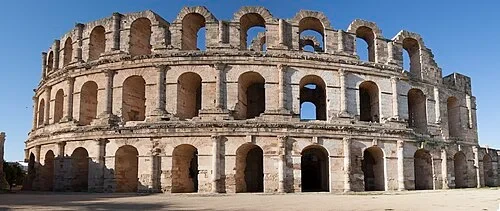 The Colossal Facade and Ancient ThysdrusThe Great Sandstone Facade
Welcome to one of the most colossal monuments of the Roman world, rising dramatically out of the Tunisian plains. Standing at a height of thirty-six meters, this giant structure features a major axis of 148 meters and a minor axis of 122 meters, which once accommodated around thirty-five thousand spectators. As you look at the facade, you can see three tiers of sweeping Roman arches made of local golden sandstone, contrasting against the blue sky. Constructed in the ancient Roman city of Thysdrus, which is today's El Jem, the building served as a major cultural landmark. During the second and third centuries AD, Thysdrus was not just a quiet provincial outpost; it was a flourishing hub of the Roman empire's olive oil trade. The immense wealth generated from cultivating and exporting olive oil funded ambitious public projects, with this massive amphitheatre serving as the ultimate display of municipal pride and economic power.
Photo: Jerzystrzelecki · CC BY 3.0
02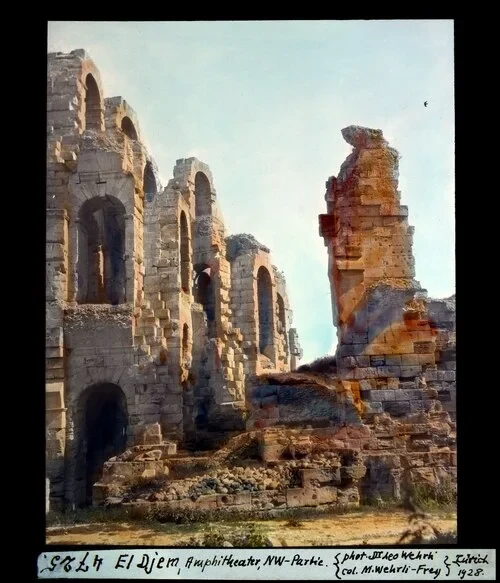 The Colossal Facade and Ancient ThysdrusThe Unfinished Monument
Looking at this historic color photograph from 1928, you can see a heavily weathered, crumbling section of the northwest facade. The image captures the architectural vulnerability of a structure whose construction history was cut short. Work on the amphitheatre started around 238 AD, likely commissioned by the wealthy local landowner who became Emperor Gordian III, as a way to elevate his home city. However, political instability soon halted the grand design. Following Gordian's death in 244 AD during a campaign in Mesopotamia, subsequent Roman emperors showed little interest in funding a massive entertainment venue in North Africa. The construction abruptly stopped, leaving the building permanently unfinished. Jagged edges and exposed, roughly shaped stones are visible in the image. These elements highlight the raw, unpolished state of the masonry, showing that several decorative details and upper seating sections were never fully smoothed or carved before the workers walked away.
Leo Wehrli · CC BY-SA 4.0
03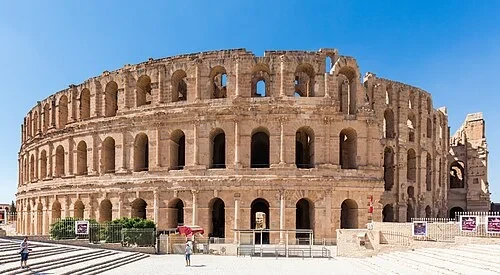 The Grand Entrance ArchesThe Plaza of Thysdrus
Standing on the wide cobblestone plaza, the sheer verticality of the ancient monument dwarfs the visitors walking along its base. Most Roman theatres and even some provincial amphitheatres relied on natural hillsides to support their heavy stone seating. However, the engineers at Thysdrus chose to build this structure entirely on flat ground, a triumph of free-standing Roman architecture. To support such an immense weight without a hillside foundation, builders designed a complex network of vaults and thick support piers. Crews quarried massive blocks of local sandstone from sites several kilometers away and hauled them to the city center, where they were carefully assembled without mortar. The precision of this engineering is the main reason why the colossal structure has survived for nearly two thousand years, resisting both seismic activity and the elements.
Listen in the appDiego Delso · CC BY-SA 4.0
04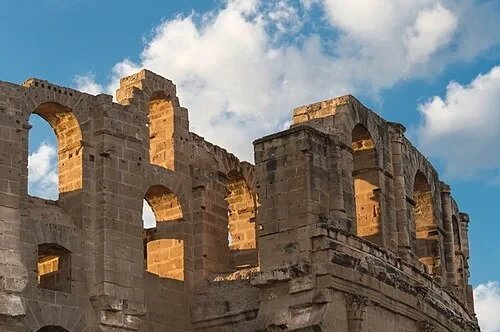 The Grand Entrance ArchesThe Crown of Arches
Examining the upper tiers of the facade reveals the rough, tactile texture and warm, honey-colored tones of the sandstone under the sun. The towering wall is made possible by the structural genius of the Roman arch. By distributing weight downward and outward along the curved stones, the arch allowed ancient engineers to stack three stories of open arcades directly on top of one another. The open design reduced the overall weight of the walls while maintaining structural integrity, preventing the massive sandstone facade from collapsing under its own immense gravity. The exceptional preservation of the multi-story arcades sets El Jem apart from other Roman ruins. Recognizing its exceptional state of completeness and its value to global architectural history, UNESCO designated the amphitheatre as a World Heritage Site in 1979.
Listen in the appPhoto: Ryadh Gharbi · CC BY-SA 4.0
05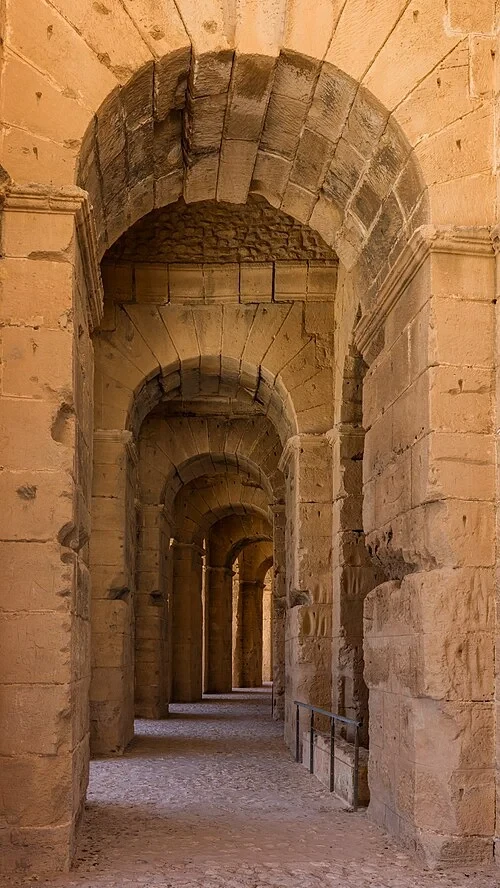 The Internal Corridors and VomitoriaThe Vaulted Galleries
Repeating vaulted arches line the inner corridors, creating a dramatic play of light and shadow across the rough sandstone floor and thick supporting pillars. The sweeping galleries were not just aesthetic features; they were the backbone of a highly sophisticated crowd control system. To manage thirty-five thousand spectators arriving at the same time, Roman architects designed these vaulted walkways as transit channels. Visitors moved through these corridors to find their assigned entry points, known as vomitoria. Wide, strategically placed exits allowed crowds to reach their seats quickly and, more importantly, evacuate the building in just a few minutes in case of an emergency. The ancient blueprint for rapid mass transit was so successful that modern sports stadiums and arenas still use the exact same layout and principles of vaulted corridors and split exit pathways to manage large crowds today.
Listen in the appDiego Delso · CC BY-SA 4.0
06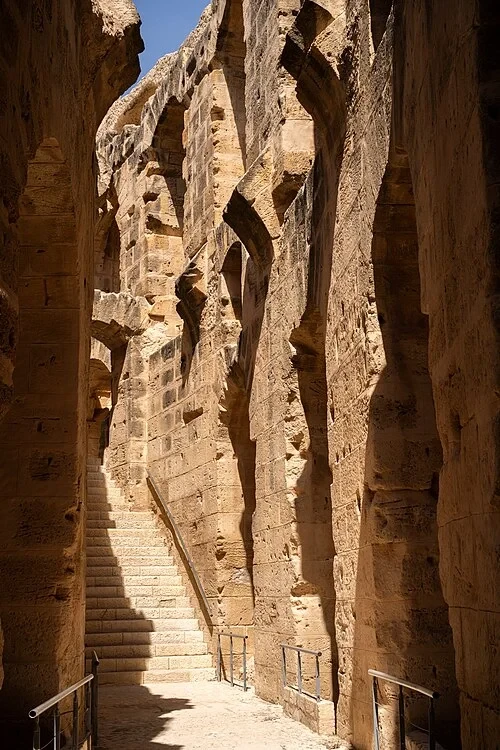 The Internal Corridors and VomitoriaStaircases of Social Order
Rising steeply between high sandstone walls, the narrow stone staircases served a critical societal function. Rather than just providing access to the upper seating, these stairs strictly enforced the rigid social hierarchy of the Roman Empire. Seating within the arena's cavea, or spectator stands, was legally organized by social class. Senators, local magistrates, and wealthy elites entered through the lowest levels to sit closest to the performance floor. Meanwhile, ordinary citizens, women, and enslaved people had to climb these steep, narrow stone steps to reach the cramped upper tiers of the theater. Squeezing through these shadowy, confined stone passageways, spectators would have felt the heat of the Tunisian sun fade, replaced by the cool dampness of the stone, all while the muffled, deafening roar of thirty-five thousand people echoed from the arena bowl above.
Listen in the appPhoto: Skander zarrad · CC BY-SA 4.0
07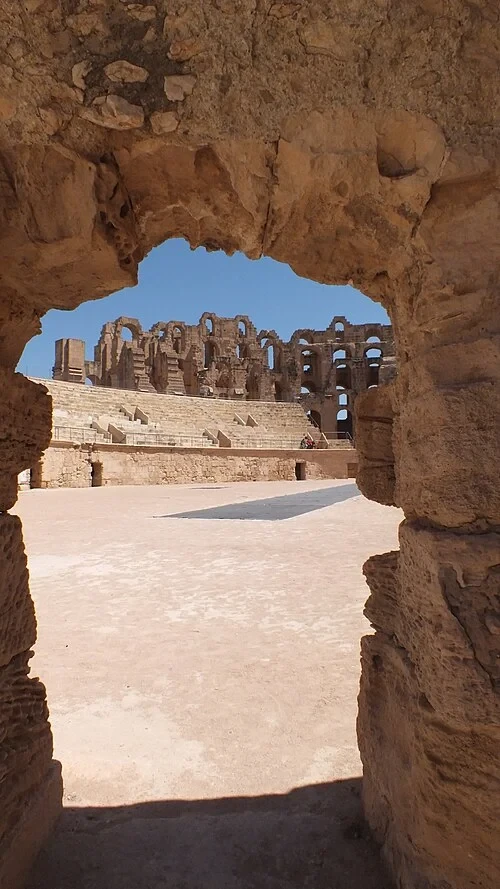 The Arena FloorThe Gladiator's View
Framed by a dark, rugged archway, the view transitions from the cool, shadowy interior galleries to the brilliant sunlight of the arena floor. The visual contrast is striking, pairing the heavy, dark foreground stones with the vast, sun-drenched open space of the central arena beyond. Walking out onto this open ground, you occupy the same space where ancient performers once stood. Crossing this threshold marks a shift in the story of El Jem, moving from the mathematical precision of Roman engineering to the human drama and raw emotion of the spectacles that took place here. For the gladiators, performers, and condemned prisoners, emerging from the dark tunnels into this bright, circular expanse meant facing a wall of sound from thousands of shouting spectators packed into the surrounding tiers. It is here, on the open sand, that the human cost of Roman entertainment becomes real.
Listen in the appPhoto: Samarhmaied · CC BY-SA 4.0
08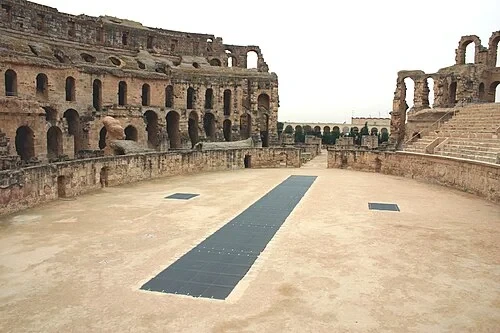 The Arena FloorThe Arena Floor
Running directly down the center of the arena floor is a long, black trench. During antiquity, the central gap was covered over with thick wooden planks and blanketed with a layer of heavy sand, which served to absorb the blood of the spectacles. The arena was designed for a dual purpose: hosting formal gladiatorial combats and staging wild beast hunts, known as venationes. These hunts featured dangerous predators, including North African leopards and lions, imported specifically to thrill the crowds. In more recent times, this exceptionally well-preserved setting has captured the imagination of modern filmmakers and directors. In 1996, the intact stone arena served as the dramatic backdrop for Nike's famous 'Good vs Evil' football commercial. In the advertisement, international football stars, including Eric Cantona, defended the beautiful game against a team of demonic warriors right here on this sun-beaten ground.
Listen in the appTony Hisgett from Birmingham, UK · CC BY 2.0
09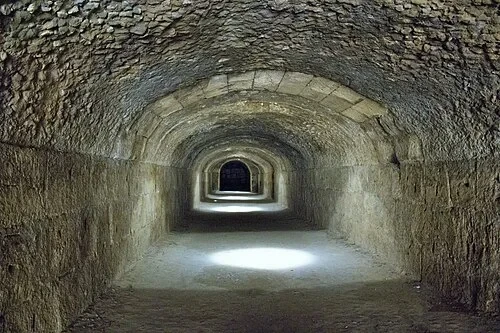 The Subterranean HypogeumThe Dark Hypogeum
Descending beneath the arena floor brings you into the damp, vaulted underground passages of the hypogeum. Lit by dramatic modern spotlights, the rough stone walls of this central subterranean tunnel reveal the hidden, backstage heart of the amphitheatre's operations. The underground corridor was where the complex logistics of the Roman games were carried out, entirely hidden from the eyes of the public. Gladiators waited in these narrow, dark passageways, while wild beasts were kept in small, cramped side cells situated along the masonry walls. Those waiting below would have heard the heavy pacing of hungry predators, the metallic rattling of iron chains, and the muffled, heavy vibrations of thousands of spectators stamping their feet on the stone seating directly overhead, creating an atmosphere of intense dread before the combat began.
Listen in the appPhoto: Fatma Hamdi · CC BY-SA 4.0
10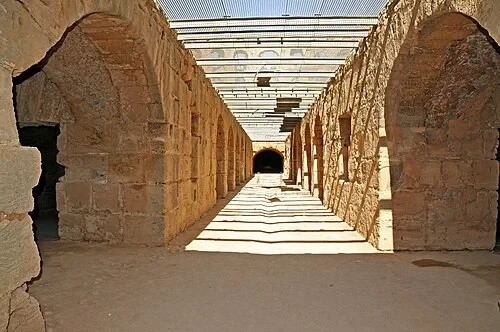 The Subterranean HypogeumThe Lift Shafts
Looking upward through the metal grates toward the sky reveals the structural openings that once housed the amphitheatre's manual elevator shafts. During Roman times, these rectangular gaps were fitted with wooden lift platforms operated by ropes, winches, and heavy counterweights. Enslaved workers stationed in the dark hypogeum turned these wooden winches by hand, hoisting heavy cages containing starved predators or armed gladiators directly up to the arena level. The mechanical system allowed for highly choreographed spectacles. Rather than entering through standard doorways, wild animals and fighters would suddenly appear on the arena floor through trapdoors in the wooden floor. The sudden, unexpected emergence of lions or leopards from beneath the ground was designed to startle both the gladiators and the spectators, keeping the audience entertained with theatrical, fast-paced action.
Listen in the appDennis G. Jarvis · CC BY-SA 2.0
Amphitheatre of El Jem
Frequently asked questions
How much does the guide cost?
Free app download. Listed guide price: $3.99. Guide price shown in the app. Audio guide only. Venue admission is separate.
Can I listen without internet?
Yes. Download the guide’s audio, images, and maps in the app before your visit. Your downloaded content is then available offline.
Can I listen in my language?
Stanza supports 15 languages. Check the app for the languages available for this guide.
Do I need to follow a schedule?
No. This is a self-guided experience. Choose your stops, pause whenever you like, and return to a story at your own pace.
At your own pace
Explore Amphitheatre of El Jem.
Download Stanza, then search for “Amphitheatre of El Jem”.
Free app download · Guide price shown in the app