Stanza · Audio guide
El Ghriba Synagogue Audio Guide
A place to remember. A story to take with you.
The El Ghriba Synagogue is an ancient Maghrebi Jewish congregation located in the village of Hara Seghira on the island of Djerba, Tunisia. It appears to be the oldest synagogue in the world.
Download Stanza, then search for “El Ghriba Synagogue”.
About the tour
One guide. Your kind of visit.
The El Ghriba Synagogue is an ancient Maghrebi Jewish congregation located in the village of Hara Seghira on the island of Djerba, Tunisia. It appears to be the oldest synagogue in the world.
Ready when you are.
- 01Get the free Stanza app.
iOS & Android
- 02Find your guide.
“El Ghriba Synagogue”
- 03Download before you go.
Works offline
Audio guide / 7 narrated stops
Inside the guide
Get to know a few of the stories before you go. Open a stop to read more.
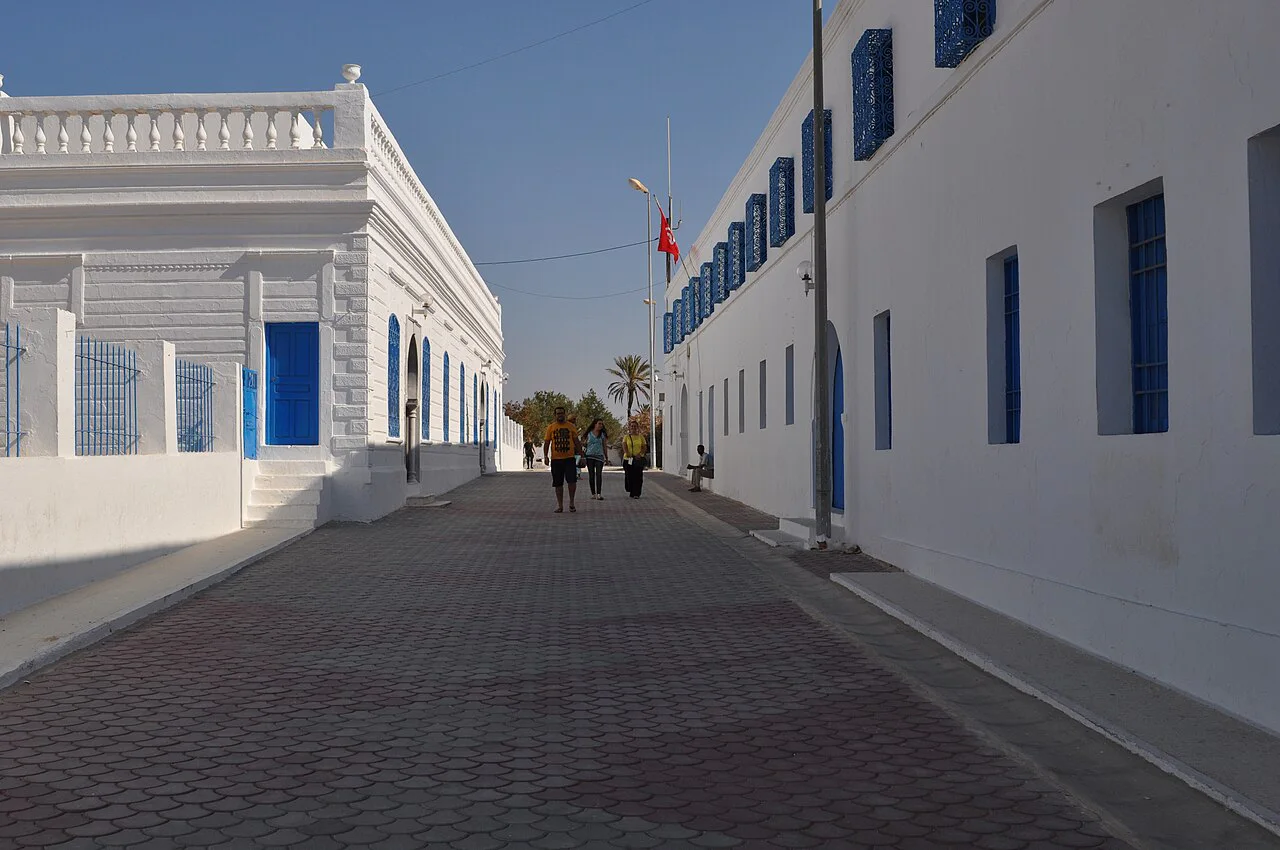
01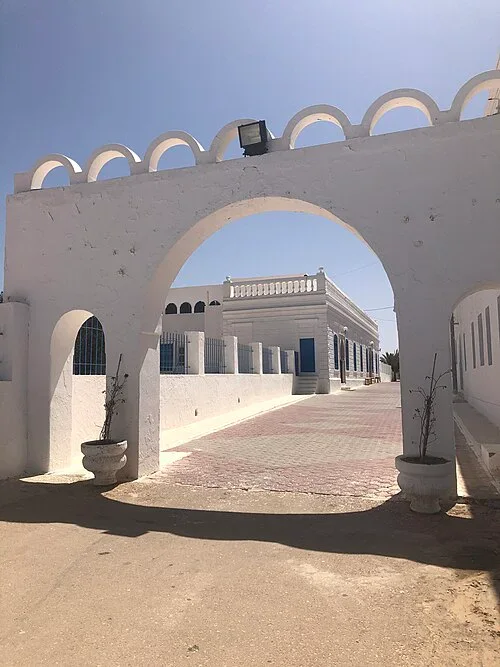 Outer Gateway and Security Entrance
Outer Gateway and Approach
Welcome to El Ghriba, on the island of Djerba in southern Tunisia. The synagogue stands in Er Riadh, a village a few kilometres southwest of Houmt El Souk, the island's main town. From the outside it is a modest whitewashed building with a cheerful row of small arches along its gateway. Inside, the rooms are richly decorated, and you will see how as we go in. El Ghriba is still an active Orthodox synagogue, and the centre of Jewish life for roughly one thousand three hundred Jews on Djerba. Its fame rests on a founding tradition. The story goes that priests, the kohanim, fled Jerusalem when the First Temple was destroyed in 586 BCE and settled on this island. They are said to have founded a sanctuary here, carrying with them a stone or a door taken from the Temple itself. Whether any such stone lies in these walls is a legend the community tells, not a settled fact. But the tradition ties this island congregation to the ancient sanctuary in Jerusalem. In 2023, Djerba joined UNESCO's World Heritage list.
Photo: Yamen · CC BY-SA 4.0
02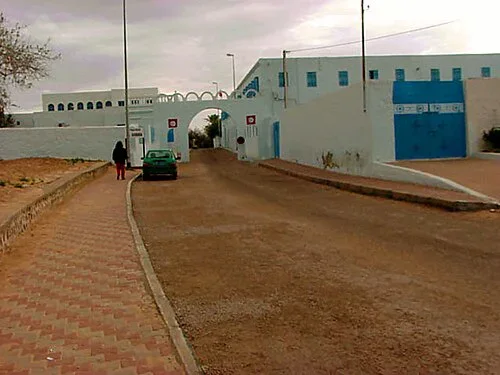 Outer Gateway and Security Entrance
The Street Outside: Attack and Resilience
On the eleventh of April 2002, a truck loaded with explosives was detonated close to the synagogue gates. Twenty-one people were killed, most of them German tourists visiting the island. Tunisians and French visitors died alongside them. Militants of al-Qaeda claimed the attack. It was not the first violence here. In 1985 a policeman assigned to guard the synagogue opened fire on worshippers celebrating Simchat Torah, killing three people. And in 2023, a gunman attacked Jews praying outside these walls. Four people were killed at the synagogue that day. Each time, the community came back. The synagogue was repaired, services resumed, and pilgrimage and religious life were later reinstated under heightened security. Visitors today pass security checks before reaching the courtyard. Through all of it, El Ghriba has remained an active house of worship.
Photo: Karl Heinz Paetzold · Public domain
03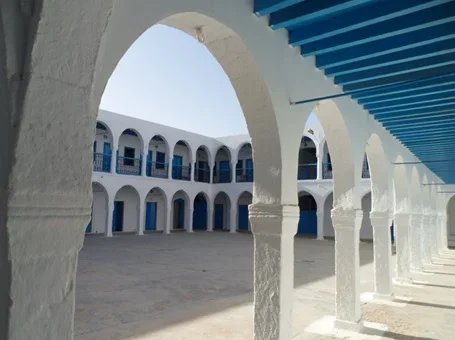 Inner Courtyard and Pilgrim Fondouk
The Courtyard and Pilgrim Lodgings
The inner courtyard is ringed by covered loggias raised on columns, all in white and blue. The buildings around it were conceived as a fondouk, a lodging house for pilgrims. The oldest of them went up at the end of the nineteenth century. The newer ones date from the early 1950s. They exist because of what happens here each spring. Every year, on the thirty-third day of the Counting of the Omer, the synagogue holds its great pilgrimage. The festivities open on the fourteenth of the Jewish month of Iyar, in memory of Rabbi Meir Baal HaNess. They build up to Lag BaOmer itself, on the eighteenth of Iyar, kept in memory of Rabbi Simeon bar Yochai, known in this region as Rabbi Shimon. For those days the lodgings fill with visitors. An administration committee, set up in the late nineteenth century under the French protectorate, organizes the pilgrimage and distributes its revenues to the village elders.
Listen in the appPhoto: Bsghaier · CC BY-SA 4.0
04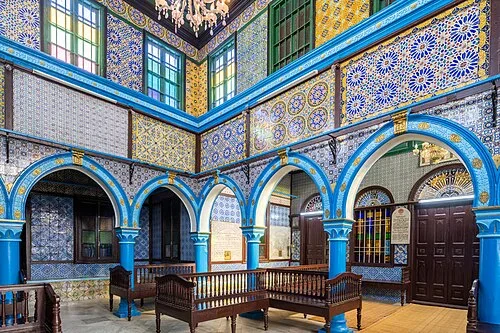 Antechamber and Qallalin Ceramic Tilework
The Antechamber and Qallalin Tilework
The first of the synagogue's two covered halls began life as an open courtyard. As crowds grew, the community roofed it over to make room for more worshippers. Two columns at the entrance divide the room into three areas, and three vaults carry the hall into the main prayer room beyond. What holds the eye here is the tilework. The inner walls are faced with ceramic tiles in the style of the old qallalin tiles, a traditional Tunisian craft. Each pattern was painted by hand, in green, yellow, blue, brown and white. The colours run together into dense, repeating designs that climb from the floor to the arches. The columns and arches themselves stand out in bright blue against the white walls. It is an unexpectedly festive dress for a house of prayer, and it was all done with a brush.
Listen in the appPhoto: Skander zarrad · CC BY-SA 4.0
05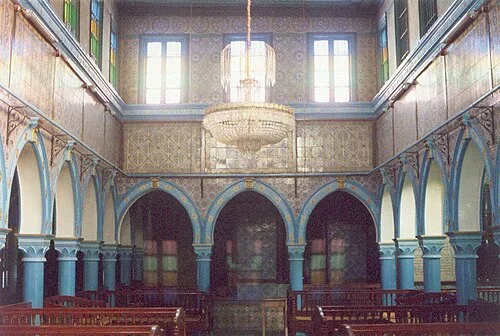 Main Prayer Hall and the Central Teva
The Main Prayer Hall and the Skylight
El Ghriba is the only synagogue on Djerba whose prayer space runs through two covered halls. The second is the main hall, the spiritual heart of the building. On its western side, two columns hold up a high skylight built of many windows. When the hall was first completed there were exactly twelve of them, one for each of the twelve tribes of Israel. Later renovations added further windows, and the north side was altered as well. One detail here is deliberately incomplete. A third column on the eastern side is missing, and it probably was never constructed at all. Local tradition reads the gap as a reminder of the destruction of the Temple of Jerusalem. The same tradition says the building should remain unfinished, because, as the saying goes, nothing except the divinity is perfect.
Listen in the appPhoto: Cecil · CC BY-SA 3.0
06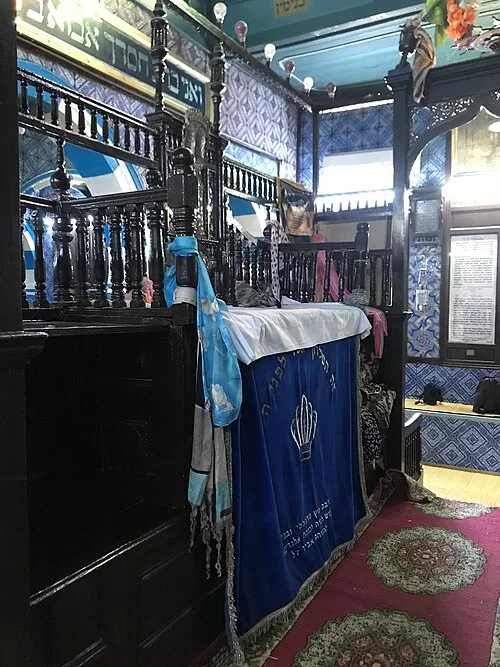 Main Prayer Hall and the Central Teva
The Teva and the Congregation's Seats
Under the skylight, on the western side of the prayer room, stands the Teva, the cupboard for the Torah. It is the point around which the whole room is organized. The wooden benches for the worshippers are set in a ring around it, so the congregation faces inward toward the reading. In an Orthodox synagogue, the Torah scrolls are brought to this platform and read aloud to the congregation in the course of the service. The dark carved woodwork gives the spot its weight, and on days of reading the platform wears its embroidered blue drape with a crown worked into the fabric. Around it, the benches stay empty between services, waiting for the next minyan.
Listen in the appPhoto: Mohatatou · CC BY-SA 4.0
07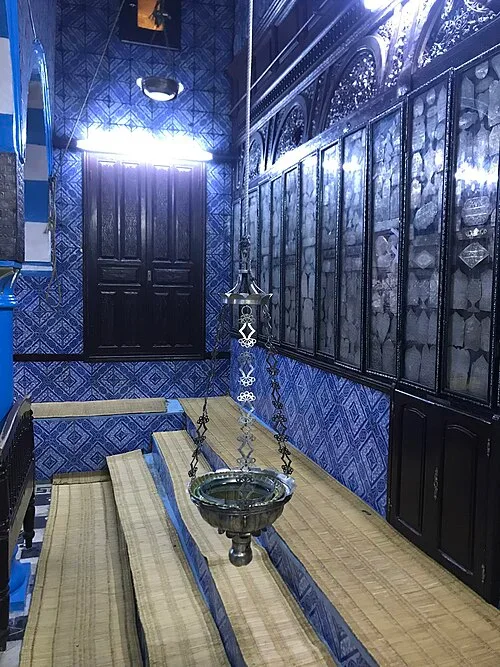 Holy Ark and the Cave of the Maiden
The Holy Ark and the Cave of the Girl
The name Ghriba means the isolated one, and it points to the story the community tells about this wall. Local tradition holds that a young girl once lived on this spot, alone and not accepted by the others. When she died, the Jews of a nearby village found her body uncorrupted, and buried it in a cave. That cave became a place of annual pilgrimage, and a sanctuary rose on the ground around it. A recess underneath the Holy Ark marks the spot where her body is said to have been found. It is known as the cave of the girl. The Ark itself, the Heikhal, stands against this wall in dark carved wood, with a silver oil lamp hanging before it and deep blue tiles behind. Out of that buried girl, the tradition says, came the name by which this whole sanctuary is still known.
Listen in the appPhoto: Mohatatou · CC BY-SA 4.0
El Ghriba Synagogue
Frequently asked questions
How much does the guide cost?
Free app download. Listed guide price: $0.99. Guide price shown in the app. Audio guide only. Venue admission is separate.
Can I listen without internet?
Yes. Download the guide’s audio, images, and maps in the app before your visit. Your downloaded content is then available offline.
Can I listen in my language?
This audio guide is available in 15 languages, including English.
Do I need to follow a schedule?
No. This is a self-guided experience. Choose your stops, pause whenever you like, and return to a story at your own pace.
At your own pace
Explore El Ghriba Synagogue.
Download Stanza, then search for “El Ghriba Synagogue”.
Free app download · Guide price shown in the app
Keep exploring
Audio guides — Tunisia
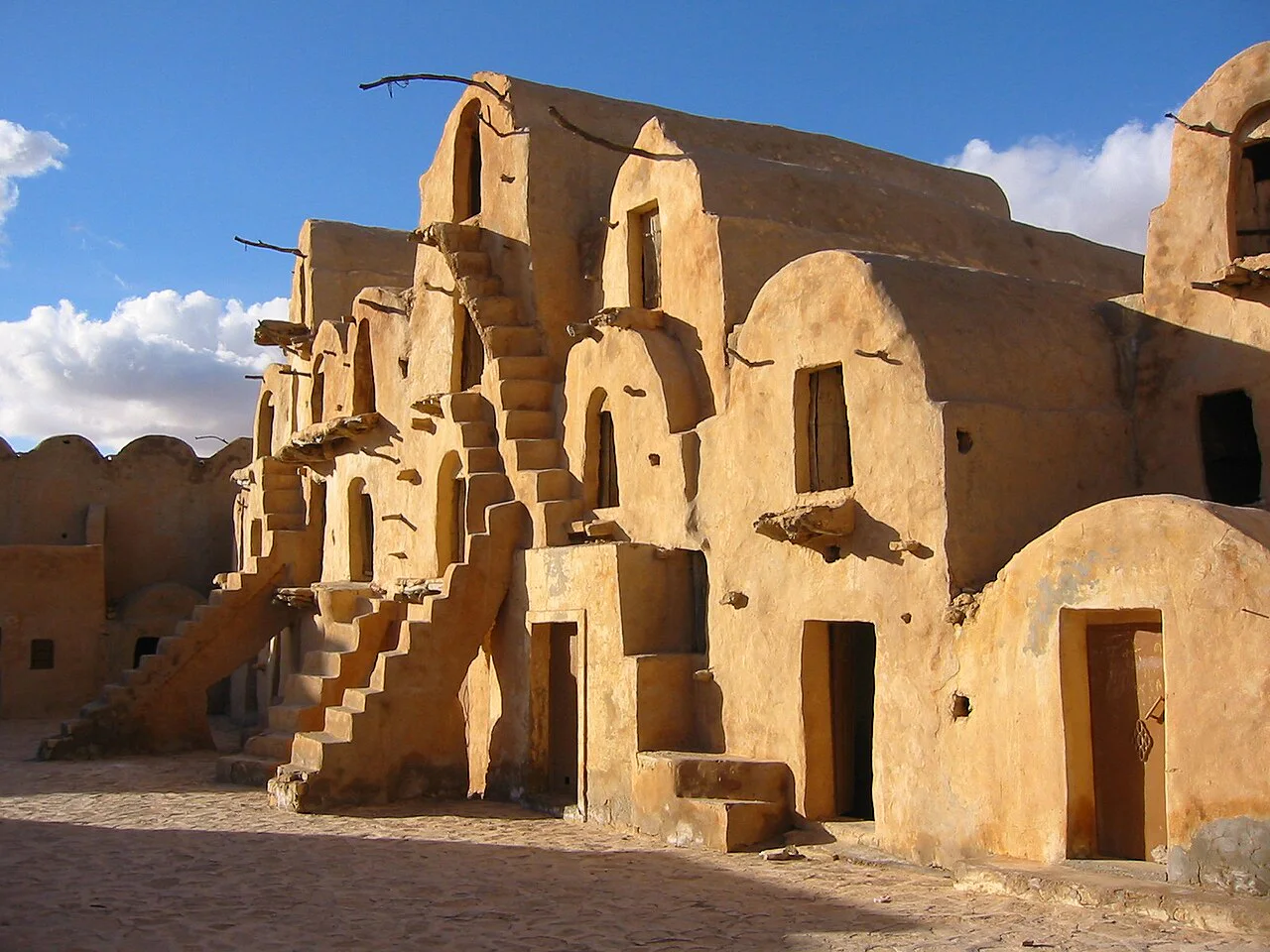
Tamelest · 118 km
Ksar Ouled Soltane
Content & sources
Ian Sewell · CC BY 2.5
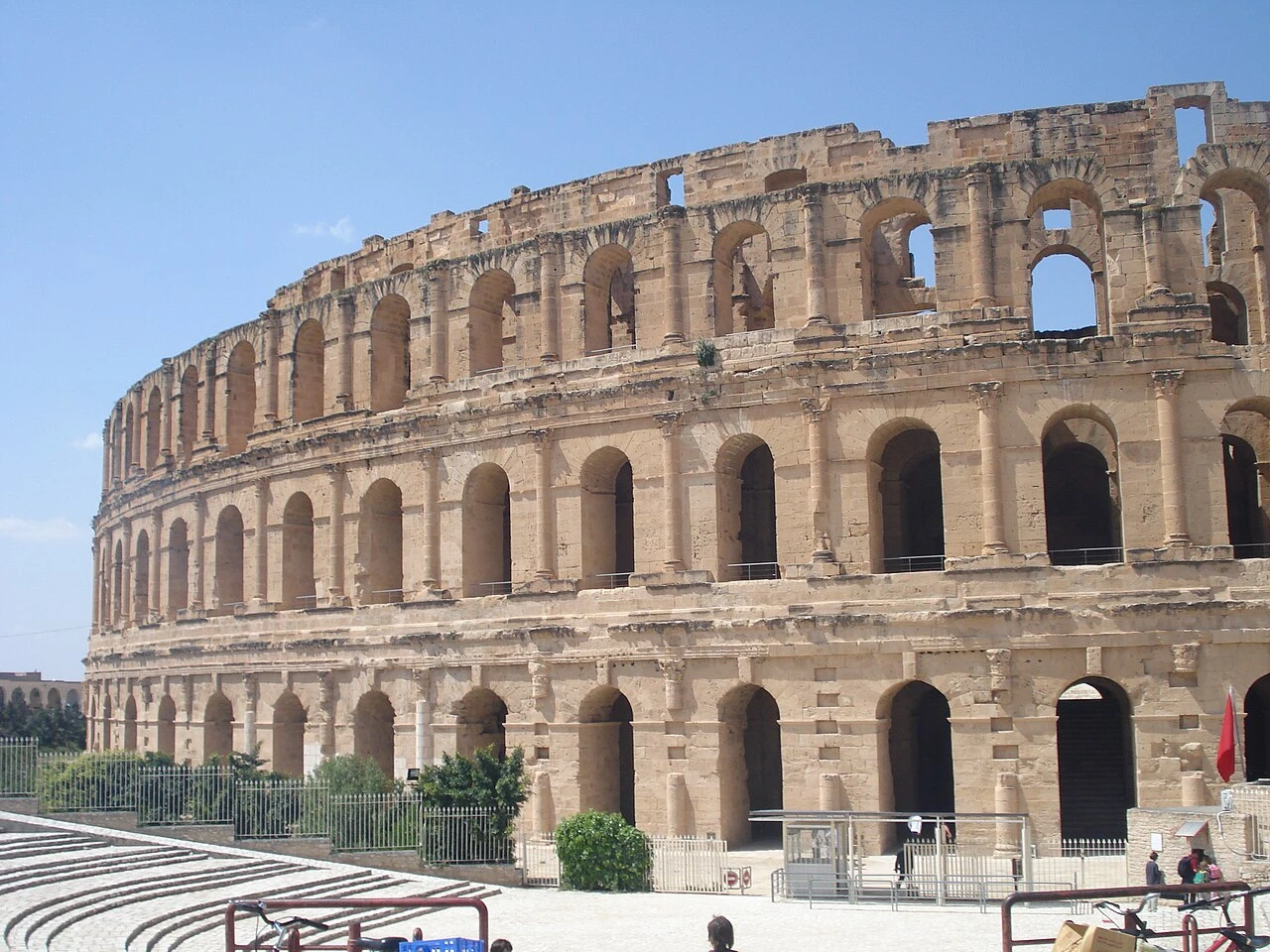
El Jem
Amphitheatre of El Jem
Content & sources
Photo: Cimoi · CC BY-SA 3.0
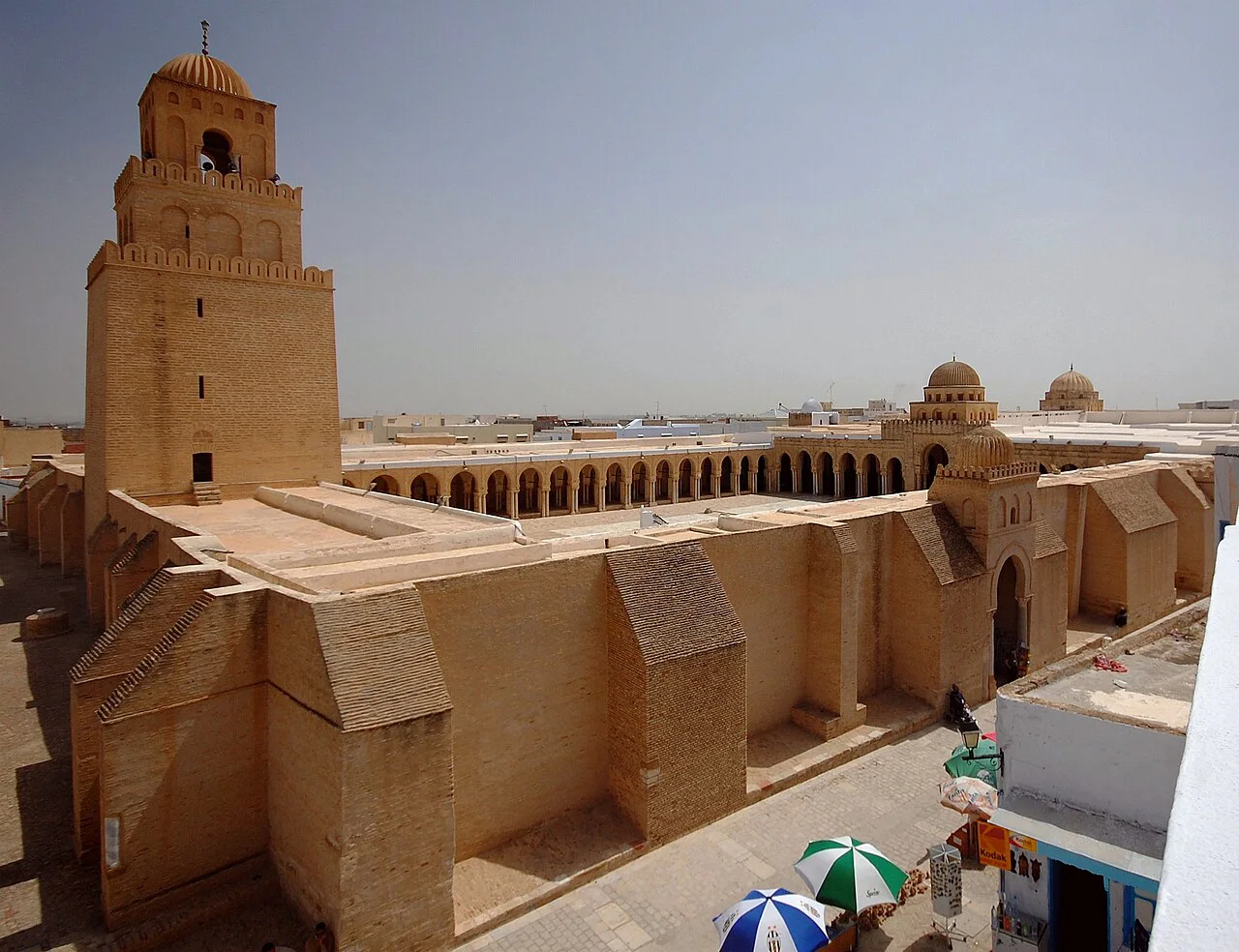
Kairouan
Great Mosque of Kairouan
Content & sources
weetoon66 · CC BY-SA 2.0
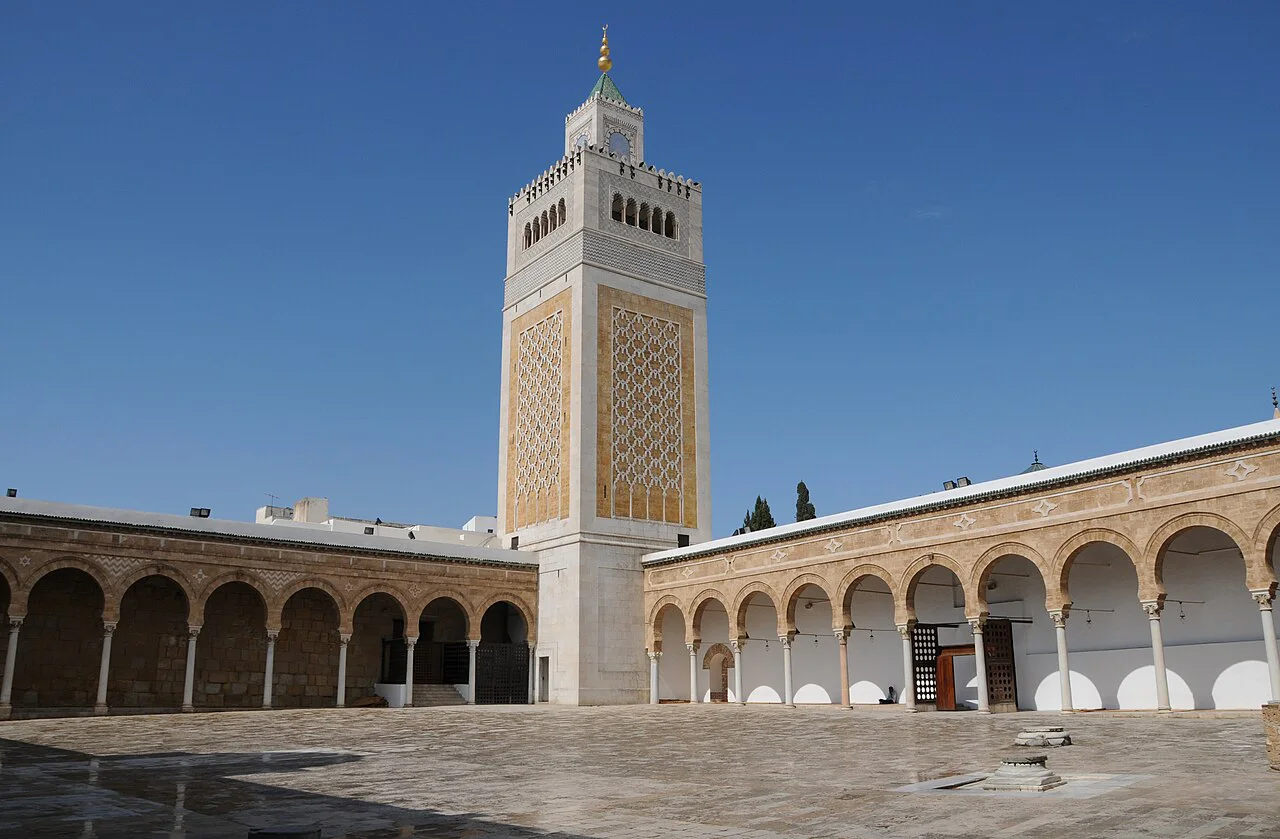
Tunis
Al-Zaytuna Mosque
Content & sources
Photo: Citizen59 · CC BY-SA 3.0