 Stanza / Audio guide
Content & sources
Stanza · Audio guide
Conwy Castle Audio Guide
A place to remember. A story to take with you.
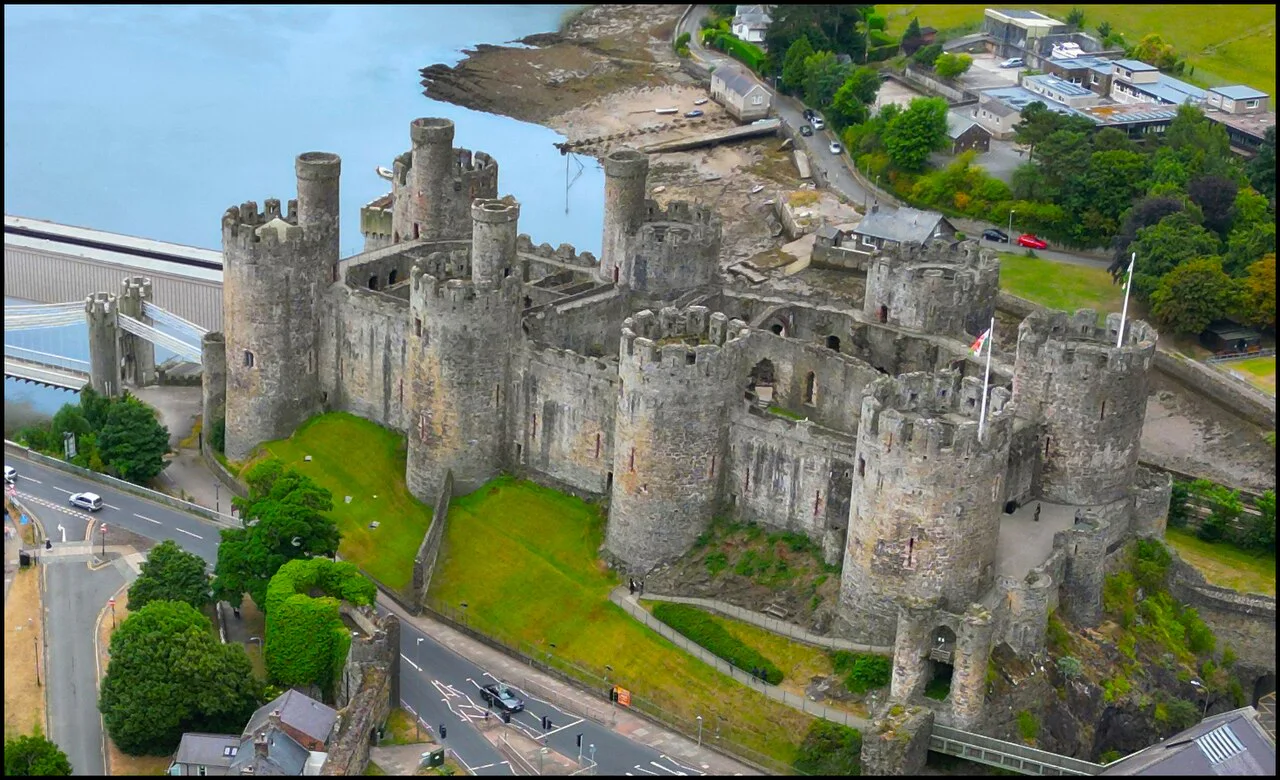
Conwy Castle is a fortification in Conwy built by Edward I between 1283 and 1287. It played an important part in several wars over the following centuries, including sieges and use as a royal haven.
Download Stanza, then search for “Conwy Castle”.
About the tour
One guide. Your kind of visit.
Conwy Castle is a fortification in Conwy built by Edward I between 1283 and 1287. It played an important part in several wars over the following centuries, including sieges and use as a royal haven.
Ready when you are.
- 01Get the free Stanza app.
iOS & Android
- 02Find your guide.
“Conwy Castle”
- 03Download before you go.
Works offline
Audio guide / 14 narrated stops
Inside the guide
Get to know a few of the stories before you go. Open a stop to read more.
01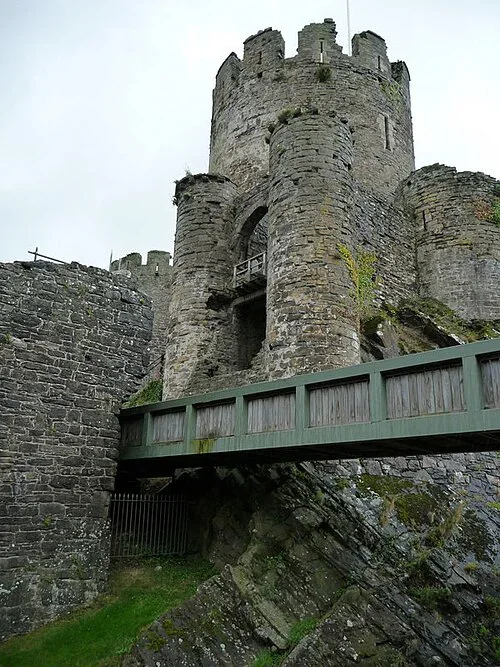 Western Approach and Barbican
Arrival at Conwy Castle
Welcome to Conwy Castle, one of the mightiest fortresses Edward the First built to hold Wales. In March 1283 his army captured Aberconwy, a place the Welsh princes held dear. It held their abbey, and one of their royal courts. Edward moved the monks eight miles up the valley to Maenan, and took the site for himself. On this ground he raised a castle and a walled town, side by side. The old ruin of Deganwy across the river was abandoned for good. Building began within days of his decision. By 1287 the whole castle stood complete. Castle and town walls together cost around fifteen thousand pounds, a colossal sum in its day. Labourers poured in from all over England, gathering each summer at Chester and walking into Wales.
Phil Champion · CC BY-SA 2.0
02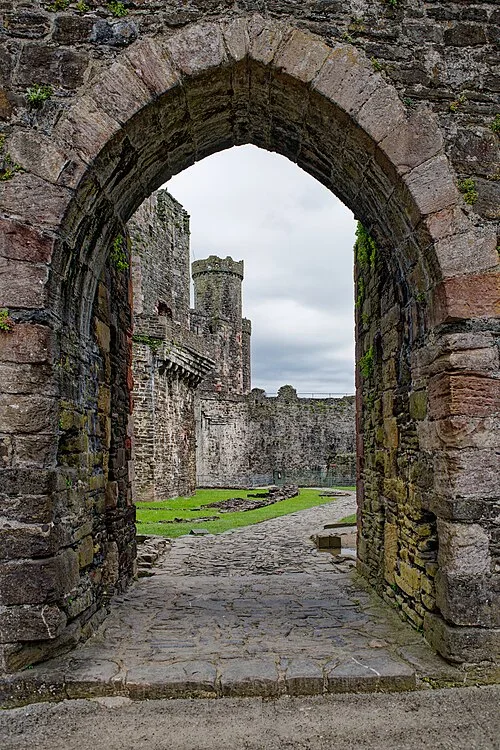 Western Approach and Barbican
The Western Barbican and Main Gate
The way into the castle runs through the western barbican, an outwork built in front of the main gate. Attackers once crossed a drawbridge and climbed a steep masonry ramp from the town below. The gate itself hung behind a portcullis, an iron grille that could crash down in a moment. High on the barbican wall, openings jut out over the approach. Through them, defenders dropped stones and missiles straight onto the heads of anyone below. These are the earliest surviving stone machicolations in Britain. The deep arch of the gateway frames the whole passage, so anyone breaking through would still be inside the killing ground.
Photo: Tilman2007 · CC BY-SA 4.0
03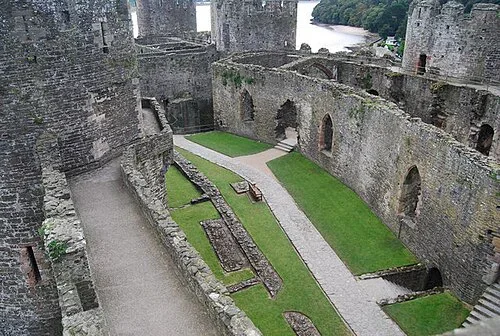 Outer Ward and the Great Hall
The Outer Ward
Beyond the gate lies the Outer Ward, once packed with administrative and service buildings. A cross-wall divided it from the royal side of the castle. In 1284 the peacetime garrison numbered thirty soldiers, half of them crossbowmen. A carpenter, a chaplain, a blacksmith, an engineer and a stonemason kept the fortress running. The constable commanded them all, and his charter gave him a second job. By royal charter of 1284, the constable of the castle was also mayor of the new town of Conwy. The arrangement survives in name to this day. The first man to hold both posts was Sir William de Cicon, who had done the same at Rhuddlan.
Listen in the appNigel Chadwick · CC BY-SA 2.0
04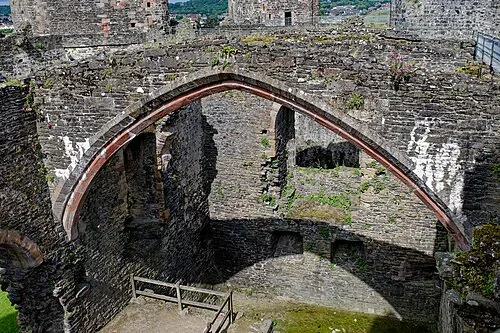 Outer Ward and the Great Hall
The Great Hall
That great stone arch, curving over the grass, once held up the roof of the great hall. The hall and chapel sat in a range on the south side, raised above cellars now open to the sky. By 1321 a survey found the castle in poor shape, with leaking roofs and rotten timbers. Help came in 1343, when Edward the Black Prince took control of the castle. His chamberlain, Sir John Weston, carried out repairs in the 1340s. Weston built new stone arches to support the great hall, and the one standing here is his. After the Black Prince died, the castle slid back into neglect.
Listen in the appPhoto: Tilman2007 · CC BY-SA 4.0
05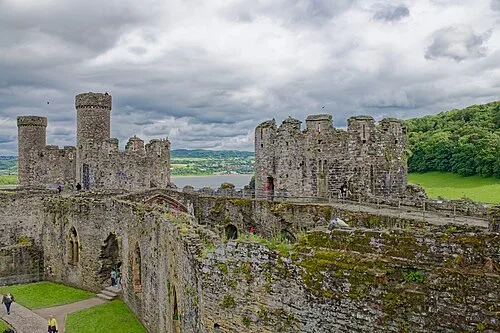 Prison and Bakehouse Towers
Bakehouse Tower and Prison Tower
Along the north side, these towers guarded the working end of the castle. A kitchen, a brewhouse and a bakehouse fed the garrison from the ranges here. The prison tower behind the great hall held a cell called the dettors chambre, the debtors' chamber, and below it an underground dungeon. But these walls remember a bolder story. On Good Friday 1401, during Owain Glyndŵr's rebellion, two brothers arrived at the gates. Rhys and Gwilym ap Tudur, cousins of Glyndŵr, came dressed as carpenters hired for repairs. Once inside they killed the two watchmen and took the whole fortress. Welsh rebels then seized the walled town as well. The brothers held out for about three months, then negotiated a surrender, and King Henry the Fourth granted them a pardon.
Listen in the appPhoto: Tilman2007 · CC BY-SA 4.0
06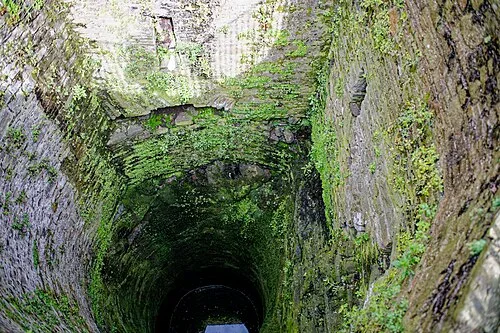 The Rock-Cut Castle Well
The Castle Well
Water decided who could survive a siege, and this well answered the question. It is fed by a spring and cut straight down into the rock, reaching about twenty-eight metres. It stands beside the gate that once separated the two wards. Behind that gate, a ditch was cut deep into the rock and crossed by a drawbridge. Anyone trying to reach the royal side had to get past all three. The ditch was filled in during the sixteenth century, and the drawbridge went with it. The well still holds water at the bottom of its mossy shaft.
Listen in the appPhoto: Tilman2007 · CC BY-SA 4.0
07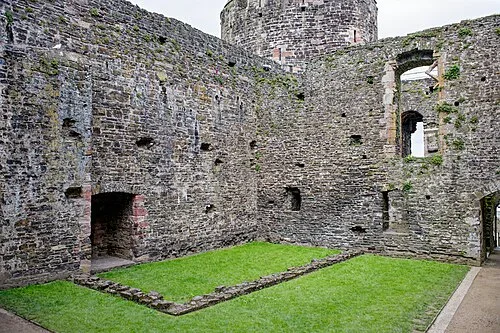 Inner Ward and Royal Apartments
The Inner Ward and Royal Apartments
The Inner Ward was the king's own ground, holding chambers for the royal household and their staff. Historian Jeremy Ashbee calls it the best-preserved suite of medieval private royal chambers in England and Wales. The design was a palace in miniature. If danger came, the whole royal side could be sealed off from the rest of the castle. Supplied through the eastern gate by sea, it could hold out almost indefinitely. There was one irony in all that planning. In practice, the royal family rarely used these rooms at all.
Listen in the appPhoto: Tilman2007 · CC BY-SA 4.0
08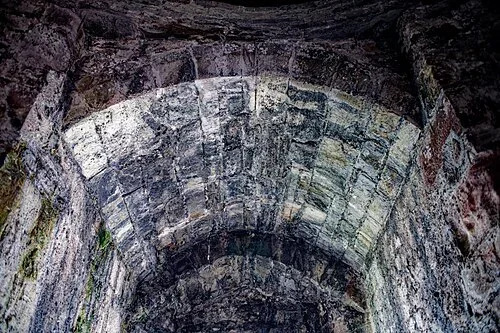 Inner Ward and Royal Apartments
Inside the King's Tower
The royal rooms ran around the outside of this courtyard on the first floor, facing inwards for privacy. Over time the two sets of apartments were joined into a single sequence. Guests passed from a great chamber to an outer chamber, and only then to the king's inner chamber. The four towers of the Inner Ward held the services, storerooms and kitchens. Each tower carries an extra watchtower turret on top. They probably served for security, and for flying the royal flag where all could see it. The whole arrangement echoed the gloriette at Corfe Castle, a royal keep of the thirteenth century.
Listen in the appPhoto: Tilman2007 · CC BY-SA 4.0
09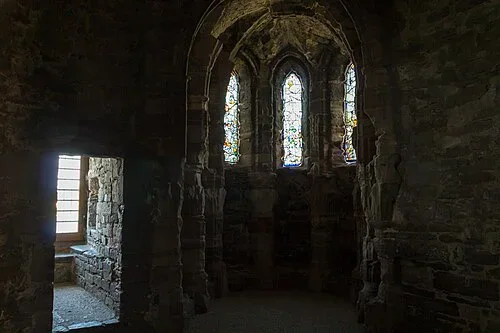 The Royal Chapel Tower
The Royal Chapel
In the Chapel Tower sat the king's private place of worship, lit by narrow windows. In August 1399 it became the setting for a fateful bargain. Richard the Second had returned from Ireland to find his rival, Henry Bolingbroke, taking England from him. On the twelfth of August the king came to Conwy, and met Bolingbroke's emissary, Henry Percy, here for negotiations. Percy swore in the chapel that he would do the king no harm. Richard trusted the oath. A week later, on the nineteenth, he surrendered to Percy at Flint Castle, promising to give up the crown if his life were spared. He was taken to London, and died in captivity at Pontefract.
Listen in the appPhotograph by Mike Peel (www.mikepeel.net). · CC BY-SA 4.0
10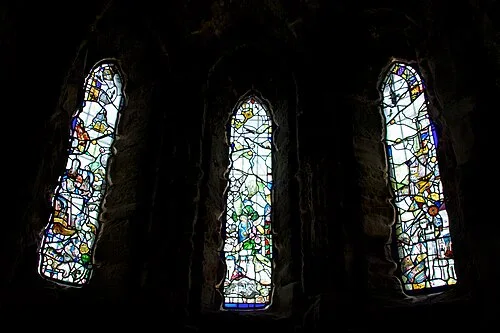 The Royal Chapel Tower
Garrison of Flowers (stained glass)
Among the old stone, the chapel windows now carry something entirely new. In 2012 the artists Linda Norris and Rachel Phillips filled them with new stained glass, telling the story of Edward the First and the princes of Gwynedd. Built into the design are lines by the poet Damian Walford Davies, and one of them speaks of a garrison of flowers. The panels bloom with bright colour against the darkness of the vaulted room. It is a modern layer laid inside a fortress built for war and worship. A ruin, treated this way, becomes a place still being made, not only remembered.
Listen in the appPhotograph by Mike Peel (www.mikepeel.net). · CC BY-SA 4.0
- 11
The East Barbican and River Gate
The river gate that saved a besieged king, and the wine he refused to drink alone.
- 12
Three Bridges Across the Conwy
Three bridges, two centuries, and the moment the town took its ruined castle back.
- 13
On the Ramparts
The Savoyard hand behind the stonework, from pinnacled merlons to the holes builders left behind.
- 14
Castle, Town and Ruin
From Civil War siege and deliberate demolition to World Heritage, seen over the dusk-lit walls.
Conwy Castle
Frequently asked questions
How much does the guide cost?
Free app download. Listed guide price: $1.99. Guide price shown in the app. Audio guide only. Venue admission is separate.
Can I listen without internet?
Yes. Download the guide’s audio, images, and maps in the app before your visit. Your downloaded content is then available offline.
Can I listen in my language?
This audio guide is available in 15 languages, including English.
Do I need to follow a schedule?
No. This is a self-guided experience. Choose your stops, pause whenever you like, and return to a story at your own pace.
At your own pace
Explore Conwy Castle.
Download Stanza, then search for “Conwy Castle”.
Free app download · Guide price shown in the app
Keep exploring
Nearby audio guides
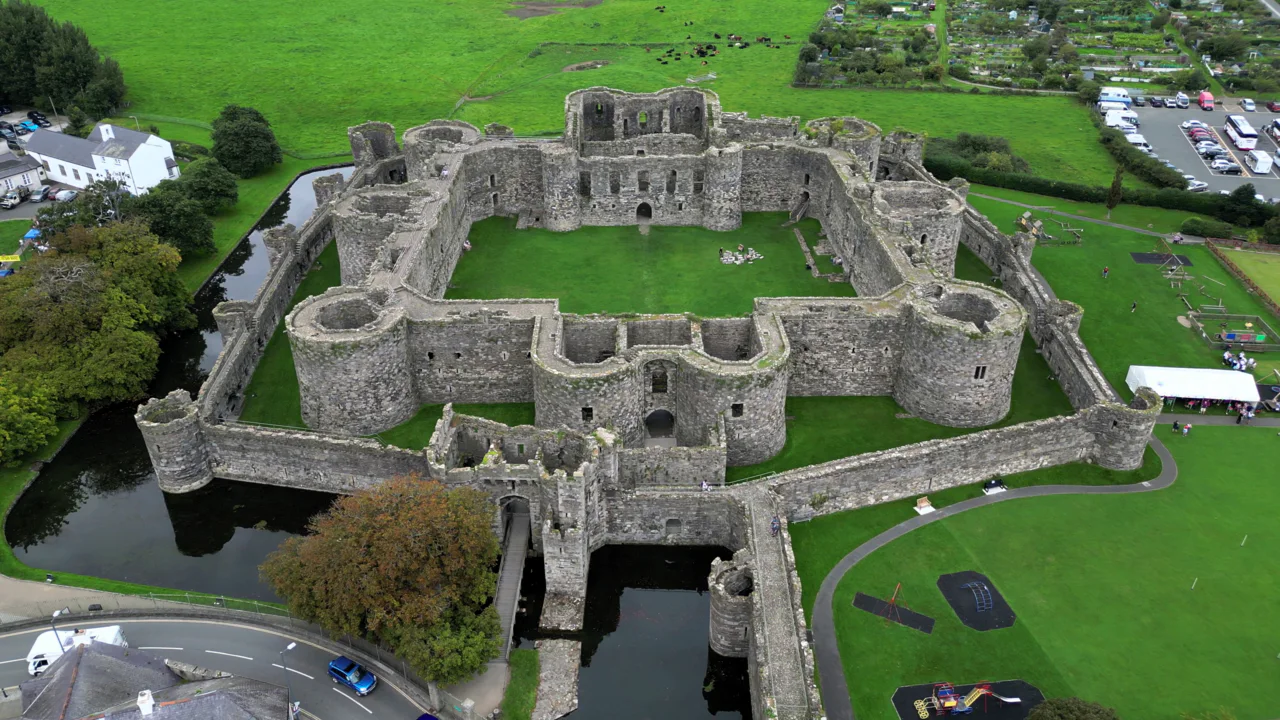
Beaumaris · 18 km
Beaumaris Castle
Content & sources
Photo: Llywelyn2000 · CC BY-SA 4.0
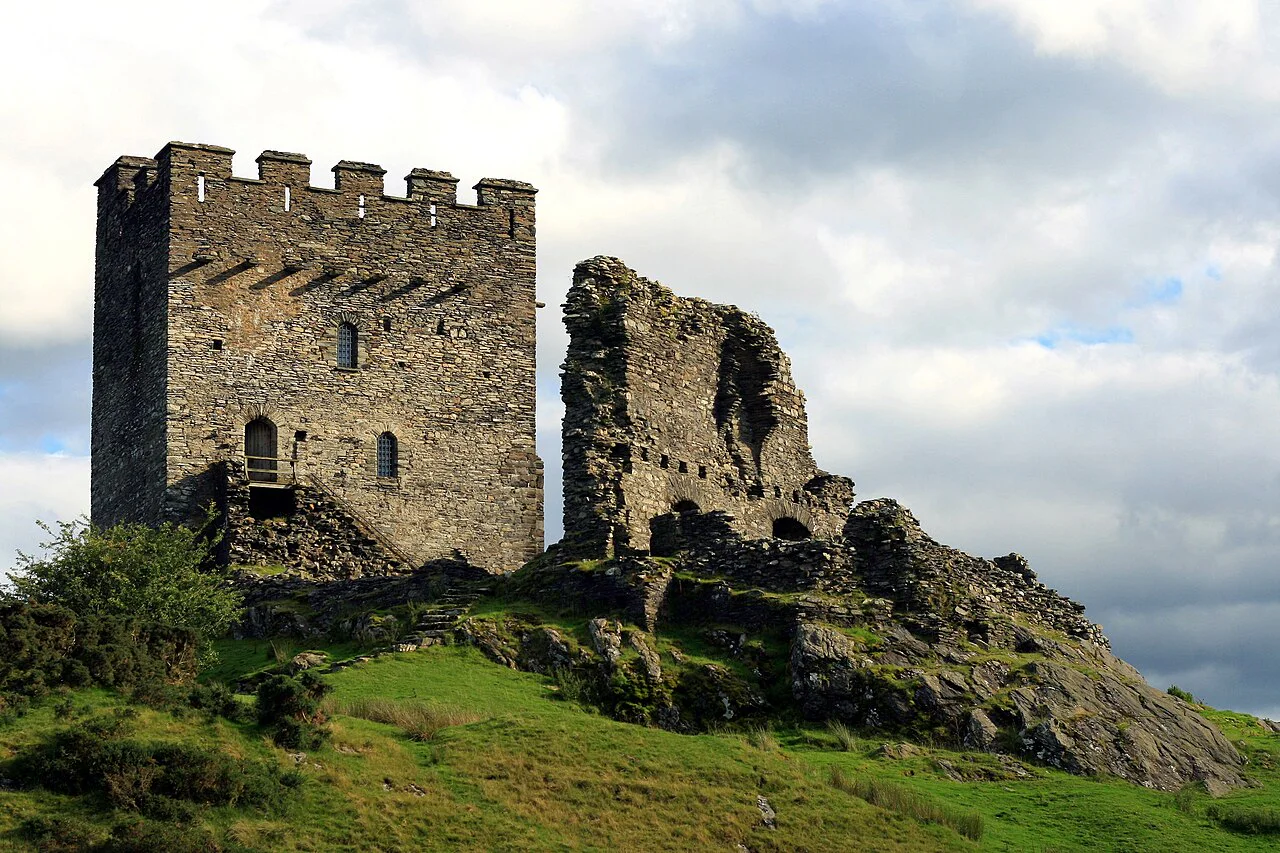
Dolwyddelan · 26 km
Dolwyddelan Castle
Content & sources
Jeff Buck · CC BY-SA 2.0
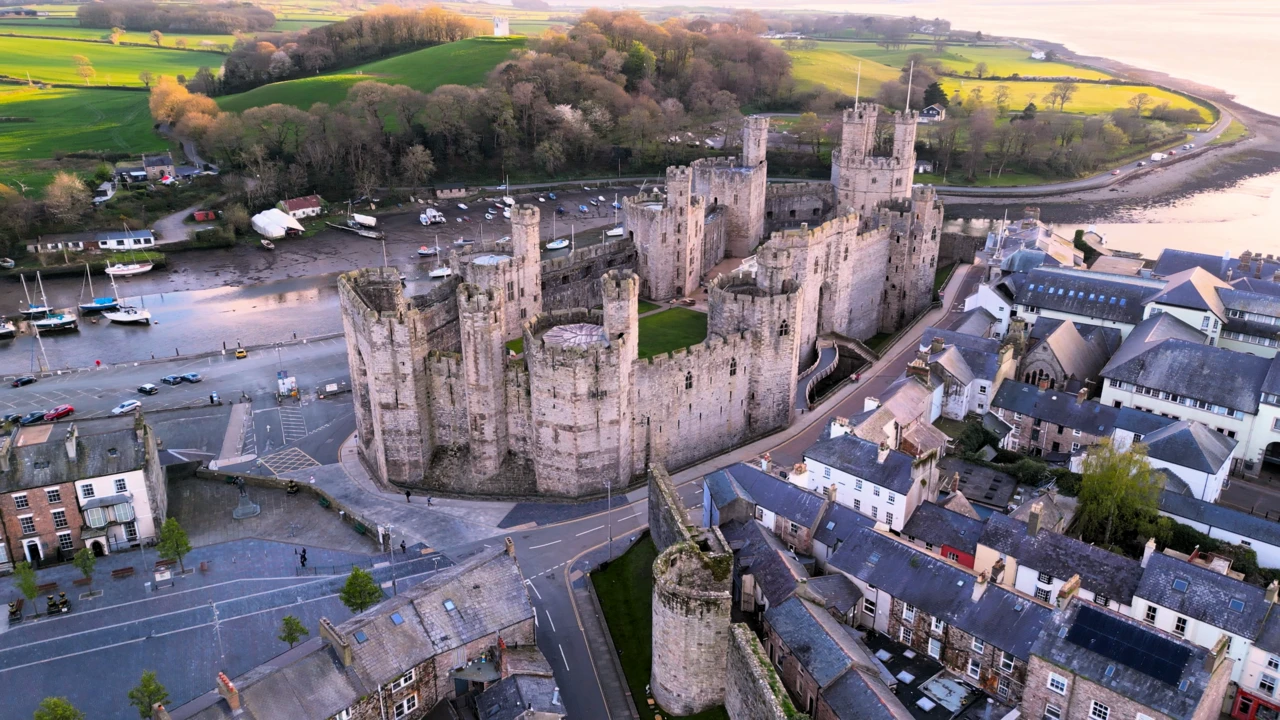
Caernarfon · 34 km
Caernarfon Castle
Content & sources
Photo: Llywelyn2000 · CC BY-SA 4.0
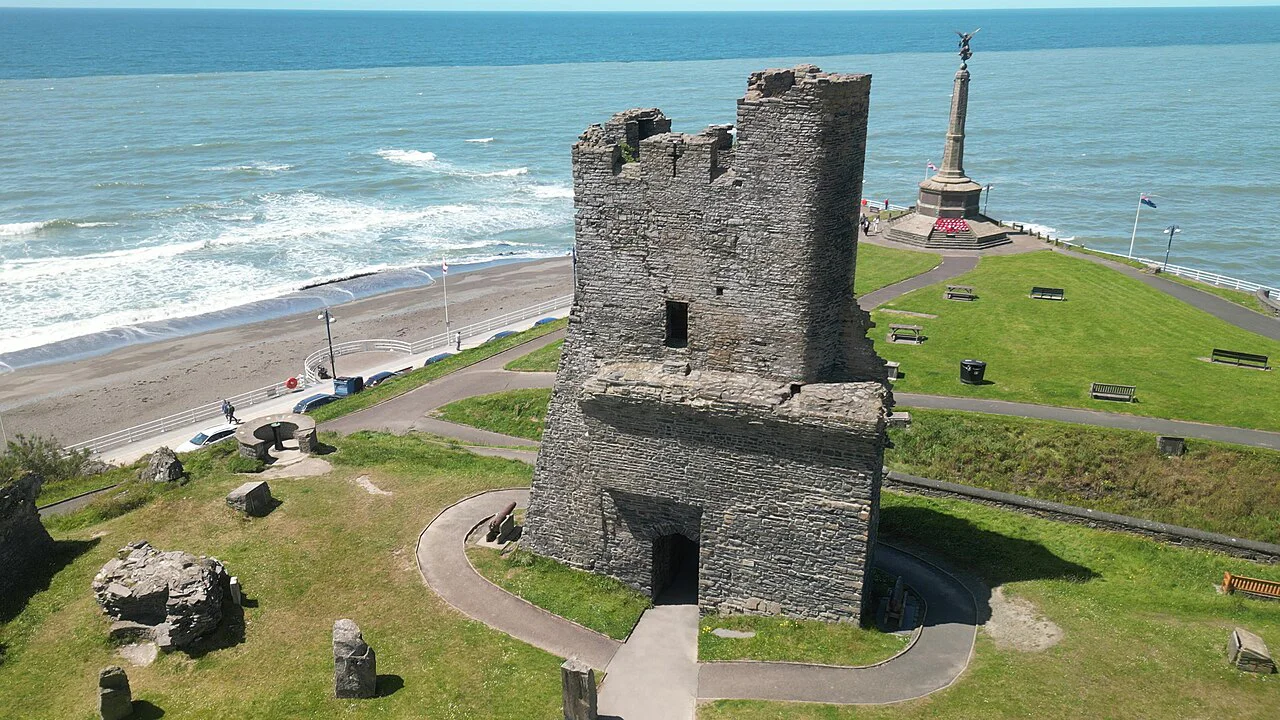
Aberystwyth · 98 km
Aberystwyth Castle
Content & sources
Photo: Llywelyn2000 · CC BY-SA 4.0