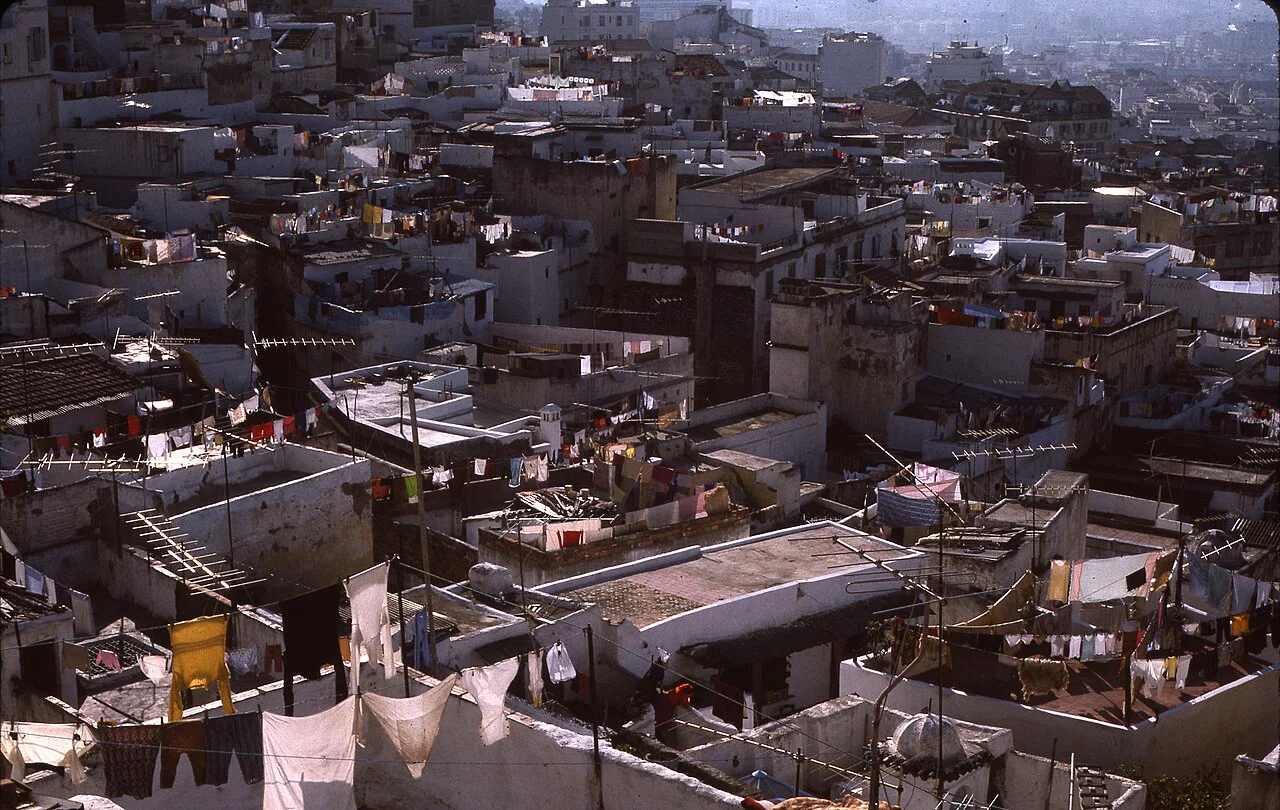
 Stanza / Audio guide
Stanza · Audio guide
Casbah of Algiers Audio Guide
A place to remember. A story to take with you.
The Casbah of Algiers is the old town or medina of Algiers, which was founded in 944 by the Zirids. It is a historic district that has been listed as a UNESCO World Heritage Site since 1992.
Download Stanza, then search for “Casbah of Algiers”.
About the tour
One guide. Your kind of visit.
The Casbah of Algiers is the old town or medina of Algiers, which was founded in 944 by the Zirids. It is a historic district that has been listed as a UNESCO World Heritage Site since 1992.
Ready when you are.
- 01Get the free Stanza app.
iOS & Android
- 02Find your guide.
“Casbah of Algiers”
- 03Download before you go.
Works offline
Audio guide / 39 narrated stops
Inside the guide
Get to know a few of the stories before you go. Open a stop to read more.
01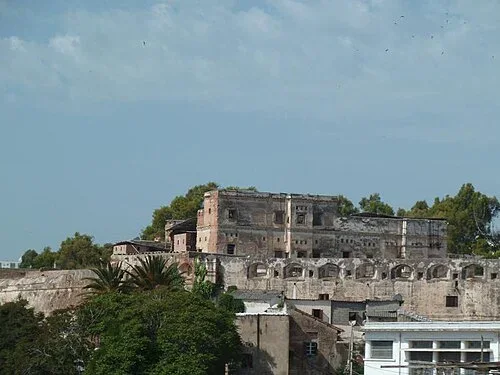 Dey's Palace (Dar Soltan)
Dey Palace (Dar Soltan) - Tour Overview
The Casbah of Algiers is a fortified medina piled on a hillside above the bay, an old Berber core that became an Ottoman capital in the sixteenth century and a UNESCO World Heritage Site in our own day. At its summit stands this fortified palace, among the finest architectural ensembles of Ottoman Algiers. For its first two centuries it was no royal home. It kept a military role, housed the council of the diwan, and a Janissary garrison stood guard over it. Only in 1817 did the dey Ali Khodja move in. Wary of his own militia, he left the central Djenina Palace, carried the public treasury up to the citadel, and barricaded himself with a personal guard of two thousand Kabyles. His successor, Dey Hussein, was the last ruler to live here. On April 30, 1827, Hussein struck the French consul with his fan, the gesture remembered as the fan blow. The quarrel was over unpaid wheat debts, and France took it as its pretext for conquest. Whether the blow fell in this palace or in the old Djenina, no one can say for certain. Either way, a small wooden wing here, richly carved, is still called the wing of the fan incident. In July 1830 French troops took the city, and Marshal Bourmont, the conquering commander, moved into the palace as its new occupant.
Yves Jalabert from La Rochelle, France · CC BY-SA 2.0
02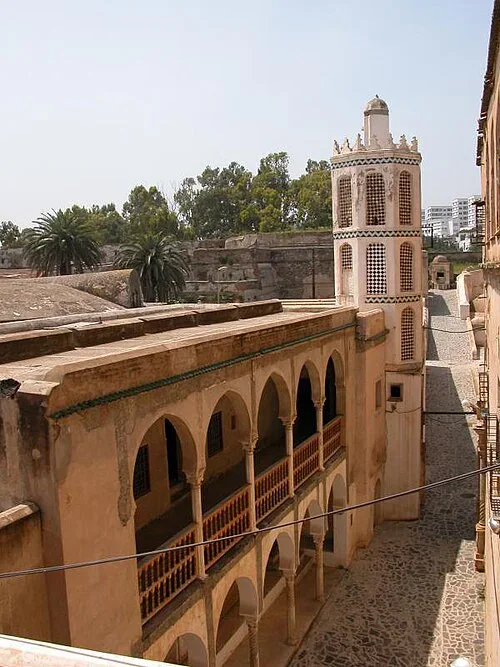 Dey's Palace (Dar Soltan)
The Citadel Ramparts and Minaret
Long before the word Casbah meant the whole old city, it meant only this fortress at its summit. Work began in 1516 under Aruj Barbarossa and was completed in 1592 under Kheder Pasha. The compound held barracks, a mosque and the ruler's palace behind these arcaded galleries. Its purpose was tested early. In 1541 Emperor Charles V sailed against Algiers with a great fleet, and the expedition failed. The city answered by strengthening its defenses. A fortified wall rose around the medina, pierced by gates such as Bab Azoun and Bab El Oued, and a chain of forts watched the coast. The citadel looming over the medina gave Algiers its Arabic nickname, El Djazair El Mahroussa, meaning Algiers the Well-Guarded. That reputation traveled across Europe, and the memory of Charles V's failed invasion lasted until the French landing of 1830.
Yves Jalabert · CC BY-SA 2.0
03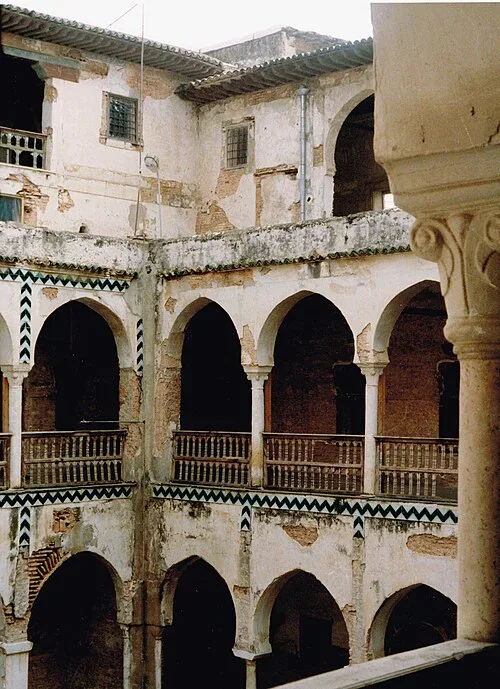 Dey's Palace (Dar Soltan)
Dey's Palace Courtyard, 1986
The paint peels from these courtyard arcades, and whole fields of tile and stucco have fallen away from the walls around them. A Polish study office drew up a restoration plan for the palace between 1979 and 1986, but the actual works began only in 2006. For decades, preservation focused on showpiece palaces like this one while the wider Casbah decayed around them. Ceramics vanished from house after house. Newer projects now speak of social renewal alongside restoration. In the late 2010s the Île-de-France region, twinned with Algiers, backed a rehabilitation plan led by the architect Jean Nouvel. A petition signed by four hundred Algerians objected that he came from the former colonial power. The architect Kamel Louafi answered them sharply, asking whether intelligence were determined by birth or ethnicity.
Listen in the appPhoto: A.S.Macur · CC BY-SA 4.0
04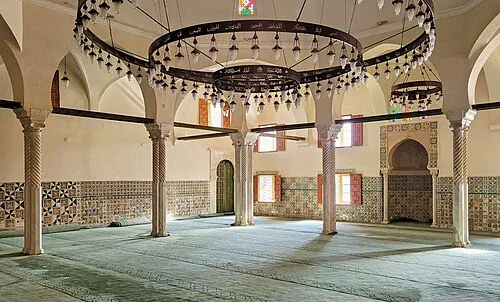 The Dey's Mosque
 - Prayer Hall
Power in the Casbah kept its distance, even at prayer. This mosque stands inside the citadel compound, so the dey and his Janissary guard could worship behind fortress walls, away from public unrest. Inside, the prayer hall is calm and cool. Rows of slender columns carry low arches, and the floor is laid wall to wall with carpet. Ringed chandeliers hang in tiers from the ceiling, and a band of patterned tile runs along the base of the walls. At the far end, a tiled niche marks the direction of Mecca.
Listen in the appBernard Gagnon · CC BY 4.0
05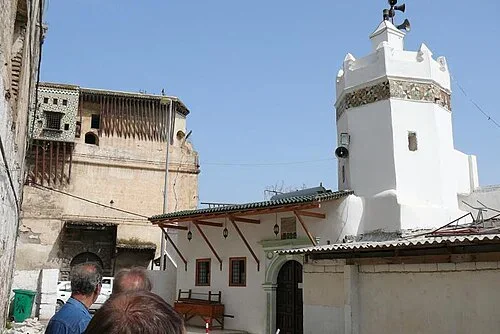 El Berrani Mosque
The name says everything: Jamaa el Berrani, the Mosque of Foreigners. It was built in 1653 outside the wall of the Ottoman citadel, before the Bab Jdid gate, a small and elegant sanctuary for worshippers who came from beyond the fortress. The berrani, the outsiders, were rural communities who migrated to Algiers to live and work, mainly from Saharan cities and oases such as Biskra, Laghouat and the M'zab. Each community was known by its home region and tied to certain trades, and its affairs were run by an amin chosen from among its own members. The mosque was rebuilt in 1818 by Hussein Dey at the foot of the citadel and served as the Agha's tribunal. Foreigners prayed there before their audience with the dey. Later, for part of the colonial period, the building became a Catholic place of worship.
Listen in the appYves Jalabert from La Rochelle, France · CC BY-SA 2.0
06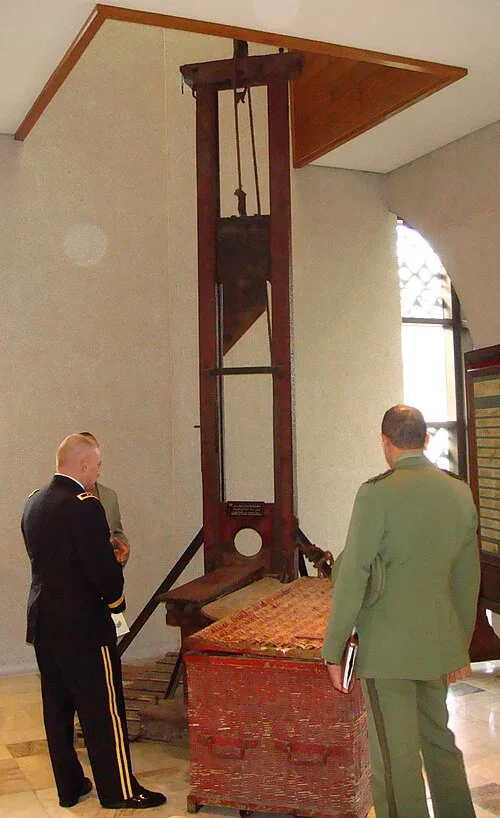 Serkadji Prison
 and the Battle of Algiers
The bitterest fighting of the Algerian War came to these streets in 1957. The Battle of Algiers pitted Yacef Saadi, head of the independence movement's Autonomous Zone, against General Massu's Tenth Parachute Division. The fighters hid in the medina's dense houses, and the French sealed the exits with barbed wire, working through intelligence gathering and torture. An infiltrated courier network led them to Saadi, captured on September 23, 1957, at 3 Rue Caton. In October, Ali la Pointe and his comrades were cornered at 5 Rue des Abderrames. Paratroopers dynamited the hideout, killing them and seventeen neighbours with them. Above the Casbah stands Serkadji prison, built by the French over an old Regency fortification. Algerians called it Serkadji; the French called it Barberousse. During the war several hundred independence militants were held there, and fifty-eight were executed by guillotine in its main courtyard. A guillotine of that era is preserved in the Central Military Museum of Algiers. Today the prison itself is a public museum.
Listen in the appUS Army Africa · CC BY 2.0
07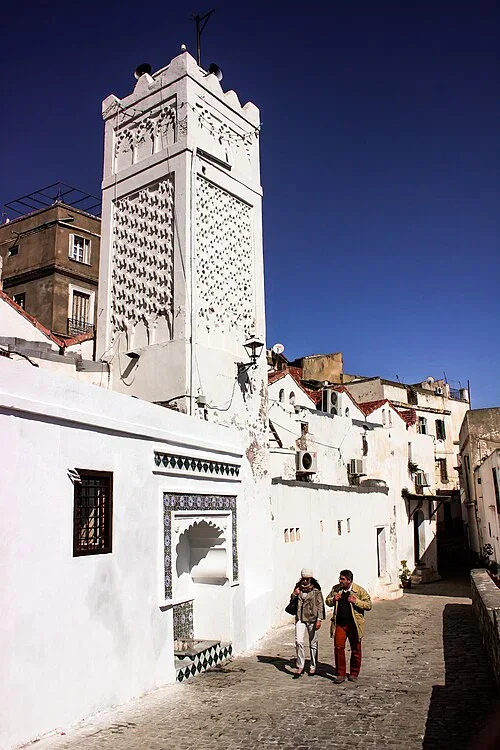 Sidi Ramdane Mosque
This white minaret belongs to one of the medieval mosques of the Casbah. Sidi Ramdane was founded in the eleventh century, long before the Ottomans reached Algiers. The French archaeologist Georges Marçais judged it roughly contemporary with the late eleventh-century Great Mosque. Under the Amazigh rulers it marked the old border of the citadel city. The name honors Sidi Ramadan, remembered as a soldier in the early conquests of North Africa under Uqba ibn Nafi, who was appointed chief of Algiers and buried here. Another account makes him a generous wali of Biskra. Inside, rows of arches on columns divide the prayer hall, with elevated galleries on three sides for the women's section. The minaret rises thirty-two metres, its façades carved with sebka ornament. The mosque was classed as national heritage in 1904 and joined the UNESCO listing with the Casbah in 1992.
Listen in the appPhoto: Rachid Ayadi · CC BY-SA 4.0
08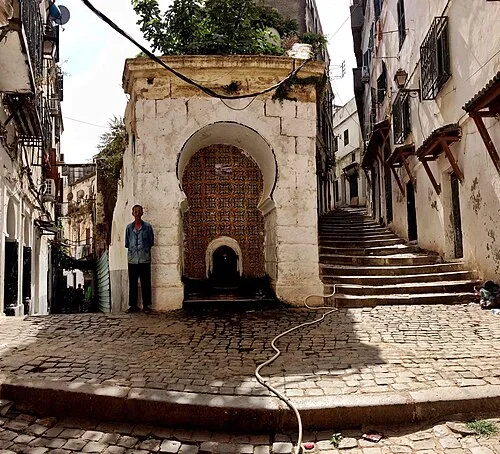 Bir Chebana Public Fountain
Water decided whether this steep city could live at all. Four main aqueducts, built between 1518 and 1620, carried spring water from the Sahel, Telemly, Hamma and Hydra down to the medina. Water wheels lifted groundwater, filtering galleries caught the smaller veins, and reservoirs at the city gates fed pipelines out to the fountains. Where gravity failed, builders used a technique called souterazi, siphon towers that balanced pressure and flow, also known in Constantinople and in cities of Spain. By the seventeenth century this system sustained about one hundred thousand people. Fountains were called sebala, from a word meaning a charitable act, and the donor's name lived on in the giving. No one, not even a palace resident, could build a fountain inside a private home, because water could never be privately owned. Bir Chebana was among the best known, a place where women drew water and neighbours met. Its arched, tiled façade is set straight into the stepped street.
Listen in the appPhoto: Meriembenhabiles · CC BY-SA 4.0
09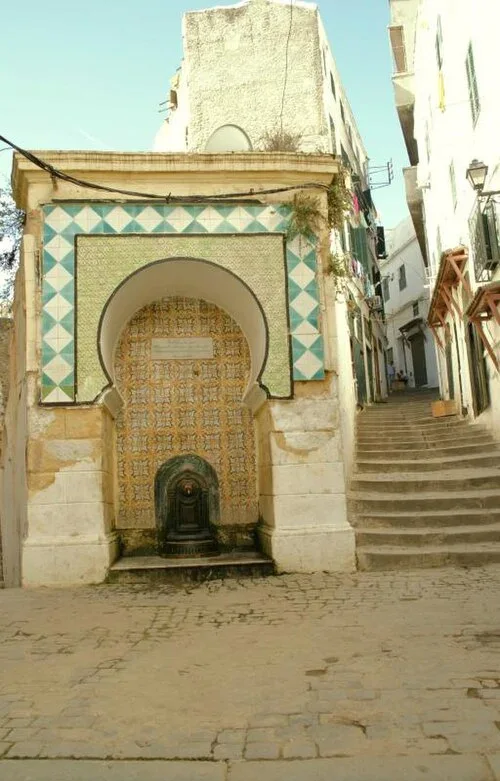 Bir Chebana Public Fountain
A Dey's Fountain Inscription
Fountains in Algiers carried words as well as water. An inscription of the period, translated by Gabriel Colin, praises the governor Hussein Pasha, whose pious intentions, it says, always aimed at good deeds. It continues: he has made this water flow and built this fountain. By irrigating this place, he has quenched the thirst of those in need. Drink freely of this fresh water in honor of Hussein. The inscription praising Hussein Pasha survives on a fountain now set into a wall of the Antiquities museum in Algiers. Fountains like this carried a ruler's piety to the city as a cup of water.
Listen in the appYves Jalabert from La Rochelle, France · CC BY-SA 2.0
10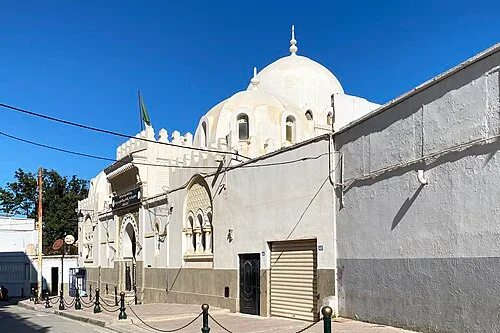 Thaalibia Madrasa
A dome and white walls beside the tomb of Sidi Abderrahmane, the patron saint of the city, mark this school, opened in 1904 under Governor Charles Jonnart. Its Neo-Moorish style was so tied to him that people called it the Jonnart style, the same idiom as the Grand Post Office of Algiers. It was built in his honor. Before colonization the Casbah held around eighty zawiyas and madrasas; most are no longer in use.
Listen in the appBernard Gagnon · CC BY 4.0
- 11
Mausoleum of Sidi Abderrahmane Et-Thaalibi
The tomb of Algiers' patron saint, its crystal chandeliers, and the pilgrims who still come.
- 12
Sidi Abderrahmane Mosque
The dey's mosque beside the saint's tomb, and the legend of the saints who saved Algiers from Charles V.
- 13
Casbah Stepped Alleys
A city built on a slope: the stairways, the donkeys, and the amphitheater of white houses above the bay.
- 14
A Sabat Overpass and Blind Facades
How the Casbah houses turn their backs on the lane, and the vaulted rooms built right over the street.
- 15
Sidi Mohamed Ech-Charif Mosque
A modest neighbourhood mosque that guards the tomb of a beloved saint, where women still leave their wishes.
- 16
Safir Mosque - Mosque of a Corsair
Where the corsair capital began, and the mosque a converted Christian commander raised in 1534.
- 17
The Great Synagogue of Algiers - Historic Postcard
The Great Synagogue of Algiers in its prime, at the heart of a Jewish quarter centuries old.
- 18
Ibn Faris Mosque - From Synagogue to Mosque, 1975
The domed building that was a synagogue and became a mosque, and the chaâbi music both communities shared.
- 19
Dar Essouf - State Storehouse of the Regency
A palace that stored the Regency's wool, then served French courts, and now trains heritage conservators.
- 20
Dar Khedaoudj el Amia - The Courtyard House Ideal
One house plan for palace and artisan home alike, told from a building that became Algiers' first town hall.
- 21
The Palace of the Blind Princess
The legend of the princess who lost her sight gazing at her own beauty, and the palace that keeps her name.
- 22
Dar Mustapha Pacha
The dey's family palace of 1798, tiled in half a million pieces gathered from the Maghreb, Spain and Italy.
- 23
Museum of Calligraphy and Illumination
A dey's palace turned museum of calligraphy, miniature and illumination, keeping the arts of the book alive.
- 24
Ketchaoua Mosque
Mosque, cathedral, mosque again: the building at the foot of the Casbah that carried three regimes of worship.
- 25
Saint-Philippe Cathedral Porch - Archival View
The cathedral years written onto the mosque's face: crosses and Latin inscriptions over horseshoe arches.
- 26
Dar Hassan Pacha: Upper Gallery
The upper gallery of Dar Hassan Pacha, later the winter residence of Algeria's French governors.
- 27
Patio of Dar Hassan Pacha
The ground-floor court of a dey's palace, in the district where old Algiers kept its power.
- 28
Patio of Dar Aziza
Two storeys of pointed horseshoe arches around the centre of a sixteenth-century palace.
- 29
Carved Basin in the Dar Aziza Courtyard
A deeply carved basin with flowers and foliage, at the heart of a palace courtyard.
- 30
Ali Bitchin Mosque and Its Market Street
A mosque built by a Venetian convert, above a street where the souk never really died.
- 31
Ali Bitchin Mosque Prayer Hall
Carved geometric relief over every arch and wall of a prayer hall once simply whitewashed.
- 32
Courtyard of the Rais Palace
The courtyard of the corsairs' residence, one of the last surviving quarters of the lower Casbah.
- 33
Hammam Room of the Rais Palace
A private bathing room lined from ledge to vault with multicoloured geometric tile.
- 34
Great Mosque of Algiers (Djamaa El Kebir) from Above
The oldest mosque in Algiers, founded in 1097, with the harbour just beyond its roofs.
- 35
Great Mosque Prayer Hall
Eleven aisles of horseshoe arches, and a pulpit that once slid into the hall on rails.
- 36
New Mosque (Djamaa al-Djedid) Exterior
A white Ottoman-style mosque of 1660, whose minaret holds a clock taken from a demolished palace.
- 37
Central Dome of the New Mosque
Looking up into the dome, and the legend of the captive who drew a cross-shaped plan.
- 38
Martyrs Square
How a colonial demolition carved an open square out of the dense lower Casbah.
- 39
Excavated Remains in Martyrs Square
Column bases and cobbled paving under a shelter, where older layers of Algiers lie beneath the square.
Casbah of Algiers
Frequently asked questions
How much does the guide cost?
Free app download. Listed guide price: $2.99. Guide price shown in the app. Audio guide only. Venue admission is separate.
Can I listen without internet?
Yes. Download the guide’s audio, images, and maps in the app before your visit. Your downloaded content is then available offline.
Can I listen in my language?
This audio guide is available in 15 languages, including English.
Do I need to follow a schedule?
No. This is a self-guided experience. Choose your stops, pause whenever you like, and return to a story at your own pace.
At your own pace
Explore Casbah of Algiers.
Download Stanza, then search for “Casbah of Algiers”.
Free app download · Guide price shown in the app
Keep exploring
Audio guides — Algeria
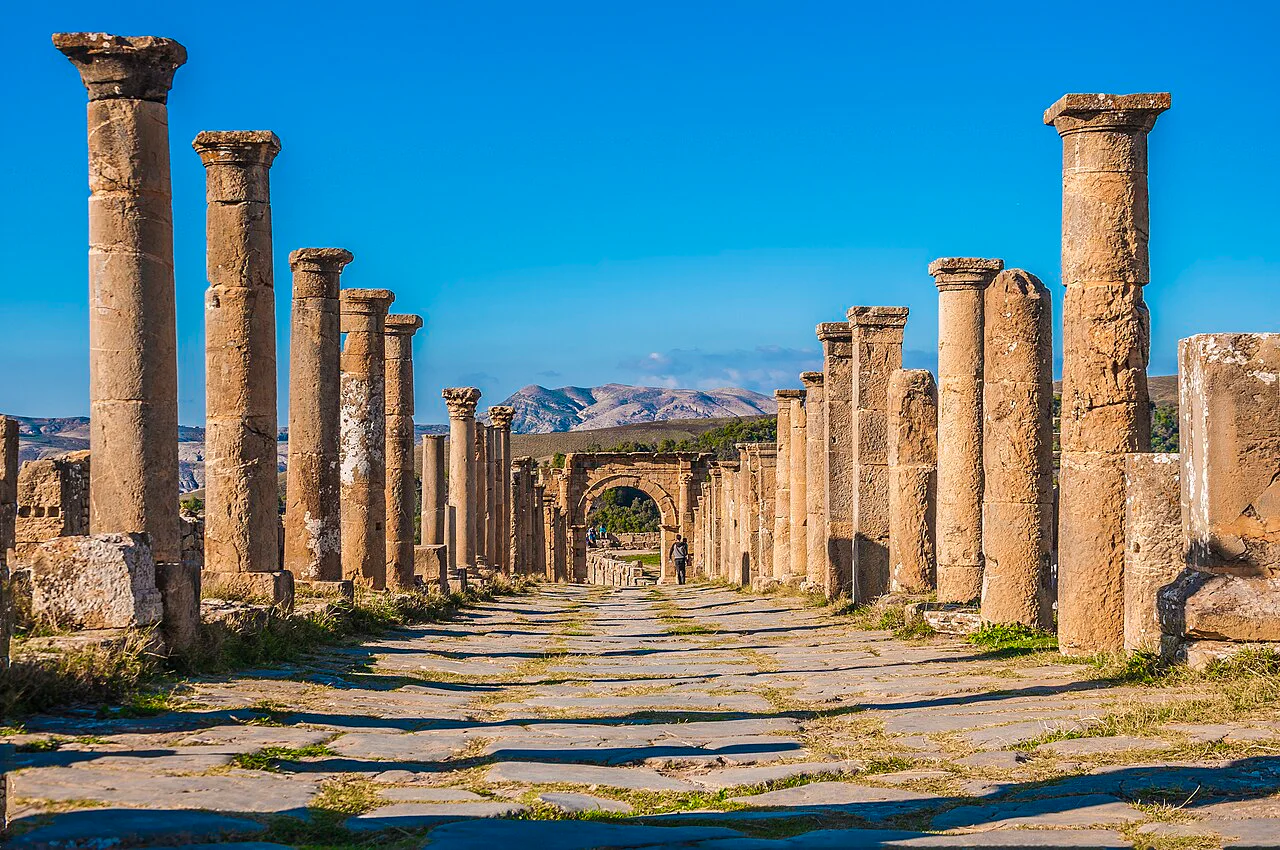
Djemila
Djémila
Content & sources
Alioueche Mokhtar · CC BY-SA 4.0
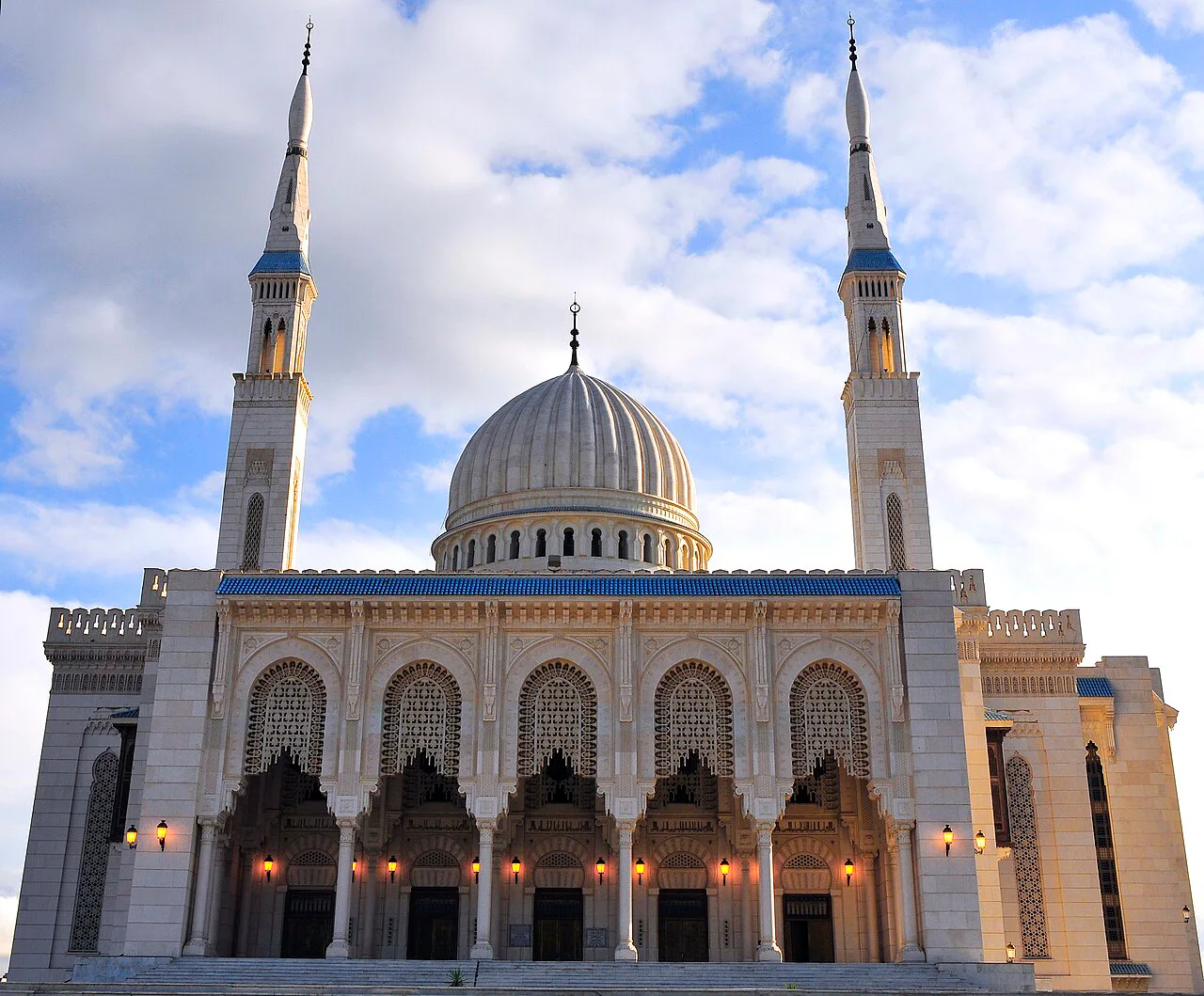
Constantine
Emir Abdelkader Mosque
Content & sources
Photo: LBM1948 · CC BY-SA 4.0
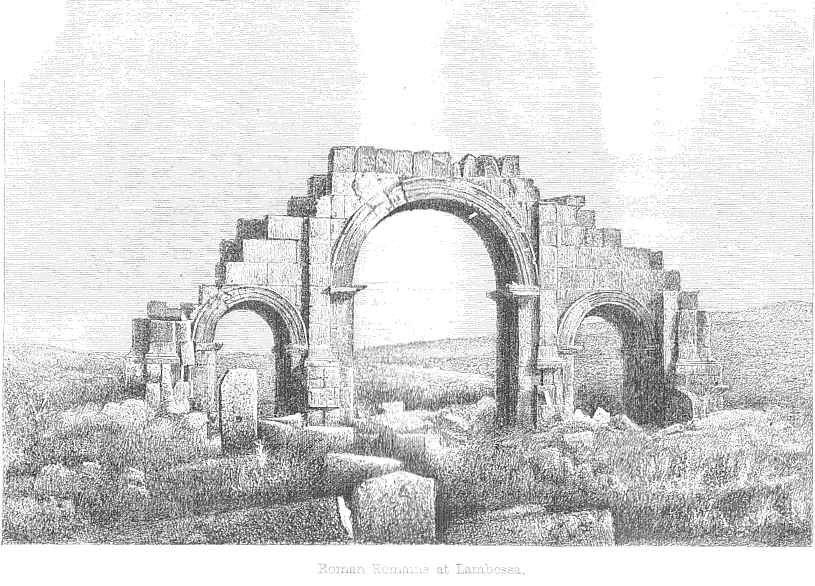
Tazoult
Lambaesis
Content & sources
Unknown author · Public domain
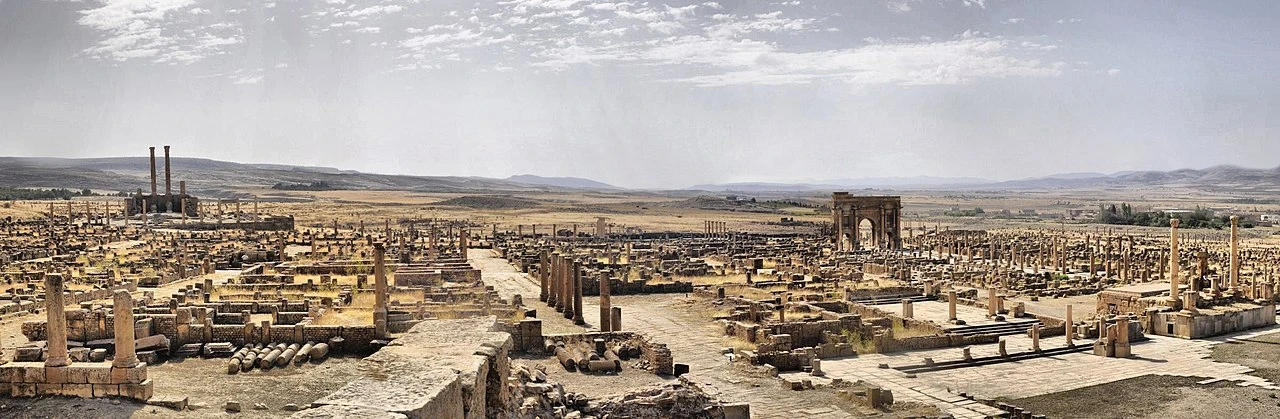
Timgad
Timgad
Content & sources
Photo: Hamza-sia · CC BY-SA 3.0