Stanza · Audio guide
Lambaesis Audio Guide
A place to remember. A story to take with you.
Lambaesis is a Roman archaeological site located in Algeria near the modern village of Tazoult. It was a Roman fort and is the site of a former bishopric.
Download Stanza, then search for “Lambaesis”.
About the tour
One guide. Your kind of visit.
Lambaesis is a Roman archaeological site located in Algeria near the modern village of Tazoult. It was a Roman fort and is the site of a former bishopric.
Ready when you are.
- 01Get the free Stanza app.
iOS & Android
- 02Find your guide.
“Lambaesis”
- 03Download before you go.
Works offline
Audio guide / 11 narrated stops
Inside the guide
Get to know a few of the stories before you go. Open a stop to read more.
01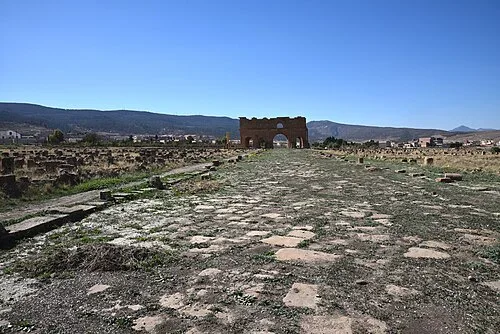 The Via Principalis and Camp Entrance
The Via Principalis – Arrival at the Legionary Base
Welcome to Lambaesis, the fortress of the Third Augustan Legion on the Roman frontier in North Africa. The paved road running ahead is the Via Principalis, the main street of the camp, leading towards the stone building at its far end. Unusually, this city had three successive military camps. The first was a scouting post, begun in AD 81 under the emperor Titus by the legion's commander, Lucius Tettius Iulianus. People still call it the camp of 81, or the eastern camp. A second camp followed, probably housing the auxiliary troops who fought alongside the legion. Then came the great camp, the permanent headquarters of the Third Augusta. The legion took a long road to get here: it had been stationed at Ammaedara, then at Theveste, before settling at Lambaesis for good around AD 117. Some historians place the camp's founding a few years later, in Hadrian's reign. The great camp itself was a huge rectangle, roughly five hundred metres long. It ran nearly four hundred and fifty metres across.
Carole Raddato · CC BY-SA 2.0
02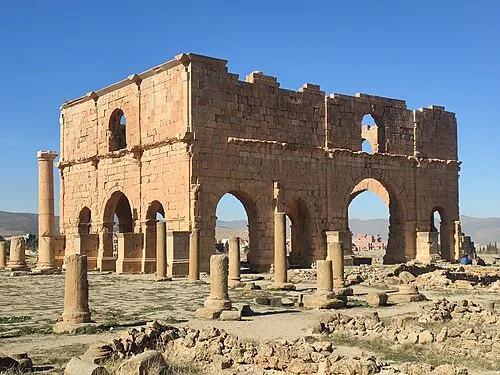 The Monumental Praetorium
The Praetorium – Headquarters of the Camp
Few buildings in Roman Africa survive this well, and it has kept a misleading name. Everyone calls it the Praetorium, but that label is wrong: it served as the camp's administrative headquarters, where the business of a whole legion was managed. It dates from the year 268. The building stretches about twenty-eight metres from end to end. It is roughly twenty metres across, and its walls still stand fifteen metres high. The southern face is the showpiece. A front row of massive Ionic columns runs across it at half the height of the wall. Behind them, flat Corinthian pilasters are set into the stonework itself. Two classical orders, one layered in front of the other, on a single facade. For the soldiers of the Third Augusta this was the visible face of Roman authority in military Africa, and against the sky it still looks the part.
Photo: Rachid Hamatou · CC BY-SA 4.0
03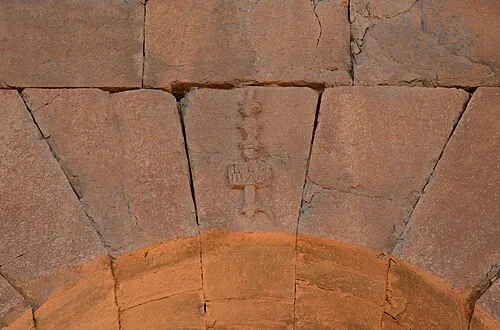 The Monumental Praetorium
The Legion's Emblem in Stone
On the keystone of an archway, a small carved relief shows a signum: the legion's standard, a pole hung with discs and crowned with its emblem. To the soldiers this meant more than a badge. A standard was the soul of the unit. In battle it showed men where to rally, and losing one to an enemy was a lasting disgrace. This legion's own fortunes swung as far as any standard's. In the time of Gordian III, around AD 238, the Third Augusta was disbanded outright, and its soldiers were scattered among the North African provinces. In the 250s the emperors Valerian and Gallienus brought it back to life. From then on it bore a new name: Augusta Restituta, the restored Augusta. Its final departure from Lambaesis came only after AD 392, and the town faded soon afterwards.
Listen in the appCarole Raddato · CC BY-SA 2.0
04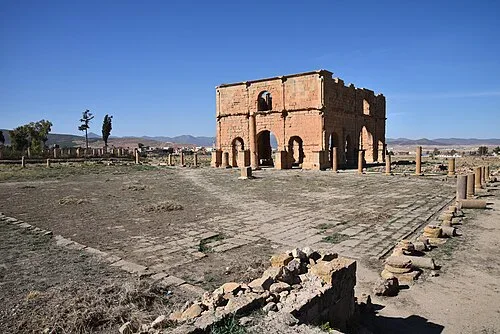 The Principia Courtyard
 – Hadrian before the Legion
A wide open courtyard ringed with porticoes was built for exactly one kind of occasion: an imperial inspection. In AD 128 the emperor Hadrian came to this camp to review the Third Augusta. He watched the legion's maneuvers, then spoke to the assembled soldiers. His address praised their discipline and their tactical skill. The proud legionaries had the whole speech carved into a monumental stone pillar. That inscription is the camp's own voice, and it is one reason the history of this place can still be written from its stones. The pillar itself came to light in a second camp west of the great one, so the carved words ended up a short walk from where they were first spoken. The emperor's visit left its mark on the name as well: this is known as the Hadrianic base.
Listen in the appCarole Raddato · CC BY-SA 2.0
05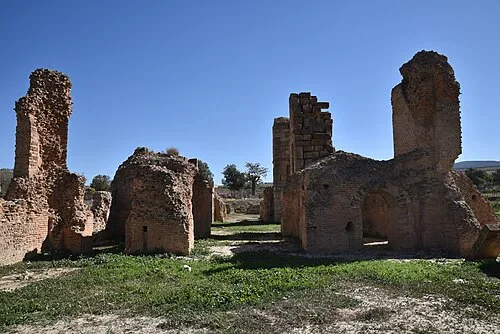 The Roman Baths
The Legionary Baths
Bathing was serious business in a Roman fortress. These brick and stone ruins, standing southeast of the headquarters building, are the remains of the baths. Across the Roman world, baths gave soldiers hygiene, warmth and a place to pass leisure hours. A permanent stone fortress was expected to provide them, along with its barracks and granaries. So whatever else the men of the Third Augusta did with a free afternoon, hot rooms and running water were part of the deal. Now grass grows quietly between the broken walls.
Listen in the appCarole Raddato · CC BY-SA 2.0
06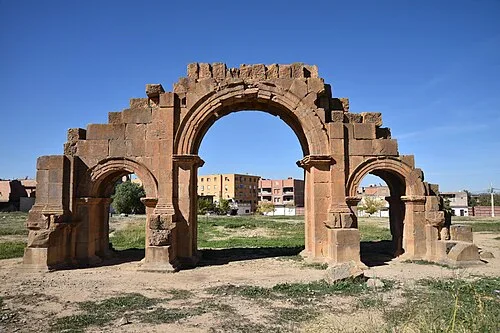 The Arch of Septimius Severus
 – From Camp to City
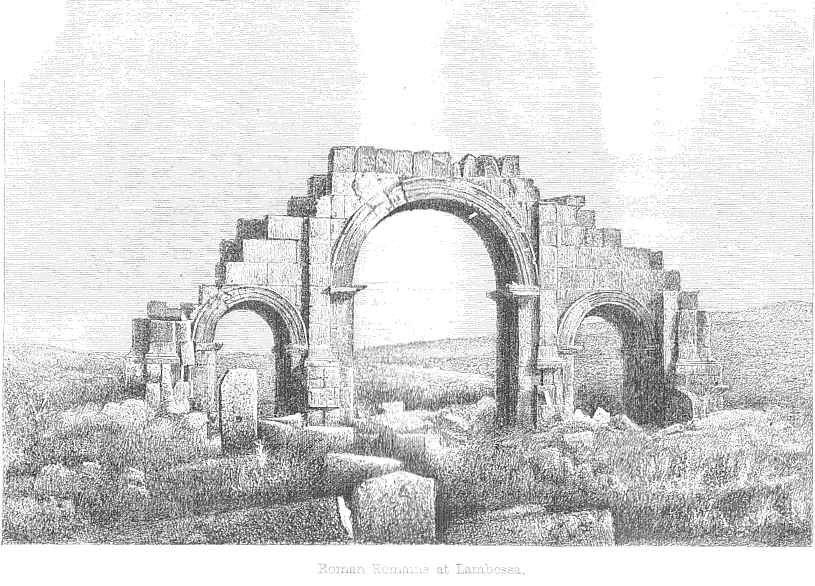
This triple-arched gate was built by the legion itself, in the reign of Septimius Severus. It stood about a kilometre from the Hadrianic base, at the very edge of the growing town. A camp full of paid soldiers attracts everything else: traders, families and retired veterans settle against the ramparts, and a settlement called a vicus takes shape. By AD 166 the vicus had its own council, with decurions, the local town councillors, and ten districts known to us by name. In time it was promoted to a municipium, a self-governing town with Roman rights. Its people were mostly Romanized Berbers, living alongside Roman colonists and their descendants. Latin was the everyday language, though Berbers spoke their own tongue mixed with Latin words. The arch marked where the soldiers' world ended and the townspeople's began.
Listen in the appCarole Raddato · CC BY-SA 2.0
07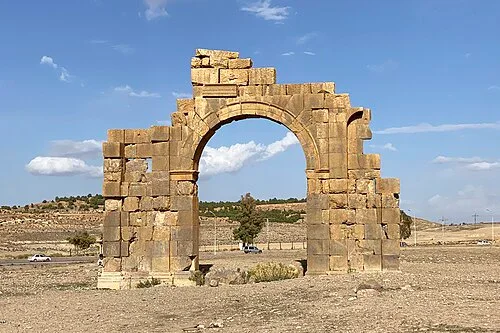 The Arch of Commodus
 – Capital of Military Numidia
A single-span arch standing alone on the open plain is civic pride in stone, a town showing off its imperial connections in the late second century, in the reign of Commodus. And Lambaesis had plenty to feel proud about. Under Septimius Severus, from AD 193, Numidia was split off from the old province of Africa and governed by its own imperial procurator. The bigger promotion came with Diocletian's reforms, around AD 303. Numidia was divided in two. The north became Numidia Cirtensis, with its capital at Cirta. The south, including the Aurès mountains and their raid-prone valleys, became Numidia Militiana, Military Numidia. Its capital was the legionary base at Lambaesis. The soldiers' town had become the seat of government. The arrangement did not last: the emperor Constantine rejoined the two provinces under Cirta, renaming it Constantina after himself.
Listen in the appBernard Gagnon · CC BY 4.0
08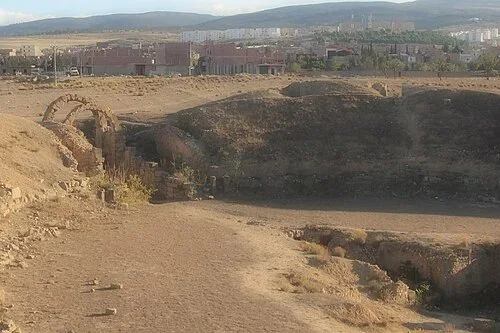 The Roman Amphitheater
The Amphitheatre – Approaching the Arena
The amphitheatre announces itself as a great hollow in the ground, with the modern town crowded on the ridge behind it. Buildings like this were made for spectacles: gladiatorial combats, hunts of wild beasts, the grand public days of the Roman calendar. Across the empire, soldiers and townspeople filled such bowls together. A legionary amphitheatre had its own character, though: it was where the garrison watched its grandest occasions, on its own ground. What happened here on any particular day is lost. The shape of the building still tells the rest, a curve of seating around a sand floor, and entrances built to move a crowd.
Listen in the appPhoto: Zinou2go · CC BY-SA 3.0
09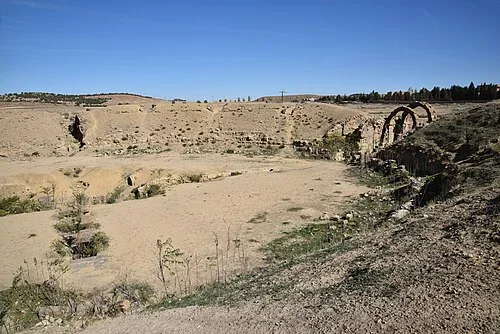 The Roman Amphitheater
Inside the Legionary Amphitheatre
From inside, the scale becomes clear. The amphitheatre was built in AD 169, under the emperor Marcus Aurelius. It was restored in AD 180. A second restoration followed in 194. Two repairs within a generation say a great deal about how much the garrison valued this place. It could hold up to twelve thousand spectators. That is a town's worth of people gathered around a single arena floor, paid for out of the legion's wealth. The basin lies open to the sky now, and a few arches of the outer ring still stand. Twelve thousand voices once filled this bowl.
Listen in the appCarole Raddato · CC BY-SA 2.0
10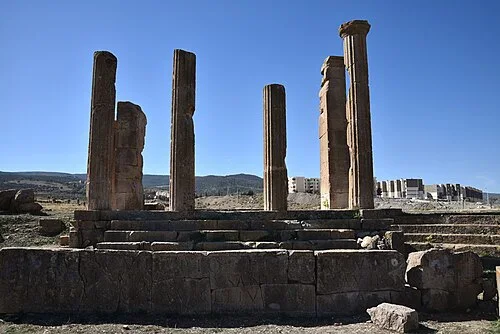 The Sanctuary of Asclepius
The Temple of Asclepius
These columns belonged to a temple of Asclepius, the god of medicine, and of Hygeia, goddess of health. The dedication was made in AD 162 by the legion's own commanding officer, its legate. A garrison posted far from home needed healing as well as victory, and the men of the Third Augusta honoured the gods of medicine here. The cult statues of Asclepius and Hygeia were later carried off to the museum in the village. As for the temple, time has been unkind. In the middle of the nineteenth century its whole facade was still standing. Today only a few of its columns stand.
Listen in the appCarole Raddato · CC BY-SA 2.0
- 11
The Museum – Voices from the Stones
The museum's mosaics and thousands of inscriptions, and the afterlife of a frontier capital.
Lambaesis
Frequently asked questions
How much does the guide cost?
Free app download. Listed guide price: $0.99. Guide price shown in the app. Audio guide only. Venue admission is separate.
Can I listen without internet?
Yes. Download the guide’s audio, images, and maps in the app before your visit. Your downloaded content is then available offline.
Can I listen in my language?
This audio guide is available in 15 languages, including English.
Do I need to follow a schedule?
No. This is a self-guided experience. Choose your stops, pause whenever you like, and return to a story at your own pace.
At your own pace
Explore Lambaesis.
Download Stanza, then search for “Lambaesis”.
Free app download · Guide price shown in the app
Keep exploring
Audio guides — Algeria
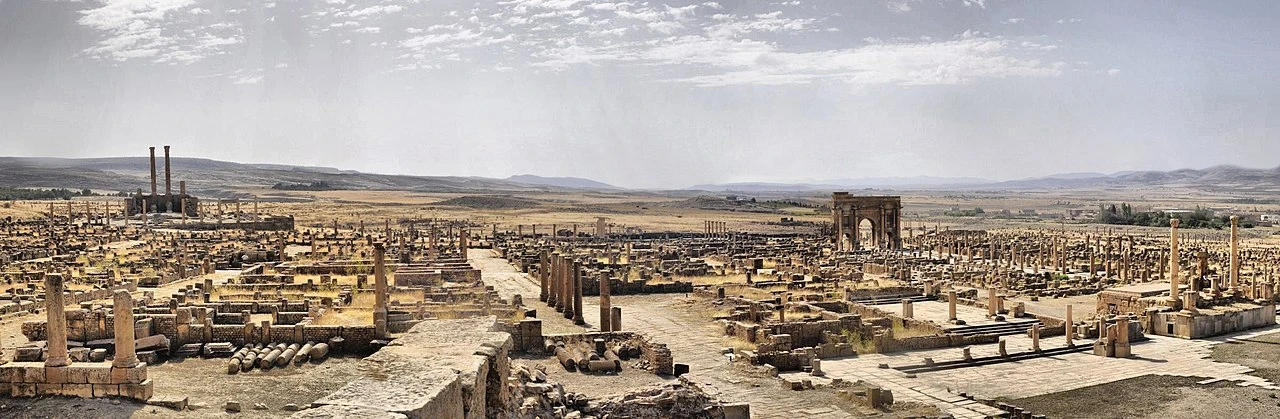
Timgad · 19 km
Timgad
Content & sources
Photo: Hamza-sia · CC BY-SA 3.0
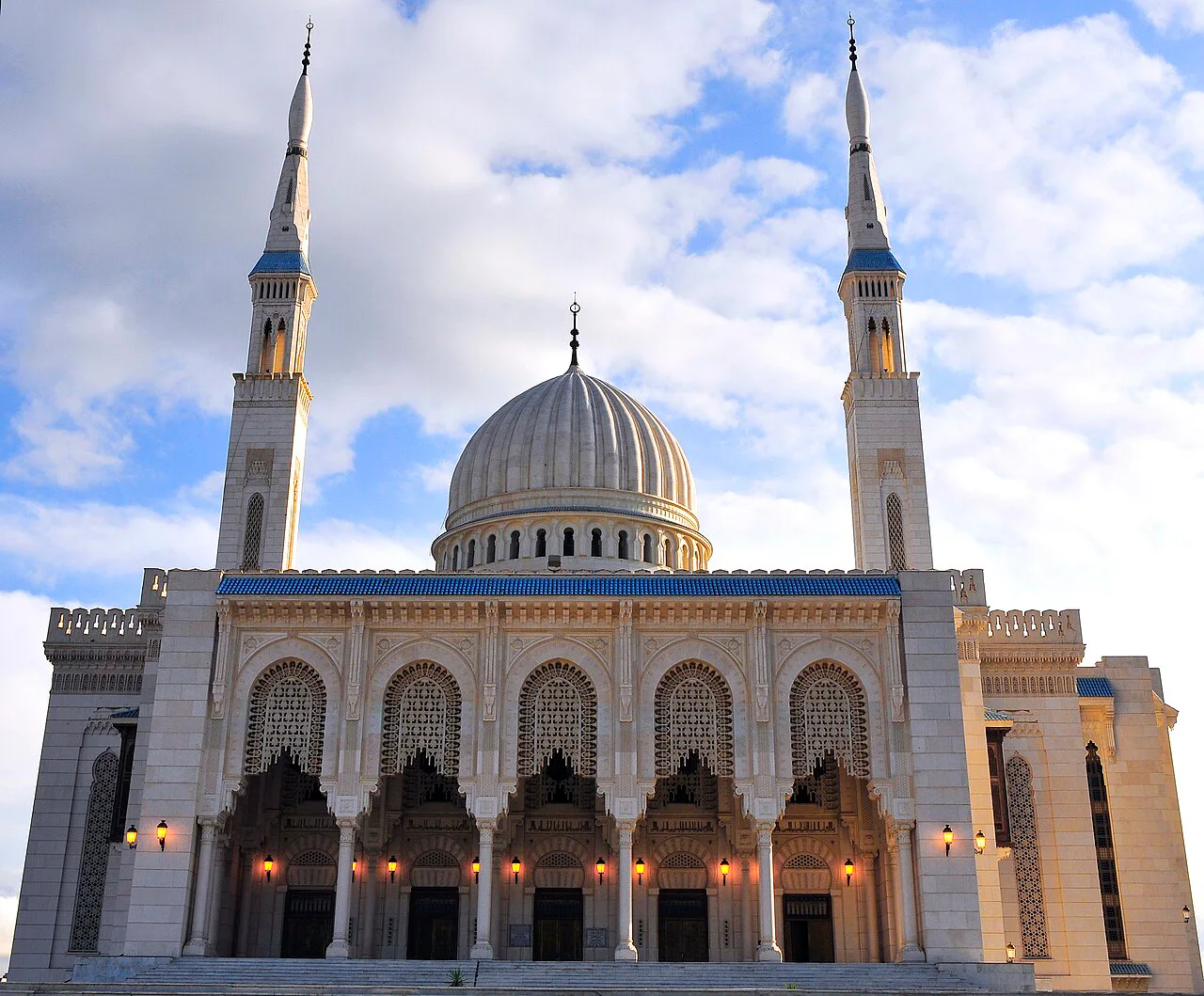
Constantine · 100 km
Emir Abdelkader Mosque
Content & sources
Photo: LBM1948 · CC BY-SA 4.0
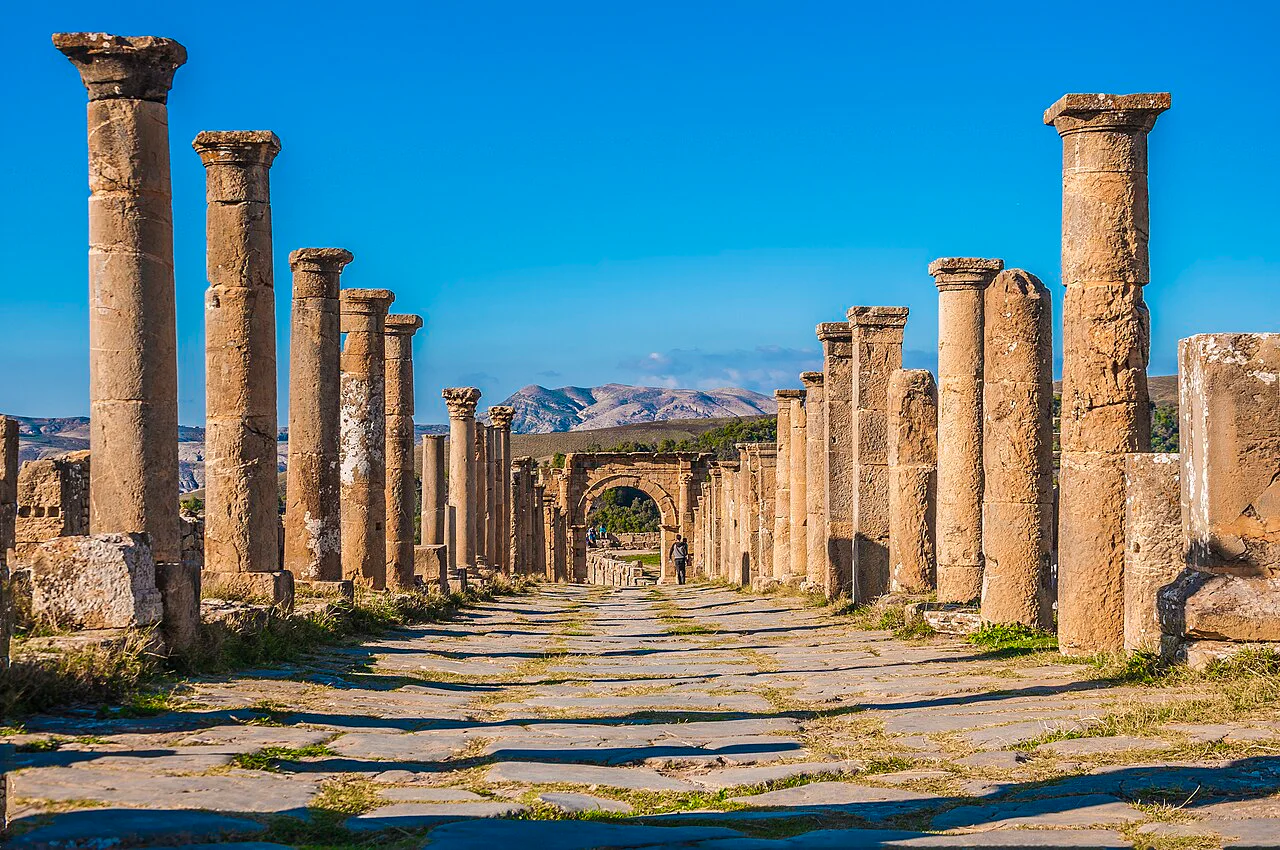
Djemila · 104 km
Djémila
Content & sources
Alioueche Mokhtar · CC BY-SA 4.0
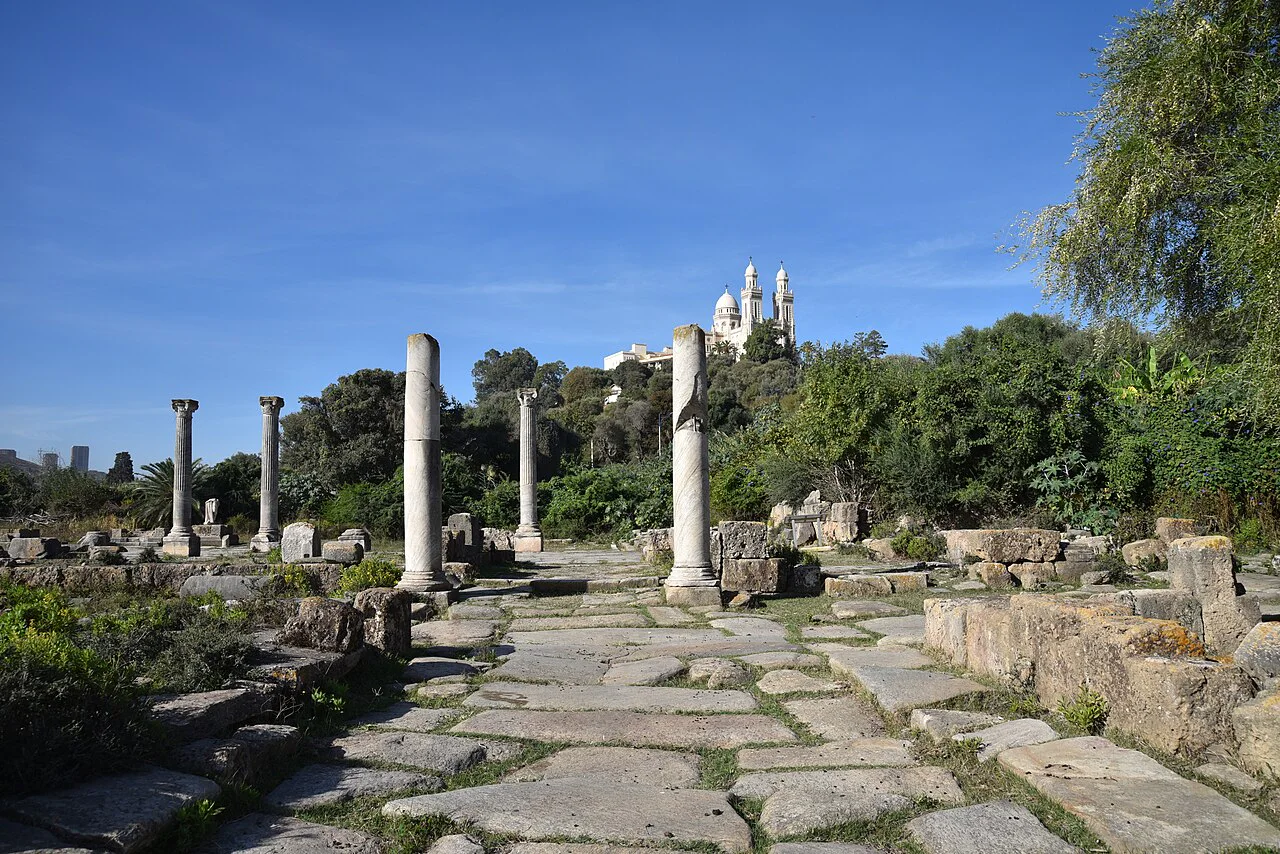
Annaba
Hippo Regius
Content & sources
Carole Raddato · CC BY-SA 2.0